


 Скачать презентацию Implementing IP Addressing Services Accessing the WAN
Exploration_Accessing_WAN_Chapter7.ppt
- Количество слайдов: 34
 Implementing IP Addressing Services Accessing the WAN – Chapter 7 Version 4. 0 © 2006 Cisco Systems, Inc. All rights reserved. Cisco Public 1
 Objectives § Configure DHCP in an enterprise branch network § Configure NAT on a Cisco router § Configure new generation RIP (RIPng) to use IPv 6 © 2006 Cisco Systems, Inc. All rights reserved. Cisco Public 2
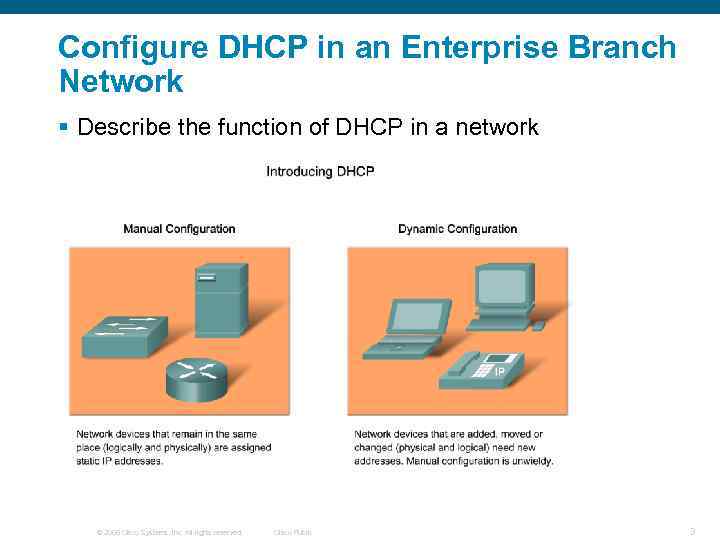 Configure DHCP in an Enterprise Branch Network § Describe the function of DHCP in a network © 2006 Cisco Systems, Inc. All rights reserved. Cisco Public 3
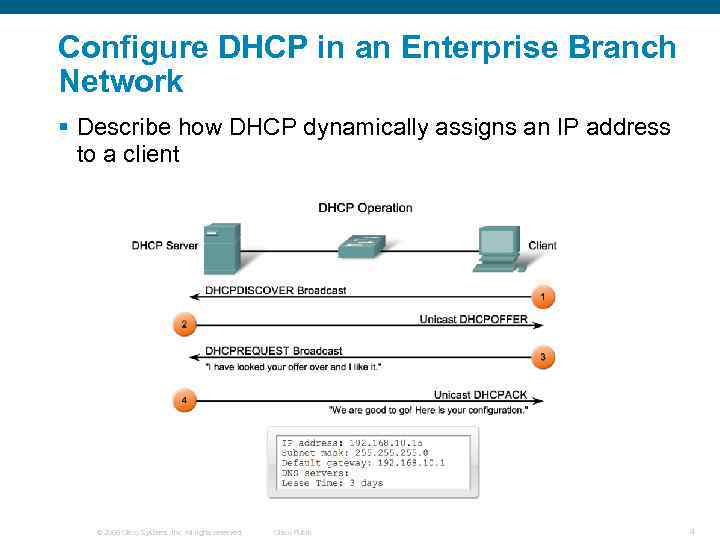 Configure DHCP in an Enterprise Branch Network § Describe how DHCP dynamically assigns an IP address to a client © 2006 Cisco Systems, Inc. All rights reserved. Cisco Public 4
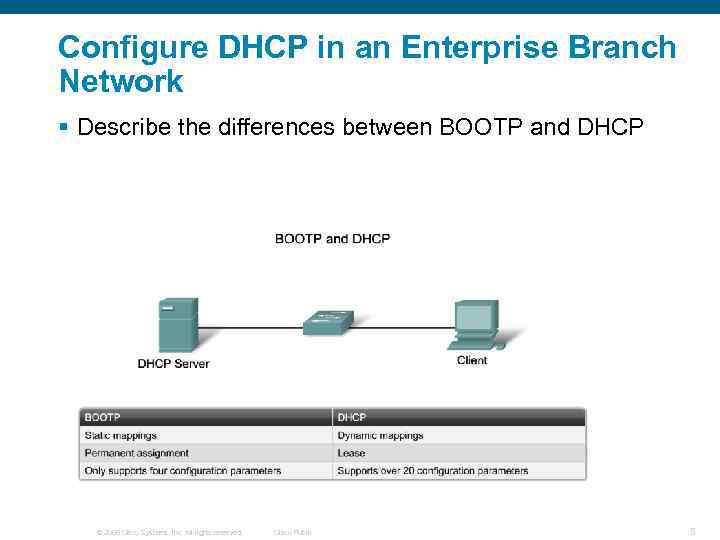 Configure DHCP in an Enterprise Branch Network § Describe the differences between BOOTP and DHCP © 2006 Cisco Systems, Inc. All rights reserved. Cisco Public 5
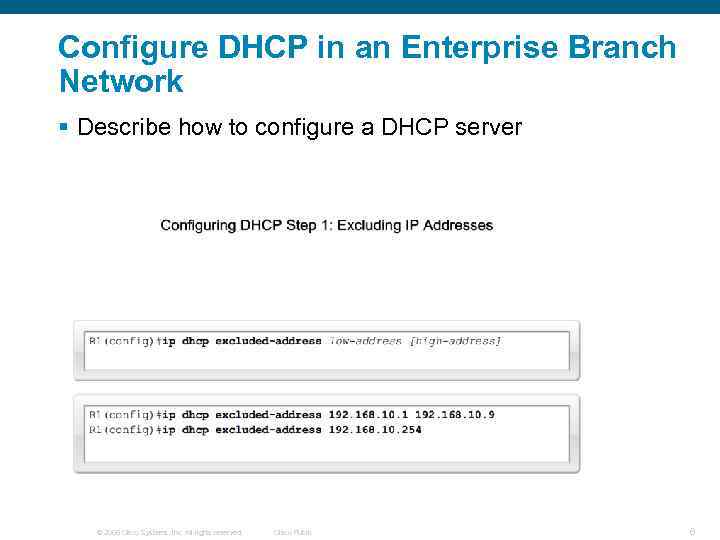 Configure DHCP in an Enterprise Branch Network § Describe how to configure a DHCP server © 2006 Cisco Systems, Inc. All rights reserved. Cisco Public 6
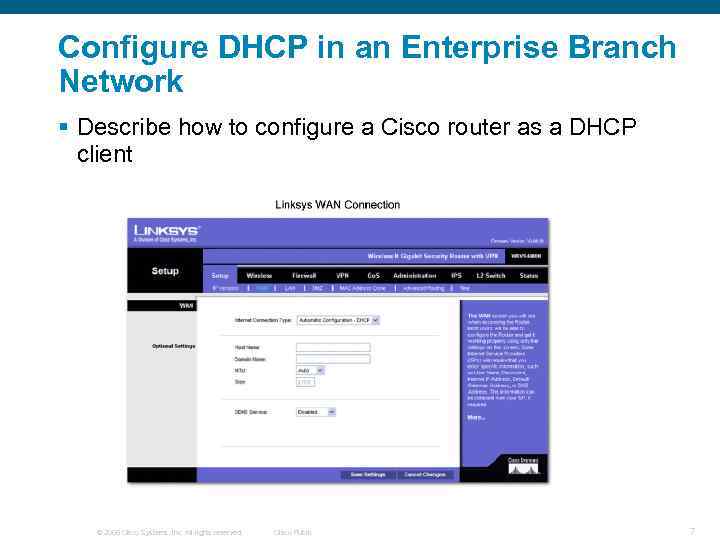 Configure DHCP in an Enterprise Branch Network § Describe how to configure a Cisco router as a DHCP client © 2006 Cisco Systems, Inc. All rights reserved. Cisco Public 7
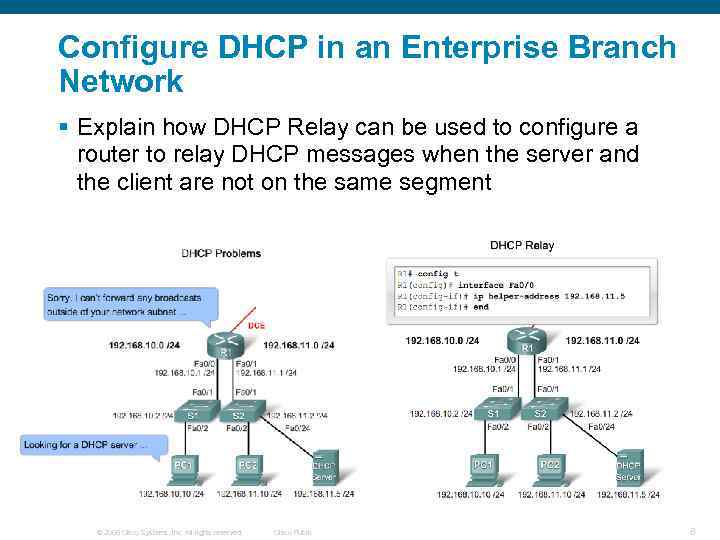 Configure DHCP in an Enterprise Branch Network § Explain how DHCP Relay can be used to configure a router to relay DHCP messages when the server and the client are not on the same segment © 2006 Cisco Systems, Inc. All rights reserved. Cisco Public 8
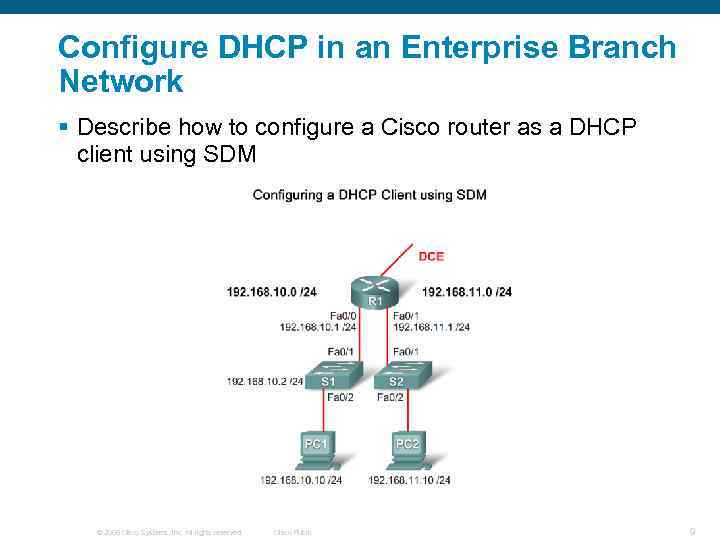 Configure DHCP in an Enterprise Branch Network § Describe how to configure a Cisco router as a DHCP client using SDM © 2006 Cisco Systems, Inc. All rights reserved. Cisco Public 9
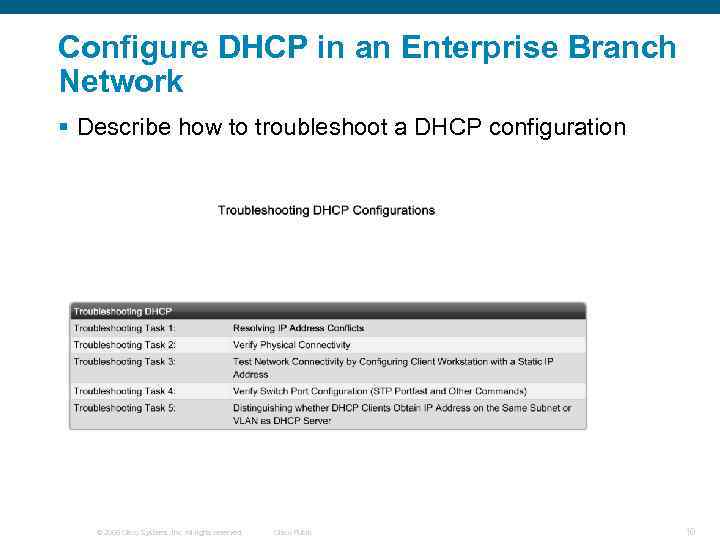 Configure DHCP in an Enterprise Branch Network § Describe how to troubleshoot a DHCP configuration © 2006 Cisco Systems, Inc. All rights reserved. Cisco Public 10
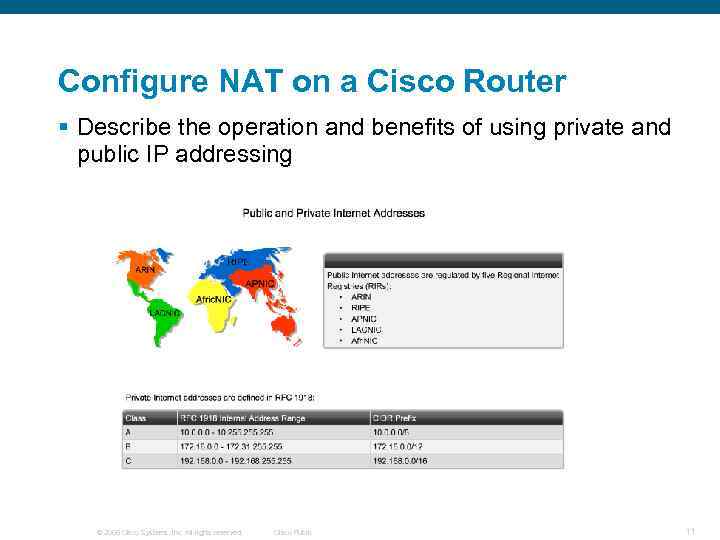 Configure NAT on a Cisco Router § Describe the operation and benefits of using private and public IP addressing © 2006 Cisco Systems, Inc. All rights reserved. Cisco Public 11
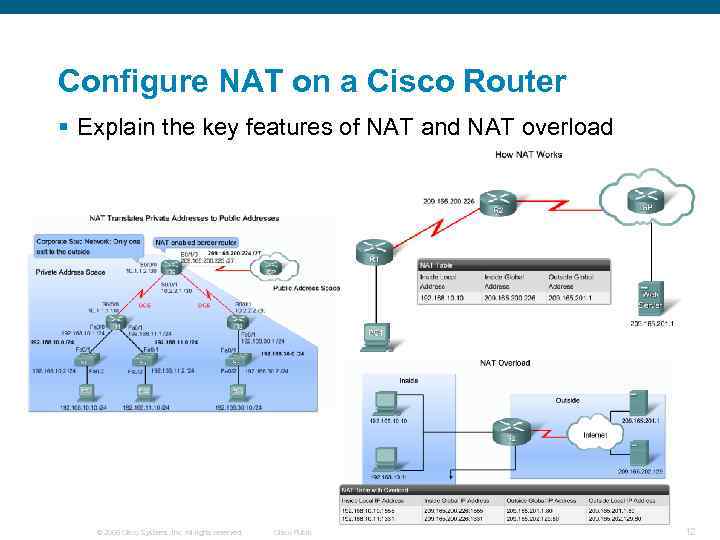 Configure NAT on a Cisco Router § Explain the key features of NAT and NAT overload © 2006 Cisco Systems, Inc. All rights reserved. Cisco Public 12
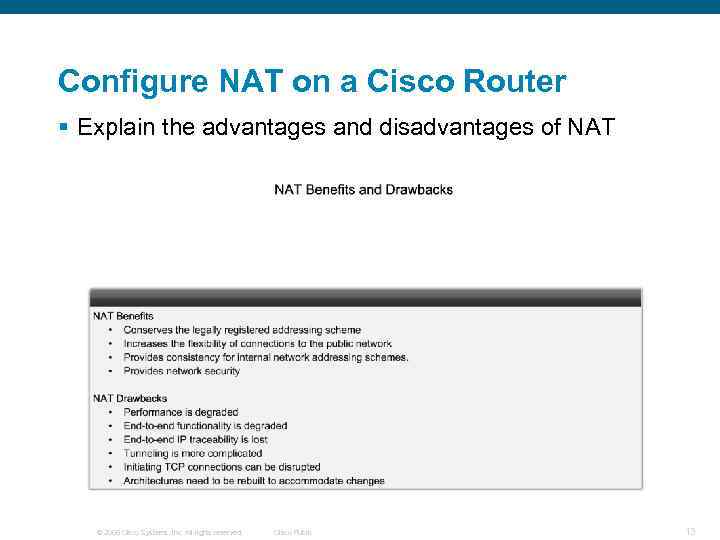 Configure NAT on a Cisco Router § Explain the advantages and disadvantages of NAT © 2006 Cisco Systems, Inc. All rights reserved. Cisco Public 13
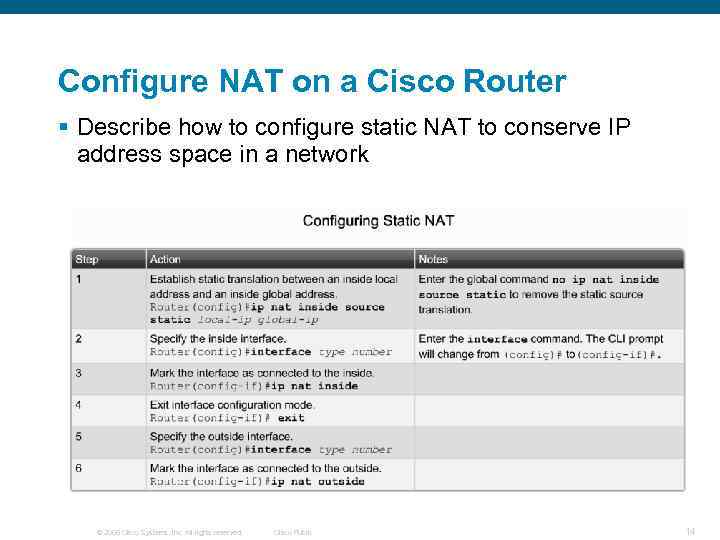 Configure NAT on a Cisco Router § Describe how to configure static NAT to conserve IP address space in a network © 2006 Cisco Systems, Inc. All rights reserved. Cisco Public 14
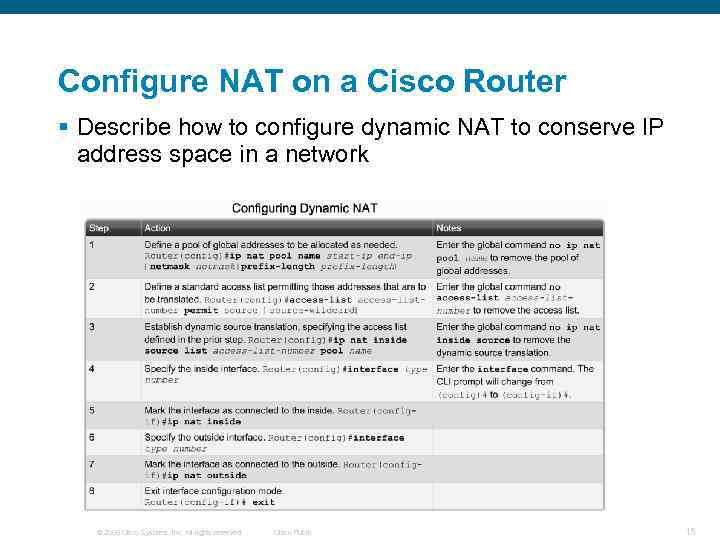 Configure NAT on a Cisco Router § Describe how to configure dynamic NAT to conserve IP address space in a network © 2006 Cisco Systems, Inc. All rights reserved. Cisco Public 15
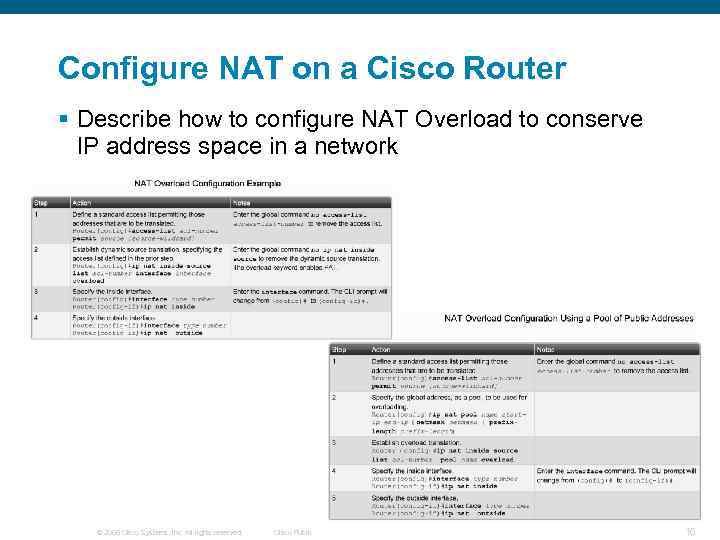 Configure NAT on a Cisco Router § Describe how to configure NAT Overload to conserve IP address space in a network © 2006 Cisco Systems, Inc. All rights reserved. Cisco Public 16
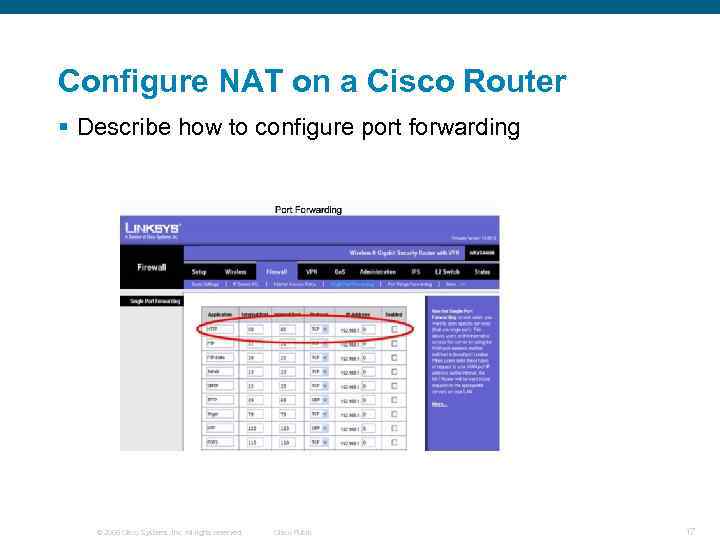 Configure NAT on a Cisco Router § Describe how to configure port forwarding © 2006 Cisco Systems, Inc. All rights reserved. Cisco Public 17
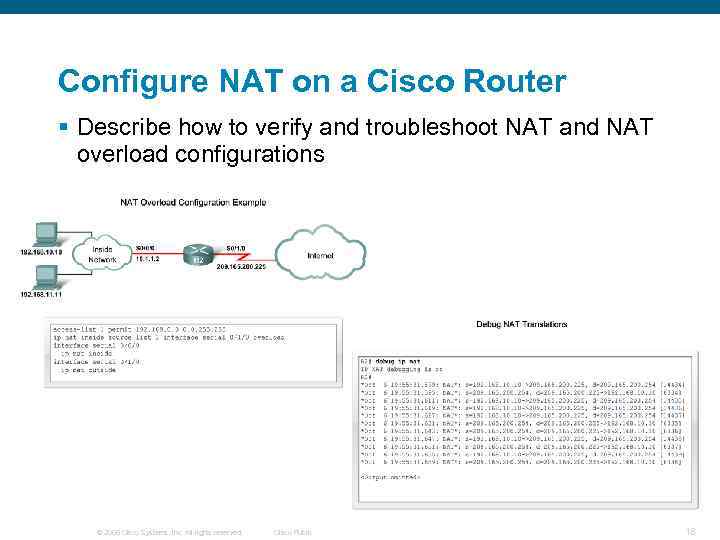 Configure NAT on a Cisco Router § Describe how to verify and troubleshoot NAT and NAT overload configurations © 2006 Cisco Systems, Inc. All rights reserved. Cisco Public 18
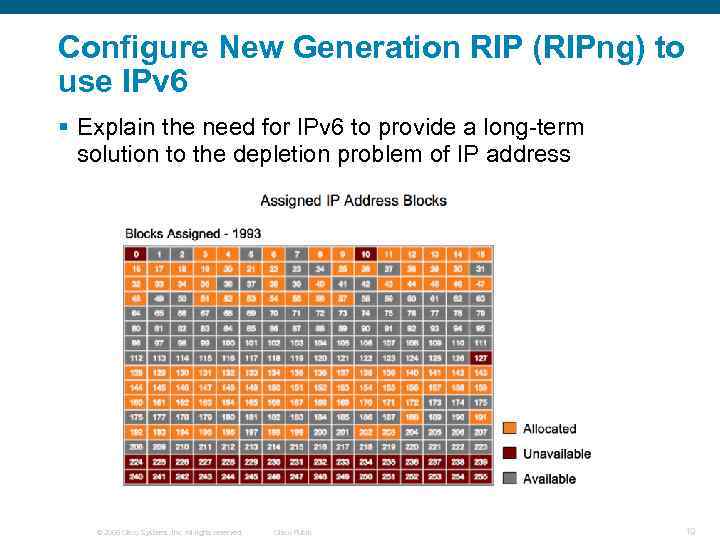 Configure New Generation RIP (RIPng) to use IPv 6 § Explain the need for IPv 6 to provide a long-term solution to the depletion problem of IP address © 2006 Cisco Systems, Inc. All rights reserved. Cisco Public 19
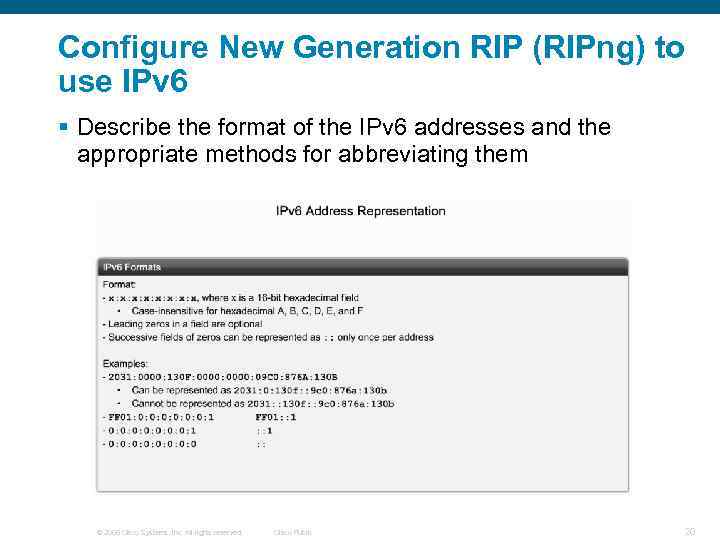 Configure New Generation RIP (RIPng) to use IPv 6 § Describe the format of the IPv 6 addresses and the appropriate methods for abbreviating them © 2006 Cisco Systems, Inc. All rights reserved. Cisco Public 20
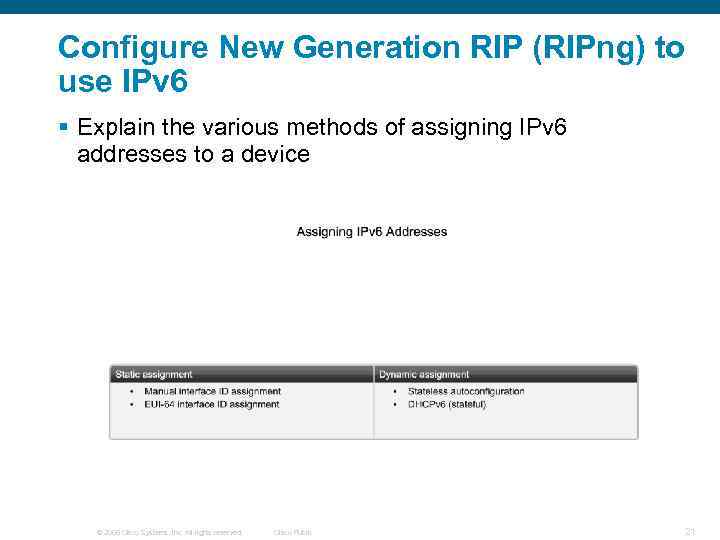 Configure New Generation RIP (RIPng) to use IPv 6 § Explain the various methods of assigning IPv 6 addresses to a device © 2006 Cisco Systems, Inc. All rights reserved. Cisco Public 21
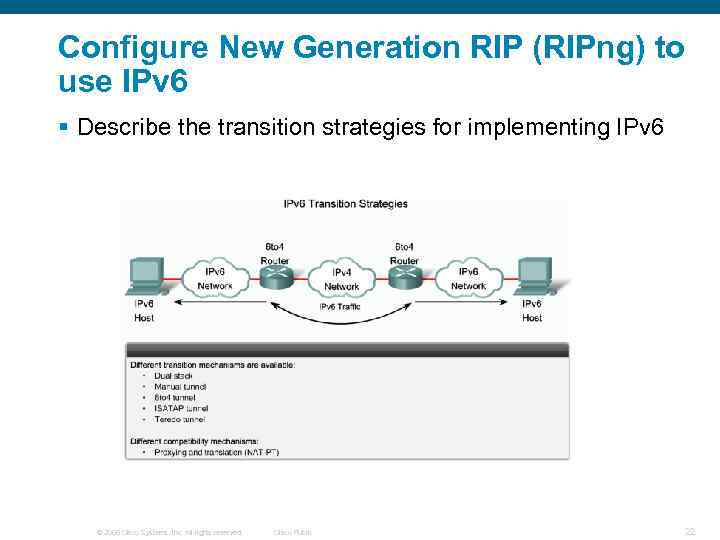 Configure New Generation RIP (RIPng) to use IPv 6 § Describe the transition strategies for implementing IPv 6 © 2006 Cisco Systems, Inc. All rights reserved. Cisco Public 22
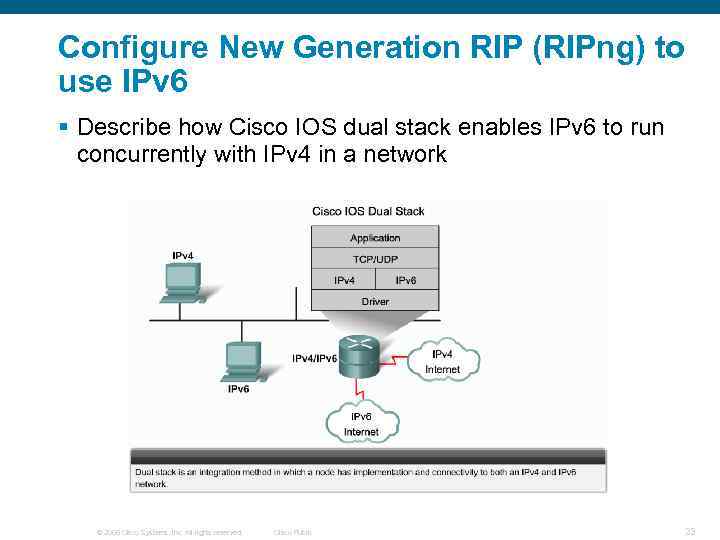 Configure New Generation RIP (RIPng) to use IPv 6 § Describe how Cisco IOS dual stack enables IPv 6 to run concurrently with IPv 4 in a network © 2006 Cisco Systems, Inc. All rights reserved. Cisco Public 23
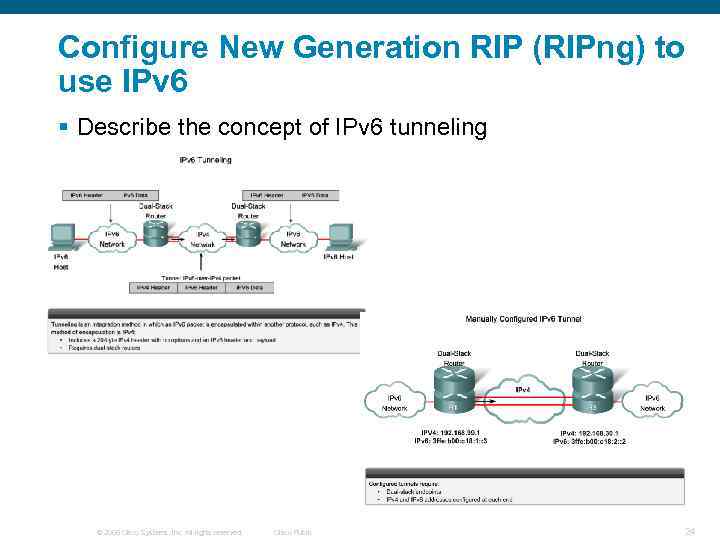 Configure New Generation RIP (RIPng) to use IPv 6 § Describe the concept of IPv 6 tunneling © 2006 Cisco Systems, Inc. All rights reserved. Cisco Public 24
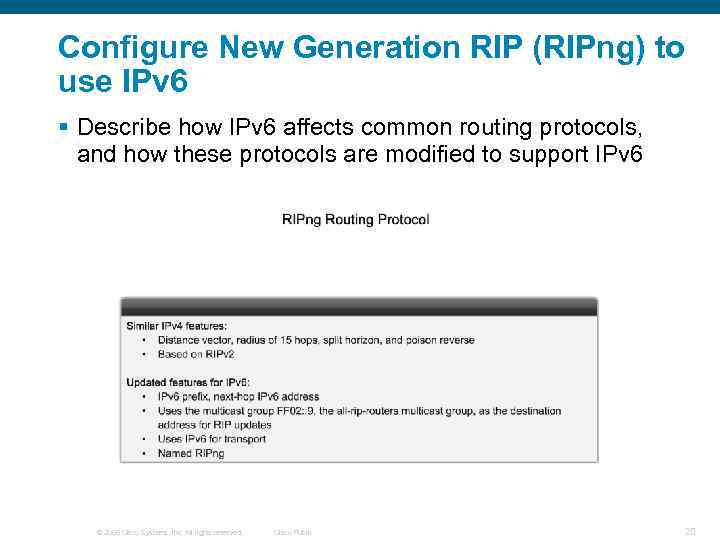 Configure New Generation RIP (RIPng) to use IPv 6 § Describe how IPv 6 affects common routing protocols, and how these protocols are modified to support IPv 6 © 2006 Cisco Systems, Inc. All rights reserved. Cisco Public 25
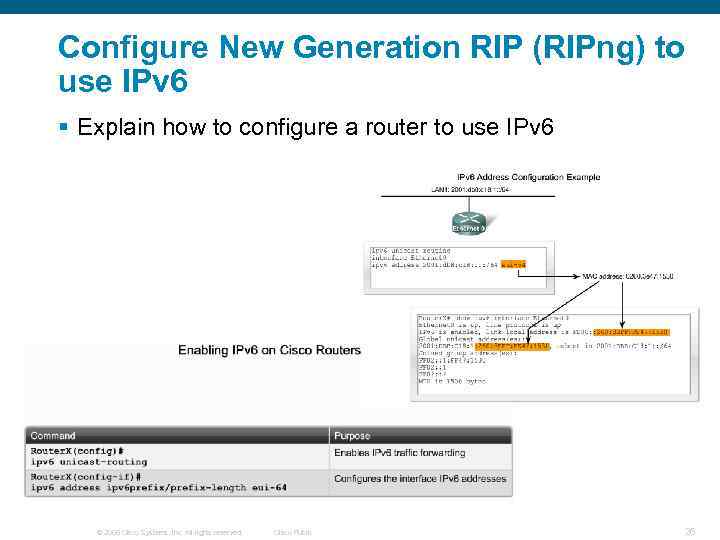 Configure New Generation RIP (RIPng) to use IPv 6 § Explain how to configure a router to use IPv 6 © 2006 Cisco Systems, Inc. All rights reserved. Cisco Public 26
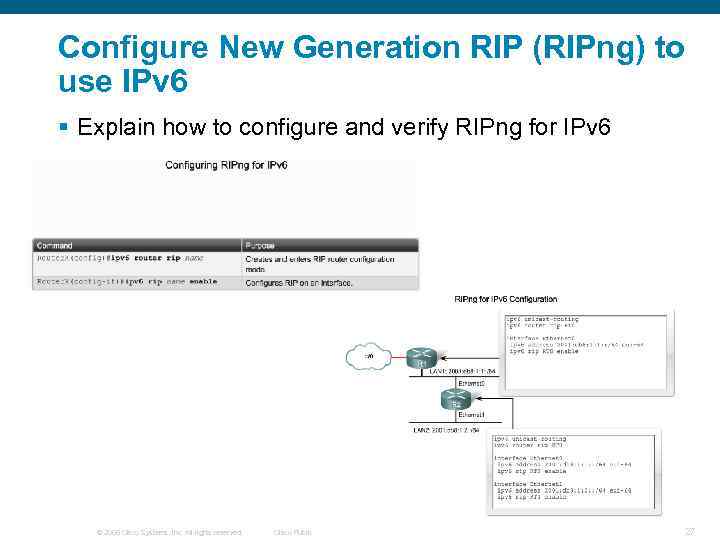 Configure New Generation RIP (RIPng) to use IPv 6 § Explain how to configure and verify RIPng for IPv 6 © 2006 Cisco Systems, Inc. All rights reserved. Cisco Public 27
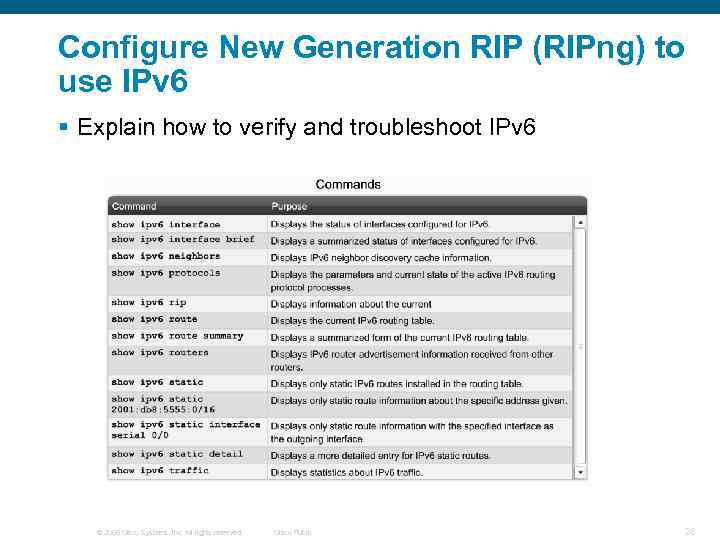 Configure New Generation RIP (RIPng) to use IPv 6 § Explain how to verify and troubleshoot IPv 6 © 2006 Cisco Systems, Inc. All rights reserved. Cisco Public 28
 Summary § Dynamic Host Control Protocol (DHCP) This is a means of assigning IP address and other configuration information automatically. § DHCP operation – 3 different allocation methods • Manual • Automatic • Dynamic –Steps to configure DHCP • Define range of addresses • Create DHCP pool • Configure DHCP pool specifics © 2006 Cisco Systems, Inc. All rights reserved. Cisco Public 29
 Summary § DHCP Relay Concept of using a router configured to listen for DHCP messages from DHCP clients and then forwards those messages to servers on different subnets § Troubleshooting DHCP –Most problems arise due to configuration errors –Commands to aid troubleshooting • Show ip dhcp • Show run • debug © 2006 Cisco Systems, Inc. All rights reserved. Cisco Public 30
 Summary § Private IP addresses –Class A = 10. x. x. x –Class B = 172. 16. x. x – 172. 31. x. x –Class C = 192. 168. x. x § Network Address Translation (NAT) –A means of translating private IP addresses to public IP addresses –Type s of NAT • Static • Dynamic –Some commands used for troubleshooting • Show ip nat translations • Show ip nat statistics • Debug ip nat © 2006 Cisco Systems, Inc. All rights reserved. Cisco Public 31
 Summary § IPv 6 –A 128 bit address that uses colons to separate entries –Normally written as 8 groups of 4 hexadecimal digits § Cisco IOS Dual Stack –A way of permitting a node to have connectivity to an IPv 4 & IP v 6 network simultaneously § IPv 6 Tunneling –An IPV 6 packet is encapsulated within another protocol © 2006 Cisco Systems, Inc. All rights reserved. Cisco Public 32
 Summary § Configuring RIPng with IPv 6 1 st globally enable IPv 6 2 nd enable IPv 6 on interfaces on which IPv 6 is to be enabled 3 rd enable RIPng using either ipv 6 rotuer rip name ipv 6 router name enable © 2006 Cisco Systems, Inc. All rights reserved. Cisco Public 33
 © 2006 Cisco Systems, Inc. All rights reserved. Cisco Public 34