 Скачать презентацию Implementing Hospitality Assured some lessons learned Barbara Rousaki
79b3ade2c9fb440daabab90f5ed761c9.ppt
- Количество слайдов: 13



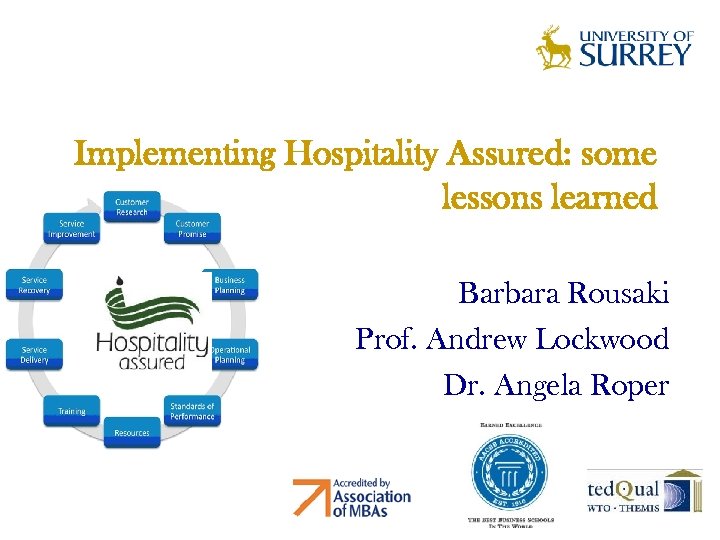
Implementing Hospitality Assured: some lessons learned Barbara Rousaki Prof. Andrew Lockwood Dr. Angela Roper
Presentation outline 1. Continuous improvement implementation (manufacturing sector evidence based) • principles, benefits, challenges. 2. The project: examining HA implementation 3. Findings • drivers, enablers, challenges, benefits. 4. Conclusions 5. Implications for • HA users, • Institute of Hospitality, • Hospitality Industry.
1. Continuous improvement (CI) implementation • CI: an organisation’s company-wide process of sustained and focused incremental innovation • Continuous improvement capabilities • involving the wider workforce in the innovation activities, • learning and unlearning of routines, • making small and frequent changes, • systematic focus on displaying, measuring and formalising tacit knowledge and • enhancing structured reflection. • Continuous improvement tools • EFQM & HA, Ii. P, Balance Scorecard, ISO 9000.
2. The project: examining HA implementation • 8 Hospitality Assured organisations • New and experienced/established users. • Meetings industry, contract catering, industry, hotel industry, hospitality services. • Interviews and meetings with 38 hospitality managers and employees • What are the drivers, enablers and challenges of the HA implementation process? • Benefits? • Lessons learned?
1. Drivers “We did a teambuilding exercise with the senior exec team and we highlighted the fact that we had probably reached a flat line. We needed a. Desire to improve something to set our sights on so we started climbing again, and the boss b. Competitive benchmarking came across this programme and he went through it. ” Coordinator 2007 “We also feel that we want to be the best in the UK, and now we want to be world class, and the only way to be world class is to never be happy, to constantly re-assess, to constantly measure…that’s all about research, is about honesty and is about allocating the right resources to do it all the time. ” Facilitator 2007
2. Enablers “One thing which I “I think ithave done pretty of the standardof think we is the simplicity well is instead and also functions and company-wide a. Leadership it talks a language, is the language of having two people effectively responsible for Hospitality Assured hospitality people, people all out and now which we did four years ago, we have filtered itunderstand when I engagement“service delivery”, is our jargon, it is an say: everybody understands that they can contribute to Hospitality ordinary concept that people in the to us Assured, • much the samecoordinators, facilitators. in initiators, way, everybody contributes industry are using. ” and our achieving our business practices targets. ” b. Collective plan Coordinator 2007 • influenced by CI experience. Facilitator 2007 c. Attributes of HA • compatibility, • adaptability, • relative advantage and • divisibility.
3. Challenges ““I think primarily because lots of people see that as extra work. You “Whenever you staff turnover is high then your standards are a. vulnerable, and the same…whenever you vulnerable then your Low always when your standards are come to any cultural know, it isstaff engagement change, any work ethic, oran culture, change, of skilled instantly preparation for method or is vulnerable too. ” • high turnover assessmentlack the people or career will be minded staff, lack of CI understanding. negative about it. ” Initiator/ Coordinator 2007 b. Knowledge related problems Facilitator 2007 b. Knowledge related problems • in (un)learning, transferring, sustaining and codifying knoweldge. c. CI not linked with strategic objectives • lack of competitive strategic posture. d. HA attributes • complexity of the language, • reliability of accreditation process.
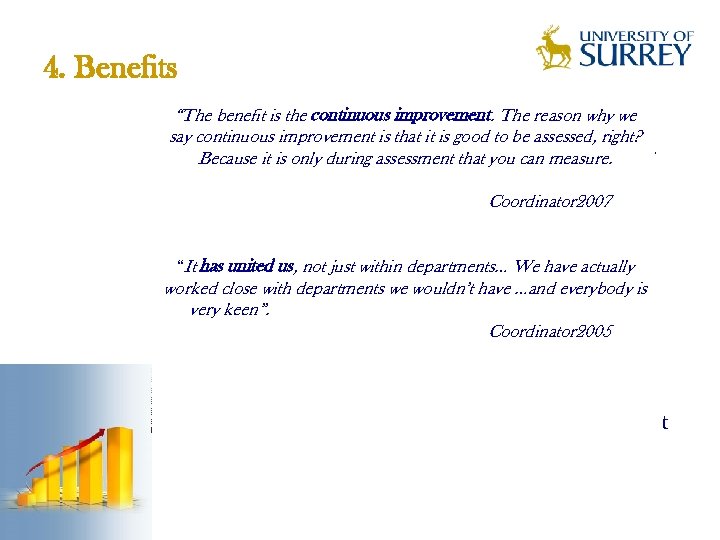
4. Benefits “The benefit is the continuous improvement. The reason why we is of no great value to us that is good advertising it right? say“It Effective in to be assessed, a. continuous improvement isinistheitsense ofbeing used as adoesn’t bring in any new only during assessment just you can measure. business Because it is business. So it really that • increasing organisational tool. ” improvement rather than a marketing interaction, Coordinator 2007 • structured continuous improvement, • organisational alertness, “It has united us, not just within departments… We have actually • proactive behaviour and worked close with departments we wouldn’t have …and everybody is very • encouraging internal best practice keen”. benchmarking. Coordinator 2005 b. Ineffective in • raising market value and • promoting consistently ways for external best practice benchmarking.
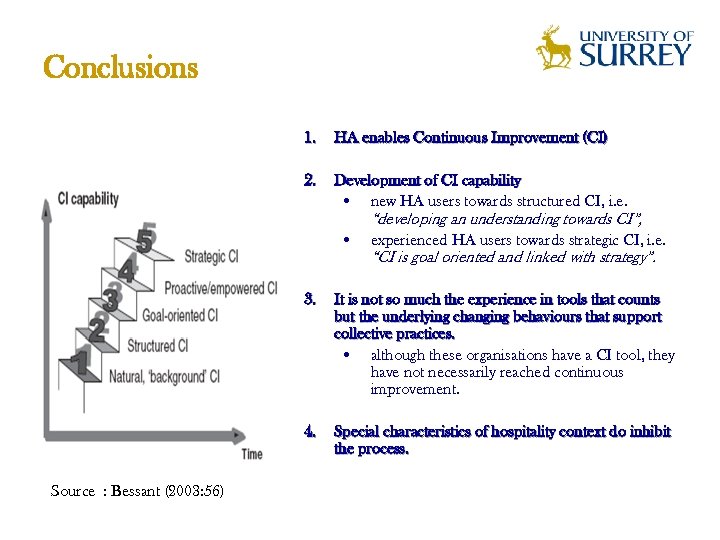
Conclusions 1. HA enables Continuous Improvement (CI) 2. Development of CI capability • new HA users towards structured CI, i. e. “developing an understanding towards CI”, • experienced HA users towards strategic CI, i. e. “CI is goal oriented and linked with strategy”. 3. 4. Source : Bessant (2003: 56) It is not so much the experience in tools that counts but the underlying changing behaviours that support collective practices. • although these organisations have a CI tool, they have not necessarily reached continuous improvement. Special characteristics of hospitality context do inhibit the process.
Implications for HA users • To make most of HA as a CI tool 1. Top management commitment and company-wide engagement. 2. Dedicated meetings on CI. 3. Develop and reward CI champions across and within the organisation. 4. Recognise and promote the enhanced capability to deliver customer promise. 5. Create an (un)learning culture.
Recommendations for Io. H 1. The assessment process should become more transparent and the recommendations clearer. 2. Experienced hospitality practitioners could also participate as assessors. 3. The language of the tool should become more userfriendly. 4. It is clear that the Institute needs to offer more opportunities for sharing best practice/experiences within and outside the industry. 5. The Institute needs to raise the market value of the tool and work on promoting the scheme to customers.
Implications for the hospitality industry 1. Invest in innovation • The development of regional, national and international innovation promoting incentives. • Continuously develop and adopt new products, services, business models, work processes and management techniques. 2. Raise the industry standards • Through the usage of CI, benchmarking tools and peerto-peer learning within and out of the industry. 3. Make work environments more attractive for employees • Invest in the careful selection of employees. • Employee training, empowerment and strategic human resource management.
Thank you for your attention Any questions?
Скачать презентацию Implementing Hospitality Assured some lessons learned Barbara Rousaki
79b3ade2c9fb440daabab90f5ed761c9.ppt