 Скачать презентацию Implementing Good Corporate Governance in Banks May 29
6f7a9e92299332703879912c4ca93a97.ppt
- Количество слайдов: 44



Implementing Good Corporate Governance in Banks May 29, 2006 Karachi, Pakistan Dr. Nasser Saidi Executive Director Hawkamah ICG DIFC May 2006
AGENDA • Corporate Governance (CG) and economic development • Why Bank CG? • Key Players in Governance of Banking Sector • Central Bank and Supervisors • Banks and Financial Institutions • Non-Bank Corporate Sector • CG in Islamic Finance • Complementary work to advance bank CG • Hawkamah Institute for Corporate Governance May 2006 2
Governance & Financial Systems • Consensus that sound financial systems involves countries adopting and implementing best practice standards in 12 key policy areas. • Both public and private sector incentives are required to stimulate country adoption and compliance with these standards. • Consensus that countries should give priority to adopting the international core standards May 2006 3
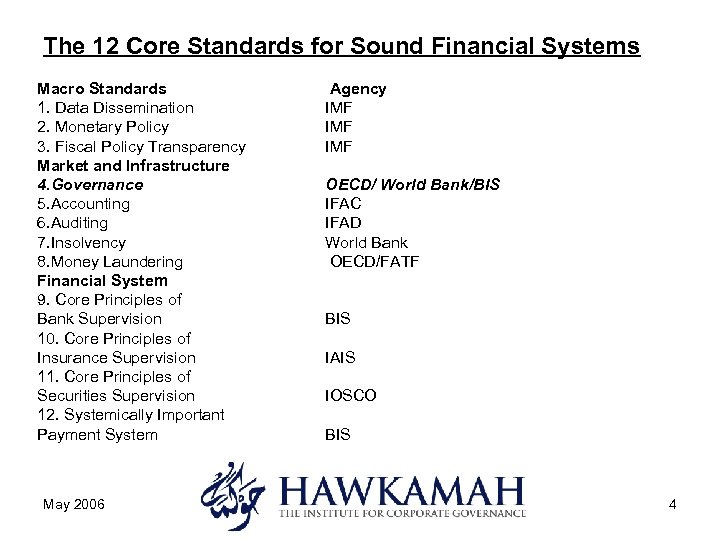
The 12 Core Standards for Sound Financial Systems Macro Standards 1. Data Dissemination 2. Monetary Policy 3. Fiscal Policy Transparency Market and Infrastructure 4. Governance 5. Accounting 6. Auditing 7. Insolvency 8. Money Laundering Financial System 9. Core Principles of Bank Supervision 10. Core Principles of Insurance Supervision 11. Core Principles of Securities Supervision 12. Systemically Important Payment System May 2006 Agency IMF IMF OECD/ World Bank/BIS IFAC IFAD World Bank OECD/FATF BIS IAIS IOSCO BIS 4
Why The Core Standards? • Deficiencies in these policy areas were a source of crises, and magnified, complicated and extended economic & financial crises • Countries complying with core standards can achieve: 1. Transparency of economic risks 2. Economy characterized by well governed institutions and companies valued and audited according to agreed upon international conventions protecting contracts & property rights 3. An ethical business environment 4. A financial system governed and regulated in a safe and sound manner, which serves the nation efficiently and sustains on going growth and economic development. May 2006 5
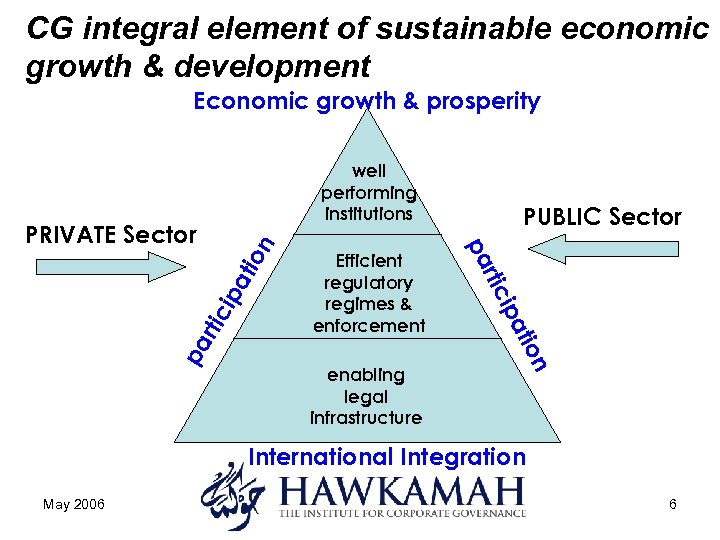
CG integral element of sustainable economic growth & development Economic growth & prosperity well performing institutions n tio ipa rtic n tio pa ipa enabling legal infrastructure rtic Efficient regulatory regimes & enforcement pa PRIVATE Sector PUBLIC Sector International Integration May 2006 6
Empirical Evidence suggests ‘country effects’ are important for good CG 1. CG frameworks and reform should address both macro and sector/micro issues 2. Legal Origins matter 3. Public Governance matters. In particular: – – – May 2006 Control of corruption Regulatory quality Rule of law 7
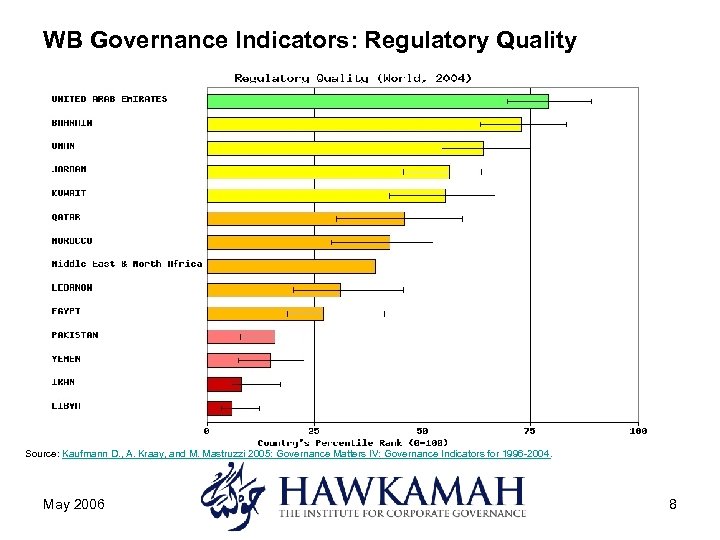
WB Governance Indicators: Regulatory Quality Source: Kaufmann D. , A. Kraay, and M. Mastruzzi 2005: Governance Matters IV: Governance Indicators for 1996 -2004. May 2006 8
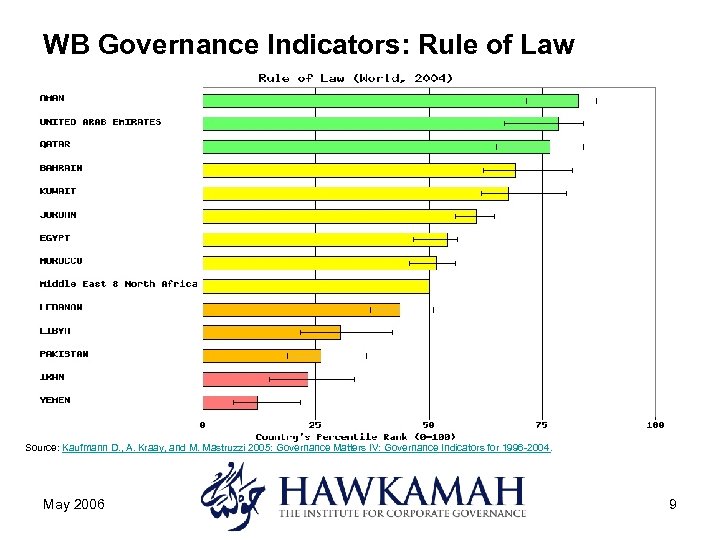
WB Governance Indicators: Rule of Law Source: Kaufmann D. , A. Kraay, and M. Mastruzzi 2005: Governance Matters IV: Governance Indicators for 1996 -2004. May 2006 9
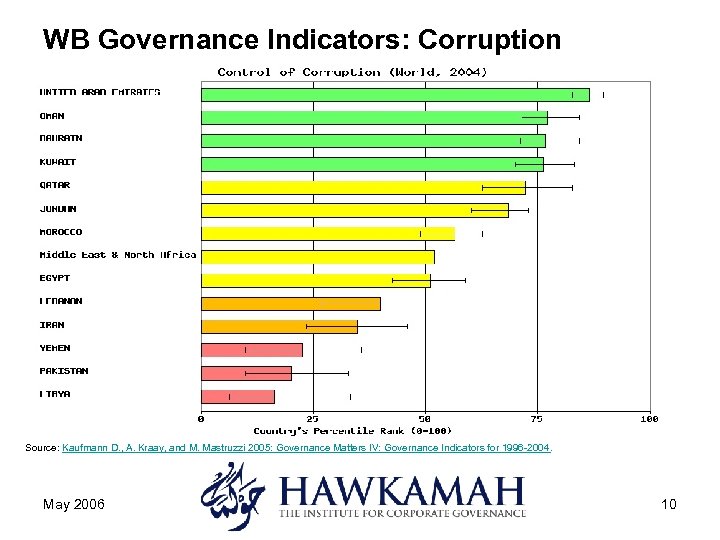
WB Governance Indicators: Corruption Source: Kaufmann D. , A. Kraay, and M. Mastruzzi 2005: Governance Matters IV: Governance Indicators for 1996 -2004. May 2006 10
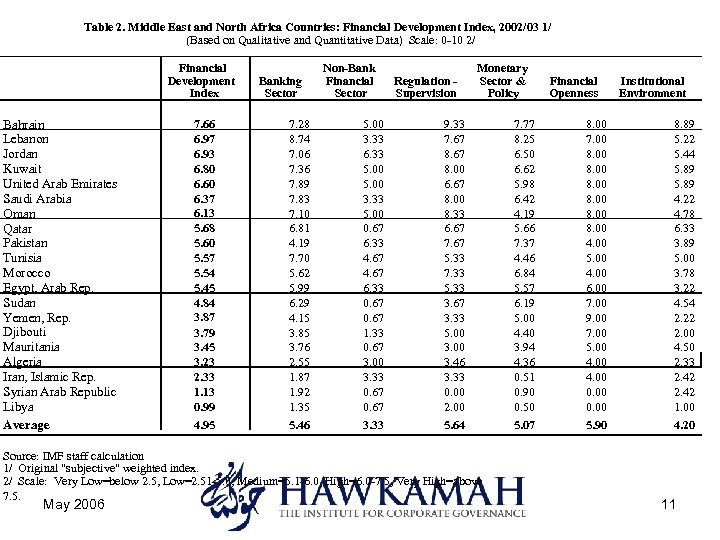
Table 2. Middle East and North Africa Countries: Financial Development Index, 2002/03 1/ (Based on Qualitative and Quantitative Data) Scale: 0 -10 2/ Financial Development Index Bahrain Lebanon Jordan Kuwait United Arab Emirates Saudi Arabia Oman Qatar Pakistan Tunisia Morocco Egypt, Arab Rep. Sudan Yemen, Rep. Djibouti Mauritania Algeria Iran, Islamic Rep. Syrian Arab Republic Libya Average Banking Sector Non-Bank Financial Sector Regulation Supervision Monetary Sector & Policy Institutional Environment 7. 66 6. 97 6. 93 6. 80 6. 60 6. 37 6. 13 5. 68 5. 60 5. 57 5. 54 5. 45 4. 84 3. 87 3. 79 3. 45 3. 23 2. 33 1. 13 0. 99 7. 28 8. 74 7. 06 7. 36 7. 89 7. 83 7. 10 6. 81 4. 19 7. 70 5. 62 5. 99 6. 29 4. 15 3. 85 3. 76 2. 55 1. 87 1. 92 1. 35 5. 00 3. 33 6. 33 5. 00 3. 33 5. 00 0. 67 6. 33 4. 67 6. 33 0. 67 1. 33 0. 67 3. 00 3. 33 0. 67 9. 33 7. 67 8. 00 6. 67 8. 00 8. 33 6. 67 7. 67 5. 33 7. 33 5. 33 3. 67 3. 33 5. 00 3. 46 3. 33 0. 00 2. 00 7. 77 8. 25 6. 50 6. 62 5. 98 6. 42 4. 19 5. 66 7. 37 4. 46 6. 84 5. 57 6. 19 5. 00 4. 40 3. 94 4. 36 0. 51 0. 90 0. 50 8. 00 7. 00 8. 00 4. 00 5. 00 4. 00 6. 00 7. 00 9. 00 7. 00 5. 00 4. 00 0. 00 8. 89 5. 22 5. 44 5. 89 4. 22 4. 78 6. 33 3. 89 5. 00 3. 78 3. 22 4. 54 2. 22 2. 00 4. 50 2. 33 2. 42 1. 00 4. 95 5. 46 3. 33 5. 64 5. 07 5. 90 4. 20 Source: IMF staff calculation 1/ Original "subjective" weighted index. 2/ Scale: Very Low=below 2. 5, Low=2. 51 -5. 0, Medium=5. 1 -6. 0, High=6. 0 -7. 5, Very High=above 7. 5. May 2006 Financial Openness 11
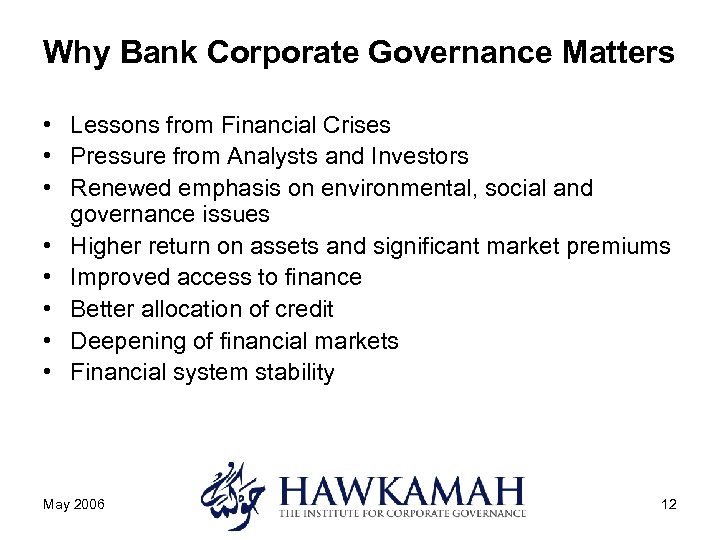
Why Bank Corporate Governance Matters • Lessons from Financial Crises • Pressure from Analysts and Investors • Renewed emphasis on environmental, social and governance issues • Higher return on assets and significant market premiums • Improved access to finance • Better allocation of credit • Deepening of financial markets • Financial system stability May 2006 12
Why Bank Corporate Governance Matters • Banks’ dominant position in financial and payment systems • Banks dominate both credit & investment process for economy and majority of firms • Government ownership and concentration of ownership in banking sector • Strengthen prudential regulation and supervision • Strengthen Transparency, Disclosure & Reporting • Face challenge of external competition • Liberalization & opening up is providing greater latitude to banks May 2006 13
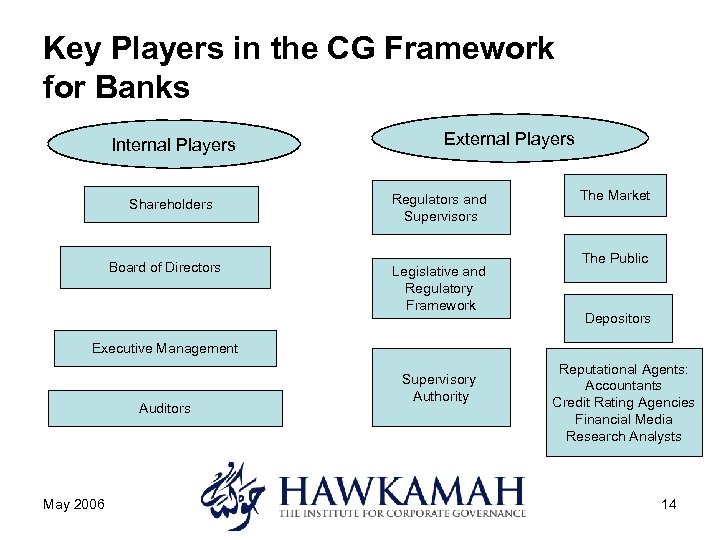
Key Players in the CG Framework for Banks Internal Players Shareholders Board of Directors External Players Regulators and Supervisors Legislative and Regulatory Framework The Market The Public Depositors Executive Management Auditors May 2006 Supervisory Authority Reputational Agents: Accountants Credit Rating Agencies Financial Media Research Analysts 14
Focus Efforts to Address CG of the Banking System 1. Central Bank and Bank Supervisors 2. Banking sector and financial institutions 3. Non-bank corporate sector 4. Shari’a compliant financial institutions May 2006 15
1. CG of Central Banks and Bank Supervisors • Develop a credible and transparent regulatory environment • Address Central Bank governance to ensure its independence and accountability • Regulatory environment must not be perceived to be under control or influence of any particular interest group • Follow BIS principles for sound banking CG May 2006 16
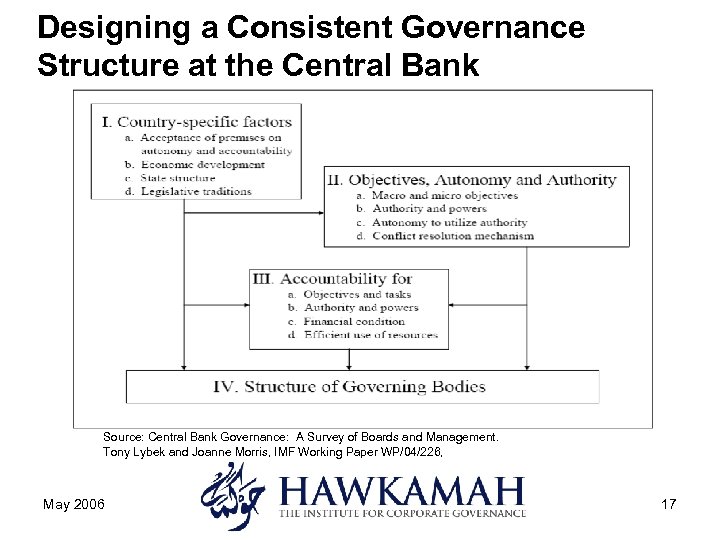
Designing a Consistent Governance Structure at the Central Bank Source: Central Bank Governance: A Survey of Boards and Management. Tony Lybek and Joanne Morris, IMF Working Paper WP/04/226, May 2006 17
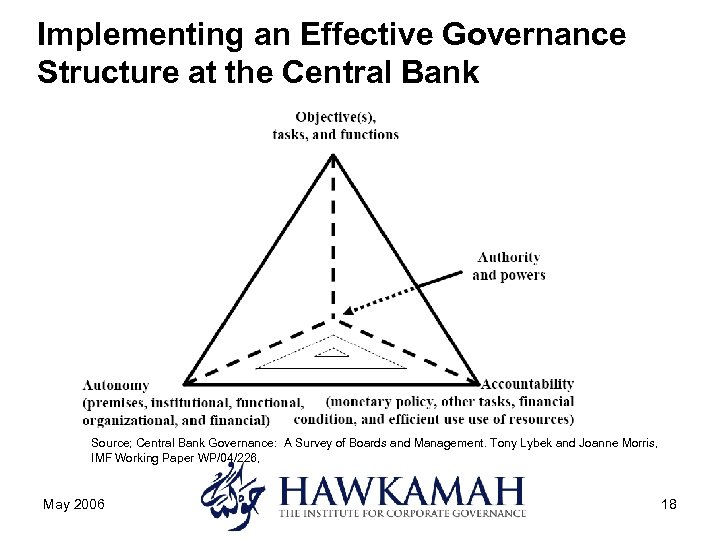
Implementing an Effective Governance Structure at the Central Bank Source; Central Bank Governance: A Survey of Boards and Management. Tony Lybek and Joanne Morris, IMF Working Paper WP/04/226, May 2006 18
Role of Bank Supervisors • Promote strong corporate governance • Determine whether the bank has sound corporate governance policies and practices • Hold the Board and senior management accountable for governance and internal control weaknesses • Be attentive to warning signs of deterioration in management May 2006 19
BIS: Sound CG Principles for Banking Organizations • • Principle 1 Board members should be qualified for their positions, have a clear understanding of their role in corporate governance and be able to exercise sound judgment about the affairs of the bank. Principle 2 The board of directors should approve and oversee the bank’s strategic objectives and corporate values that are communicated throughout the banking organisation. Principle 3 The board of directors should set and enforce clear lines of responsibility and accountability throughout the organisation. Principle 4 The board should ensure that there is appropriate oversight by senior management consistent with board policy. Principle 5 The board and senior management should effectively utilise the work conducted by the internal audit function, external auditors, and internal control functions. Principle 6 The board should ensure that compensation policies and practices are consistent with the bank’s corporate culture, long-term objectives and strategy, and control environment. Principle 7 The bank should be governed in a transparent manner. Principle 8 The board and senior management should understand the bank’s operational structure, including where the bank operates in jurisdictions, or through structures, that impede transparency (i. e. “know-your-structure”). May 2006 20
BIS Sound CG Principles for Banking Organizations: The Role of Supervisors • Supervisors should provide guidance to banks on sound corporate governance and the pro-active practices that should be in place. • Supervisors should consider corporate governance as one element of depositor protection. • Supervisors should determine whether the bank has adopted and effectively implemented sound corporate governance policies and practices. • Supervisors should assess the quality of banks’ audit and control functions. • Supervisors should evaluate the effects of the bank’s group structure. • Supervisors should bring to the board of directors’ and management’s attention problems that they detect through their supervisory efforts. May 2006 21
2. CG of Banking Sector and Financial Institutions • Understand implement BIS standards • Address institutional barriers from implementing BIS standards • Be transparent and disclose: – – – Board and senior management structure Organisational structure Incentive structure of the bank Related party transactions Annual financial statements with supporting notes and schedules • Develop codes of ethics and CG handbooks for banks, as guidance for directors and staff – Jordan, Pakistan May 2006 22
3. Banks have a role in extending CG to non-bank corporate sector • • • For CG to take root in countries with relatively undeveloped financial markets, banks can play a crucial role to advance good CG practices. Establish ‘cascading effect’ of CG to banks’ corporate clients. Over 90% of firms in emerging markets are FOEs and are mostly dependent on banks, not capital markets, for source of capital. May 2006 23
Implementing CG in Non-Bank Financial Sector • Two step process 1. Develop a mandatory bank CG Code Ø Monitored by bank supervisors and reported on by board Ø Reporting on compliance in bank annual report 2. Central Bank issues a circular relating to CG code for non-bank corporate clients of the banking system Ø Develop effective monitoring by banks (i. e. market based monitoring) Ø Support monitoring by development of credit bureaus and credit rating agencies Ø Create incentives (such as lower risk assessment for capital adequacy requirements) for CG-compliant corporate clients thereby also providing incentives for banks May 2006 24
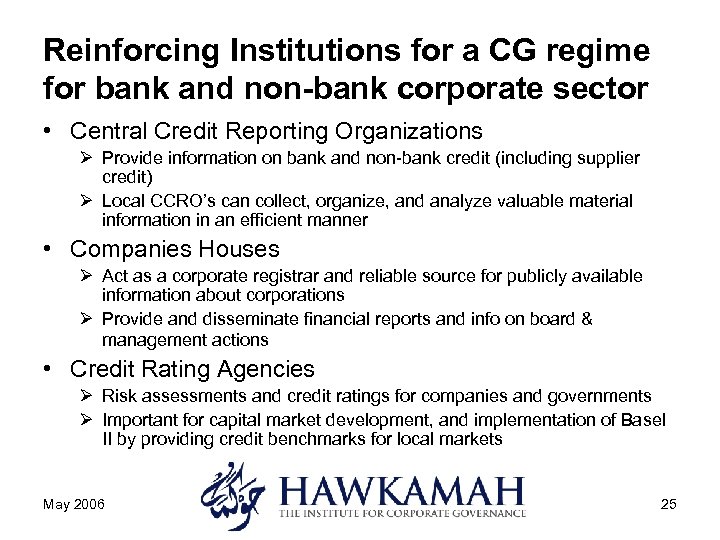
Reinforcing Institutions for a CG regime for bank and non-bank corporate sector • Central Credit Reporting Organizations Ø Provide information on bank and non-bank credit (including supplier credit) Ø Local CCRO’s can collect, organize, and analyze valuable material information in an efficient manner • Companies Houses Ø Act as a corporate registrar and reliable source for publicly available information about corporations Ø Provide and disseminate financial reports and info on board & management actions • Credit Rating Agencies Ø Risk assessments and credit ratings for companies and governments Ø Important for capital market development, and implementation of Basel II by providing credit benchmarks for local markets May 2006 25
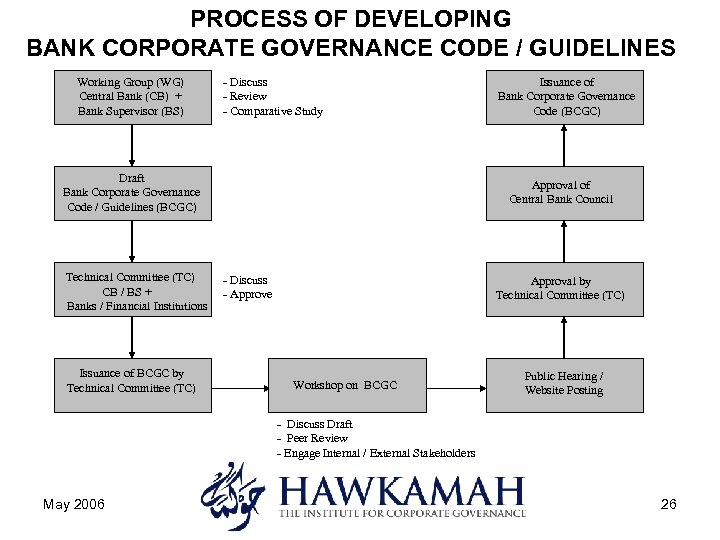
PROCESS OF DEVELOPING BANK CORPORATE GOVERNANCE CODE / GUIDELINES Working Group (WG) Central Bank (CB) + Bank Supervisor (BS) - Discuss - Review - Comparative Study Draft Bank Corporate Governance Code / Guidelines (BCGC) Technical Committee (TC) CB / BS + Banks / Financial Institutions Issuance of BCGC by Technical Committee (TC) Issuance of Bank Corporate Governance Code (BCGC) Approval of Central Bank Council - Discuss - Approve Approval by Technical Committee (TC) Workshop on BCGC Public Hearing / Website Posting - Discuss Draft - Peer Review - Engage Internal / External Stakeholders May 2006 26
4. Shari’a Compliant Financial Institutions • Islamic Financial Services Board developed seven guiding principles, divided into four parts, on CG for institutions offering only Islamic financial services (IIFS). • Complements current corporate governance principles issued by OECD, BCBS and other international standard setting bodies. • Recognizes that specific CG practices will vary in scope and content • Prudential regulations covering aspects of capital adequacy, risk management, investor protection, transparency and market discipline, accounting practices will have CG dimension on structure and business practice. Focus is on holistic compliance of regulations. May 2006 27
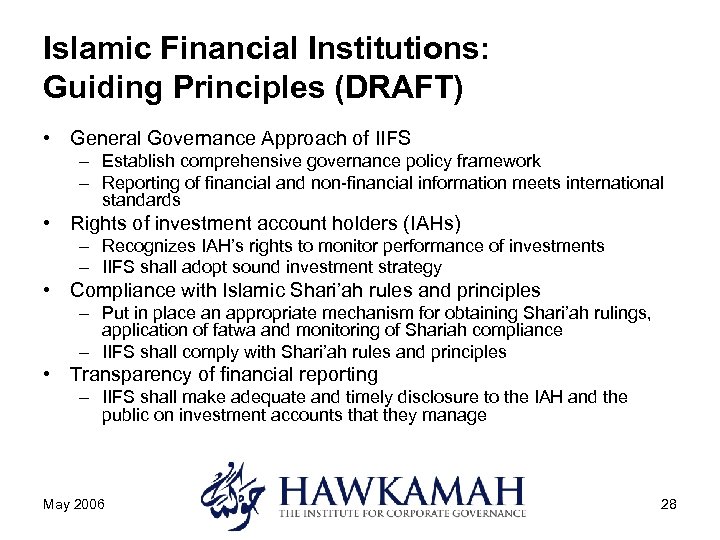
Islamic Financial Institutions: Guiding Principles (DRAFT) • General Governance Approach of IIFS – Establish comprehensive governance policy framework – Reporting of financial and non-financial information meets international standards • Rights of investment account holders (IAHs) – Recognizes IAH’s rights to monitor performance of investments – IIFS shall adopt sound investment strategy • Compliance with Islamic Shari’ah rules and principles – Put in place an appropriate mechanism for obtaining Shari’ah rulings, application of fatwa and monitoring of Shariah compliance – IIFS shall comply with Shari’ah rules and principles • Transparency of financial reporting – IIFS shall make adequate and timely disclosure to the IAH and the public on investment accounts that they manage May 2006 28
Complementary Work Needed to Advance CG • Engage wide participation from NGO’s, chambers of commerce, media, business associations, government • Develop necessary institutions and build human capacity in major areas (accountants, regulators, bankers, company directors) • Design an effective regulatory system, but also create the conditions that make such a system credible. • In the end, corporate governance is about establishing a climate of trust and confidence. May 2006 29
Bank IT Corporate Governance • IT CG: – Public dimension: enabling framework for Digital economies & societies. E-Government imperative – Private dimension • “IT governance is the responsibility of the board of directors and executive management. It is an integral part of enterprise governance and consists of the leadership and organisational structures and processes that ensure that the organisation’s IT sustains and extends the organisation’s strategies and objectives. ” • IT governance is concerned about two responsibilities: – IT must deliver value and enable the business – IT-related risks must be mitigated. May 2006 30
Hawkamah Institute for Corporate Governance • First Institute of its kind in the region • An autonomous, international association, hosted by the Dubai International Financial Centre (DIFC), and serving the MENA countries, Central Asia and beyond • Premises in DIFC to be ready by October 2006 to host Hawkamah ICG and Hawkamah Institute of Directors (HIo. D) as well as academic institutions • Financially self-sustaining organisation with income from memberships, consultation, training, in addition to grants & sponsorship May 2006 31
Mission and Vision • ‘Bridge the CG gap’ • Assist the countries and companies of the region in developing sound and globally well integrated CG frameworks: – Coordinate and sequence the designing, and implementation of CG reforms – Monitor the outcomes of CG policies at the public and private sector level. • “Hawkamah-ICG will serve as a platform for regional cooperation, based on a concrete agenda for measurable and time-bound action, aiming to raise awareness of national, regional and global initiatives and build a coalition for reform”, Joint Declaration OECD-UAE, 2005. May 2006 32
Hawkamah Institute for Corporate Governance • Strengthen institutional and capacity building by setting up a regional Institute of Directors. • Source of CG technical assistance, monitoring, analysis, research, consultation and reform. • Foster communication and policy dialogue on CG • Develop home-grown CG frameworks working with national task forces • Natural bridge and intermediary for institutions promoting CG in the region May 2006 33
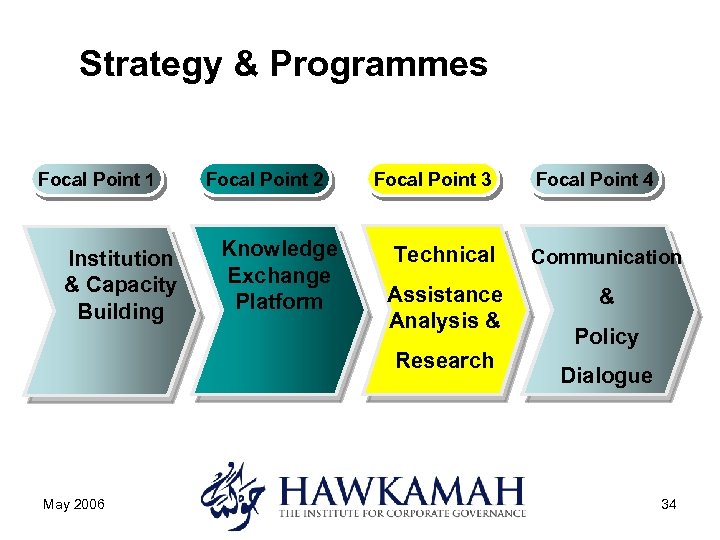
Strategy & Programmes Focal Point 1 Institution & Capacity Building Focal Point 2 Knowledge Exchange Platform Focal Point 3 Technical Communication Assistance Analysis & & Research May 2006 Focal Point 4 Policy Dialogue 34
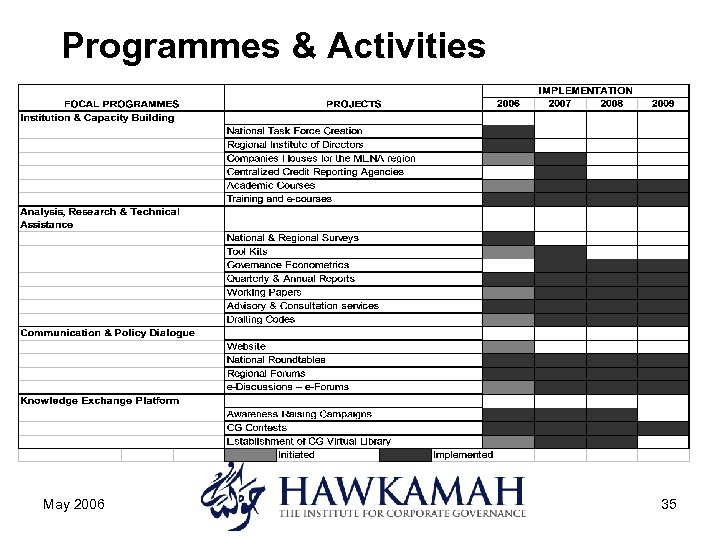
Programmes & Activities May 2006 35
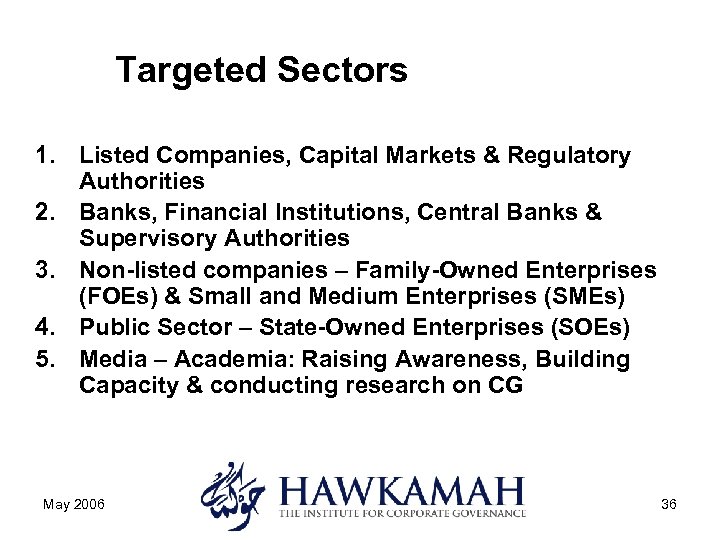
Targeted Sectors 1. Listed Companies, Capital Markets & Regulatory Authorities 2. Banks, Financial Institutions, Central Banks & Supervisory Authorities 3. Non-listed companies – Family-Owned Enterprises (FOEs) & Small and Medium Enterprises (SMEs) 4. Public Sector – State-Owned Enterprises (SOEs) 5. Media – Academia: Raising Awareness, Building Capacity & conducting research on CG May 2006 36
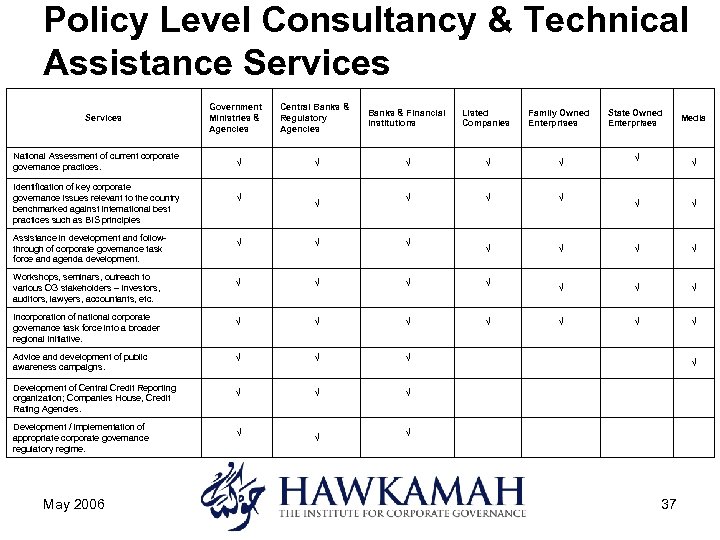
Policy Level Consultancy & Technical Assistance Services National Assessment of current corporate governance practices. Identification of key corporate governance issues relevant to the country benchmarked against international best practices such as BIS principles Assistance in development and followthrough of corporate governance task force and agenda development. Workshops, seminars, outreach to various CG stakeholders – investors, auditors, lawyers, accountants, etc. Incorporation of national corporate governance task force into a broader regional initiative. Advice and development of public awareness campaigns. Development of Central Credit Reporting organization; Companies House, Credit Rating Agencies. Development / implementation of appropriate corporate governance regulatory regime. May 2006 Government Ministries & Agencies Central Banks & Regulatory Agencies Banks & Financial Institutions Listed Companies Family Owned Enterprises √ √ √ √ √ √ √ √ √ √ √ √ Media √ √ √ State Owned Enterprises √ √ 37
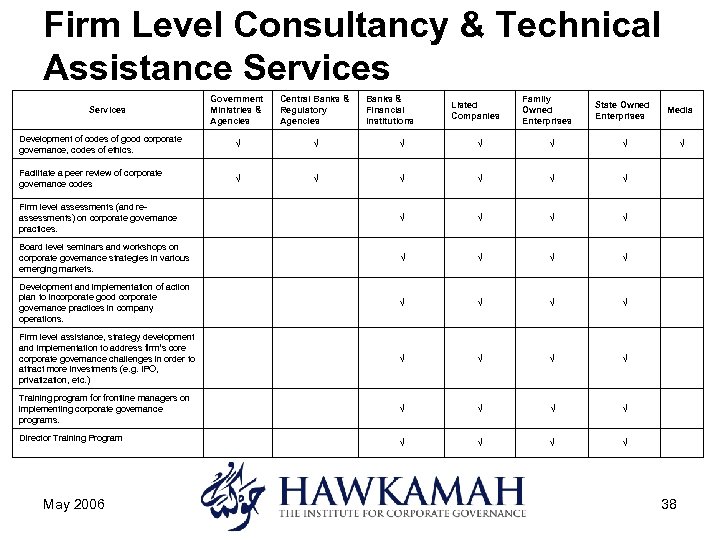
Firm Level Consultancy & Technical Assistance Services Government Ministries & Agencies Central Banks & Regulatory Agencies Banks & Financial Institutions Development of codes of good corporate governance, codes of ethics. √ √ Facilitate a peer review of corporate governance codes √ √ √ Firm level assessments (and reassessments) on corporate governance practices. Media √ √ √ √ √ Board level seminars and workshops on corporate governance strategies in various emerging markets. √ √ Development and implementation of action plan to incorporate good corporate governance practices in company operations. √ √ Firm level assistance, strategy development and implementation to address firm’s core corporate governance challenges in order to attract more investments (e. g. IPO, privatization, etc. ) √ √ Training program for frontline managers on implementing corporate governance programs. √ √ √ √ Director Training Program May 2006 Listed Companies Family Owned Enterprises State Owned Enterprises Services 38
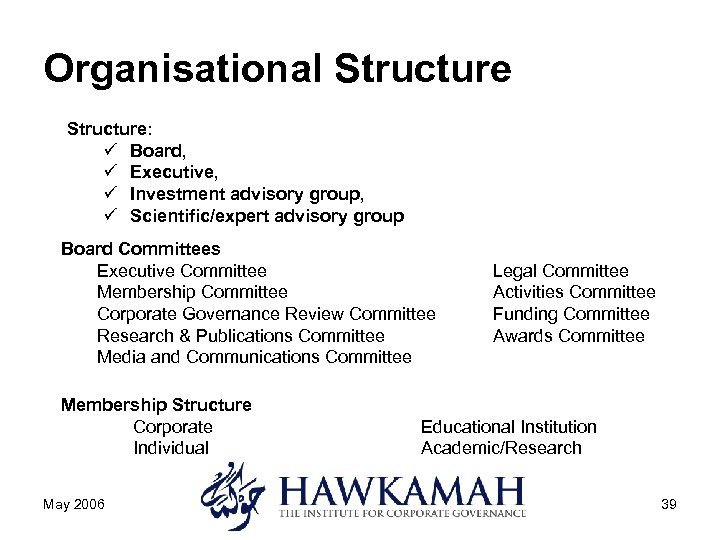
Organisational Structure: ü Board, ü Executive, ü Investment advisory group, ü Scientific/expert advisory group Board Committees Executive Committee Membership Committee Corporate Governance Review Committee Research & Publications Committee Media and Communications Committee Membership Structure Corporate Individual May 2006 Legal Committee Activities Committee Funding Committee Awards Committee Educational Institution Academic/Research 39
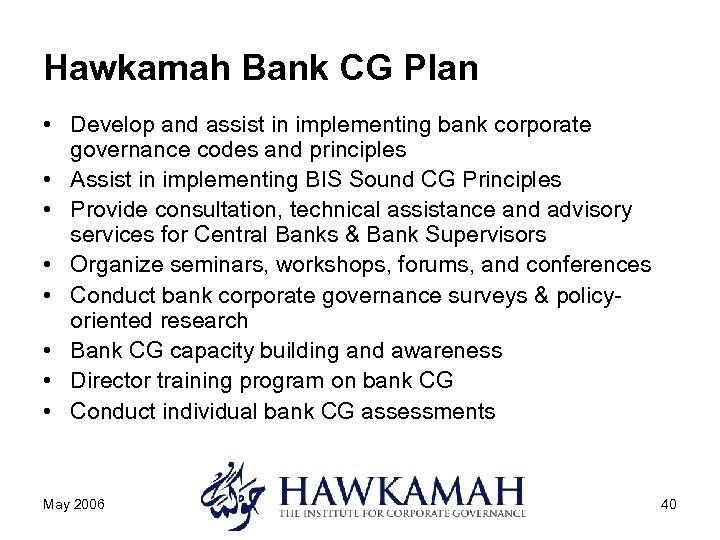
Hawkamah Bank CG Plan • Develop and assist in implementing bank corporate governance codes and principles • Assist in implementing BIS Sound CG Principles • Provide consultation, technical assistance and advisory services for Central Banks & Bank Supervisors • Organize seminars, workshops, forums, and conferences • Conduct bank corporate governance surveys & policyoriented research • Bank CG capacity building and awareness • Director training program on bank CG • Conduct individual bank CG assessments May 2006 40

Hawkamah Institute of Directors Open to private and public sector companies, entrepreneurs of start-up companies, and people responsible for the strategic direction of a business organization. Services offered include: ü Training and certification program ü Executive coaching ü Workshops, seminars and conferences ü Financial planning and consultancy services ü Affinity programs such as personal loans, liability insurance coverage, etc. ü Access to members only lounges and facilities May 2006 41

Strategic Partners Hawkamah is partnering with: • OECD * • WB-IFC * • WB Global Corporate Governance Forum • Union of Arab Banks * • Center for International Private Enterprise* • DSG, IMD, YAL • Central Banks, Bank Supervisory Authorities & Bank Associations • Capital Market Authorities, Stock Exchanges, Market Professional Associations & SROs • International & Regional organizations • Countries participating in the MENA-OECD Investment Program • CG centers, universities May 2006 42

Role of Strategic Partners • Provide technical assistance and advisory services related to institutional and human resource capacity building in corporate sector reform and governance • Establish sustained dialogue with regional and international organizations specialized in corporate governance • Provide funding for various Corporate Governance Programmes and Projects • Organize seminars, workshops, forums, and conferences dedicated to issues of corporate governance in the region and the world • Conduct research and surveys on corporate governance in the region and means of enhancement May 2006 43

Hawkamah BUILDING INSTITUTIONS FOR THE REGION www. hawkamah. org Hawkamah Institute for Corporate Governance DIFC, The Gate Level 14 T: +9714 -362 -2222 F: +9714 -362 -3333 E: info@hawkamah. org May 2006 44
Скачать презентацию Implementing Good Corporate Governance in Banks May 29
6f7a9e92299332703879912c4ca93a97.ppt