


 Скачать презентацию Implementing Canada s Innovation Strategy Engaging Stakeholders in Policy
7c0669668a604b93413203d17a40660c.ppt
- Количество слайдов: 31
 Implementing Canada’s Innovation Strategy: Engaging Stakeholders in Policy Learning Process A. Duff Mitchell Manufacturing Competitiveness Directorate Industry Canada Six Countries Programme, Stockholm, Sweden May 23, 2006
 Canada: Who we are & public policy challenges 2
 Canada is a prosperous & successful country large, resource rich country … relatively small, high income, bilingual & multicultural population … federal political system & situated next to U. S. § Canada ranks high as place to live & do business: • United Nations Human Development Index – 5 th among 177 countries in 2005 • World Economic Forum’s international competitiveness ranking – 13 th in 2005 • OECD’s measure of living standards – real GDP per capita was 2 nd highest in G 7, 9 th in the OECD in 2004 3
 Focused on three policy challenges & innovation 1. Increasing productivity growth on sustained basis (objective: closing productivity gap vis-à-vis U. S. ) 2. Improving human capital through education & training (objective: one of best educated society/economy in world) 3. Enhancing global economic reach (objective: more global FDI, deeper trade links in key markets, creating stronger “Canada brand”) Canada’s Innovation Goal: To be recognized as one of the most innovative countries in the world 4
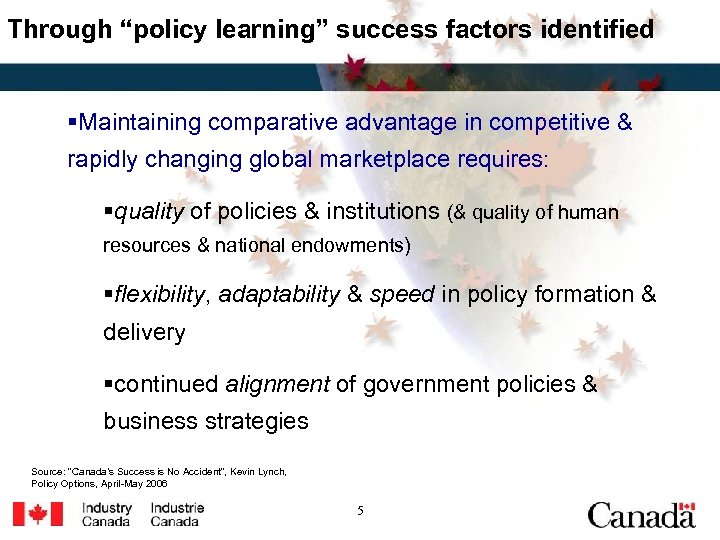 Through “policy learning” success factors identified §Maintaining comparative advantage in competitive & rapidly changing global marketplace requires: §quality of policies & institutions (& quality of human resources & national endowments) §flexibility, adaptability & speed in policy formation & delivery §continued alignment of government policies & business strategies Source: “Canada’s Success is No Accident”, Kevin Lynch, Policy Options, April-May 2006 5
 Why an Innovation Strategy? 6
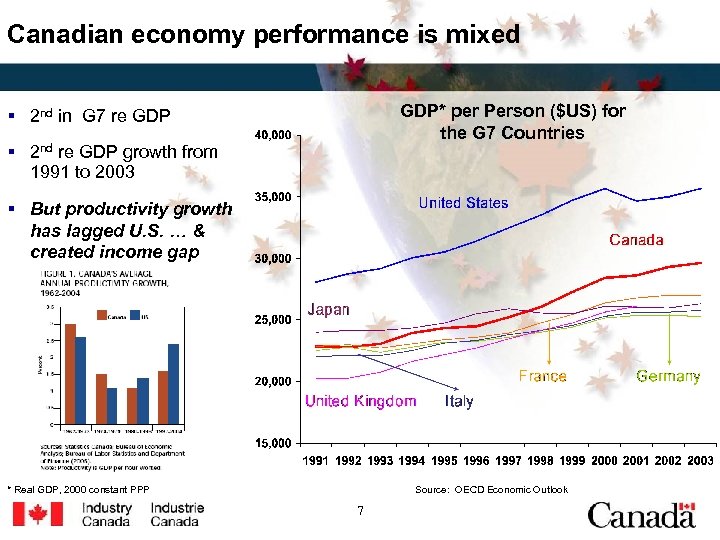 Canadian economy performance is mixed GDP* per Person ($US) for the G 7 Countries § 2 nd in G 7 re GDP § 2 nd re GDP growth from 1991 to 2003 § But productivity growth has lagged U. S. … & created income gap * Real GDP, 2000 constant PPP Source: OECD Economic Outlook 7
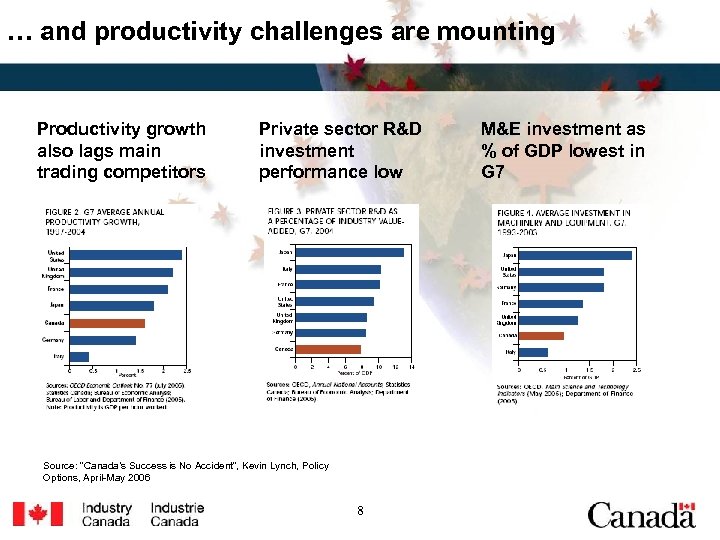 … and productivity challenges are mounting Productivity growth also lags main trading competitors Private sector R&D investment performance low Source: “Canada’s Success is No Accident”, Kevin Lynch, Policy Options, April-May 2006 8 M&E investment as % of GDP lowest in G 7
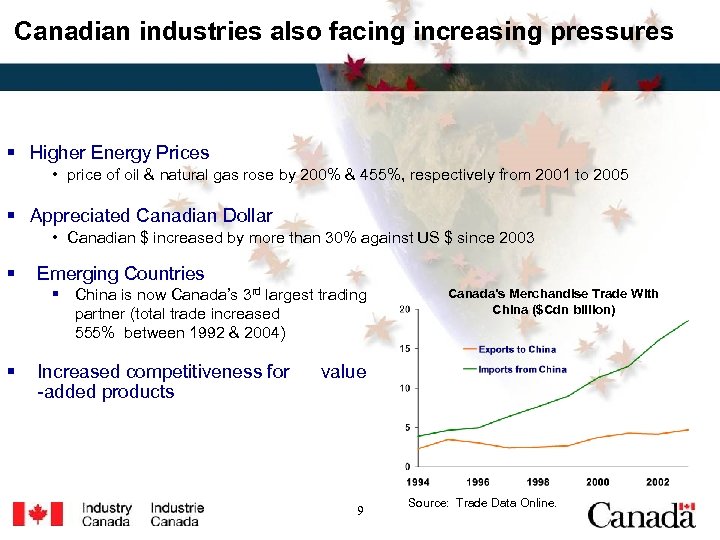 Canadian industries also facing increasing pressures § Higher Energy Prices • price of oil & natural gas rose by 200% & 455%, respectively from 2001 to 2005 § Appreciated Canadian Dollar • Canadian $ increased by more than 30% against US $ since 2003 § Emerging Countries § China is now Canada’s 3 rd largest trading partner (total trade increased 555% between 1992 & 2004) § Increased competitiveness for -added products Canada’s Merchandise Trade With China ($Cdn billion) value 9 Source: Trade Data Online.
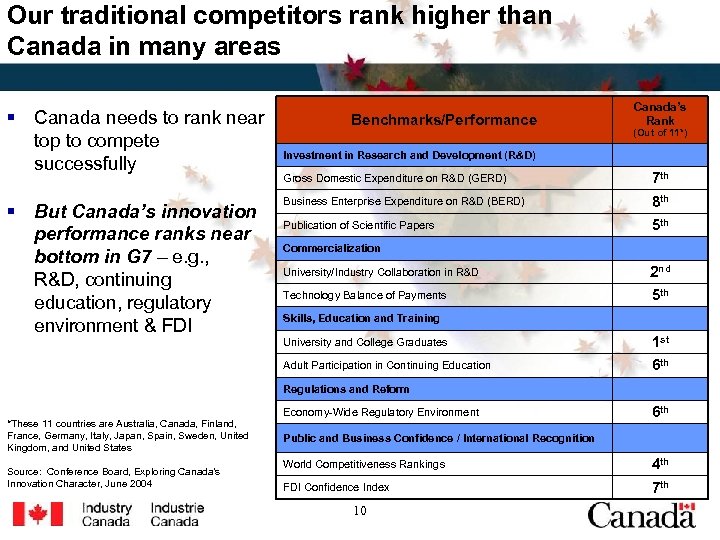 Our traditional competitors rank higher than Canada in many areas § Canada needs to rank near top to compete successfully § But Canada’s innovation performance ranks near bottom in G 7 – e. g. , R&D, continuing education, regulatory environment & FDI Benchmarks/Performance Canada’s Rank (Out of 11*) Investment in Research and Development (R&D) Gross Domestic Expenditure on R&D (GERD) 7 th Business Enterprise Expenditure on R&D (BERD) 8 th Publication of Scientific Papers 5 th Commercialization University/Industry Collaboration in R&D 2 nd Technology Balance of Payments 5 th Skills, Education and Training University and College Graduates 1 st Adult Participation in Continuing Education 6 th Regulations and Reform Economy-Wide Regulatory Environment *These 11 countries are Australia, Canada, Finland, France, Germany, Italy, Japan, Spain, Sweden, United Kingdom, and United States Source: Conference Board, Exploring Canada’s Innovation Character, June 2004 6 th Public and Business Confidence / International Recognition World Competitiveness Rankings 4 th FDI Confidence Index 7 th 10
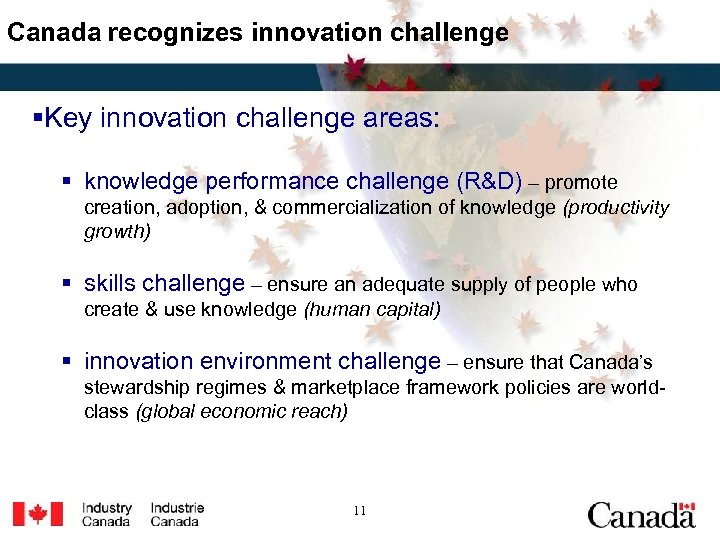 Canada recognizes innovation challenge §Key innovation challenge areas: § knowledge performance challenge (R&D) – promote creation, adoption, & commercialization of knowledge (productivity growth) § skills challenge – ensure an adequate supply of people who create & use knowledge (human capital) § innovation environment challenge – ensure that Canada’s stewardship regimes & marketplace framework policies are worldclass (global economic reach) 11
 The Federal Government Innovation Strategy Initiative 12
 National Innovation Strategy involved multi-pronged engagement process § National Engagement Process launched 2002: § February: released Innovation Strategy Papers – set directions for 2010 § May – October: asked Canadians for views on targets, priority actions, recommendations § November – National Innovation Summit § Two overarching objectives: § mobilize Canadians to make commitments – and turn them into action – so that Canada becomes one of most innovative countries in world § examine Government’s Strategy to accomplish this goal – then tell us if we’ve got it right http: //www. innovationstrategy. gc. ca 13
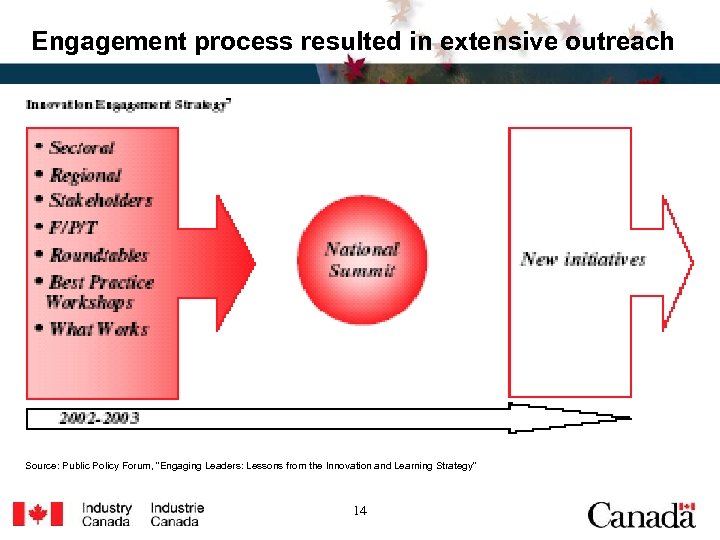 Engagement process resulted in extensive outreach Source: Public Policy Forum, “Engaging Leaders: Lessons from the Innovation and Learning Strategy” 14
 Innovation initiative heard from all Canadians §Innovation Secretariat established § 10, 000+ Canadians participated in: § 33 regional events § 80 sectoral group meetings § 40 expert, best-practice, and interest group roundtables §multiple streams, e. g. sectors, regions, youth, provinces § 600+ online responses from individuals & SMEs § 250+ formal submissions received from organizations representing hundreds of thousands of Canadians (posted on line) §key federal government departments involved Knowledge Matters: Skills & Learning for Canadians Achieving Excellence: Investing in People, Knowledge & Opportunities 15
 … and Canadians had a lot to say §Confirmed major directions set out in Innovation Strategy papers §Suggested modifications to certain targets & milestones §Move faster in key areas (e. g. regulatory reform) §Modify performance measures in key cases (e. g. R&D intensity) §Provide more clarity (e. g. cluster strategy) §Pointed out deficiencies (e. g. insufficient focus on commercialization efforts; skilled trades) §Recognized that many stakeholders must collaborate §Government cannot act alone; innovation is everybody’s business; role for all key stakeholders §Demonstrated sense of ‘readiness’ to move forward – Canadians mobilized; ready to commit; wanted ‘fast action’ 16
 Canadian views captured for policy analysis §Views summarized in Canadians Speak on Innovation and Learning §Analysis of key issues & recommendations by stream § 2000+ recommendations; 5 key horizontal issues with 93 recommendations for prioritization at National Summit (National Summit Discussion Guide) http: //www. innovation. gc. ca/gol/innovation/ 17
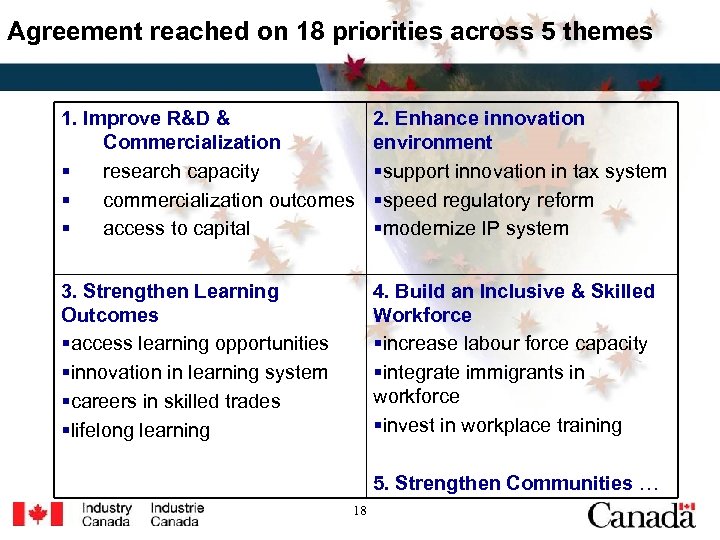 Agreement reached on 18 priorities across 5 themes 1. Improve R&D & Commercialization § research capacity § commercialization outcomes § access to capital 2. Enhance innovation environment §support innovation in tax system §speed regulatory reform §modernize IP system 3. Strengthen Learning Outcomes §access learning opportunities §innovation in learning system §careers in skilled trades §lifelong learning 4. Build an Inclusive & Skilled Workforce §increase labour force capacity §integrate immigrants in workforce §invest in workplace training 5. Strengthen Communities … 18
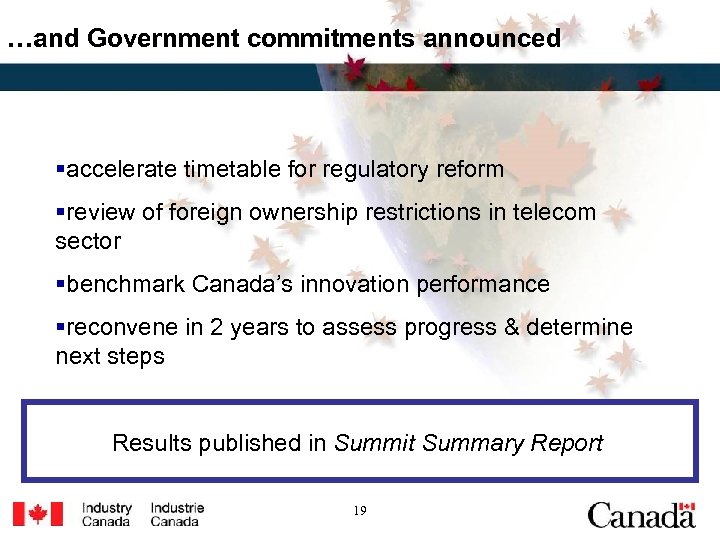 …and Government commitments announced §accelerate timetable for regulatory reform §review of foreign ownership restrictions in telecom sector §benchmark Canada’s innovation performance §reconvene in 2 years to assess progress & determine next steps Results published in Summit Summary Report 19
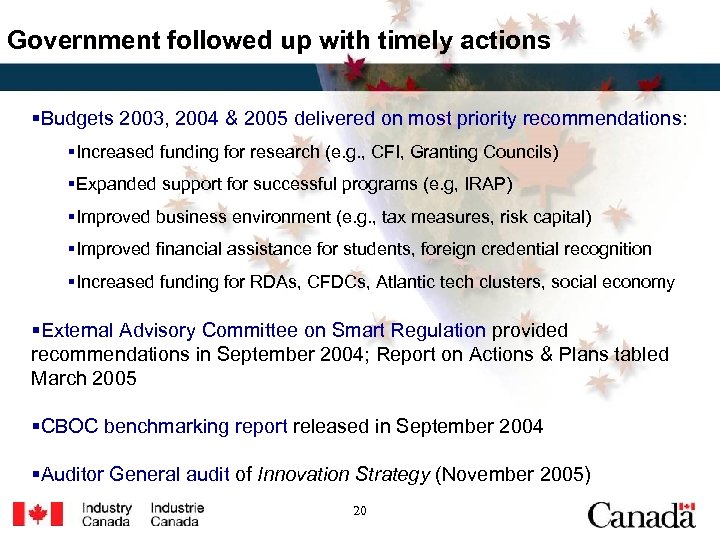 Government followed up with timely actions §Budgets 2003, 2004 & 2005 delivered on most priority recommendations: §Increased funding for research (e. g. , CFI, Granting Councils) §Expanded support for successful programs (e. g, IRAP) §Improved business environment (e. g. , tax measures, risk capital) §Improved financial assistance for students, foreign credential recognition §Increased funding for RDAs, CFDCs, Atlantic tech clusters, social economy §External Advisory Committee on Smart Regulation provided recommendations in September 2004; Report on Actions & Plans tabled March 2005 §CBOC benchmarking report released in September 2004 §Auditor General audit of Innovation Strategy (November 2005) 20
 Policy learning from engaging stakeholders in Innovation Strategy 21
 Post-Summit review of engagement strategy mixed Engagement process achieved “core” objectives: §consensus obtained on innovation challenge & need for action §government delivered on most commitments & responded to priority recommendations (e. g. , Budgets 2003, 2004, & 2005) §themes identified at Summit continue to resonate in public policy discussions & program funding decisions But … not all expectations realized … and many private sector stakeholders did not develop action plans 22
 External assessment critical of process Public Policy Forum (PPF) observations based on interviews of only 23 Summit “leaders”: “…National Summit was not successful in achieving its goals of creating a national action plan or in securing commitment from all sectors to participate in its implementation because of flaws in the process, agenda, participants, timing and outcomes. ” Source: Public Policy Forum, “Engaging Leaders: Lessons from the Innovation and Learning Strategy” (pg. , 11) 23
 PPF focused on “perception” of coordination issues National Summit Process: §pre-set course of action §dominated by universities who monopolized debate §complicated by having two-leading departments (Industry Canada & HRSDC) §politicized by “politics of the day” National Summit Agenda: §too large to be meaningful (500+ leaders over 2 days) §mix of priorities & ideas (& too many ideas) §some themes poorly defined (e. g. , Strengthening Communities) §Insufficient time for full discussion of issues §not national enough in scope (especially re private sector) Post-Summit: §little awareness of follow-up actions §“taking stock” Summit not held two years later §outcomes too high-level & too government-centric §focus more on National Summit event than continued stakeholder engagement 24
 Overall conclusions from innovation strategy … 1. importance of innovation was never in question 2. government actions must correspond to advice received during engagement process 3. communities & sectors were ready to move, but were waiting for government to act as well 4. resources needed for follow-up work 5. approach must be integrated 6. partnerships must be established with enterprises & communities 7. a Summit can gave credibility to Innovation Strategy, but just beginning of implementation process 25
 … and lessons learned for future engagement §federal co-leads on horizontal files can result in increased workload for stakeholders, imposes coordination challenges for departments & can lead to an “accountability vacuum” §focus on a short list of national issues to produce viable plan. Develop jointly with private sector to ensure they share responsibility to implement §engage for implementation of action plans as well as development, using networks developed during consultation §better communication of follow-up actions required 26
 Building on stakeholder engagement process 27
 Industry launches national consultation on future Canadian Manufacturers & Exporters’ (CME) Manufacturing 20/20: §challenges & changes affecting manufacturing §future of manufacturing in Canada? § 98 meetings held in 2004/05, involving 3, 500+ manufacturers & stakeholders §input from 15 industry associations §survey of 942 manufacturers in 2005 §National Manufacturing Summit (February 2005) §Reports: innovation, workforce capabilities & international business www. cme-mec. ca 28
 Commercialization Expert Panel addresses key issue People and Excellence: The Heart of Successful Commercialization (April 2006): § 11 recommendations §focus on development of business-led Commercialization Partnership Board (CPB) §would create new role for private sector as full partner in charting course for, & developing policy related to, commercialization www. strategis. ic. gc. ca/commercialization 29
 Government to advance innovation in Budget 2006 “Over the coming year, the Minister of Industry will be developing a science and technology strategy, in collaboration with the Minister of Finance, that will encompass the broad range of government support for research, including knowledge infrastructure. The Government will also undertake a review of the accountability and value for money of the granting councils’ activities. ” 30
 31
31