


 Скачать презентацию Implementing Automated Pathology Report Case Identification In a
c388851a42056fb1d65167cd5bf2c0ef.ppt
- Количество слайдов: 27
 Implementing Automated Pathology Report Case Identification In a Cancer Registry Ann Griffin, Ph. D, CTR, UCSF Comprehensive Cancer Center San Francisco, California Chris Rogers C/NET Solutions Berkeley, California 2007 NCRA Education Conference Las Vegas, NV April 23, 2007
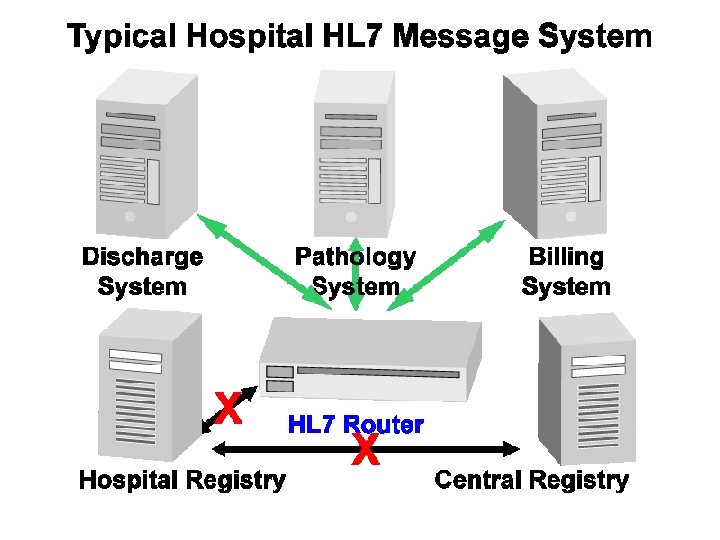 Pathology System X HL 7 Router X Billing System
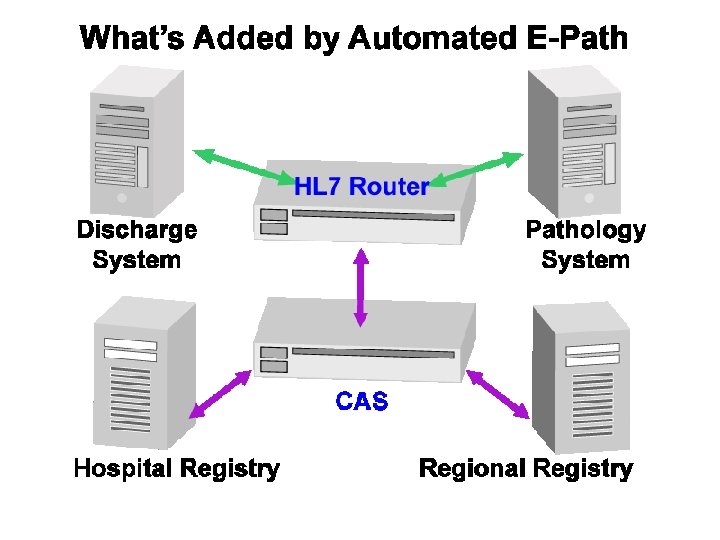
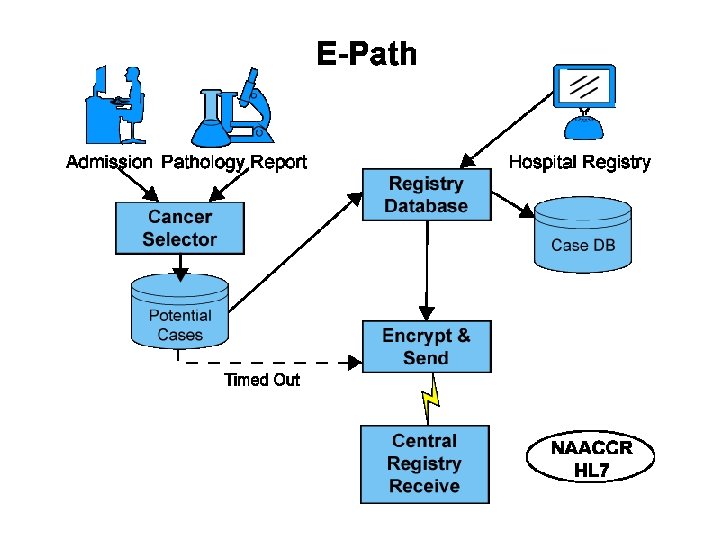
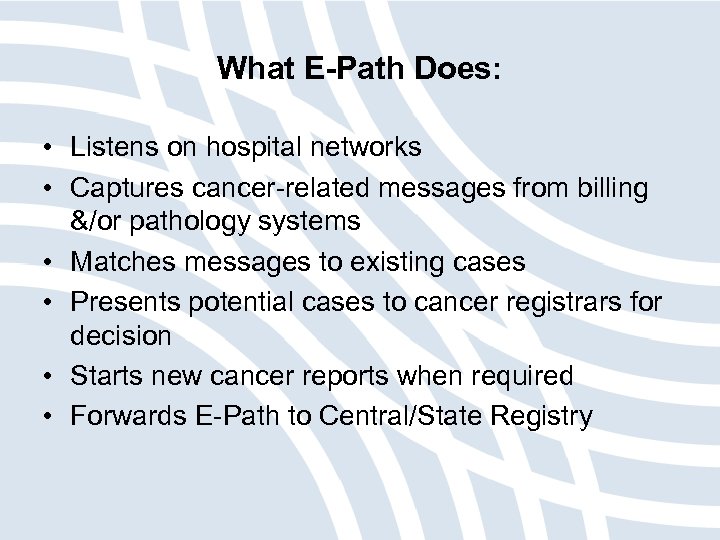 What E-Path Does: • Listens on hospital networks • Captures cancer-related messages from billing &/or pathology systems • Matches messages to existing cases • Presents potential cases to cancer registrars for decision • Starts new cancer reports when required • Forwards E-Path to Central/State Registry
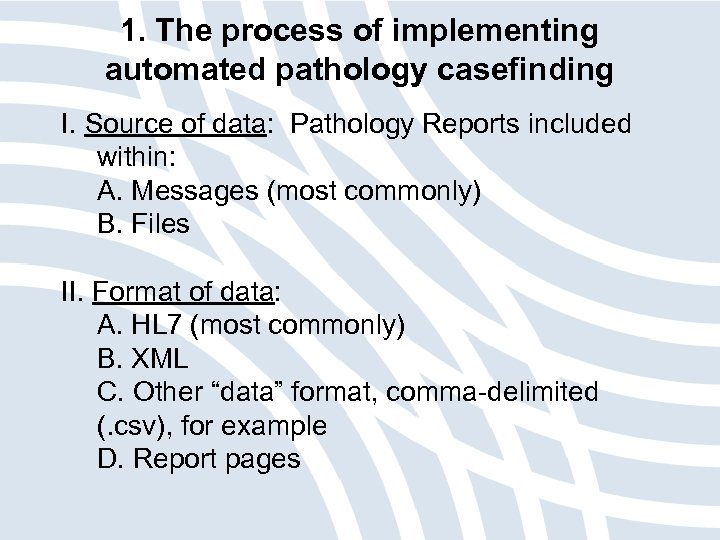 1. The process of implementing automated pathology casefinding I. Source of data: Pathology Reports included within: A. Messages (most commonly) B. Files II. Format of data: A. HL 7 (most commonly) B. XML C. Other “data” format, comma-delimited (. csv), for example D. Report pages
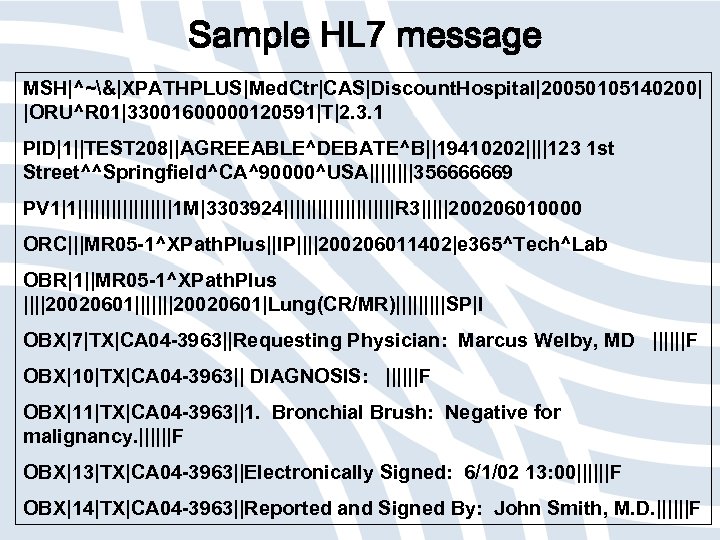 Sample HL 7 message MSH|^~&|XPATHPLUS|Med. Ctr|CAS|Discount. Hospital|20050105140200| |ORU^R 01|33001600000120591|T|2. 3. 1 PID|1||TEST 208||AGREEABLE^DEBATE^B||19410202||||123 1 st Street^^Springfield^CA^90000^USA||||356666669 PV 1|1|||||||||1 M|3303924||||||||||R 3|||||200206010000 ORC|||MR 05 -1^XPath. Plus||IP||||200206011402|e 365^Tech^Lab OBR|1||MR 05 -1^XPath. Plus ||||20020601|||||||20020601|Lung(CR/MR)|||||SP|I OBX|7|TX|CA 04 -3963||Requesting Physician: Marcus Welby, MD ||||||F OBX|10|TX|CA 04 -3963|| DIAGNOSIS: ||||||F OBX|11|TX|CA 04 -3963||1. Bronchial Brush: Negative for malignancy. ||||||F OBX|13|TX|CA 04 -3963||Electronically Signed: 6/1/02 13: 00||||||F OBX|14|TX|CA 04 -3963||Reported and Signed By: John Smith, M. D. ||||||F
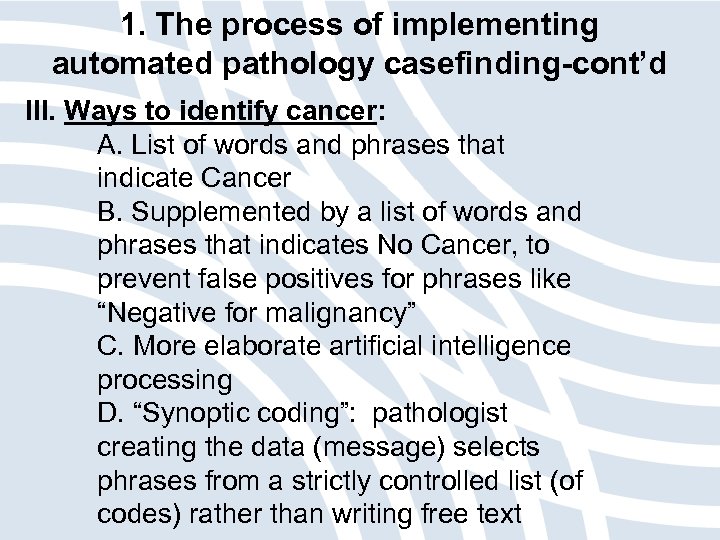 1. The process of implementing automated pathology casefinding-cont’d III. Ways to identify cancer: A. List of words and phrases that indicate Cancer B. Supplemented by a list of words and phrases that indicates No Cancer, to prevent false positives for phrases like “Negative for malignancy” C. More elaborate artificial intelligence processing D. “Synoptic coding”: pathologist creating the data (message) selects phrases from a strictly controlled list (of codes) rather than writing free text
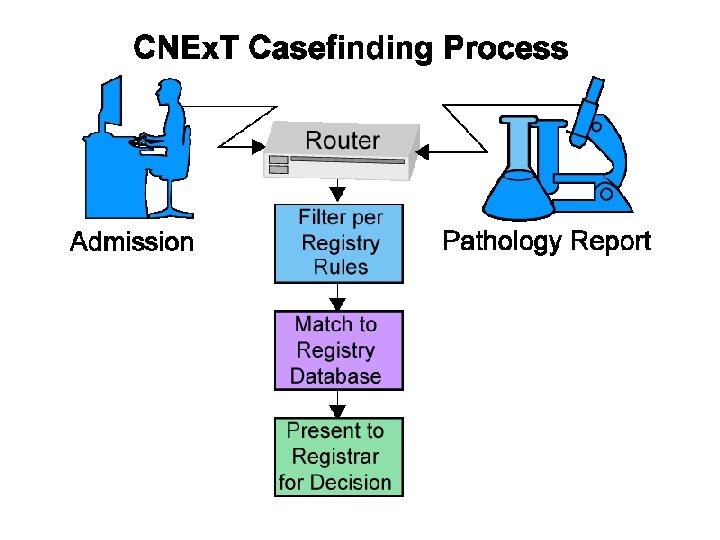
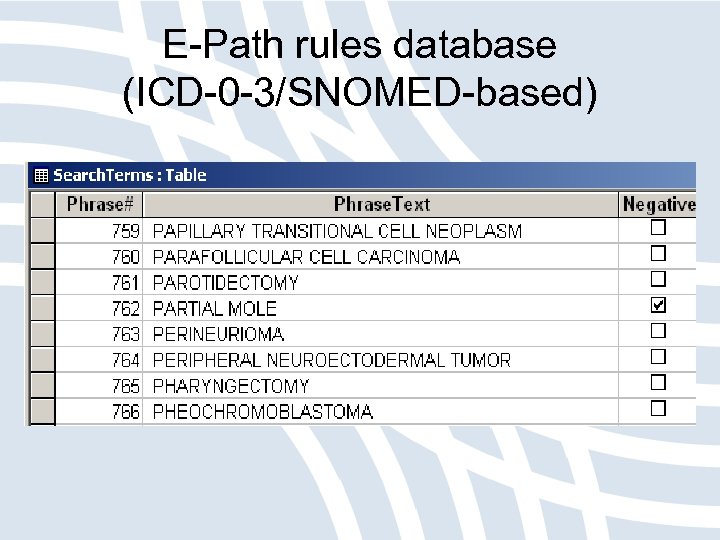 E-Path rules database (ICD-0 -3/SNOMED-based)
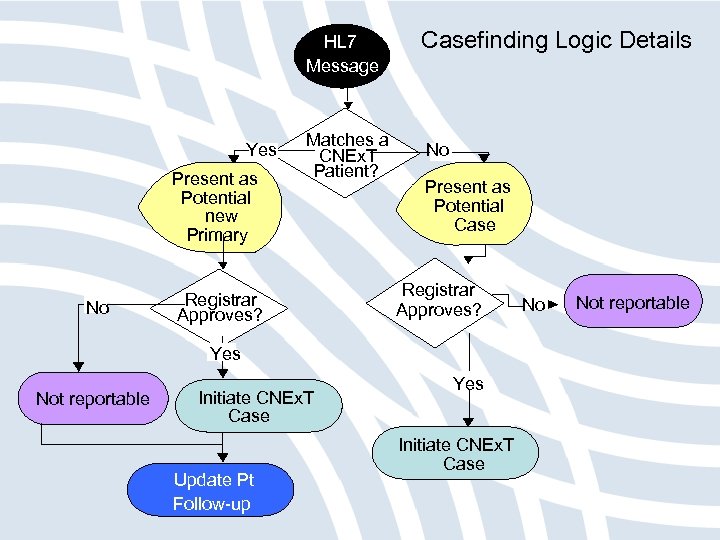 HL 7 Message Yes Present as Potential new Primary No Matches a CNEx. T Patient? Registrar Approves? Casefinding Logic Details No Present as Potential Case Registrar Approves? Yes Not reportable Initiate CNEx. T Case Update Pt Follow-up Yes Initiate CNEx. T Case No Not reportable
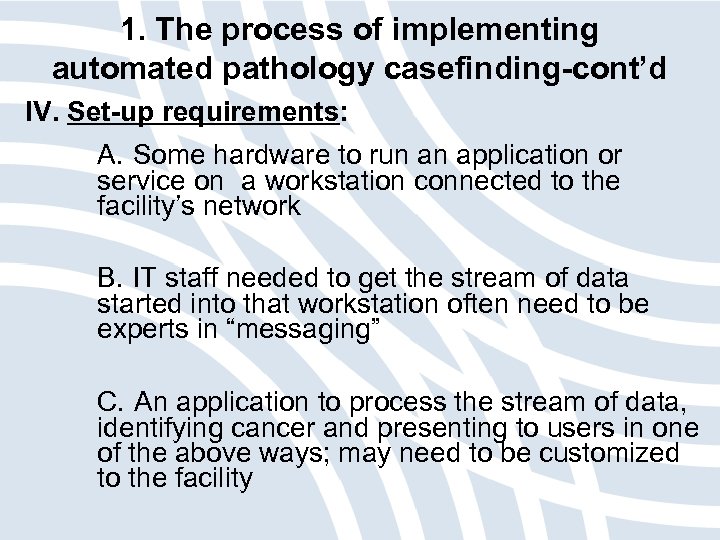 1. The process of implementing automated pathology casefinding-cont’d IV. Set-up requirements: A. Some hardware to run an application or service on a workstation connected to the facility’s network B. IT staff needed to get the stream of data started into that workstation often need to be experts in “messaging” C. An application to process the stream of data, identifying cancer and presenting to users in one of the above ways; may need to be customized to the facility
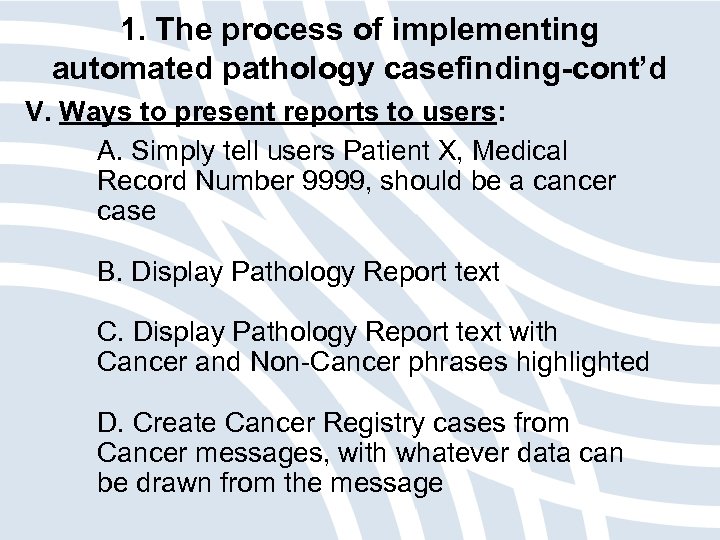 1. The process of implementing automated pathology casefinding-cont’d V. Ways to present reports to users: A. Simply tell users Patient X, Medical Record Number 9999, should be a cancer case B. Display Pathology Report text C. Display Pathology Report text with Cancer and Non-Cancer phrases highlighted D. Create Cancer Registry cases from Cancer messages, with whatever data can be drawn from the message
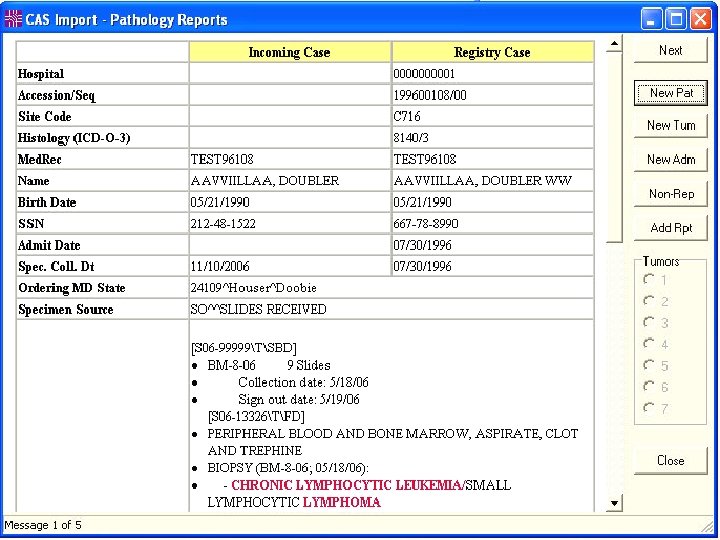
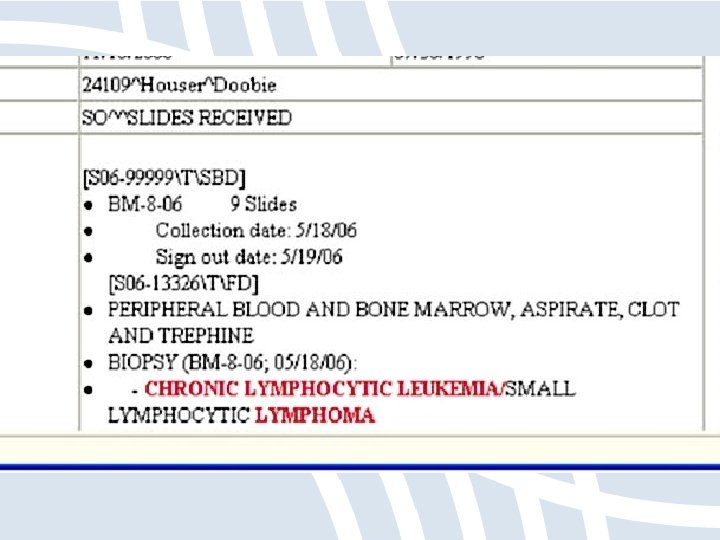
 E-Path aids to evaluation • Tracks what information was shown to casefinder, including highlighting of cancer phrases • Tracks casefinders’ decisions • All in a query-able database
 2. The impact of automated pathology report case identification on registry workflow I. Current Procedure A. Manual pathology report review process B. Number of reports C. Time involved D. Cost involved E. Impact on Pathology Department F. Central Registry
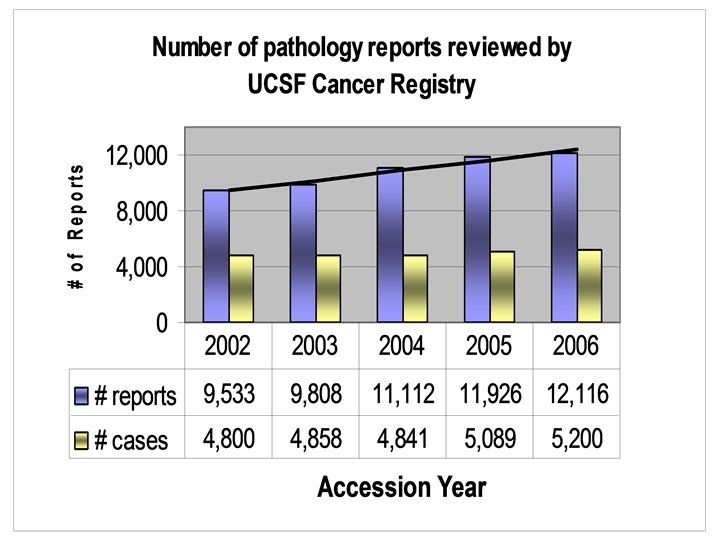
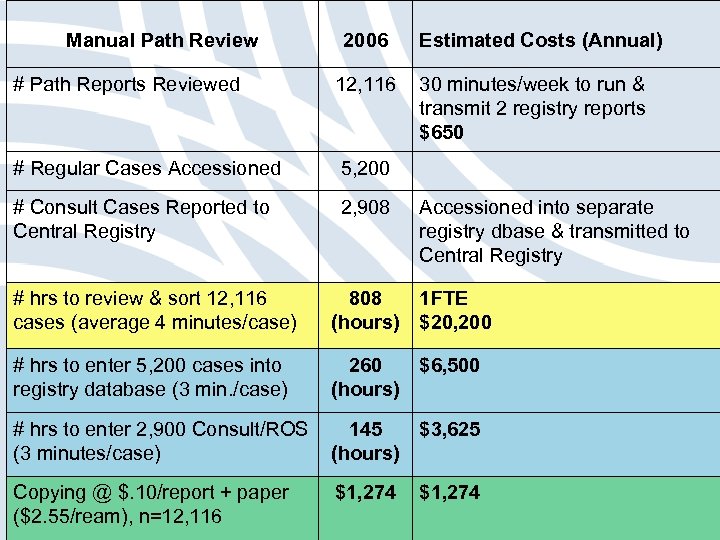 Manual Path Review 2006 # Path Reports Reviewed 12, 116 # Regular Cases Accessioned 5, 200 # Consult Cases Reported to Central Registry 2, 908 Estimated Costs (Annual) 30 minutes/week to run & transmit 2 registry reports $650 Accessioned into separate registry dbase & transmitted to Central Registry # hrs to review & sort 12, 116 cases (average 4 minutes/case) 808 1 FTE (hours) $20, 200 # hrs to enter 5, 200 cases into registry database (3 min. /case) 260 $6, 500 (hours) # hrs to enter 2, 900 Consult/ROS (3 minutes/case) 145 $3, 625 (hours) Copying @ $. 10/report + paper ($2. 55/ream), n=12, 116 $1, 274
 2. The impact of automated pathology report case identification on registry workflow-cont’d II. New Procedure A. Electronic pathology report review process (streamlined) B. Number of reports (stay the same) C. Time Involved (decreased) D. Cost involved (less cost) E. Impact on Pathology Department (eliminated) F. Central Registry (improved timeliness of reporting)
 E-Path features affecting workflow One-Button entry of new case minimizing hand data entry/errors in: • First/Last Name • MRN • SSN • DOB • Date of Contact • Address at diagnosis • Path report number • Ordering Physician
 More E-Path features affecting workflow: • Visual report display w/highlight of cancer and noncancer terms • Matches cases for registrar in advance • Can attach report to case in database • Applies better follow-up date (even from negative pathology if case already exists in database)
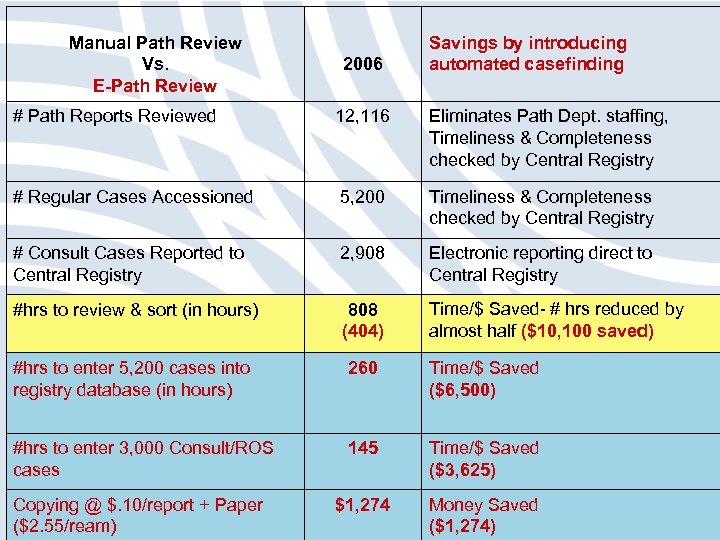 Manual Path Review Vs. E-Path Review 2006 Savings by introducing automated casefinding # Path Reports Reviewed 12, 116 Eliminates Path Dept. staffing, Timeliness & Completeness checked by Central Registry # Regular Cases Accessioned 5, 200 Timeliness & Completeness checked by Central Registry # Consult Cases Reported to Central Registry 2, 908 Electronic reporting direct to Central Registry #hrs to review & sort (in hours) 808 (404) Time/$ Saved- # hrs reduced by almost half ($10, 100 saved) #hrs to enter 5, 200 cases into registry database (in hours) 260 Time/$ Saved ($6, 500) #hrs to enter 3, 000 Consult/ROS cases 145 Time/$ Saved ($3, 625) $1, 274 Money Saved ($1, 274) Copying @ $. 10/report + Paper ($2. 55/ream)
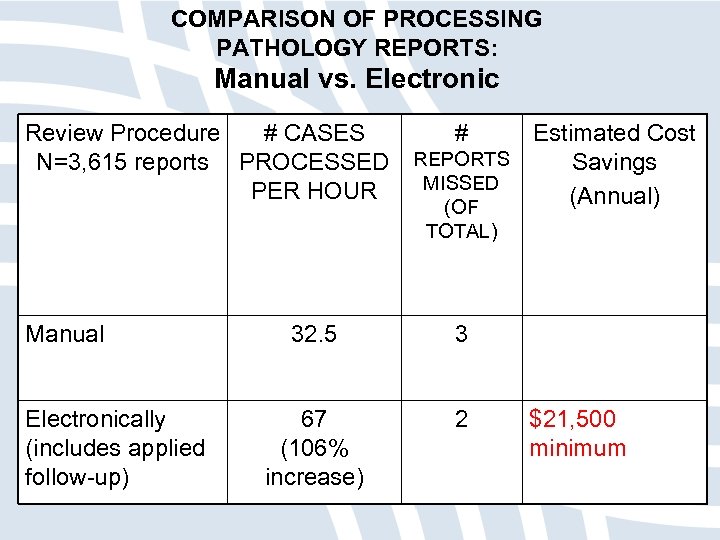 COMPARISON OF PROCESSING PATHOLOGY REPORTS: Manual vs. Electronic Review Procedure # CASES # Estimated Cost N=3, 615 reports PROCESSED REPORTS Savings MISSED PER HOUR (Annual) (OF TOTAL) Manual Electronically (includes applied follow-up) 32. 5 3 67 (106% increase) 2 $21, 500 minimum
 CONTRIBUTERS UCSF Comprehensive Cancer Center Ann Griffin, Ph. D, CTR (ann. griffin@ucsfmedctr. org) Jana Frankel C/NET Solutions Chris Rogers Valerie Spadt, CTR Barry Gordon