


 Скачать презентацию Implementing a Performance Management System Overview n n
f2788c383b3904e3bdba1b1cd427254a.ppt
- Количество слайдов: 30
 Implementing a Performance Management System: Overview n n n Preparation Communication Plan Appeals Process Training Programs Pilot Testing Ongoing Monitoring and Evaluation
 Preparation n Need to gain system buyin through: • Communication plan regarding Performance Management system n Including appeals process • Training programs for raters • Pilot testing system n Ongoing monitoring and evaluation
 Communication Plan answers: n n What is Performance Management (PM)? How does PM fit in our strategy? n What’s in it for me? n How does it work? n n What are our roles and responsibilities? How does PM relate to other initiatives?
 Cognitive Biases that affect communications effectiveness n n n Selective exposure perception retention
 To minimize effects of cognitive biases: A. Consider employees: n n Involve employees in system design Show employee needs are met
 To minimize effects of cognitive biases (continued): B. Emphasize the positive n n n Use credible communicators Strike first – create positive attitude Provide facts and conclusions
 To minimize effects of cognitive biases (continued): C. Repeat, document, be consistent n n n Put it in writing Use multiple channels of communication Say it, and then – say it again
 Appeals Process n Promote Employee buy-in to PM system • Amicable/Non-retaliatory • Resolution of disagreements
 Appeals Process n Employees can question two types of issues: • Judgmental n (validity of evaluation) • Administrative n (whether policies and procedures were followed)
 Appeals Process n Level 1 • HR reviews facts, policies, procedures • HR reports to supervisor/employee • HR attempts to negotiate settlement n Level 2 • Arbitrator (panel of peers and managers) and/or • High-level manager – final decision
 Rater Training Programs n Content Areas to include • Information • Identifying, Observing, Recording, Evaluating • How to Interact with Employees n Choices of Training Programs to implement • Rater Error Training • Frame of Reference Training • Behavioral Observation • Self-leadership Training
 Content A. Information - how the system works • Reasons for implementing the performance management system • Information the appraisal form n system mechanics n
 Content (continued) B. Identifying, observing, recording, and evaluating performance • How to identify and rank job activities • How to observe, record, and measure performance • How to minimize rating errors
 Content (continued) C. How to interact with employees when they receive performance information • How to conduct an appraisal interview • How to train, counsel, and coach
 Choices of Training Programs Rater Error Training (RET) n Frame of Reference Training (FOR) n Behavioral Observation Training (BO) n Self-leadership Training (SL) n
 Rater Error Training (RET) n Goals of Rater Error Training (RET) • Make raters aware of types of rating errors • Help raters minimize errors • Increase rating accuracy
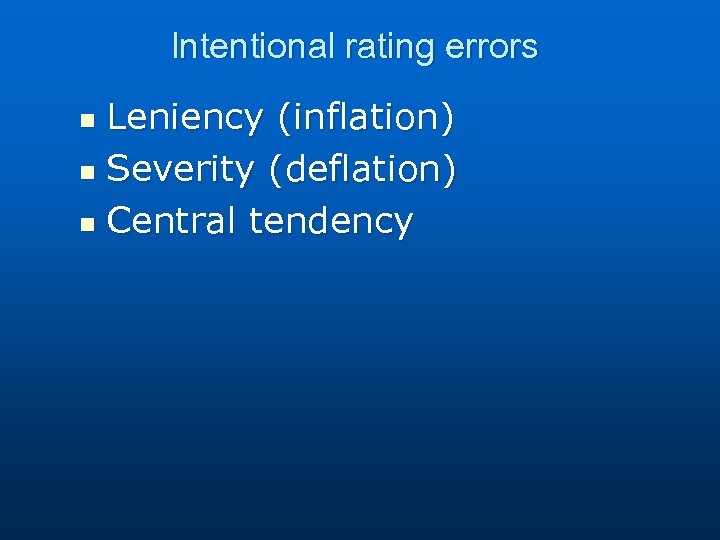 Intentional rating errors Leniency (inflation) n Severity (deflation) n Central tendency n
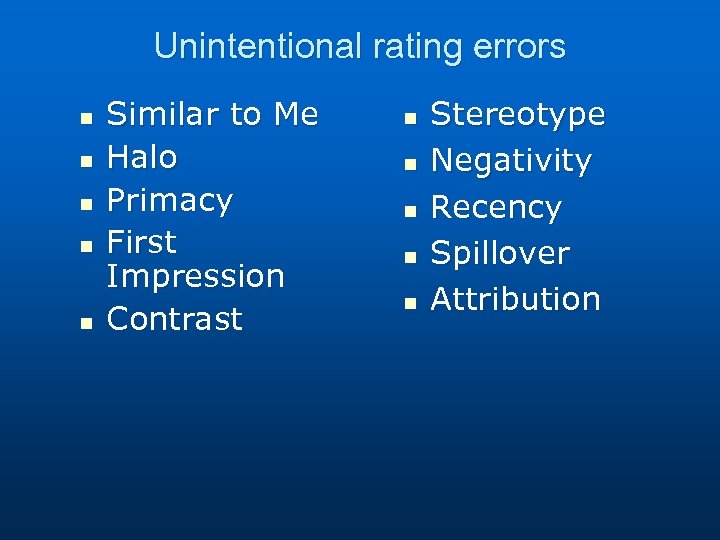 Unintentional rating errors n n n Similar to Me Halo Primacy First Impression Contrast n n n Stereotype Negativity Recency Spillover Attribution
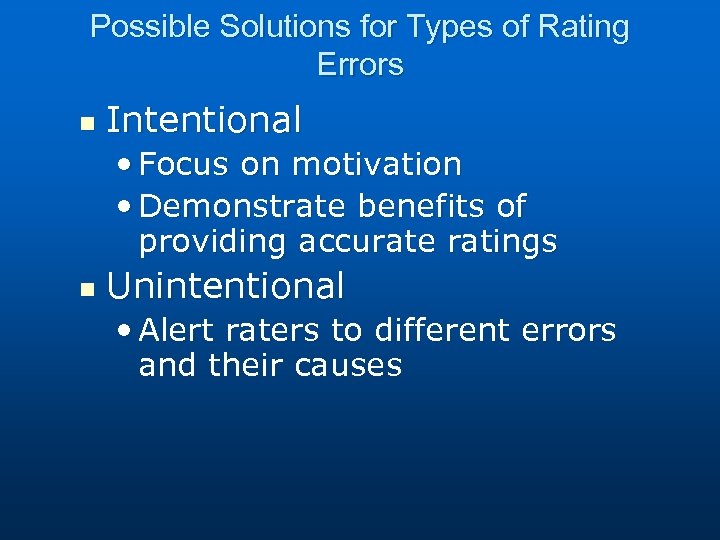 Possible Solutions for Types of Rating Errors n Intentional • Focus on motivation • Demonstrate benefits of providing accurate ratings n Unintentional • Alert raters to different errors and their causes
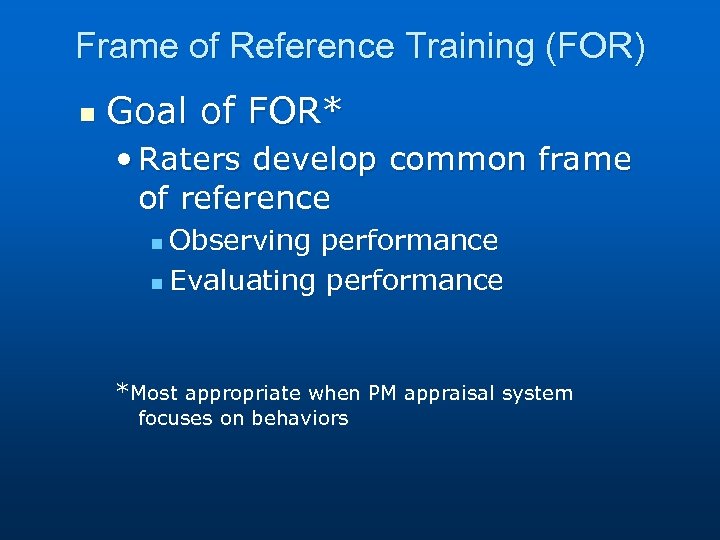 Frame of Reference Training (FOR) n Goal of FOR* • Raters develop common frame of reference Observing performance n Evaluating performance n *Most appropriate when PM appraisal system focuses on behaviors
 Expected Results of FOR n n Raters provide consistent, more accurate ratings Raters help employees design effective development plans
 Behavioral Observation Training (BO) n Goals of BO • Minimize unintentional rating errors • Improve rater skills by focusing on how raters: Observe performance n Store information about performance n Recall information about performance n Use information about performance n
 Self-leadership Training (SL) n Goals of SL • Improve rater confidence in ability to manage performance • Enhance mental processes • Increase self-efficacy
 Pilot Testing n Provides ability to • Discover potential problems • Fix them
 Pilot Testing - benefits n n n Gain information from potential participants Learn about difficulties/obstacles Collect recommendations on how to improve Understand personal reactions Get early buy-in Get higher rate of acceptance
 Implementing a Pilot Test n Roll out test version with sample group • Staff and jobs generalizable to organization n Fully implement planned system • All participants keep records of issues encountered • Do not record appraisal scores • Collect input from all participants
 Ongoing Monitoring and Evaluation n When system is implemented, decide: • How to evaluate system effectiveness • How to measure implementation • How to measure results
 Evaluation data to collect: n n Reactions to the system Assessments of requirements • Operational • Technical n Effectiveness of performance ratings
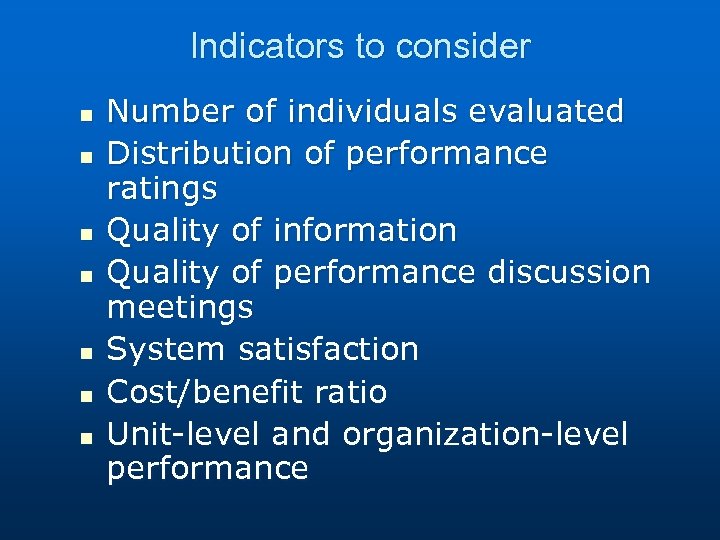 Indicators to consider n n n n Number of individuals evaluated Distribution of performance ratings Quality of information Quality of performance discussion meetings System satisfaction Cost/benefit ratio Unit-level and organization-level performance
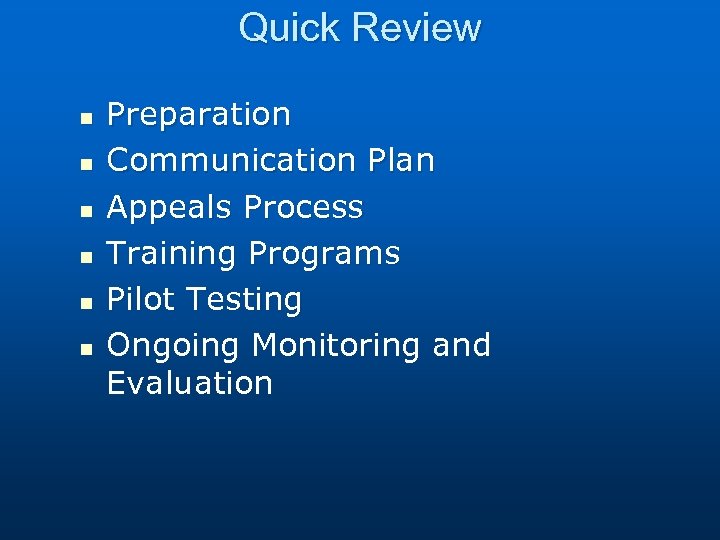 Quick Review n n n Preparation Communication Plan Appeals Process Training Programs Pilot Testing Ongoing Monitoring and Evaluation