


 Скачать презентацию Implementation of the USEPA Methods Update Rule to
26a56438e4408b953f9e5683cf37ed42.ppt
- Количество слайдов: 27
 Implementation of the USEPA Methods Update Rule to 40 CFR : Field Filtration & Preservation Gerard Marzec, James Broderick and Karen Moore, Ph. D NYC Department of Environmental Protection
 Introduction u USEPA Method Update Rule (MUR) u Implementation of field filtration u Statistical design of side-by-side sampling comparison u Future work – data analysis
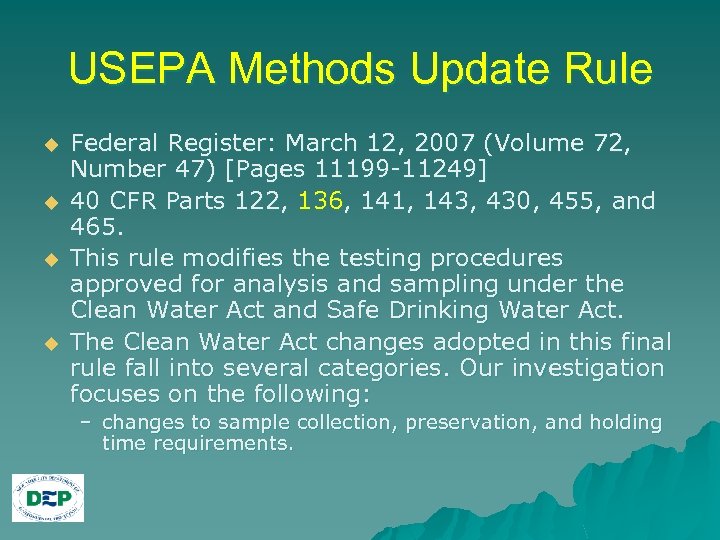 USEPA Methods Update Rule u u Federal Register: March 12, 2007 (Volume 72, Number 47) [Pages 11199 -11249] 40 CFR Parts 122, 136, 141, 143, 430, 455, and 465. This rule modifies the testing procedures approved for analysis and sampling under the Clean Water Act and Safe Drinking Water Act. The Clean Water Act changes adopted in this final rule fall into several categories. Our investigation focuses on the following: – changes to sample collection, preservation, and holding time requirements.
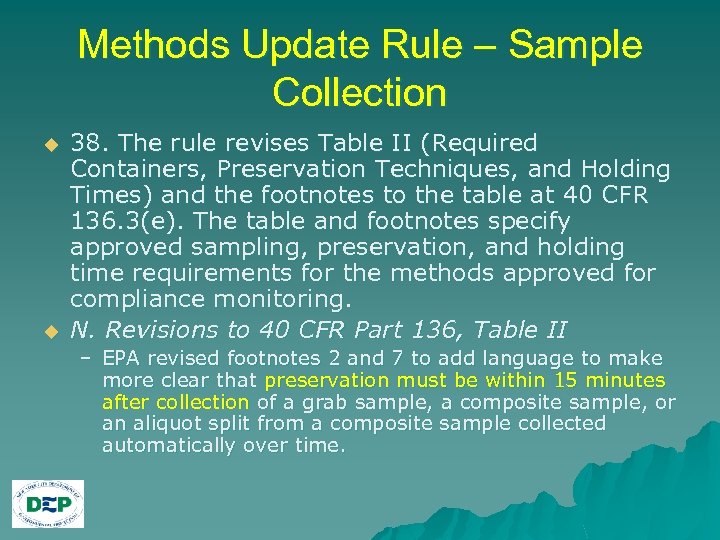 Methods Update Rule – Sample Collection u u 38. The rule revises Table II (Required Containers, Preservation Techniques, and Holding Times) and the footnotes to the table at 40 CFR 136. 3(e). The table and footnotes specify approved sampling, preservation, and holding time requirements for the methods approved for compliance monitoring. N. Revisions to 40 CFR Part 136, Table II – EPA revised footnotes 2 and 7 to add language to make more clear that preservation must be within 15 minutes after collection of a grab sample, a composite sample, or an aliquot split from a composite sample collected automatically over time.
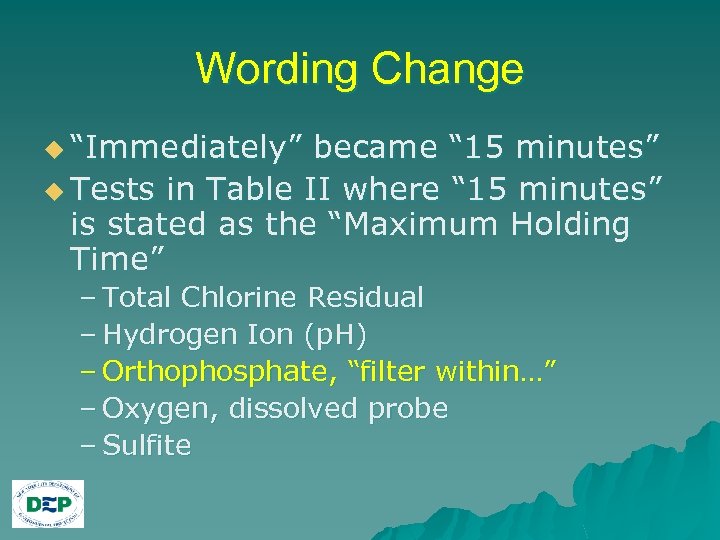 Wording Change u “Immediately” became “ 15 minutes” u Tests in Table II where “ 15 minutes” is stated as the “Maximum Holding Time” – Total Chlorine Residual – Hydrogen Ion (p. H) – Orthophosphate, “filter within…” – Oxygen, dissolved probe – Sulfite
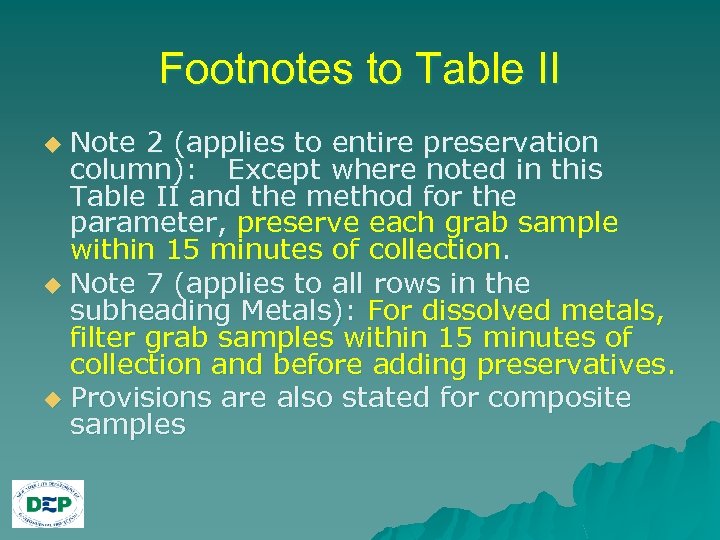 Footnotes to Table II Note 2 (applies to entire preservation column): Except where noted in this Table II and the method for the parameter, preserve each grab sample within 15 minutes of collection. u Note 7 (applies to all rows in the subheading Metals): For dissolved metals, filter grab samples within 15 minutes of collection and before adding preservatives. u Provisions are also stated for composite samples u
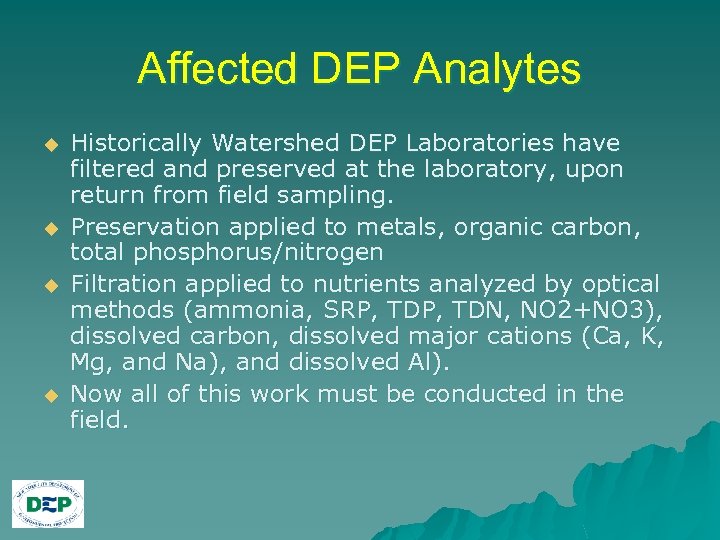 Affected DEP Analytes u u Historically Watershed DEP Laboratories have filtered and preserved at the laboratory, upon return from field sampling. Preservation applied to metals, organic carbon, total phosphorus/nitrogen Filtration applied to nutrients analyzed by optical methods (ammonia, SRP, TDN, NO 2+NO 3), dissolved carbon, dissolved major cations (Ca, K, Mg, and Na), and dissolved Al). Now all of this work must be conducted in the field.
 What is a compliance sample? u Rule states “for compliance samples” under the Clean Water Act. u Obviously affects SPDES samples u Does it affect all other samples that DEP collects and analyzes?
 NYS Public Health Law 502 u u u Excerpts from Law – 1. "Environmental Laboratory" is any facility that examines or is available for the examination of samples or specimens. – 2. No environmental laboratory may perform any examination on samples collected in the State of New York for which the commissioner issues a certificate of approval for such examination unless the laboratory has been issued such certificate of approval. As a result, any sample collected in the State of New York must comply with the Rules of the ELAP Program and is thus a “compliance sample”. Additionally, much of our data is reported directly (e. g. , DMR) or indirectly (Filtration Avoidance Deliverable reports) to EPA and NYS. Failure to comply with subdivision 2 of this law is considered a misdemeanor!
 The Need for Change With the regulatory changes stated in the MUR, it seemed that DEP had no choice but to change. u With that decision made, we embarked on a collaborative change effort, including staff from Management, Field, Laboratory, Health & Safety, Quality Assurance and Science & Research. u The objective: Determine safe, efficient, technically appropriate procedures and equipment to meet the requirements. u
 Approach to implementation of field filtration u Brain storm u Test equipment and procedures for general acceptance (time, pressure, battery life, flow rates, safety) u Test equipment for contamination u Implement the change u Evaluate the long term effect of the change
 Field Filtration Considerations One filtration procedure if possible for all analytes and sample types. u Filtration procedure needs to be practical (able to be performed on a boat with limited space during a rain event). u Must address potentially high sediment in some watersheds (select filter with best surface area). u Procedures must be safe (use of acids in the field). u Avoid rushing or overburdening field staff. u Standardize all of our procedures (4 lab/field groups). u
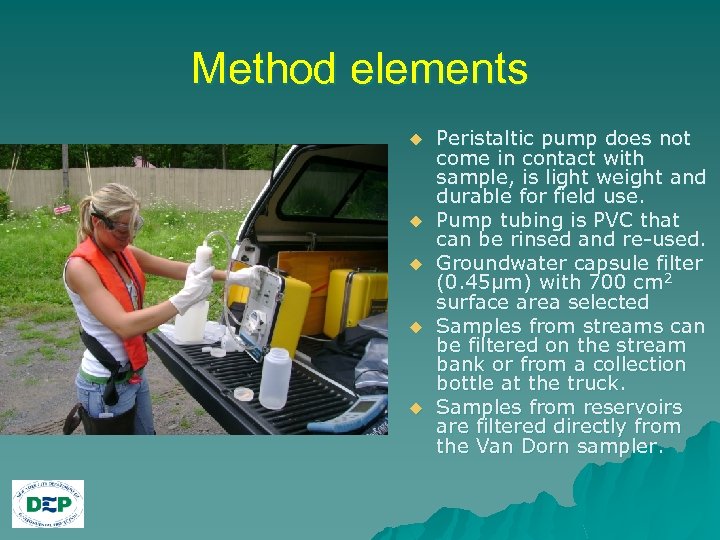 Method elements u u u Peristaltic pump does not come in contact with sample, is light weight and durable for field use. Pump tubing is PVC that can be rinsed and re-used. Groundwater capsule filter (0. 45µm) with 700 cm 2 surface area selected Samples from streams can be filtered on the stream bank or from a collection bottle at the truck. Samples from reservoirs are filtered directly from the Van Dorn sampler.
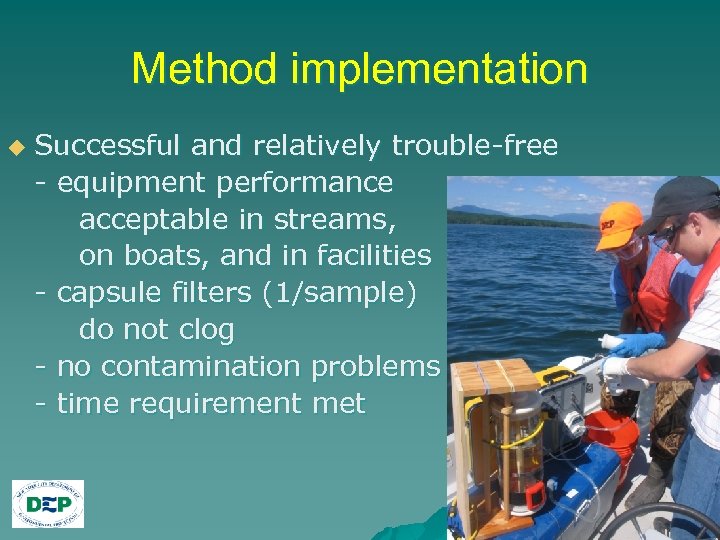 Method implementation u Successful and relatively trouble-free - equipment performance acceptable in streams, on boats, and in facilities - capsule filters (1/sample) do not clog - no contamination problems - time requirement met
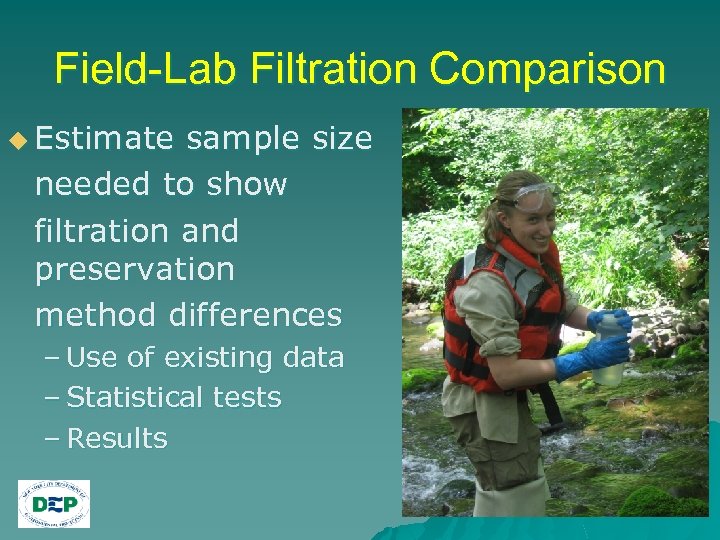 Field-Lab Filtration Comparison u Estimate sample size needed to show filtration and preservation method differences – Use of existing data – Statistical tests – Results
 Sample-size estimates Method u 2002 -2006 data u Used 2 sample t-test – over 27, 000 samples – data separated by watershed and by sample type – data review essential – Normalized data via log or other transformation – Applied significance level of alpha=0. 05 and a power of 0. 9 and analyte-dependent magnitude of difference (effect level) – So why are we interested in power?
 Why are we interested in power? u In a side-by-side comparison, the number of samples required for power=0. 9 will give you the ability to detect differences 90% of time. u Results…
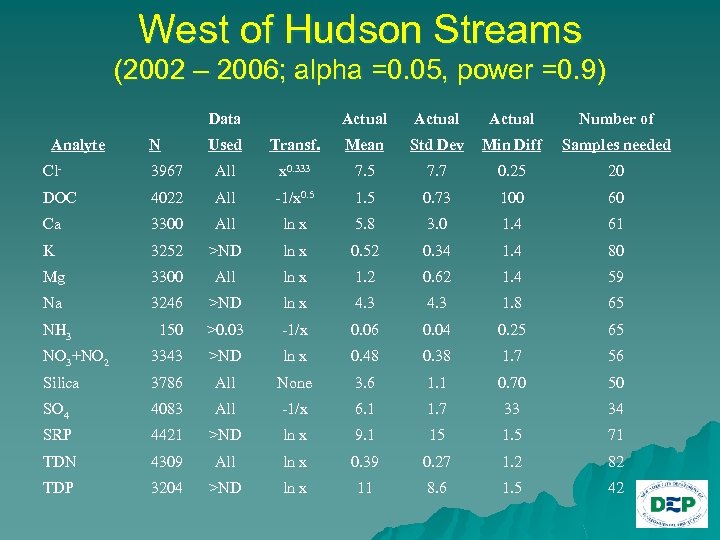 West of Hudson Streams (2002 – 2006; alpha =0. 05, power =0. 9) Data Analyte N Actual Number of Used Transf. Mean Std Dev Min Diff Samples needed Cl- 3967 All x 0. 333 7. 5 7. 7 0. 25 20 DOC 4022 All -1/x 0. 5 1. 5 0. 73 100 60 Ca 3300 All ln x 5. 8 3. 0 1. 4 61 K 3252 >ND ln x 0. 52 0. 34 1. 4 80 Mg 3300 All ln x 1. 2 0. 62 1. 4 59 Na 3246 >ND ln x 4. 3 1. 8 65 150 >0. 03 -1/x 0. 06 0. 04 0. 25 65 NO 3+NO 2 3343 >ND ln x 0. 48 0. 38 1. 7 56 Silica 3786 All None 3. 6 1. 1 0. 70 50 SO 4 4083 All -1/x 6. 1 1. 7 33 34 SRP 4421 >ND ln x 9. 1 15 1. 5 71 TDN 4309 All ln x 0. 39 0. 27 1. 2 82 TDP 3204 >ND ln x 11 8. 6 1. 5 42 NH 3
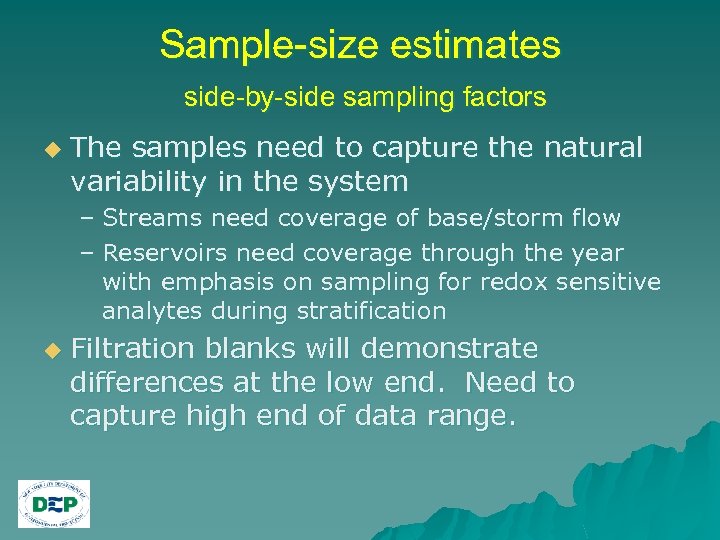 Sample-size estimates side-by-side sampling factors u The samples need to capture the natural variability in the system – Streams need coverage of base/storm flow – Reservoirs need coverage through the year with emphasis on sampling for redox sensitive analytes during stratification u Filtration blanks will demonstrate differences at the low end. Need to capture high end of data range.
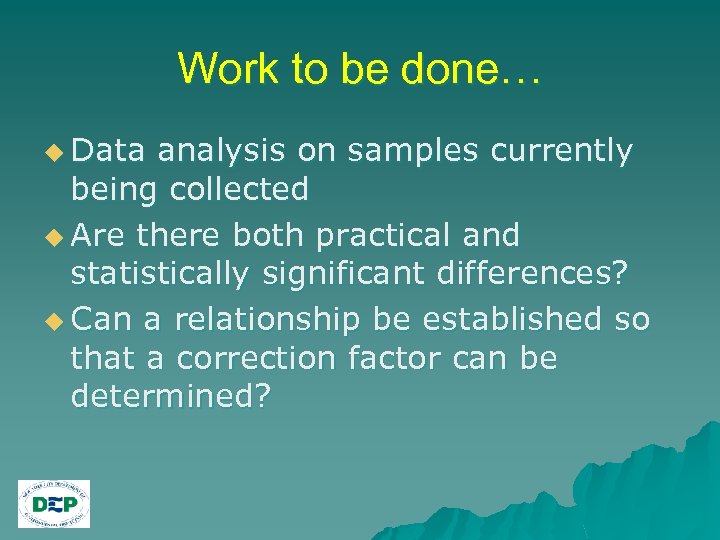 Work to be done… u Data analysis on samples currently being collected u Are there both practical and statistically significant differences? u Can a relationship be established so that a correction factor can be determined?
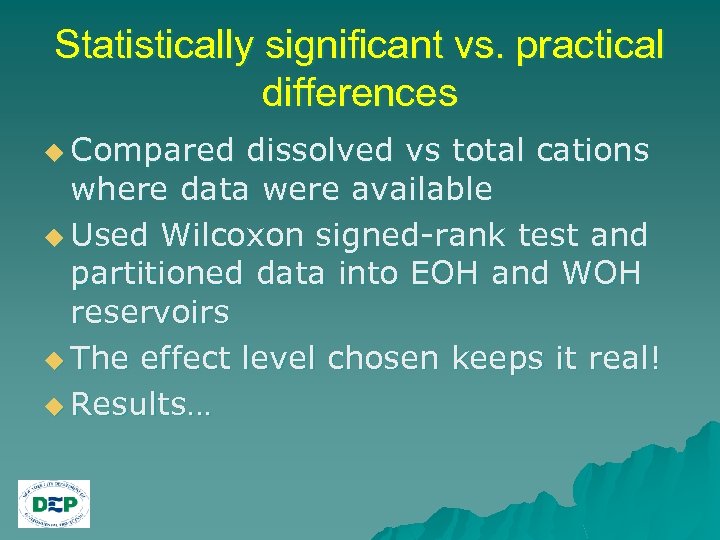 Statistically significant vs. practical differences u Compared dissolved vs total cations where data were available u Used Wilcoxon signed-rank test and partitioned data into EOH and WOH reservoirs u The effect level chosen keeps it real! u Results…
 WOH Reservoirs
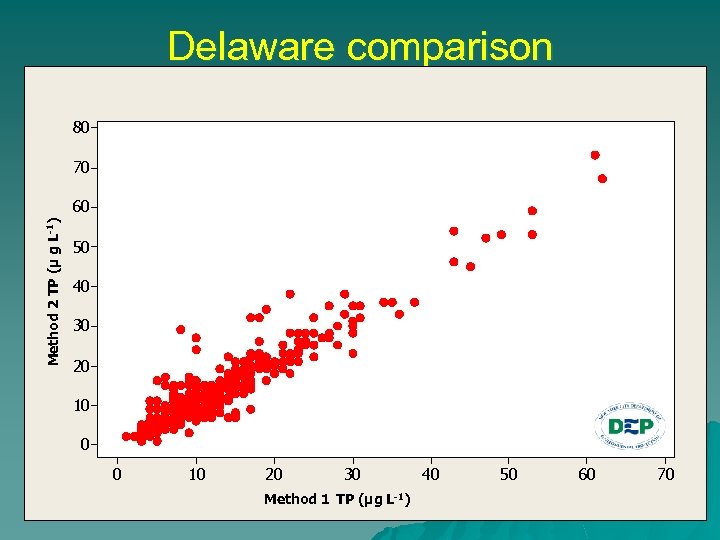
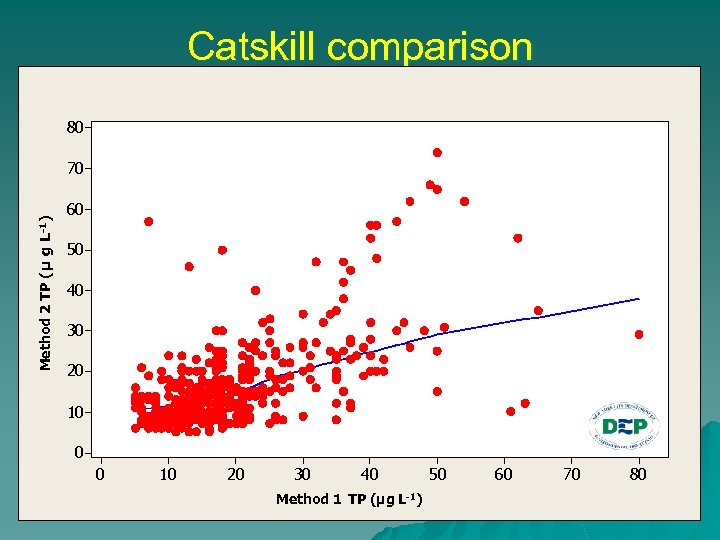
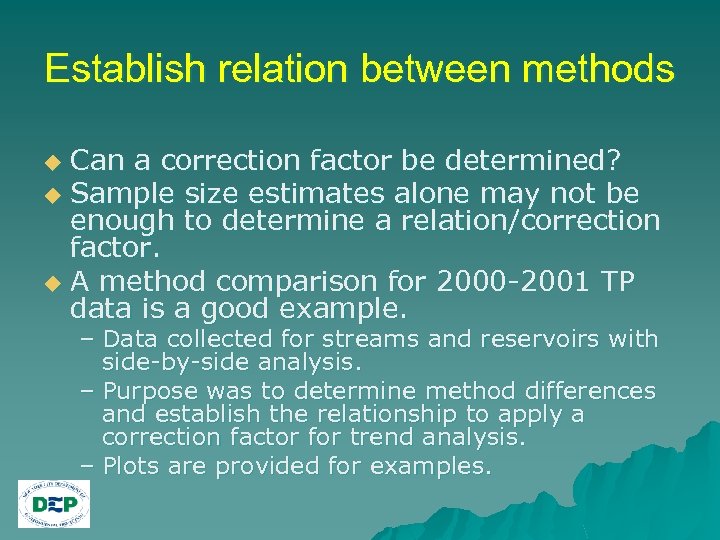 Establish relation between methods Can a correction factor be determined? u Sample size estimates alone may not be enough to determine a relation/correction factor. u A method comparison for 2000 -2001 TP data is a good example. u – Data collected for streams and reservoirs with side-by-side analysis. – Purpose was to determine method differences and establish the relationship to apply a correction factor for trend analysis. – Plots are provided for examples.
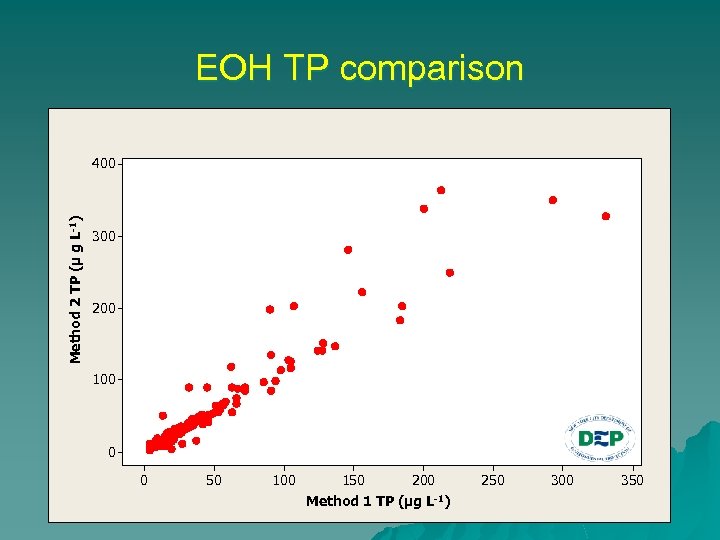 EOH TP comparison Method 2 TP (µ g L-1) 400 300 200 100 0 0 50 100 150 200 Method 1 TP (µg L-1) 250 300 350
 Delaware comparison 80 70 Method 2 TP (µ g L-1) 60 50 40 30 20 10 0 0 10 20 30 Method 1 TP (µg L-1) 40 50 60 70
 Catskill comparison 80 Method 2 TP (µ g L-1) 70 60 50 40 30 20 10 0 0 10 20 30 40 Method 1 TP (µg L-1) 50 60 70 80
 Summary u u Checked the requirements of the MUR and developed most practical field methods Determined sample size estimates were for all analytes and sample types – Used existing data to guide decisions for this study – The number of samples needed was based on the variability found in the existing data u u u Although statistically significant differences were found, the median differences suggest that there was little practical difference between the filtered and unfiltered cations. Sample size estimates alone may not be enough to determine a relation/correction factor Complete statistical analysis will be performed when project is completed.