


 Скачать презентацию Implementation of ICH Q 8 Q 9 Q
be013789964b95128706eb13696d92cb.ppt
- Количество слайдов: 41
 Implementation of ICH Q 8, Q 9, Q 10 Product Development: Case Study Overview International Conference on Harmonisation of Technical Requirements for Registration of Pharmaceuticals for Human Use
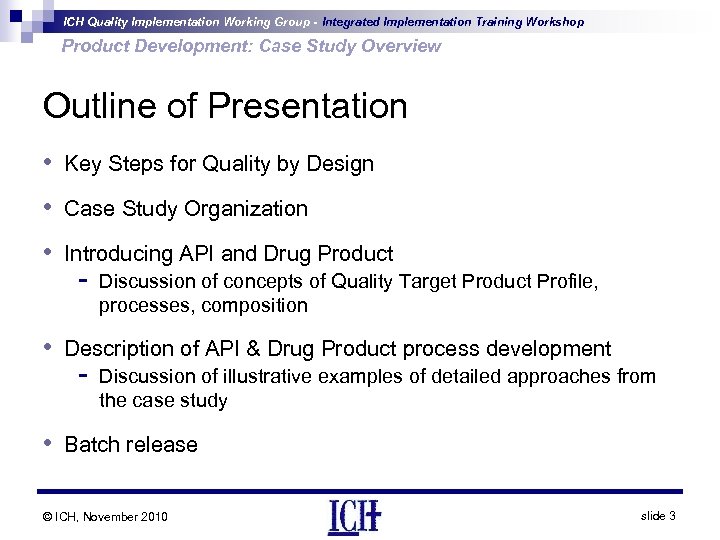 ICH Quality Implementation Working Group - Integrated Implementation Training Workshop Product Development: Case Study Overview Outline of Presentation • Key Steps for Quality by Design • Case Study Organization • Introducing API and Drug Product - Discussion of concepts of Quality Target Product Profile, processes, composition • Description of API & Drug Product process development - Discussion of illustrative examples of detailed approaches from the case study • Batch release © ICH, November 2010 slide 3
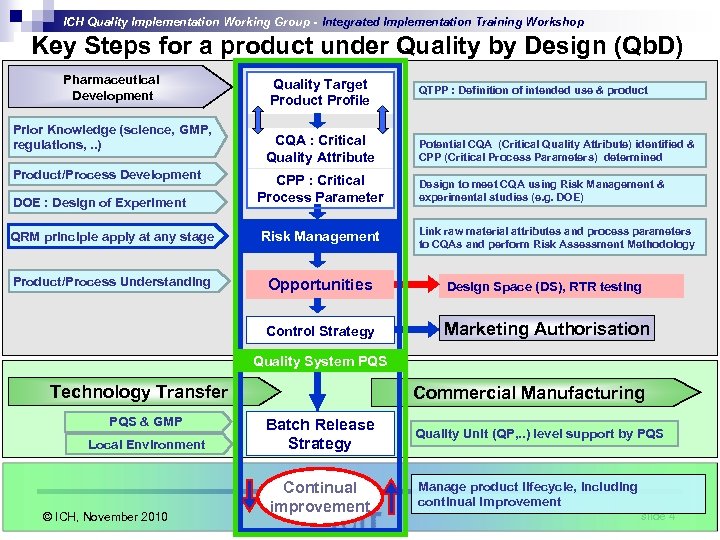 ICH Quality Implementation Working Group - Integrated Implementation Training Workshop Product Development: Case Study Overview Key Steps for a product under Quality by Design (Qb. D) Pharmaceutical Development Prior Knowledge (science, GMP, regulations, . . ) Product/Process Development Quality Target Product Profile CQA : Critical Quality Attribute QTPP : Definition of intended use & product Potential CQA (Critical Quality Attribute) identified & CPP (Critical Process Parameters) determined DOE : Design of Experiment CPP : Critical Process Parameter QRM principle apply at any stage Risk Management Product/Process Understanding Opportunities Design Space (DS), RTR testing Control Strategy Marketing Authorisation Design to meet CQA using Risk Management & experimental studies (e. g. DOE) Link raw material attributes and process parameters to CQAs and perform Risk Assessment Methodology Quality System PQS Technology Transfer PQS & GMP Local Environment © ICH, November 2010 Commercial Manufacturing Batch Release Strategy Continual improvement Quality Unit (QP, . . ) level support by PQS Manage product lifecycle, including continual improvement slide 4
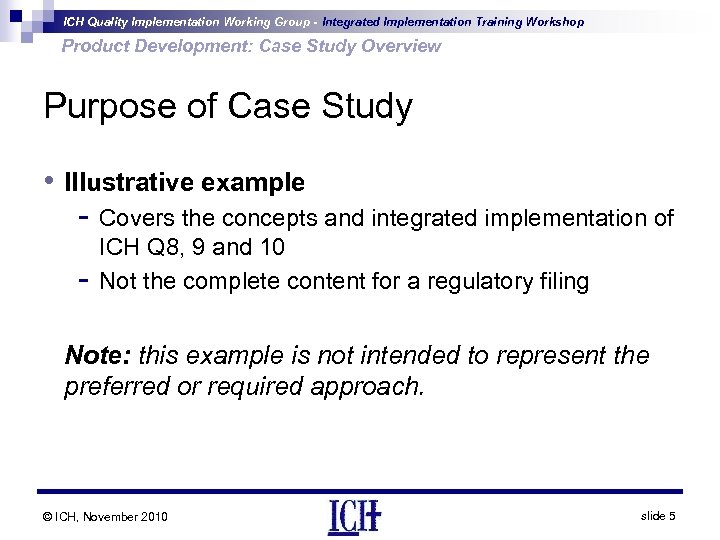 ICH Quality Implementation Working Group - Integrated Implementation Training Workshop Product Development: Case Study Overview Purpose of Case Study • Illustrative example - Covers the concepts and integrated implementation of - ICH Q 8, 9 and 10 Not the complete content for a regulatory filing Note: this example is not intended to represent the preferred or required approach. © ICH, November 2010 slide 5
 ICH Quality Implementation Working Group - Integrated Implementation Training Workshop Product Development: Case Study Overview Case Study Organization © ICH, November 2010 slide 6
 ICH Quality Implementation Working Group - Integrated Implementation Training Workshop Product Development: Case Study Overview Basis for Development Information • Fictional active pharmaceutical ingredient (API) • Drug product information is based on the ‘Sakura’ Tablet case study - Full Sakura case study can be found at http: //www. nihs. go. jp/drug/Drug. Div-E. html • Alignment between API and drug product - API Particle size and drug product dissolution - Hydrolytic degradation and dry granulation /direct compression © ICH, November 2010 slide 7
 ICH Quality Implementation Working Group - Integrated Implementation Training Workshop Product Development: Case Study Overview Organization of Content • Quality Target Product Profile (QTPP) • API properties and assumptions • Process and Drug product composition overview • Initial risk assessment of unit operations • Quality by Design assessment of selected unit operations © ICH, November 2010 slide 8
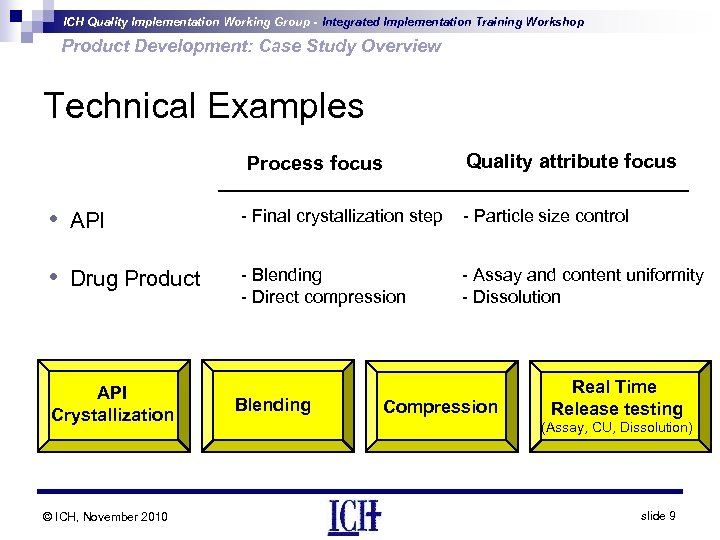 ICH Quality Implementation Working Group - Integrated Implementation Training Workshop Product Development: Case Study Overview Technical Examples Process focus • API • Drug Product API Crystallization © ICH, November 2010 Quality attribute focus - Final crystallization step - Particle size control - Blending - Direct compression - Assay and content uniformity - Dissolution Blending Compression Real Time Release testing (Assay, CU, Dissolution) slide 9
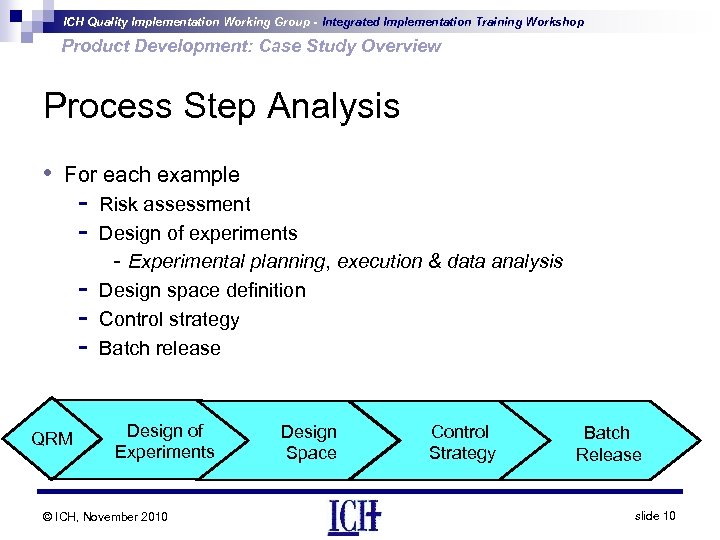 ICH Quality Implementation Working Group - Integrated Implementation Training Workshop Product Development: Case Study Overview Process Step Analysis • For each example - QRM Risk assessment Design of experiments - Experimental planning, execution & data analysis Design space definition Control strategy Batch release Design of Experiments © ICH, November 2010 Design Space Control Strategy Batch Release slide 10
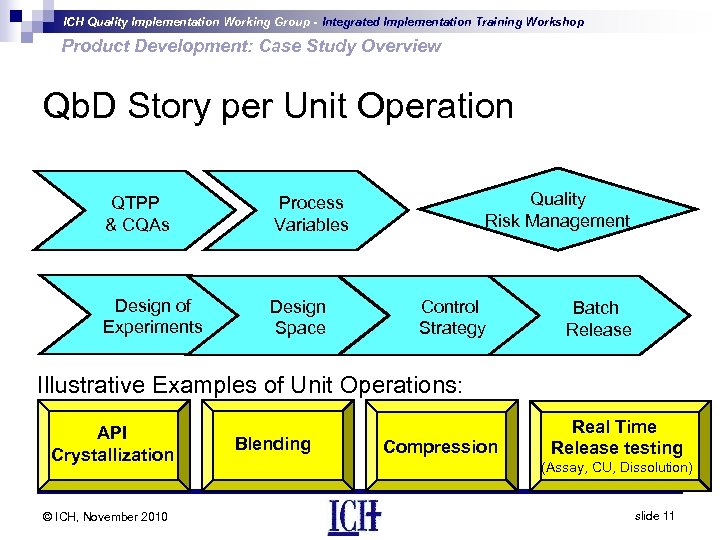 ICH Quality Implementation Working Group - Integrated Implementation Training Workshop Product Development: Case Study Overview Qb. D Story per Unit Operation QTPP & CQAs Design of Experiments Design Space Quality Risk Management Process Variables Control Strategy Batch Release Illustrative Examples of Unit Operations: API Crystallization © ICH, November 2010 Blending Compression Real Time Release testing (Assay, CU, Dissolution) slide 11
 ICH Quality Implementation Working Group - Integrated Implementation Training Workshop Product Development: Case Study Overview Introducing API and Drug Product © ICH, November 2010 slide 12
 ICH Quality Implementation Working Group - Integrated Implementation Training Workshop Product Development: Case Study Overview Assumptions • API is designated as Amokinol - Single, neutral polymorph - Biopharmaceutical Classification System (BCS) class II – low solubility & - high permeability API solubility (dissolution) affected by particle size Degrades by hydrolytic mechanism • In vitro-in vivo correlation (IVIVC) established – allows dissolution to be used as surrogate for clinical performance • Drug product is oral immediate release tablet © ICH, November 2010 slide 13
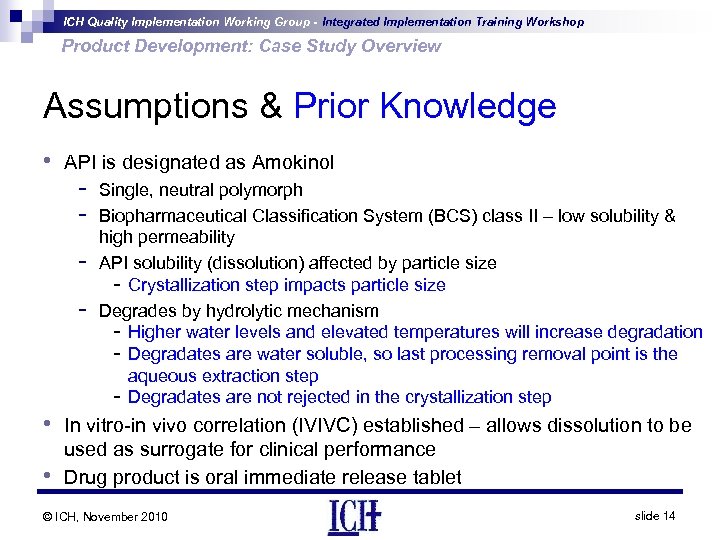 ICH Quality Implementation Working Group - Integrated Implementation Training Workshop Product Development: Case Study Overview Assumptions & Prior Knowledge • API is designated as Amokinol - Single, neutral polymorph - Biopharmaceutical Classification System (BCS) class II – low solubility & - high permeability API solubility (dissolution) affected by particle size - Crystallization step impacts particle size Degrades by hydrolytic mechanism - Higher water levels and elevated temperatures will increase degradation - Degradates are water soluble, so last processing removal point is the aqueous extraction step - Degradates are not rejected in the crystallization step • In vitro-in vivo correlation (IVIVC) established – allows dissolution to be • used as surrogate for clinical performance Drug product is oral immediate release tablet © ICH, November 2010 slide 14
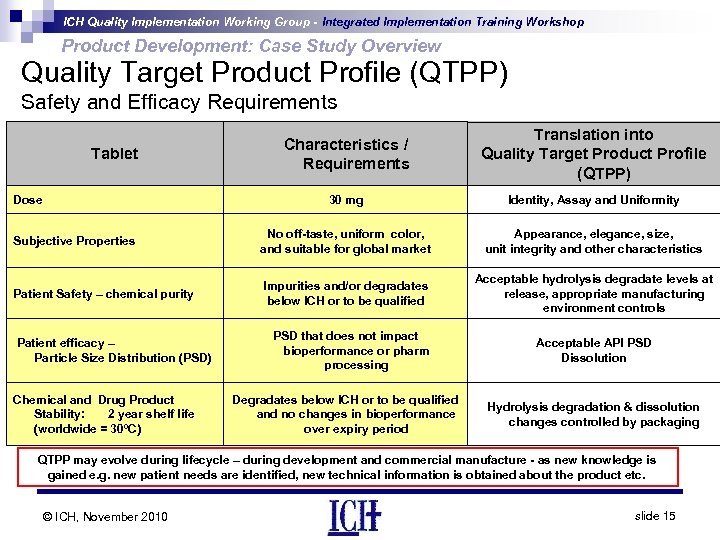 ICH Quality Implementation Working Group - Integrated Implementation Training Workshop Product Development: Case Study Overview Quality Target Product Profile (QTPP) Safety and Efficacy Requirements Characteristics / Requirements Translation into Quality Target Product Profile (QTPP) 30 mg Identity, Assay and Uniformity Subjective Properties No off-taste, uniform color, and suitable for global market Appearance, elegance, size, unit integrity and other characteristics Patient Safety – chemical purity Impurities and/or degradates below ICH or to be qualified Acceptable hydrolysis degradate levels at release, appropriate manufacturing environment controls Tablet Dose Patient efficacy – Particle Size Distribution (PSD) Chemical and Drug Product Stability: 2 year shelf life (worldwide = 30ºC) PSD that does not impact bioperformance or pharm processing Degradates below ICH or to be qualified and no changes in bioperformance over expiry period Acceptable API PSD Dissolution Hydrolysis degradation & dissolution changes controlled by packaging QTPP may evolve during lifecycle – during development and commercial manufacture - as new knowledge is gained e. g. new patient needs are identified, new technical information is obtained about the product etc. © ICH, November 2010 slide 15
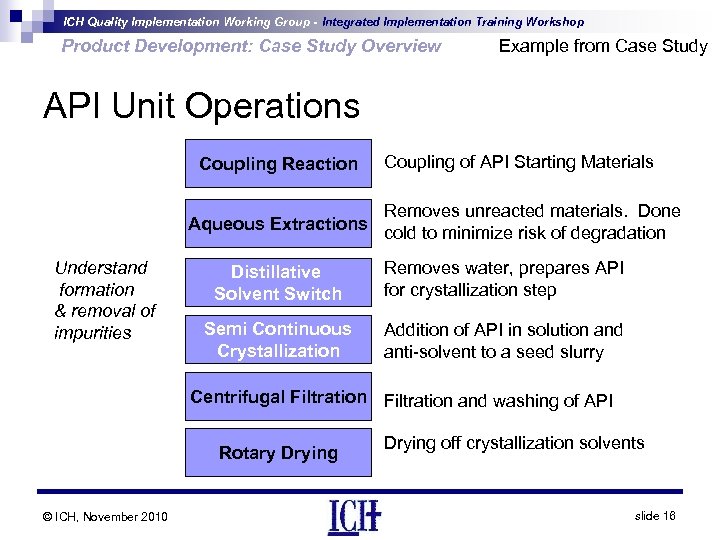 ICH Quality Implementation Working Group - Integrated Implementation Training Workshop Product Development: Case Study Overview Example from Case Study API Unit Operations Coupling Reaction Coupling of API Starting Materials Removes unreacted materials. Done Aqueous Extractions cold to minimize risk of degradation Understand formation & removal of impurities Distillative Solvent Switch Removes water, prepares API for crystallization step Semi Continuous Crystallization Addition of API in solution and anti-solvent to a seed slurry Centrifugal Filtration and washing of API Rotary Drying © ICH, November 2010 Drying off crystallization solvents slide 16
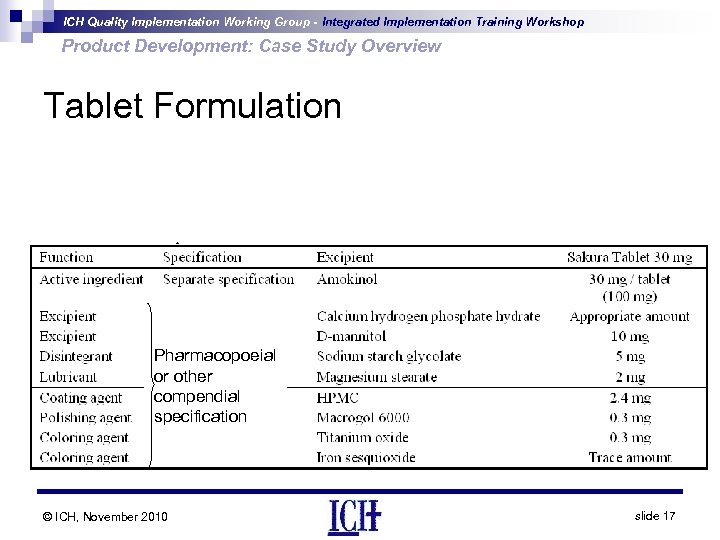 ICH Quality Implementation Working Group - Integrated Implementation Training Workshop Product Development: Case Study Overview Tablet Formulation Pharmacopoeial or other compendial specification © ICH, November 2010 slide 17
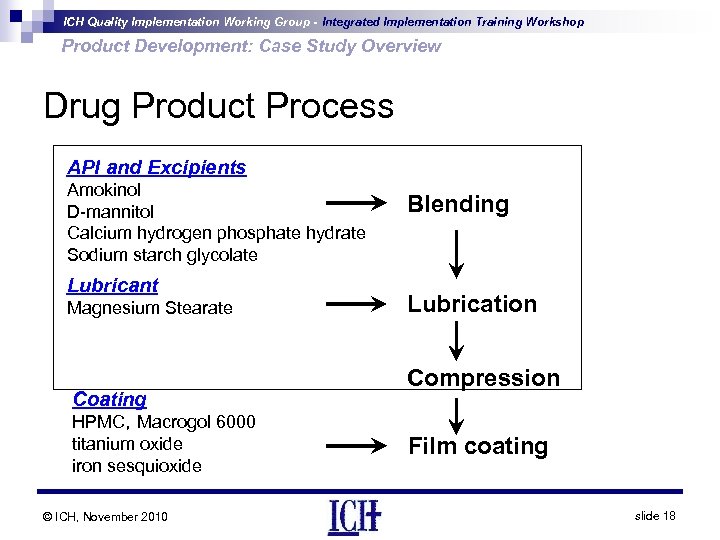 ICH Quality Implementation Working Group - Integrated Implementation Training Workshop Product Development: Case Study Overview Drug Product Process API and Excipients Amokinol D-mannitol Calcium hydrogen phosphate hydrate Sodium starch glycolate Lubricant Magnesium Stearate Coating HPMC,Macrogol 6000 titanium oxide iron sesquioxide © ICH, November 2010 Blending Lubrication Compression Film coating slide 18
 ICH Quality Implementation Working Group - Integrated Implementation Training Workshop Product Development: Case Study Overview of API and Drug Product Case Study Elements Representative Examples from the full Case Study © ICH, November 2010 slide 19
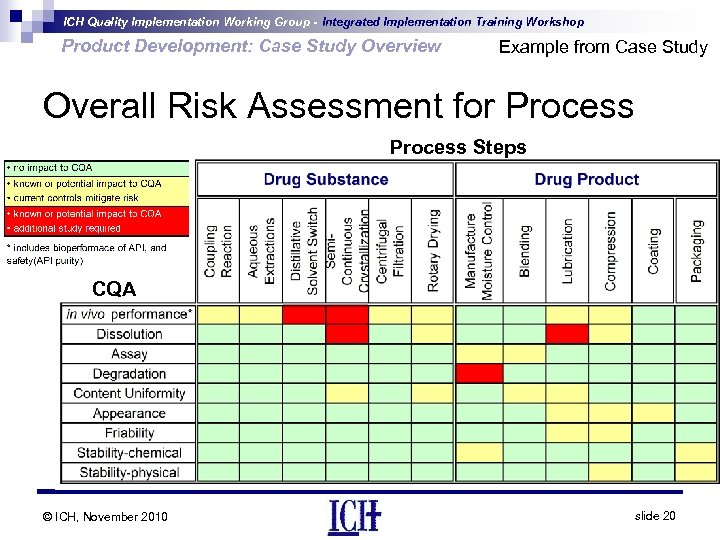 ICH Quality Implementation Working Group - Integrated Implementation Training Workshop Product Development: Case Study Overview Example from Case Study Overall Risk Assessment for Process Steps CQA © ICH, November 2010 slide 20
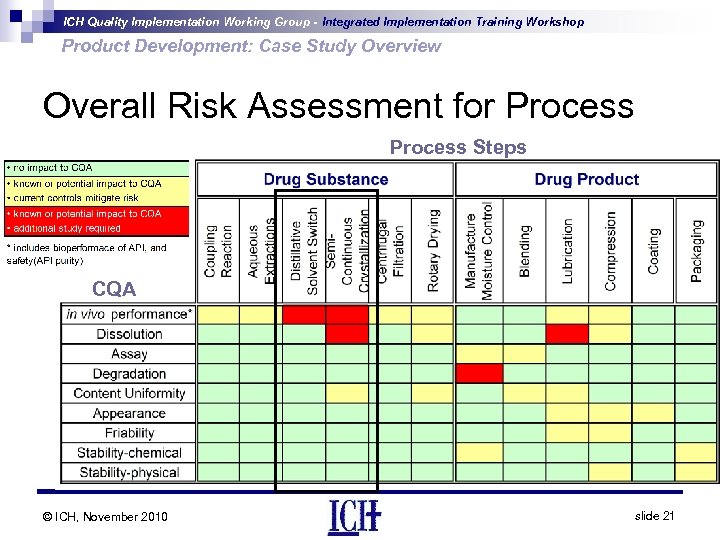 ICH Quality Implementation Working Group - Integrated Implementation Training Workshop Product Development: Case Study Overview Overall Risk Assessment for Process Steps CQA © ICH, November 2010 slide 21
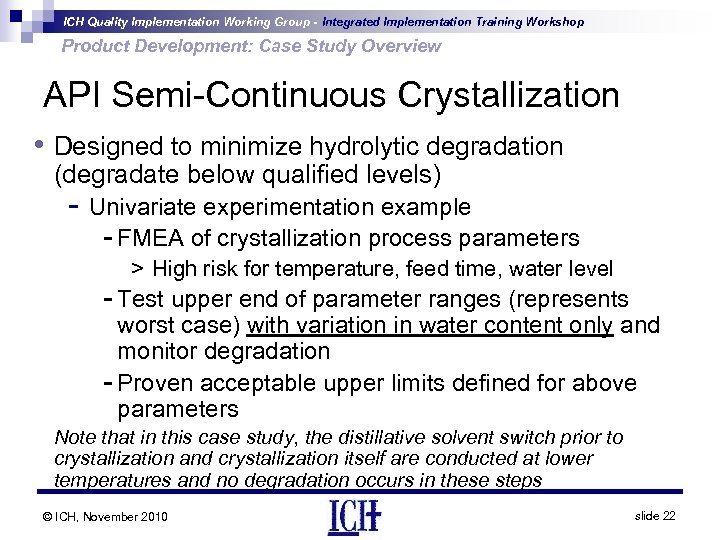 ICH Quality Implementation Working Group - Integrated Implementation Training Workshop Product Development: Case Study Overview API Semi-Continuous Crystallization • Designed to minimize hydrolytic degradation (degradate below qualified levels) - Univariate experimentation example - FMEA of crystallization process parameters > High risk for temperature, feed time, water level - Test upper end of parameter ranges (represents worst case) with variation in water content only and monitor degradation - Proven acceptable upper limits defined for above parameters Note that in this case study, the distillative solvent switch prior to crystallization and crystallization itself are conducted at lower temperatures and no degradation occurs in these steps © ICH, November 2010 slide 22
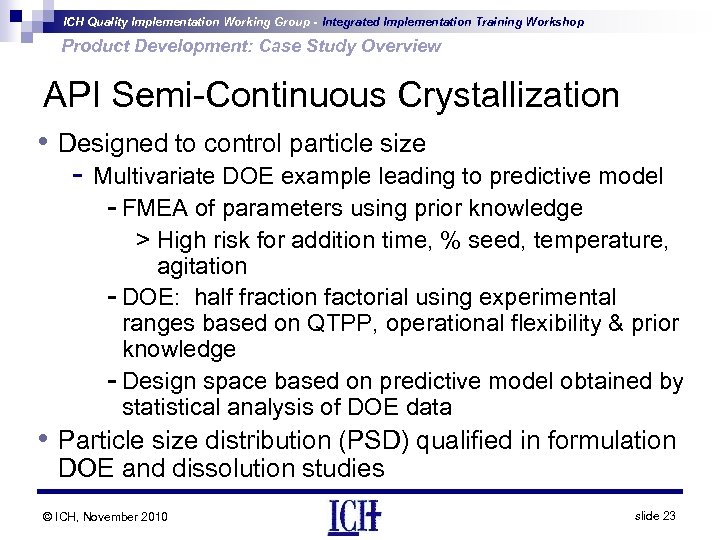 ICH Quality Implementation Working Group - Integrated Implementation Training Workshop Product Development: Case Study Overview API Semi-Continuous Crystallization • Designed to control particle size - Multivariate DOE example leading to predictive model - FMEA of parameters using prior knowledge > High risk for addition time, % seed, temperature, agitation - DOE: half fraction factorial using experimental ranges based on QTPP, operational flexibility & prior knowledge - Design space based on predictive model obtained by statistical analysis of DOE data • Particle size distribution (PSD) qualified in formulation DOE and dissolution studies © ICH, November 2010 slide 23
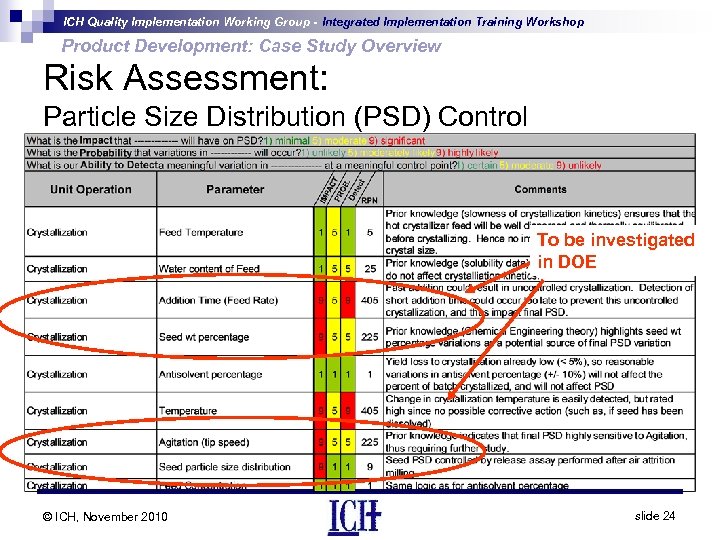 ICH Quality Implementation Working Group - Integrated Implementation Training Workshop Product Development: Case Study Overview Risk Assessment: Particle Size Distribution (PSD) Control To be investigated in DOE © ICH, November 2010 slide 24
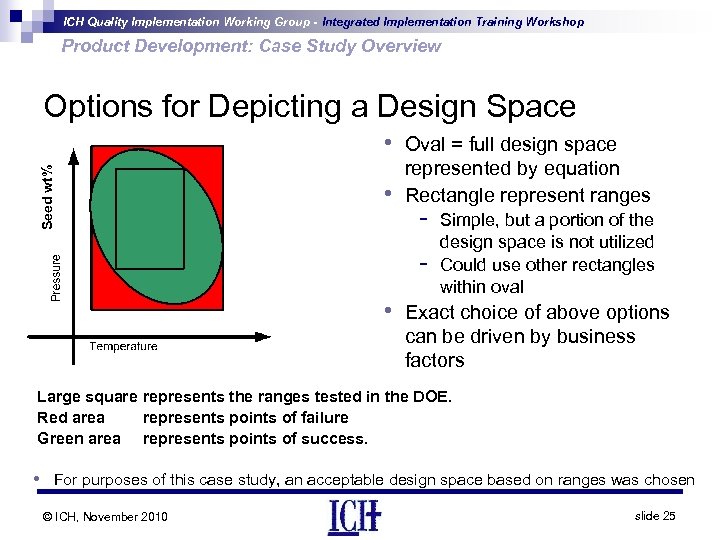 ICH Quality Implementation Working Group - Integrated Implementation Training Workshop Product Development: Case Study Overview Options for Depicting a Design Space Seed wt% • Oval = full design space • represented by equation Rectangle represent ranges - Simple, but a portion of the design space is not utilized Could use other rectangles within oval • Exact choice of above options can be driven by business factors Large square represents the ranges tested in the DOE. Red area represents points of failure Green area represents points of success. • For purposes of this case study, an acceptable design space based on ranges was chosen © ICH, November 2010 slide 25
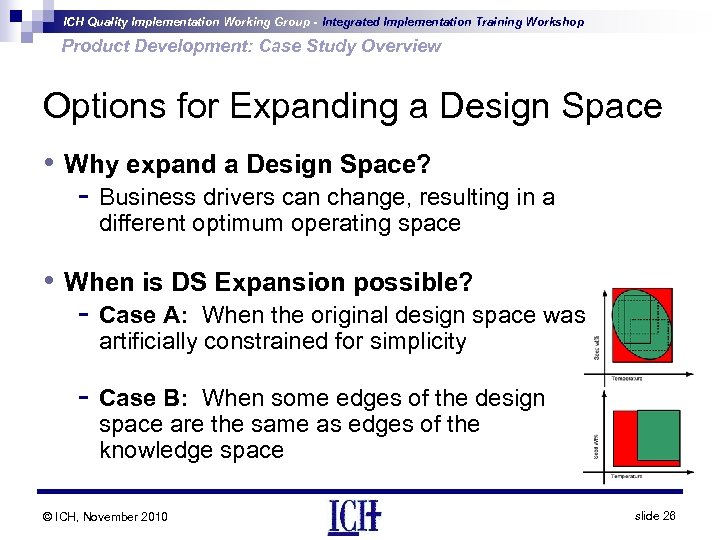 ICH Quality Implementation Working Group - Integrated Implementation Training Workshop Product Development: Case Study Overview Options for Expanding a Design Space • Why expand a Design Space? - Business drivers can change, resulting in a different optimum operating space • When is DS Expansion possible? - Case A: When the original design space was artificially constrained for simplicity - Case B: When some edges of the design space are the same as edges of the knowledge space © ICH, November 2010 slide 26
 ICH Quality Implementation Working Group - Integrated Implementation Training Workshop Product Development: Case Study Overview API Crystallization: Design Space & Control Strategy • Control Strategy should address: - Parameter controls - Distillative solvent switch achieves target water content - Crystallization parameters are within the design space - Testing - API feed solution tested for water content - Final API will be tested for hydrolysis degradate - Using the predictive model, PSD does not need to be routinely tested since it is consistently controlled by the process parameters © ICH, November 2010 slide 27
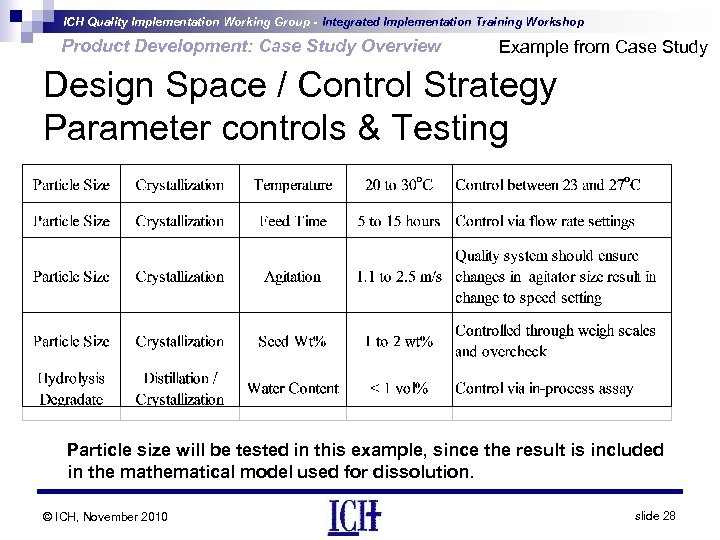 ICH Quality Implementation Working Group - Integrated Implementation Training Workshop Product Development: Case Study Overview Example from Case Study Design Space / Control Strategy Parameter controls & Testing Particle size will be tested in this example, since the result is included in the mathematical model used for dissolution. © ICH, November 2010 slide 28
 ICH Quality Implementation Working Group - Integrated Implementation Training Workshop Product Development: Case Study Overview Drug Product • Immediate release tablet containing 30 mg Amokinol • Rationale formulation composition and process selection provided • In vitro-in vivo correlation (IVIVC) determination - Correlation shown between pharmacokinetic data and - dissolution results Robust dissolution measurement needed - For a low solubility drug, close monitoring is important © ICH, November 2010 slide 29
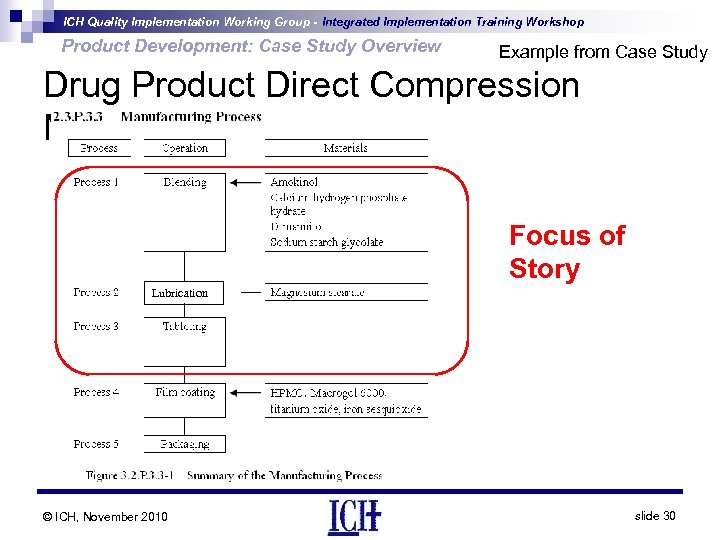 ICH Quality Implementation Working Group - Integrated Implementation Training Workshop Product Development: Case Study Overview Example from Case Study Drug Product Direct Compression Manufacturing Process Focus of Story Lubrication © ICH, November 2010 slide 30
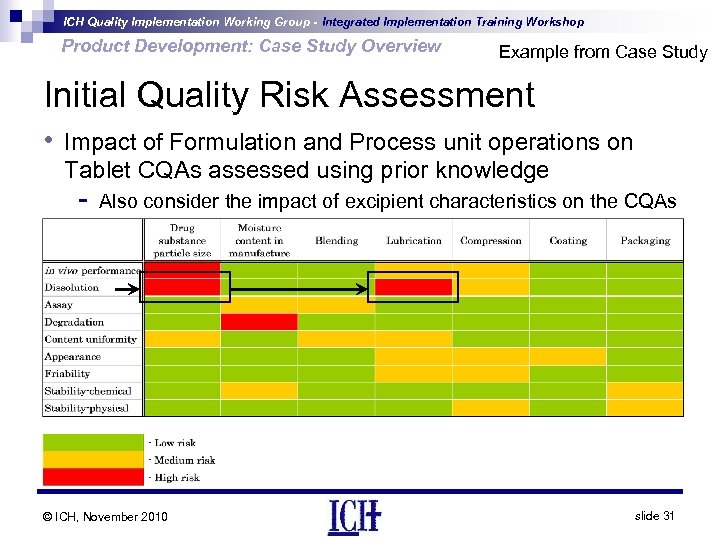 ICH Quality Implementation Working Group - Integrated Implementation Training Workshop Product Development: Case Study Overview Example from Case Study Initial Quality Risk Assessment • Impact of Formulation and Process unit operations on Tablet CQAs assessed using prior knowledge - Also consider the impact of excipient characteristics on the CQAs © ICH, November 2010 slide 31
 ICH Quality Implementation Working Group - Integrated Implementation Training Workshop Product Development: Case Study Overview Drug Product CQA – Dissolution Summary • Quality risk assessment - High impact risk for API particle size, filler, lubrication and compression - Fillers selected based on experimental work to confirm compatibility with - Amokinol and acceptable compression and product dissolution characteristics API particle size affects both bioavailability & dissolution • Multivariate DOE to determine factors that affect dissolution • and extent of their impact Predictive mathematical model generated - Confirmed by comparison of results from model vs. actual dissolution testing • Possible graphical representations of this design space © ICH, November 2010 slide 32
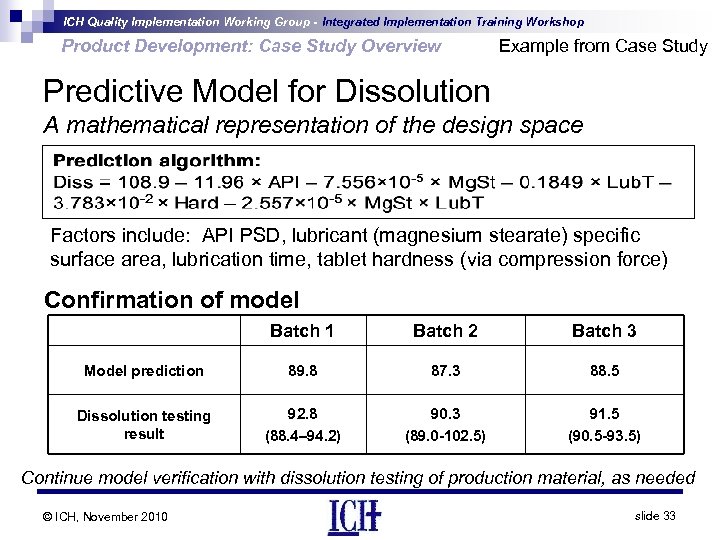 ICH Quality Implementation Working Group - Integrated Implementation Training Workshop Product Development: Case Study Overview Example from Case Study Predictive Model for Dissolution A mathematical representation of the design space Factors include: API PSD, lubricant (magnesium stearate) specific surface area, lubrication time, tablet hardness (via compression force) Confirmation of model Batch 1 Batch 2 Batch 3 Model prediction 89. 8 87. 3 88. 5 Dissolution testing result 92. 8 (88. 4– 94. 2) 90. 3 (89. 0 -102. 5) 91. 5 (90. 5 -93. 5) Continue model verification with dissolution testing of production material, as needed © ICH, November 2010 slide 33
 ICH Quality Implementation Working Group - Integrated Implementation Training Workshop Product Development: Case Study Overview Dissolution: Control Strategy • Controls of input material CQAs - API particle size - - Control of crystallisation step Magnesium stearate specific surface area - Specification for incoming material • Controls of process parameter CPPs - Lubrication step blending time within design space - Compression force (set for tablet hardness) within design space - Tablet press force-feedback control system • Prediction mathematical model - Use in place of dissolution testing of finished drug product Potentially allows process to be adjusted for variation (e. g. in API particle size) and still assure dissolution performance © ICH, November 2010 slide 34
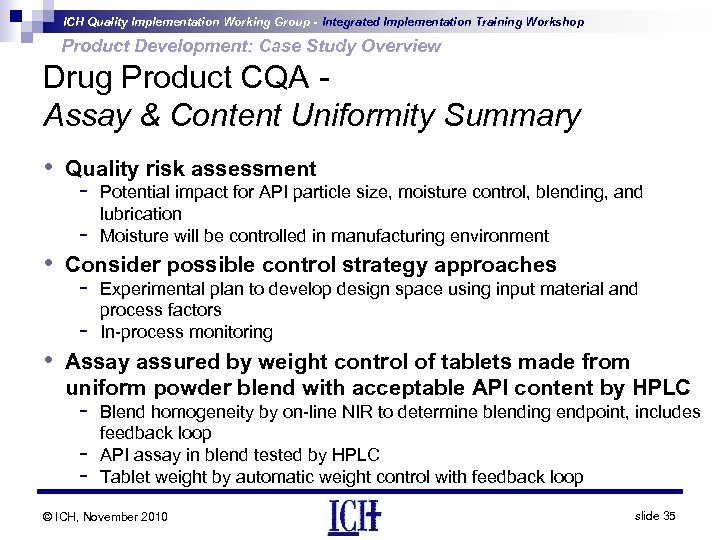 ICH Quality Implementation Working Group - Integrated Implementation Training Workshop Product Development: Case Study Overview Drug Product CQA Assay & Content Uniformity Summary • Quality risk assessment - Potential impact for API particle size, moisture control, blending, and - lubrication Moisture will be controlled in manufacturing environment - process factors In-process monitoring • Consider possible control strategy approaches - Experimental plan to develop design space using input material and • Assay assured by weight control of tablets made from uniform powder blend with acceptable API content by HPLC - Blend homogeneity by on-line NIR to determine blending endpoint, includes feedback loop API assay in blend tested by HPLC Tablet weight by automatic weight control with feedback loop © ICH, November 2010 slide 35
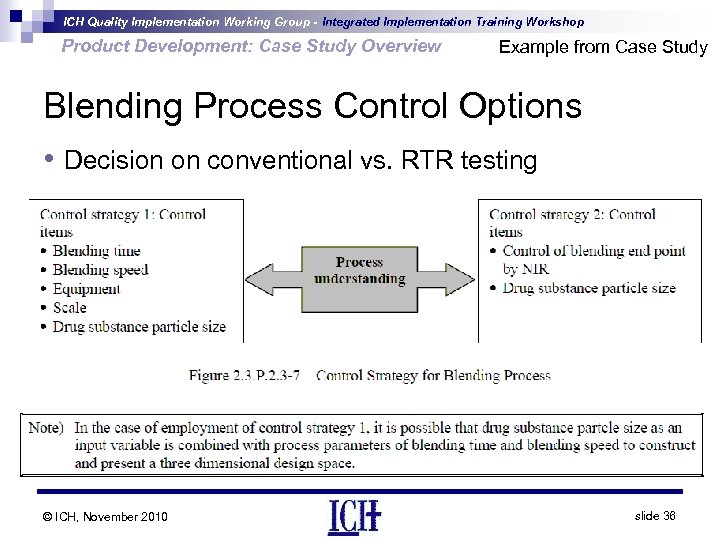 ICH Quality Implementation Working Group - Integrated Implementation Training Workshop Product Development: Case Study Overview Example from Case Study Blending Process Control Options • Decision on conventional vs. RTR testing © ICH, November 2010 slide 36
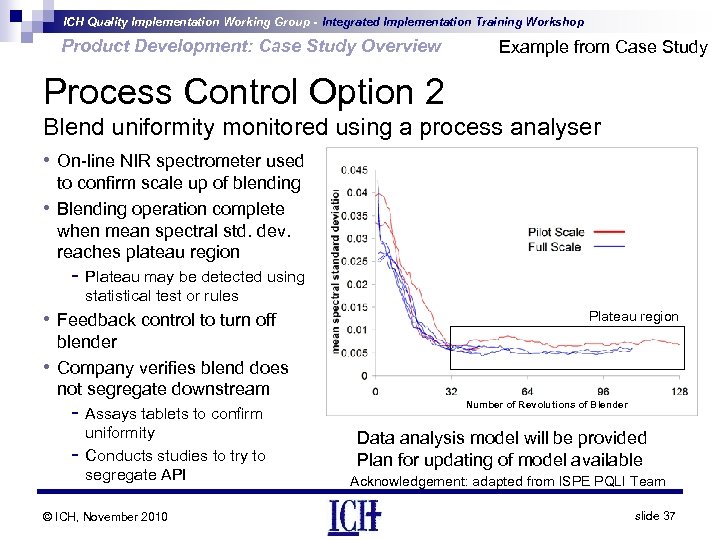 ICH Quality Implementation Working Group - Integrated Implementation Training Workshop Product Development: Case Study Overview Example from Case Study Process Control Option 2 Blend uniformity monitored using a process analyser • On-line NIR spectrometer used • to confirm scale up of blending Blending operation complete when mean spectral std. dev. reaches plateau region - Plateau may be detected using statistical test or rules • Feedback control to turn off • Plateau region blender Company verifies blend does not segregate downstream - Assays tablets to confirm - uniformity Conducts studies to try to segregate API © ICH, November 2010 Number of Revolutions of Blender Data analysis model will be provided Plan for updating of model available Acknowledgement: adapted from ISPE PQLI Team slide 37
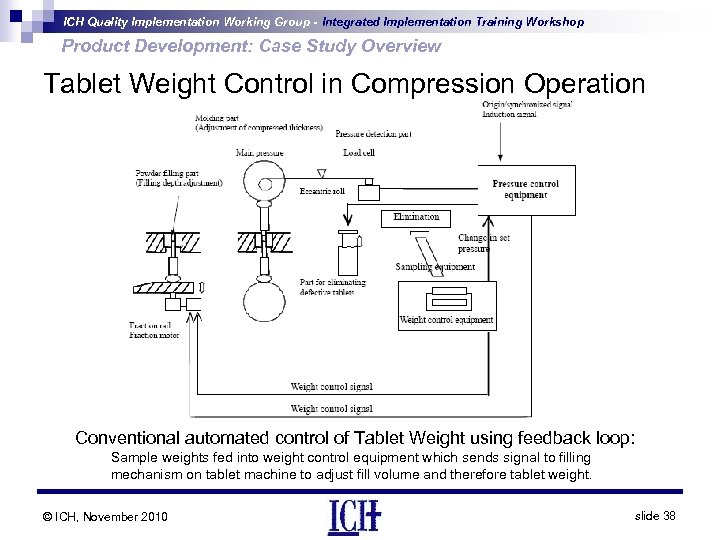 ICH Quality Implementation Working Group - Integrated Implementation Training Workshop Product Development: Case Study Overview Tablet Weight Control in Compression Operation Conventional automated control of Tablet Weight using feedback loop: Sample weights fed into weight control equipment which sends signal to filling mechanism on tablet machine to adjust fill volume and therefore tablet weight. © ICH, November 2010 slide 38
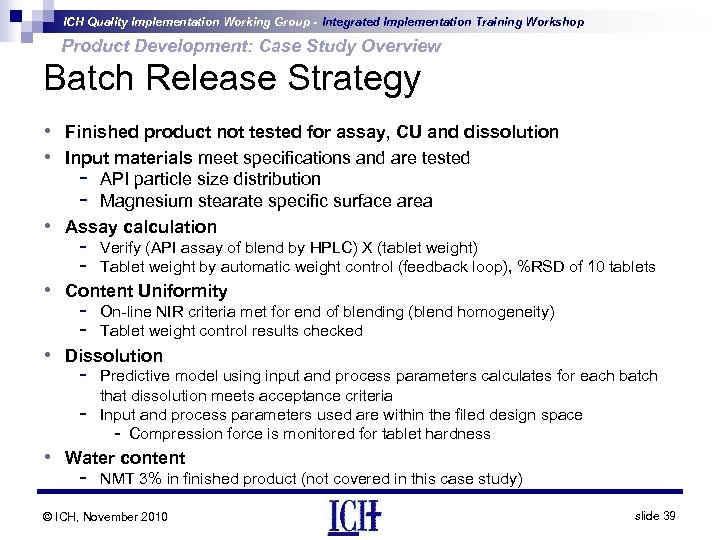 ICH Quality Implementation Working Group - Integrated Implementation Training Workshop Product Development: Case Study Overview Batch Release Strategy • Finished product not tested for assay, CU and dissolution • Input materials meet specifications and are tested • - API particle size distribution Magnesium stearate specific surface area Assay calculation - Verify (API assay of blend by HPLC) X (tablet weight) Tablet weight by automatic weight control (feedback loop), %RSD of 10 tablets - that dissolution meets acceptance criteria Input and process parameters used are within the filed design space - Compression force is monitored for tablet hardness • Content Uniformity - On-line NIR criteria met for end of blending (blend homogeneity) - Tablet weight control results checked • Dissolution - Predictive model using input and process parameters calculates for each batch • Water content - NMT 3% in finished product (not covered in this case study) © ICH, November 2010 slide 39
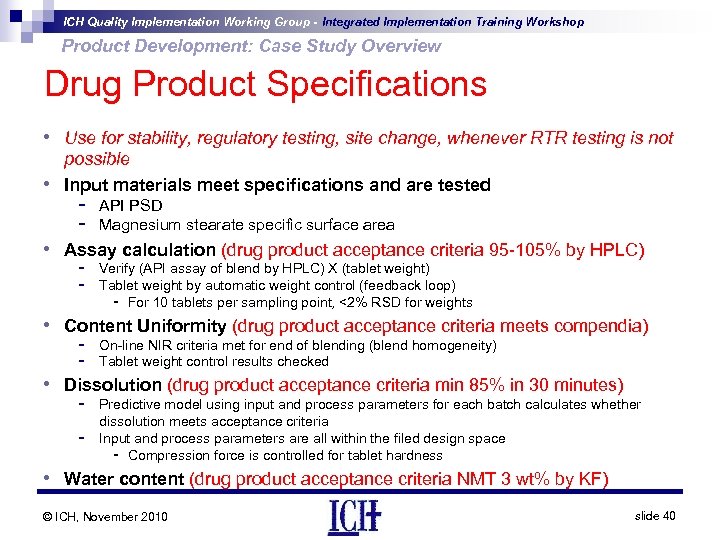 ICH Quality Implementation Working Group - Integrated Implementation Training Workshop Product Development: Case Study Overview Drug Product Specifications • Use for stability, regulatory testing, site change, whenever RTR testing is not • possible Input materials meet specifications and are tested - API PSD Magnesium stearate specific surface area • Assay calculation (drug product acceptance criteria 95 -105% by HPLC) - Verify (API assay of blend by HPLC) X (tablet weight) Tablet weight by automatic weight control (feedback loop) - For 10 tablets per sampling point, <2% RSD for weights • Content Uniformity (drug product acceptance criteria meets compendia) - On-line NIR criteria met for end of blending (blend homogeneity) Tablet weight control results checked • Dissolution (drug product acceptance criteria min 85% in 30 minutes) - Predictive model using input and process parameters for each batch calculates whether dissolution meets acceptance criteria Input and process parameters are all within the filed design space - Compression force is controlled for tablet hardness • Water content (drug product acceptance criteria NMT 3 wt% by KF) © ICH, November 2010 slide 40
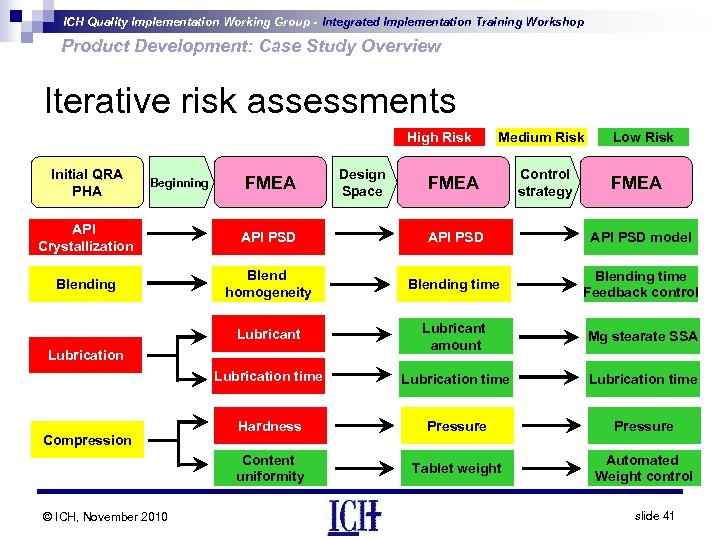 ICH Quality Implementation Working Group - Integrated Implementation Training Workshop Product Development: Case Study Overview Iterative risk assessments High Risk Initial QRA PHA Beginning FMEA Design Space Medium Risk FMEA Control strategy Low Risk FMEA API Crystallization API PSD model Blending Blend homogeneity Blending time Feedback control Lubricant amount Mg stearate SSA Lubrication time Hardness Pressure Content uniformity Tablet weight Automated Weight control Lubrication Compression © ICH, November 2010 slide 41
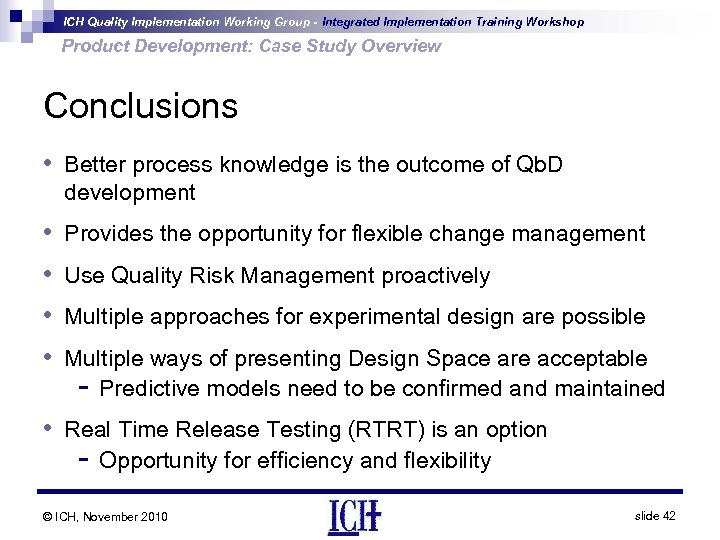 ICH Quality Implementation Working Group - Integrated Implementation Training Workshop Product Development: Case Study Overview Conclusions • Better process knowledge is the outcome of Qb. D development • • Provides the opportunity for flexible change management Use Quality Risk Management proactively Multiple approaches for experimental design are possible Multiple ways of presenting Design Space are acceptable - Predictive models need to be confirmed and maintained • Real Time Release Testing (RTRT) is an option - Opportunity for efficiency and flexibility © ICH, November 2010 slide 42