


 Скачать презентацию Implementation of ICH Q 8 Q 9 Q
7859ee9c982f215fdaffd23efbf70c68.ppt
- Количество слайдов: 38
 Implementation of ICH Q 8, Q 9, Q 10 Inspection International Conference on Harmonisation of Technical Requirements for Registration of Pharmaceuticals for Human Use
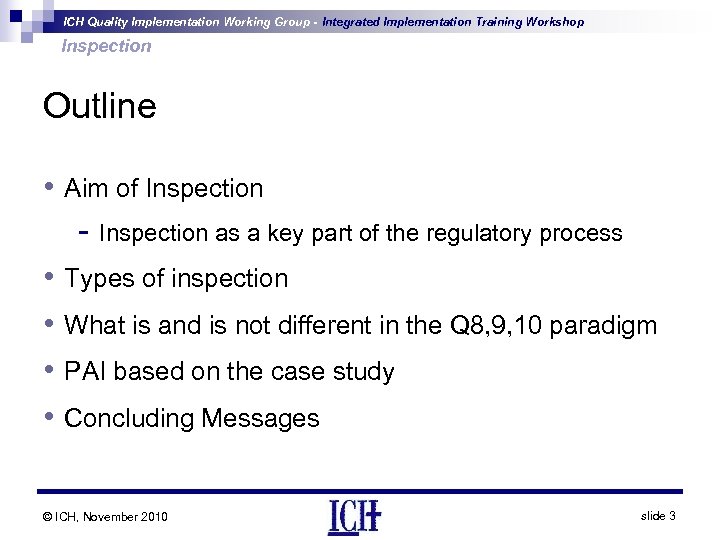 ICH Quality Implementation Working Group - Integrated Implementation Training Workshop Inspection Outline • Aim of Inspection - Inspection as a key part of the regulatory process • • Types of inspection What is and is not different in the Q 8, 9, 10 paradigm PAI based on the case study Concluding Messages © ICH, November 2010 slide 3
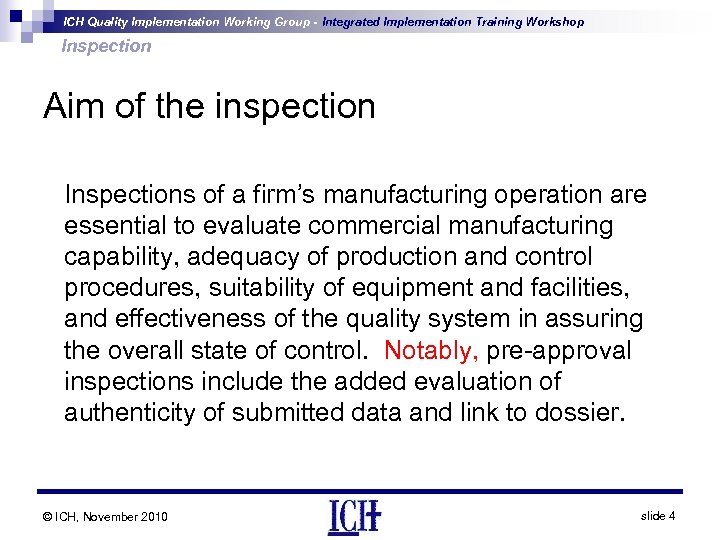 ICH Quality Implementation Working Group - Integrated Implementation Training Workshop Inspection Aim of the inspection Inspections of a firm’s manufacturing operation are essential to evaluate commercial manufacturing capability, adequacy of production and control procedures, suitability of equipment and facilities, and effectiveness of the quality system in assuring the overall state of control. Notably, pre-approval inspections include the added evaluation of authenticity of submitted data and link to dossier. © ICH, November 2010 slide 4
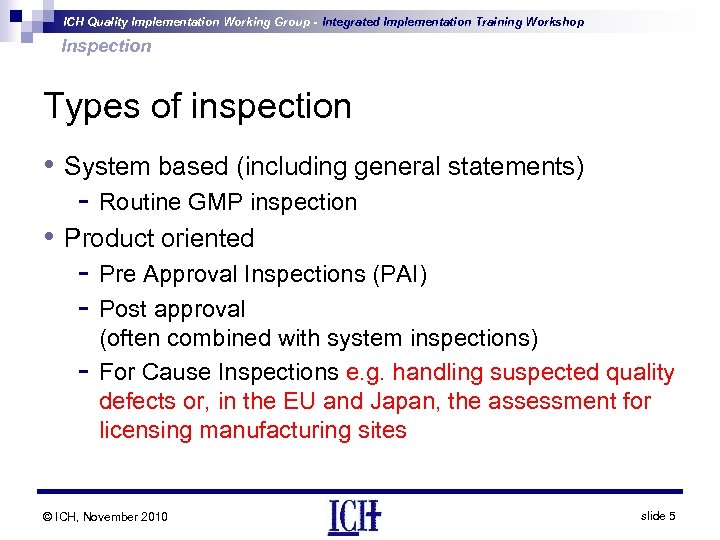 ICH Quality Implementation Working Group - Integrated Implementation Training Workshop Inspection Types of inspection • System based (including general statements) - Routine GMP inspection • Product oriented - Pre Approval Inspections (PAI) - Post approval - (often combined with system inspections) For Cause Inspections e. g. handling suspected quality defects or, in the EU and Japan, the assessment for licensing manufacturing sites © ICH, November 2010 slide 5
 ICH Quality Implementation Working Group - Integrated Implementation Training Workshop Inspection What is or is not different under Q 8, 9, 10? © ICH, November 2010 slide 6
 ICH Quality Implementation Working Group - Integrated Implementation Training Workshop Inspection What is or is not different under Q 8, 9, 10? Assessment provides essential input on product/process design, and feeds into the inspection to evaluate commercial process implementation (please see concluding messages for the other quotes) Monitoring during scale-up activities can provide a preliminary indication of process performance and the successful integration into manufacturing. Knowledge obtained during transfer and scale-up activities can be useful in further developing the control strategy. ICH Q 10 © ICH, November 2010 slide 7
 ICH Quality Implementation Working Group - Integrated Implementation Training Workshop Inspection What is or is not different under Q 8, 9, 10? • The inspection methodology and scope is the same • The inspection is more focused e. g. - What about implementing the process parameters (both CPPs and non-critical)? How to perform change control in the design space? Are you inside / outside Design Space? - How to manage an event ‘out of design space’? • Is the manufacturing site capable of implementing the control • strategy (e. g. RTRT)? Is the manufacturing site capable of developing and implementing an appropriate batch release strategy based on GMP and control strategy ? © ICH, November 2010 slide 8
 ICH Quality Implementation Working Group - Integrated Implementation Training Workshop Inspection What is or is not different under Q 8, 9, 10? • RTRT is an option BUT once it is granted in the Marketing Authorisation it should be appropriately applied - To assure acceptable implementation of RTRT and models - Reverting to conventional testing of finished product is not allowed unless justified e. g. for investigational purposes, equipment failure (see Q&A) - Post-approval plan for monitoring of the models © ICH, November 2010 slide 9
 ICH Quality Implementation Working Group - Integrated Implementation Training Workshop Inspection What is or is not different under Q 8, 9, 10? • Drug Product Development predictions based on predictive mathematical models - Protocols for change control - Flexible change management under quality system - Protocols for monitoring - Protocols for management of out of trends, deviations, and specifications - These predictive models will be verified/ validated at commercial site and throughout lifecycle. Subsequent adaptation under PQS will be monitored by inspection oversight © ICH, November 2010 slide 10
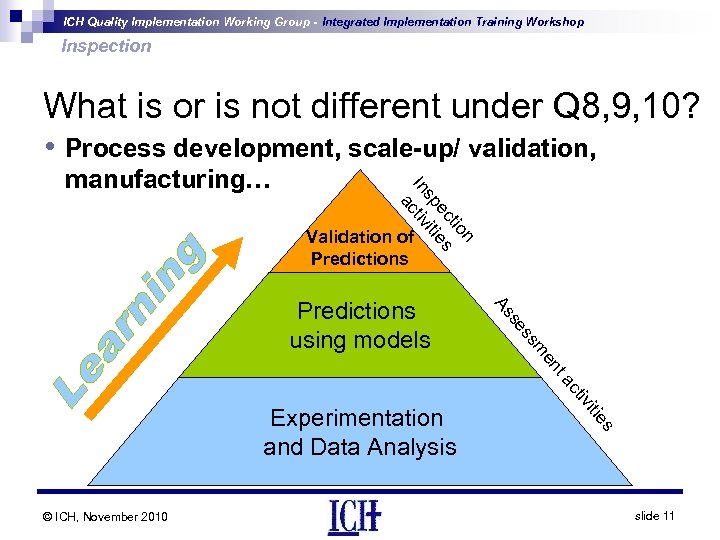 ICH Quality Implementation Working Group - Integrated Implementation Training Workshop Inspection What is or is not different under Q 8, 9, 10? • Process development, scale-up/ validation, ac n tio ec es sp iviti t In manufacturing… Validation of Predictions t en m ss se As Predictions using models s itie © ICH, November 2010 tiv ac Experimentation and Data Analysis slide 11
 ICH Quality Implementation Working Group - Integrated Implementation Training Workshop Inspection What is or is not different under Q 8, 9, 10? Focus of post approval inspection • Maintain a State of Control via the PQS using e. g. : - Management review of process performance and - product quality Process performance and product quality monitoring system Corrective action and preventive action (CAPA) system Change management system • Contributing to the continual improvement of the product © ICH, November 2010 slide 12
 ICH Quality Implementation Working Group - Integrated Implementation Training Workshop Inspection PAI based on the case study © ICH, November 2010 slide 13
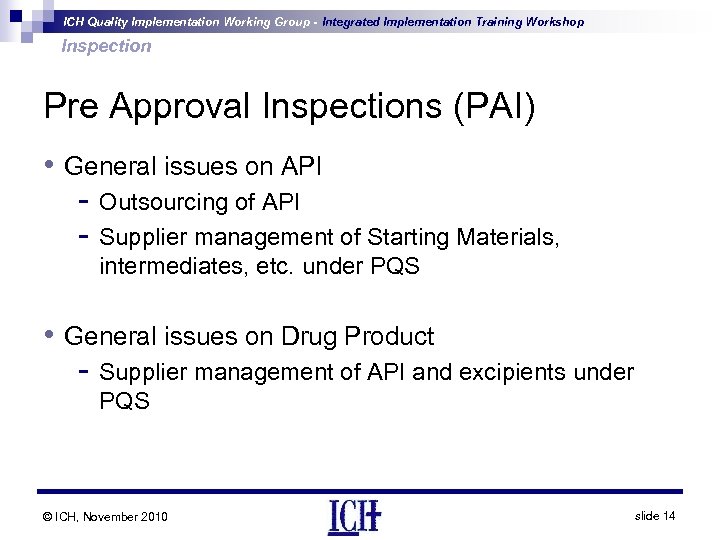 ICH Quality Implementation Working Group - Integrated Implementation Training Workshop Inspection Pre Approval Inspections (PAI) • General issues on API - Outsourcing of API - Supplier management of Starting Materials, intermediates, etc. under PQS • General issues on Drug Product - Supplier management of API and excipients under PQS © ICH, November 2010 slide 14
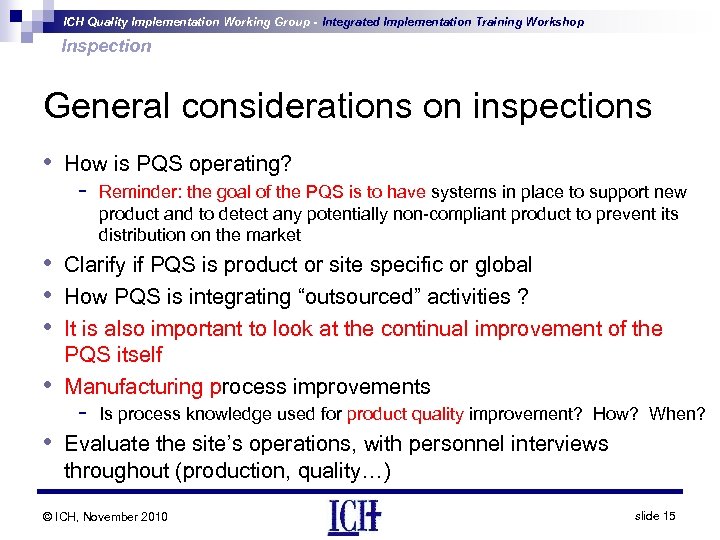 ICH Quality Implementation Working Group - Integrated Implementation Training Workshop Inspection General considerations on inspections • How is PQS operating? - Reminder: the goal of the PQS is to have systems in place to support new product and to detect any potentially non-compliant product to prevent its distribution on the market • Clarify if PQS is product or site specific or global • How PQS is integrating “outsourced” activities ? • It is also important to look at the continual improvement of the • PQS itself Manufacturing process improvements - Is process knowledge used for product quality improvement? How? When? • Evaluate the site’s operations, with personnel interviews throughout (production, quality…) © ICH, November 2010 slide 15
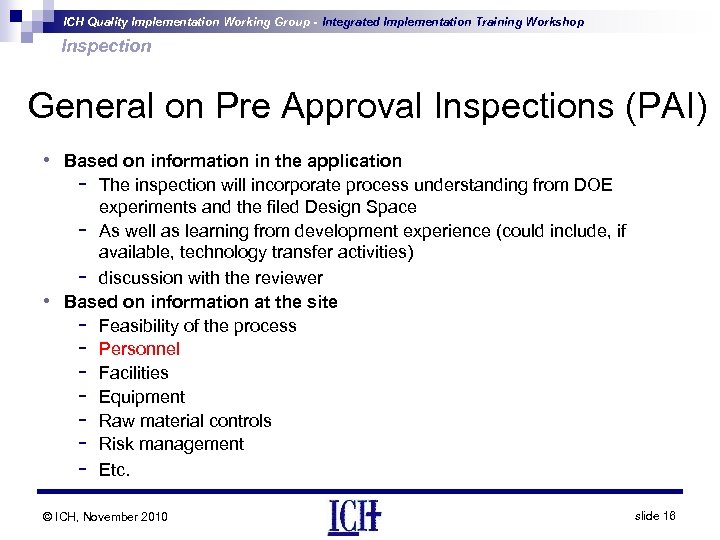 ICH Quality Implementation Working Group - Integrated Implementation Training Workshop Inspection General on Pre Approval Inspections (PAI) • Based on information in the application - • The inspection will incorporate process understanding from DOE experiments and the filed Design Space - As well as learning from development experience (could include, if available, technology transfer activities) - discussion with the reviewer Based on information at the site - Feasibility of the process - Personnel - Facilities - Equipment - Raw material controls - Risk management - Etc. © ICH, November 2010 slide 16
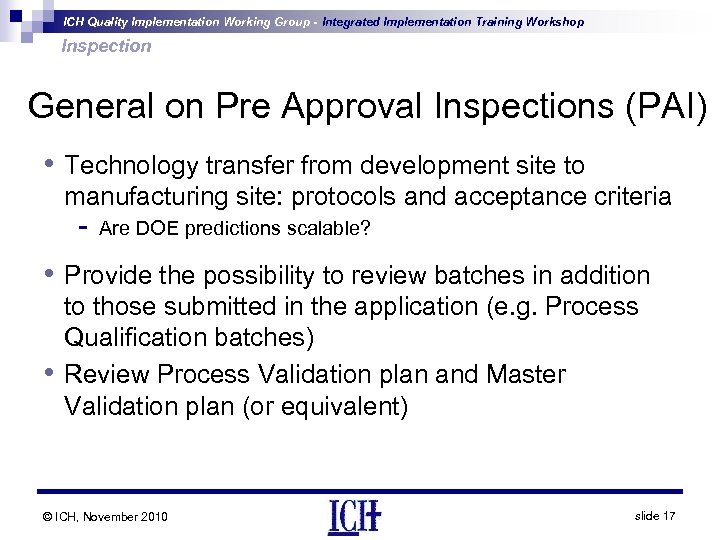 ICH Quality Implementation Working Group - Integrated Implementation Training Workshop Inspection General on Pre Approval Inspections (PAI) • Technology transfer from development site to manufacturing site: protocols and acceptance criteria - Are DOE predictions scalable? • Provide the possibility to review batches in addition • to those submitted in the application (e. g. Process Qualification batches) Review Process Validation plan and Master Validation plan (or equivalent) © ICH, November 2010 slide 17
 ICH Quality Implementation Working Group - Integrated Implementation Training Workshop Inspection General on PAI - API • API process would be reviewed (DMF, batch records, • • • receipt/handling/storage of starting materials, any holding during the process, as well as storage of the API). Some of which is included in submitted dossiers Equipment/ facility capability, production SOPs, scale-up Control of starting materials and intermediates Control for potential degradation Control of particle size during crystallization Focus is on critical parameters e. g. degradation and crystallization. Are there parameters other than those described in the application file impacting product quality? © ICH, November 2010 slide 18
 ICH Quality Implementation Working Group - Integrated Implementation Training Workshop Inspection General on PAI - Drug Product • Inspectors will look at - Process feasibility - Equipment capability - Scale up, including learning • Review the pivotal clinical batch (IMP) for deviations and process comparison of bio-batch to scale up • Review other development batches beyond those submitted in the application (e. g. scale up batch, demo batches) © ICH, November 2010 slide 19
 ICH Quality Implementation Working Group - Integrated Implementation Training Workshop Inspection General on PAI - Drug Product • Potential variables and associated risk (e. g. raw materials, sites, equipment, personnel…) as described in the following slide • What parts of the process require control and why? • Review the development report, if one has been prepared © ICH, November 2010 slide 20
 ICH Quality Implementation Working Group - Integrated Implementation Training Workshop Inspection General on PAI Drug Product Evaluation of potential variables and associated risk • Does the operation support the intended volume of production? • Resources • Equipment (including support equipment e. g HVAC) • Documentation including written procedures • Personnel training • Environmental control • IT support/validation/control • Is there a process for acquiring and managing knowledge? © ICH, November 2010 slide 21
 ICH Quality Implementation Working Group - Integrated Implementation Training Workshop Inspection Elements from the case study Assessment of the implementation of marketing authorisation at the manufacturing site through current GMP and PQS © ICH, November 2010 slide 22
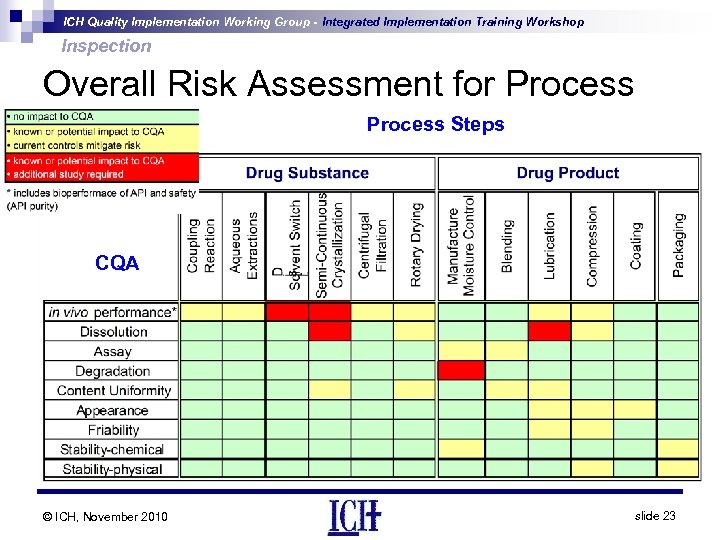 ICH Quality Implementation Working Group - Integrated Implementation Training Workshop Inspection Overall Risk Assessment for Process Steps CQA © ICH, November 2010 slide 23
 ICH Quality Implementation Working Group - Integrated Implementation Training Workshop Inspection PAI - API • Related to the case study slide as presented Information in the application assists the focus on the inspection e. g. - Concentrate on the ‘red’ and ‘yellow’ boxes in the - application Evaluation of assessment of impact on e. g. Critical Quality Attributes (CQA) and whether current controls are of sufficient support Due to potential hydrolysis degradation - testing by HPLC would be reviewed - any batch rejections, quality issues, processing issues, reprocessing…in accordance with current GMPs © ICH, November 2010 slide 24
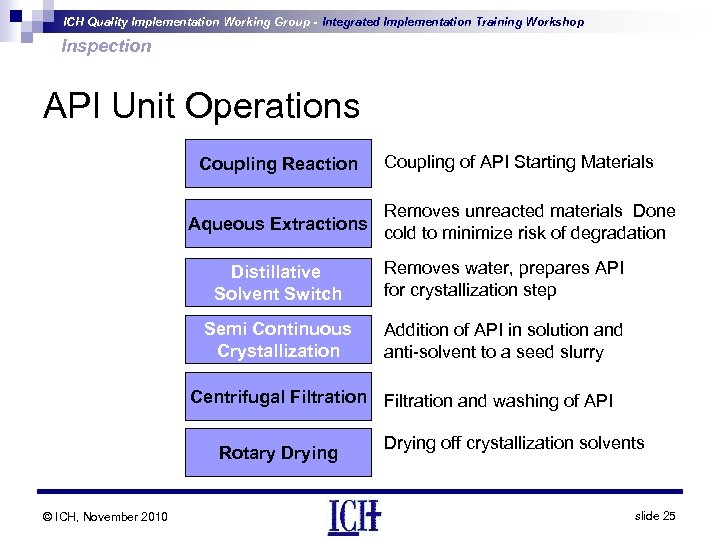 ICH Quality Implementation Working Group - Integrated Implementation Training Workshop Inspection API Unit Operations Coupling Reaction Coupling of API Starting Materials Removes unreacted materials Done Aqueous Extractions cold to minimize risk of degradation Distillative Solvent Switch Removes water, prepares API for crystallization step Semi Continuous Crystallization Addition of API in solution and anti-solvent to a seed slurry Centrifugal Filtration and washing of API Rotary Drying © ICH, November 2010 Drying off crystallization solvents slide 25
 ICH Quality Implementation Working Group - Integrated Implementation Training Workshop Inspection PAI - API Questions which could be raised during the inspection • Water level in the vessel is a critical parameter for the crystallization step: is it related to the vessel fill volume? Is the vessel size a critical parameter? • Does the crystallization step concern sub-batches or full batch? Determine precise batch size versus vessel fill volume and evaluate other factors that influence particle size. © ICH, November 2010 slide 26
 ICH Quality Implementation Working Group - Integrated Implementation Training Workshop Inspection PAI - API: evaluation of Scale-Up impact during API-PAI Questions which could be raised during the inspection • Distillative Solvent Switch - Distillation time - Decompression level - Distillation temperature © ICH, November 2010 slide 27
 ICH Quality Implementation Working Group - Integrated Implementation Training Workshop Inspection PAI - API: evaluation of Scale-Up impact during API-PAI Questions which could be raised during the inspection • Semi Continuous Crystallization - - Preparation stage of feed solution - Control water content - Dissolution temperature - Dissolution time Crystallization stage - Program of temperature descent - Stir speed - Concentration - Timing of seed crystal © ICH, November 2010 slide 28
 ICH Quality Implementation Working Group - Integrated Implementation Training Workshop Inspection PAI – API Questions which could be raised during the inspection • The assessor will evaluate the proposed control strategy of the API • • for identified CQA(s), hydrolytic degradation and Particle Size Distribution (PSD). The inspector will evaluate the proposed plans for implementation of the control strategy (linked to submitted dossier), audit data, and evaluate c. GMP (e. g. facility, equipment, production and QC) The inspector will evaluate the site’s capability to ensure appropriate storage and shipment conditions for API to ensure: - Temperature and Humidity control; any dessicant used - May look at studies to assure storage/shipment stability © ICH, November 2010 slide 29
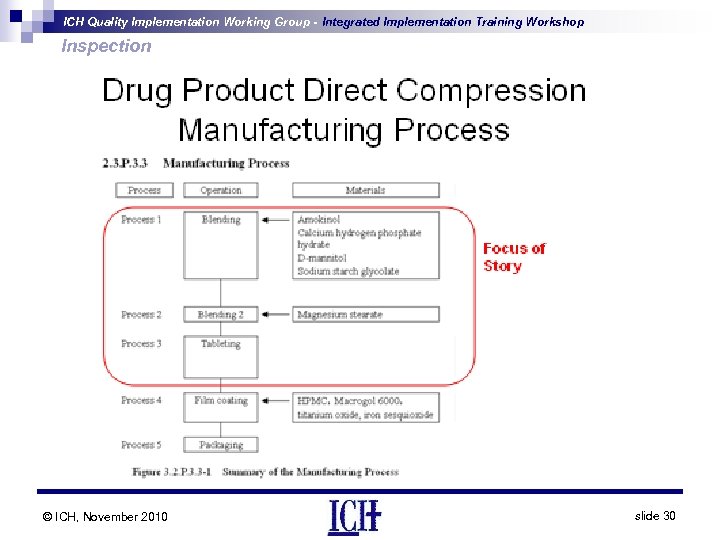 ICH Quality Implementation Working Group - Integrated Implementation Training Workshop Inspection © ICH, November 2010 slide 30
 ICH Quality Implementation Working Group - Integrated Implementation Training Workshop Inspection PAI - Drug Product • Inspectors will look at aspects of the raw Material Controls Program e. g. - Supplier selection and qualification program Incoming raw material testing program • Example of the Case study - - Mg Stearate - Focus on critical quality attribute (CQA) including specific surface area (SSA) - Is the sampling plan and testing adequate? Sodium Starch Glycolate - Similar focus if sampling plan and testing is adequate as it is a disintegrant © ICH, November 2010 slide 31
 ICH Quality Implementation Working Group - Integrated Implementation Training Workshop Inspection PAI - Drug Product • Evaluation of manual aspects of unit operations with focus on manual or semi-automated aspects in the enhanced approach such as - Blender loading and discharge - Transport and storage of blends - Charging of the compression machine - Training adequacy (risk based training? ) • Evaluate mechanical aspects of unit operations e. g. - Special equipment performance and capability to deliver the desired output © ICH, November 2010 slide 32
 ICH Quality Implementation Working Group - Integrated Implementation Training Workshop Inspection PAI - Drug Product Can the test method as named in the application be implemented? • Evaluate the viability of blend homogeneity - Looking at e. g. IQ, OQ, PQ and check e. g. type of transmittance probe or window - Scientific justification to determine the precise hold time after blending which could include studying the demonstration of absence of segregation / aggregation during discharge, transport, charging and hold time - API assay in blend: sampling tool, number of samples, sampling plan - Stability to moisture risks © ICH, November 2010 slide 33
 ICH Quality Implementation Working Group - Integrated Implementation Training Workshop Inspection PAI - Drug Product Control of Compression operation e. g. • Evaluate details of the control strategy for tablet hardness established within quality system - How is this parameter controlled - on line, at line or in line? Provide sampling plan Total number of tablets tested Acceptance criteria SOPs for handling deviations © ICH, November 2010 slide 34
 ICH Quality Implementation Working Group - Integrated Implementation Training Workshop Inspection PAI - Drug Product Check the basis for replacing the end-product testing & how to manage deviations under the PQS • Tablet weight - Sampling plan - Monitoring models - Frequency and total number of tablets per batch - Management of out of spec in the frame of feedback - control system and handling of other deviations Batch Overall RSD © ICH, November 2010 slide 35
 ICH Quality Implementation Working Group - Integrated Implementation Training Workshop Inspection Concluding messages © ICH, November 2010 slide 36
 ICH Quality Implementation Working Group - Integrated Implementation Training Workshop Inspection Concluding messages • Implementation of Q 8, Q 9 and Q 10 should enhance GMP compliance and could have a positive impact on frequency and duration of inspections. © ICH, November 2010 slide 37
 ICH Quality Implementation Working Group - Integrated Implementation Training Workshop Inspection Concluding messages • Assessment and inspection are complementary but different activities - Encourage collaboration among assessors and inspectors in pre-approval inspections respecting the distinct roles of assessors and inspectors • Inspection determines manufacturing capability • Information from technology transfer activities, scaleup, demonstration, and process qualification batches is particularly valuable © ICH, November 2010 slide 38
 ICH Quality Implementation Working Group - Integrated Implementation Training Workshop Inspection Concluding messages • PQS and QRM are not only considered specifically for product, but as systematic lifecycle approaches • Ultimate goal for assessors and inspectors is to be sure that the marketed product meets the predefined quality © ICH, November 2010 slide 39