


 Скачать презентацию Implement advanced procedures 2 20 2 21 Lesley Pearce
710eb5a3e3a5aa16ab01dfb2758d0f5e.ppt
- Количество слайдов: 47
 Implement advanced procedures 2. 20/2. 21 Lesley Pearce National Facilitator Team Solutions
 Learning objective: CONSTRUCT A RESISTANT MATERIAL PRODUCT • Level 6 Implement basic procedures to make a resistant materials product • Level 7 Implement advanced procedures to make a resistant materials product • Level 8 Implement complex procedures to make a resistant materials product
 Learning objective: CONSTRUCT A TEXTILES MATERIAL PRODUCT • Implement basic procedures to make a textiles product • Implement advanced procedures to make a textiles product • Implement complex procedures to make a textiles product
 Learning indicators At level 7 Students can… • undertake advanced procedures to construct a product with special features that meets specifications • select and apply scheduled techniques to comply with relevant health and safety regulations • show independence and accuracy in executing the scheduled techniques and tests • undertake techniques and tests in a manner that economises time, effort and materials.
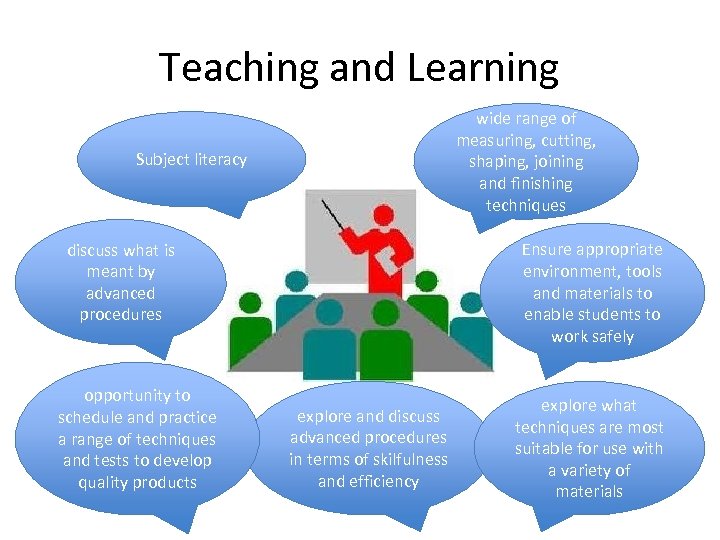 Teaching and Learning wide range of measuring, cutting, shaping, joining and finishing techniques Subject literacy Ensure appropriate environment, tools and materials to enable students to work safely discuss what is meant by advanced procedures opportunity to schedule and practice a range of techniques and tests to develop quality products explore and discuss advanced procedures in terms of skilfulness and efficiency explore what techniques are most suitable for use with a variety of materials
 Activity • What is your understanding of advanced procedures? • Discuss in groups
 Advanced procedures • Specified product must have two special features • One aesthetic • One structural • Consistent application of accepted conventions – advanced craft skills
 Advanced processes • are those that require the student to perform a range of operations involving parallel processing (requiring scheduling of techniques, and accurate measuring) to ensure a successful product.
 Parallel processing • where things need to be done to parts/components and then brought together to create a technological outcome/product Examples • making drawers and then fitting them into cabinets, • making up a bodice and fitting it into the skirt to form a dress • making up an axle or steering assembly and fitting onto a cart • using widening joints to make a top, finishing it and assembling it onto a cabinet carcass
 Advanced processes • That is procedures that require the student to make informed selection and scheduling of techniques and testing to make the product and undertaking evaluative tests to demonstrate the final product meets specifications
 Advanced craft skills • rely on the consistent application of accepted conventions which may relate to such things as flush, parallel, perpendicular, offset, symmetry, array, tolerance, ease, press fit, clearances, eccentricity, taper, continuous bound placket, rolled hem. Fly fronts
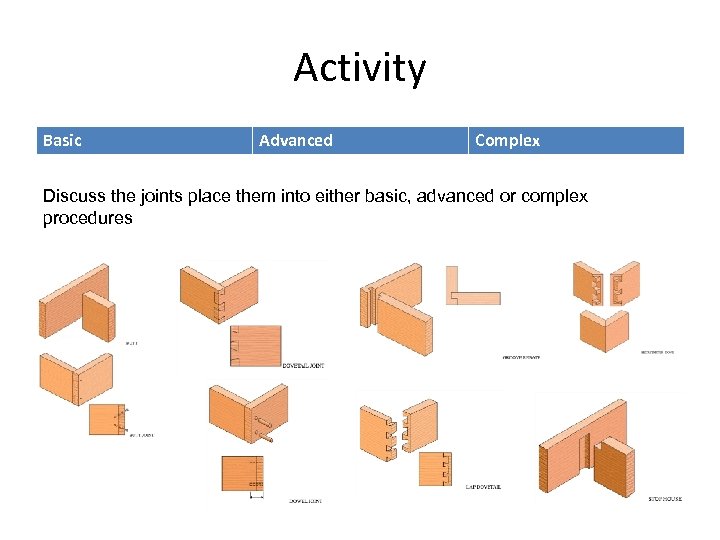 Activity Basic Advanced Complex Discuss the joints place them into either basic, advanced or complex procedures
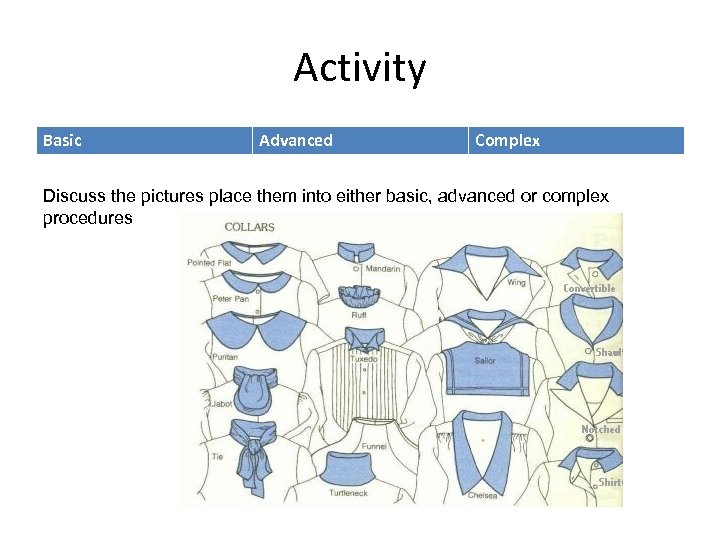 Activity Basic Advanced Complex Discuss the pictures place them into either basic, advanced or complex procedures
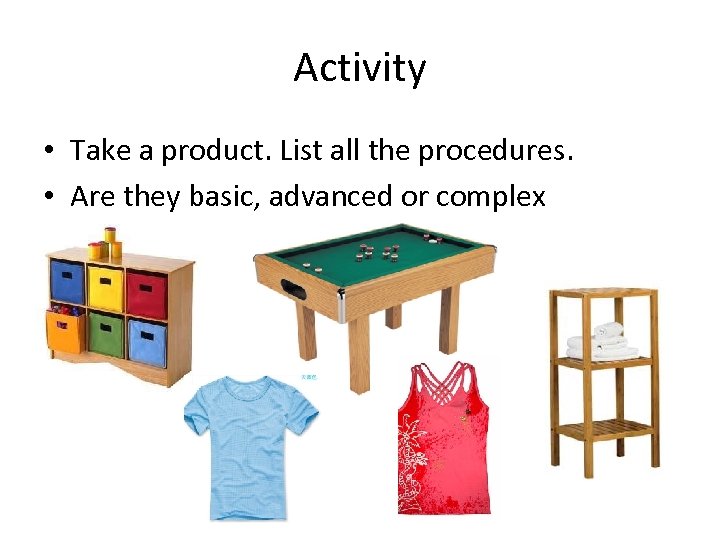 Activity • Take a product. List all the procedures. • Are they basic, advanced or complex
 Activity • Identify two clearly identifiable special features one structural and one aesthetic from the given pictures
 Activity • In groups write a paragraph that explains advanced procedures to students. • Share with all groups.
 Option A: Teacher given brief • Students are given a set of plans for specified product. The whole class makes the same product (or their own modification) • the teacher may develop class drawings and the special features in discussion with the class • also allow individual students to negotiate individual variations and special features
 Option B: Technological Practice • Students are presented with a context and required to identify an issue and an opportunity and undertake technological practice to develop a technological outcome that addresses it • Outcome must include at least two special features and require the consistent application of advanced craft skills • Teachers must verify that the design of the intended technological outcome includes two clearly identifiable special features
 Check list for students 1. Specifications include 2 special features (aesthetic and structural) - outcome meets specifications 2. Techniques selected, tested and applied 3. Construction plan specifies the order in which to do the various steps involved in the construction/testing 4. Construct product - working to health and safety regulations 5. Worked independently, with accuracy and efficiency
 Student evidence 1. Photograph/annotate what you did and problems resolved, tests taken to ensure specifications are met, evidence of techniques used etc 2. Photograph finished product, show special features in detail plus other specifications 3. Teacher observations annotated
 Student evidence continued • judgements about the ways in which students execute techniques and tests, as well as about the quality of a finished product.
 Assessment • Merit the student has shown ‘independence and accuracy in the execution of the techniques and tests’ • Excellence) whether the student has worked ‘in a manner that economises time, effort, and materials • Teachers must be able to justify their judgements by providing evidence derived from student or teacher recordings, classroom observation, and/or discussion with students.
 Possible student evidence • a brief record of progress (e. g. photographic), materials used and costing, and how they have resolved problems (by, for example, annotating their construction plans and drawings, making recordings and/or photographs of modifications). • Teachers could add own observations to the student’s records • Establishing a schedule of tests and recording the outcomes of tests as they apply them; • Taking and annotating photos that show accuracy and economic use of materials.
 Student evidence continued… • establishing a schedule of tests (i. e. what tests will be done and when they will be done? ) and recording the outcomes of tests as they apply them • taking and annotating photos to show economic use of materials (for example, by photographing layout) and accuracy.
 Important • The recording process does not need to become too consuming e. g. annotate their construction plans • Teachers add own observations to the students’ records
 E. g. teacher comments… • “The student planned and carried out testing/checks as they created their product. The student needed to be reminded to carry out some checking and did not always do this with a high degree of accuracy. ” Give e. g. • “The techniques were scheduled and implemented in a straightforward manner, following accepted practice. Little or no time was spent repeating techniques as the student confidently used the correct technique in the first place. ”
 Student assessment 1. product meets all specifications 2. the manner and accuracy with which techniques and testing procedures are applied to create a quality, finished product 3. how independently and efficiently students go about their work
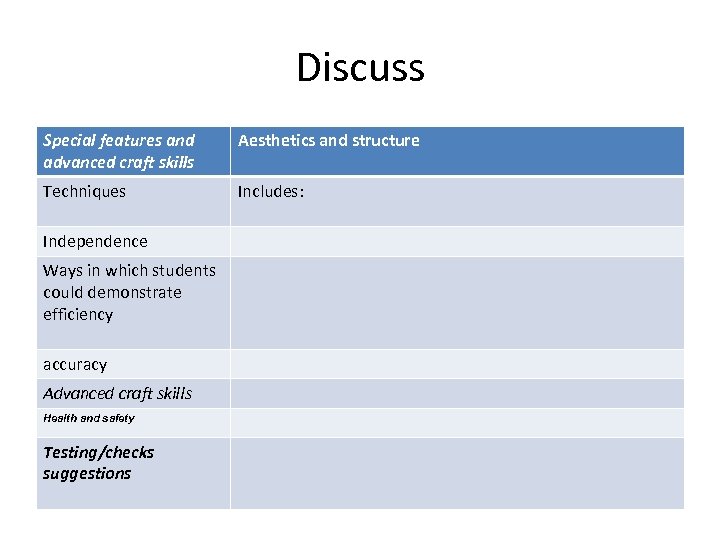 Discuss Special features and advanced craft skills Aesthetics and structure Techniques Includes: Independence Ways in which students could demonstrate efficiency accuracy Advanced craft skills Health and safety Testing/checks suggestions
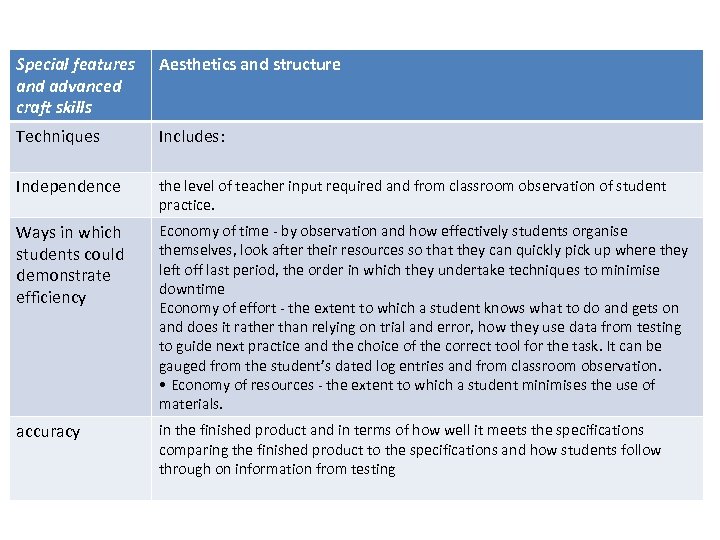 Special features and advanced craft skills Aesthetics and structure Techniques Includes: Independence the level of teacher input required and from classroom observation of student practice. Ways in which students could demonstrate efficiency Economy of time - by observation and how effectively students organise themselves, look after their resources so that they can quickly pick up where they left off last period, the order in which they undertake techniques to minimise downtime Economy of effort - the extent to which a student knows what to do and gets on and does it rather than relying on trial and error, how they use data from testing to guide next practice and the choice of the correct tool for the task. It can be gauged from the student’s dated log entries and from classroom observation. • Economy of resources - the extent to which a student minimises the use of materials. accuracy in the finished product and in terms of how well it meets the specifications comparing the finished product to the specifications and how students follow through on information from testing
 Advanced craft skills Health and safety Testing/checks suggestions
 Demonstrate efficiency could include • having resources available when needed • being organised in the workplace and having alternatives when machines are in use at the time you want it • storing all materials safely between classes so they can easily find them and start work quickly when next time in class • being lean and mean with materials • having a plan of what is to be achieved each day before arrival and getting on and doing this • organising in advance everything needed for the day’s work • knowing and practicing the most efficient techniques • having timely conversations teachers or other experts
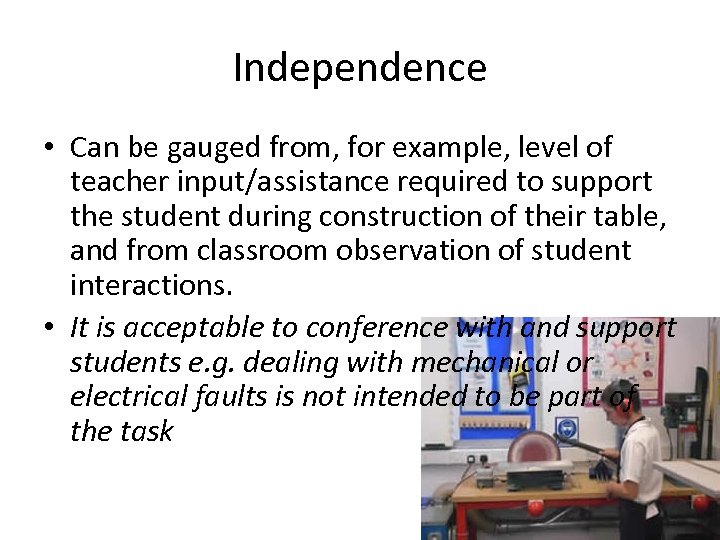 Independence • Can be gauged from, for example, level of teacher input/assistance required to support the student during construction of their table, and from classroom observation of student interactions. • It is acceptable to conference with and support students e. g. dealing with mechanical or electrical faults is not intended to be part of the task
 (KC) Managing Self • self-motivation, a “can-do” attitude, capable learners • enterprising, resourceful, reliable, and resilient • establish personal goals, make plans, manage projects, and set high standards • strategies for meeting challenges. • know when to lead, when to follow, and when and how to act independently.
 Economy of time • Can be gauged by, for example, observation, and relates to how effectively students organise themselves, look after their resources so that they can quickly pick up where they left off last period, and minimise downtime.
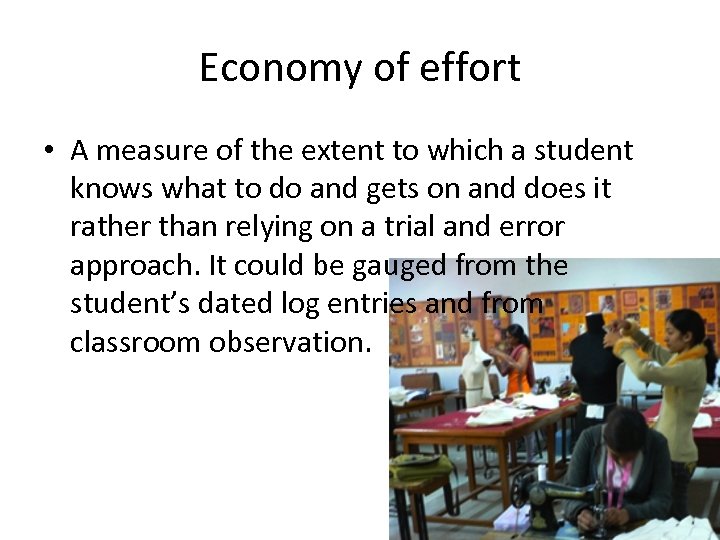 Economy of effort • A measure of the extent to which a student knows what to do and gets on and does it rather than relying on a trial and error approach. It could be gauged from the student’s dated log entries and from classroom observation.
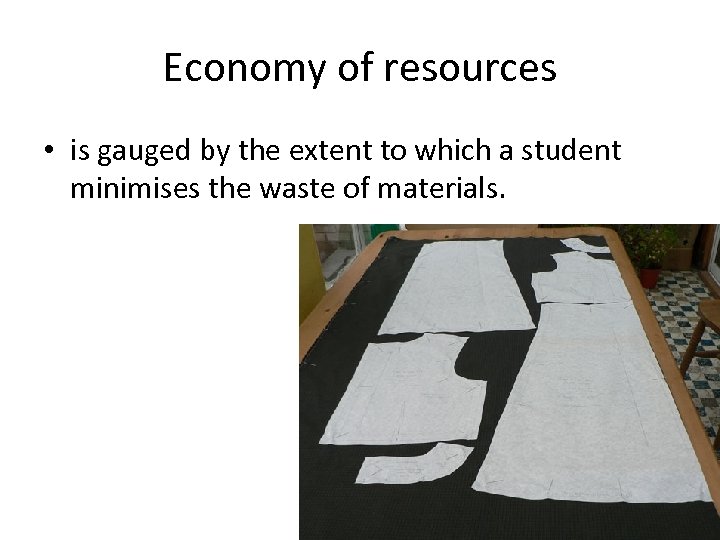 Economy of resources • is gauged by the extent to which a student minimises the waste of materials.
 Economy of time, effort and resources • may be demonstrated in the same action • e. g. students could choose the correct tool for the task which saves them time and effort and minimises wastage as the tool chosen allowed a task to be completed accurately the first time it was attempted.
 Student evidence • through different modes (oral, written, diagrammatic) • provide guidance or support to ensure that all students have the opportunity to explain clearly why they did what they did
 What could that look like… • Discuss
 Check • the selected materials and special features provide sufficient scope for the student to meet the requirements of the standard. • Discuss the following examples…
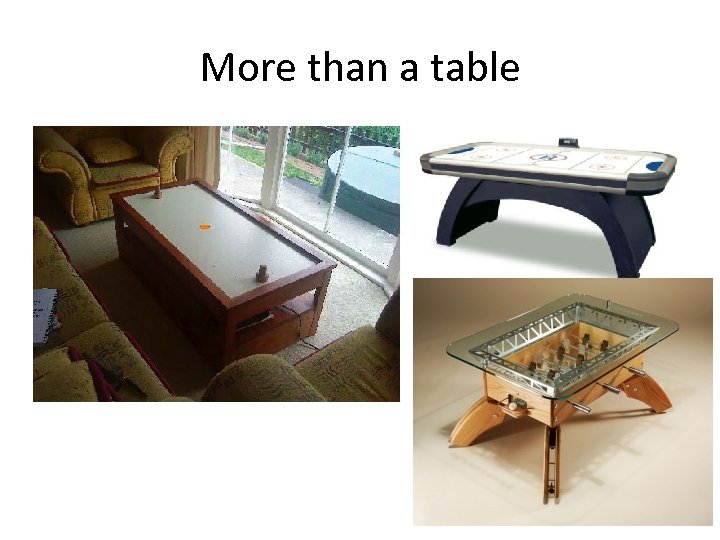 More than a table
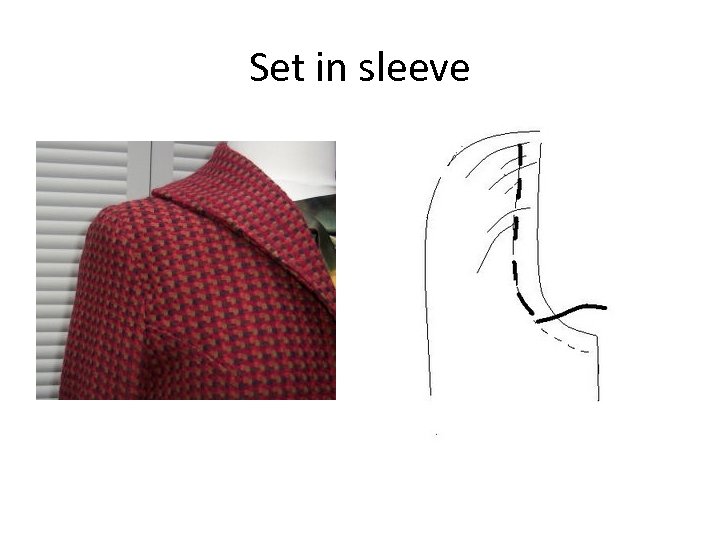 Set in sleeve
 Off road go kart
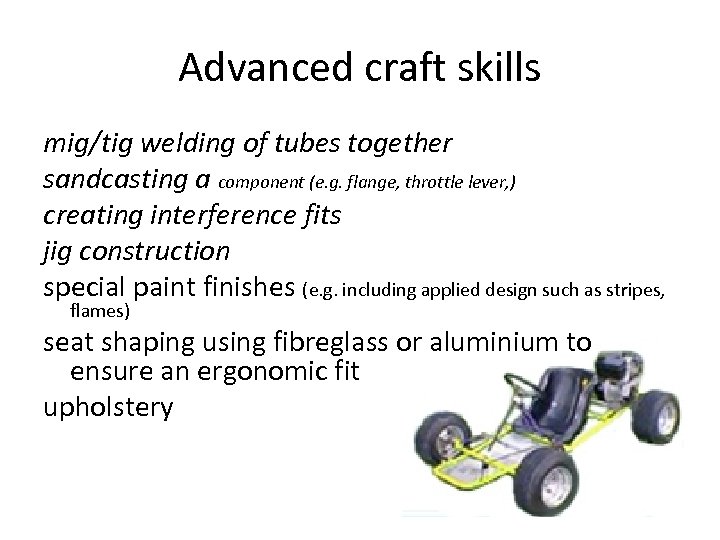 Advanced craft skills mig/tig welding of tubes together sandcasting a component (e. g. flange, throttle lever, ) creating interference fits jig construction special paint finishes (e. g. including applied design such as stripes, flames) seat shaping using fibreglass or aluminium to ensure an ergonomic fit upholstery
 Health and safety • All students should be familiar with classroom rules for welding and using machines for example: • don’t look directly at the welding arc unless you are wearing a welding helmet • make sure the welding curtains are drawn • wear leather gloves so you don’t burn yourself or get arc burn • ensure sleeves rolled up when using any machines • wear safety glasses when machining • ensure all machine guards are fitted and working before starting machines • ensure machines are turned off before using any measuring instruments.
 Testing examples • Check joints are accurate, strong • Checking the front and back axles are parallel and perpendicular to each other • Make sure the frame is symmetrical
 Some things to think about A teaching programme should meet the requirements of the New Zealand Curriculum. • An assessment programme should give students the opportunity to demonstrate their understanding of a range of learning, not necessarily all their learning. • Factors that might determine the amount of assessment undertaken: • • school assessment policy. • the needs of the students. • number of credits needed to gain a qualification, course endorsement, university entrance, or other tertiary entrance requirements. • certificate and course endorsement require "quality credits" rather than "a large quantity of credits". • the manner in which evidence of achievement can be gathered.