


 Скачать презентацию IMPACTS OF THE HELSINKI 2005 WORLD CHAMPIONSHIPS IN
d5d2a023128811030e2f099837cf542a.ppt
- Количество слайдов: 17
 IMPACTS OF THE HELSINKI 2005 WORLD CHAMPIONSHIPS IN ATHLETICS A multidisciplinary study in Finnish: ”Urheilu, maine ja raha : tutkimuksia vuoden 2005 yleisurheilun MM- kisoista”, ed. by Mats Nylund, Seppo Laakso, Sanna Ojajärvi, Helsinki: Gaudeamus : Helsingin kaupungin tietokeskus, 2006 l l I will present result of one of thye subprojects which considers economic impacts of WC 2005.
 ECONOMIC IMPACTS OF THE HELSINKI 2005 WORLD CHAMPIONSHIPS IN ATHLETICS Heikki A. Loikkanen 2, Seppo Laakso 1, Päivi Kilpeläinen 1, Eeva Kostiainen 1 and Ilkka Susiluoto 3 1 Kaupunkitutkimus TA Oy (Urban Research TA Ltd) 2 University of Helsinki 3 Urban Facts, City of Helsinki Finnish report can be found from http: //www. kihu. fi/tuotostiedostot/julkinen/julkaisusarja_nro 3. pdf English article type summary of the report can be found from http: //www. kihu. fi/tuotostiedostot/julkinen/julkaisusarja_nro 7. pdf
 WC 2005 in Athletics in Helsinki, 6. – 14. 8. 2005 l l l Biggest ever sports event in Finland 1800 athletes from over 200 countries 130 000 visitors to games – – – l l 2 700 media representatives Revenue of for Loc. Org. (LO) about 28 M€ – l 60 000 from Helsinki Region 45 000 from other parts of Finland 25 000 from abroad of which 17 M€ from ticket sales Financial result of LO: profit about 400 000 €
 BACKGROUND OF THE ECONOMIC IMPACT PROJECT l Commissioned by Ministry of Education – – One of projects which studied the social and economic impacts of WC 2005 Other studies concentrated on: l l l l citizens´and spectators’ view on WC effects on sporting club activitity and sport voluteers’s interests environmental effects media’s view on WC organisation of WC sponsoring WC Objectives: – – – To study the mechanisms of economic impact of mega events (literature survey) Study especially the regional and national economic impacts of WC 2005 The results can be used in formulation of Min. Edu’s of strategy for future mega events
 APPROACH AND DATA OF THE STUDY l Topics of the study – – l Approach – l regional demand impulse model Main financial flows connected with WC – – – l effects on business of firms in the Helsinki region and whole country immediate and multiplikative effects on regional economy (value added and employment) the financial imputs of municipalities and the state to WC and the effects to their tax revenue the importance of WC to the business sector and the region from the point of view of image, attractiveness and markenting investments in WC infrastrukture, like new roof of Olympic Stadium and athletes’ willage in Otaniemi Local Organisation’s puchases of goods and services and own employment WC guests’ puchases of goods and services from local firms Data sources – – – activities and finances of Local Organisation kisavieraiden haastattelut interview stydy of local firms spceilised if tourist services interview stydy of WC guests business indicators of tourist industrials (Statistics Finland) other statistics
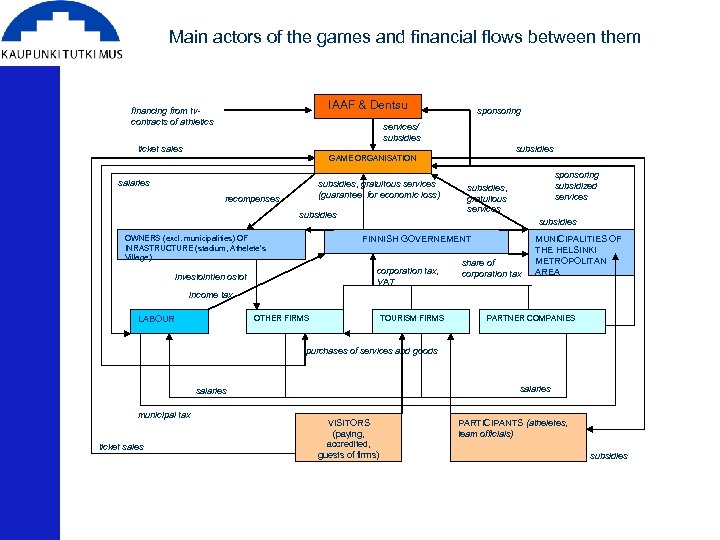 Main actors of the games and financial flows between them IAAF & Dentsu financing from tvcontracts of athletics sponsoring services/ subsidies ticket sales subsidies GAME ORGANISATION salaries subsidies, gratuitous services (guarantee for economic loss) recompenses subsidies OWNERS (excl. municipalities) OF INRASTRUCTURE (stadium, Athelete’s Village) sponsoring subsidized services subsidies, gratuitous services subsidies FINNISH GOVERNEMENT corporation tax, VAT investointien ostot share of corporation tax MUNICIPALITIES OF THE HELSINKI METROPOLITAN AREA income tax OTHER FIRMS LABOUR TOURISM FIRMS PARTNER COMPANIES purchases of services and goods salaries municipal tax ticket sales VISITORS (paying, accredited, guests of firms) PARTICIPANTS (atheletes, team officials) subsidies
 WC GUESTS’ BACKGROUND AND USE OF MONEY l WC guests – – l about 340 000 tickets were sold estimation: about 125 000 WC guests (persons) Backgroud of the WC guests – – – about half of the guests from the Helsinki region, half from outside ”WC tourists” 20 -25 % of WC tourists from abroad sex: 40 % female, 60 % male age: mainly 25 -54 years income: mainly middle income accommodation: of WC tourists staying seval days l l l – over 1/2 accommodated with relatives of friends, 1/3 in hotels and hostels etc. 1/5 visited WC from home outside the region foreign WC tourists: 90 % accommodated in hotels
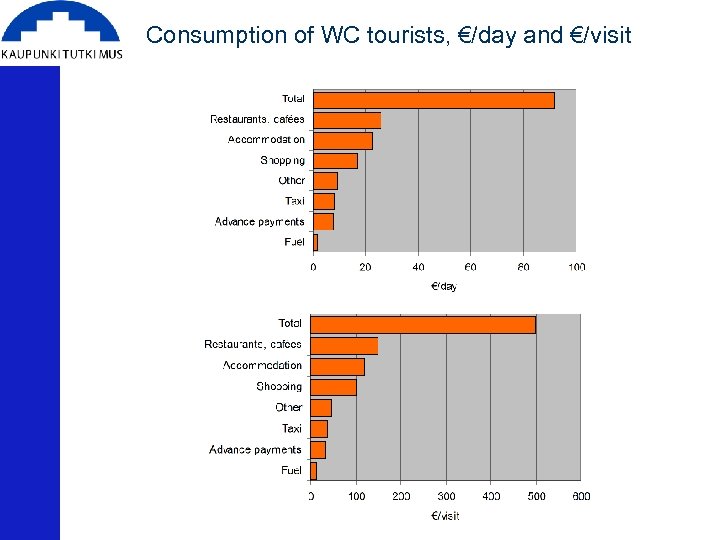 Consumption of WC tourists, €/day and €/visit
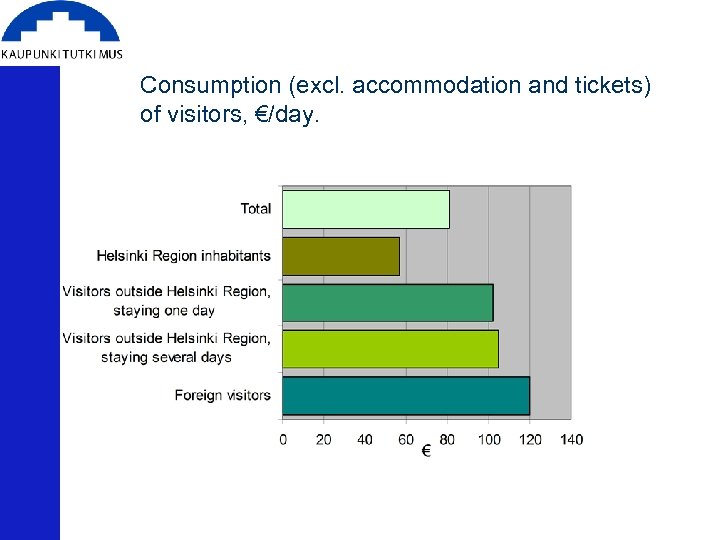 Consumption (excl. accommodation and tickets) of visitors, €/day.
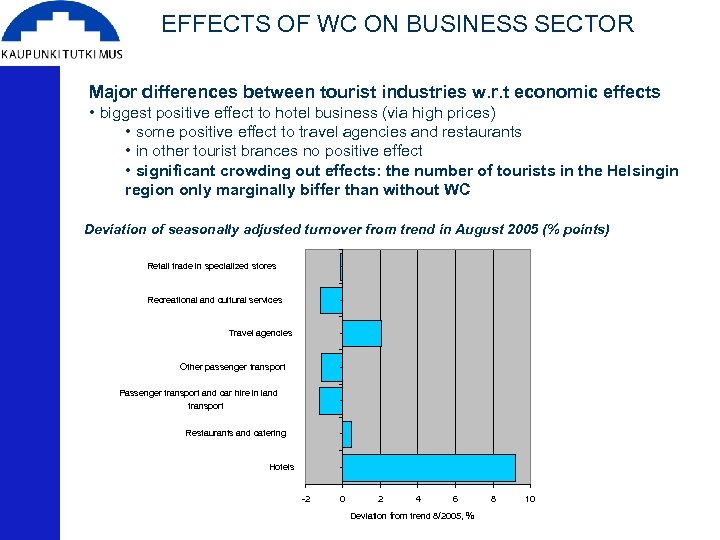 EFFECTS OF WC ON BUSINESS SECTOR Major differences between tourist industries w. r. t economic effects • biggest positive effect to hotel business (via high prices) • some positive effect to travel agencies and restaurants • in other tourist brances no positive effect • significant crowding out effects: the number of tourists in the Helsingin region only marginally biffer than without WC Deviation of seasonally adjusted turnover from trend in August 2005 (% points) Retail trade in specialized stores Recreational and cultural services Travel agencies Other passenger transport Passenger transport and car hire in land transport Restaurants and catering Hotels -2 0 2 4 6 Deviation from trend 8/2005, % 8 10
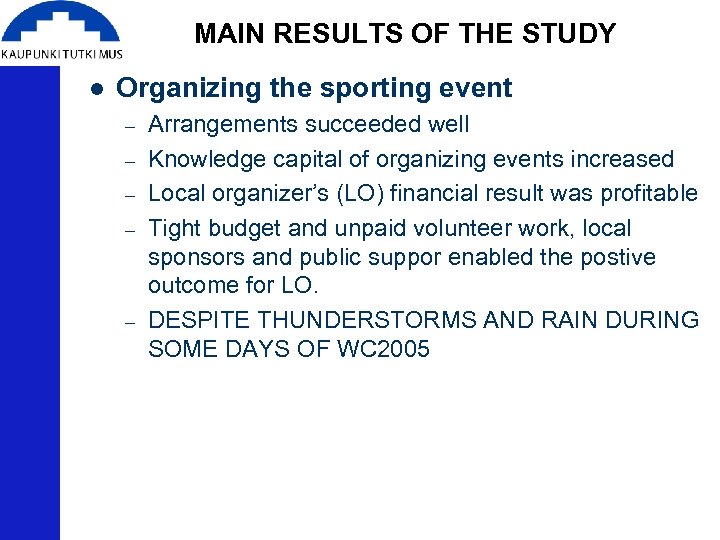 MAIN RESULTS OF THE STUDY l Organizing the sporting event – – – Arrangements succeeded well Knowledge capital of organizing events increased Local organizer’s (LO) financial result was profitable Tight budget and unpaid volunteer work, local sponsors and public suppor enabled the postive outcome for LO. DESPITE THUNDERSTORMS AND RAIN DURING SOME DAYS OF WC 2005
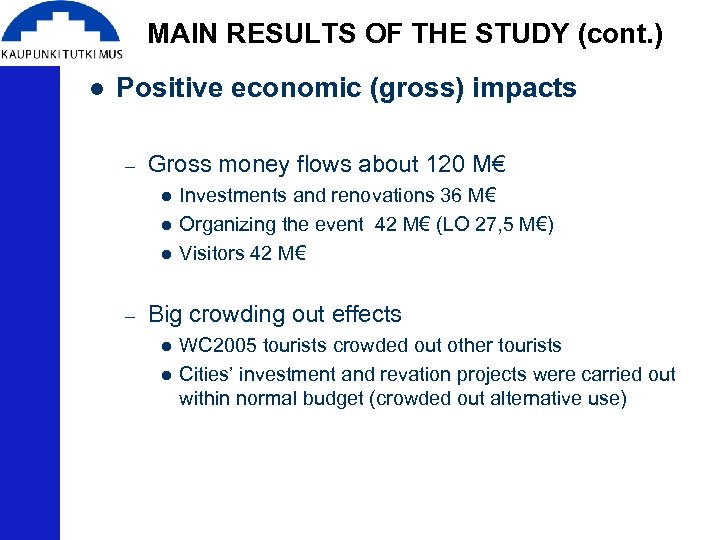 MAIN RESULTS OF THE STUDY (cont. ) l Positive economic (gross) impacts – Gross money flows about 120 M€ l l l – Investments and renovations 36 M€ Organizing the event 42 M€ (LO 27, 5 M€) Visitors 42 M€ Big crowding out effects l l WC 2005 tourists crowded out other tourists Cities’ investment and revation projects were carried out within normal budget (crowded out alternative use)
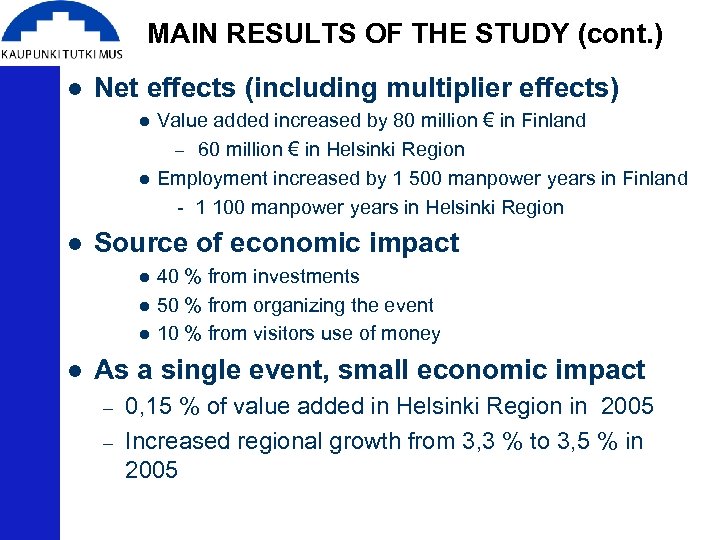 MAIN RESULTS OF THE STUDY (cont. ) l Net effects (including multiplier effects) l l l Source of economic impact l l Value added increased by 80 million € in Finland – 60 million € in Helsinki Region Employment increased by 1 500 manpower years in Finland - 1 100 manpower years in Helsinki Region 40 % from investments 50 % from organizing the event 10 % from visitors use of money As a single event, small economic impact – – 0, 15 % of value added in Helsinki Region in 2005 Increased regional growth from 3, 3 % to 3, 5 % in 2005
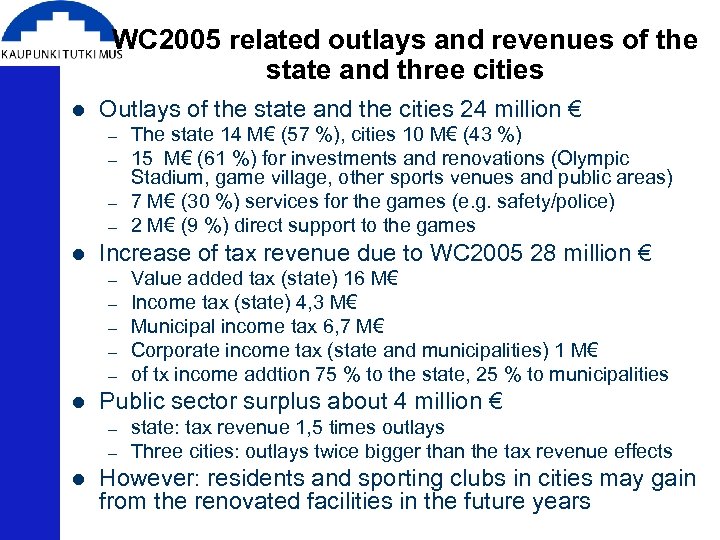 WC 2005 related outlays and revenues of the state and three cities l Outlays of the state and the cities 24 million € – – l Increase of tax revenue due to WC 2005 28 million € – – – l Value added tax (state) 16 M€ Income tax (state) 4, 3 M€ Municipal income tax 6, 7 M€ Corporate income tax (state and municipalities) 1 M€ of tx income addtion 75 % to the state, 25 % to municipalities Public sector surplus about 4 million € – – l The state 14 M€ (57 %), cities 10 M€ (43 %) 15 M€ (61 %) for investments and renovations (Olympic Stadium, game village, other sports venues and public areas) 7 M€ (30 %) services for the games (e. g. safety/police) 2 M€ (9 %) direct support to the games state: tax revenue 1, 5 times outlays Three cities: outlays twice bigger than the tax revenue effects However: residents and sporting clubs in cities may gain from the renovated facilities in the future years
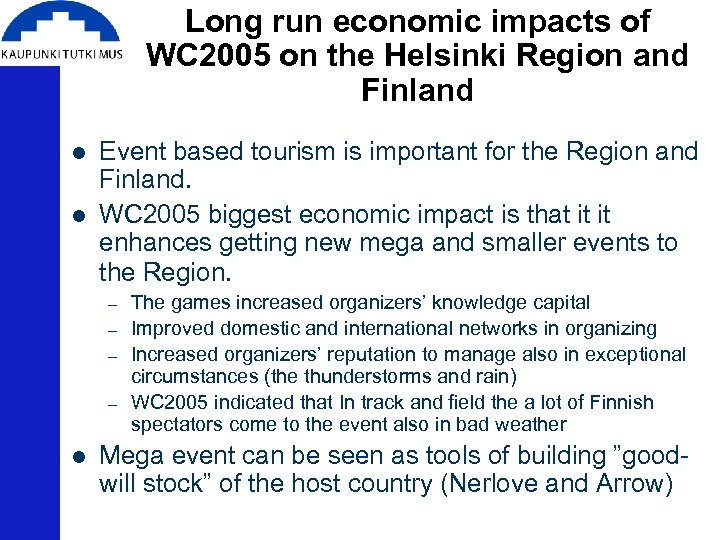 Long run economic impacts of WC 2005 on the Helsinki Region and Finland l l Event based tourism is important for the Region and Finland. WC 2005 biggest economic impact is that it it enhances getting new mega and smaller events to the Region. – – l The games increased organizers’ knowledge capital Improved domestic and international networks in organizing Increased organizers’ reputation to manage also in exceptional circumstances (the thunderstorms and rain) WC 2005 indicated that In track and field the a lot of Finnish spectators come to the event also in bad weather Mega event can be seen as tools of building ”goodwill stock” of the host country (Nerlove and Arrow)
 On the role of IAAF • The process of selecting the host for the games is questionable. • Applicants (consortiums of cities, regions, states and sports organizations) must make public and transparent commitments to finance the events. • The economy of IAAF is not transparent, its financial statements are secret. • Applicants do not know the resources of IAAF and the investments it is willing to make to finance the games • Why do EU countries accept that a non-transparent organization like IAAF races candidates with rather vague terms?
 On the role of IAAF (cont. ) • WC 2005 brought IAAF 20 M € from its sponsors and as income from selling the TV rights. • Cost of organizing the event as about 27, 5 M €. • Despite this, IAAF did not finance the event directly. • It only gave certain things worth 1, 2 million €. • The local organizers paid most costs of athletes and accredited guests including IAAF’s guests. • LO and the state carried all the financial risks of organizing WC 2005, • IAAF had no risks, but instead could reap the gains of its monopoly position as seller of TV contracts and international sponsor positions.