


 Скачать презентацию Impacts of the FCC s Lifeline Reform Order Olivia
31ee8bf030ce4c9fc87ae730abbe9474.ppt
- Количество слайдов: 14
 Impacts of the FCC’s Lifeline Reform Order Olivia Wein, Staff Attorney National Consumer Law Center NASUCA Mid-Year Meeting June 26, 2012 Charleston, South Carolina 1
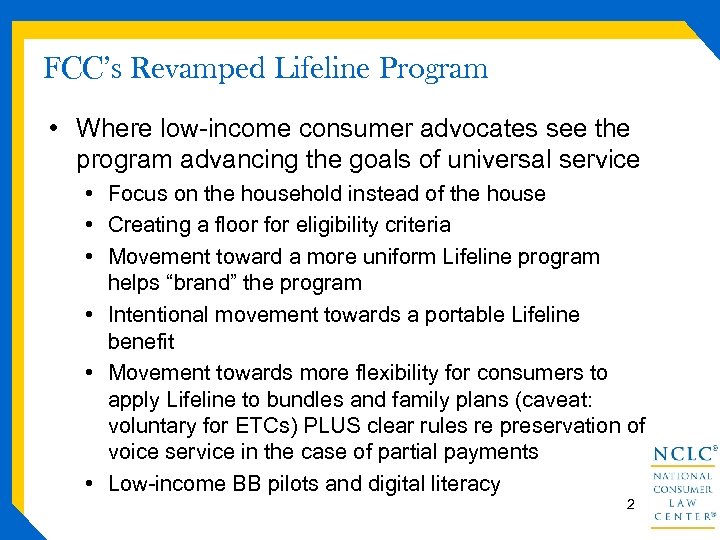 FCC’s Revamped Lifeline Program • Where low-income consumer advocates see the program advancing the goals of universal service • Focus on the household instead of the house • Creating a floor for eligibility criteria • Movement toward a more uniform Lifeline program helps “brand” the program • Intentional movement towards a portable Lifeline benefit • Movement towards more flexibility for consumers to apply Lifeline to bundles and family plans (caveat: voluntary for ETCs) PLUS clear rules re preservation of voice service in the case of partial payments • Low-income BB pilots and digital literacy 2
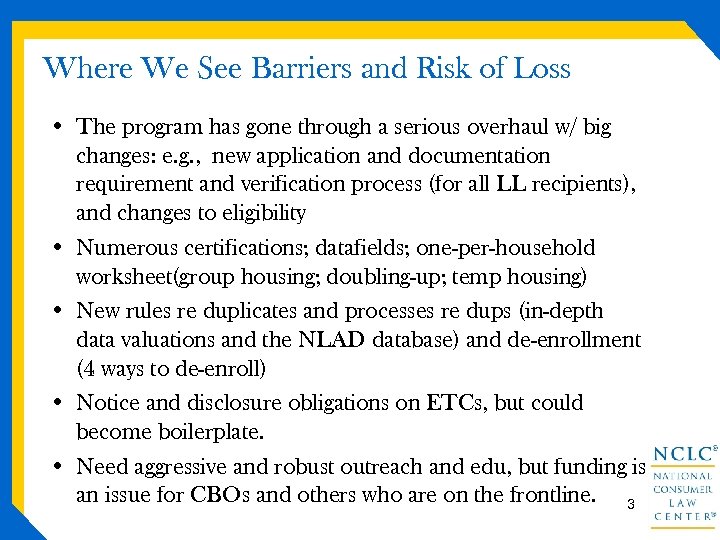 Where We See Barriers and Risk of Loss • The program has gone through a serious overhaul w/ big changes: e. g. , new application and documentation requirement and verification process (for all LL recipients), and changes to eligibility • Numerous certifications; datafields; one-per-household worksheet(group housing; doubling-up; temp housing) • New rules re duplicates and processes re dups (in-depth data valuations and the NLAD database) and de-enrollment (4 ways to de-enroll) • Notice and disclosure obligations on ETCs, but could become boilerplate. • Need aggressive and robust outreach and edu, but funding is an issue for CBOs and others who are on the frontline. 3
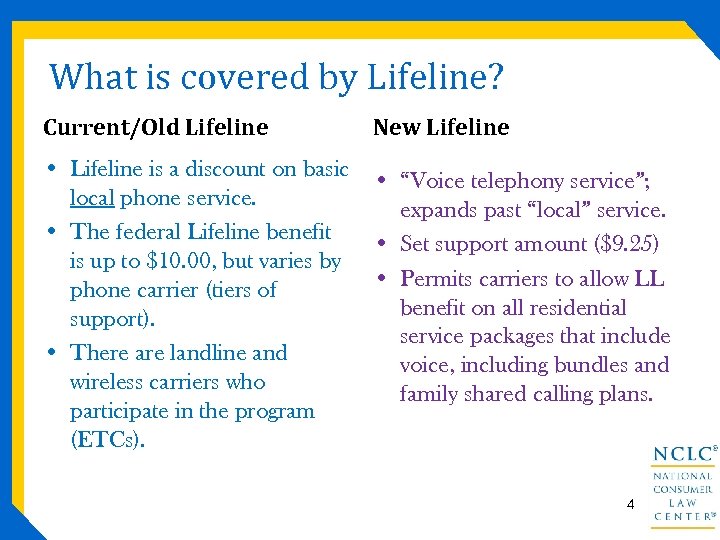 What is covered by Lifeline? Current/Old Lifeline New Lifeline • Lifeline is a discount on basic • “Voice telephony service”; local phone service. expands past “local” service. • The federal Lifeline benefit • Set support amount ($9. 25) is up to $10. 00, but varies by • Permits carriers to allow LL phone carrier (tiers of benefit on all residential support). service packages that include • There are landline and voice, including bundles and wireless carriers who family shared calling plans. participate in the program (ETCs). 4
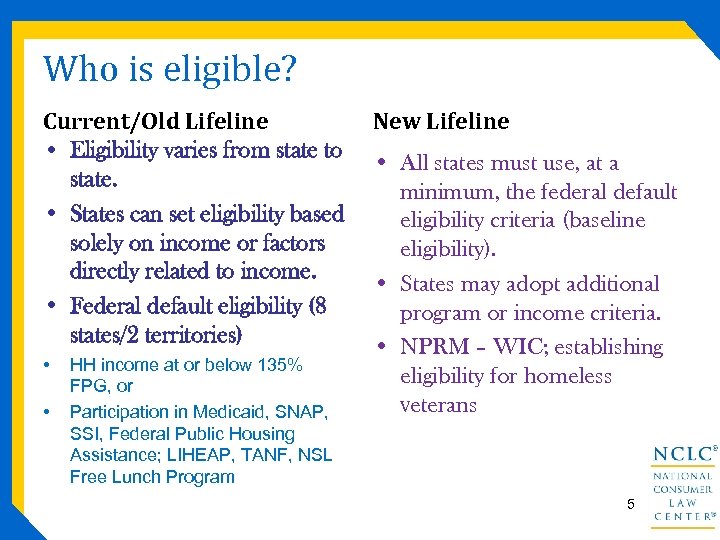 Who is eligible? Current/Old Lifeline • Eligibility varies from state to state. • States can set eligibility based solely on income or factors directly related to income. • Federal default eligibility (8 states/2 territories) • • HH income at or below 135% FPG, or Participation in Medicaid, SNAP, SSI, Federal Public Housing Assistance; LIHEAP, TANF, NSL Free Lunch Program New Lifeline • All states must use, at a minimum, the federal default eligibility criteria (baseline eligibility). • States may adopt additional program or income criteria. • NPRM – WIC; establishing eligibility for homeless veterans 5
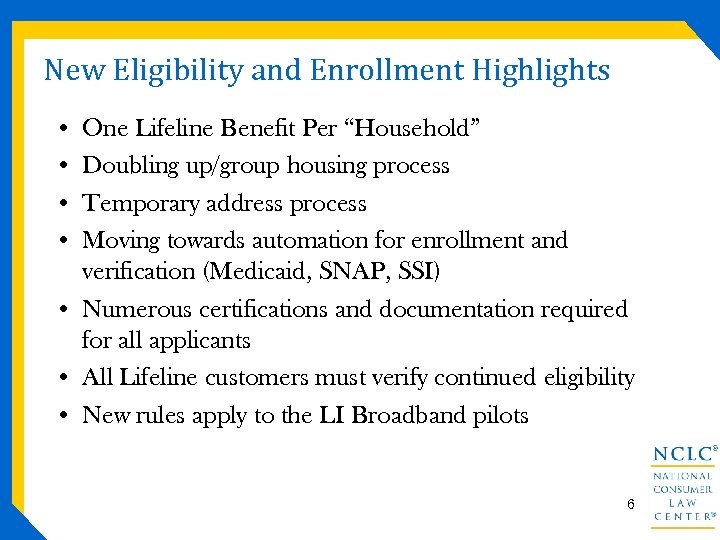 New Eligibility and Enrollment Highlights • • One Lifeline Benefit Per “Household” Doubling up/group housing process Temporary address process Moving towards automation for enrollment and verification (Medicaid, SNAP, SSI) • Numerous certifications and documentation required for all applicants • All Lifeline customers must verify continued eligibility • New rules apply to the LI Broadband pilots 6
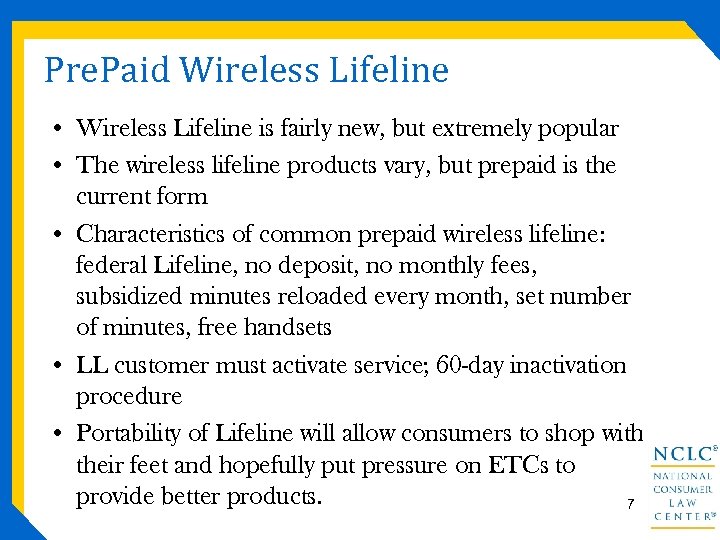 Pre. Paid Wireless Lifeline • Wireless Lifeline is fairly new, but extremely popular • The wireless lifeline products vary, but prepaid is the current form • Characteristics of common prepaid wireless lifeline: federal Lifeline, no deposit, no monthly fees, subsidized minutes reloaded every month, set number of minutes, free handsets • LL customer must activate service; 60 -day inactivation procedure • Portability of Lifeline will allow consumers to shop with their feet and hopefully put pressure on ETCs to provide better products. 7
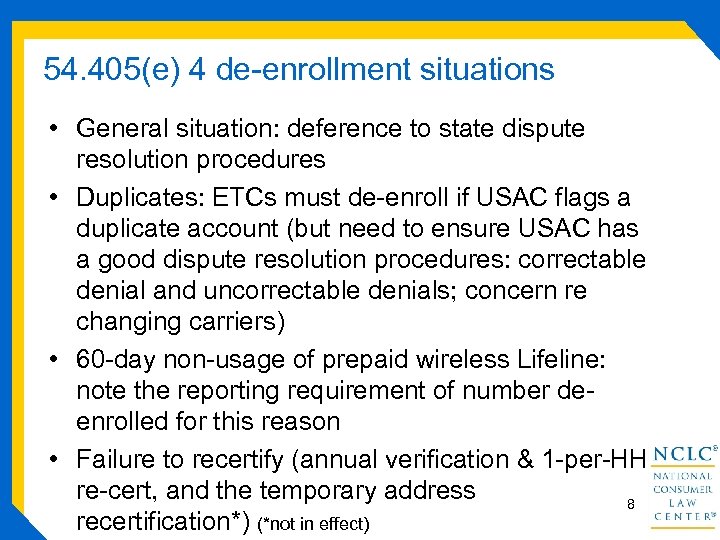 54. 405(e) 4 de-enrollment situations • General situation: deference to state dispute resolution procedures • Duplicates: ETCs must de-enroll if USAC flags a duplicate account (but need to ensure USAC has a good dispute resolution procedures: correctable denial and uncorrectable denials; concern re changing carriers) • 60 -day non-usage of prepaid wireless Lifeline: note the reporting requirement of number deenrolled for this reason • Failure to recertify (annual verification & 1 -per-HH re-cert, and the temporary address 8 recertification*) (*not in effect)
 Duplicates and Database(s) • Process started in the states to check for duplicate Lifeline support (in-depth data valuations) and will likely continue until duplicates database is operational. • Moving to an automated check for duplicate benefits (National Lifeline Accountability Database) • Need consumer’s consent to transmit info to USAC for the duplicates check • SSNs (last 4 digits): privacy/security/limits access • Temp/doubling up/group housing processes 9
 Consumer information/data fields • • • 54. 404(b)(6) NLAD Full name Full res’l address DOB SSN/tribal ID number (last 4) Date service initiated/terminated • Amount of support sought • How qualified • 54. 410(d)(2) applications • Full name • Full res’l address – Temp/perm address – Check box if multiple HH at address – Billing address if different • DOB • SSN/tribal ID number (last 4) • If program eligible, which program • If income eligible, how many in HH 10
 54. 410(d)(3) certifications for new applicants • • • Applicant meets eligibility criteria Duty to notify ETC if no longer eligible If applying for Tribal LL, lives on tribal land Duty to notify ETC if moves to new address If provided a temp address, duty to recertify every 90 days • Household only receives one LL benefit • Information is true and correct • Consequences of providing false info 11
 Key take-away The outreach and education will be critical to mitigate loss in participation during this transition and moving forward. • Documentation; certifications; timelines • Understanding de-enrollment and the processes for correcting denials • Duplicates/one-per-household/NLAD 2012 – annual re-certification of all existing LL customers; More guidance will be issued re 2013 and moving forward 12
 Next Steps • Low Income Broadband Pilots • Issues still under consideration • • • Eligibility Database (cost/ feasibility) Digital Literacy Program WIC Eligibility for Homeless Veterans Mandatory Application of Lifeline to Bundles Lifeline Support Amount Eligible Telecommunication Carrier Requirements Tribal Lands Support Other 13
 For More Information Olivia Wein, Staff Attorney National Consumer Law Center 1001 Connecticut Avenue, NW, Suite 510 Washington, DC 20036 202 -452 -6252 owein@nclc. org 14