


 Скачать презентацию Impact of Realistic Tele-Communications for Fast-acting Demand Side
b4d8c28eca2fc71df0b0abf0d030040d.ppt
- Количество слайдов: 11
 Impact of Realistic Tele-Communications for Fast-acting Demand Side Management P. Dambrauskas, M. H. Syed, S. M. Blair, J. M. Irvine, I. F. Abdulhadi, G. M. Burt University of Strathclyde – UK paulius. dambrauskas@strath. ac. uk ETP Annual Conference 2017 10 th October 2017
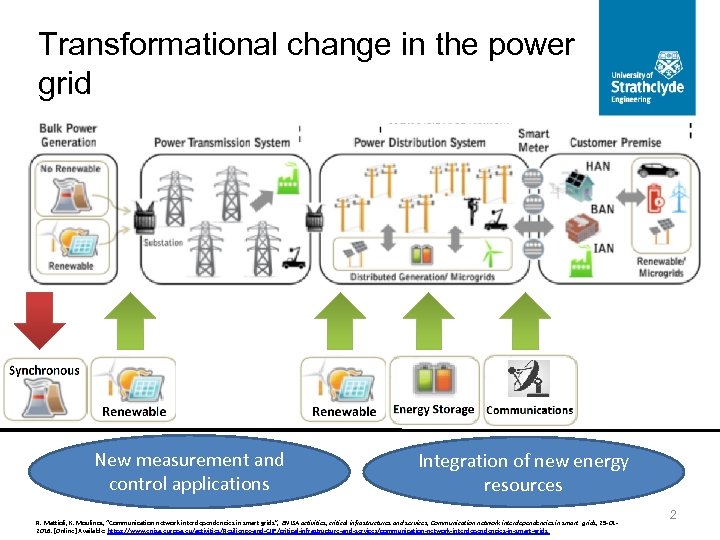 Transformational change in the power grid New measurement and control applications Integration of new energy resources R. Mattioli, K. Moulinos, “Communication network interdependencies in smart grids”, ENISA activities, critical infrastructures and services, Communication network interdependencies in smart grids, 29 -012016. [Online] Available: https: //www. enisa. europa. eu/activities/Resilience-and-CIIP/critical-infrastructure-and-services/communication-network-interdependencies-in-smart-grids 2
 Frequency balancing and demand side resources • We need reliable and cheap frequency balancing resources due to the rise of renewable generation • Existence of 22 demand side aggregators present in Great Britain shows the interest system operators in smaller and distributed energy resources 3
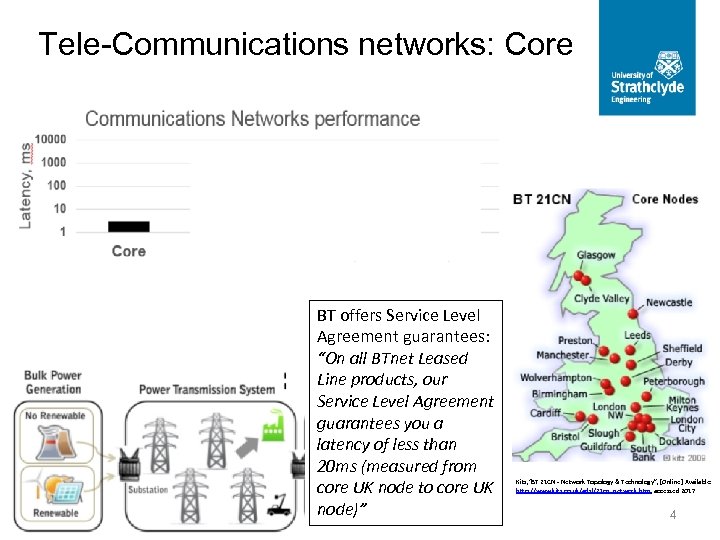 Tele-Communications networks: Core BT offers Service Level Agreement guarantees: “On all BTnet Leased Line products, our Service Level Agreement guarantees you a latency of less than 20 ms (measured from core UK node to core UK node)” Kitz, “BT 21 CN - Network Topology & Technology”, [Online] Available: http: //www. kitz. co. uk/adsl/21 cn_network. htm, accessed 2017 4
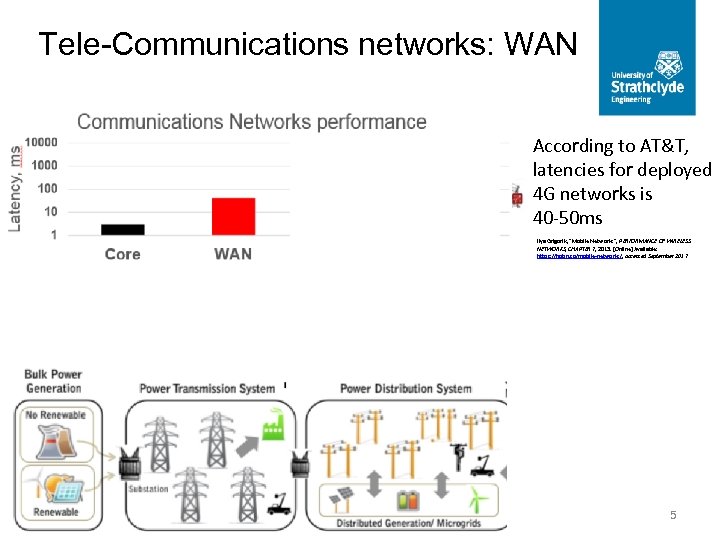 Tele-Communications networks: WAN According to AT&T, latencies for deployed 4 G networks is 40 -50 ms Ilya Grigorik, “Mobile Networks”, PERFORMANCE OF WIRELESS NETWORKS, CHAPTER 7, 2013. [Online] Available: https: //hpbn. co/mobile-networks/, accessed September 2017 5
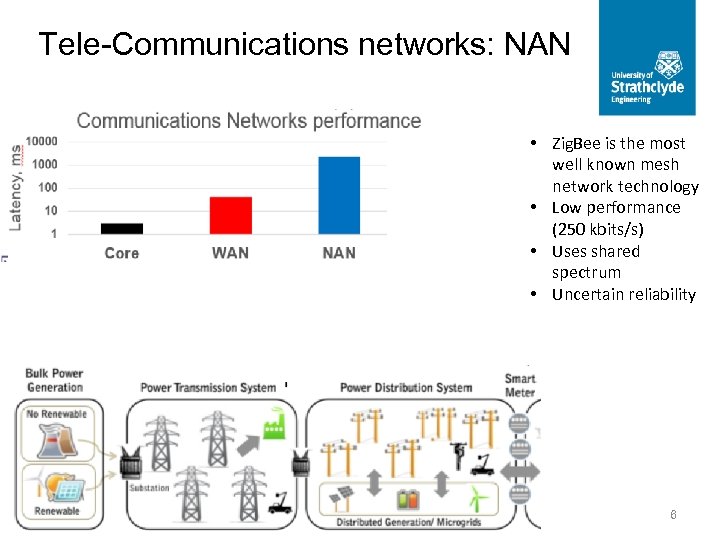 Tele-Communications networks: NAN • Zig. Bee is the most well known mesh network technology • Low performance (250 kbits/s) • Uses shared spectrum • Uncertain reliability 6
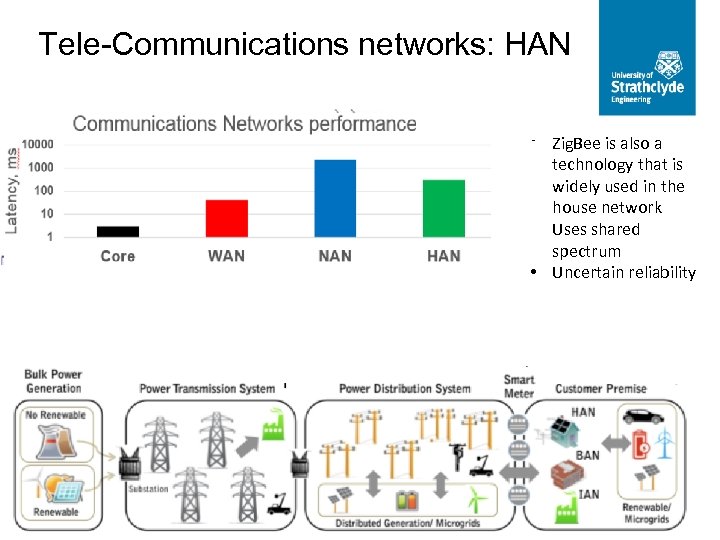 Tele-Communications networks: HAN • Zig. Bee is also a technology that is widely used in the house network • Uses shared spectrum • Uncertain reliability 7
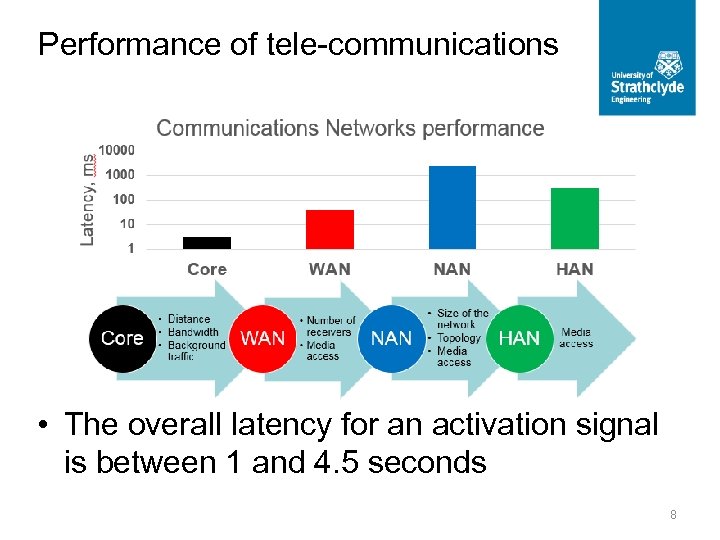 Performance of tele-communications • The overall latency for an activation signal is between 1 and 4. 5 seconds 8
 Requirements of ancillary services in UK • We need a response to a frequency deviation within 10 seconds for primary frequency response • UK’s enhanced frequency response expects a sub second response 9
 Conclusions • Communications is the enabler of the smart grid which makes it possible for Domestic loads to be part of ancillary services • The role of DSM in ancillary services will depend on the communications technologies used 10
 Future work • Analysis of the impact communications can have on frequency balancing using a RTDS based power system communications test-bed 11