


 Скачать презентацию Impact of nutrition and management on the occurrence
354dc64deb8e8870a38e11e3503fc0fb.ppt
- Количество слайдов: 64
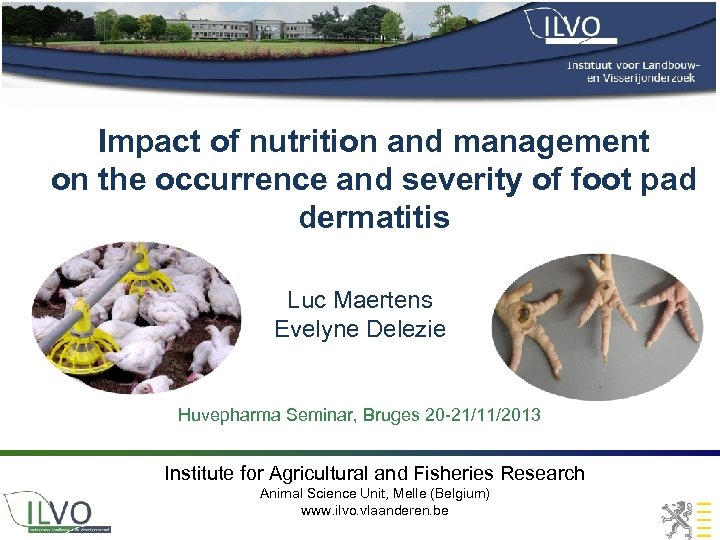 Impact of nutrition and management on the occurrence and severity of foot pad dermatitis Luc Maertens Evelyne Delezie Huvepharma Seminar, Bruges 20 -21/11/2013 Institute for Agricultural and Fisheries Research Animal Science Unit, Melle (Belgium) www. ilvo. vlaanderen. be
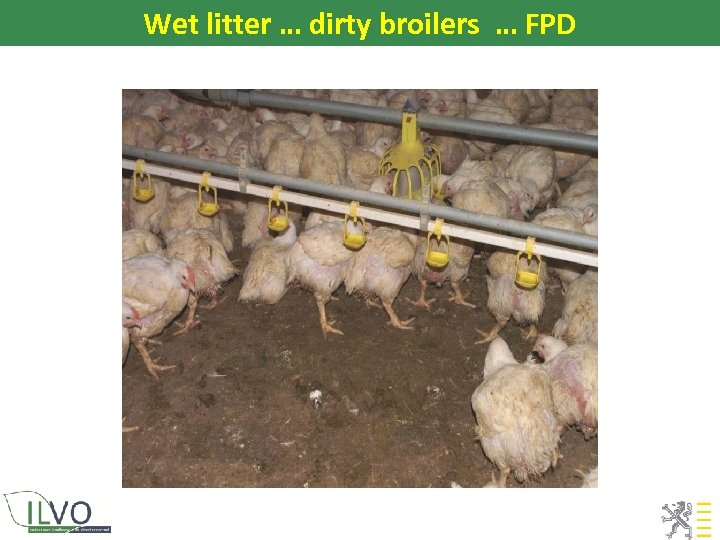
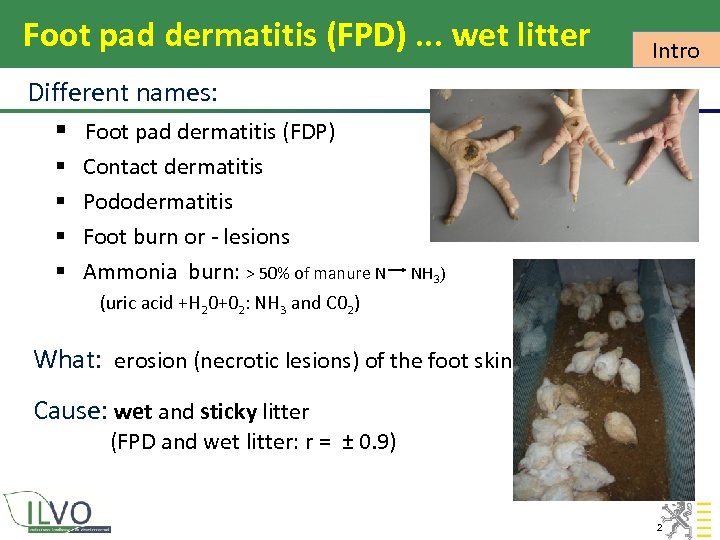 Foot pad dermatitis (FPD). . . wet litter Intro Different names: § Foot pad dermatitis (FDP) § § Contact dermatitis Pododermatitis Foot burn or - lesions Ammonia burn: > 50% of manure N NH 3) (uric acid +H 20+02: NH 3 and C 02) What: erosion (necrotic lesions) of the foot skin Cause: wet and sticky litter (FPD and wet litter: r = ± 0. 9) 2
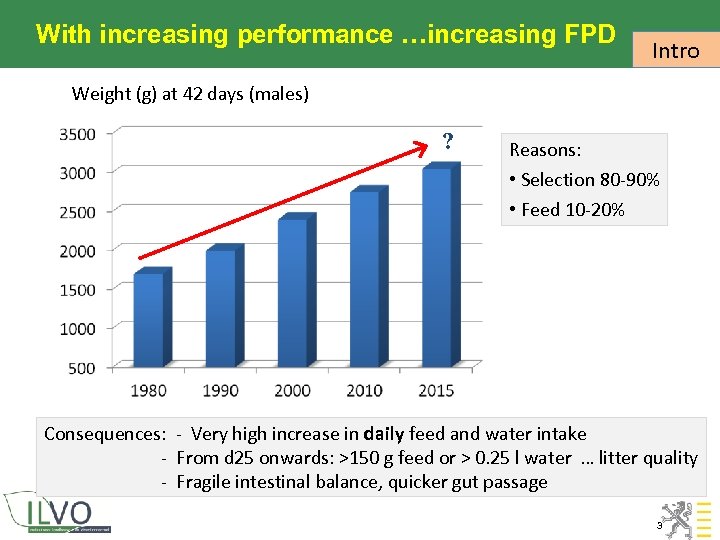 Development of performance With increasingbroiler weight …increasing FPD Intro Weight (g) at 42 days (males) ? Reasons: • Selection 80 -90% • Feed 10 -20% Consequences: - Very high increase in daily feed and water intake - From d 25 onwards: >150 g feed or > 0. 25 l water … litter quality - Fragile intestinal balance, quicker gut passage 3
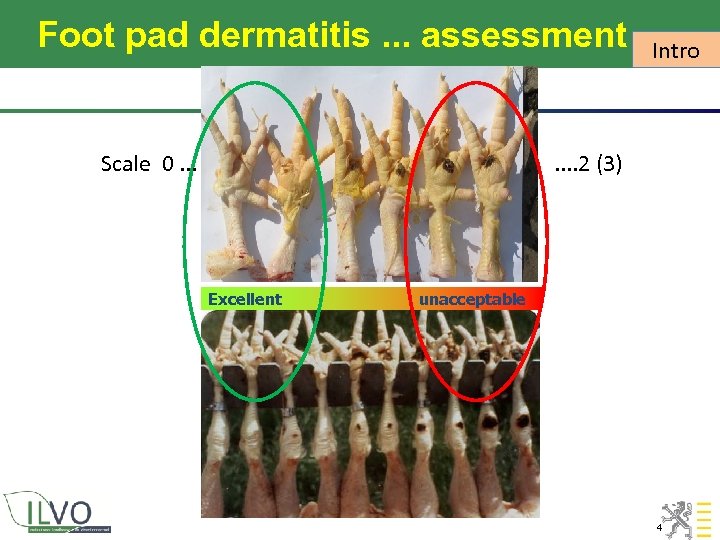 Foot pad dermatitis. . . assessment Scale 0. . . Intro . . 2 (3) Excellent unacceptable 4
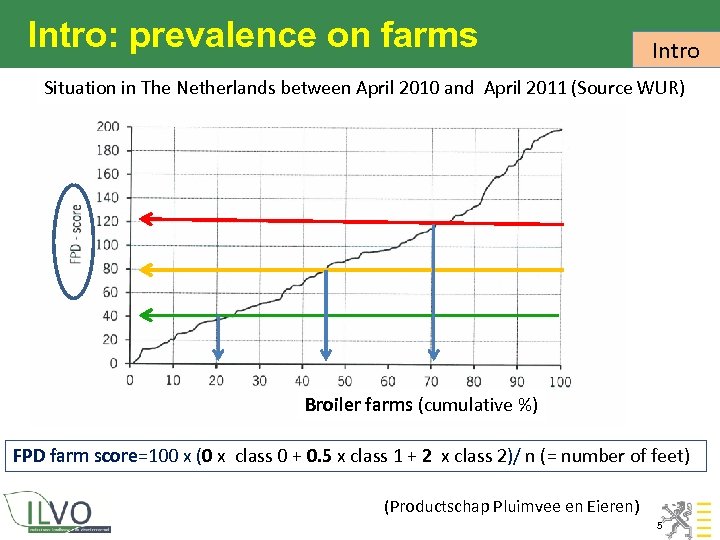 Intro: prevalence on farms Intro Situation in The Netherlands between April 2010 and April 2011 (Source WUR) Broiler farms (cumulative %) FPD farm score=100 x (0 x class 0 + 0. 5 x class 1 + 2 x class 2)/ n (= number of feet) (Productschap Pluimvee en Eieren) 5
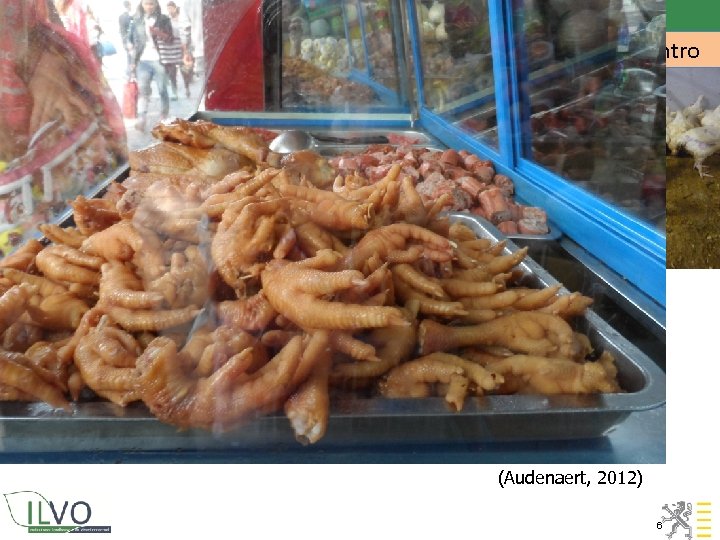 Adverse effects of foot pad dermatitis Intro Ø Animal welfare (pain, move less, eat and drink less) Ø Links with prevalence of breast blisters & rejections at slaughterhouse Ø Dirty broilers, catching. . . Ø A gateway for bacteria (secondary infections) Ø Reduced use of antibiotics (link with gut health, litter quality) Ø Economical value of feet (Asia) Ø Reduced performances (DWG & FCR) because of reduced mobility Litter moisture DWG FCR Prob. (P) with litter moisture, % 0. 036 0. 001 Corr. (R) with litter moisture, % -0. 373 0. 544 (Audenaert, 2012) 6
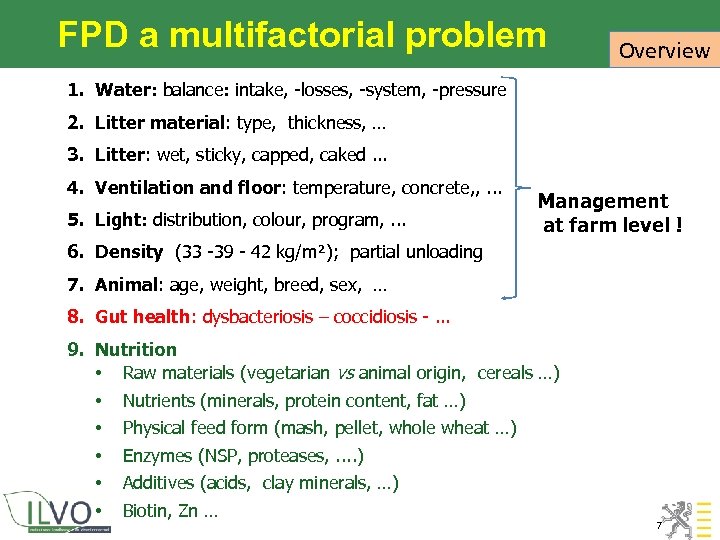 FPD a multifactorial problem Overview 1. Water: balance: intake, -losses, -system, -pressure 2. Litter material: type, thickness, … 3. Litter: wet, sticky, capped, caked. . . 4. Ventilation and floor: temperature, concrete, , . . . 5. Light: distribution, colour, program, . . . Management at farm level ! 6. Density (33 -39 - 42 kg/m²); partial unloading 7. Animal: age, weight, breed, sex, … 8. Gut health: dysbacteriosis – coccidiosis -. . . 9. Nutrition • Raw materials (vegetarian vs animal origin, cereals …) • Nutrients (minerals, protein content, fat …) • Physical feed form (mash, pellet, whole wheat …) • Enzymes (NSP, proteases, . . ) • Additives (acids, clay minerals, …) • Biotin, Zn … 7
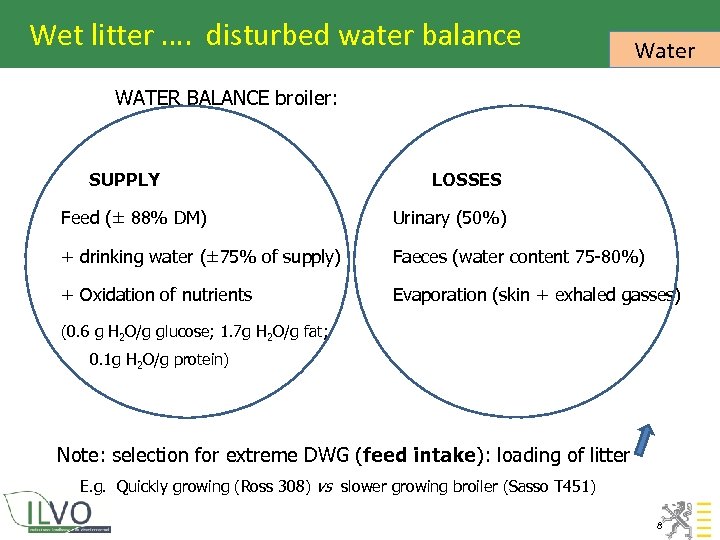 Wet litter …. disturbed water balance Water WATER BALANCE broiler: SUPPLY LOSSES Feed (± 88% DM) Urinary (50%) + drinking water (± 75% of supply) Faeces (water content 75 -80%) + Oxidation of nutrients Evaporation (skin + exhaled gasses) (0. 6 g H 2 O/g glucose; 1. 7 g H 2 O/g fat; 0. 1 g H 2 O/g protein) Note: selection for extreme DWG (feed intake): loading of litter E. g. Quickly growing (Ross 308) vs slower growing broiler (Sasso T 451) 8
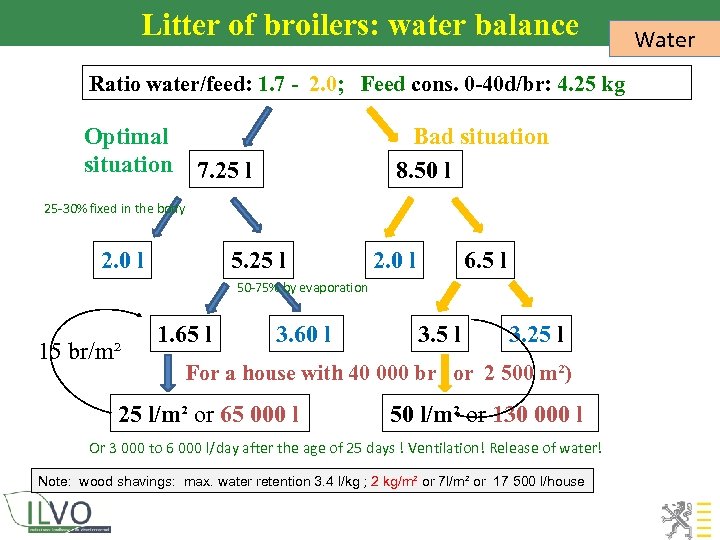 Litter of broilers: water balance Ratio water/feed: 1. 7 - 2. 0; Feed cons. 0 -40 d/br: 4. 25 kg Optimal situation Bad situation 8. 50 l 7. 25 l 25 -30% fixed in the body 2. 0 l 5. 25 l 2. 0 l 6. 5 l 50 -75% by evaporation 15 br/m² 1. 65 l 3. 60 l 3. 5 l 3. 25 l For a house with 40 000 br or 2 500 m²) 25 l/m² or 65 000 l 50 l/m² or 130 000 l Or 3 000 to 6 000 l/day after the age of 25 days ! Ventilation! Release of water! Note: wood shavings: max. water retention 3. 4 l/kg ; 2 kg/m² or 7 l/m² or 17 500 l/house Water
 Wet litter … dirty broilers … FPD
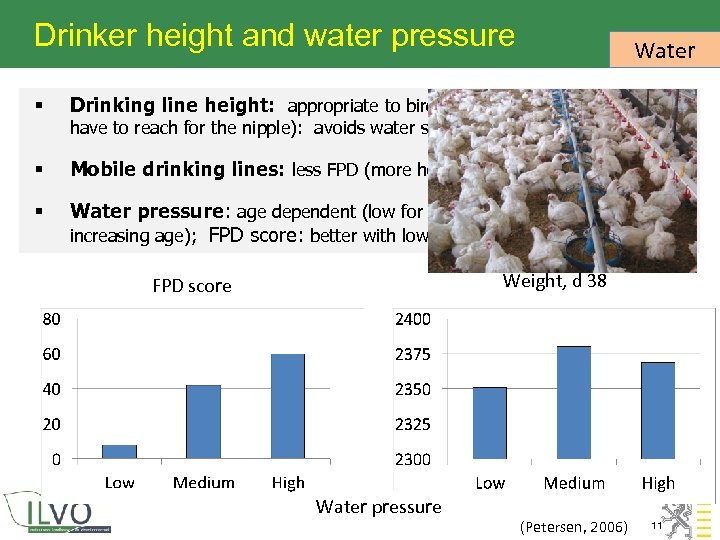 Drinker height and water pressure Water § Drinking line height: appropriate to bird height (when standing birds § Mobile drinking lines: less FPD (more homogeneous litter) § Water pressure: age dependent (low for young birds, higher with increasing age); FPD score: better with low pressure BUT performances. . . have to reach for the nipple): avoids water spillage or “playing” Weight, d 38 FPD score Water pressure (Petersen, 2006) 11
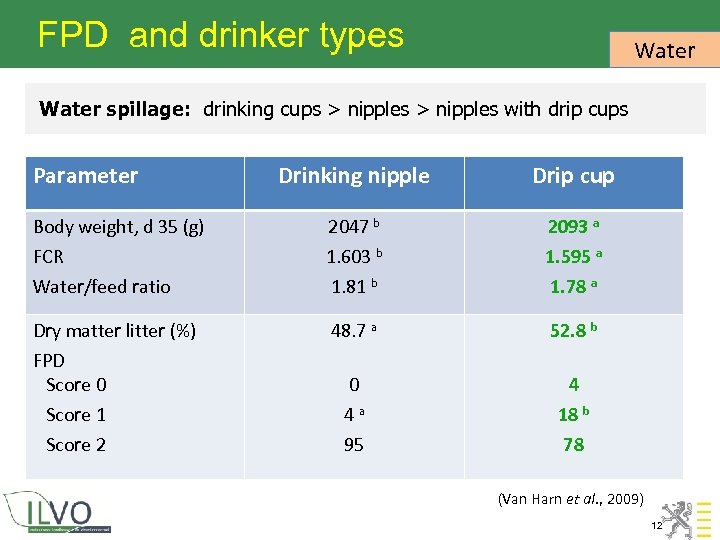 FPD and drinker types Water spillage: drinking cups > nipples with drip cups Parameter Drinking nipple Drip cup Body weight, d 35 (g) 2047 b 2093 a FCR Water/feed ratio 1. 603 b 1. 81 b 1. 595 a 1. 78 a Dry matter litter (%) 48. 7 a 52. 8 b 0 4 a 95 4 18 b 78 FPD Score 0 Score 1 Score 2 (Van Harn et al. , 2009) 12
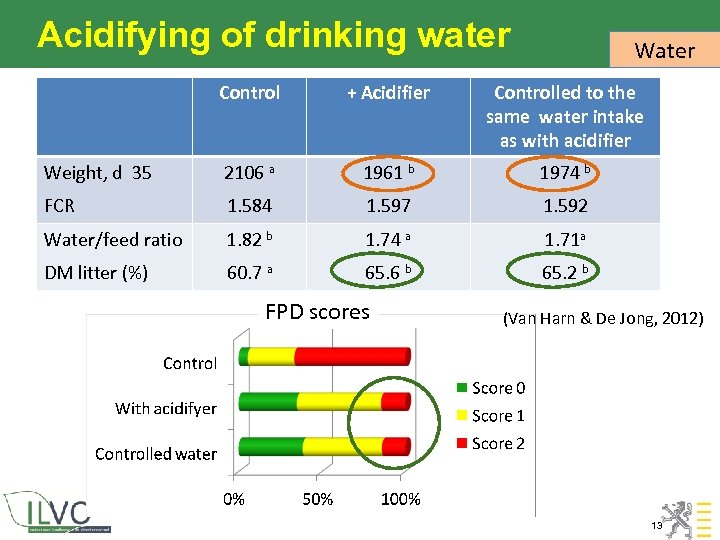 Acidifying of drinking water Water Control + Acidifier Controlled to the same water intake as with acidifier Weight, d 35 2106 a 1961 b 1974 b FCR 1. 584 1. 597 1. 592 Water/feed ratio 1. 82 b 1. 74 a 1. 71 a DM litter (%) 60. 7 a 65. 6 b 65. 2 b FPD scores (Van Harn & De Jong, 2012) 13
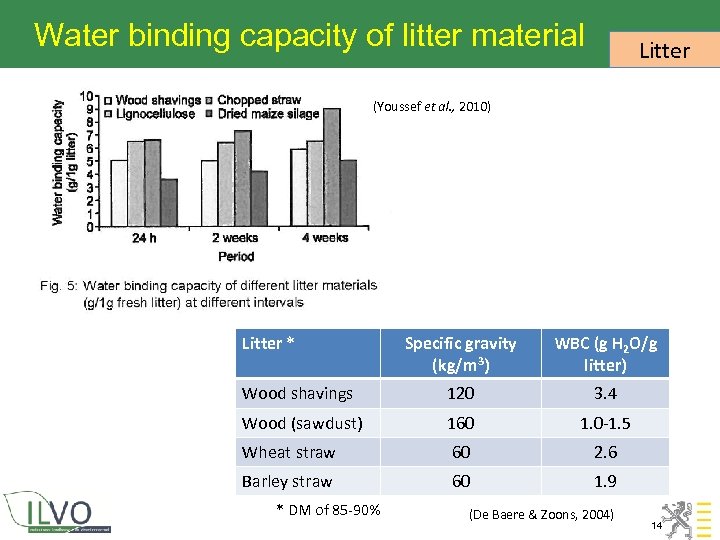 Water binding capacity of litter material Litter (Youssef et al. , 2010) Litter * Specific gravity (kg/m 3) WBC (g H 2 O/g litter) Wood shavings 120 3. 4 Wood (sawdust) 160 1. 0 -1. 5 Wheat straw 60 2. 6 Barley straw 60 1. 9 * DM of 85 -90% (De Baere & Zoons, 2004) 14
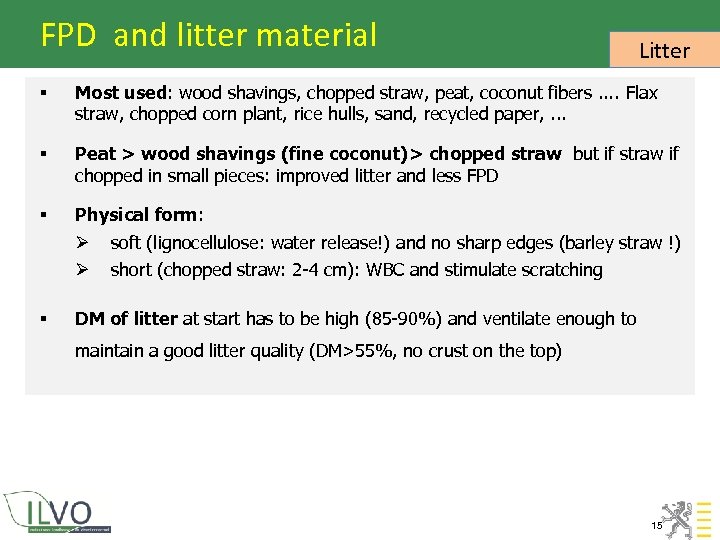 FPD and litter material Litter § Most used: wood shavings, chopped straw, peat, coconut fibers. . Flax straw, chopped corn plant, rice hulls, sand, recycled paper, . . . § Peat > wood shavings (fine coconut)> chopped straw but if straw if chopped in small pieces: improved litter and less FPD § Physical form: Ø Ø § soft (lignocellulose: water release!) and no sharp edges (barley straw !) short (chopped straw: 2 -4 cm): WBC and stimulate scratching DM of litter at start has to be high (85 -90%) and ventilate enough to maintain a good litter quality (DM>55%, no crust on the top) 15
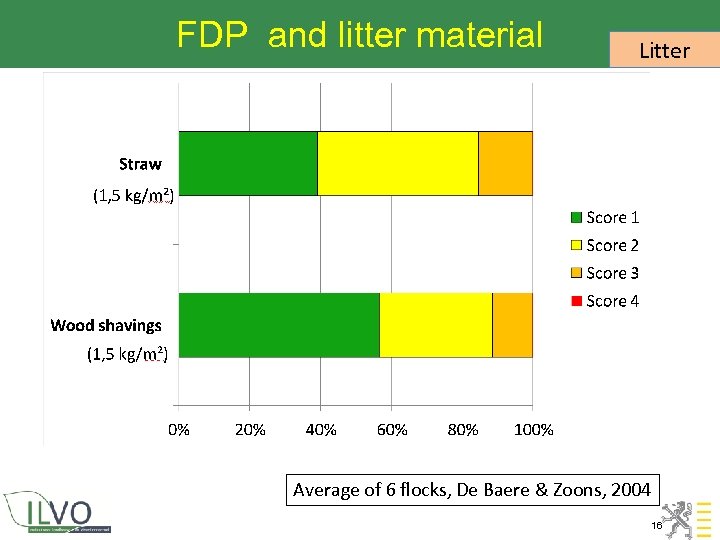 FDP and litter material Litter Average of 6 flocks, De Baere & Zoons, 2004 16
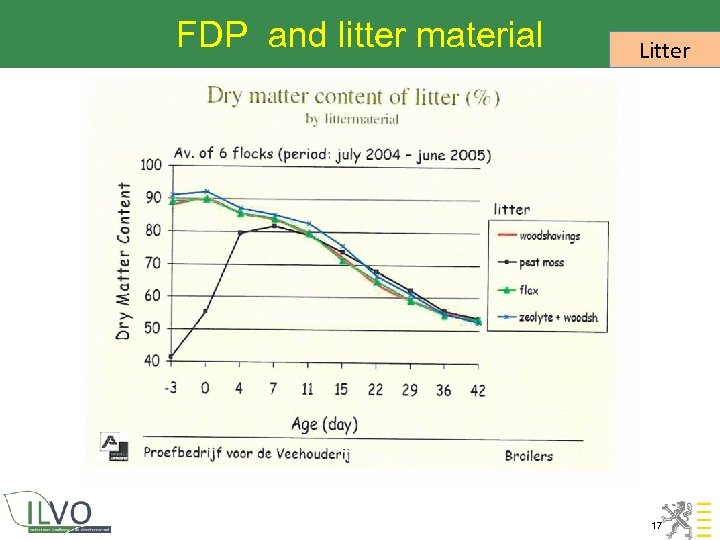 FDP and litter material Litter 17
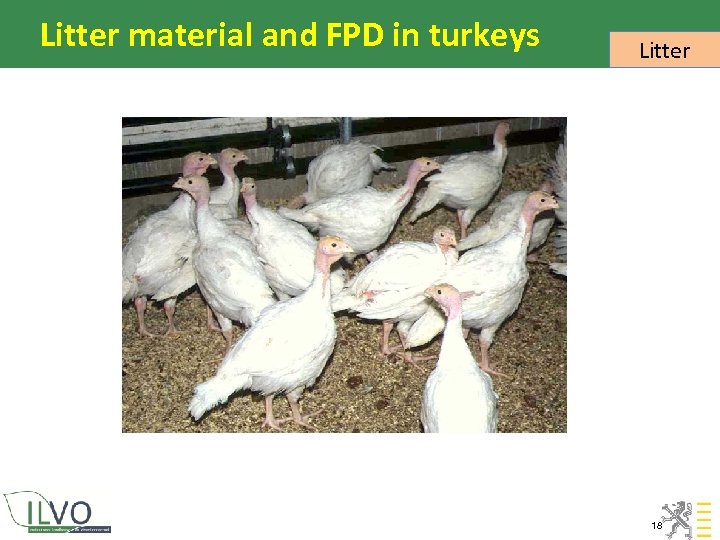 Litter material and FPD in turkeys Litter 18
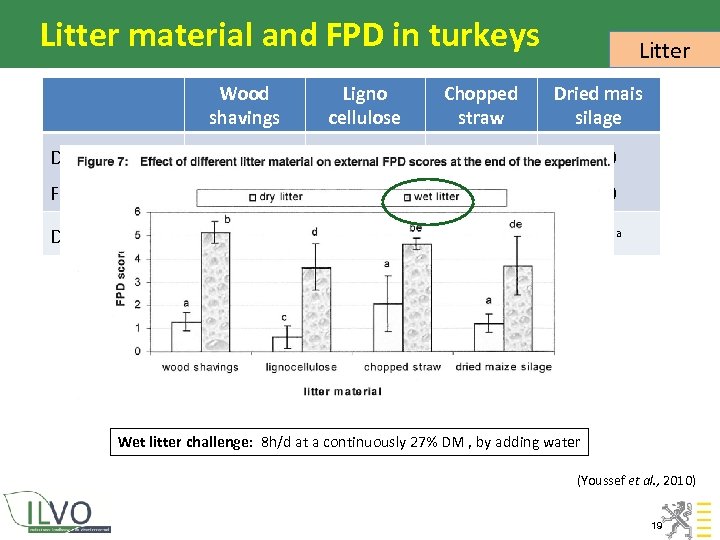 Litter material and FPD in turkeys Litter Wood shavings Ligno cellulose Chopped & De Jong, mais Dried 2012 Van Harn straw silage DWG (d 15 -42) 68. 8 67. 1 72. 4 72. 0 FCR 1. 51 1. 63 1. 61 1. 60 DM litter, % 76. 7 a 83. 2 b 68. 8 c 75. 0 a Wet litter challenge: 8 h/d at a continuously 27% DM , by adding water (Youssef et al. , 2010) 19
 FPD and bedding amount – litter depth Litter Ø Contrasting results: more bedding material does not necessary result in improved FDP (1. 0 vs 1. 5 kg/m² wood shavings or 1. 25 vs 2. 5 kg/m² straw) Ø Interactions with floor isolation, heating (e. g. under ground), ventilation? Ø If floor is well isolated: with a thin layer of litter (0. 5 – 1 kg/m²) ± 1 cm § Increased scratching and turning of the litter by the chicks § Increased aeration, drier and friable litter § But floor temperature! Pre-warming § Spreading of litter material after pre-warming to avoid condensation Ø If a “cold” floor: a ticker layer of litter is required (>2 -3 cm) 20
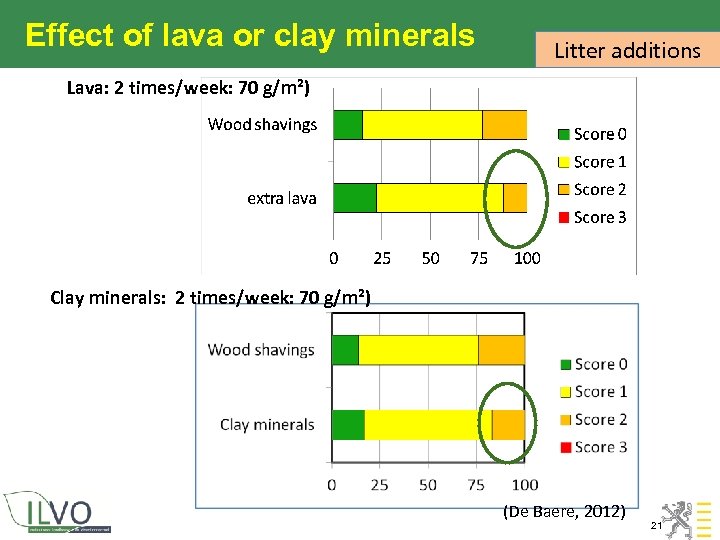 Effect of lava or clay minerals Litter additions Lava: 2 times/week: 70 g/m²) Clay minerals: 2 times/week: 70 g/m²) (De Baere, 2012) 21
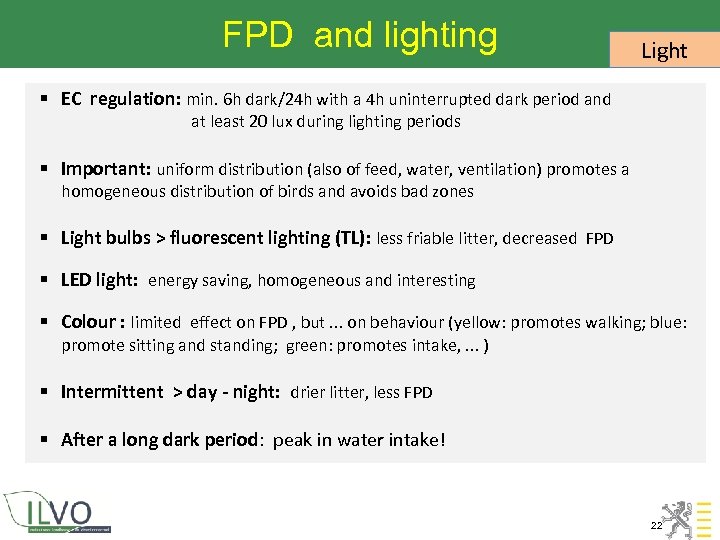 FPD and lighting Light § EC regulation: min. 6 h dark/24 h with a 4 h uninterrupted dark period and at least 20 lux during lighting periods § Important: uniform distribution (also of feed, water, ventilation) promotes a homogeneous distribution of birds and avoids bad zones § Light bulbs > fluorescent lighting (TL): less friable litter, decreased FPD § LED light: energy saving, homogeneous and interesting § Colour : limited effect on FPD , but. . . on behaviour (yellow: promotes walking; blue: promote sitting and standing; green: promotes intake, . . . ) § Intermittent > day - night: drier litter, less FPD § After a long dark period: peak in water intake! 22
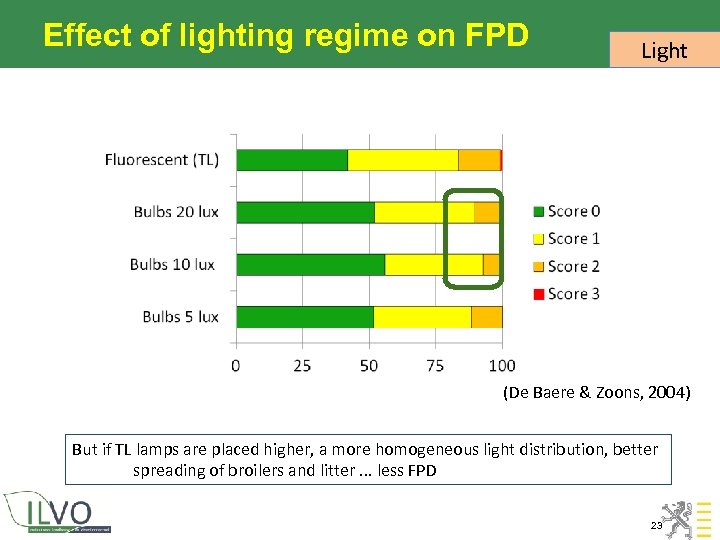 Effect of lighting regime on FPD Light (De Baere & Zoons, 2004) But if TL lamps are placed higher, a more homogeneous light distribution, better spreading of broilers and litter. . . less FPD 23
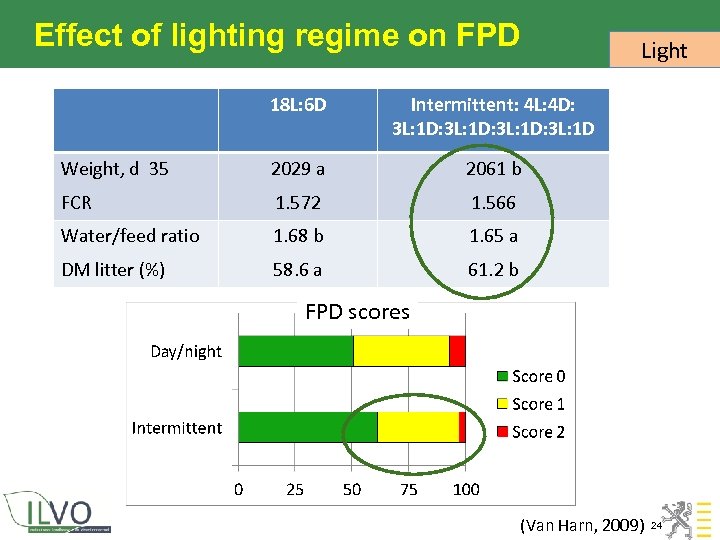 Effect of lighting regime on FPD Light 18 L: 6 D Intermittent: 4 L: 4 D: 3 L: 1 D: 3 L: 1 D Weight, d 35 2029 a 2061 b FCR 1. 572 1. 566 Water/feed ratio 1. 68 b 1. 65 a DM litter (%) 58. 6 a 61. 2 b FPD scores (Van Harn, 2009) 24
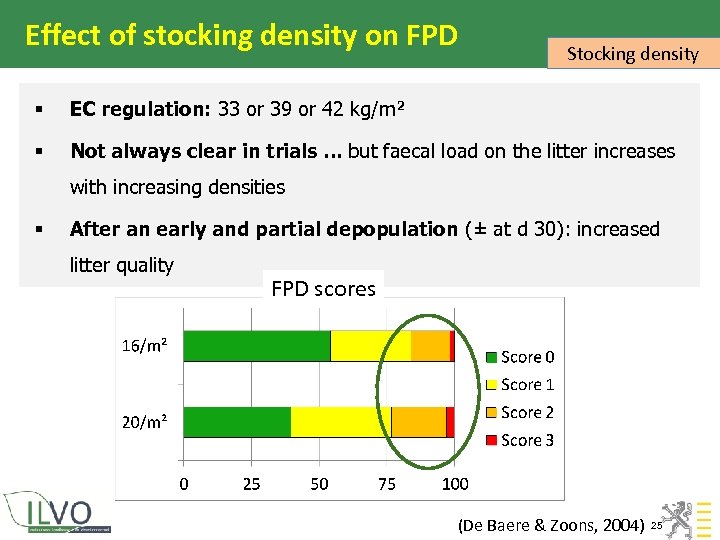 Effect of stocking density on FPD Stocking density § EC regulation: 33 or 39 or 42 kg/m² § Not always clear in trials. . . but faecal load on the litter increases with increasing densities § After an early and partial depopulation (± at d 30): increased litter quality FPD scores (De Baere & Zoons, 2004) 25
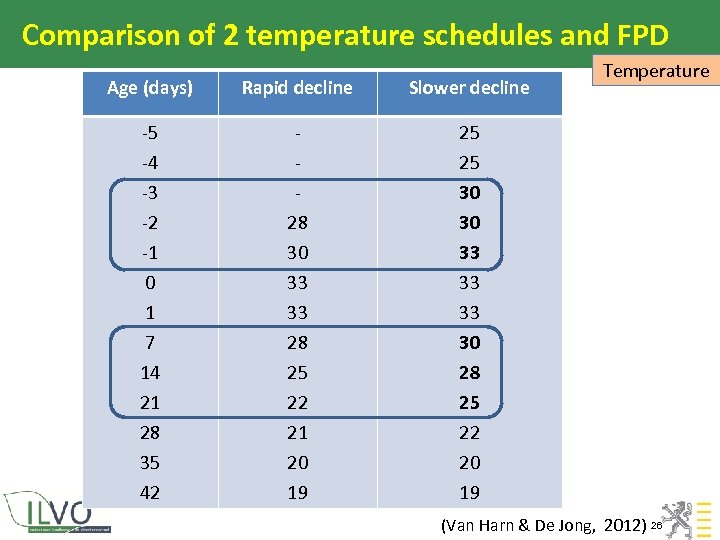 Comparison of 2 temperature schedules and FPD Age (days) Rapid decline Slower decline -5 - 25 -4 -3 -2 -1 0 1 7 14 21 28 35 42 28 30 33 33 28 25 22 21 20 19 Temperature 25 30 30 33 33 33 30 28 25 22 20 19 (Van Harn & De Jong, 2012) 26
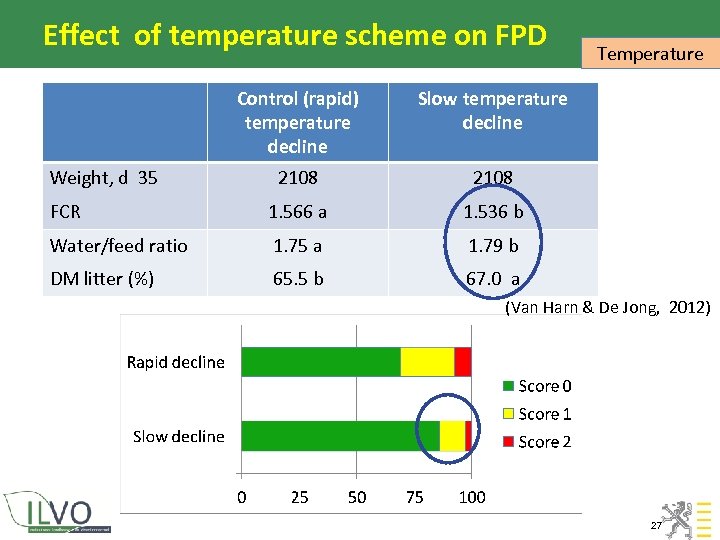 Effect of temperature scheme on FPD Control (rapid) temperature decline Slow temperature decline 2108 FCR 1. 566 a 1. 536 b Water/feed ratio 1. 75 a 1. 79 b DM litter (%) 65. 5 b Temperature 67. 0 a Weight, d 35 (Van Harn & De Jong, 2012) 27
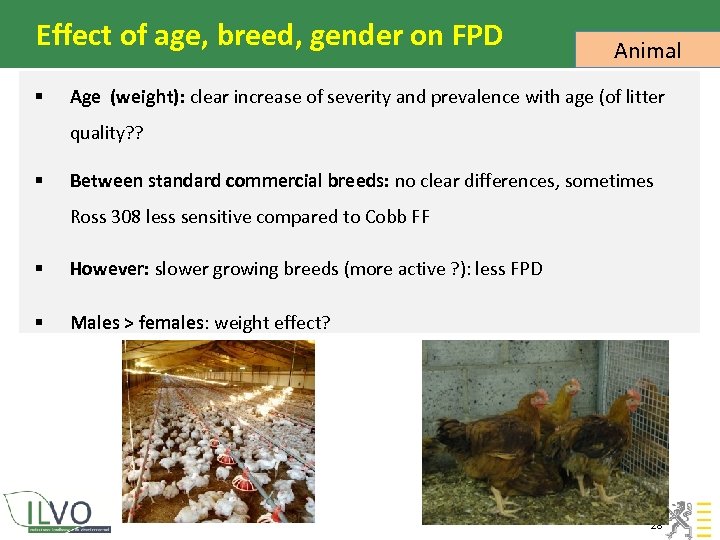 Effect of age, breed, gender on FPD § Animal Age (weight): clear increase of severity and prevalence with age (of litter quality? ? § Between standard commercial breeds: no clear differences, sometimes Ross 308 less sensitive compared to Cobb FF § However: slower growing breeds (more active ? ): less FPD § Males > females: weight effect? 28
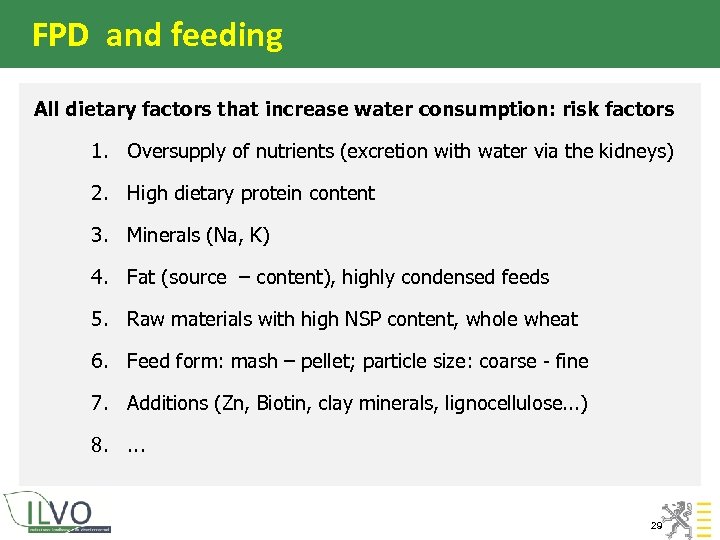 FPD and feeding All dietary factors that increase water consumption: risk factors 1. Oversupply of nutrients (excretion with water via the kidneys) 2. High dietary protein content 3. Minerals (Na, K) 4. Fat (source – content), highly condensed feeds 5. Raw materials with high NSP content, whole wheat 6. Feed form: mash – pellet; particle size: coarse - fine 7. Additions (Zn, Biotin, clay minerals, lignocellulose. . . ) 8. . 29
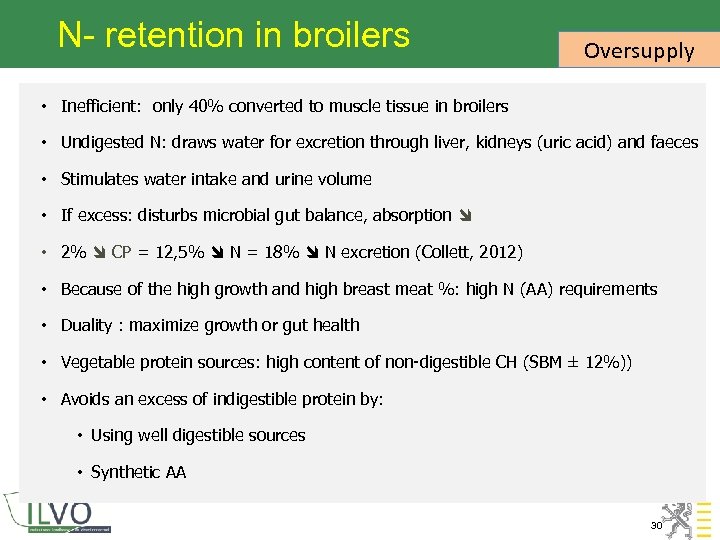 N- retention in broilers Oversupply • Inefficient: only 40% converted to muscle tissue in broilers • Undigested N: draws water for excretion through liver, kidneys (uric acid) and faeces • Stimulates water intake and urine volume • If excess: disturbs microbial gut balance, absorption • 2% CP = 12, 5% N = 18% N excretion (Collett, 2012) • Because of the high growth and high breast meat %: high N (AA) requirements • Duality : maximize growth or gut health • Vegetable protein sources: high content of non-digestible CH (SBM ± 12%)) • Avoids an excess of indigestible protein by: • Using well digestible sources • Synthetic AA 30
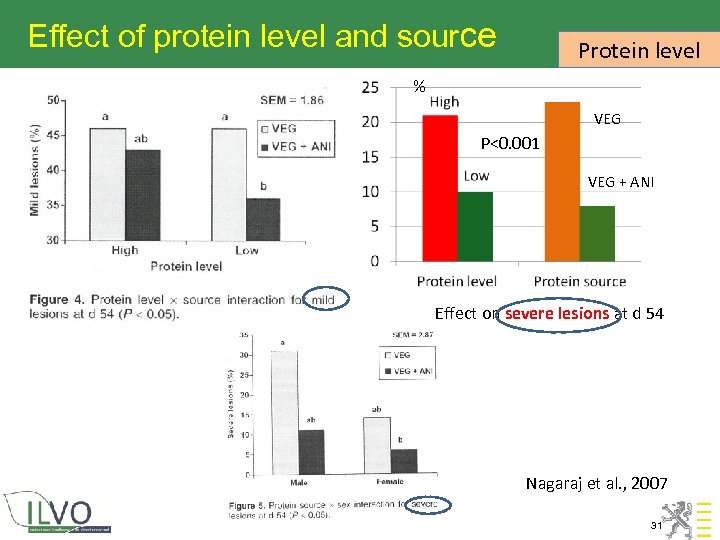 Effect of protein level and source Protein level % VEG H P<0. 001 VEG + ANI L Effect on severe lesions at d 54 Nagaraj et al. , 2007 31
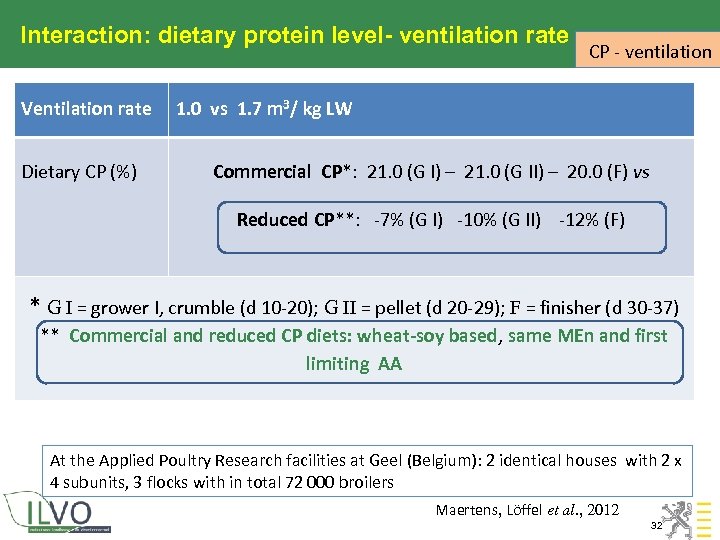 Interaction: dietary protein level- ventilation rate Ventilation rate Dietary CP (%) CP - ventilation 1. 0 vs 1. 7 m³/ kg LW Commercial CP*: 21. 0 (G I) – 21. 0 (G II) – 20. 0 (F) vs Reduced CP**: -7% (G I) -10% (G II) -12% (F) * G I = grower I, crumble (d 10 -20); G II = pellet (d 20 -29); F = finisher (d 30 -37) ** Commercial and reduced CP diets: wheat-soy based, same MEn and first limiting AA At the Applied Poultry Research facilities at Geel (Belgium): 2 identical houses with 2 x 4 subunits, 3 flocks with in total 72 000 broilers Maertens, Löffel et al. , 2012 32
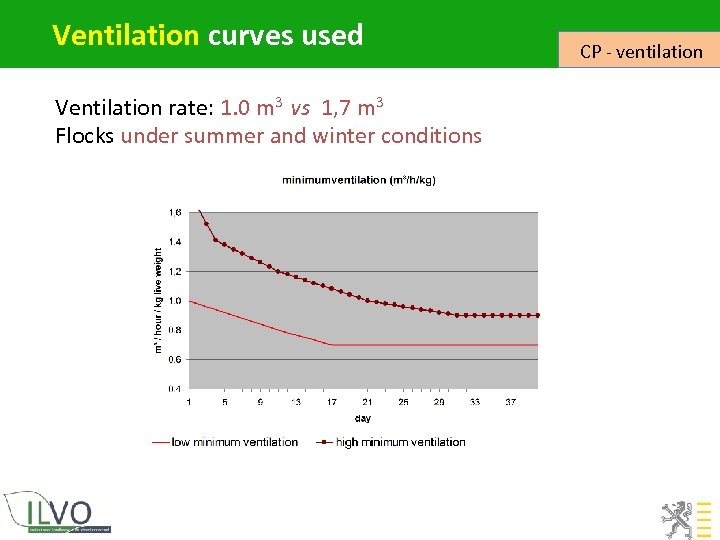 Ventilation curves used Ventilation rate: 1. 0 m 3 vs 1, 7 m 3 Flocks under summer and winter conditions CP - ventilation
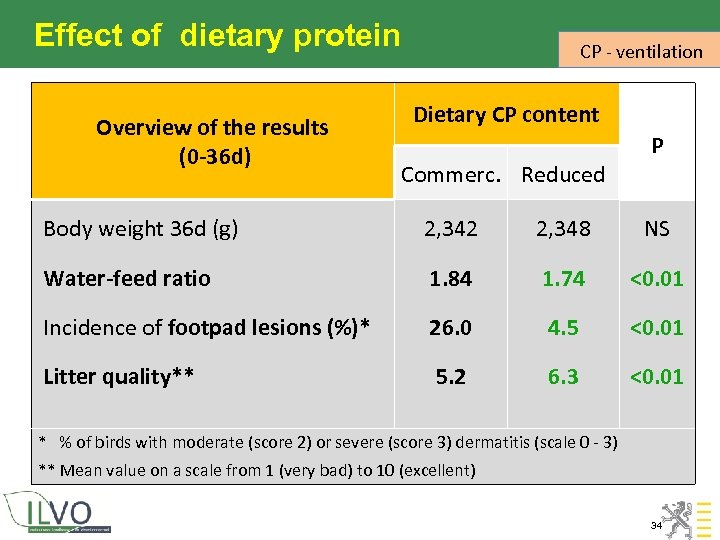 Effect of dietary protein Overview of the results (0 -36 d) CP - ventilation Dietary CP content Commerc. Reduced P Body weight 36 d (g) 2, 342 2, 348 NS Water-feed ratio 1. 84 1. 74 <0. 01 Incidence of footpad lesions (%)* 26. 0 4. 5 <0. 01 Litter quality** 5. 2 6. 3 <0. 01 * % of birds with moderate (score 2) or severe (score 3) dermatitis (scale 0 - 3) ** Mean value on a scale from 1 (very bad) to 10 (excellent) 34
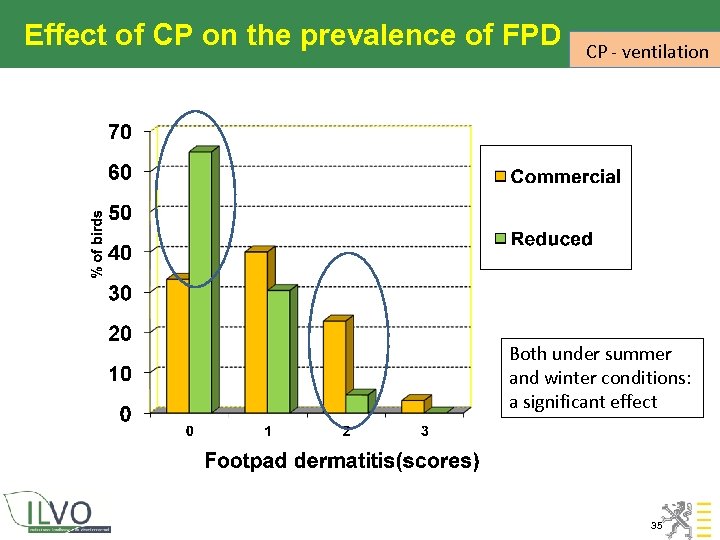 Effect of CP on the prevalence of FPD CP - ventilation Both under summer and winter conditions: a significant effect 35
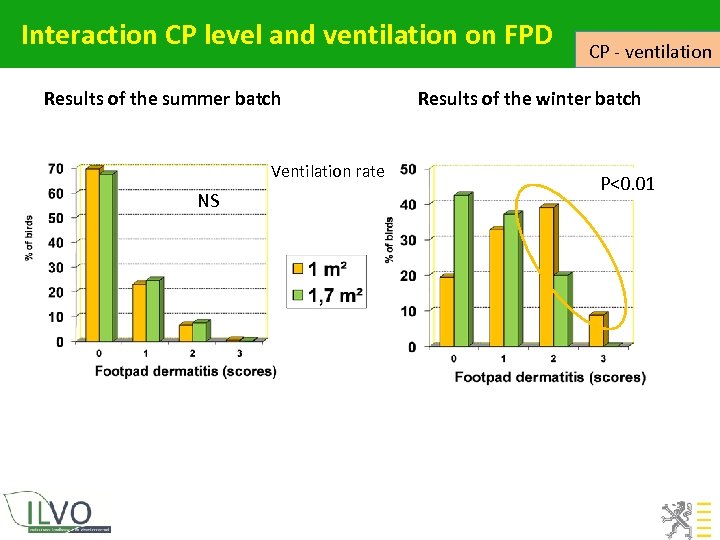 Interaction CP level and ventilation on FPD Results of the summer batch Ventilation rate NS CP - ventilation Results of the winter batch P<0. 01
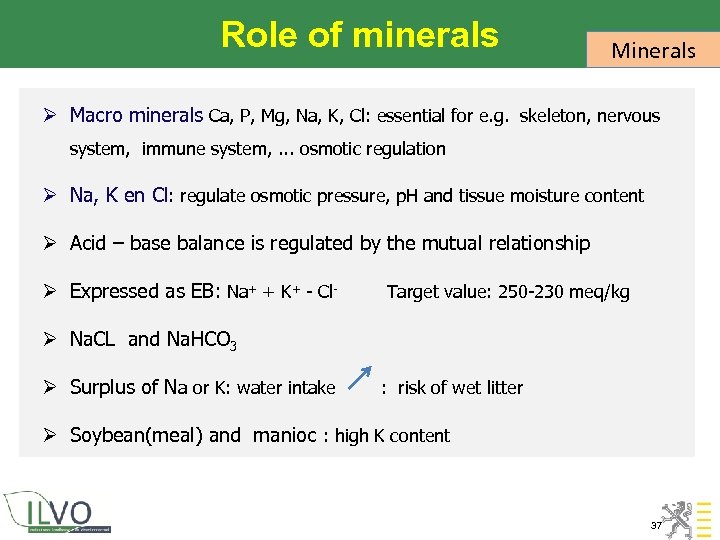 Role of minerals Minerals Ø Macro minerals Ca, P, Mg, Na, K, Cl: essential for e. g. skeleton, nervous system, immune system, . . . osmotic regulation Ø Na, K en Cl: regulate osmotic pressure, p. H and tissue moisture content Ø Acid – base balance is regulated by the mutual relationship Ø Expressed as EB: Na+ + K+ - Cl- Target value: 250 -230 meq/kg Ø Na. CL and Na. HCO 3 Ø Surplus of Na or K: water intake : risk of wet litter Ø Soybean(meal) and manioc : high K content 37
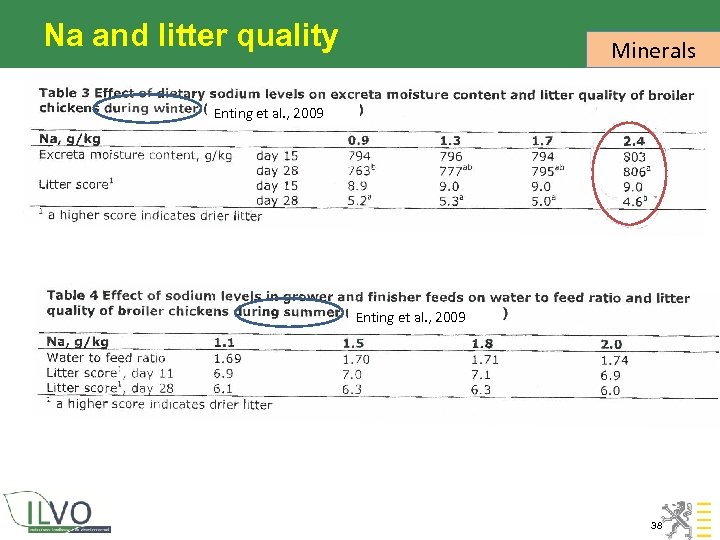 Na and litter quality Minerals Enting et al. , 2009 38
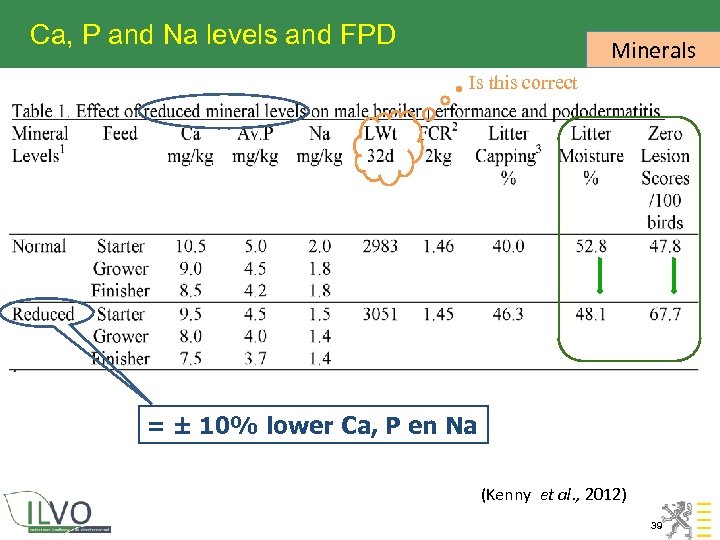 Ca, P and Na levels and FPD Minerals Is this correct = ± 10% lower Ca, P en Na (Kenny et al. , 2012) 39
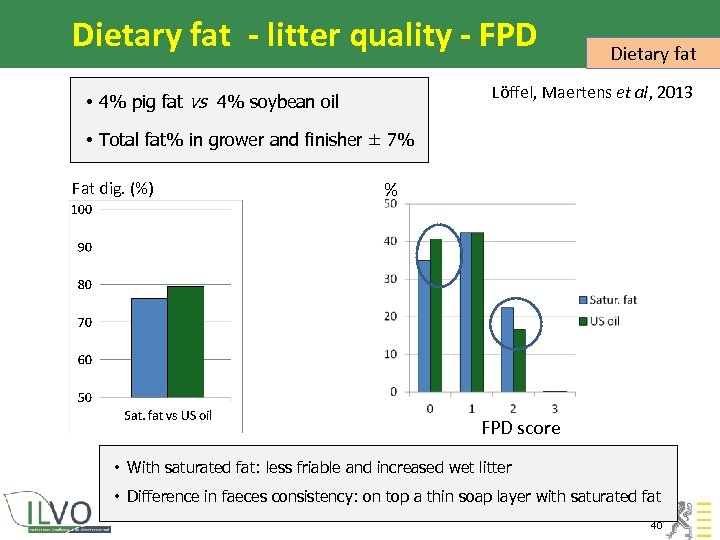 Dietary fat - litter quality - FPD Dietary fat Löffel, Maertens et al, 2013 • 4% pig fat vs 4% soybean oil • Total fat% in grower and finisher ± 7% Fat dig. (%) % FPD score • With saturated fat: less friable and increased wet litter • Difference in faeces consistency: on top a thin soap layer with saturated fat 40
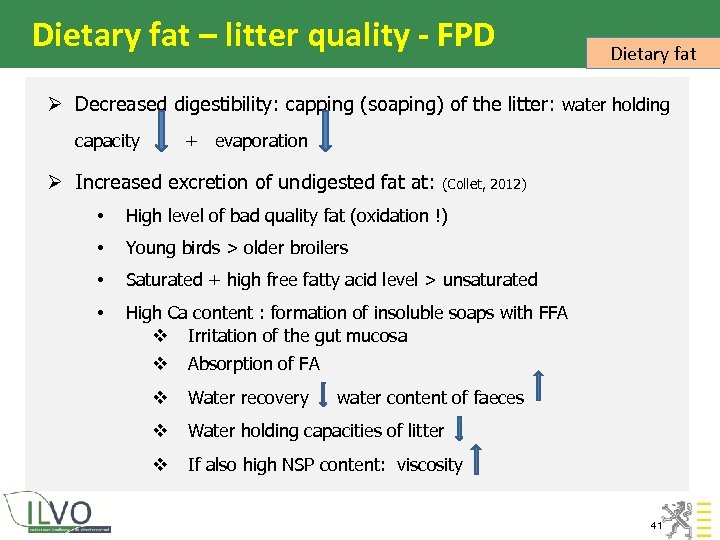 Dietary fat – litter quality - FPD Dietary fat Ø Decreased digestibility: capping (soaping) of the litter: water holding capacity + evaporation Ø Increased excretion of undigested fat at: (Collet, 2012) • High level of bad quality fat (oxidation !) • Young birds > older broilers • Saturated + high free fatty acid level > unsaturated • High Ca content : formation of insoluble soaps with FFA v Irritation of the gut mucosa v Absorption of FA v Water recovery v Water holding capacities of litter v If also high NSP content: viscosity water content of faeces 41
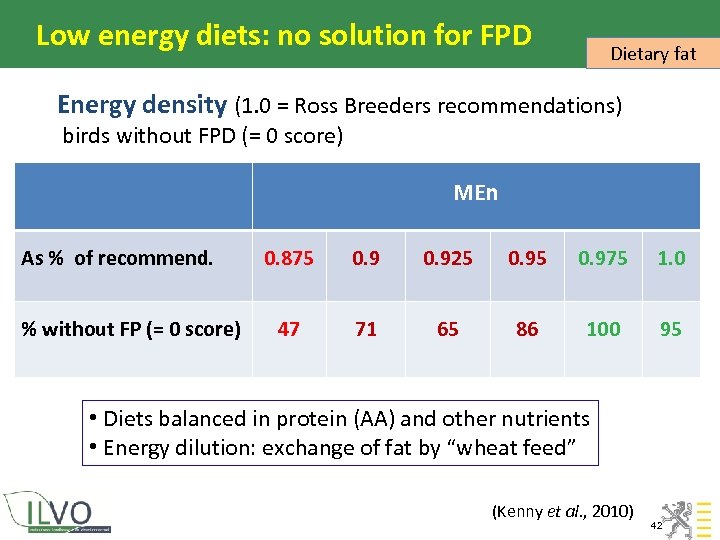 Low energy diets: no solution for FPD Dietary fat Energy density (1. 0 = Ross Breeders recommendations) birds without FPD (= 0 score) MEn As % of recommend. % without FP (= 0 score) 0. 875 0. 925 0. 975 1. 0 47 71 65 86 100 95 • Diets balanced in protein (AA) and other nutrients • Energy dilution: exchange of fat by “wheat feed” (Kenny et al. , 2010) 42
 Adding whole wheat to the diet Raw materials Ø Dietary requirements are age dependent! Ø With adding whole wheat, a progressive dilution with age (AA, CP) is possible (if suitable ratio) 43
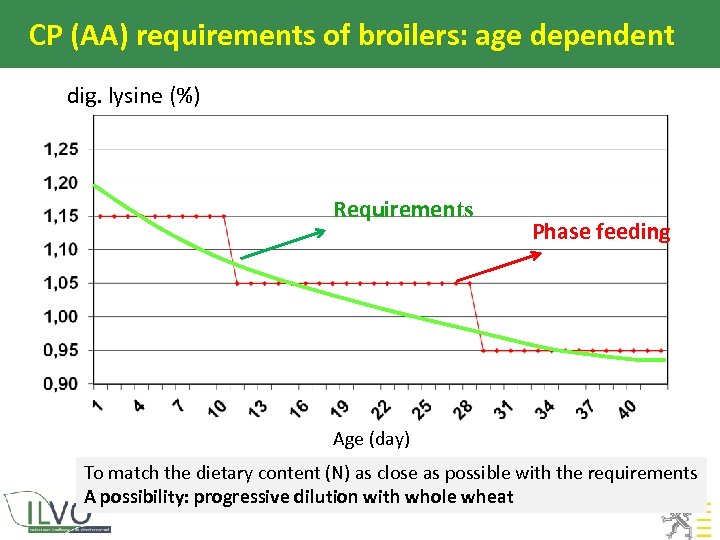 CP (AA) requirements of broilers: age dependent dig. lysine (%) Requirements Phase feeding Age (day) To match the dietary content (N) as close as possible with the requirements A possibility: progressive dilution with whole wheat
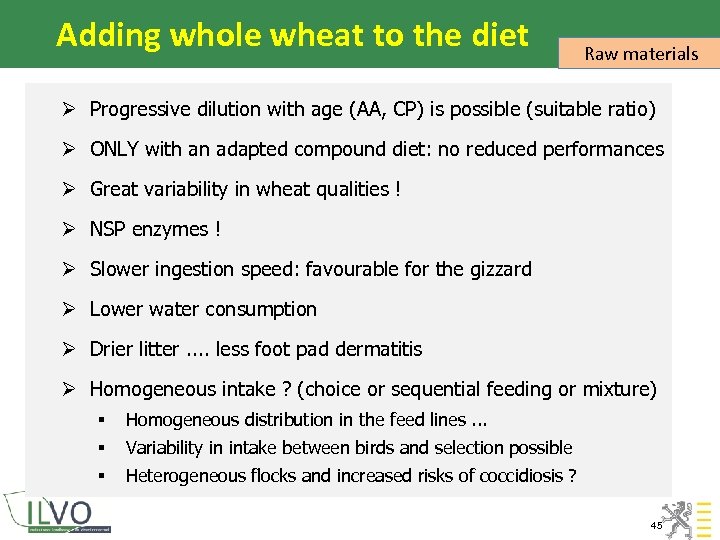 Adding whole wheat to the diet Raw materials Ø Progressive dilution with age (AA, CP) is possible (suitable ratio) Ø ONLY with an adapted compound diet: no reduced performances Ø Great variability in wheat qualities ! Ø NSP enzymes ! Ø Slower ingestion speed: favourable for the gizzard Ø Lower water consumption Ø Drier litter. . less foot pad dermatitis Ø Homogeneous intake ? (choice or sequential feeding or mixture) § § § Homogeneous distribution in the feed lines. . . Variability in intake between birds and selection possible Heterogeneous flocks and increased risks of coccidiosis ? 45
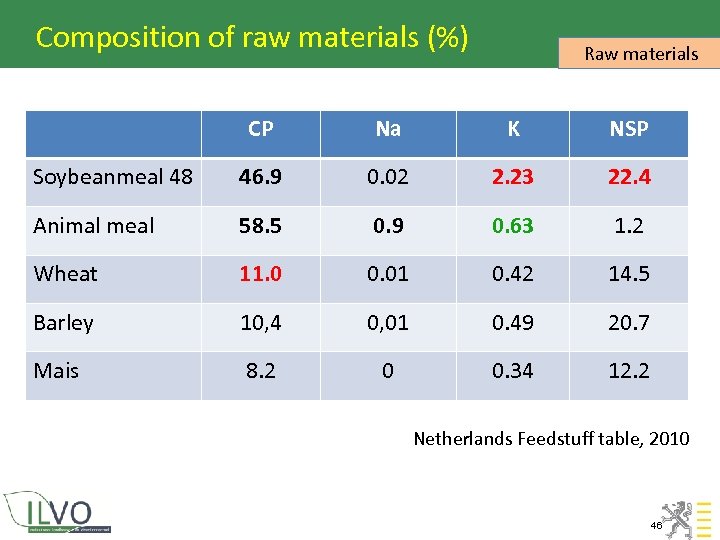 Composition of raw materials (%) Raw materials CP Na K NSP Soybeanmeal 48 46. 9 0. 02 2. 23 22. 4 Animal meal 58. 5 0. 9 0. 63 1. 2 Wheat 11. 0 0. 01 0. 42 14. 5 Barley 10, 4 0, 01 0. 49 20. 7 Mais 8. 2 0 0. 34 12. 2 Netherlands Feedstuff table, 2010 46
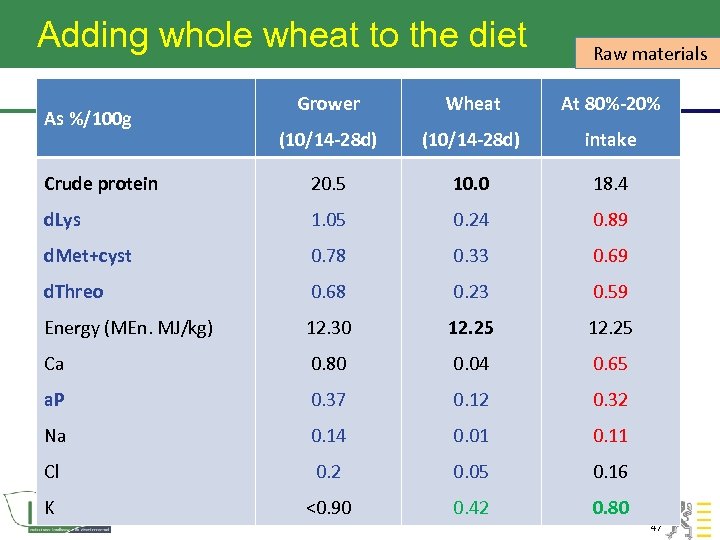 Adding whole wheat to the diet Raw materials Grower Wheat At 80%-20% (10/14 -28 d) intake Crude protein 20. 5 10. 0 18. 4 d. Lys 1. 05 0. 24 0. 89 d. Met+cyst 0. 78 0. 33 0. 69 d. Threo 0. 68 0. 23 0. 59 Energy (MEn. MJ/kg) 12. 30 12. 25 Ca 0. 80 0. 04 0. 65 a. P 0. 37 0. 12 0. 32 Na 0. 14 0. 01 0. 11 Cl 0. 2 0. 05 0. 16 K <0. 90 0. 42 0. 80 As %/100 g 47
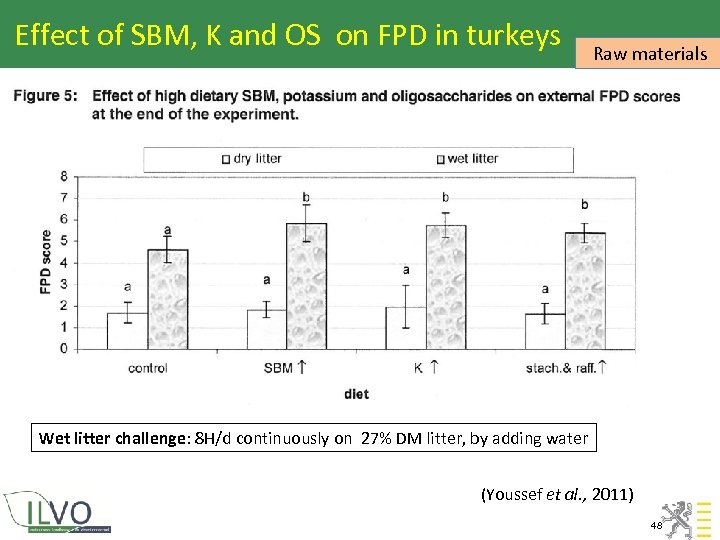 Effect of SBM, K and OS on FPD in turkeys Raw materials Wet litter challenge: 8 H/d continuously on 27% DM litter, by adding water (Youssef et al. , 2011) 48
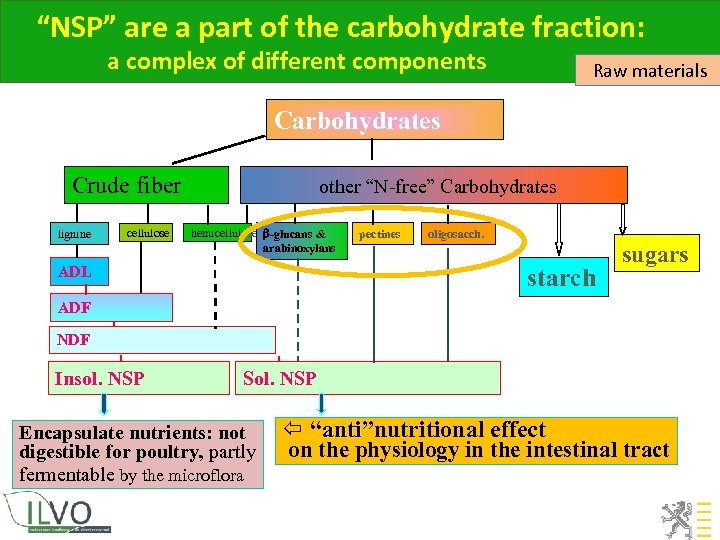 “NSP” are a part of the carbohydrate fraction: a complex of different components Raw materials Carbohydrates Crude fiber lignine cellulose other “N-free” Carbohydrates hemicellulose b-glucans & arabinoxylans ADL pectines oligosacch. starch sugars ADF NDF Insol. NSP Sol. NSP Encapsulate nutrients: not digestible for poultry, partly fermentable by the microflora “anti”nutritional effect anti on the physiology in the intestinal tract
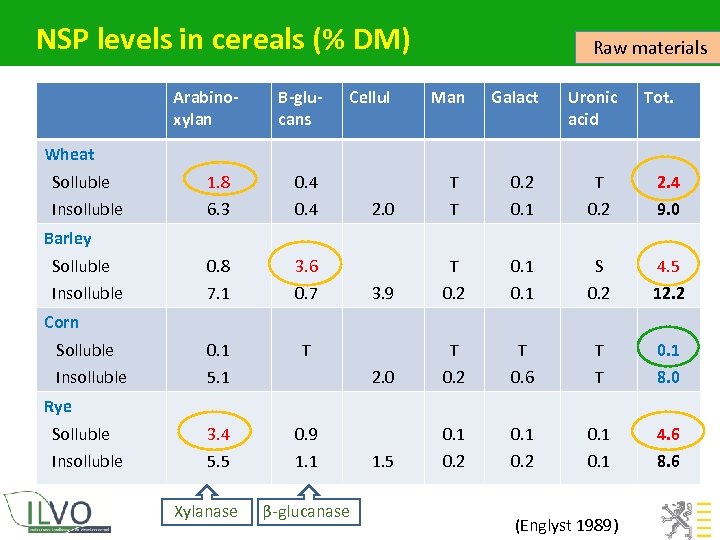 NSP levels in cereals (% DM) Arabinoxylan Β-glucans Cellul Raw materials Man Galact Uronic acid Tot. Wheat Solluble 1. 8 0. 4 Insolluble 6. 3 0. 4 Solluble 0. 8 3. 6 Insolluble 7. 1 0. 7 Solluble 0. 1 T Insolluble 5. 1 T T 2. 4 T 0. 1 0. 2 9. 0 T 0. 1 S 4. 5 0. 2 0. 1 0. 2 12. 2 T T T 0. 1 0. 2 0. 6 T 8. 0 0. 1 2. 0 0. 2 0. 1 4. 6 0. 2 0. 1 8. 6 Barley 3. 9 Corn 2. 0 Rye Solluble 3. 4 0. 9 Insolluble 5. 5 1. 1 Xylanase β-glucanase 1. 5 (Englyst 1989)
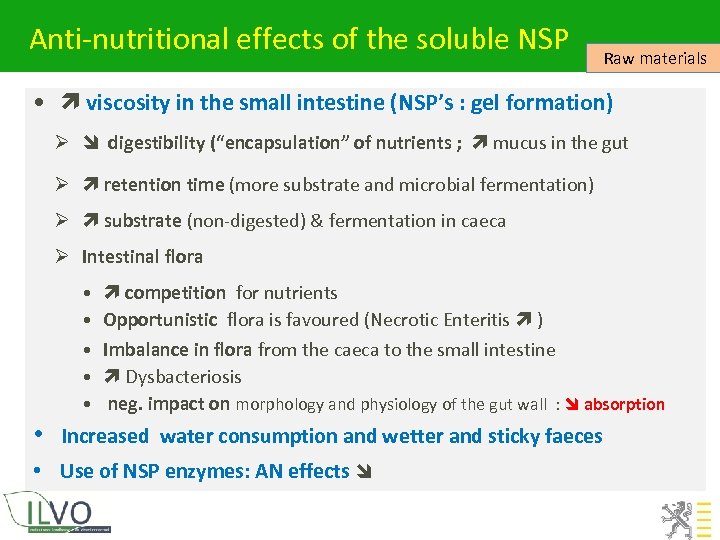 Anti-nutritional effects of the soluble NSP Raw materials • viscosity in the small intestine (NSP’s : gel formation) Ø digestibility (“encapsulation” of nutrients ; mucus in the gut Ø retention time (more substrate and microbial fermentation) Ø substrate (non-digested) & fermentation in caeca Ø Intestinal flora • • competition for nutrients Opportunistic flora is favoured (Necrotic Enteritis ) Imbalance in flora from the caeca to the small intestine Dysbacteriosis • neg. impact on morphology and physiology of the gut wall : absorption • Increased water consumption and wetter and sticky faeces • Use of NSP enzymes: AN effects
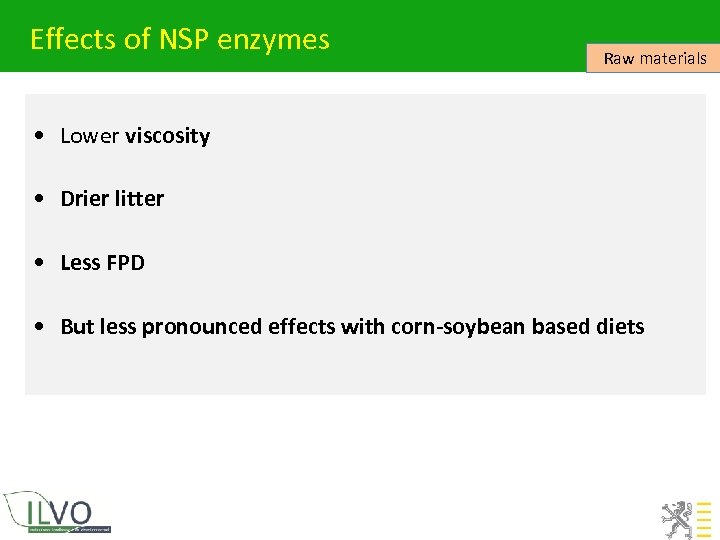 Effects of NSP enzymes Raw materials • Lower viscosity • Drier litter • Less FPD • But less pronounced effects with corn-soybean based diets
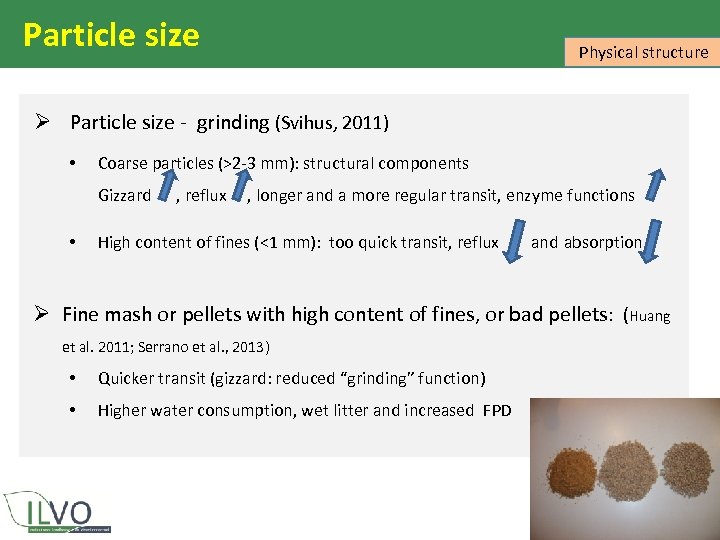 Particle size Physical structure Ø Particle size - grinding (Svihus, 2011) • Coarse particles (>2 -3 mm): structural components Gizzard • , reflux , longer and a more regular transit, enzyme functions High content of fines (<1 mm): too quick transit, reflux and absorption Ø Fine mash or pellets with high content of fines, or bad pellets: (Huang et al. 2011; Serrano et al. , 2013) • Quicker transit (gizzard: reduced “grinding” function) • Higher water consumption, wet litter and increased FPD 53
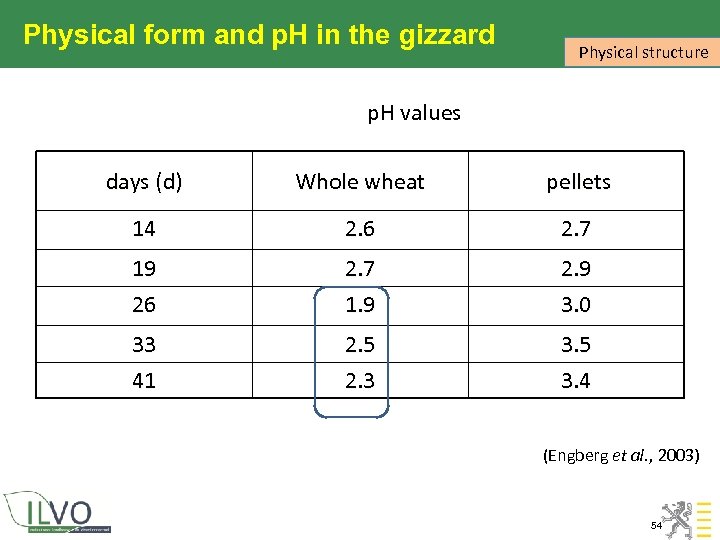 Physical form and p. H in the gizzard Physical structure p. H values days (d) Whole wheat pellets 14 2. 6 2. 7 19 26 2. 7 1. 9 2. 9 3. 0 33 41 2. 5 2. 3 3. 5 3. 4 (Engberg et al. , 2003) 54
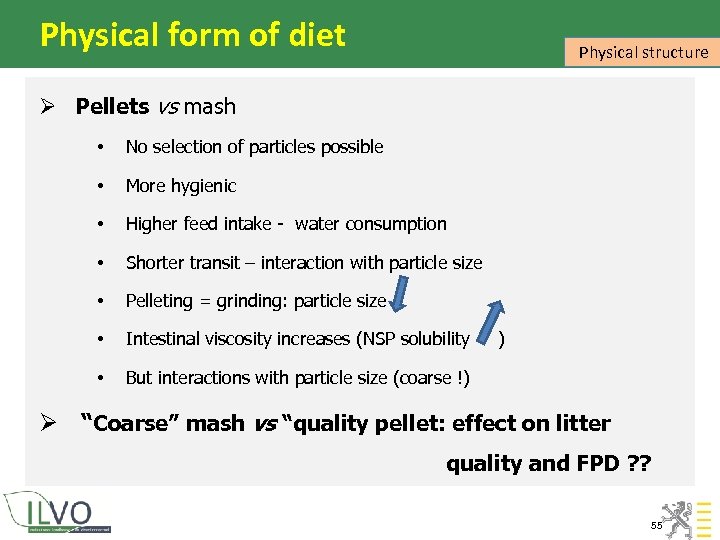 Physical form of diet Physical structure Ø Pellets vs mash • No selection of particles possible • More hygienic • Higher feed intake - water consumption • Shorter transit – interaction with particle size • Pelleting = grinding: particle size • Intestinal viscosity increases (NSP solubility • But interactions with particle size (coarse !) ) Ø “Coarse” mash vs “quality pellet: effect on litter quality and FPD ? ? 55
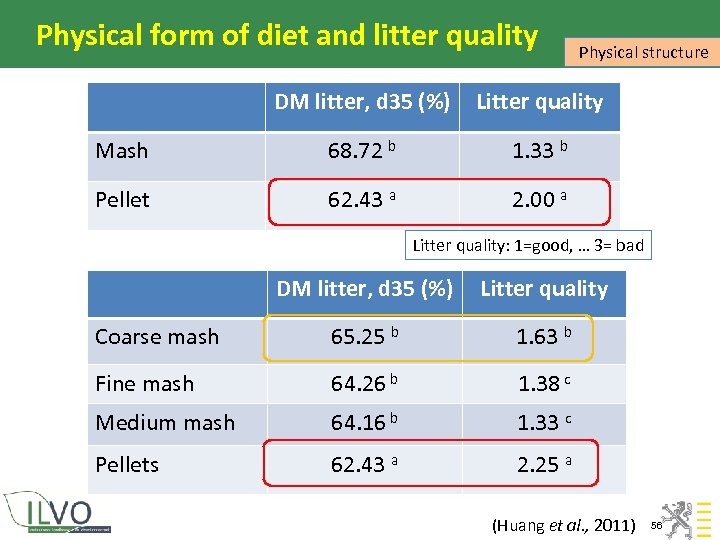 Physical form of diet and litter quality Physical structure DM litter, d 35 (%) Litter quality Mash 68. 72 b 1. 33 b Pellet 62. 43 a 2. 00 a Litter quality: 1=good, … 3= bad DM litter, d 35 (%) Litter quality Coarse mash 65. 25 b 1. 63 b Fine mash 64. 26 b 1. 38 c Medium mash 64. 16 b 1. 33 c Pellets 62. 43 a 2. 25 a (Huang et al. , 2011) 56
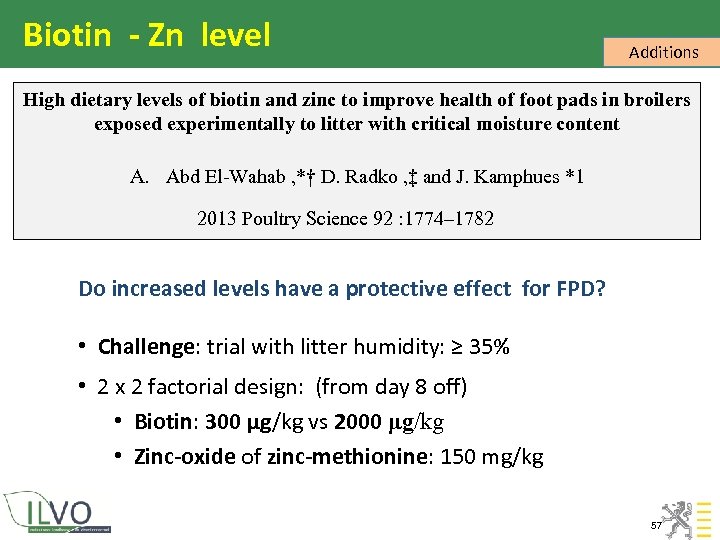 Biotin - Zn level Additions High dietary levels of biotin and zinc to improve health of foot pads in broilers exposed experimentally to litter with critical moisture content A. Abd El-Wahab , *† D. Radko , ‡ and J. Kamphues *1 2013 Poultry Science 92 : 1774– 1782 Do increased levels have a protective effect for FPD? • Challenge: trial with litter humidity: ≥ 35% • 2 x 2 factorial design: (from day 8 off) • Biotin: 300 μg/kg vs 2000 μg/kg • Zinc-oxide of zinc-methionine: 150 mg/kg 57
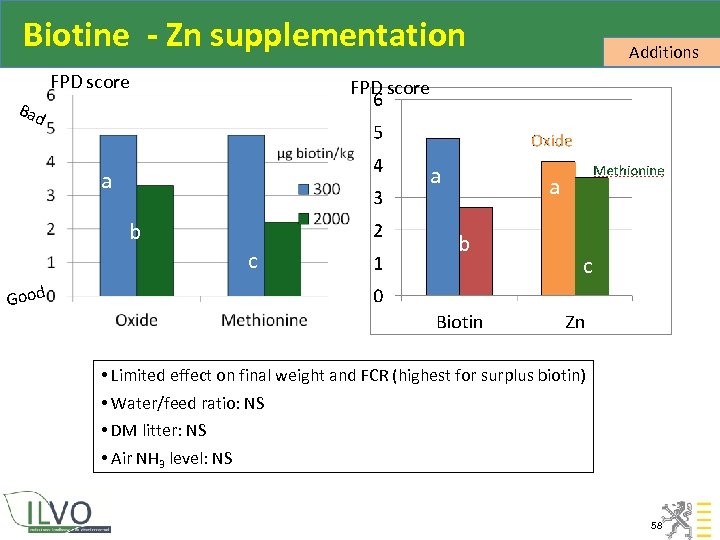 Biotine - Zn supplementation FPD score Bad a a b Additions c a b c Good • Limited effect on final weight and FCR (highest for surplus biotin) • Water/feed ratio: NS • DM litter: NS • Air NH 3 level: NS 58
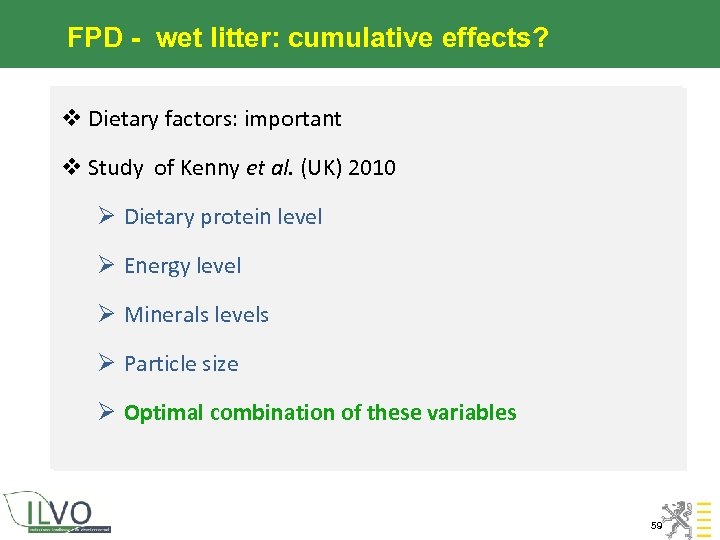 FPD - wet litter: cumulative effects? v Voedingsvariabelen belangrijk v Dietary factors: important v Studie van Kenny et al. (UK) 9 v Study of Kenny et al. (UK) 2010 Ø Eiwit niveau Ø Dietary protein level Ø Energie level Ø Energy niveau Ø Mineralen gehalten Ø Minerals levels Ø. . . Ø Particle size Ø Optimalecombinationvan these variabelen Ø Optimal combinatie of deze variables 59
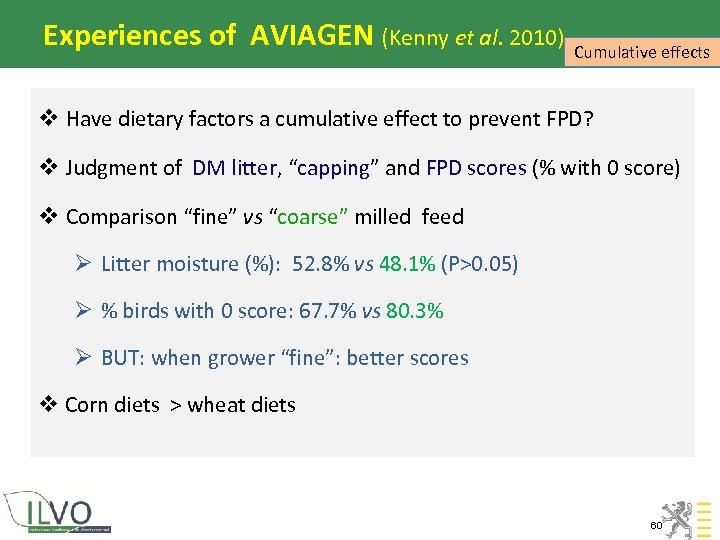 Experiences of AVIAGEN (Kenny et al. 2010) Cumulative effects v Have dietary factors a cumulative effect to prevent FPD? v Judgment of DM litter, “capping” and FPD scores (% with 0 score) v Comparison “fine” vs “coarse” milled feed Ø Litter moisture (%): 52. 8% vs 48. 1% (P>0. 05) Ø % birds with 0 score: 67. 7% vs 80. 3% Ø BUT: when grower “fine”: better scores v Corn diets > wheat diets 60
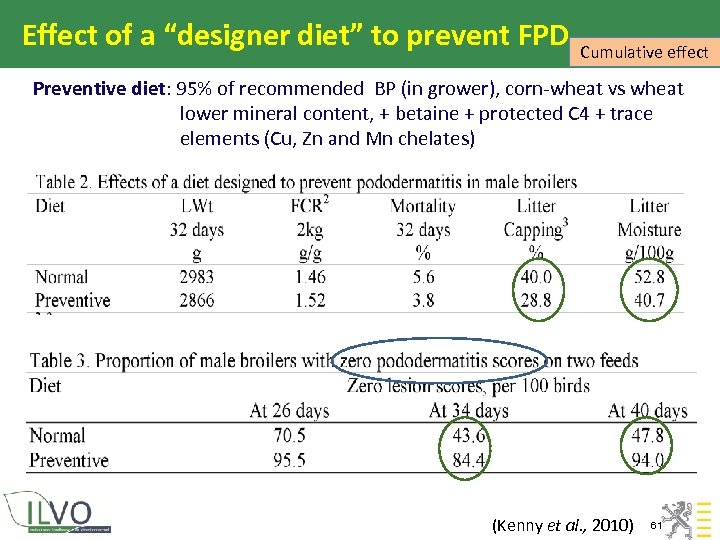 Effect of a “designer diet” to prevent FPD Cumulative effect Preventive diet: 95% of recommended BP (in grower), corn-wheat vs wheat lower mineral content, + betaine + protected C 4 + trace elements (Cu, Zn and Mn chelates) (Kenny et al. , 2010) 61
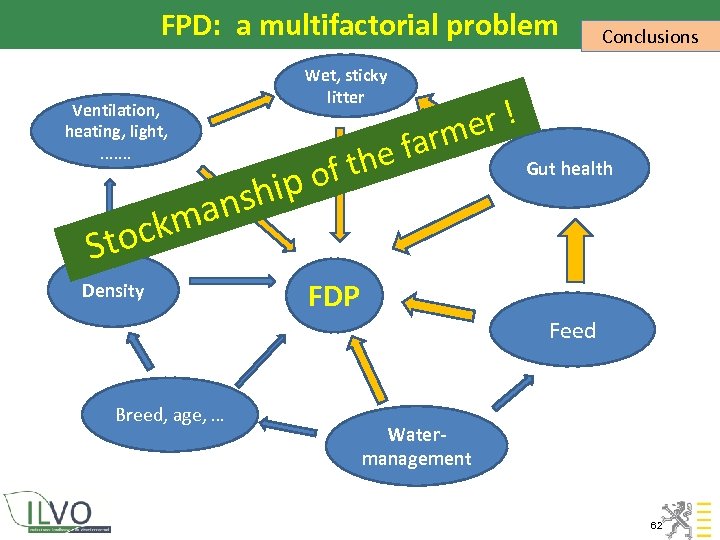 FPD: a multifactorial problem Conclusions Ventilation, heating, light, . . . . Wet, sticky litter er ! farm he of t ip nsh ma ock t Gut health S Density Breed, age, … FDP Feed Watermanagement 62
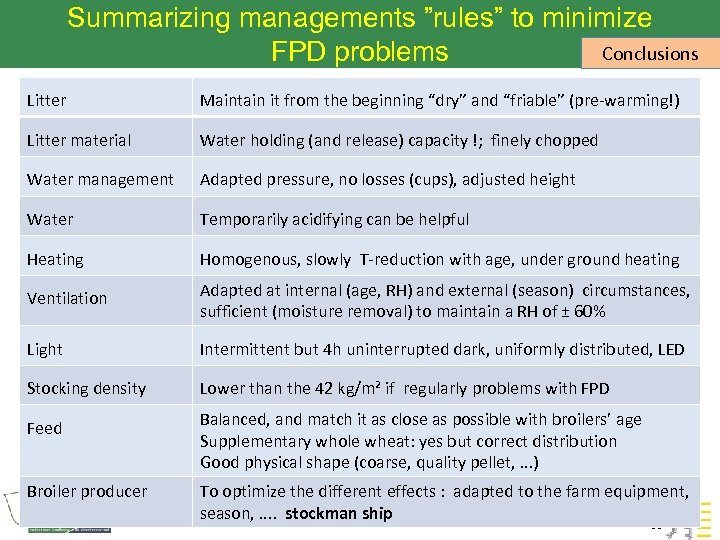 Summarizing managements ”rules” to minimize Conclusions FPD problems Litter Maintain it from the beginning “dry” and “friable” (pre-warming!) Litter material Water holding (and release) capacity !; finely chopped Water management Adapted pressure, no losses (cups), adjusted height Water Temporarily acidifying can be helpful Heating Homogenous, slowly T-reduction with age, under ground heating Ventilation Adapted at internal (age, RH) and external (season) circumstances, sufficient (moisture removal) to maintain a RH of ± 60% Light Intermittent but 4 h uninterrupted dark, uniformly distributed, LED Stocking density Lower than the 42 kg/m² if regularly problems with FPD Feed Balanced, and match it as close as possible with broilers’ age Supplementary whole wheat: yes but correct distribution Good physical shape (coarse, quality pellet, . . . ) Broiler producer To optimize the different effects : adapted to the farm equipment, season, . . stockman ship 63
 Thank you for the attention Institute for Agricultural and Fisheries Research Animal Science Unit, Melle (Belgium) www. ilvo. vlaanderen. be