 Скачать презентацию Impact of HPAI on rural livelihoods in Cambodia
07741bff28629e0f5d0bdd3d3b51f684.ppt
- Количество слайдов: 18



Impact of HPAI on rural livelihoods in Cambodia: Differentiation by gender and socio-economic categories Suon Seng, CENTDOR Consulting
Where these findings come from? • Extraction from the results of PRA on HAPI Impact study in Cambodia June and July 2007, for FAO. • The study was conducted in 36 villages by a team of 15 researchers from CEDAC and FAO • 36 villages: 10 HPAI experienced villages and 26 village non HPAI experienced villages. • 69 FGD and 258 individual interviews and case studies.
Pre-determined patterns: similarity and differentiation • From group discussion was targeted in four main categories: Poorest, Poor, Medium and Better-off • Additionally, woman-headed family from cross categories above mentioned. • Different scale of poultry production: Small, medium and large scales. • Separated by Chicken and Duck, plus other poultry species which newly emerged… • Poultry system practices by village animal health workers (VAHW)
Poultry raising / production systems in Cambodia • The study was done on the backyard poultry raising only. Industrial farm is not included in the study • Duck raising: Large scale, medium scale and small scale • Chicken raising: It is always small scale • The production of other birds are always small scales. Newly emerged as commercial purposes and traditionally for pleasure.
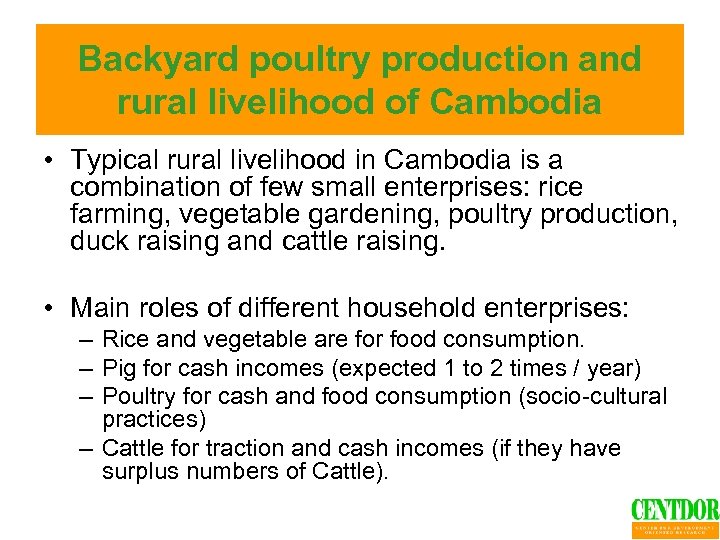
Backyard poultry production and rural livelihood of Cambodia • Typical rural livelihood in Cambodia is a combination of few small enterprises: rice farming, vegetable gardening, poultry production, duck raising and cattle raising. • Main roles of different household enterprises: – Rice and vegetable are for food consumption. – Pig for cash incomes (expected 1 to 2 times / year) – Poultry for cash and food consumption (socio-cultural practices) – Cattle for traction and cash incomes (if they have surplus numbers of Cattle).
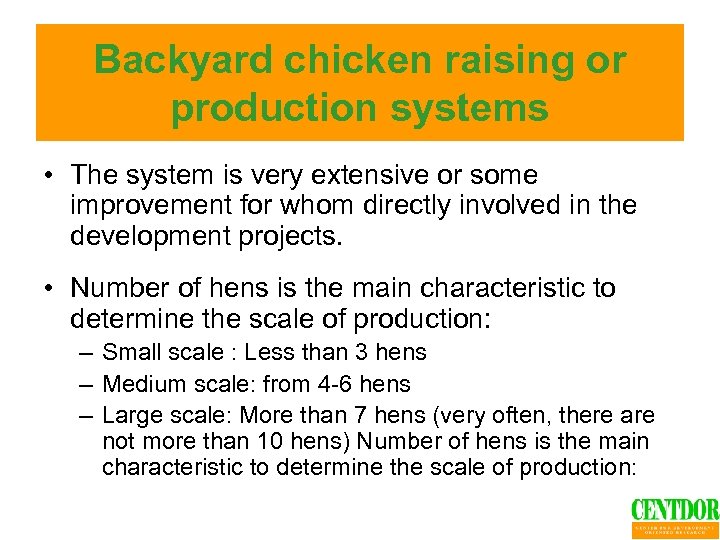
Backyard chicken raising or production systems • The system is very extensive or some improvement for whom directly involved in the development projects. • Number of hens is the main characteristic to determine the scale of production: – Small scale : Less than 3 hens – Medium scale: from 4 -6 hens – Large scale: More than 7 hens (very often, there are not more than 10 hens) Number of hens is the main characteristic to determine the scale of production:
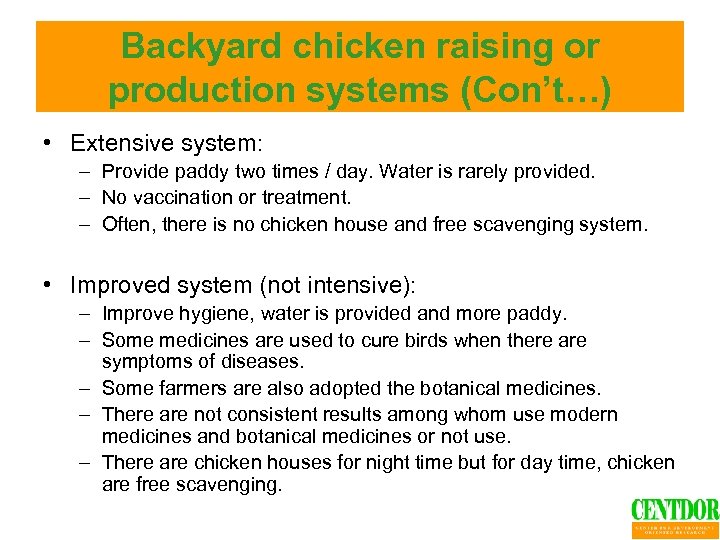
Backyard chicken raising or production systems (Con’t…) • Extensive system: – Provide paddy two times / day. Water is rarely provided. – No vaccination or treatment. – Often, there is no chicken house and free scavenging system. • Improved system (not intensive): – Improve hygiene, water is provided and more paddy. – Some medicines are used to cure birds when there are symptoms of diseases. – Some farmers are also adopted the botanical medicines. – There are not consistent results among whom use modern medicines and botanical medicines or not use. – There are chicken houses for night time but for day time, chicken are free scavenging.
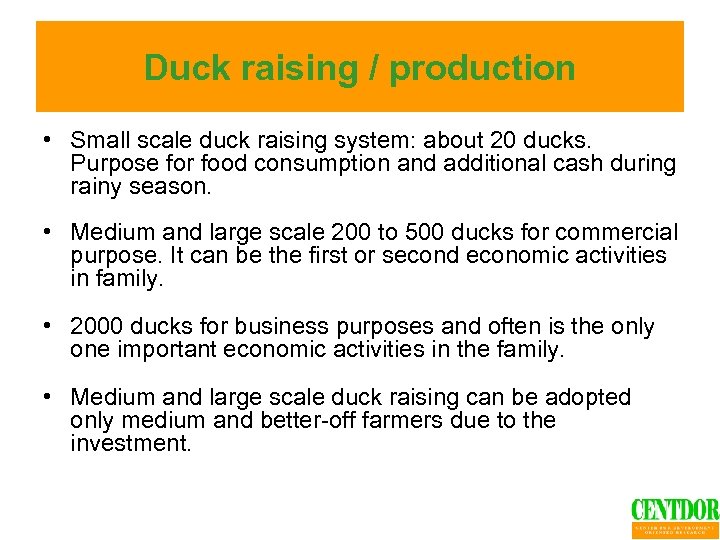
Duck raising / production • Small scale duck raising system: about 20 ducks. Purpose for food consumption and additional cash during rainy season. • Medium and large scale 200 to 500 ducks for commercial purpose. It can be the first or second economic activities in family. • 2000 ducks for business purposes and often is the only one important economic activities in the family. • Medium and large scale duck raising can be adopted only medium and better-off farmers due to the investment.
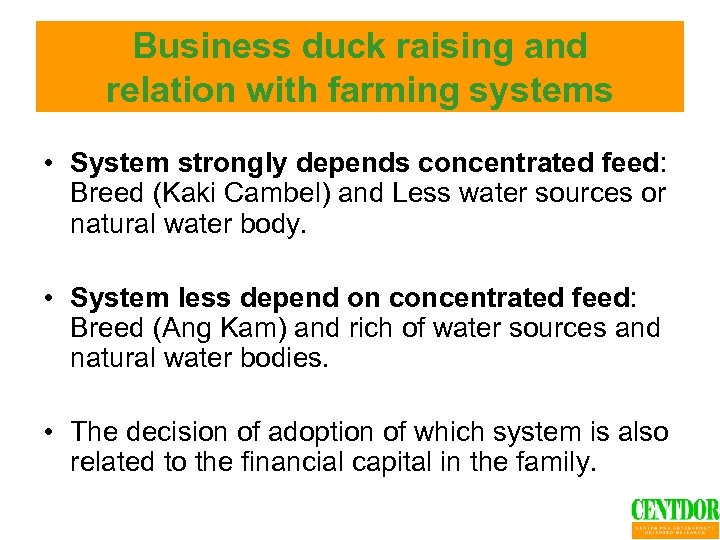
Business duck raising and relation with farming systems • System strongly depends concentrated feed: Breed (Kaki Cambel) and Less water sources or natural water body. • System less depend on concentrated feed: Breed (Ang Kam) and rich of water sources and natural water bodies. • The decision of adoption of which system is also related to the financial capital in the family.
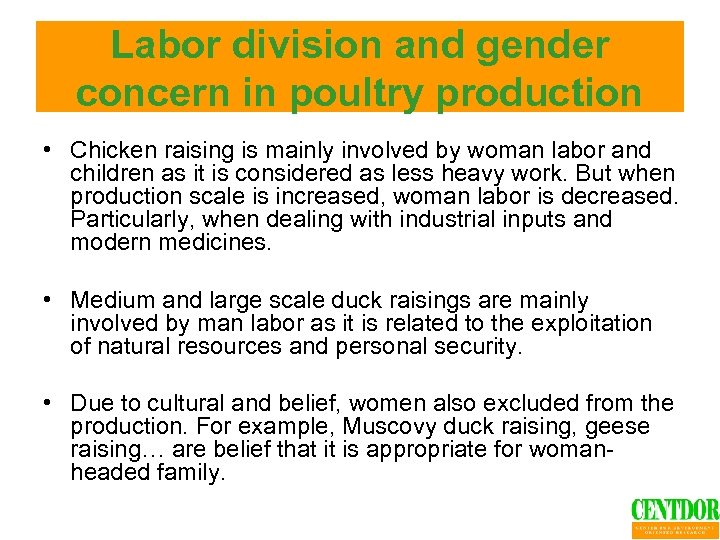
Labor division and gender concern in poultry production • Chicken raising is mainly involved by woman labor and children as it is considered as less heavy work. But when production scale is increased, woman labor is decreased. Particularly, when dealing with industrial inputs and modern medicines. • Medium and large scale duck raisings are mainly involved by man labor as it is related to the exploitation of natural resources and personal security. • Due to cultural and belief, women also excluded from the production. For example, Muscovy duck raising, geese raising… are belief that it is appropriate for womanheaded family.
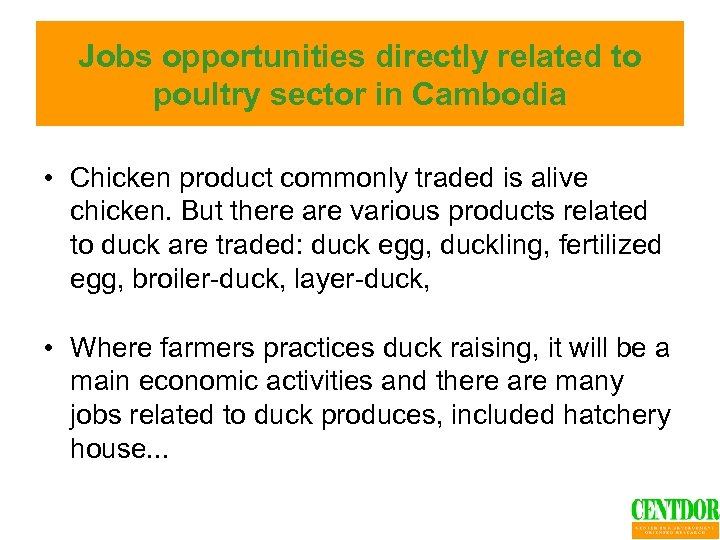
Jobs opportunities directly related to poultry sector in Cambodia • Chicken product commonly traded is alive chicken. But there are various products related to duck are traded: duck egg, duckling, fertilized egg, broiler-duck, layer-duck, • Where farmers practices duck raising, it will be a main economic activities and there are many jobs related to duck produces, included hatchery house. . .
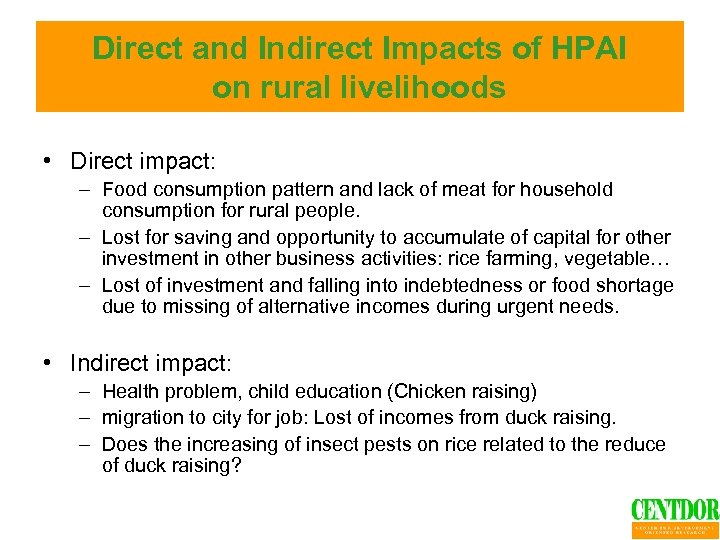
Direct and Indirect Impacts of HPAI on rural livelihoods • Direct impact: – Food consumption pattern and lack of meat for household consumption for rural people. – Lost for saving and opportunity to accumulate of capital for other investment in other business activities: rice farming, vegetable… – Lost of investment and falling into indebtedness or food shortage due to missing of alternative incomes during urgent needs. • Indirect impact: – Health problem, child education (Chicken raising) – migration to city for job: Lost of incomes from duck raising. – Does the increasing of insect pests on rice related to the reduce of duck raising?
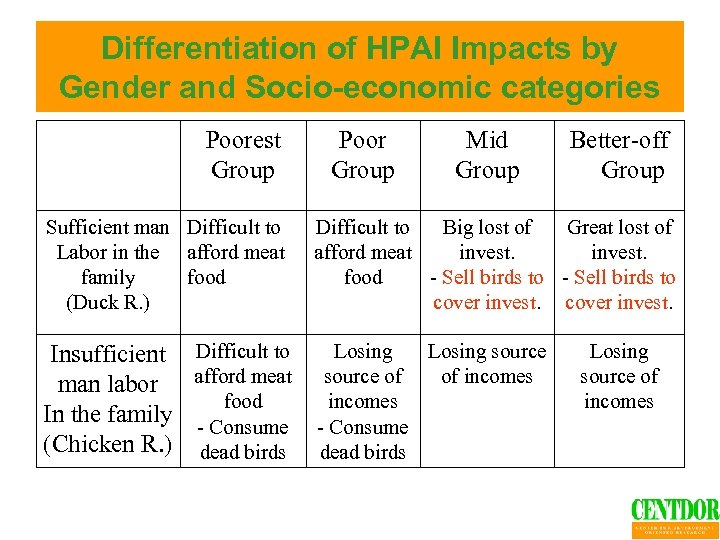
Differentiation of HPAI Impacts by Gender and Socio-economic categories Poorest Group Poor Group Mid Group Better-off Group Sufficient man Difficult to Labor in the afford meat family food (Duck R. ) Difficult to Big lost of Great lost of afford meat invest. food - Sell birds to cover invest. Insufficient Difficult to man labor afford meat food In the family - Consume (Chicken R. ) dead birds Losing source of of incomes - Consume dead birds Losing source of incomes
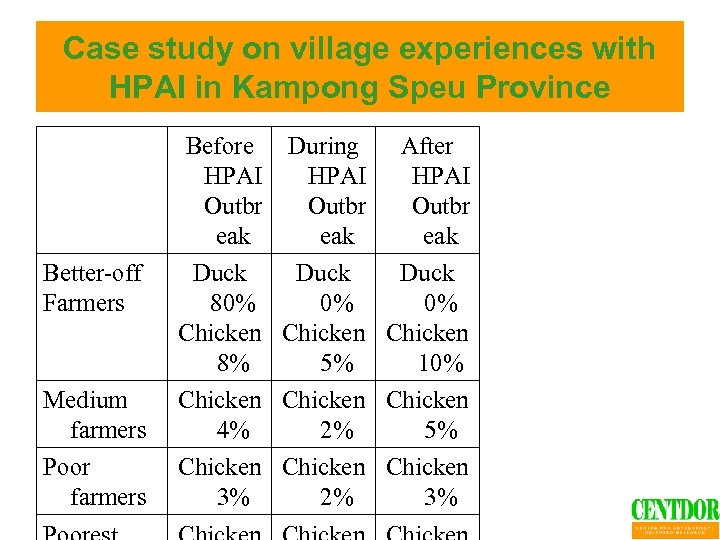
Case study on village experiences with HPAI in Kampong Speu Province Better-off Farmers Medium farmers Poor farmers Before During After HPAI Outbr eak eak Duck 80% 0% 0% Chicken 8% 5% 10% Chicken 4% 2% 5% Chicken 3% 2% 3%
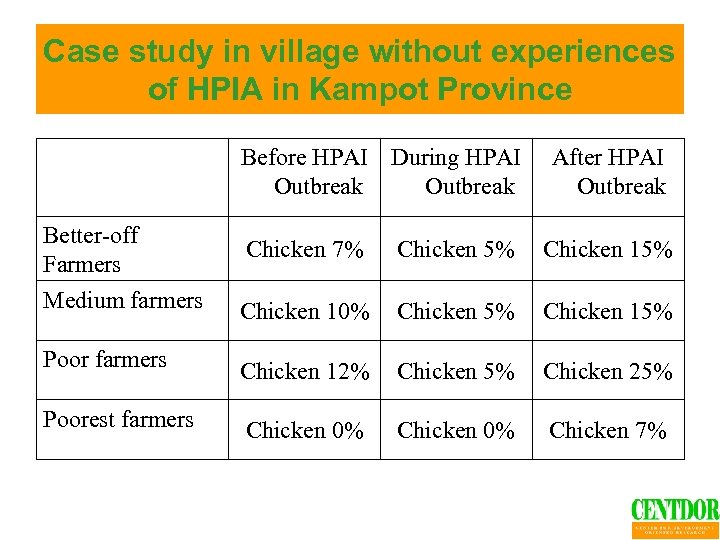
Case study in village without experiences of HPIA in Kampot Province Before HPAI During HPAI Outbreak After HPAI Outbreak Better-off Farmers Chicken 7% Chicken 5% Chicken 15% Medium farmers Chicken 10% Chicken 5% Chicken 15% Poor farmers Chicken 12% Chicken 5% Chicken 25% Poorest farmers Chicken 0% Chicken 7%
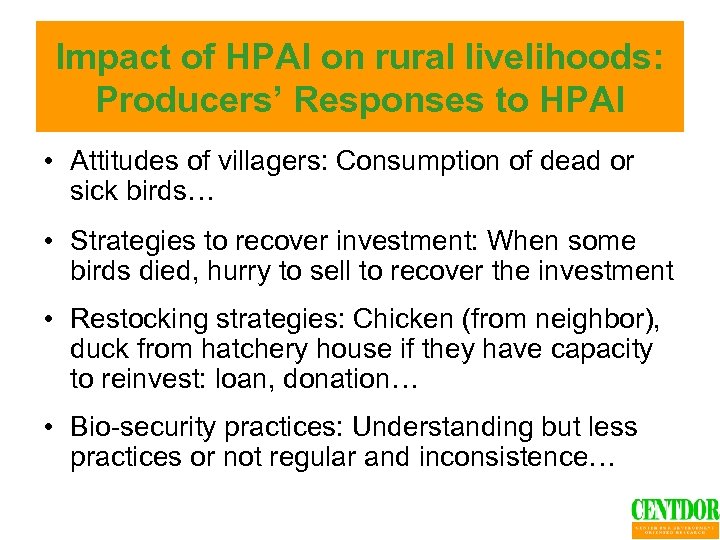
Impact of HPAI on rural livelihoods: Producers’ Responses to HPAI • Attitudes of villagers: Consumption of dead or sick birds… • Strategies to recover investment: When some birds died, hurry to sell to recover the investment • Restocking strategies: Chicken (from neighbor), duck from hatchery house if they have capacity to reinvest: loan, donation… • Bio-security practices: Understanding but less practices or not regular and inconsistence…
Government intervention and stakeholders involved in poultry production and control of HPAI • VAHW is a large scale structure of the government to promote livestock at village level. However, the services of VAHW are mostly focused on cattle and pig rather than poultry. • Poultry services can be said that it mainly provided by private enterprises: feed, vaccines and medicines. • NGOs provided technical training, or can be said that “improvement of farmers’ practices” while government services mainly on urgent intervention.
Concluding Remarks • In term of economic, HPAI outbreak have large direct and indirect impacts on duck producers but small impact of chicken producer as: – Duck raising is practiced as business enterprise. – Chicken raising is a second or third activities of the family and with very small scale. • According to the perception and practices of poultry producers, public health is a big concern. For example: selling sick birds, consume dead birds, and improper disposal of dead-birds. . .
Скачать презентацию Impact of HPAI on rural livelihoods in Cambodia
07741bff28629e0f5d0bdd3d3b51f684.ppt