 Скачать презентацию Impact Fault Tolerance and High Confidence Embedded Systems
bb23217ed84485861350dac72f0b17d5.ppt
- Количество слайдов: 20



Impact: Fault Tolerance and High Confidence Embedded Systems Design Edited and presented by Gabor Karsai Vanderbilt University, ISIS Chess Review October 4, 2006 Alexandria, VA
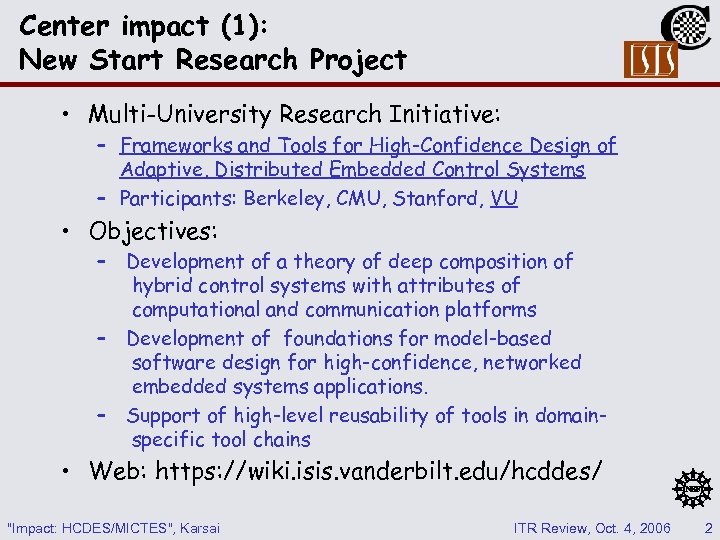
Center impact (1): New Start Research Project • Multi-University Research Initiative: – Frameworks and Tools for High-Confidence Design of Adaptive, Distributed Embedded Control Systems – Participants: Berkeley, CMU, Stanford, VU • Objectives: – Development of a theory of deep composition of hybrid control systems with attributes of computational and communication platforms – Development of foundations for model-based software design for high-confidence, networked embedded systems applications. – Support of high-level reusability of tools in domainspecific tool chains • Web: https: //wiki. isis. vanderbilt. edu/hcddes/ "Impact: HCDES/MICTES", Karsai ITR Review, Oct. 4, 2006 2
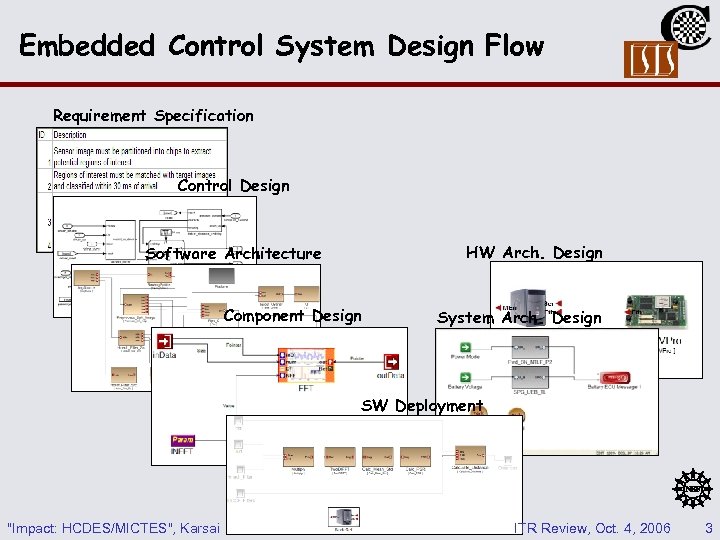
Embedded Control System Design Flow Requirement Specification Control Design HW Arch. Design Software Architecture Component Design System Arch. Design SW Deployment "Impact: HCDES/MICTES", Karsai ITR Review, Oct. 4, 2006 3
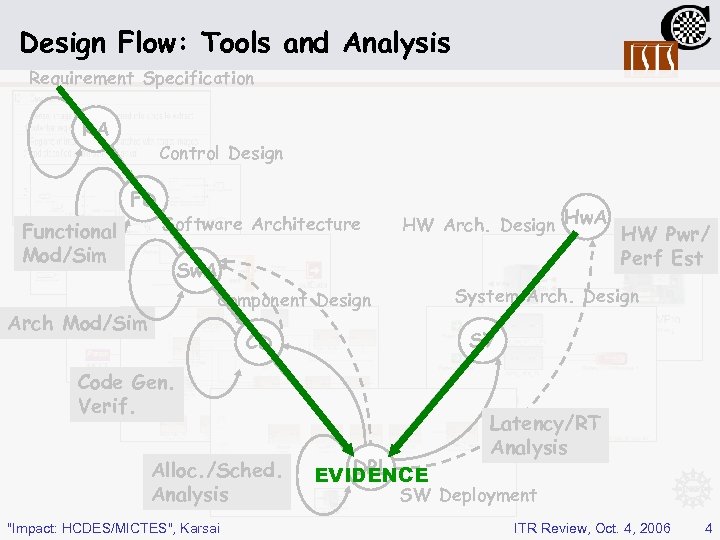
Design Flow: Tools and Analysis Requirement Specification RA Control Design FD Functional Mod/Sim Software Architecture HW Arch. Design Hw. A System Arch. Design Component Design Arch Mod/Sim SY CD Code Gen. Verif. Alloc. /Sched. Analysis "Impact: HCDES/MICTES", Karsai HW Pwr/ Perf Est DPL EVIDENCE Latency/RT Analysis SW Deployment ITR Review, Oct. 4, 2006 4
Overall Undertaking • Development of component technologies in all areas (theory/design/tools) • Incrementally building a tool chain for a selected domain (UAV flight and mission control) • Demonstration of control software development with the tool chain • Experiments "Impact: HCDES/MICTES", Karsai ITR Review, Oct. 4, 2006 5
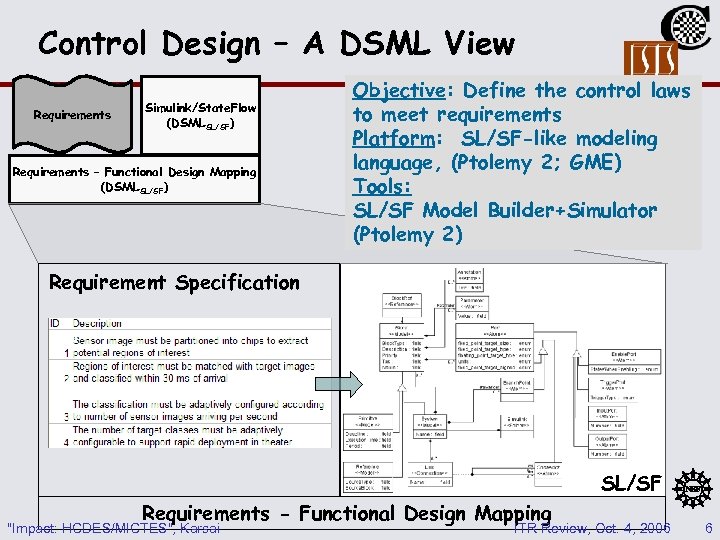
Control Design – A DSML View Requirements Simulink/State. Flow (DSMLSL/SF) Requirements – Functional Design Mapping (DSMLSL/SF) Objective: Define the control laws to meet requirements Platform: SL/SF-like modeling language, (Ptolemy 2; GME) Tools: SL/SF Model Builder+Simulator (Ptolemy 2) Requirement Specification SL/SF Requirements - Functional Design Mapping "Impact: HCDES/MICTES", Karsai ITR Review, Oct. 4, 2006 6
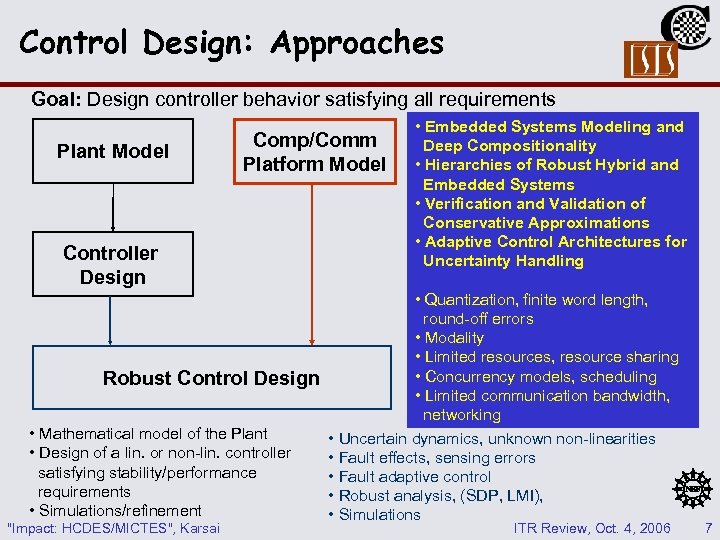
Control Design: Approaches Goal: Design controller behavior satisfying all requirements Plant Model Comp/Comm Platform Model Controller Design Robust Control Design • Mathematical model of the Plant • Design of a lin. or non-lin. controller satisfying stability/performance requirements • Simulations/refinement "Impact: HCDES/MICTES", Karsai • Embedded Systems Modeling and Deep Compositionality • Hierarchies of Robust Hybrid and Embedded Systems • Verification and Validation of Conservative Approximations • Adaptive Control Architectures for Uncertainty Handling • Quantization, finite word length, round-off errors • Modality • Limited resources, resource sharing • Concurrency models, scheduling • Limited communication bandwidth, networking • Uncertain dynamics, unknown non-linearities • Fault effects, sensing errors • Fault adaptive control • Robust analysis, (SDP, LMI), • Simulations ITR Review, Oct. 4, 2006 7
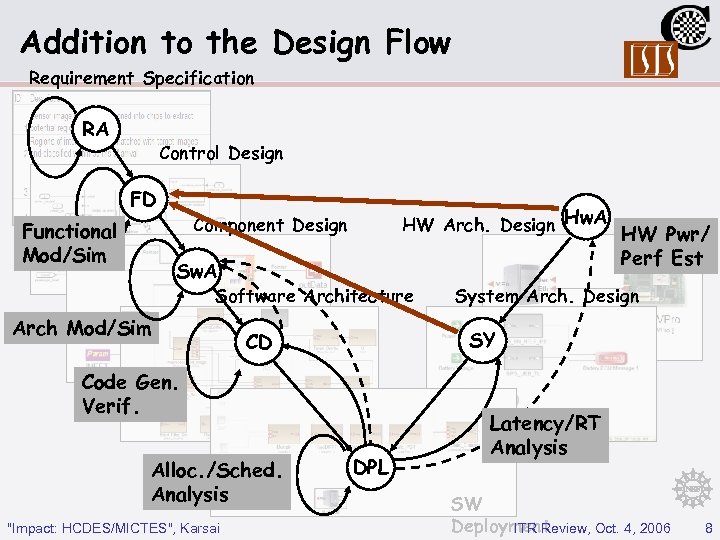
Addition to the Design Flow Requirement Specification RA Control Design FD Functional Mod/Sim HW Arch. Design Hw. A Component Design Sw. A Software Architecture Arch Mod/Sim Code Gen. Verif. "Impact: HCDES/MICTES", Karsai System Arch. Design SY CD Alloc. /Sched. Analysis HW Pwr/ Perf Est DPL Latency/RT Analysis SW Deployment ITR Review, Oct. 4, 2006 8
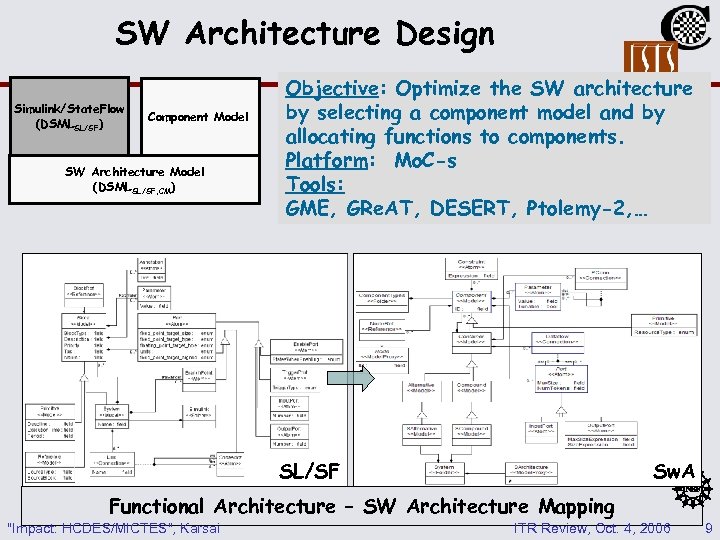
SW Architecture Design Simulink/State. Flow (DSMLSL/SF) Component Model SW Architecture Model (DSMLSL/SF, CM) Objective: Optimize the SW architecture by selecting a component model and by allocating functions to components. Platform: Mo. C-s Tools: GME, GRe. AT, DESERT, Ptolemy-2, … SL/SF Sw. A Functional Architecture – SW Architecture Mapping "Impact: HCDES/MICTES", Karsai ITR Review, Oct. 4, 2006 9
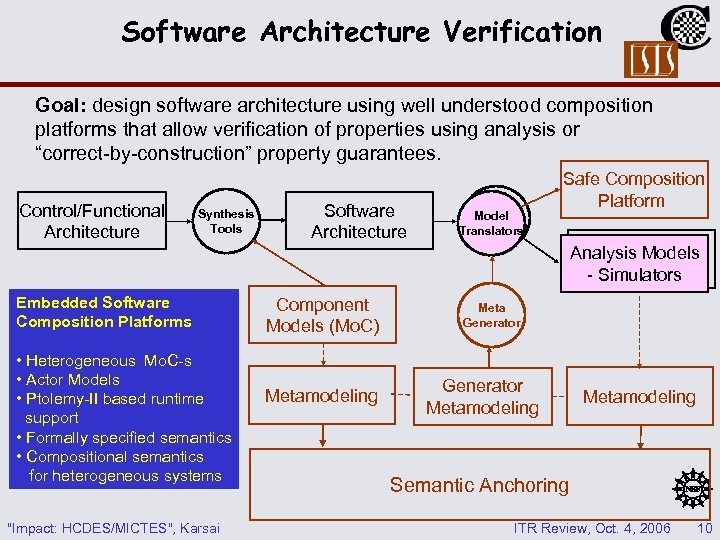
Software Architecture Verification Goal: design software architecture using well understood composition platforms that allow verification of properties using analysis or “correct-by-construction” property guarantees. Control/Functional Architecture Synthesis Tools Embedded Software Composition Platforms • Heterogeneous Mo. C-s • Actor Models • Ptolemy-II based runtime support • Formally specified semantics • Compositional semantics for heterogeneous systems "Impact: HCDES/MICTES", Karsai Software Architecture Component Models (Mo. C) Metamodeling Model Translators Safe Composition Platform Analysis Models Simulators - -Simulators Meta Generator Metamodeling Semantic Anchoring ITR Review, Oct. 4, 2006 10
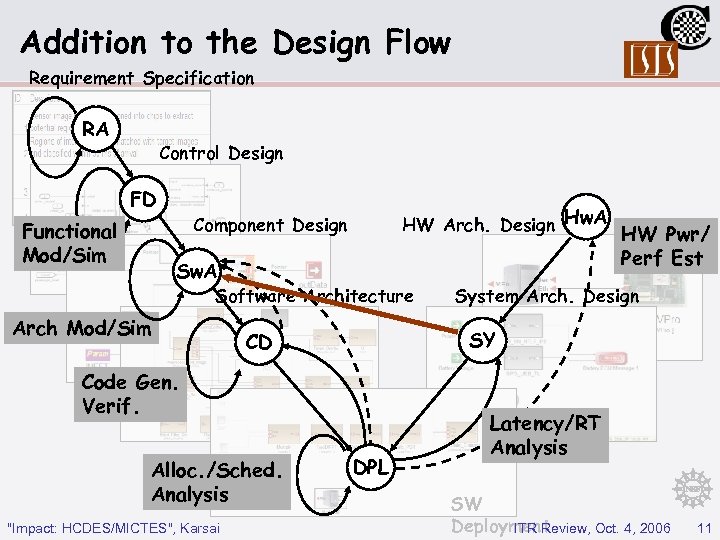
Addition to the Design Flow Requirement Specification RA Control Design FD Functional Mod/Sim HW Arch. Design Hw. A Component Design Sw. A Software Architecture Arch Mod/Sim Code Gen. Verif. "Impact: HCDES/MICTES", Karsai System Arch. Design SY CD Alloc. /Sched. Analysis HW Pwr/ Perf Est DPL Latency/RT Analysis SW Deployment ITR Review, Oct. 4, 2006 11
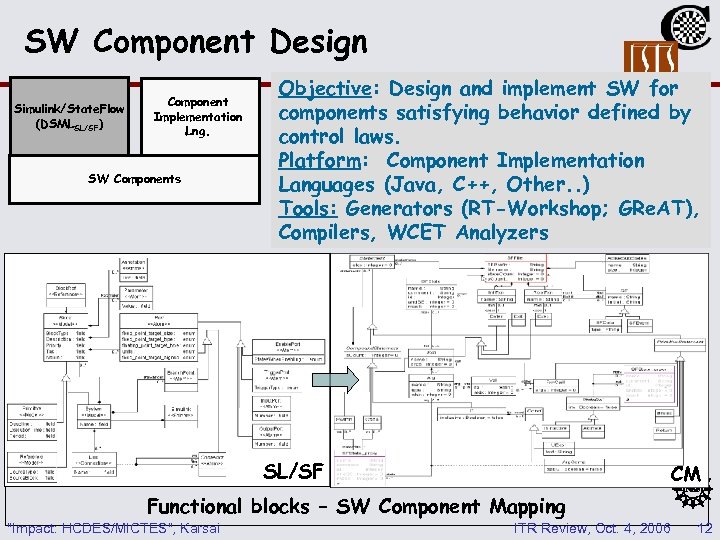
SW Component Design Simulink/State. Flow (DSMLSL/SF) Component Implementation Lng. SW Components Objective: Design and implement SW for components satisfying behavior defined by control laws. Platform: Component Implementation Languages (Java, C++, Other. . ) Tools: Generators (RT-Workshop; GRe. AT), Compilers, WCET Analyzers SL/SF CM Functional blocks – SW Component Mapping "Impact: HCDES/MICTES", Karsai ITR Review, Oct. 4, 2006 12
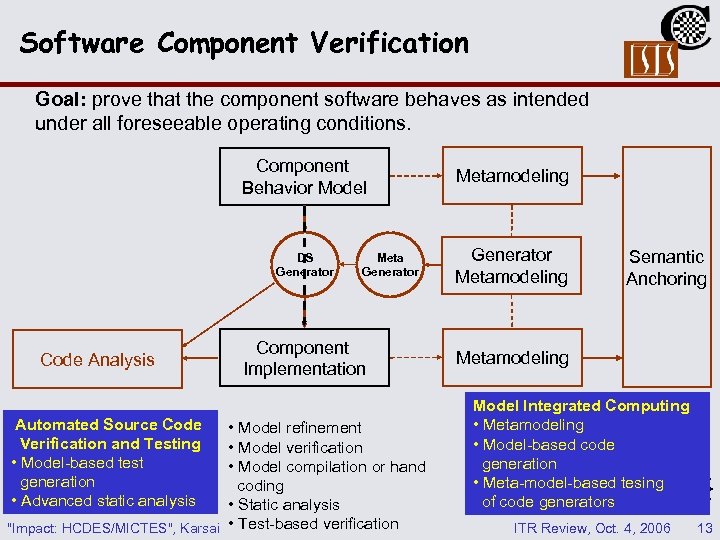
Software Component Verification Goal: prove that the component software behaves as intended under all foreseeable operating conditions. Component Behavior Model DS Generator Code Analysis Automated Source Code Verification and Testing • Model-based test generation • Advanced static analysis Metamodeling Generator Metamodeling Meta Generator Component Implementation • Model refinement • Model verification • Model compilation or hand coding • Static analysis "Impact: HCDES/MICTES", Karsai • Test-based verification Semantic Anchoring Metamodeling Model Integrated Computing • Metamodeling • Model-based code generation • Meta-model-based tesing of code generators ITR Review, Oct. 4, 2006 13
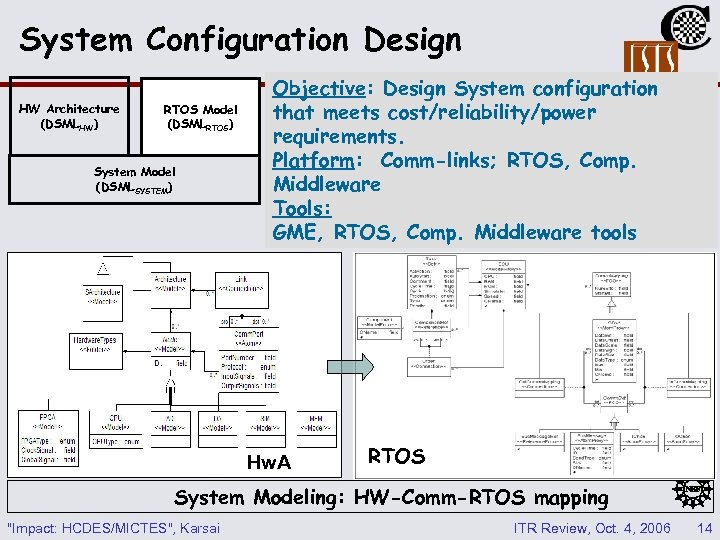
System Configuration Design HW Architecture (DSMLHW) RTOS Model (DSMLRTOS) System Model (DSMLSYSTEM) Objective: Design System configuration that meets cost/reliability/power requirements. Platform: Comm-links; RTOS, Comp. Middleware Tools: GME, RTOS, Comp. Middleware tools Hw. A RTOS System Modeling: HW-Comm-RTOS mapping "Impact: HCDES/MICTES", Karsai ITR Review, Oct. 4, 2006 14
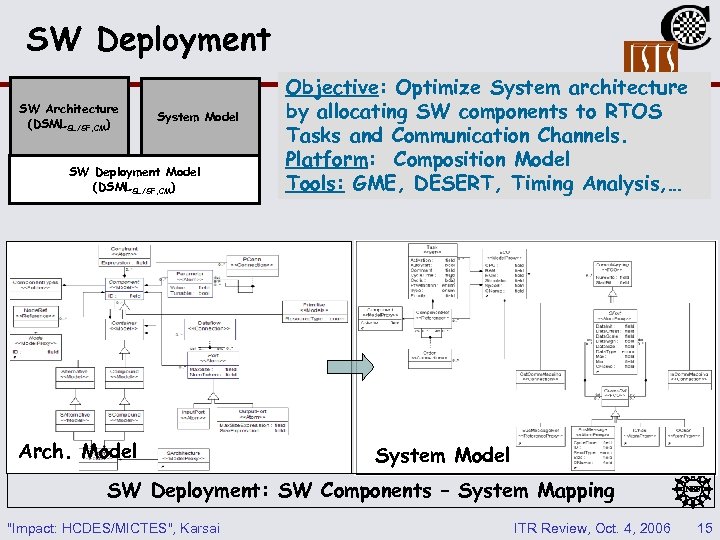
SW Deployment SW Architecture (DSMLSL/SF, CM) System Model SW Deployment Model (DSMLSL/SF, CM) Arch. Model Objective: Optimize System architecture by allocating SW components to RTOS Tasks and Communication Channels. Platform: Composition Model Tools: GME, DESERT, Timing Analysis, … System Model SW Deployment: SW Components – System Mapping "Impact: HCDES/MICTES", Karsai ITR Review, Oct. 4, 2006 15
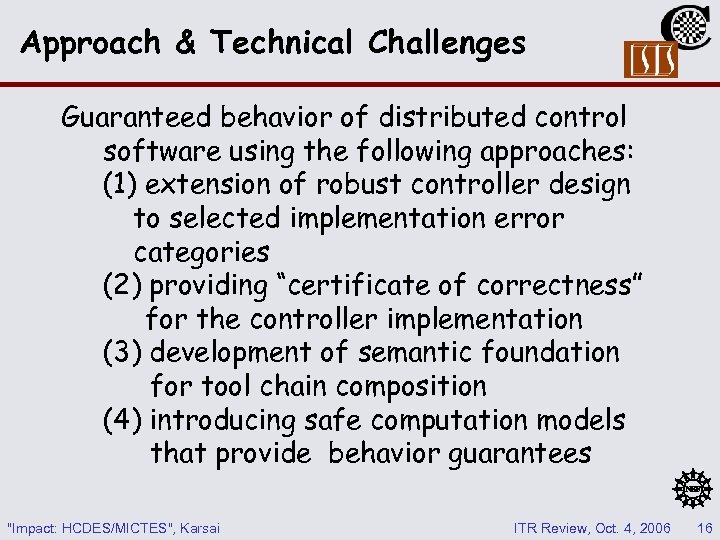
Approach & Technical Challenges Guaranteed behavior of distributed control software using the following approaches: (1) extension of robust controller design to selected implementation error categories (2) providing “certificate of correctness” for the controller implementation (3) development of semantic foundation for tool chain composition (4) introducing safe computation models that provide behavior guarantees "Impact: HCDES/MICTES", Karsai ITR Review, Oct. 4, 2006 16
Expected Deliverables • Composable tool architecture – New generation of Open Tool Integration Framework – Prototype Tool Chain • Testing and Experimental Validation – Software fully built and validated by tools • Avionics for small UAVs • Mission Management • COP for C 2 "Impact: HCDES/MICTES", Karsai ITR Review, Oct. 4, 2006 17
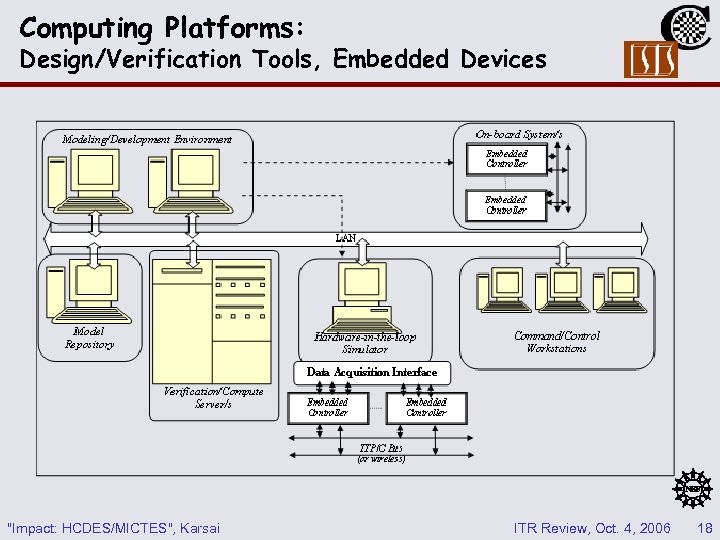
Computing Platforms: Design/Verification Tools, Embedded Devices "Impact: HCDES/MICTES", Karsai ITR Review, Oct. 4, 2006 18
Transition Approach • Tools are disseminated through the ESCHER Repository (Open Source) • Government: AFRL connections – AFRL/IF, AFRL/VACC, AFRL/VACA, AFRL/CSD • Cer. TA Project (Boeing/UCB) • Future Combat Systems Program (Boeing/VU) "Impact: HCDES/MICTES", Karsai ITR Review, Oct. 4, 2006 19
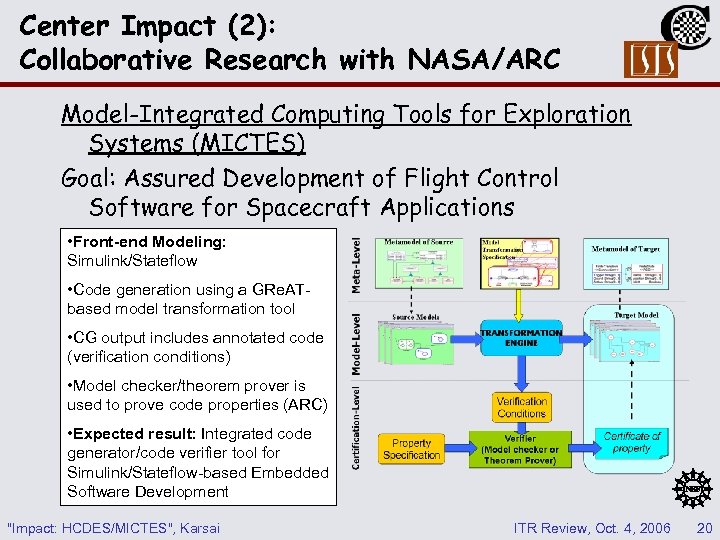
Center Impact (2): Collaborative Research with NASA/ARC Model-Integrated Computing Tools for Exploration Systems (MICTES) Goal: Assured Development of Flight Control Software for Spacecraft Applications • Front-end Modeling: Simulink/Stateflow • Code generation using a GRe. ATbased model transformation tool • CG output includes annotated code (verification conditions) • Model checker/theorem prover is used to prove code properties (ARC) • Expected result: Integrated code generator/code verifier tool for Simulink/Stateflow-based Embedded Software Development "Impact: HCDES/MICTES", Karsai ITR Review, Oct. 4, 2006 20
Скачать презентацию Impact Fault Tolerance and High Confidence Embedded Systems
bb23217ed84485861350dac72f0b17d5.ppt