 Скачать презентацию Imp EE THE Improving Engineering Education PROJECT Stabilisation
f2c0709a0682ec7cbb25bb4bbd0e640e.ppt
- Количество слайдов: 27



Imp. EE THE Improving Engineering Education PROJECT Stabilisation Wedges: Solving the Climate Problem for the Next 50 Years with Current Technologies
Targets for CO 2 emissions • Proposals to limit atmospheric CO 2 to a concentration that would prevent most damaging climate change have focused on a goal of 500 +/- 50 parts per million (ppm) • This is less than double the pre-industrial concentration of 280 ppm. • The current CO 2 concentration is 375 ppm.
Stabilization Wedges • Technologies that could be implemented to stabilise atmospheric carbon dioxide emissions within the next 50 years already exist. • A stabilisation wedge, the focus of this presentation, represents an activity that starts at zero reduction of emissions in 2005 and increases linearly until it accounts for 1 Gt. C/year of reduced carbon emissions in 2055. • Each wedge thus represents a cumulative total of 25 Gt. C of reduced emissions over 50 years.
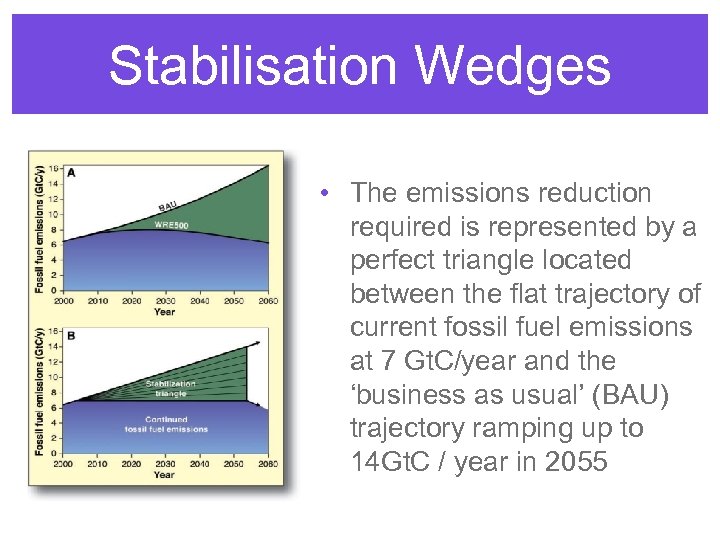
Stabilisation Wedges • The emissions reduction required is represented by a perfect triangle located between the flat trajectory of current fossil fuel emissions at 7 Gt. C/year and the ‘business as usual’ (BAU) trajectory ramping up to 14 Gt. C / year in 2055
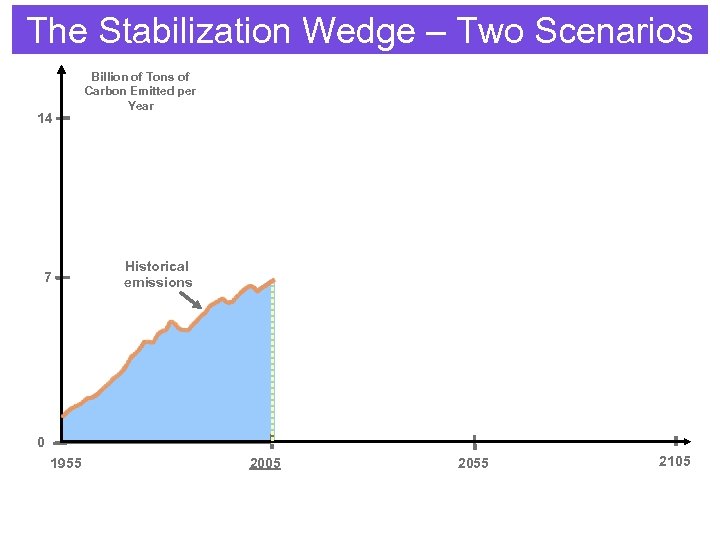
The Stabilization Wedge – Two Scenarios 14 7 Billion of Tons of Carbon Emitted per Year Historical emissions 0 1955 2005 2055 2105
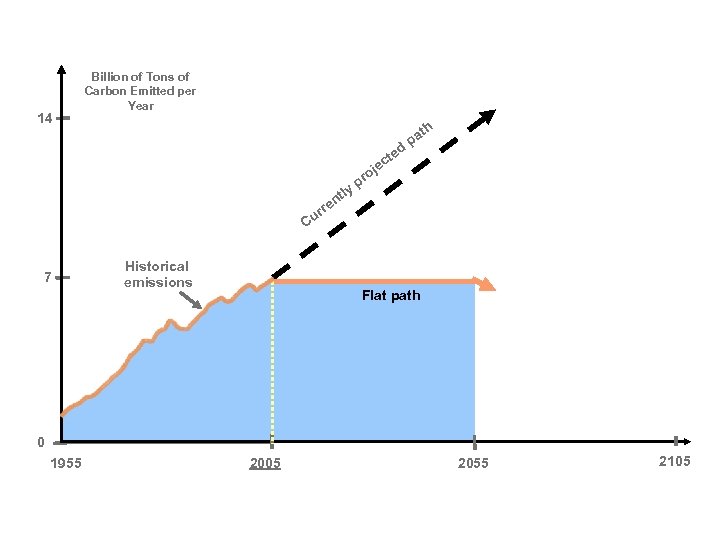
14 Billion of Tons of Carbon Emitted per Year ed ly t en pr ct je th pa o r r Cu 7 Historical emissions Flat path 0 1955 2005 2055 2105
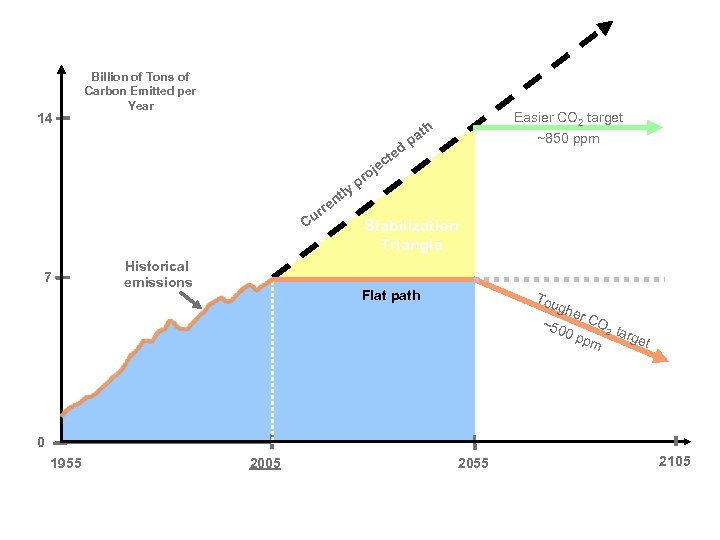
14 Billion of Tons of Carbon Emitted per Year ed ly t en pr ct je Easier CO 2 target ~850 ppm th pa o r r Cu 7 Historical emissions Stabilization Triangle Flat path Tou ghe r CO ~50 2 tar 0 p get pm 0 1955 2005 2055 2105
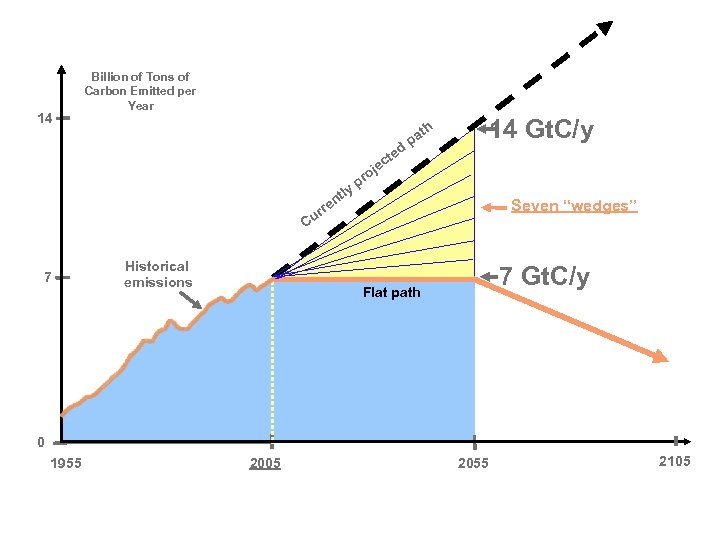
14 Billion of Tons of Carbon Emitted per Year ed ly t en pr ct je th pa 14 Gt. C/y o Seven “wedges” r r Cu 7 Historical emissions 7 Gt. C/y Flat path 0 1955 2005 2055 2105
Business as Usual? • If the ‘business as usual’ option is taken for the next 50 years before flat growth is achieved, then this will result in a tripling of the pre-industrialisation concentration of green house gases.
Current technology options to provide a wedge • • • Improve fuel economy Reduce reliance on cars More efficient buildings Improved power plant efficiency Decarbonisation of Electricity and Fuels Substitution of Natural gas for coal Carbon capture and storage Nuclear fission Wind electricity Photovoltaic electricity Biofuels
Natural Sinks • Forest Management • Agricultural Soils Management
Stabilization Wedges • The slides that follow suggest a number of ways in which current technologies might be employed to save ‘one wedge’ of CO 2 emissions over the next 50 years • One wedge provides a cumulative total of 25 Gt. C of reduced emissions. • A total of seven are required to stabilise emissions at 500 ppm CO 2 in fifty years
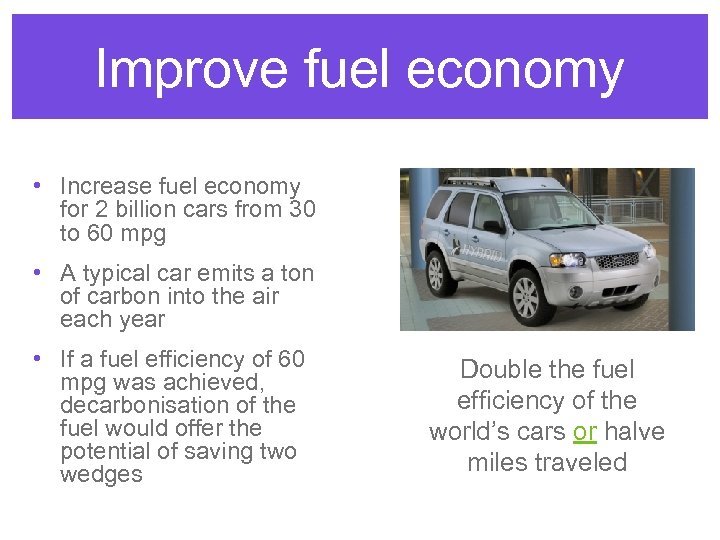
Improve fuel economy • Increase fuel economy for 2 billion cars from 30 to 60 mpg • A typical car emits a ton of carbon into the air each year • If a fuel efficiency of 60 mpg was achieved, decarbonisation of the fuel would offer the potential of saving two wedges Double the fuel efficiency of the world’s cars or halve miles traveled
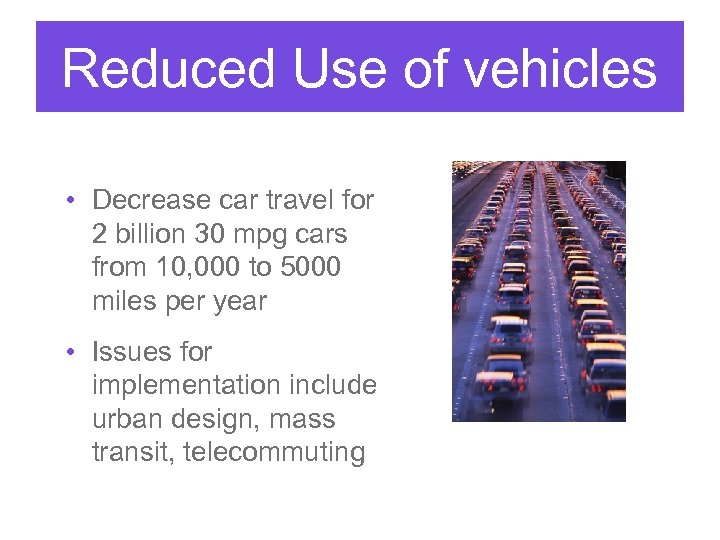
Reduced Use of vehicles • Decrease car travel for 2 billion 30 mpg cars from 10, 000 to 5000 miles per year • Issues for implementation include urban design, mass transit, telecommuting
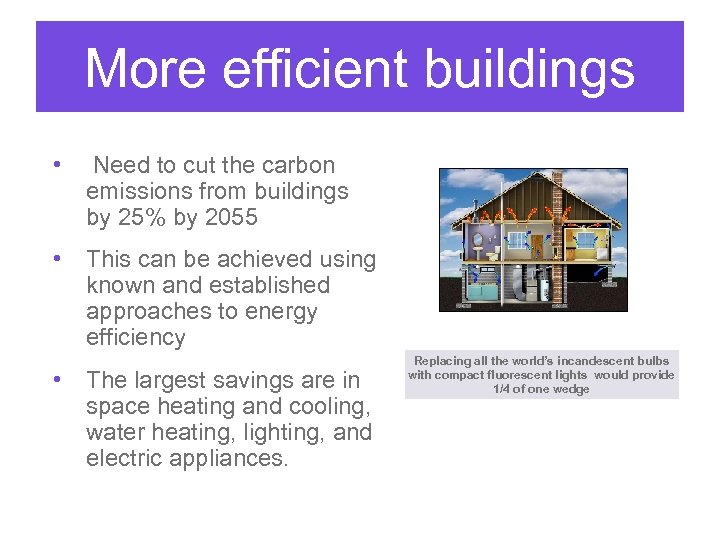
More efficient buildings • Need to cut the carbon emissions from buildings by 25% by 2055 • This can be achieved using known and established approaches to energy efficiency • The largest savings are in space heating and cooling, water heating, lighting, and electric appliances. Replacing all the world’s incandescent bulbs with compact fluorescent lights would provide 1/4 of one wedge
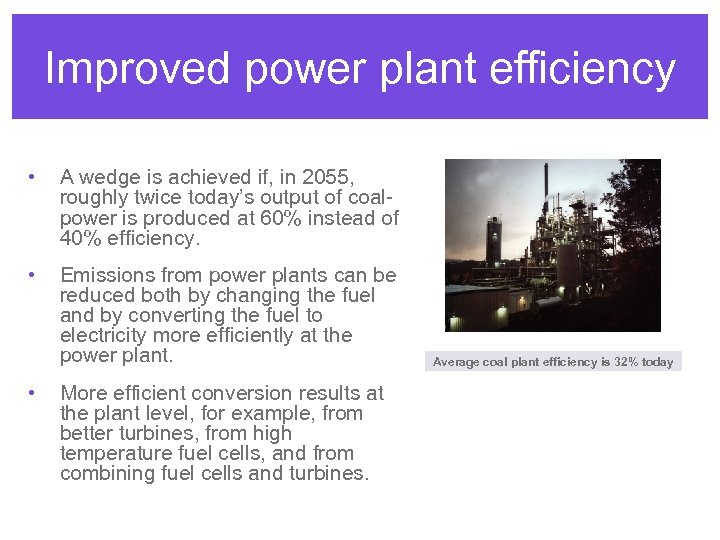
Improved power plant efficiency • A wedge is achieved if, in 2055, roughly twice today’s output of coalpower is produced at 60% instead of 40% efficiency. • Emissions from power plants can be reduced both by changing the fuel and by converting the fuel to electricity more efficiently at the power plant. • More efficient conversion results at the plant level, for example, from better turbines, from high temperature fuel cells, and from combining fuel cells and turbines. Average coal plant efficiency is 32% today
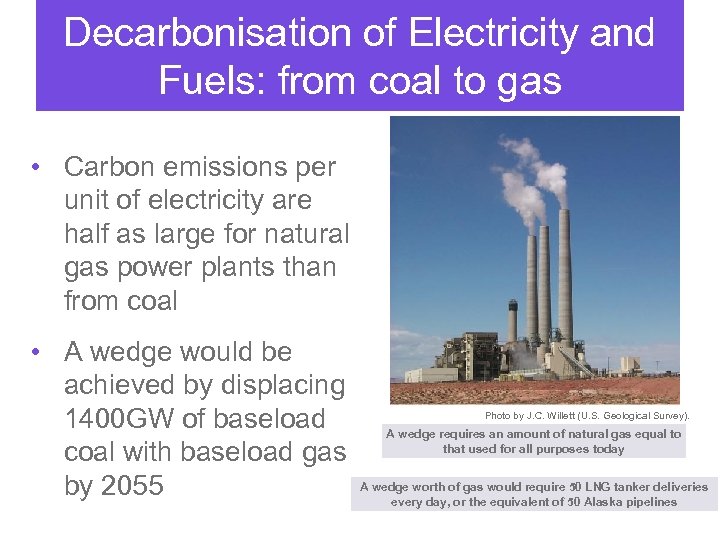
Decarbonisation of Electricity and Fuels: from coal to gas • Carbon emissions per unit of electricity are half as large for natural gas power plants than from coal • A wedge would be achieved by displacing 1400 GW of baseload coal with baseload gas by 2055 Photo by J. C. Willett (U. S. Geological Survey). A wedge requires an amount of natural gas equal to that used for all purposes today A wedge worth of gas would require 50 LNG tanker deliveries every day, or the equivalent of 50 Alaska pipelines
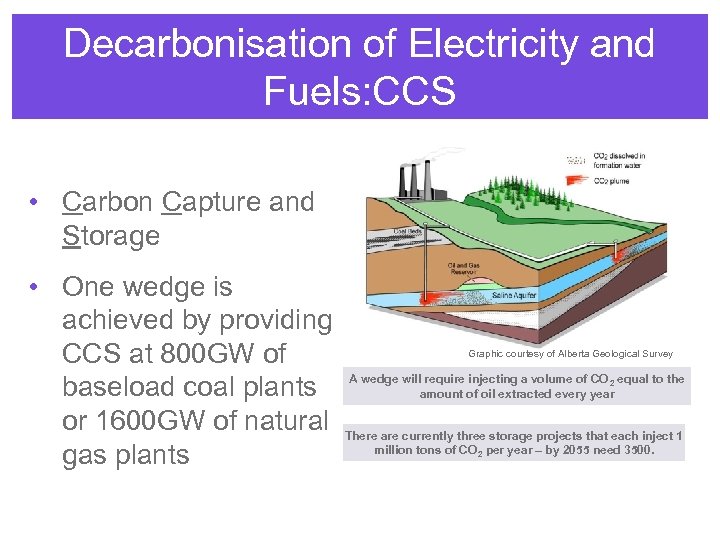
Decarbonisation of Electricity and Fuels: CCS • Carbon Capture and Storage • One wedge is achieved by providing CCS at 800 GW of baseload coal plants or 1600 GW of natural gas plants Graphic courtesy of Alberta Geological Survey A wedge will require injecting a volume of CO 2 equal to the amount of oil extracted every year There are currently three storage projects that each inject 1 million tons of CO 2 per year – by 2055 need 3500.
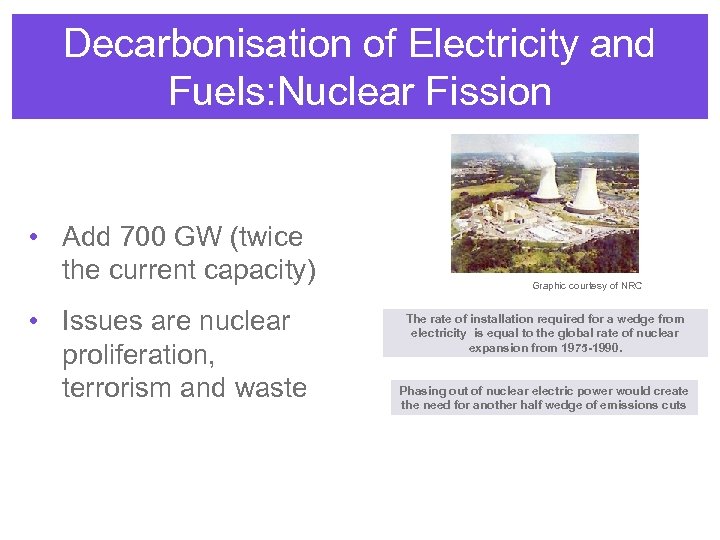
Decarbonisation of Electricity and Fuels: Nuclear Fission • Add 700 GW (twice the current capacity) • Issues are nuclear proliferation, terrorism and waste Graphic courtesy of NRC The rate of installation required for a wedge from electricity is equal to the global rate of nuclear expansion from 1975 -1990. Phasing out of nuclear electric power would create the need for another half wedge of emissions cuts
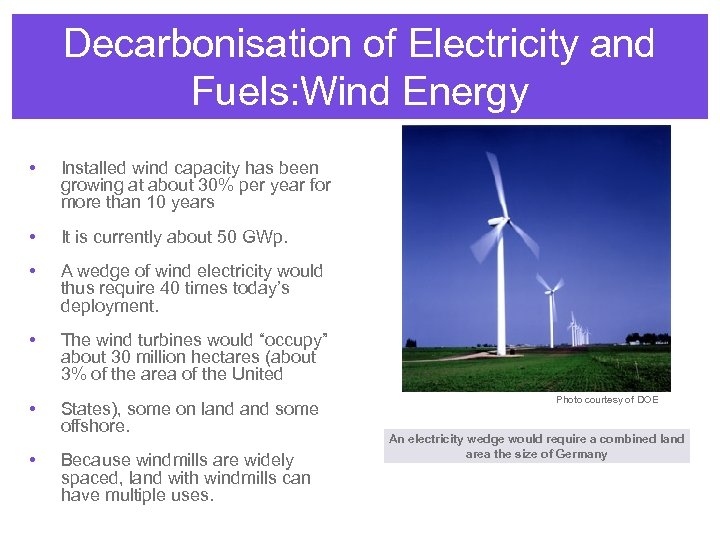
Decarbonisation of Electricity and Fuels: Wind Energy • Installed wind capacity has been growing at about 30% per year for more than 10 years • It is currently about 50 GWp. • A wedge of wind electricity would thus require 40 times today’s deployment. • The wind turbines would “occupy” about 30 million hectares (about 3% of the area of the United • States), some on land some offshore. • Because windmills are widely spaced, land with windmills can have multiple uses. Photo courtesy of DOE An electricity wedge would require a combined land area the size of Germany
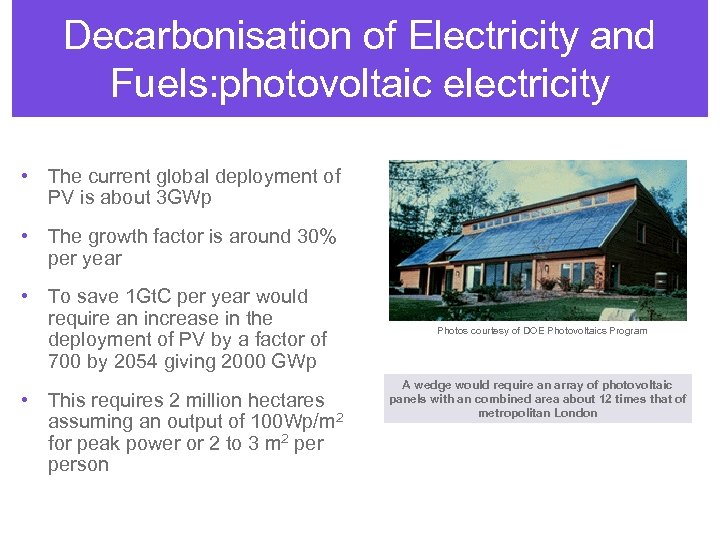
Decarbonisation of Electricity and Fuels: photovoltaic electricity • The current global deployment of PV is about 3 GWp • The growth factor is around 30% per year • To save 1 Gt. C per year would require an increase in the deployment of PV by a factor of 700 by 2054 giving 2000 GWp • This requires 2 million hectares assuming an output of 100 Wp/m 2 for peak power or 2 to 3 m 2 person Photos courtesy of DOE Photovoltaics Program A wedge would require an array of photovoltaic panels with an combined area about 12 times that of metropolitan London
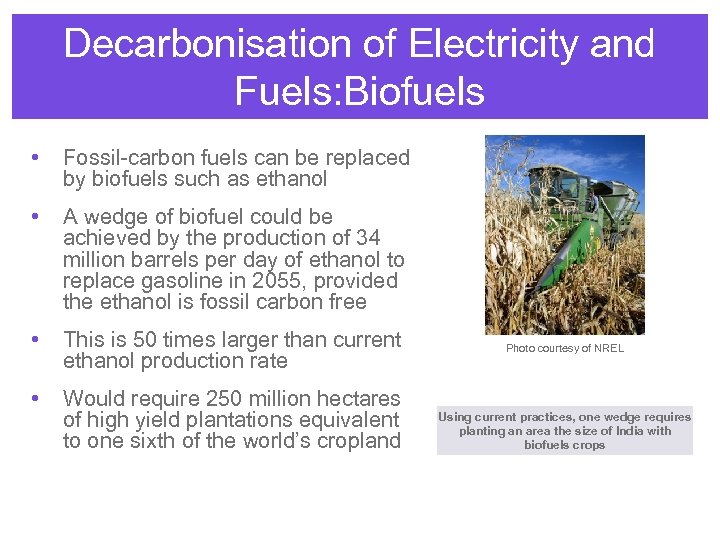
Decarbonisation of Electricity and Fuels: Biofuels • Fossil-carbon fuels can be replaced by biofuels such as ethanol • A wedge of biofuel could be achieved by the production of 34 million barrels per day of ethanol to replace gasoline in 2055, provided the ethanol is fossil carbon free • This is 50 times larger than current ethanol production rate • Would require 250 million hectares of high yield plantations equivalent to one sixth of the world’s cropland Photo courtesy of NREL Using current practices, one wedge requires planting an area the size of India with biofuels crops
Natural sinks: Reduced Tropical Deforestation • Estimates of tropical forest lost per year in the 1990 s vary from 6 to 12 million hectares • This leads to a factor of two difference in emissions to the atmosphere: ~1 vs. ~2 Gt. C/y • At least half a wedge could be obtained by eliminating deforestation • Another half could be created by reforesting 250 million hectares in the tropics or 400 million in the temperate zone One wedge would require new forests over an area the size of the continental U. S.
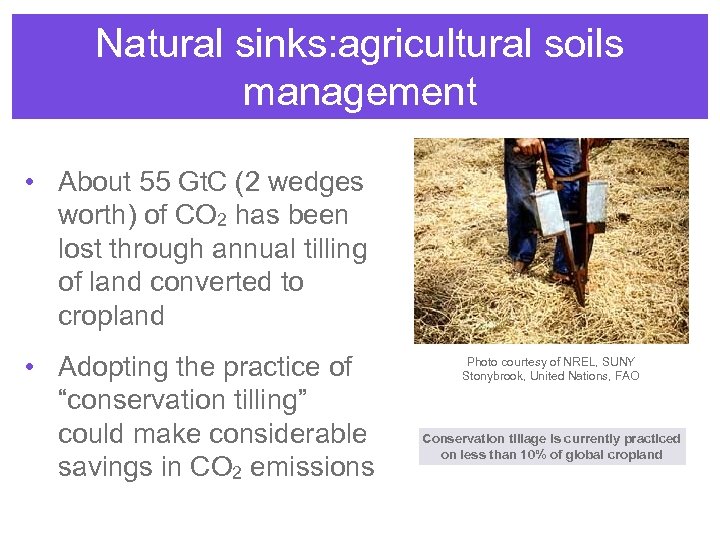
Natural sinks: agricultural soils management • About 55 Gt. C (2 wedges worth) of CO 2 has been lost through annual tilling of land converted to cropland • Adopting the practice of “conservation tilling” could make considerable savings in CO 2 emissions Photo courtesy of NREL, SUNY Stonybrook, United Nations, FAO Conservation tillage is currently practiced on less than 10% of global cropland
Choices: a case for action • The choice we have in facing the problem of climate change is between action and delay. • The technologies presented here make a case for action. • All of these technologies exist today and could be scaled up over 50 years to help stabilisation the rise in CO 2 emissions.
Things to think about • In order to avoid a doubling of atmospheric CO 2, we need to rapidly deploy low-carbon energy technologies and/or enhance natural sinks • We already have an adequate portfolio of technologies to make large cuts in emissions • No one technology can do the whole job – a variety of strategies will need to be used to stay on a path that avoids a CO 2 doubling • Every “wedge” has associated impacts and costs
© University of Cambridge, 2006 This material was produced as a part of the Imp. EE Project at the University of Cambridge. It may be reproduced, modified and used freely for educational purposes. Imp. EE is based at the Department of Engineering at the University of Cambridge and is funded by the CMI Institute.
Скачать презентацию Imp EE THE Improving Engineering Education PROJECT Stabilisation
f2c0709a0682ec7cbb25bb4bbd0e640e.ppt