


 Скачать презентацию IMO requirements to reduce emission to air from
50e823a151407ba0bda8a5cc60f5c040.ppt
- Количество слайдов: 27
 IMO requirements to reduce emission to air from ships by Erik. Ranheim@INTERTANKO. com Manager Research and Projects Gdansk April 2008 ‘
 INTERTANKO International Association of Independent Tanker Owners A non-governmental organization established in Oslo in 1970 to speak authoritatively and proactively on behalf of tanker operators at international, regional, national and local level Membership 260 Members in 40 countries + 2, 900 tankers 236 million dwt 75% of independent tanker fleet 300 Associate Members
 INTERTANKO MISSION Provide leadership to the Tanker Industry in serving the world with safe, environmentally sound and efficient seaborne transportation of oil, gas and chemical products. VISION for the TANKER INDUSTRY A responsible, sustainable and respected Tanker Industry, committed to continuous improvement and constructively influencing its future.
 Emission from shipping Shipping needs - INTERTANKO seeks • • Positive reduction of harmful emission A feasible, realistic and sustainable solution Long-term, predictable and solid IMO standards No unilateral nor regional regulations 1. Emission Annex VI, SOx, NOx, PM. . 2. Green House Gas Emission
 Reducing harmful emissions from ships • Onboard abatement technology – Scrubbers, filters, separators, catalysts • ECAs – Emission Control Areas • Type and quality of fuel – Heavy fuel oil = a blending of refinery residues and distillate (up to 30% dist. ) – Distillates = gasoil and diesel • Improved efficiency and lgistics
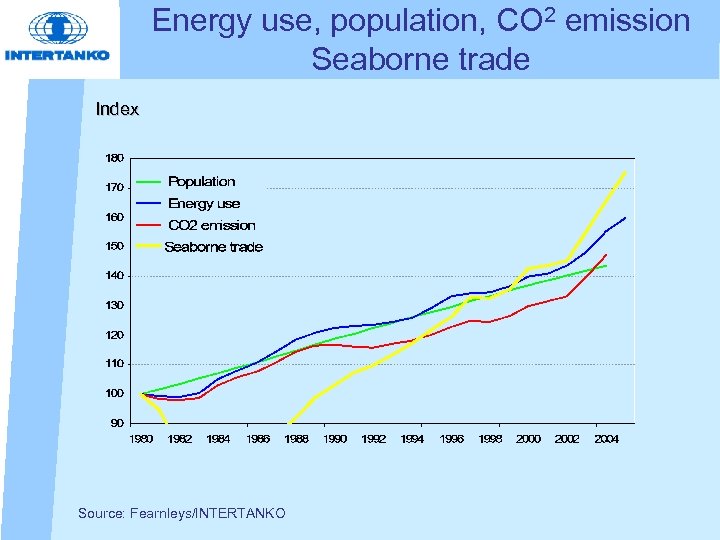 Energy use, population, CO 2 emission Seaborne trade Index Source: Fearnleys/INTERTANKO
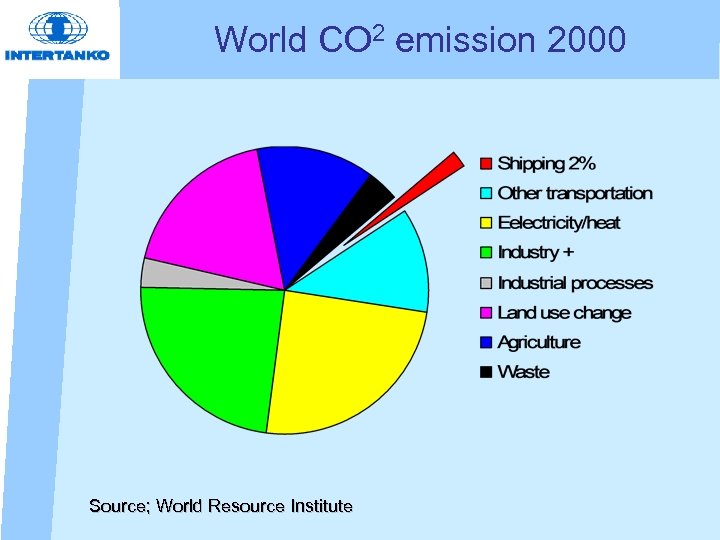 World CO 2 emission 2000 Source; World Resource Institute
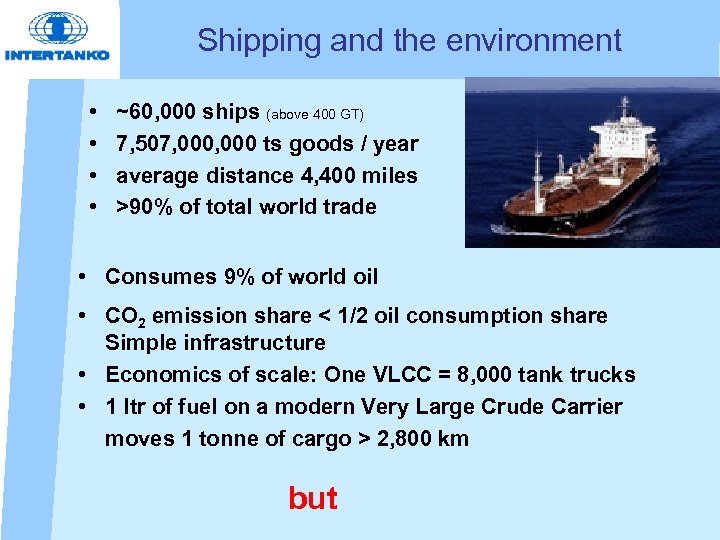 Shipping and the environment • • ~60, 000 ships (above 400 GT) 7, 507, 000 ts goods / year average distance 4, 400 miles >90% of total world trade • Consumes 9% of world oil • CO 2 emission share < 1/2 oil consumption share Simple infrastructure • Economics of scale: One VLCC = 8, 000 tank trucks • 1 ltr of fuel on a modern Very Large Crude Carrier moves 1 tonne of cargo > 2, 800 km but
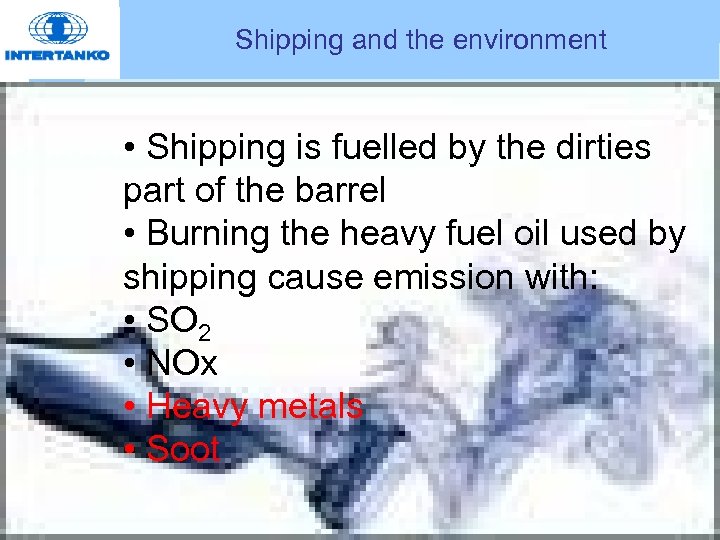 Shipping and the environment • Shipping is fuelled by the dirties part of the barrel • Burning the heavy fuel oil used by shipping cause emission with: • SO 2 • NOx • Heavy metals • Soot
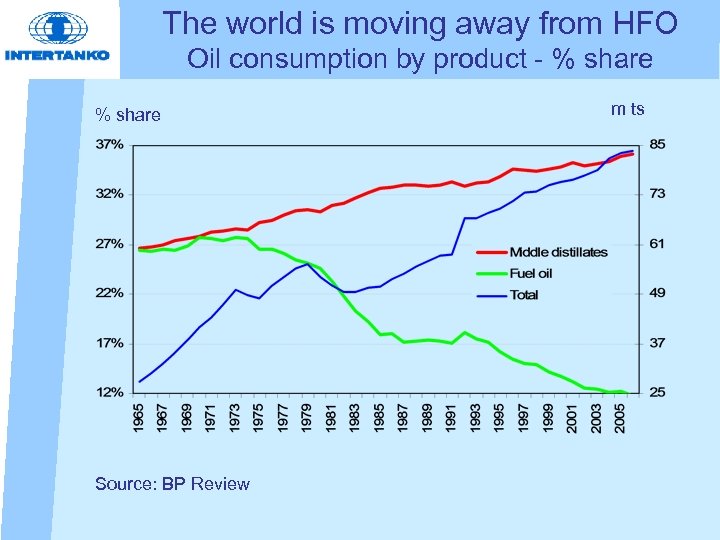 The world is moving away from HFO Oil consumption by product - % share Source: BP Review m ts
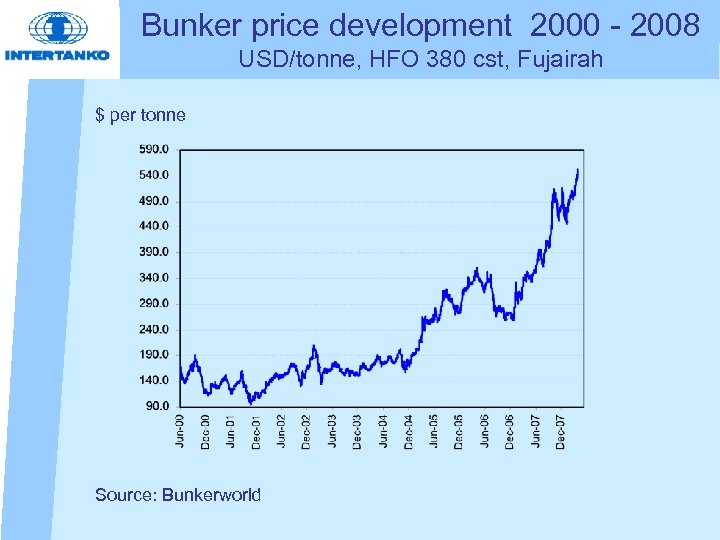 Bunker price development 2000 - 2008 USD/tonne, HFO 380 cst, Fujairah $ per tonne Source: Bunkerworld
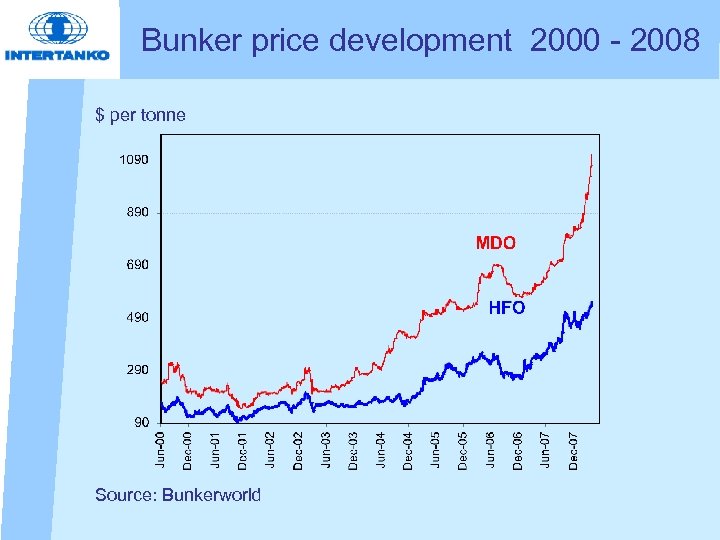 Bunker price development 2000 - 2008 $ per tonne Source: Bunkerworld
 The IMO emission package • • • New regulation on SOx and PM Compliance through fuel only Equivalent measures accepted Marine fuel oil quality to be improved No measures on ships that do not receive adequate bunker supply • Guidelines to asses compliance if BDN data is challenged by PSC or lab test results • NOx Tier I on large 1990 s built engines • NOx Tier II and Tier III on new engines
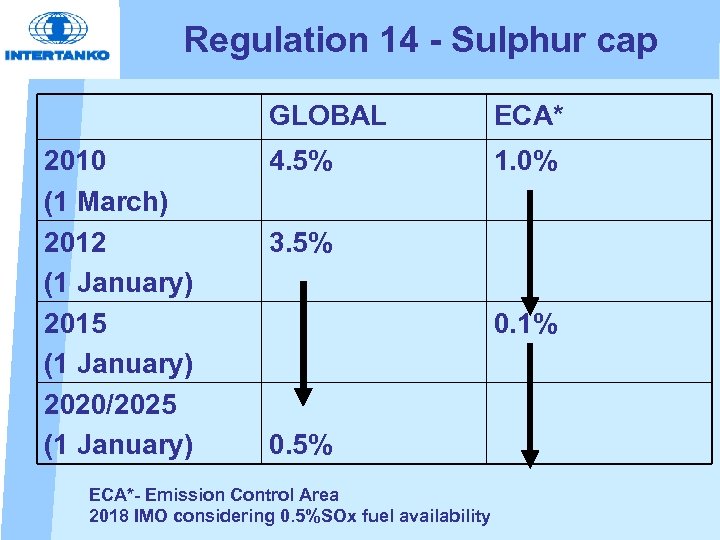 Regulation 14 - Sulphur cap GLOBAL 2010 (1 March) 2012 (1 January) 2015 (1 January) 2020/2025 (1 January) ECA* 4. 5% 1. 0% 3. 5% 0. 1% 0. 5% ECA*- Emission Control Area 2018 IMO considering 0. 5%SOx fuel availability
 Regulation 4 – Equivalent measures • An Administration may allow any fitting, material, appliance or apparatus to be fitted in a ship or other procedures, alternative fuel oils, or compliance methods used as an alternative to that required by this Annex if such methods are at least as effective in terms of emissions reductions as that required by this Annex • This means the Administration (and not the ship) have to acknowledge that: – They have equivalent efficiency in terms of SOx, PM and NOx. – That they do not harm the environment – As they operate within the requirements of the IMO guidelines
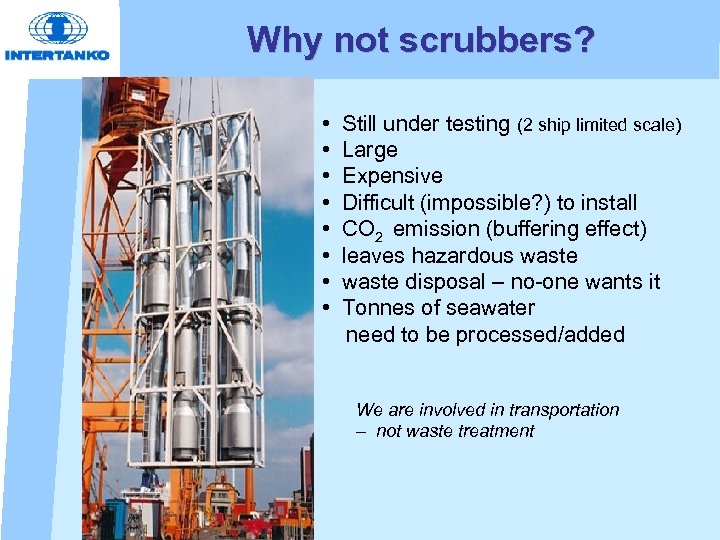 Why not scrubbers? • Still under testing (2 ship limited scale) • Large • Expensive • Difficult (impossible? ) to install • CO 2 emission (buffering effect) • leaves hazardous waste • waste disposal – no-one wants it • Tonnes of seawater need to be processed/added We are involved in transportation – not waste treatment
 Revised Regulation 18 • If a ship is not compliant it should present evidence/record it attempted to buy the compliant fuel in accordance with the voyage plan • The ship not required to deviate from the voyage and should not be delayed • If evidence is provided, there should be no measures against the ship
 Fuel oil quality • IMO Secretariat to request the ISO to consider a revision of a marine fuel oil specification (ISO 8217) addressing : -air quality, -ship safety, -engine performance, -crew health with recommendations for future consideration by the IMO, and if feasible, report back to MEPS 58
 NOx emissions – Pre-2000 engines Upgrade Methodology • Measures on engines: – installed onboard ships constructed between 1 Jan 1990 and 31 Dec 1999 – power output > 5, 000 k. W; and – per cylinder displacement at or > 90 litres • The NOx emissions at Tier I level • If the engine already meets Tier I NOx emission limits, simple certification is sufficient
 NOx emissions – pre-2000 engines Part of the certification, • Parties should check that the upgrading: – does not reduce the engine rating by more than 1% – does not increase the fuel consumption by more than 2%, and – it has no other adverse effect on the durability or reliability of the engine • Upgrading to an acceptable cost/benefit level calculated according to a cost efficiency formula
 Pre-2000 engines NOT-complying with Tier I NOx emission limitations: • measures against ship ONLY if there is a certified, efficient system commercially available • upgrade at the ship’s first renewal survey after a upgrading system is available • Documented that a system not available at the first renewal survey, flag gives an extension until the next Annual Survey
 NOx emissions – Tier II (new engines) • Tier II standards (emission reductions related to Tier I limits): – 15. 5% reduction (slow engines) – 15. 5% and 21. 8% (medium speed) engines – 21. 8% reduction (fast engines) • Applies to engines installed on ships constructed on and after 1 January 2011 Engines manufacturers says it is possible
 NOx emissions-Tier III (new engines) • Tier III standards – 80% emission reductions from Tier I limits • Tier III limits apply to engines: – installed on ships constructed on & after 1 Jan 2016 – power output of > 750 k. W (130 k. W – 750 k. W may be exempted by the Administration) • Tier III limits in ECAs only • Outside ECAs - Tier II limits
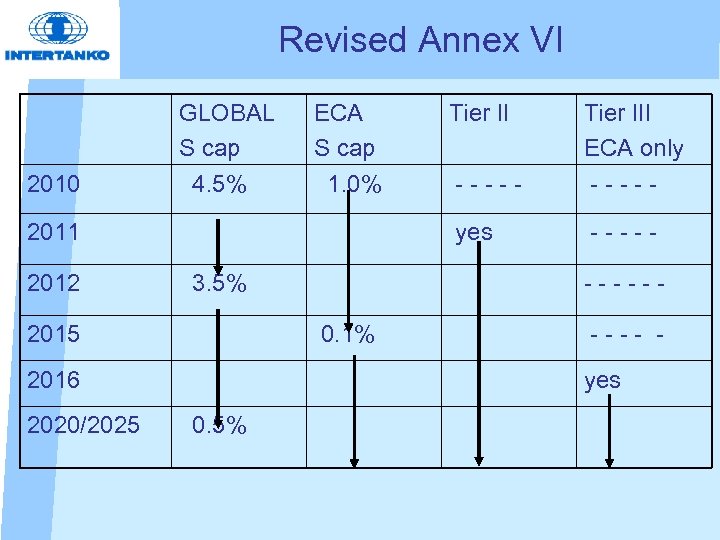 Revised Annex VI 2010 GLOBAL S cap 4. 5% ECA S cap 1. 0% 2012 3. 5% 2015 2020/2025 ----- 0. 1% 2016 ----- Tier III ECA only ----- yes 2011 Tier II ---- yes 0. 5%
 INTERTANKO welcome IMO package • Goals set by the INTERTANKO Council fully achieved: – a solid platform of requirements – realistic and feasible – contribute to achieve a global, long-term and positive reduction of air emissions from ships; and – contribute to a long-term and predictable global regulatory regime Cleaner, Simpler and more Efficient ships
 GHG reduction • Ship – striving for efficiency improvement – – Engine Hull, • • • – • Kite/sails…. . others Trades- charterers/traders optimising logistic – – – • paint, cleanliness shape Ballast part Part loading Sourcing Indexing of ships Cleaner, Simpler and more Efficient ships
 OUTCOME ON MARPOL ANNEX VI THANK YOU VERY MUCH Cleaner, Simpler and more Efficient ships