


 Скачать презентацию IMMUNIZATION PROGRAMME IN TANZANIA Dr Aza Introduction
803ef2a91ce90a71a94a876e21e8e771.ppt
- Количество слайдов: 17
 IMMUNIZATION PROGRAMME IN TANZANIA Dr Aza
 Introduction The Expanded Programme on Immunization (EPI) in the country started in 1975 with the aim of reducing morbidity and mortality caused by measles, poliomyelitis, whooping cough, tetanus and tuberculosis in children under 5 years of age. The programme is currently involved in delivering safe vaccines for vaccine preventable diseases to under one and women of child bearing age and/or populations at risk.
 The programme also involves procurement of vaccines, supplies and equipment from the manufacturer/suppliers to the point of vaccine administration in a recommended condition. In the process of delivering vaccines, appropriate storage and transport facilities are important issues of the programme.
 Vaccine-preventable diseases Vaccine preventable diseases in Tanzania that are currently addressed by immunization programme include: Polio, Measles, Neonatal Tetanus, Diphtheria, Pertusis, Tuberculosis Hepatitis B.
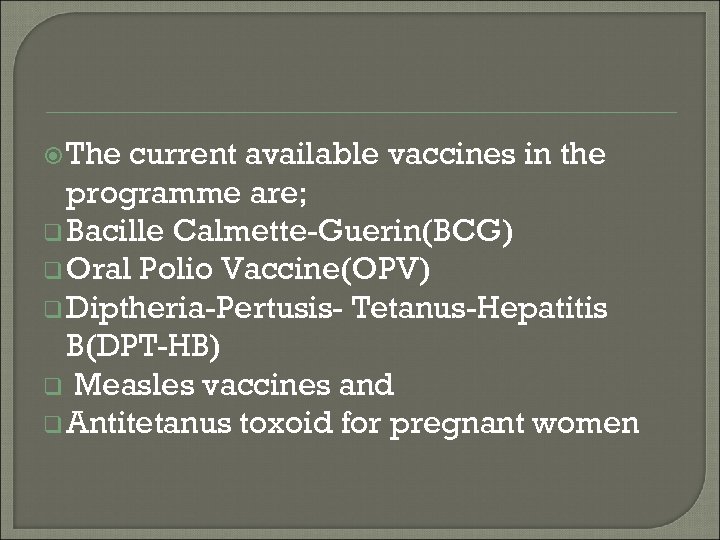 The current available vaccines in the programme are; q Bacille Calmette-Guerin(BCG) q Oral Polio Vaccine(OPV) q Diptheria-Pertusis- Tetanus-Hepatitis B(DPT-HB) q Measles vaccines and q Antitetanus toxoid for pregnant women
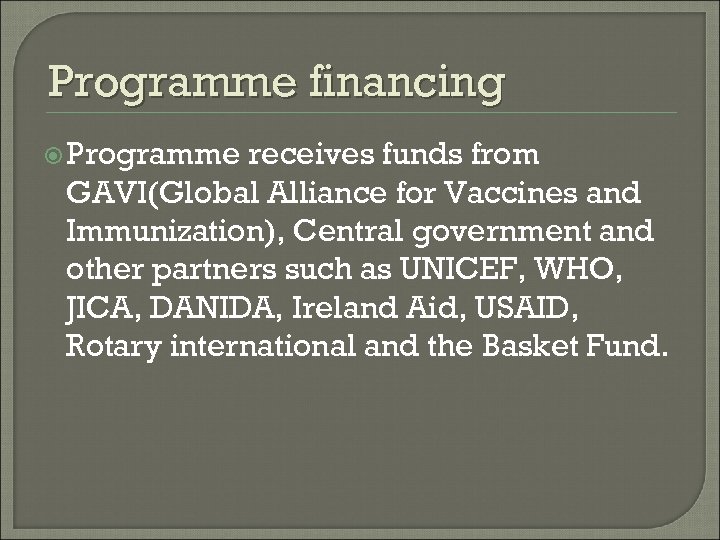 Programme financing Programme receives funds from GAVI(Global Alliance for Vaccines and Immunization), Central government and other partners such as UNICEF, WHO, JICA, DANIDA, Ireland Aid, USAID, Rotary international and the Basket Fund.
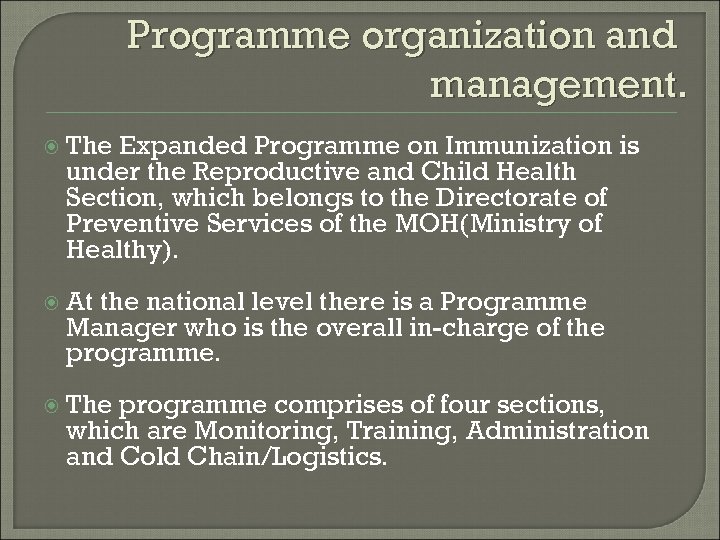 Programme organization and management. The Expanded Programme on Immunization is under the Reproductive and Child Health Section, which belongs to the Directorate of Preventive Services of the MOH(Ministry of Healthy). At the national level there is a Programme Manager who is the overall in-charge of the programme. The programme comprises of four sections, which are Monitoring, Training, Administration and Cold Chain/Logistics.
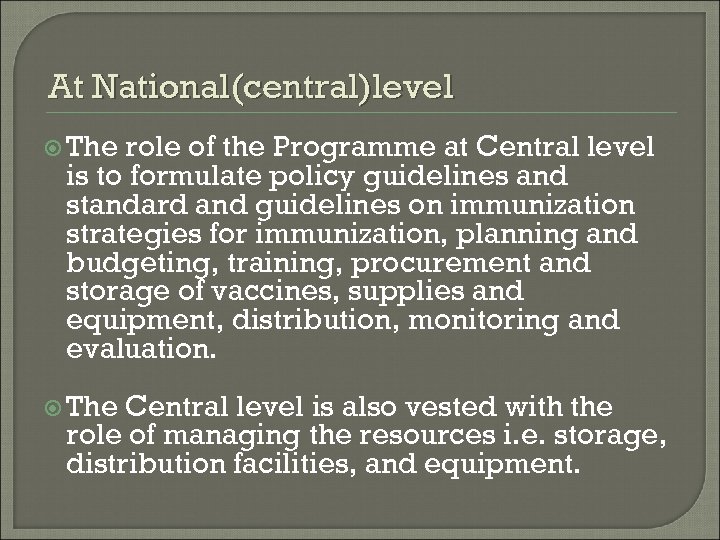 At National(central)level The role of the Programme at Central level is to formulate policy guidelines and standard and guidelines on immunization strategies for immunization, planning and budgeting, training, procurement and storage of vaccines, supplies and equipment, distribution, monitoring and evaluation. The Central level is also vested with the role of managing the resources i. e. storage, distribution facilities, and equipment.
 At regional level At this level, the programme is under the Regional Medical Officer (RMO) who is being assisted by Regional Cold Chain Officer (RCCO) and Regional MCH(Mother and Child Health)Coordinator. Their functions include planning and budgeting, storage, distribution, monitoring and supervision, training, technical support and management of resources of immunization activities at regional level.
 At district level At the district, the District Medical Officer (DMO) is the in-charge of the programme and is being assisted by the District Cold Chain Officer (DCCO) and the District MCH Coordinators. Their roles include: planning and budgeting for immunization activities, storage and distribution, monitoring and supervision, facilitating the implementation, training and providing technical support to the facilities.
 Program performance Immunization Schedules There are two immunization schedules currently in use. The first schedule is targeting to children under one year of age and the second is for women of childbearing age, that is, 15 -49 years.
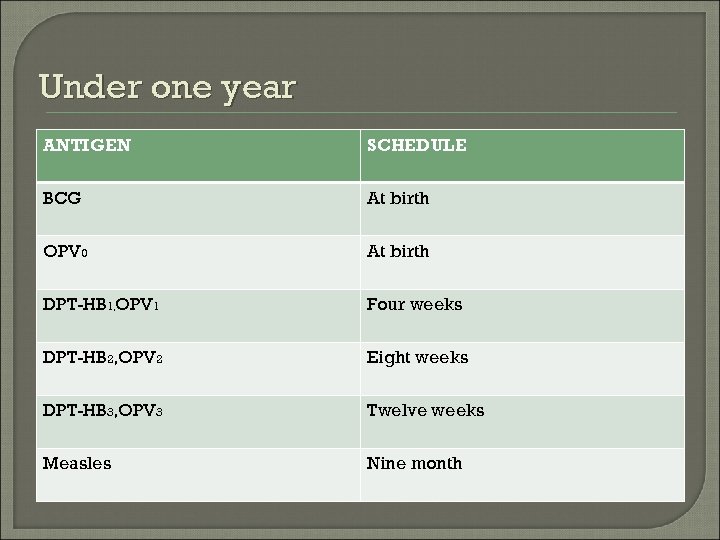 Under one year ANTIGEN SCHEDULE BCG At birth OPV 0 At birth DPT-HB 1, OPV 1 Four weeks DPT-HB 2, OPV 2 Eight weeks DPT-HB 3, OPV 3 Twelve weeks Measles Nine month
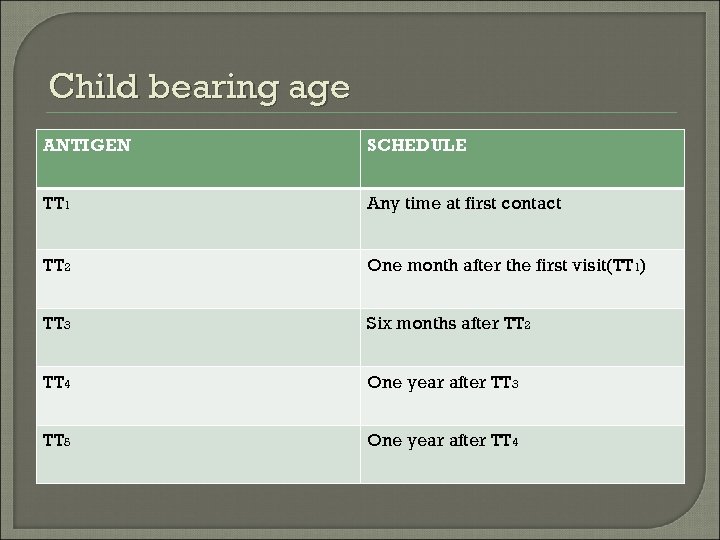 Child bearing age ANTIGEN SCHEDULE TT 1 Any time at first contact TT 2 One month after the first visit(TT 1) TT 3 Six months after TT 2 TT 4 One year after TT 3 TT 5 One year after TT 4
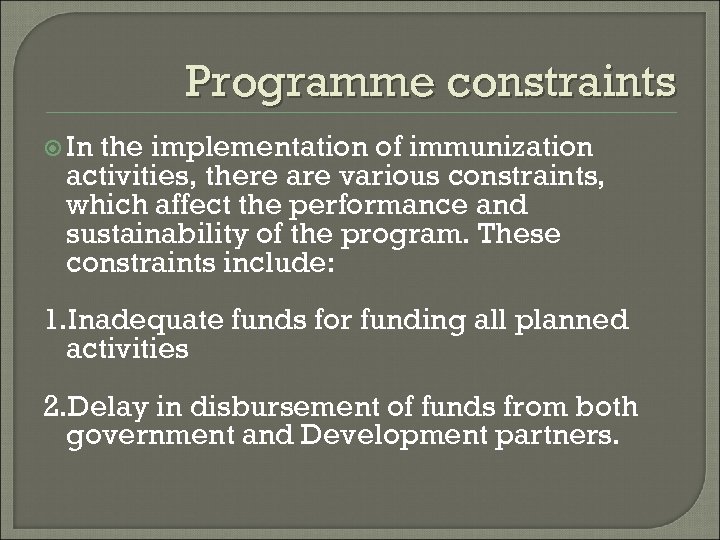 Programme constraints In the implementation of immunization activities, there are various constraints, which affect the performance and sustainability of the program. These constraints include: 1. Inadequate funds for funding all planned activities 2. Delay in disbursement of funds from both government and Development partners.
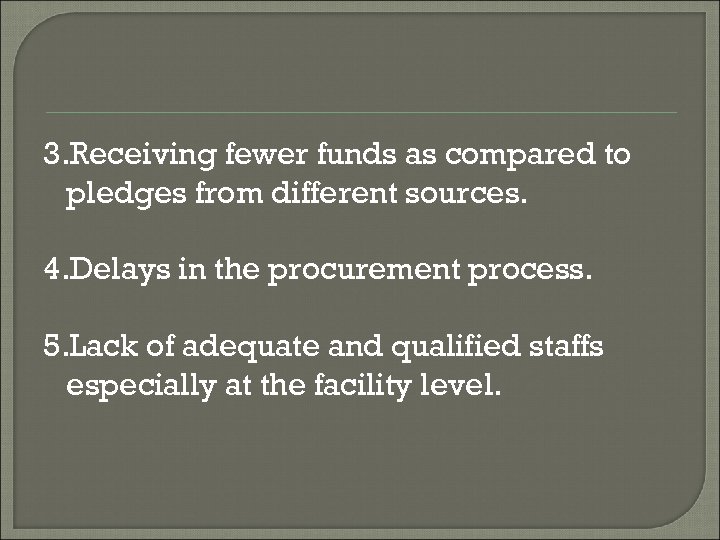 3. Receiving fewer funds as compared to pledges from different sources. 4. Delays in the procurement process. 5. Lack of adequate and qualified staffs especially at the facility level.
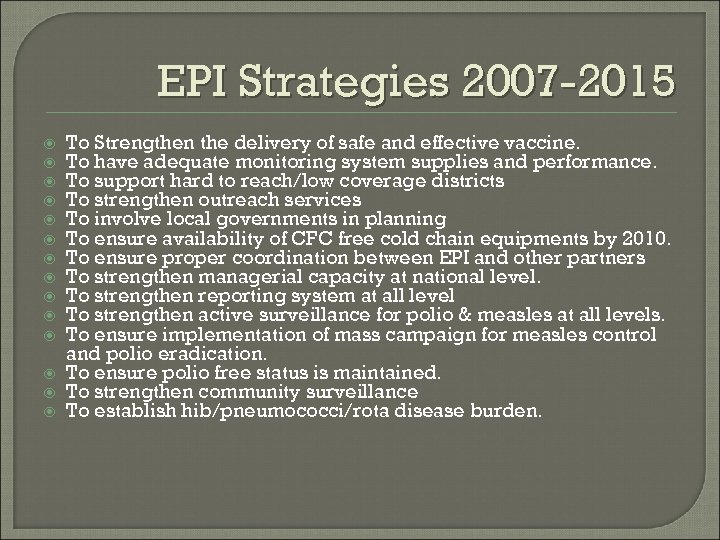 EPI Strategies 2007 -2015 To Strengthen the delivery of safe and effective vaccine. To have adequate monitoring system supplies and performance. To support hard to reach/low coverage districts To strengthen outreach services To involve local governments in planning To ensure availability of CFC free cold chain equipments by 2010. To ensure proper coordination between EPI and other partners To strengthen managerial capacity at national level. To strengthen reporting system at all level To strengthen active surveillance for polio & measles at all levels. To ensure implementation of mass campaign for measles control and polio eradication. To ensure polio free status is maintained. To strengthen community surveillance To establish hib/pneumococci/rota disease burden.
 Thank you for your attention