


 Скачать презентацию Immunization Information Systems as a Data Source for
7d6bab3e2da12ab299492c86f97c12cc.ppt
- Количество слайдов: 23
 Immunization Information Systems as a Data Source for Health Plan Quality Measures Christine M. Layton*; Alan C. O’Connor*; Bobby Rasulnia§; Todd Osbeck†; Therese Hoyle◊ and Gary Urquhart§ *RTI International; §Centers for Disease Control and Prevention; †Priority Health, and ◊Public Health Consultant www. rti. org RTI International is a trade name of Research Triangle Ins
 Overview • Background – What IIS are and why they’re natural partners for health plans (and public health agencies). • Objective for the Study – To describe the business case for one health plan’s use of a state-based IIS as a data source to measure quality. • Methods – Primary (key-informant interviews) and secondary data were used to estimate immunization rates with and without IIS data and to calculate the cost effect. • Results – The use of IIS data resulted in a benefit-to-cost ratio of $8. 06 and improved immunization rates. – Intangible benefits. • Conclusions – IIS and health plans leverage of each other’s mandates is a win-win. 2 www. rti. org 3/19/2018
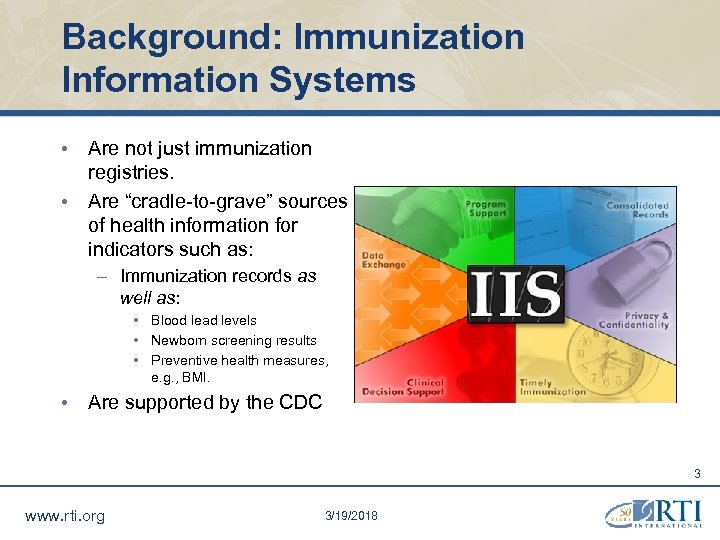 Background: Immunization Information Systems • Are not just immunization registries. • Are “cradle-to-grave” sources of health information for indicators such as: – Immunization records as well as: • Blood lead levels • Newborn screening results • Preventive health measures, e. g. , BMI. • Are supported by the CDC 3 www. rti. org 3/19/2018
 Why Would a Health Plan Leverage an IIS? • Health plans have been called “natural partners” for IIS because they use data similar to those in IIS for quality measurement and HEDIS reporting. • Is there a business case for health plans to make use (“leveraging”) of IIS’ surveillance mandate? • Priority Health began using MCIR as the primary means for recording members’ immunizations in 2004, following NCQA certification. • What was the “business case” for using IIS? www. rti. org
 Michigan Care Improvement Registry (MCIR) • • Established in 1997 Funded through tobacco settlement Contains 4. 7 mil. person records (MI pop’n 10 mil. ) Links to: – – – Vital records WIC Medicaid Department of Education Childhood Lead Poisoning Prevention Program MCOs/health plans 5 www. rti. org 3/19/2018
 Priority Health • Provider-owned, not-for-profit health plan based in Grand Rapids, MI. • 480, 000 members. • Health plan rated #1 by the National Business Coalition on Health. • HMO ranked 15 th nationally by NCQA for the best commercial health plan product in 2008. • Focus on health care quality reflected by: – HEDIS -- benchmarks – Physician Incentive Program (PIP) – pay for performance – “Apples on the Web” – public reporting of quality measures www. rti. org
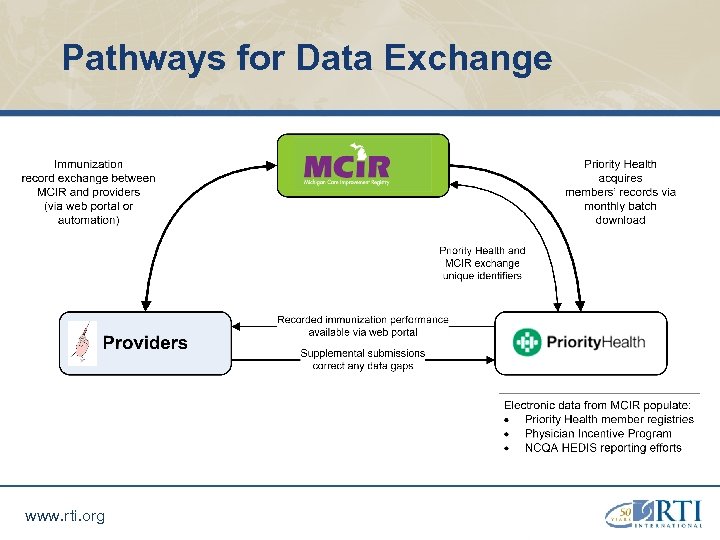 Pathways for Data Exchange www. rti. org
 Research Objective To assess the use of Immunization Information Systems (IIS) as a single point of data entry for use in managed care organization’s (MCO): (1) physician incentive program (PIP), (2) internal quality tracking program (“Apples on the Web”, and; (3) external quality reporting program (HEDIS). 8 www. rti. org 3/19/2018
 Methods • Business case. • Data were collected through key informant interviews and from the MCO’s data systems. • Immunization coverage rates and MCO quality measures from 2004 through 2007 were analyzed with and without the IIS as a data source. • A cost-benefit-analysis was performed. 9 www. rti. org 3/19/2018
 Result: Health Plan Leverages IIS Data • Priority Health providers were already responsible for reporting immunization records as part of existing data collection used for: – HEDIS – Apples on the Web – PIP • Priority Health’s use of MCIR data facilitated its quality measurement activities. www. rti. org
 Why Does Priority Health Leverage MCIR? • MCIR is a single point of data entry and leverages Michigan providers’ legal obligation to record childhood immunizations • MCIR enables providers to demonstrate progress in meeting immunization measures at no additional cost or reporting burden, irrespective of whether a claim was filed. • MCIR offered Priority Health an opportunity to acquire immunization data on members who receive immunizations outside the provider network. www. rti. org
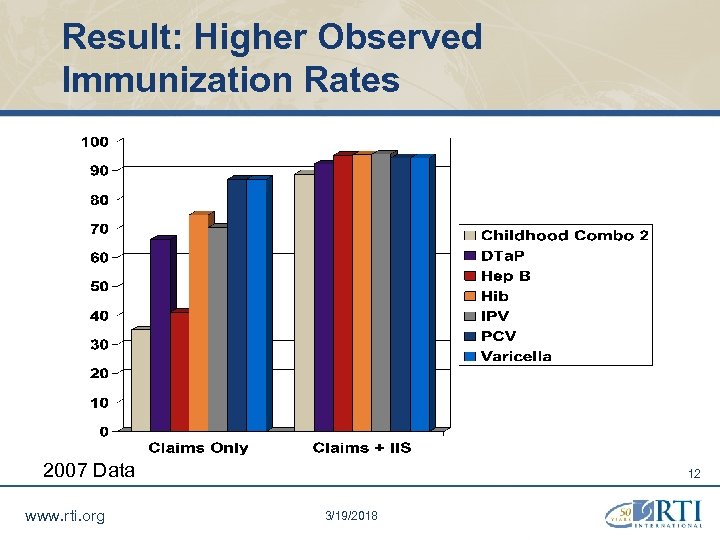 Result: Higher Observed Immunization Rates 2007 Data www. rti. org 12 3/19/2018
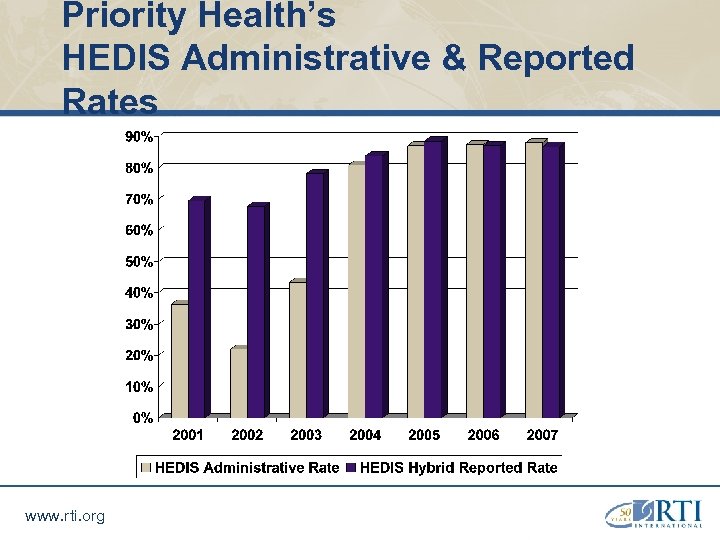 Priority Health’s HEDIS Administrative & Reported Rates www. rti. org
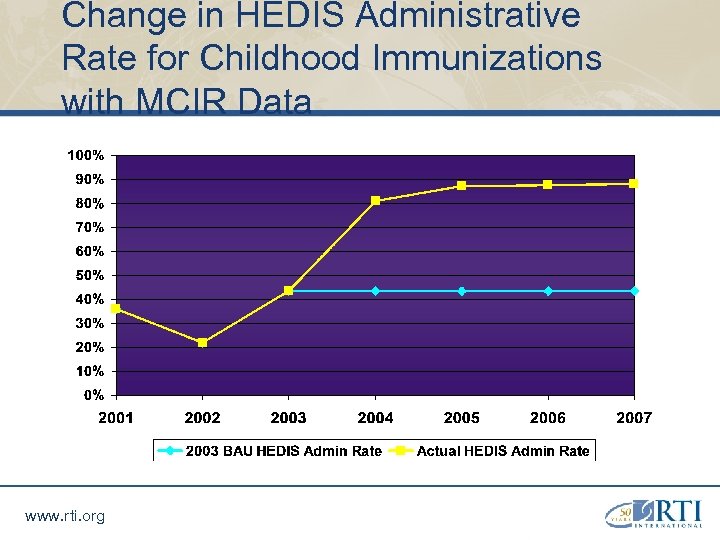 Change in HEDIS Administrative Rate for Childhood Immunizations with MCIR Data www. rti. org
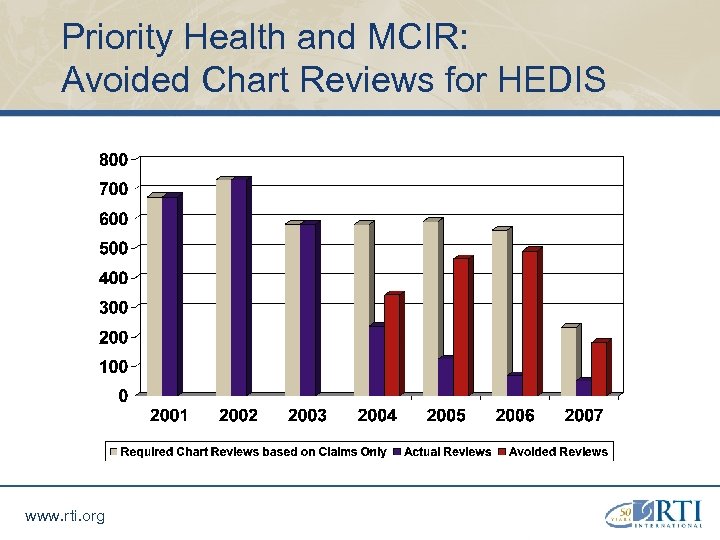 Priority Health and MCIR: Avoided Chart Reviews for HEDIS www. rti. org
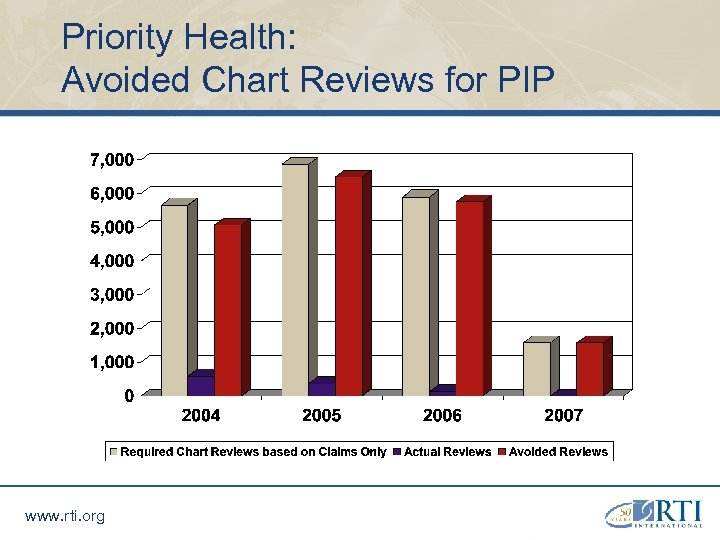 Priority Health: Avoided Chart Reviews for PIP www. rti. org
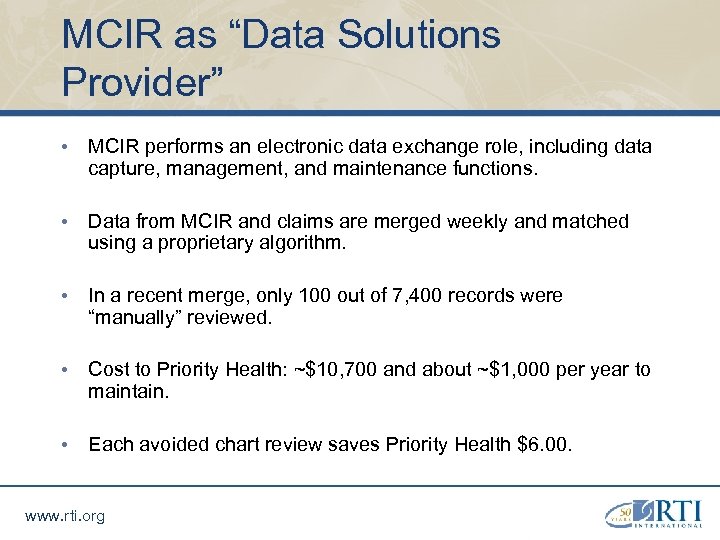 MCIR as “Data Solutions Provider” • MCIR performs an electronic data exchange role, including data capture, management, and maintenance functions. • Data from MCIR and claims are merged weekly and matched using a proprietary algorithm. • In a recent merge, only 100 out of 7, 400 records were “manually” reviewed. • Cost to Priority Health: ~$10, 700 and about ~$1, 000 per year to maintain. • Each avoided chart review saves Priority Health $6. 00. www. rti. org
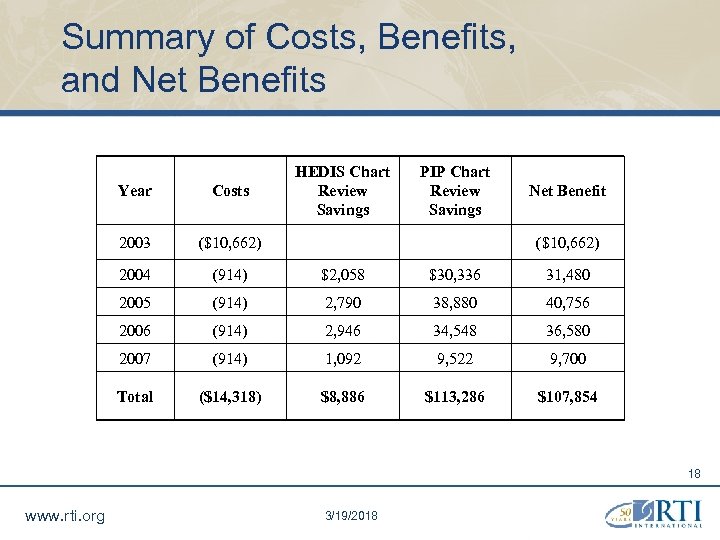 Summary of Costs, Benefits, and Net Benefits HEDIS Chart Review Savings PIP Chart Review Savings Year Costs Net Benefit 2003 ($10, 662) 2004 (914) $2, 058 $30, 336 31, 480 2005 (914) 2, 790 38, 880 40, 756 2006 (914) 2, 946 34, 548 36, 580 2007 (914) 1, 092 9, 522 9, 700 Total ($14, 318) $8, 886 $113, 286 $107, 854 ($10, 662) 18 www. rti. org 3/19/2018
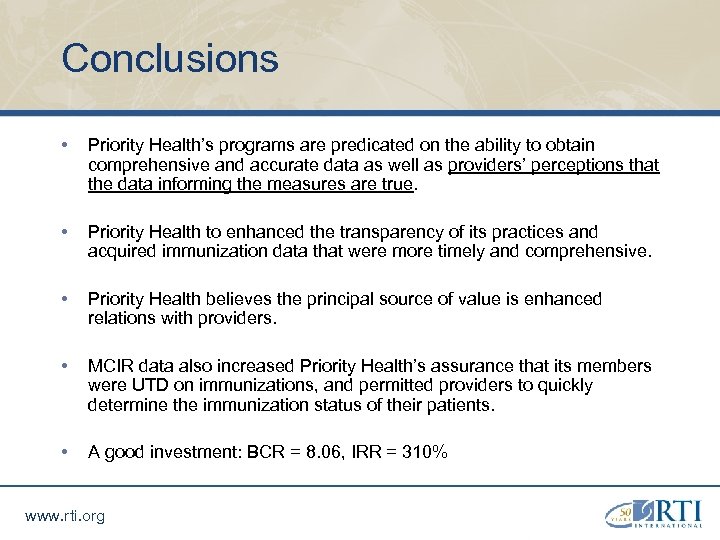 Conclusions • Priority Health’s programs are predicated on the ability to obtain comprehensive and accurate data as well as providers’ perceptions that the data informing the measures are true. • Priority Health to enhanced the transparency of its practices and acquired immunization data that were more timely and comprehensive. • Priority Health believes the principal source of value is enhanced relations with providers. • MCIR data also increased Priority Health’s assurance that its members were UTD on immunizations, and permitted providers to quickly determine the immunization status of their patients. • A good investment: BCR = 8. 06, IRR = 310% www. rti. org
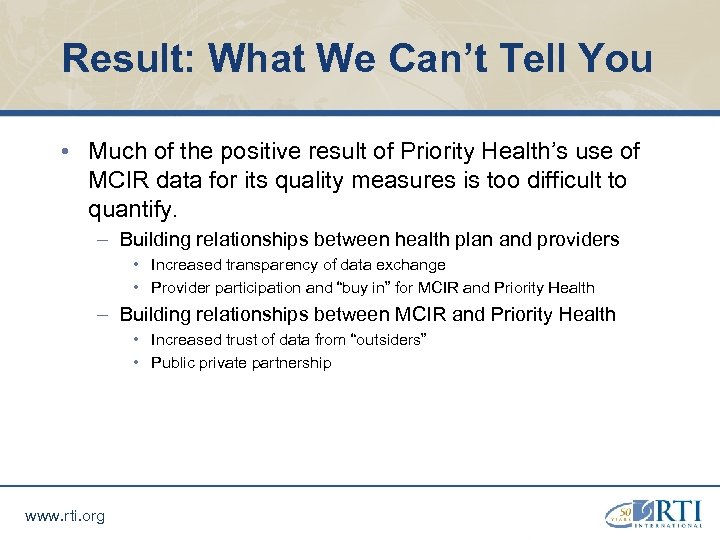 Result: What We Can’t Tell You • Much of the positive result of Priority Health’s use of MCIR data for its quality measures is too difficult to quantify. – Building relationships between health plan and providers • Increased transparency of data exchange • Provider participation and “buy in” for MCIR and Priority Health – Building relationships between MCIR and Priority Health • Increased trust of data from “outsiders” • Public private partnership www. rti. org
 Acknowledgements Many, many people at Priority Health and the MCIR generously shared their time, expertise, and data. RTI Priority Health MCIR Dallas Wood Laura Stuursma Bob Van Eck Brian Myers Eric Richter Satish Challa and many more Laura Korten Laura Rappleye 21 www. rti. org 3/19/2018
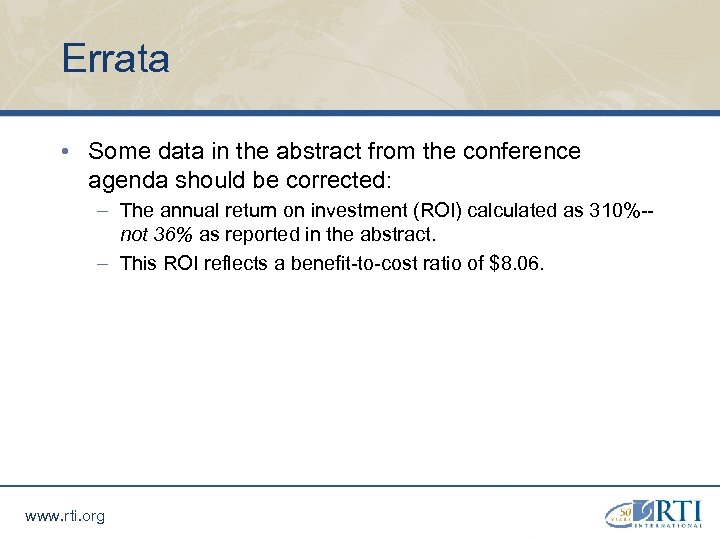 Errata • Some data in the abstract from the conference agenda should be corrected: – The annual return on investment (ROI) calculated as 310%-not 36% as reported in the abstract. – This ROI reflects a benefit-to-cost ratio of $8. 06. www. rti. org
 www. rti. org