 Скачать презентацию Immigration Images and Realities Lee Baxter Dustin Brooks
8bf540136a8fb7ce0106a009a64d665f.ppt
- Количество слайдов: 57



Immigration Images and Realities Lee Baxter, Dustin Brooks, Lena Chiang, Lindsay Dilworth, Julianna Landry, Jay Lee, Luis Manzo, Maraia Mc. Gary, Phaydra Mutch-Geiger, Jackie Phan, Sara Pierie, Margaret Rogers, Lindsay Rozee, Lance Sasser, Michael Thyken, Alycia Werthan, Ryan Westhusing
Introduction • Asian-American: Common Differences • Asian Americans & The Model Minority • Asian American Movement 1980’s & 1990’s • Latino’s in the U. S • Resistance
Asian American Common Differences l l Who are these groups? How does the history of their immigration shape their differences?
“Asian Americans were systematically stripped of their political, economic, cultural, and citizen rights” (Bob Wing, 2005).
Korean Americans l l l First wave arrives in 1903 Pursue the American dream Immigration Law 1965 Ethnic enclave Struggle
Japanese American Immigrants l l l WWII Pearl Harbor 1890 First arrival because of Japans dependency on the West. Effects and aftermath – Redress Movement
Immigration Process and West Indians l l l Student Visas Selective Immigration process Myth of West Indians
Vietnamese Immigration l l l Spring 1975 – first wave (ship/ air lift). Different refuge centers throughout the U. S. The fall of Saigon
In Americal l Mainstream Unwelcome Ethnic Enclaves Reunification
Chinese Immigration l l First wave arrived in 1848 arrived for Gold Rush. Economic instability (ex. Poverty and lifestyle) Effects and aftermath- The naturalization, Chinese and Walter-Mc. Carren Act passed 2000 Census of Chinese Immigrants – – 1, 314, 537 have migrated 39. 8% growth rate
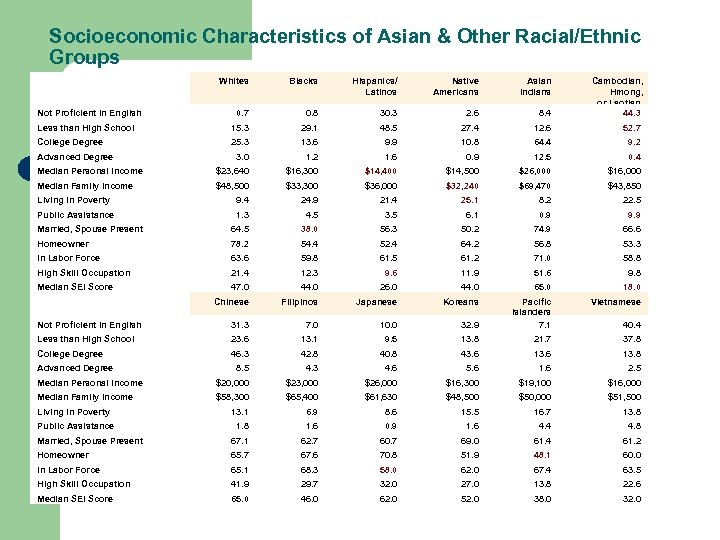
Socioeconomic Characteristics of Asian & Other Racial/Ethnic Groups Whites 0. 7 0. 8 30. 3 2. 6 8. 4 Cambodian, Hmong, or Laotian 44. 3 Less than High School 15. 3 29. 1 48. 5 27. 4 12. 6 52. 7 College Degree 25. 3 13. 6 9. 9 10. 8 64. 4 9. 2 3. 0 1. 2 1. 6 0. 9 12. 5 0. 4 Median Personal Income $23, 640 $16, 300 $14, 400 $14, 500 $26, 000 $16, 000 Median Family Income Not Proficient in English Advanced Degree Blacks Hispanics/ Latinos Native Americans Asian Indians $48, 500 $33, 300 $36, 000 $32, 240 $69, 470 $43, 850 Living in Poverty 9. 4 24. 9 21. 4 25. 1 8. 2 22. 5 Public Assistance 1. 3 4. 5 3. 5 6. 1 0. 9 9. 9 Married, Spouse Present 64. 5 38. 0 56. 3 50. 2 74. 9 66. 6 Homeowner 78. 2 54. 4 52. 4 64. 2 56. 8 53. 3 In Labor Force 63. 6 59. 8 61. 5 61. 2 71. 0 58. 8 High Skill Occupation 21. 4 12. 3 9. 6 11. 9 51. 6 9. 8 Median SEI Score 47. 0 44. 0 26. 0 44. 0 65. 0 18. 0 Chinese Filipinos Japanese Koreans Vietnamese Not Proficient in English 31. 3 7. 0 10. 0 32. 9 Pacific Islanders 7. 1 Less than High School 23. 6 13. 1 9. 5 13. 8 21. 7 37. 8 College Degree 46. 3 42. 8 40. 8 43. 6 13. 8 8. 5 4. 3 4. 6 5. 6 1. 6 2. 5 Median Personal Income $20, 000 $23, 000 $26, 000 $16, 300 $19, 100 $16, 000 Median Family Income $58, 300 $65, 400 $61, 630 $48, 500 $50, 000 $51, 500 13. 1 6. 9 8. 6 15. 5 16. 7 13. 8 Advanced Degree Living in Poverty Public Assistance 40. 4 1. 8 1. 6 0. 9 1. 6 4. 4 4. 8 Married, Spouse Present 67. 1 62. 7 60. 7 69. 0 61. 4 61. 2 Homeowner 65. 7 67. 6 70. 8 51. 9 48. 1 60. 0 In Labor Force 65. 1 68. 3 58. 0 62. 0 67. 4 63. 5 High Skill Occupation 41. 9 29. 7 32. 0 27. 0 13. 8 22. 6 Median SEI Score 65. 0 46. 0 62. 0 52. 0 38. 0 32. 0
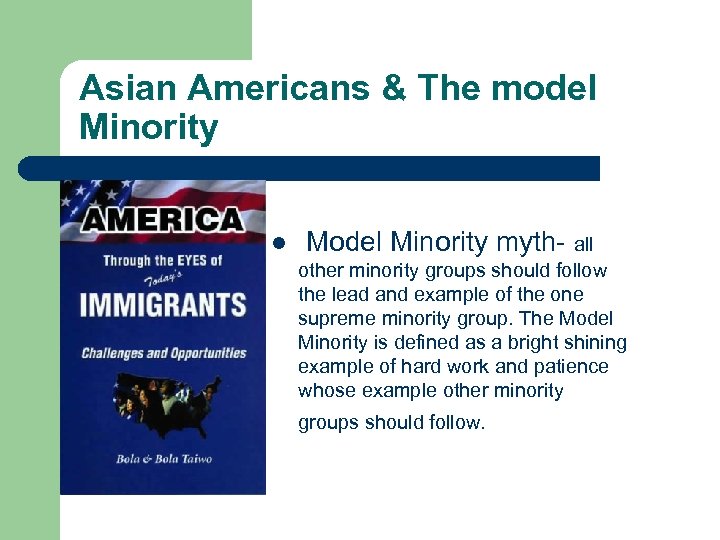
Asian Americans & The model Minority l Model Minority myth- all other minority groups should follow the lead and example of the one supreme minority group. The Model Minority is defined as a bright shining example of hard work and patience whose example other minority groups should follow.
Model Minority continued. . l l l Model Minority myth is based primarily on statistics. Do statistics lie? Myth of Asian Success – – Genetic Advantages? Cultural Traditions?
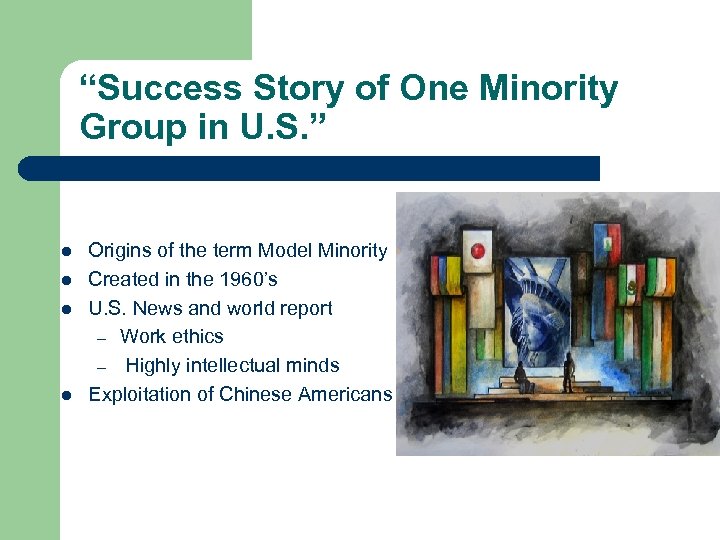
“Success Story of One Minority Group in U. S. ” l l Origins of the term Model Minority Created in the 1960’s U. S. News and world report – Work ethics – Highly intellectual minds Exploitation of Chinese Americans
Today’s immigrants from Asia l l Middle class immigrants vs. refugees Consequences of the model minority myth. Whites vs. Asian Americans Overall Impacts
Asian American movement 1980’s & 1990’s
Asian American Movements Pre-1980’s l l Asian American population grew due to reform of immigration laws More Asian Americans in poverty and more hate crimes More Asian Americans enrolling in universities Organized successful grassroots organizations
Impacts of Movements prior to 1980 l l Proud of Asian culture Accelerated desegregation of the suburbs with middle-class Asian Americans Moving into predominately white suburbs Young Asian Americans gained access to higher education – greater numbers enrolling in universities including elite universities
Possible Reasons Asian Americans were able to make such progress l l l Cultures emphasis on education/Family values/community cohesion Structural changes in Gov. policy and changes in global economy Grassroots organizations able to last into the 1980’s Many were small business owners which gave access to “start up capital” Rise in number on young Asian American professionals due to the removal of quotas at universities and more job opportunities for middle-class people of color
Increased Number of Neo-Conservatist Professionals l l l l Born during the Regan-Bush ear Experienced a time period of class and racial polarization. Emphasize individual advancement through higher education Proud to be Asian American and speak out against racism Belief in ending affirmative action will result in ending racism Oppose minority quotas admitted to universities Belief that lack of advancement for other groups of color are due to their culture
Chinese Progressive Association (CPA) l Founded in 1977, composed primarily of Chinese immigrants, most are workers in low-wage industries. l Main Focus : Is on workers and improving their living and working conditions.
Asian Immigrant Women Advocates (AIWA) l l Founded in 1983, it is a community-based organization. Main Focus: To empower low-income, limited -English-speaking Asian immigrant women in their homes and their work places.
Korean Immigrant Worker Advocates (KIWA) l Founded in 1982, it is focused on low-income Korean immigrants in Los Angeles' Korea town l Main Focus: Bringing labor issues to the forefront of the Asian American community, educating labor unions about the needs of Asian American workers, and forming coalitions with other forces in the city to deal with interethnic tensions
The Future Vera Cruz l Manong generation: came in the early twentieth century and worked in restaurants, fields, and hotels l United Farm Workers (UFW): he helped develop the organization and now is the vice president l Empowerment: Vera Cruz has defined the word empowerment as the “expansion of democracy for the many”. He also says that empowerment is not for an elite group of people. It is up the people to join together and develop their own ideas and then have leadership build from there. ”
Cruz’s movement for liberation l l l Compassion/solidarity/commitment “whiz kids”: growing poor population, increase of non excelling students, and large number of family owned businesses not making it Need for change
Latinos in the U. S. l l Who are the new immigrants (as compared with historical figures)? Where are the new destinations of these immigrants? Why have most changed choice of destination (changed cities)? What immigration patterns have there been in Oregon?
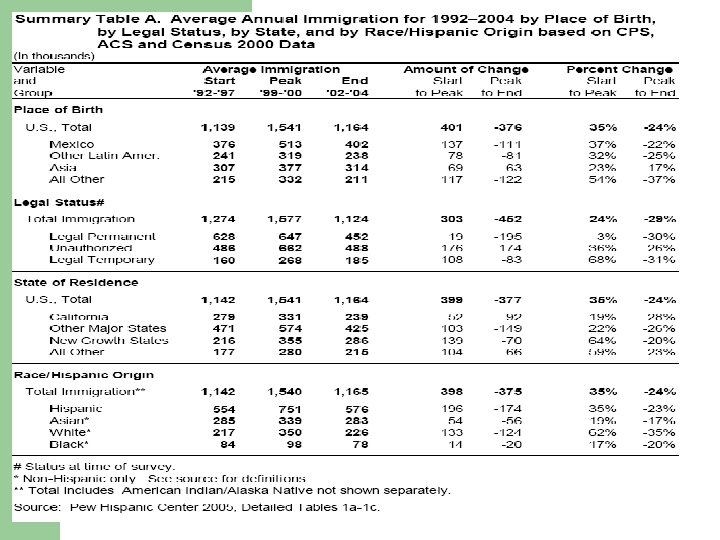
New Destinations l l l Where are the new destinations? Changed cities Patterns in Oregon
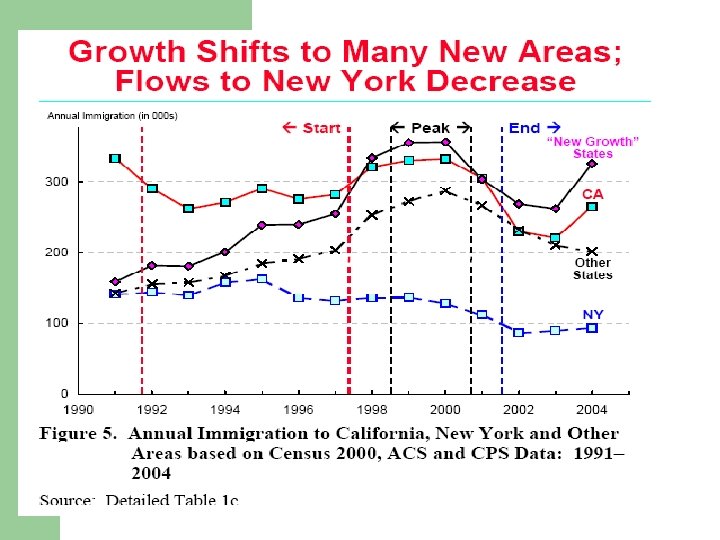
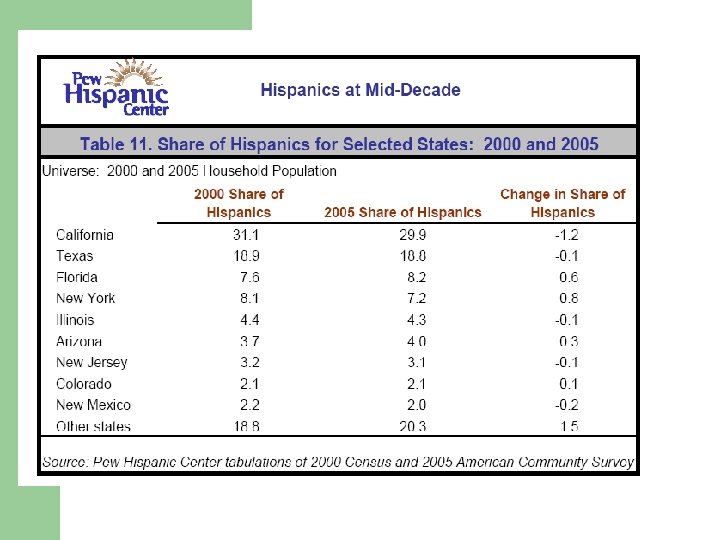
Latinos in the U. S. Continued… l l What is the growth rate of native born Hispanics vs. foreign born Hispanics? How many undocumented workers are there in Oregon? What is the rate of growth of these undocumented workers? What do we believe is the main underlying cause of immigration into the U. S. ?
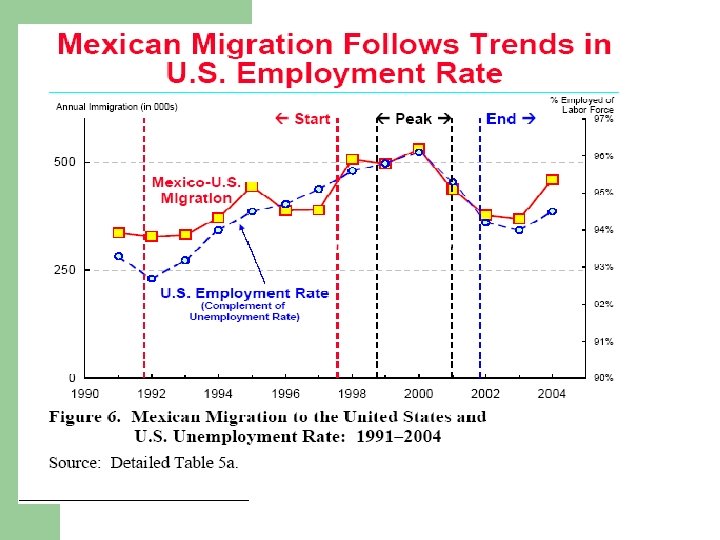
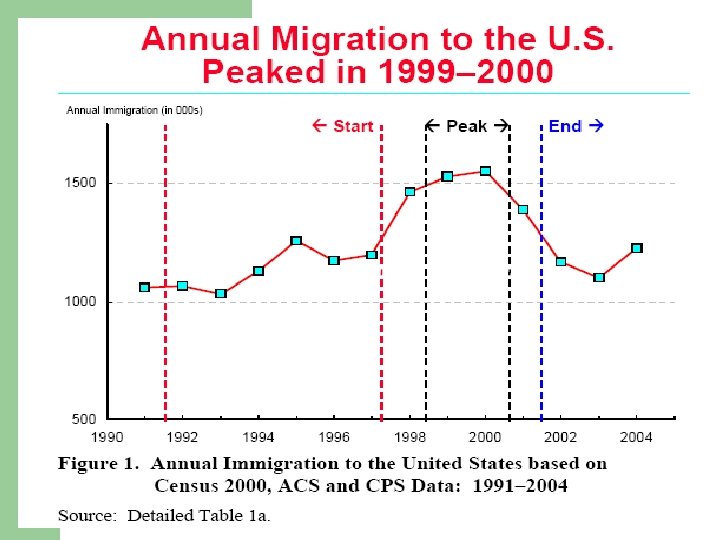
Latino Immigration l l Immigration has been thought to be a direct result from the push factors from people’s home country. Economic factors largely influence the numbers of immigrants flowing into the U. S. When unemployment in the U. S. hit a record low at 3. 9% immigration was at its peak. At the highest unemployment rate the Mexican immigration was at its 15 year low.
Latinos in the U. S. conclusion l l l We have shown many graphs and tables made up of raw statistics from three major sources. The statistics have shown us where most of the immigrants are coming from. The statistics indicate how many of them are documented workers vs. undocumented workers. Where the new destinations are for Hispanic immigrants. The underlying causes of immigration.
Resistance
Be Down With The Brown l l March 1968 - Chicano and Chicana high school students walked out of class to protest a racist educational system The “Blowouts” Began with several thousand students from six schools, and increase each day till 10, 000 had struck Brought the largest cities school system to a halt First time Chicano students had marched in masses in demonstration against racism and educational change
Thirty Years Later New “Blowouts” Emerged l l Combating repressive new anti-crime laws Re-election of right wing Gov. Pete Wilson To fight proposition 187 - (the call to deny educational and health services to anyone suspected of being undocumented) The “Blowouts” focused on public schools for the reason that California’s public schools lose $17. 20 for each un-excused absence per day
Reasons l l l Racism in the school system was at the top of the list for the reasons of the new blowout wave Nation wide Latinos have the lowest high school graduation rate of any group Of every 100 Latinos who enter kindergarten only 55 graduate from high school. Of those 55, only 25 enter college, Of the 25, 7 finish Only 4 go on to graduate school and 2 finish
Boycotting Taco Bell: The Coalition of Immokalee Workers l l The Coalition of Immokalee Workers (CIW) was founded in 1995 with workers from Mexico, Guatemala, and Haiti October 1997, the CIW launched an “antislavery campaign” to call to public attention to sub-poverty wages in the tomato fields and orange groves
Focus Attention on Taco Bell l CIW discovers that the power is beyond the growers and focus attention at the large corporations Boycott Taco Bell because they are the largest consumers of the tomatoes they pick CIW gives demands to Taco Bell, there is no response from Taco Bell
Taco Bell l The coalition decided to target 16 -24 yearolds, which was the largest consumer for Taco Bell CIW begins the Truth Tour receives a great deal of media attention
The Coalition of Immokalee Workers l l l Students “booted the Bell” from campus or declared their campus a “Taco Bell-free zone” Pressure toward the shareholders at the Yum Brands start to develop Taco Bell has not reached the demands of CIW
Freedom Riders l l Since 9/11, immigrant communities generally, Arab, Muslim, and South Asian communities in particular, feel besieged. The federal government has conducted random sweeps workplace raids, and carried out secret detentions and judicial proceedings, initiated special registration programs based on nationality, and deported established immigrants based on mere technicalities Since 9/11, the government measures have ended up going too far, These measures target immigrants who have nothing to do with terrorism
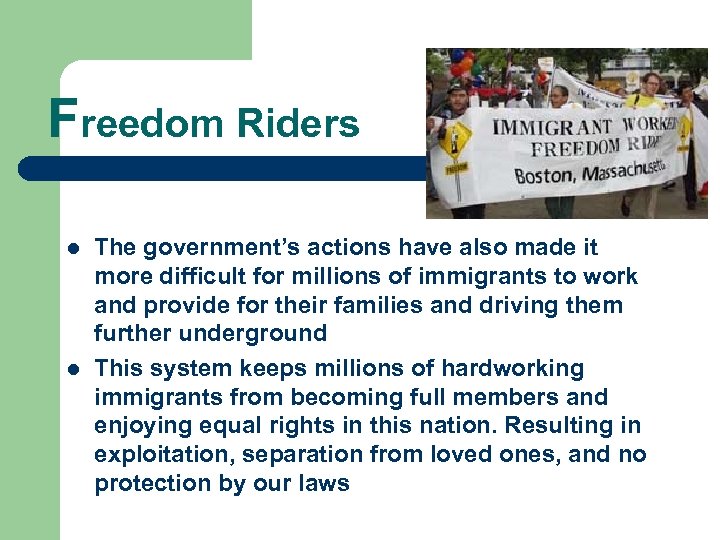
Freedom Riders l l The government’s actions have also made it more difficult for millions of immigrants to work and provide for their families and driving them further underground This system keeps millions of hardworking immigrants from becoming full members and enjoying equal rights in this nation. Resulting in exploitation, separation from loved ones, and no protection by our laws
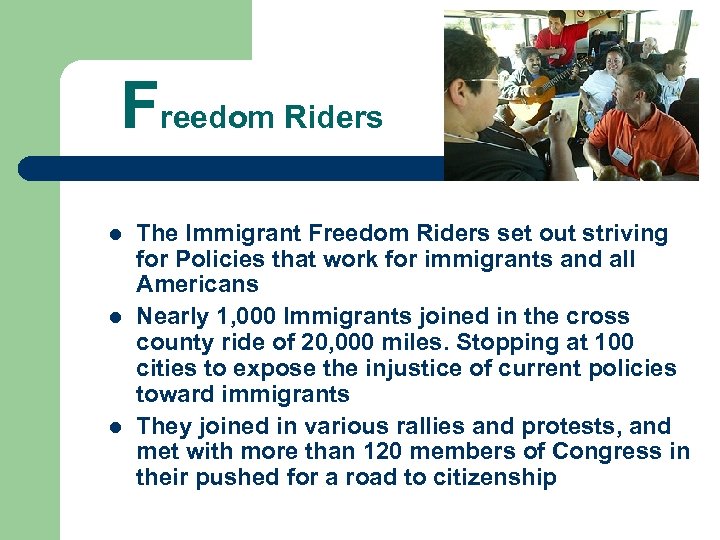
Freedom Riders l l l The Immigrant Freedom Riders set out striving for Policies that work for immigrants and all Americans Nearly 1, 000 Immigrants joined in the cross county ride of 20, 000 miles. Stopping at 100 cities to expose the injustice of current policies toward immigrants They joined in various rallies and protests, and met with more than 120 members of Congress in their pushed for a road to citizenship
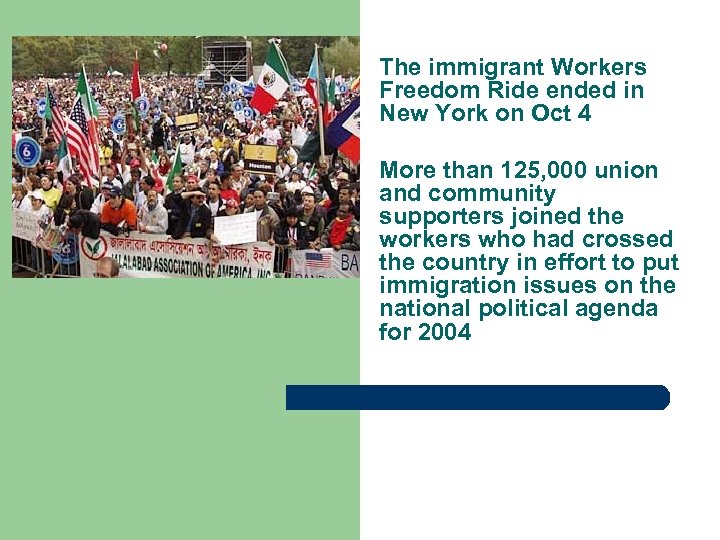
The immigrant Workers Freedom Ride ended in New York on Oct 4 More than 125, 000 union and community supporters joined the workers who had crossed the country in effort to put immigration issues on the national political agenda for 2004
Northwest Treeplanters and Farmworkers United (PCUN) l l l PCUN=Pineros y Campesinos Unidos Del Noroeste Oregon’s union of farmworkers, nursery, and reforestation workers, and Oregon’s largest Latino organization PCUN’s fundamental goal is to empower farmworkers to understand take action against systematic exploitation and all of its effects by being involved in community and workplace organizing
PCUN l l l Founded in 1985 PCUN has more than 5, 000 registered members Office is located in center of Oregon filtered agricultural industry in the mid. Willamette Valley, city of Woodburn A cultural center for the Valleys Mexican community, Woodburn currently has a majority Latino population of just over 50%
What and Who is PCUN fighting for? l l l Oregon farm workers Employees work long hours for low wages, with no overtime pay, paid breaks, seniority, job security, or other benefits Seasonal workers often housed in squalid labor camps owned and operated by growers or labor contractors Exposed to a myriad of chemicals and pesticides sprayed on crops and often lack the proper protective gear and training to apply pesticides They also lack the right to collective bargaining, which is guaranteed to all other industries under the National Labor Relations Act
How Do They Do It? l l Through successfully organizing and collective bargaining Organizing efforts: PCUN’s Collective Bargaining Committee uses various direct organizing tactics, such as visiting fields, distributing leaflets, and holding house meetings and marches, yet PCUN also organizes through its Service Center for Farmworkers. Collective bargaining: Most effective and lasting way to improve Farmworker conditions it re-addresses the power imbalance between growers and workers, and establishes respect, fairness and dignity as the bases for the employment relationship. Collective bargaining agreements negotiated by a committee elected by their peers and ratified by a vote of the workers
Key Components Of These Agreements l l l l Expeditious procedure to resolve grievances; Seniority rights Prohibition against retaliation/discipline without just cause Paid breaks and overtime pay Right to refuse work in conditions unsafe or hazardous; Right to paid and unpaid absence Right to information about chemical used in the workplace Union recognition l None of these protections or procedures is presently provided by law
Collaborative Efforts: PCUN Works Closely With a Variety of Other Local Organization l l Farmworker Housing Development Corporation, runs the farmworker housing units in Woodburn Voz Hispana, organizes Latino voters and educates community members of the legacy of Cesar Chavez CAUSA advocates for immigrant rights Mujeres Luchadoras Progresistas promotes economic and leadership development for farmworker women
National Level l Advocates with the Oregon Legislature to protect farmworkers rights involved national and statewide collaboration around issues such as controlling pesticide use and protecting the health of workers PCUN has led or been involved in numerous organizing efforts and campaigns since its founding
Sources l l l l Asian Nation Website www. asian-nation. org “Success Story of One Minority Group in U. S. ” Us. News & world Report (1966) in Asian-American Studies, eds. Jean Yu-wen Shen Wu and Min Song (Rutgers U Press, 2000), pp. 158 -163 Elaine Kim, “Home is Where the Han Is, ” in Asian-American Studies, eds. Jean Yuwen Shen Wu and Min Song (Rutgers U Press, 2000) Min Zhou, “Are Asian Americans Becoming White? ”, Contexts vol 3, iss 1 (Winter 2004) Excerpts from Glenn Omatsu, “The Four Prisons” and the Movements of Liberation: Asian American Activism from the 1960’s) in Asian-American Studies, eds. Jean Yu-wen Shen Wu and Min Song (Rutgers U Press, 2000), pp. 176 -194 The Model Minority Website http: //modelminority. com/article 1067. html
Sources, Continued l l l l l A Statistical Portrait of Hispanics at Mid-Decade http: //pewhispanic. org/reports/middecade/ Rise, Peak, and Decline: Trends in US Immigration 1992 -2004 http: //pewhispanic. org/files/reports/53. pdf Immigrant Workers’ Freedom Ride Coalition http: //www. iwfr. org/ PCUN (Northwest Tree Planters and Farmworkers United) http: //www. pcun. org/resources/aboutpcun. asp Peter Ian Asen, “Boycotting Taco Bell: The Coalition of Immokalee Workers, ” A Troublemaker’s Handbook, ed. , Jane Slaughter (Labor Notes 2005) Elizabeth Martinez, De Colores Means All of Us (South End Press, 1998) Chapter 25

The End… Any Questions?
Скачать презентацию Immigration Images and Realities Lee Baxter Dustin Brooks
8bf540136a8fb7ce0106a009a64d665f.ppt