


 Скачать презентацию Immigration Ethnicity and Ethnic Relations in Israel Larissa
2d48f4db8684f4bb5006f455926ac34b.ppt
- Количество слайдов: 9
 Immigration, Ethnicity and Ethnic Relations in Israel Larissa Remennick, Ph. D. Schusterman Visiting Professor of Israeli studies
 Israel as Ultimate Immigrant Society 95% are 1 st, 2 nd or 3 rd generation immigrants 35% were born outside of Israel Major ethnic groups: Palestinians (20%), Ashkenazi Jews (30%), Sephardic/Mizrahi Jews (30%), Mixed Jewish Ethics (15%); non-Jews from FSU (4%), Black Ethiopian Jews (1%) Historic outline: late 19 -early 20 century Aliyah waves, pre-state immigrants of the
 Israel as Ethnic Democracy The Law of Return (1950/1970) regulates immigration to Israel. 'Jew' for the purposes of Aliyah& citizenship is defined broadly similarly to the Nazi anti-Jewish laws of the 1930 s The gap between a civic and Halachic definitions of Jewishness as source of discrimination of non-Jews Lack of separation between state and
 Ethnic democracy (continued) Lack of Constitution and system of Basic Laws The Law of Return does not include Arabs Minority rights – political representation, freedom of occupation, non-discrimination by sex, age, ethnicity or religion The problem of occupied territories and status of Palestinians beyond the Green Line (including East Jerusalem)
 Jewish Israel: The lines of social stratification Ahkenasim, Spharadim & Mizrahim Old-timers vs. recent immigrants Social class and wealth Center vs periphery Political right-center-left-radical left Skin color, accents, dress & behavior codes
 The pillars of Israeli identity Nation-building project on-going Militarism and 'security culture' Hebrew mono-lingualism at the expense of diaspora languages Zionism or Post-Zionism? Familism and 'motherhood mandate' Immigration & Absorption
 The Great Russian Aliyah of the 1990 s Driven by push factors – demise of the USSR Other destination countries closing their doors About 1, 000 immigrants between 1989 -2004, among them half just between 1990&1993 High on human capital but low on Jewish identity High % of mixed families and non-Jews Multiple integration challenges
 Ethiopian Immigrants in Israel Arriving in two organized airlifts: 1984 & 1991 Many families split by Israel's migration decisions (Jews vs Falashim) Hard sacrifices and difficult road to Aliyah Low human capital and pre-modern society Problems of integration & racism
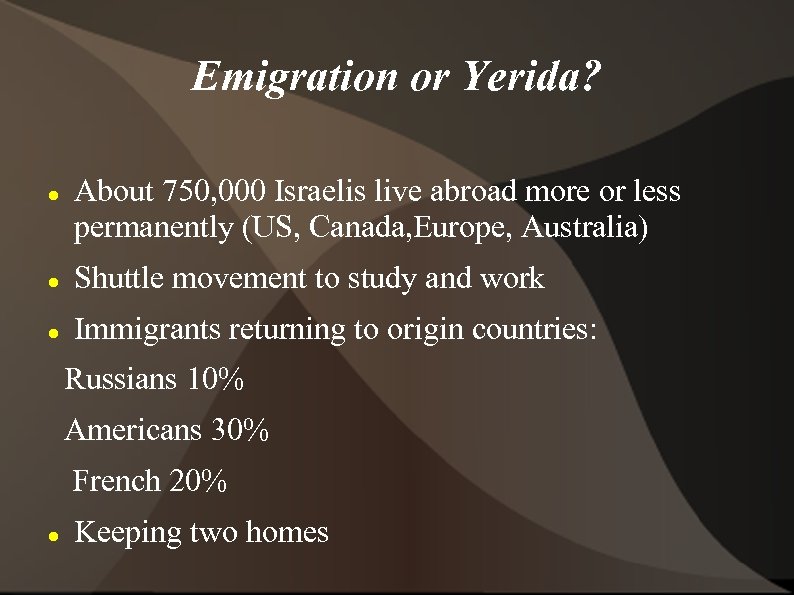 Emigration or Yerida? About 750, 000 Israelis live abroad more or less permanently (US, Canada, Europe, Australia) Shuttle movement to study and work Immigrants returning to origin countries: Russians 10% Americans 30% French 20% Keeping two homes