


 Скачать презентацию IMGS TA 4 Protection Neutralisation and Restoration
bcc3d737e8d1fb09da5a606041918585.ppt
- Количество слайдов: 17
 IMGS TA 4 – Protection Neutralisation and Restoration
 Presentation • Overview of the IMG-S and the SRR • Overview of TA 4 Working Group • Overview of the TA 4 Themes
 IMG-S • Since 2005, European Commission has produced two security-specific reports to define coherent security research agenda for Europe. ESRIA resulted in large number of well-founded strategic recommendations • the Integrated Mission Group on Security (IMG-S) was created by participants from across the European security research community (RTOs, academia, SMEs and Industry) to refine these strategic recommendations and produce a security research roadmap (SRR) – enables all security research stakeholders to understand how research may be structured to meet the ESRIA • Within IMG-S a two-tier structure has been developed: – Technical Areas (TAs): • focusing on technically-oriented research areas - generate bottom – up needs for research and development – Synthesis and Coordination Group (SCG): • focusing on integrating and harmonising the output from the TAs to map between Missions and research topics • generates SRR and annual topic input to EC Framework Programmes in a top down structure of missions and themes
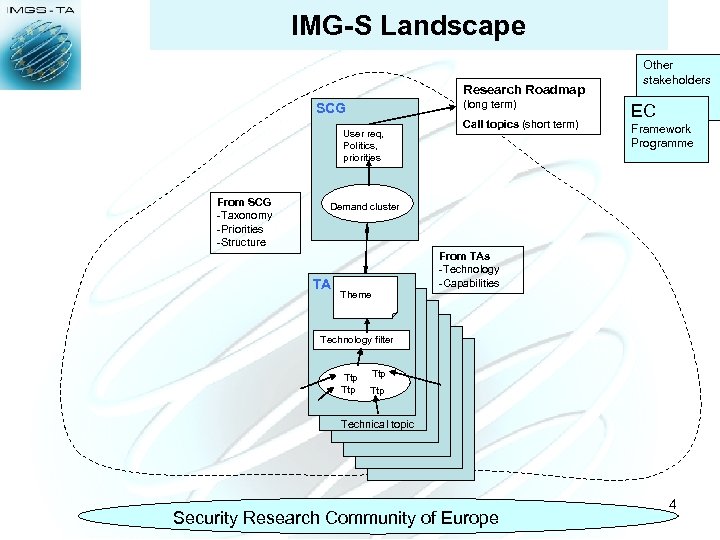 IMG-S Landscape Research Roadmap (long term) SCG User req, Politics, priorities From SCG -Taxonomy -Priorities -Structure Call topics (short term) Other stakeholders EC Framework Programme Demand cluster TA From TAs -Technology -Capabilities Theme Technology filter Ttp Ttp Technical topic Security Research Community of Europe 4
 SRR • This current release of the SRR (pilot version) provides part of the intended content as a frame of reference for FP 7 Call 5 and perspectives for Call 6. • The pilot is being used to enable a dialog among security research stakeholders to improving the shape and format of a commonly accepted vehicle for dialog on security research direction. • A second release is scheduled for autumn 2010 with improved format and extended content to provide the first hints for FP 8. • A third release, the first full scale roadmap is scheduled for first half 2011 allowing for an iterative evolution of format and content to best fit its purpose as a vehicle of communication between Security research stakeholders. 5
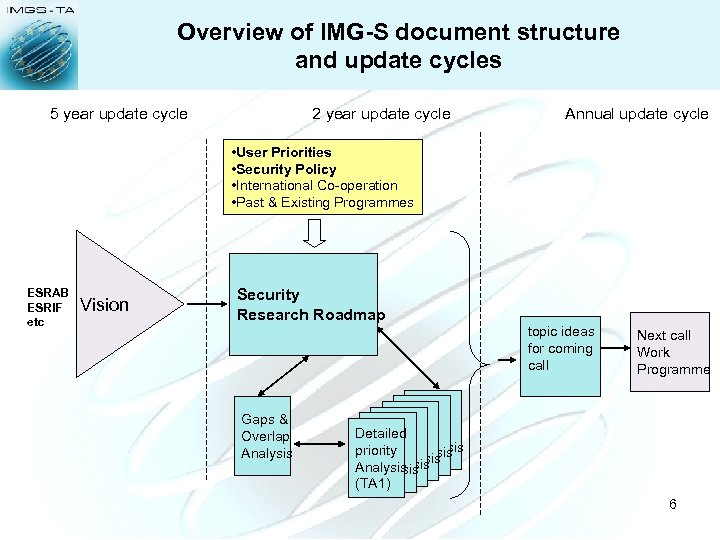 Overview of IMG-S document structure and update cycles 5 year update cycle 2 year update cycle Annual update cycle • User Priorities • Security Policy • International Co-operation • Past & Existing Programmes ESRAB ESRIF etc Vision Security Research Roadmap topic ideas for coming call Gaps & Overlap Analysis Next call Work Programme Detail Detailed TA Detail. TA TA TA Analysis priority Analysis TA Analysis (TA 1) 6
 TA 4 Organization and Members • Technical Area – Protection, neutralisation and restoration – The TA identifies topics using the group’s knowledge and experience of ESRAB, ESRIF and emerging technologies which are harmonised to produce common themes • TA 4 Members – 23 Organisations • With expertise from Industry, Research Organisations, SME’s and links to end-users – Countries include • France, Germany Sweden, United Kingdom, Italy, Greece, Ireland, Portugal, Turkey, Israel, Netherlands – New members and active participants are welcome
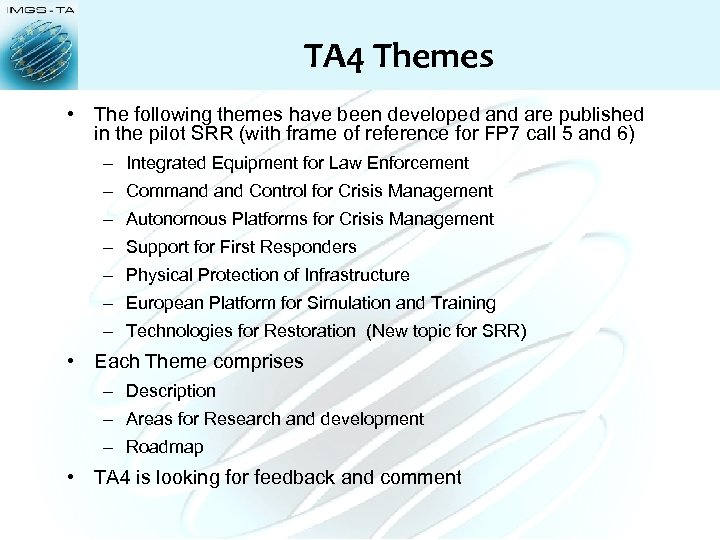 TA 4 Themes • The following themes have been developed and are published in the pilot SRR (with frame of reference for FP 7 call 5 and 6) – Integrated Equipment for Law Enforcement – Command Control for Crisis Management – Autonomous Platforms for Crisis Management – Support for First Responders – Physical Protection of Infrastructure – European Platform for Simulation and Training – Technologies for Restoration (New topic for SRR) • Each Theme comprises – Description – Areas for Research and development – Roadmap • TA 4 is looking for feedback and comment
 Command Control for Crisis Management • Description – A Command Control System must support, all organisations involved, at various levels, at all tasks in relation to management of a crisis – An alternative to the ‘traditional’ hierarchical organisation is the concept of a net-centric organisation – Applications of the concept in this domain difficult due to : • Number of organisation involved, Relative independency, Differences in policies and internal structures, Replacement of legacy systems and equipment. – Proposed idea • Link together existing (legacy) systems by an “umbrella system” • Providing all available information and support for collaborative planning and decision making. • Areas for Research and Development – – Improved Situational Awareness Communications Decision Support Interoperability
 Support for First Responders • Description – Public expectations of first responders are on the rise and faster and more efficient intervention is required – To perform this job the responder must be: • Effectively protected against hazards • Able to perform the required tasks • Have efficient and adaptable equipment • Areas for Research and Development – Minimising the burden of First Responders – Reliable, linked and affordable detection – Situational Awareness and decision making – Strengthening Response forces All of the above being fast deployable, cost effective, plug and play, interoperable and reliable
 Integrated Equipment For Law Enforcement • Description – Law enforcement officers play a major role in policing and security: • Enable lawful activities of all citizens, to protect human rights, and to be prepared for public disorder, major incidents and acts of terrorism. • Have the capability to execute a graduated response according to the level of the threat. • Spend as much time as possible engaged in traditional policing • Be able to act quickly in critical situations where effective protection is needed and where the officer may need to use force. – Equipment must provide protection and be compatible with the performance of the activities that are required in such critical conditions. • Areas for Research and Development: a systemic approach on – – Information and communication issues Adaptive protection Efficient reaction equipment Ergonomics and societal needs
 Autonomous Platforms for Crisis Management • Description – Operation of First Responders in critical situations is subjected to a number of factors which can cause serious risks for human operators and also reduce their operational effectiveness. – A robotic platform, with the necessary skill to operate in hazardous environments in place of – or in cooperation with - a FR team • Would substantially reduce injury or loss of life among First Responders • Would enhance their operational effectiveness and capability. • Areas for Research and Development – Mobility • In any environment, as autonomously as possible, to solve the problem of using the robot alongside the FR. – Sensing and cognitive capabilities • For self localisation, search and rescue as well as detection of dangerous situations for FR – Natural and fast interaction with the FR team in the field. • Communications • Situational Awareness
 European Platform for Simulation and Training • • Description – Modelling, Simulation and Analysis (MS&A) is invaluable tool to understand the inherent causality in complex processes surrounding crises management. – Physical systems and human actions can be predicted in a safe way. – Generally both cheaper and more effective than traditional training methods. – Provides insights into the collective behaviour of the whole Crisis Management System by modelling the behaviour of its components and their operating rules. – There is a need to develop a generic pan-European simulation platform • To form basis for planning, training and management of crisis management operations. Areas for Research and Development – Plug-in framework as part of a general architecture for different models. – Transform a suitable set of research models (describing different kinds of disasters) to simulation tools that are easy to use – Combining models for simulation of cascade effects – enable complex scenarios
 Physical Protection of Infrastructure • Description – Increasing the resilience of critical built infrastructures such as • supply chains (energy, water, food, emergency and rescue services) • information- and communication systems • transportation (harbours, air ports, railroads, interchanges) • critical industrial facilities (chemicals industry, nuclear power plants, refinery…) • banking and finance • government agencies and public buildings • Areas for Research and Development – – Risk Assessment Situation and Structural Assessment Passive Reinforcement Measure Smart Built in capabilities enabling rapid assessments of damaged structures – Integrated Networks of Active and Passive Protection Measures
 Technologies for Restoration (New Theme not in pilot SRR) • Description – Crisis Management challenges dependent upon the phase in the crisis management cycle and on type of incident – Complex incidents will pose especially significant demands during restoration phase, particularly on logistics capabilities. – Consequence Management is required to respond quickly to interruptions of critical infrastructure as inefficient practices will lead to a massive downfall in business and domestic continuity • Areas for Research and Development – Recovery Logistics • Post crisis needs assessment methods and tools for reconstruction and recovery planning • Structural damage assessment tools • Sustainability logistics planning and consequence management • Search and rescue operations – Service Restoration • • Basic service restoration (e. g. energy, food, water, communication) Recovery of, and support to, national government Social normality e. g. schools, employment Consequence Restoration Decontamination
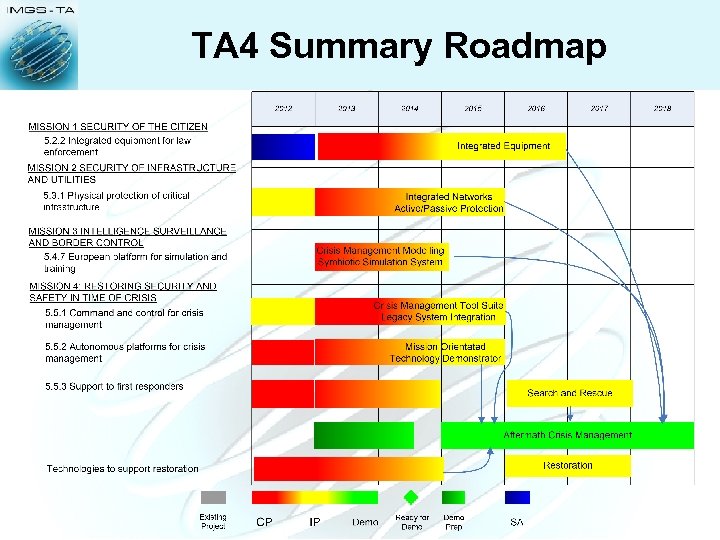 TA 4 Summary Roadmap
 TA 4 Contact Details • Website – TA 4 • https: //imgsta 4. frascati. enea. it/ • Chairperson – Clive. goodchild@baesystems. com • Or: – sofie@foi. se