


 Скачать презентацию Imagery For The Nation Overview NAIP Planning Requirements Meeting
86c9ff857a3bdc36a8a3b8ef17d31fde.ppt
- Количество слайдов: 10
 Imagery For The Nation Overview NAIP Planning/Requirements Meeting November 2007
 Imagery for the Nation The Vision The Nation will have a sustainable and flexible national digital imagery program that meets the needs of local, State, regional, Tribal, and Federal agencies. 2
 IFTN: Overview § Imagery for the Nation - Concept Ø Proposed by the National States Geographic Information Council (NSGIC) to create a coordinated national digital imagery program that will acquire, archive, and disseminate standardized, cyclic, multi-resolution imagery products. Ø Purpose was to reduce duplicative efforts, and to increase economies of scale, return on investment, and the availability of imagery to all sectors. Ø To be funded by Federal agencies with “buy-up” options funded by States and localities. Ø To be managed by the National Digital 3
 IFTN: Overview Original IFTN Concept § Administered by FSA 1 -m imagery over 48 States (NAIP), annual cycle, Federally funded 1 -m imagery over ocean islands (HI, PR, VI, etc. ), 3 -year cycle, Federally funded “Leaf-On” collection, Natural Color, Limited buy-ups § Administered by USGS 1 -m imagery over Alaska, 5 -year cycle, Federally funded 1 -ft imagery over counties with a population greater than 25/sq. mi. , 3 -year cycle, Federally funded 6 -in imagery over Census blocks with a population greater than 1, 000/sq. mi. , 3 -year cycle, 50% Federal cost-share with States and localities 4
 History § NSGIC Presents to Federal Geographic Data Committee late 2005 § FGDC Steering Committee tasked NDOP to develop a business plan and funding strategy § Geospatial Line of Business established March 2006. IFTN activities slowed on assumption that the Geo. LOB would be facilitate. This did not occur. FGDC requested that NDOP continue its efforts. § Mid - 2006, USGS approached NDOP agencies to help establish a Cost Benefit Analysis (CBA). § CBA begun September 2006 by Perot Systems Corporation, jointly funded by USGS and FSA, 5
 Description of Baseline and Alternatives § Current State: Baseline § Alternative #1 – Original IFTN Concept Ø 1 -m federally funded nationwide coverage, 1 -ft federally funded coverage determined by population model, and 6 -in cost share coverage of urban areas. § Alternative #2 – Original IFTN Concept with Full Federal Funding for 1 -ft Program Ø IFTN as proposed by NSGIC/NDOP with 1 -ft coverage of lower 48 states and Hawaii. Alaska and the Insular Areas will adhere to population model. § Alternative #3 – Original IFTN Concept with Mandatory 50% Cost Share for 1 -ft Program Ø IFTN as proposed by NSGIC/NDOP with 1 -ft coverage of lower 48 states and Hawaii, with mandatory cost share. Federal government will provide 50% according to statewide business plan. Alaska and the Insular Areas will adhere to population model. § Alternative #4 – Original IFTN Concept with Optional 50% Cost Share for 1 -ft Program Ø IFTN as proposed by NSGIC/NDOP with 1 -ft coverage of lower 48 states and Hawaii with optional cost share. Federal government will guarantee the availability of 50% funding for coverage according to statewide business plans. Statewide councils can increase funding to increase program coverage. Alaska and the Insular Areas will adhere to population model. 6
 Recommended Alternative § The alternatives received the same scores in the categories of business processes and non-quantifiable benefits; therefore, the remaining categories, cost, business requirements and risk were used to select the recommended alternative. The Recommended Alternative is #4: Original IFTN Concept with Optional 50% Cost Share for 1 -ft Program § This alternative presents a positive ROI and NPV while providing an equitable program to all federal, state, and local agencies. § This is particularly appealing to western states, since most of their less populous areas require higher resolution imagery to support industries such as, utility corridors, transportation, energy development, and tourism. § Funding for Alternative #4 is more likely to be supported by Congress than Alternative #1. § The rate of adoption of such a program is also estimated to be higher than that of Alternative #1 due to the population requirements which limit the national coverage of 1 -ft imagery. § Alternative #4 offers the flexibility that will allow statewide coordinating councils (with federal representation) to determine the exact land area of 7
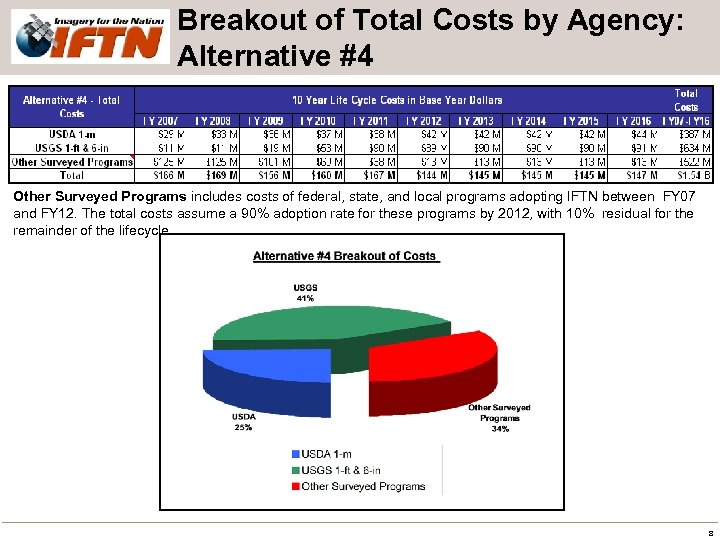 Breakout of Total Costs by Agency: Alternative #4 Other Surveyed Programs includes costs of federal, state, and local programs adopting IFTN between FY 07 and FY 12. The total costs assume a 90% adoption rate for these programs by 2012, with 10% residual for the remainder of the lifecycle. 8
 Ongoing Activity/Next Steps § NSGIC met with Hill to advocate for IFTN throughout 2007. § NSGIC is continuing to advocate directly with Congress for inclusion of IFTN in 2009 budget language. Private industry groups have indicated they are doing the same. § NDOP Steering and Sub-Committee Development § While there still remains two components to Imagery for the Nation, NAIP appears 9
 Cost Benefit Analysis CBA Posted at: www. ndop. gov Additional information www. nsgic. org 10