Скачать презентацию Image Segmentation and Seg 3 D Ross Whitaker
cd36291a23f280f108191fffbb29e9fc.ppt
- Количество слайдов: 28
 Image Segmentation and Seg 3 D Ross Whitaker SCI Institute, School of Computing University of Utah
 Overview • Segmentation intro – What is it • Strategies and state of the art • Seg 3 D intro
 Segmentation: Why? • Detection/recognition – Is there a lesion? • Quantifying object properties – How big is the tumor? Is is expanding or shrinking? – Statistical analyses of sets of biological volumes • Building models
 What is Segmentation? • Different definitions/meanings – Depends on context, person, etc. – Application – Type of output • e. g. Lines vs pixels • Different tools for different applications/needs – Tradeoffs between general and specific
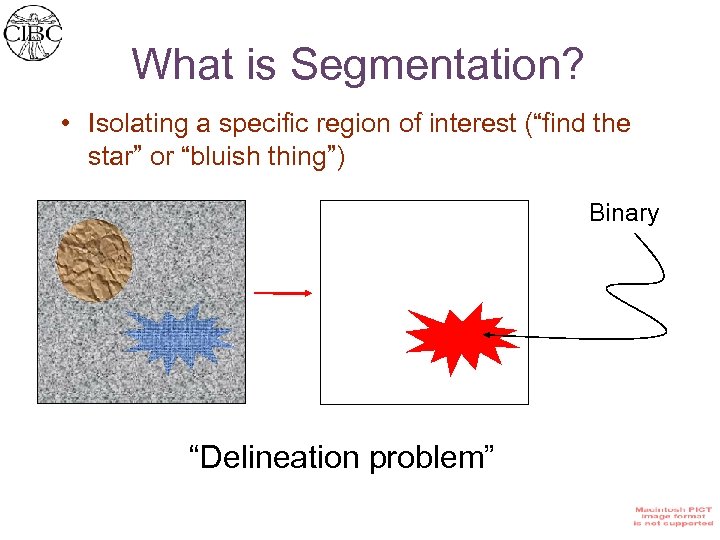 What is Segmentation? • Isolating a specific region of interest (“find the star” or “bluish thing”) Binary “Delineation problem”
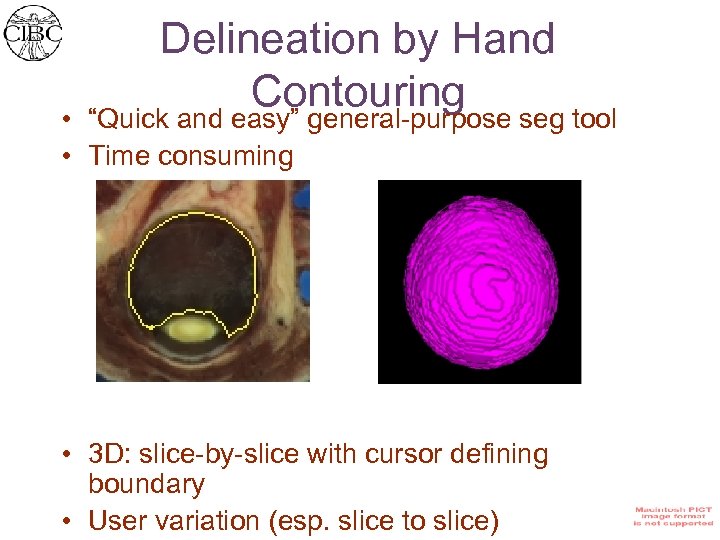 Delineation by Hand Contouring seg tool “Quick and easy” general-purpose • • Time consuming • 3 D: slice-by-slice with cursor defining boundary • User variation (esp. slice to slice)
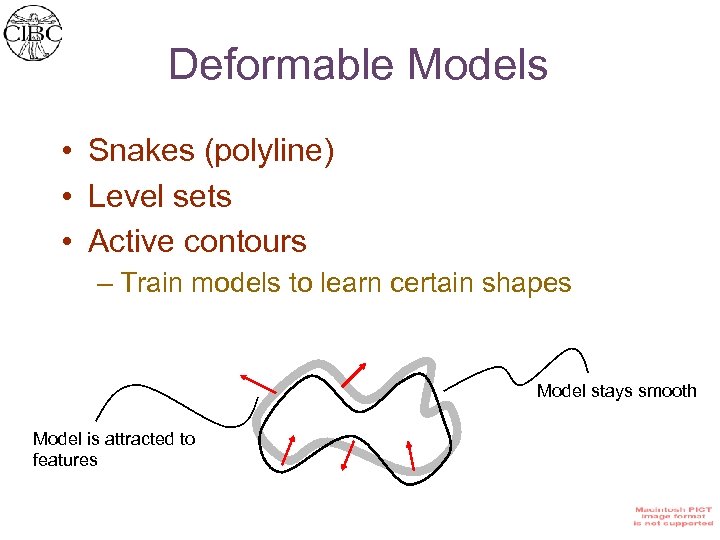 Deformable Models • Snakes (polyline) • Level sets • Active contours – Train models to learn certain shapes Model stays smooth Model is attracted to features
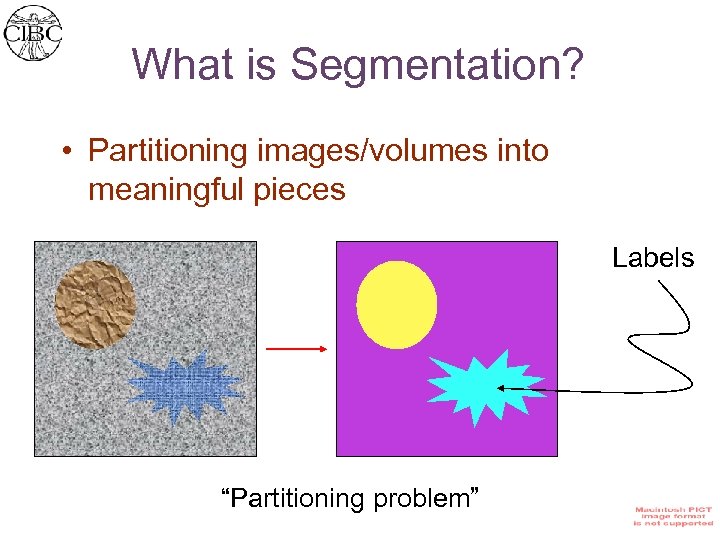 What is Segmentation? • Partitioning images/volumes into meaningful pieces Labels “Partitioning problem”
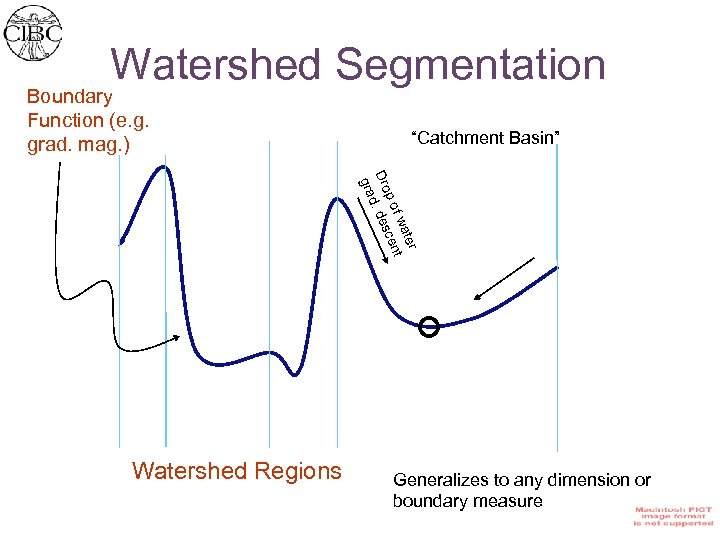 Watershed Segmentation Boundary Function (e. g. grad. mag. ) “Catchment Basin” r ate f w ent po c Dro. des d gra Watershed Regions Generalizes to any dimension or boundary measure
 Image Partitioning Jurrus et al. , ISBI 2008
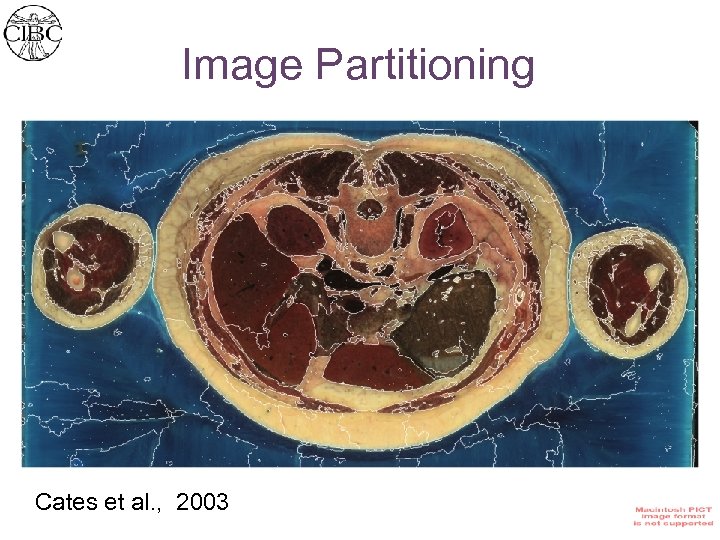 Image Partitioning Cates et al. , 2003
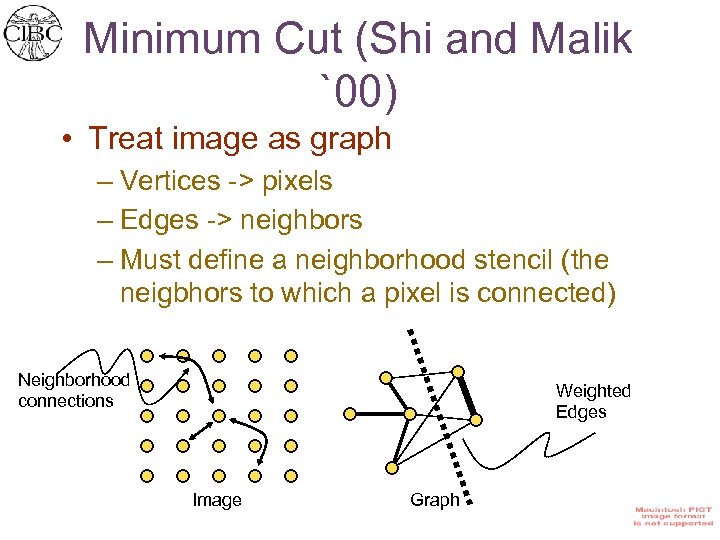 Minimum Cut (Shi and Malik `00) • Treat image as graph – Vertices -> pixels – Edges -> neighbors – Must define a neighborhood stencil (the neigbhors to which a pixel is connected) Neighborhood connections Weighted Edges Image Graph
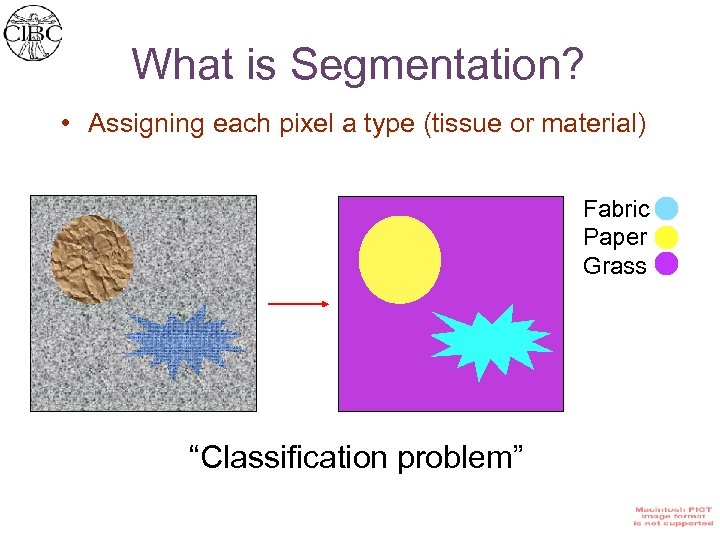 What is Segmentation? • Assigning each pixel a type (tissue or material) Fabric Paper Grass “Classification problem”
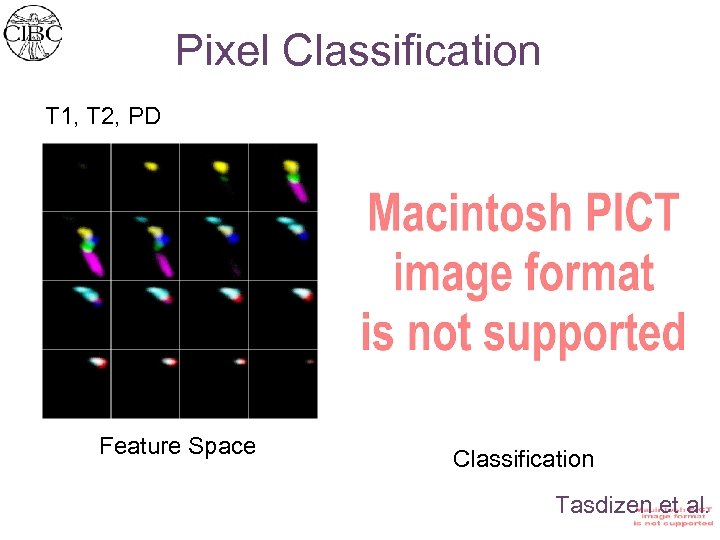 Pixel Classification T 1, T 2, PD Feature Space Classification Tasdizen et al.
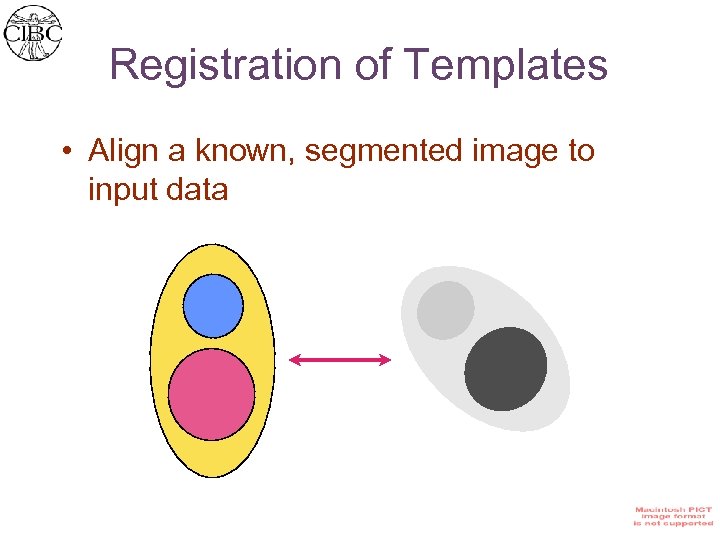 Registration of Templates • Align a known, segmented image to input data
 What is The Best Way to Segment Images? • Depends… – Kind of data: type of noise, signal, etc. – What you are looking for: shape, size, variability – Application specifics: how accurate, how many • State of the art – Specific data and shapes • Train a template or model (variability) • Deform to fit specific data – General data and shapes • So many methods
 State of the Art Segmentation: Statistics and Learning • Intensities and image statistics – Grey-levels and neighborhoods • Positions and templates – Register templates with spatial knowledge • Shapes – Learning statistics of contours and surfaces – Nonlocal relationships
 Example: Head Segmentation MRI • Tissue classification – GM, WM, CSF – Skull stripping (nonbrain) – Prior based on statistical template • Combine with registration • Priors on local configurations • Limbic system (subcortical structures) – Deformable shapes with priors
 Free. Surfer • Fischl and Anders MGH MRI WM Surfaces Partition
 EM-Segmenter, Slicer 3 • Tissue classification – Inhomogeneity correction – Gaussian mixture model • Simultaneous classification and template – Iterative – Probabilistic atlas/template
 Specific vs General Methods • Specific – Automated – Moderately reliable (user QC) – Training/learning – Works for specific: • anatomy • imaging modalities • applications – Pathology? • General
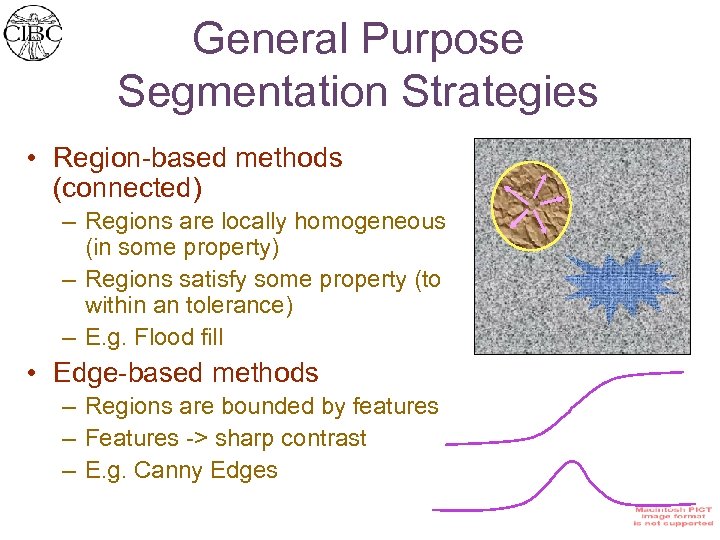 General Purpose Segmentation Strategies • Region-based methods (connected) – Regions are locally homogeneous (in some property) – Regions satisfy some property (to within an tolerance) – E. g. Flood fill • Edge-based methods – Regions are bounded by features – Features -> sharp contrast – E. g. Canny Edges
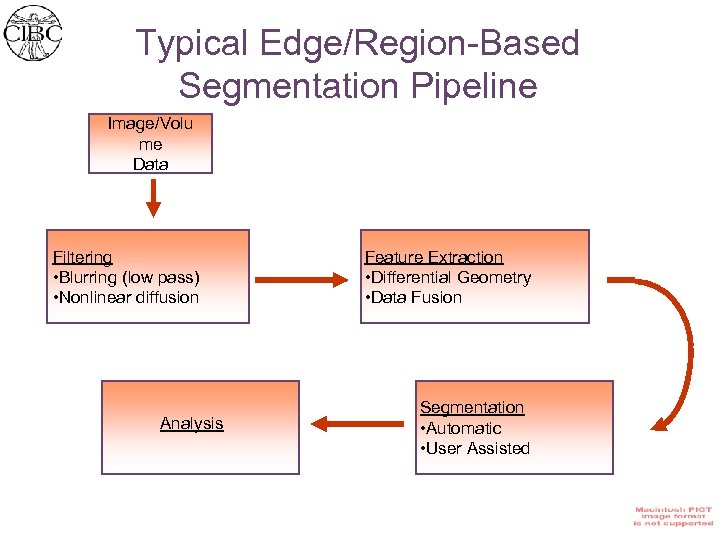 Typical Edge/Region-Based Segmentation Pipeline Image/Volu me Data Filtering • Blurring (low pass) • Nonlinear diffusion Analysis Feature Extraction • Differential Geometry • Data Fusion Segmentation • Automatic • User Assisted
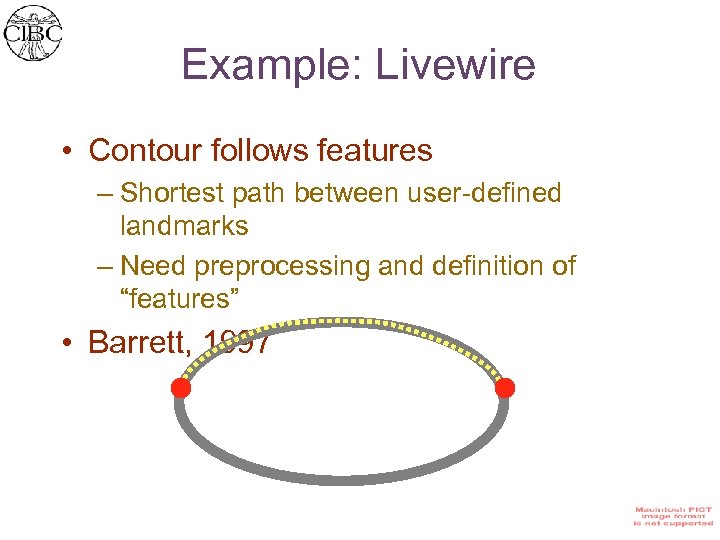 Example: Livewire • Contour follows features – Shortest path between user-defined landmarks – Need preprocessing and definition of “features” • Barrett, 1997
 Seg 3 D • Goals – End-user application – General purpose – User-assisted • Philosophy – Voxel/pixel-based – Layers and labels, 3 D photoshop – GUIs and user interaction for user-assisted segmentation – 3 D interaction to aid 2 D views
 Seg 3 D • Software engineering – Wrapping ITK filters and image I/O – Cross platform, WX widgets • Software design/user interface Views (reconfigurable) Data/ Parameters Layers/image s