


 Скачать презентацию Image Registration and Application to Image-Guided Neurosurgery Lara
acb869c24fecf2f7530d30151abcedb7.ppt
- Количество слайдов: 37
 Image Registration and Application to Image-Guided Neurosurgery Lara Vigneron Lara. Vigneron@ulg. ac. be 04 366 26 42
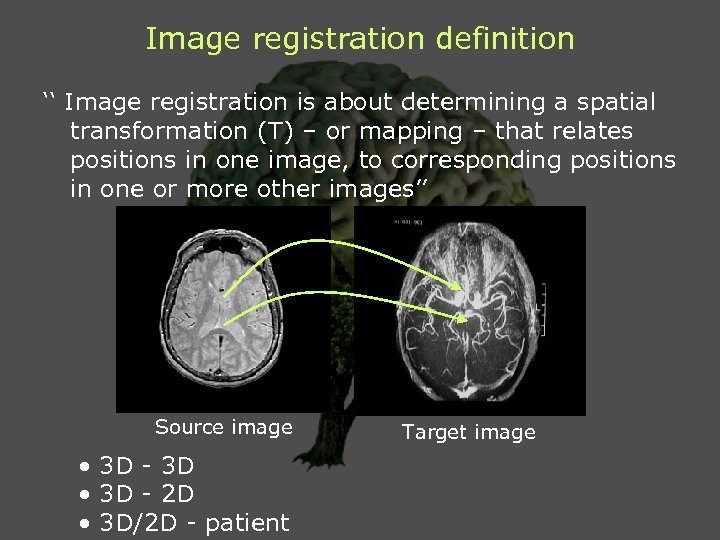 Image registration definition ‘‘ Image registration is about determining a spatial transformation (T) – or mapping – that relates positions in one image, to corresponding positions in one or more other images’’ Source image • 3 D - 3 D • 3 D - 2 D • 3 D/2 D - patient Target image
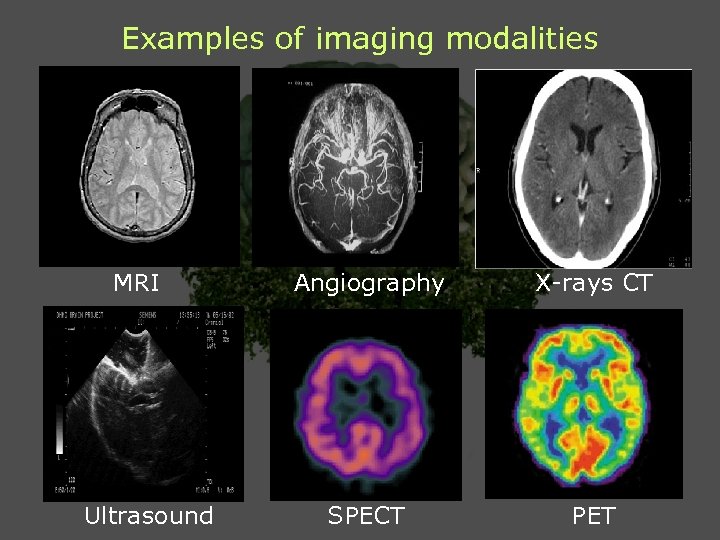 Examples of imaging modalities MRI Ultrasound Angiography X-rays CT SPECT PET
 Application of image registration • Same modality, same patient - monitoring and quatifying disease progession over time, - evaluation of intraoperative brain deformation, etc… • Different modalities, same patient - correction for different patient position between scans, - linking between structural and functional images, etc… • Same modality, differents patients - Atlas construction, - studies of variability between subjects, etc…
 A registration algoritm is divided into 3 components 1) Similarity The similarity criterion measures how well 2 images match 2) Transformation The transformation specifies the way in which the source image can be changed to match the target. A number of numerical parameters specify a particular instance of the transformation 3) Optimization The optimization process varies the parameters of the transformation model to maximize the matching criterion
 A registration algoritm is decomposed into 3 components 1) Similarity The similarity criterion measures how well 2 images match 2) Transformation The transformation specifies the way in which the source image can be changed to match the target. A number of numerical parameters specify a particular instance of the transformation 3) Optimization The optimization process varies the parameters of the transformation model to maximize the matching criterion
 Similarity measures are geometric- or intensity-based • Geometric approach Matches identifiable anatomical features, like points or surfaces, extracted from source and target images. ex: birfurcation of blood vessels, center of orbit of the eyes, … Advantage: the use of structural information ensures that the mapping has biological validity and allows the transformation to be interpreted in terms of the underlying anatomy or physiology • Intensity approach Matches intensity patterns in each image using mathematical or statistical criteria Advantage: all (or a large proportion of) data is used in source and target images
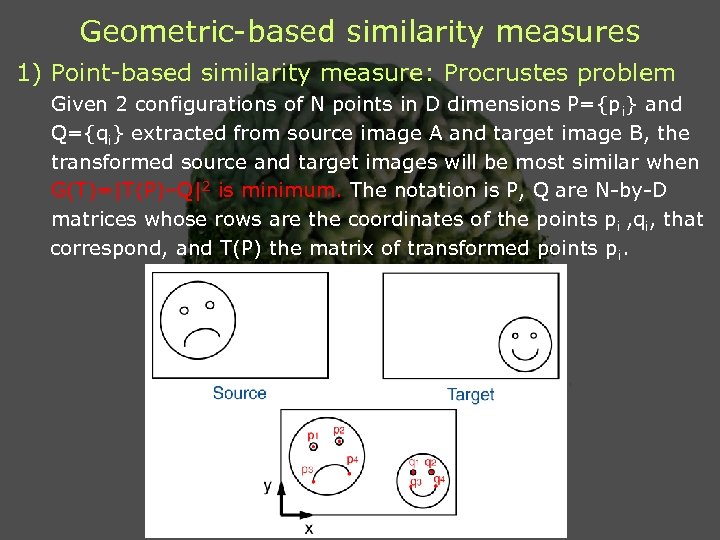 Geometric-based similarity measures 1) Point-based similarity measure: Procrustes problem Given 2 configurations of N points in D dimensions P={p i} and Q={qi} extracted from source image A and target image B, the transformed source and target images will be most similar when G(T)=|T(P)–Q|2 is minimum. The notation is P, Q are N-by-D matrices whose rows are the coordinates of the points p i , qi, that correspond, and T(P) the matrix of transformed points p i.
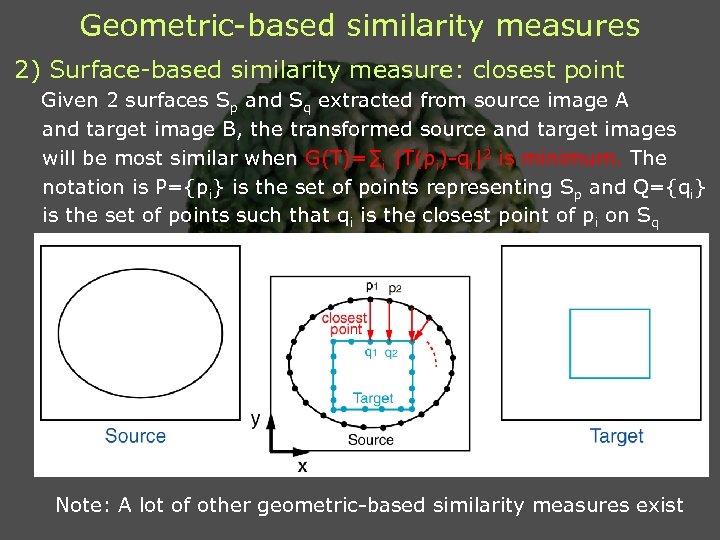 Geometric-based similarity measures 2) Surface-based similarity measure: closest point Given 2 surfaces Sp and Sq extracted from source image A and target image B, the transformed source and target images will be most similar when G(T)=∑i |T(pi)-qi|2 is minimum. The notation is P={pi} is the set of points representing Sp and Q={qi} is the set of points such that qi is the closest point of pi on Sq Note: A lot of other geometric-based similarity measures exist
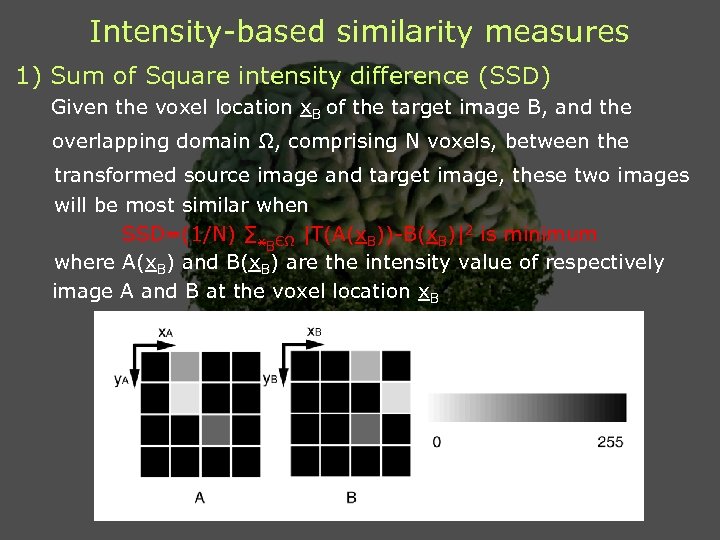 Intensity-based similarity measures 1) Sum of Square intensity difference (SSD) Given the voxel location x. B of the target image B, and the overlapping domain Ω, comprising N voxels, between the transformed source image and target image, these two images will be most similar when SSD=(1/N) ∑x. BЄΩ |T(A(x. B))-B(x. B)|2 is minimum where A(x. B) and B(x. B) are the intensity value of respectively image A and B at the voxel location x. B
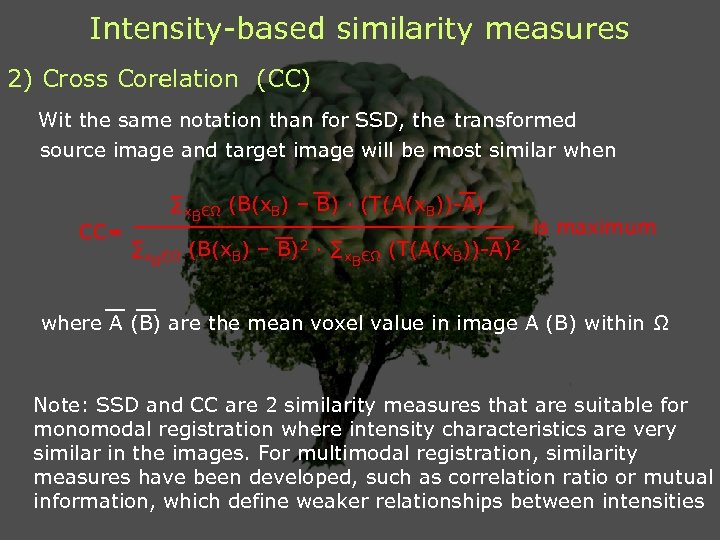 Intensity-based similarity measures 2) Cross Corelation (CC) Wit the same notation than for SSD, the transformed source image and target image will be most similar when CC= ∑x. BЄΩ (B(x. B) – B) ∙ (T(A(x. B))-A) ∑x. BЄΩ (B(x. B) – B)2 ∙ ∑x. BЄΩ (T(A(x. B))-A)2 is maximum where A (B) are the mean voxel value in image A (B) within Ω Note: SSD and CC are 2 similarity measures that are suitable for monomodal registration where intensity characteristics are very similar in the images. For multimodal registration, similarity measures have been developed, such as correlation ratio or mutual information, which define weaker relationships between intensities
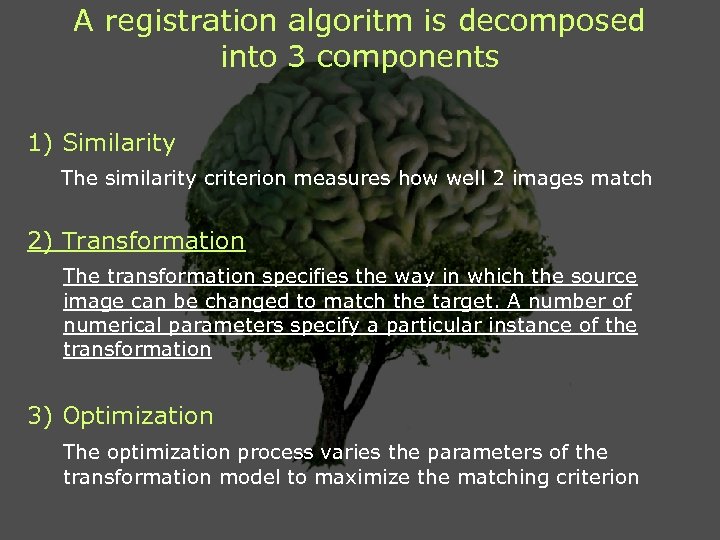 A registration algoritm is decomposed into 3 components 1) Similarity The similarity criterion measures how well 2 images match 2) Transformation The transformation specifies the way in which the source image can be changed to match the target. A number of numerical parameters specify a particular instance of the transformation 3) Optimization The optimization process varies the parameters of the transformation model to maximize the matching criterion
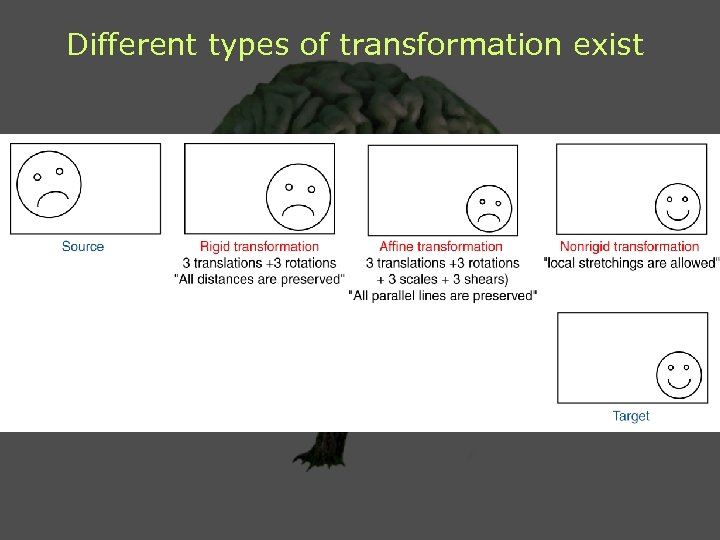 Different types of transformation exist
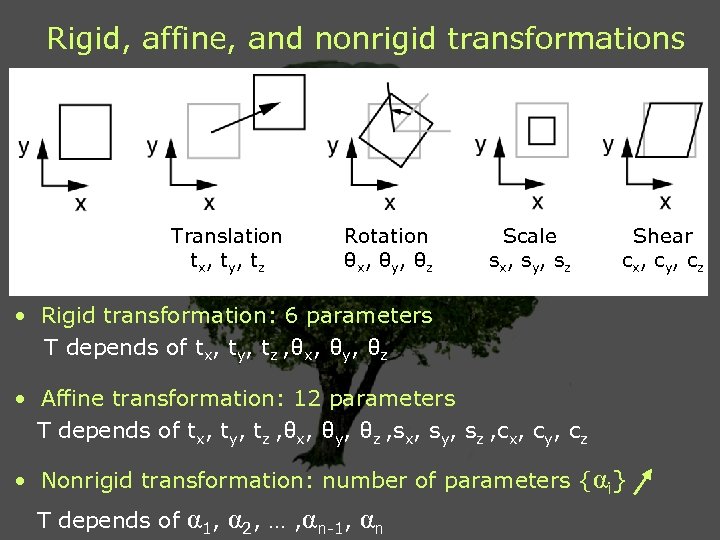 Rigid, affine, and nonrigid transformations Translation tx, ty, tz Rotation θx, θy, θz Scale sx, sy, sz Shear cx, cy, cz • Rigid transformation: 6 parameters T depends of tx, ty, tz , θx, θy, θz • Affine transformation: 12 parameters T depends of tx, ty, tz , θx, θy, θz , sx, sy, sz , cx, cy, cz • Nonrigid transformation: number of parameters {αi} T depends of α 1, α 2, … , αn-1, αn
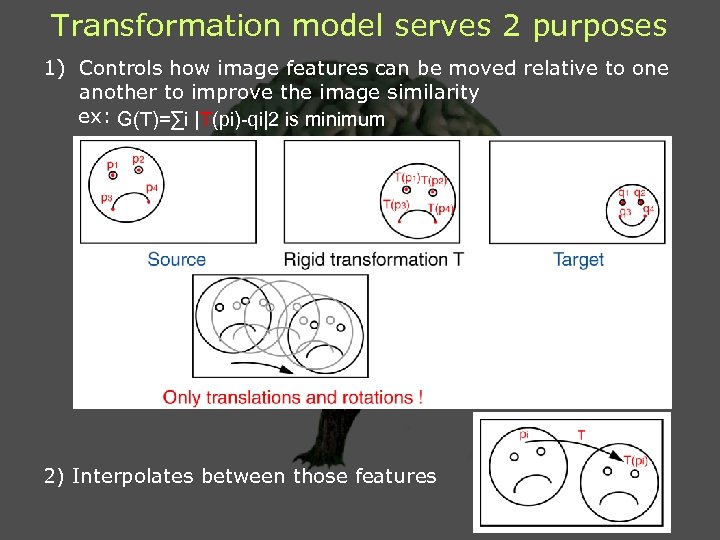 Transformation model serves 2 purposes 1) Controls how image features can be moved relative to one another to improve the image similarity ex: G(T)=∑i |T(pi)-qi|2 is minimum 2) Interpolates between those features
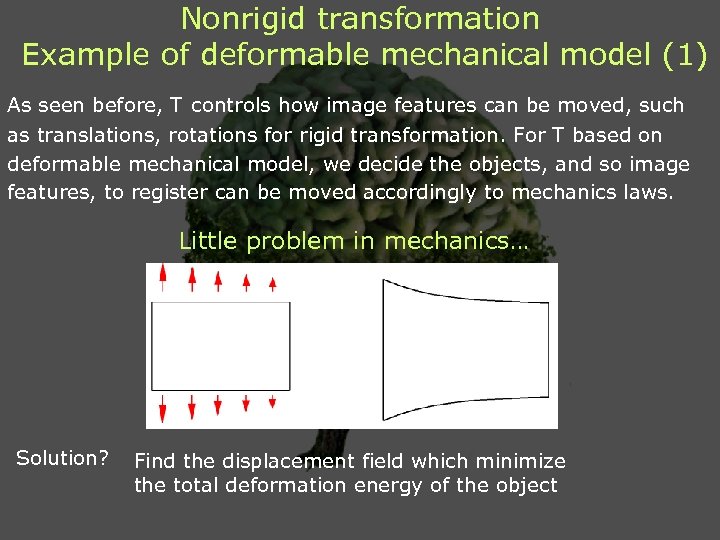 Nonrigid transformation Example of deformable mechanical model (1) As seen before, T controls how image features can be moved, such as translations, rotations for rigid transformation. For T based on deformable mechanical model, we decide the objects, and so image features, to register can be moved accordingly to mechanics laws. Little problem in mechanics… Solution? Find the displacement field which minimize the total deformation energy of the object
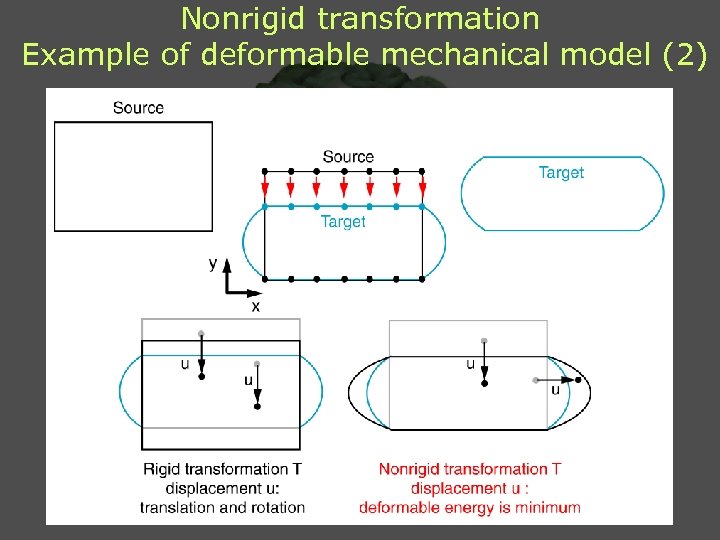 Nonrigid transformation Example of deformable mechanical model (2)
 A registration algoritm is decomposed into 3 components 1) Similarity The similarity criterion measures how well 2 images match 2) Transformation The transformation specifies the way in which the source image can be changed to match the target. A number of numerical parameters specify a particular instance of the transformation 3) Optimization The optimization process varies the parameters of the transformation model to maximize the matching criterion
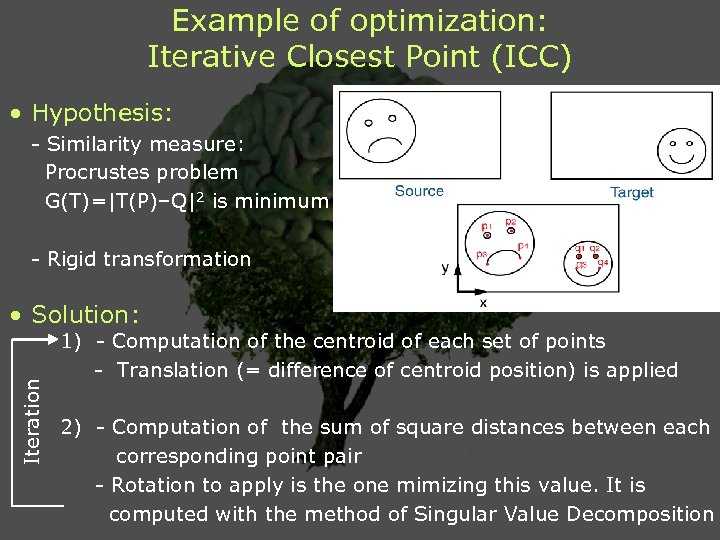 Example of optimization: Iterative Closest Point (ICC) • Hypothesis: - Similarity measure: Procrustes problem G(T)=|T(P)–Q|2 is minimum - Rigid transformation Iteration • Solution: 1) - Computation of the centroid of each set of points - Translation (= difference of centroid position) is applied 2) - Computation of the sum of square distances between each corresponding point pair - Rotation to apply is the one mimizing this value. It is computed with the method of Singular Value Decomposition
 Application of Image Registration to Image-Guided Neurosurgery
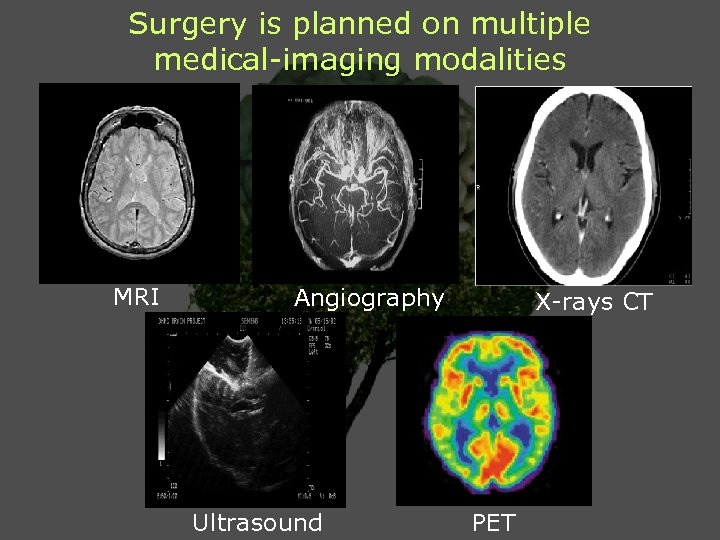 Surgery is planned on multiple medical-imaging modalities MRI Angiography Ultrasound X-rays CT PET
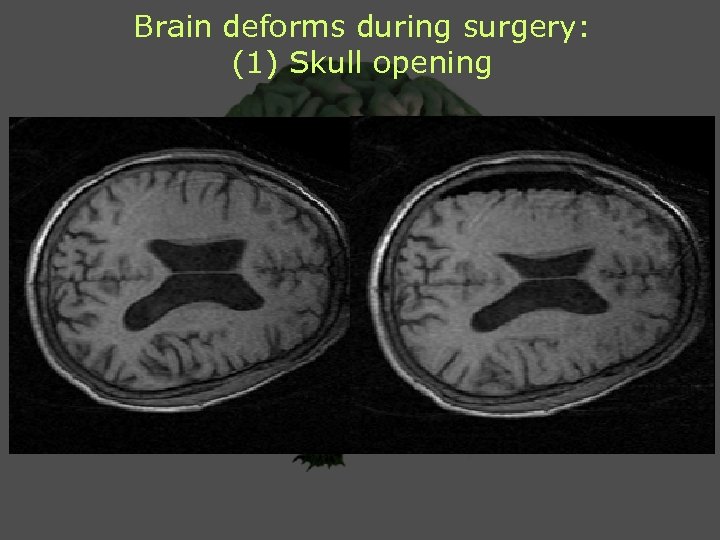 Brain deforms during surgery: (1) Skull opening
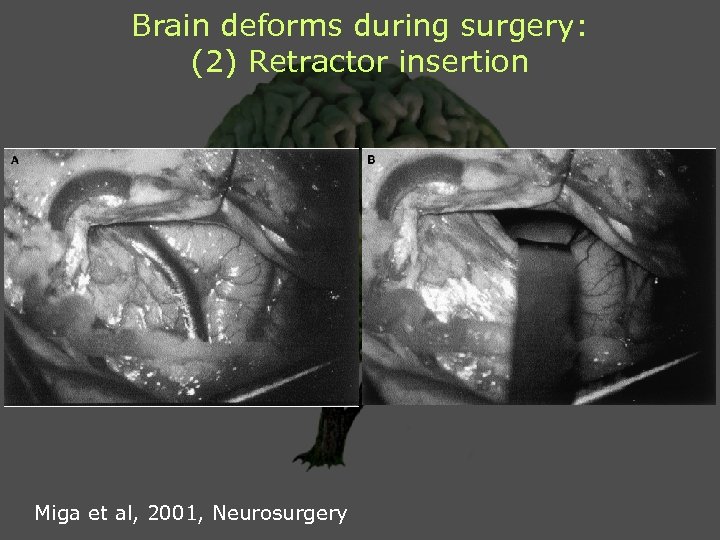 Brain deforms during surgery: (2) Retractor insertion Miga et al, 2001, Neurosurgery
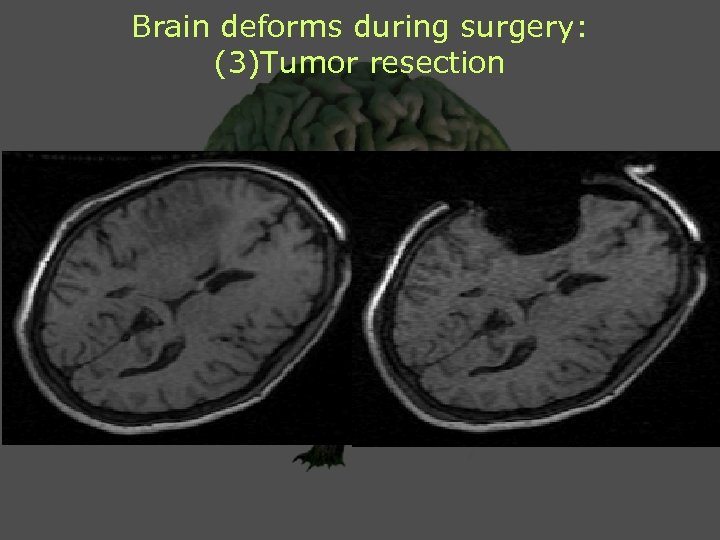 Brain deforms during surgery: (3)Tumor resection
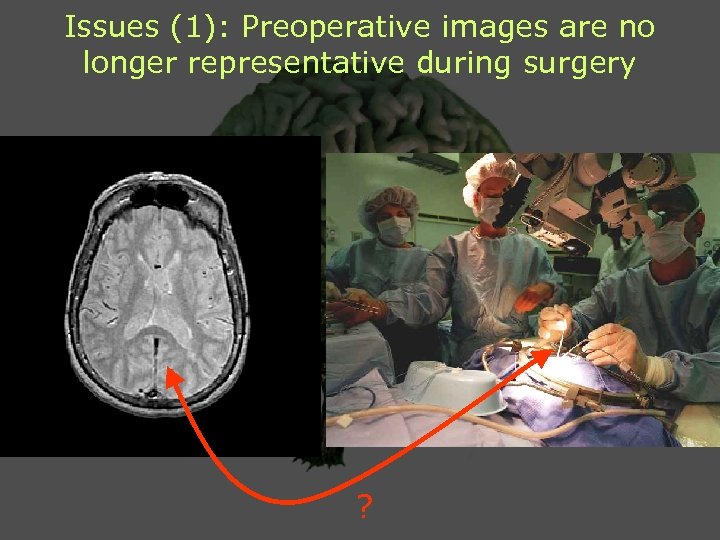 Issues (1): Preoperative images are no longer representative during surgery ?
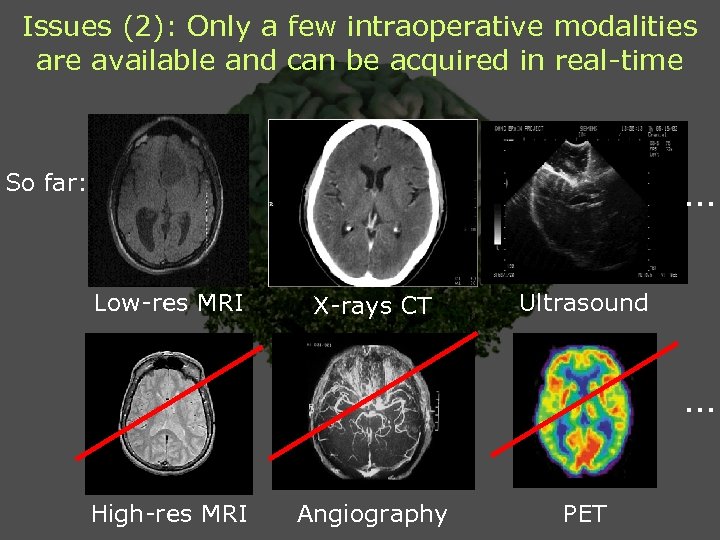 Issues (2): Only a few intraoperative modalities are available and can be acquired in real-time So far: … Low-res MRI X-rays CT Ultrasound … High-res MRI Angiography PET
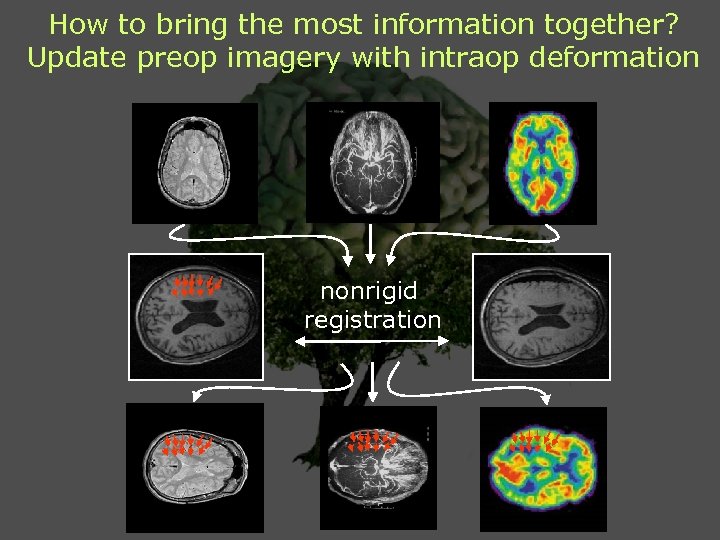 How to bring the most information together? Update preop imagery with intraop deformation nonrigid registration
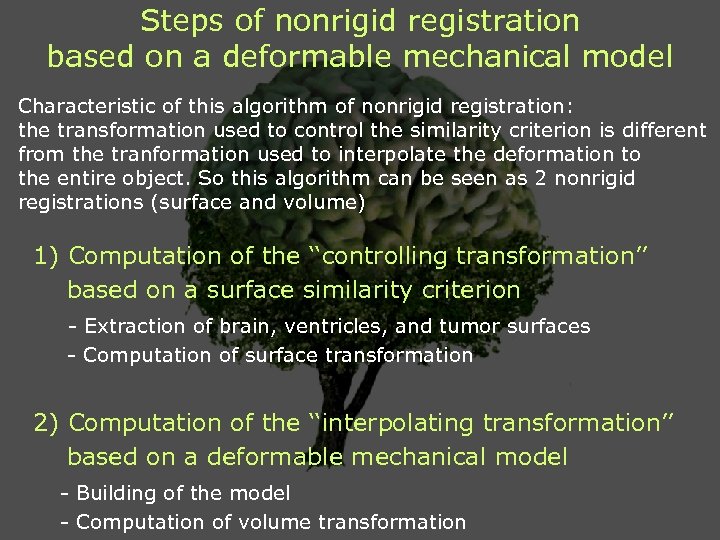 Steps of nonrigid registration based on a deformable mechanical model Characteristic of this algorithm of nonrigid registration: the transformation used to control the similarity criterion is different from the tranformation used to interpolate the deformation to the entire object. So this algorithm can be seen as 2 nonrigid registrations (surface and volume) 1) Computation of the ‘‘controlling transformation’’ based on a surface similarity criterion - Extraction of brain, ventricles, and tumor surfaces - Computation of surface transformation 2) Computation of the ‘‘interpolating transformation’’ based on a deformable mechanical model - Building of the model - Computation of volume transformation
 Steps of nonrigid registration based on a deformable mechanical model Characteristic of this algorithm of nonrigid registration: the transformation used to control the similarity criterion is different from the tranformation used to interpolate the deformation to the entire object. So this algorithm can be seen as 2 nonrigid registrations (surface and volume) 1) Computation of the ‘‘controlling transformation’’ based on a surface similarity criterion - Extraction of brain, ventricles, and tumor surfaces - Computation of surface transformation 2) Computation of the ‘‘interpolating transformation’’ based on a deformable mechanical model - Building of the model - Computation of volume transformation
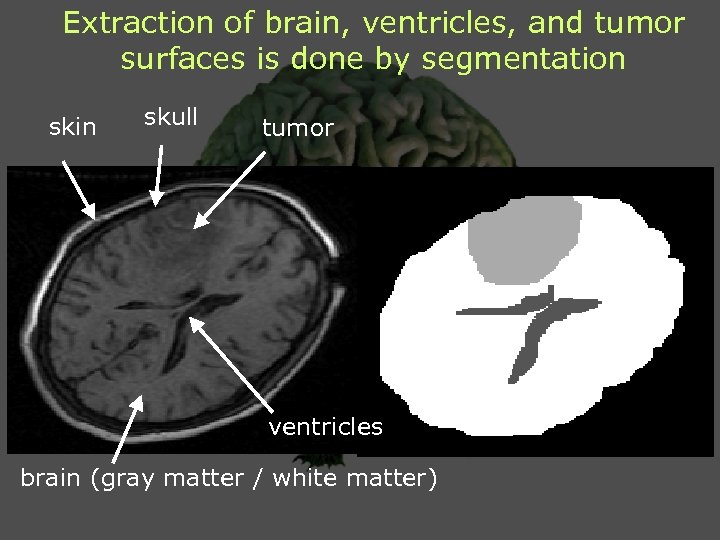 Extraction of brain, ventricles, and tumor surfaces is done by segmentation skin skull tumor ventricles brain (gray matter / white matter)
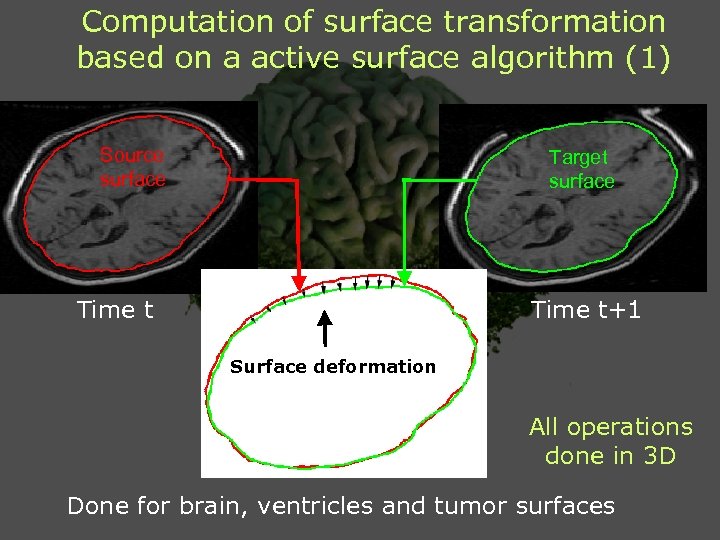 Computation of surface transformation based on a active surface algorithm (1) Source surface Target surface Time t+1 Surface deformation All operations done in 3 D Done for brain, ventricles and tumor surfaces
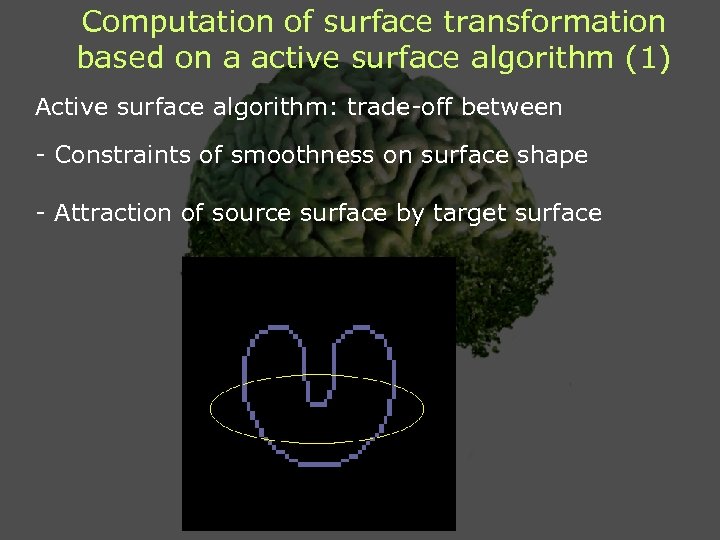 Computation of surface transformation based on a active surface algorithm (1) Active surface algorithm: trade-off between - Constraints of smoothness on surface shape - Attraction of source surface by target surface
 Steps of nonrigid registration based on a deformable mechanical model Characteristic of this algorithm of nonrigid registration: the transformation used to control the similarity criterion is different from the tranformation used to interpolate the deformation to the entire object. So this algorithm can be seen as 2 nonrigid registrations (surface and volume) 1) Computation of the ‘‘controlling transformation’’ based on a surface similarity criterion - Extraction of brain, ventricles, and tumor surfaces - Computation of surface transformation 2) Computation of the ‘‘interpolating transformation’’ based on a deformable mechanical model - Building of the model - Computation of volume transformation
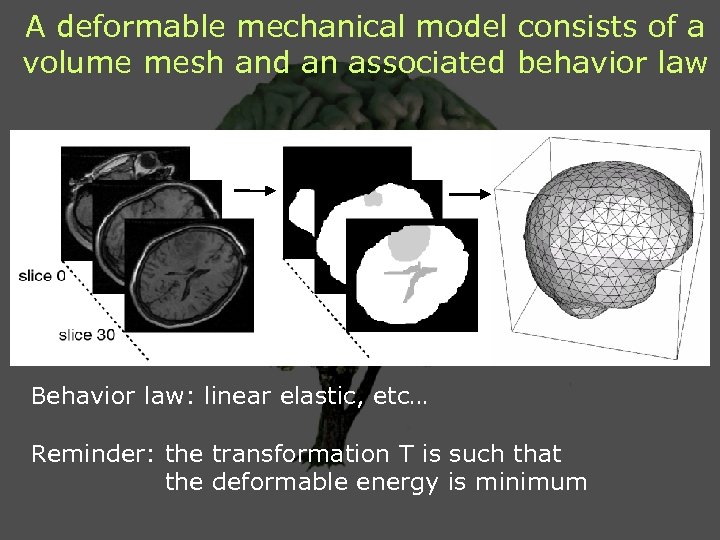 A deformable mechanical model consists of a volume mesh and an associated behavior law Behavior law: linear elastic, etc… Reminder: the transformation T is such that the deformable energy is minimum
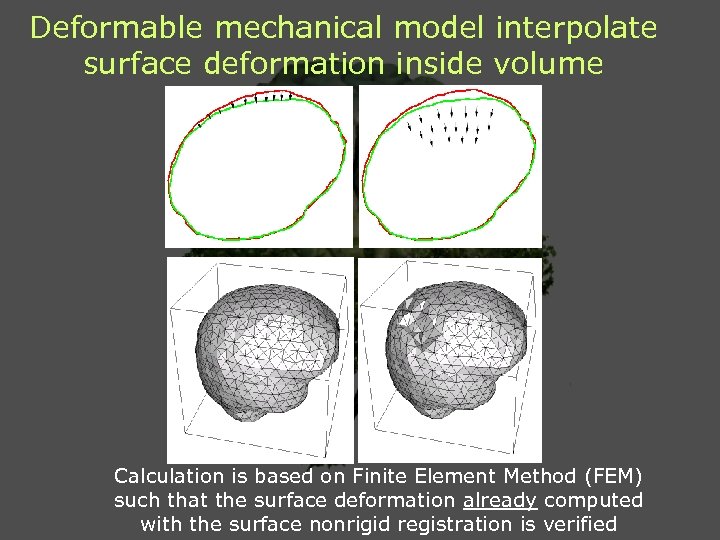 Deformable mechanical model interpolate surface deformation inside volume Calculation is based on Finite Element Method (FEM) such that the surface deformation already computed with the surface nonrigid registration is verified
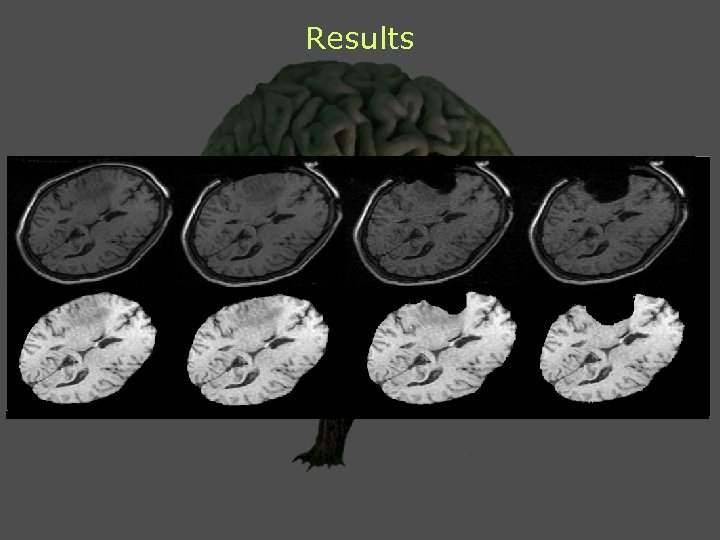 Results
 For more information… • Non-rigid image registration: theory and practice W. R. Crum, T. Hartkens, and D. L. G. Hill, 2004 http: //code. ucsd. edu/~pcosman/Crum. pdf • Medical image registration D. L. G. Hill, P. G. Batchelor, M. Holden, D. J. Hawkes Physics in Medicine and Biology, 2001