


 Скачать презентацию Image Pattern Recognition The identification of animal species
212e4d1766b30c7218c75172e8494f97.ppt
- Количество слайдов: 28
 Image Pattern Recognition The identification of animal species through the classification of hair patterns using image pattern recognition: A case study of identifying cheetah prey. Principal Investigator: Thamsanqa Moyo Supervisors: Dr Greg Foster and Professor Shaun Bangay.
 Presentation Outline • Problem Statement • Objectives • Approach • Research Done • Conclusion
 Problem Statement • Hair identification in Zoology and Forensics • Subjectivity
 Problem Statement • First application of automated image pattern recognition techniques to the problem of classifying African mammalian species using hair patterns. – based on the numerical and statistical analysis of hair patterns.
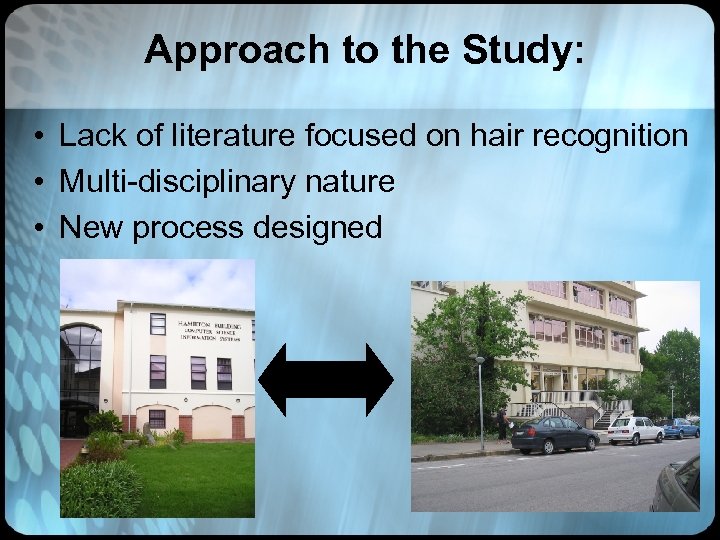 Approach to the Study: • Lack of literature focused on hair recognition • Multi-disciplinary nature • New process designed
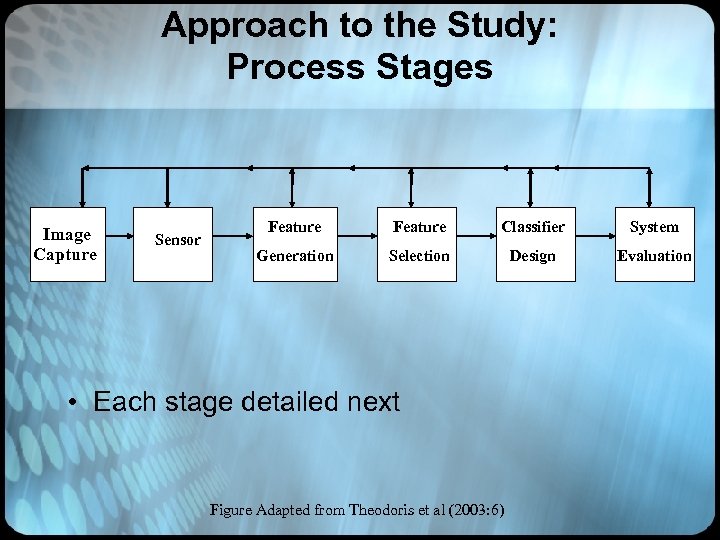 Approach to the Study: Process Stages Image Capture Sensor Feature Classifier System Generation Selection Design Evaluation • Each stage detailed next Figure Adapted from Theodoris et al (2003: 6)
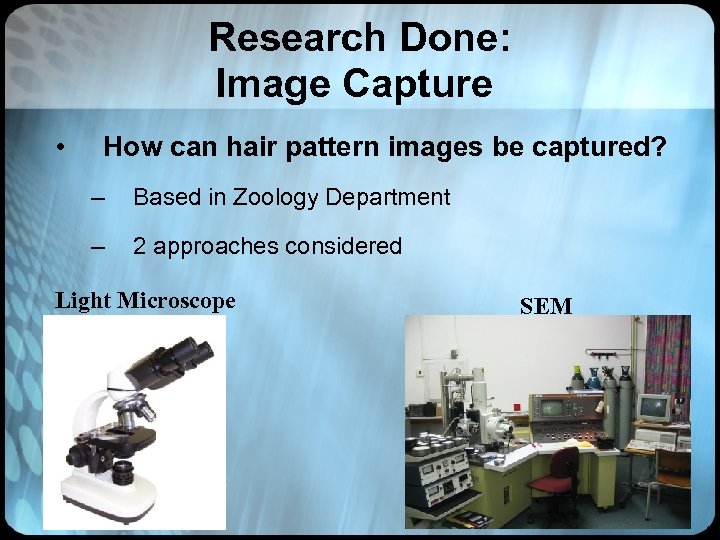 Research Done: Image Capture • How can hair pattern images be captured? – Based in Zoology Department – 2 approaches considered Light Microscope SEM
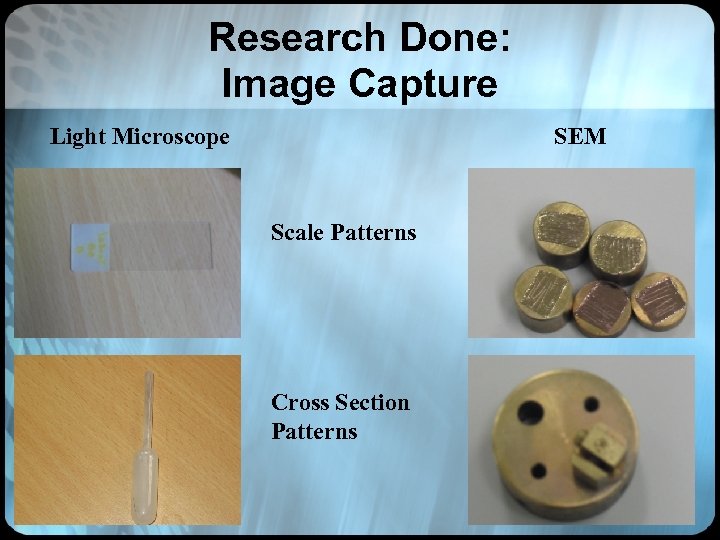 Research Done: Image Capture Light Microscope SEM Scale Patterns Cross Section Patterns
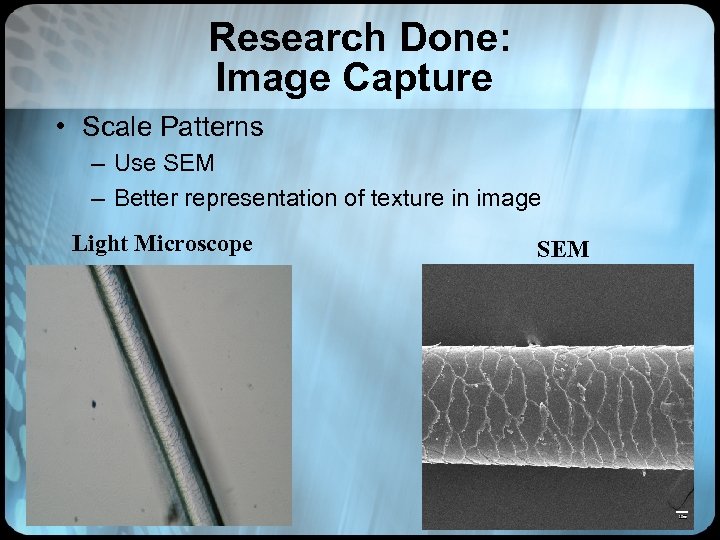 Research Done: Image Capture • Scale Patterns – Use SEM – Better representation of texture in image Light Microscope SEM
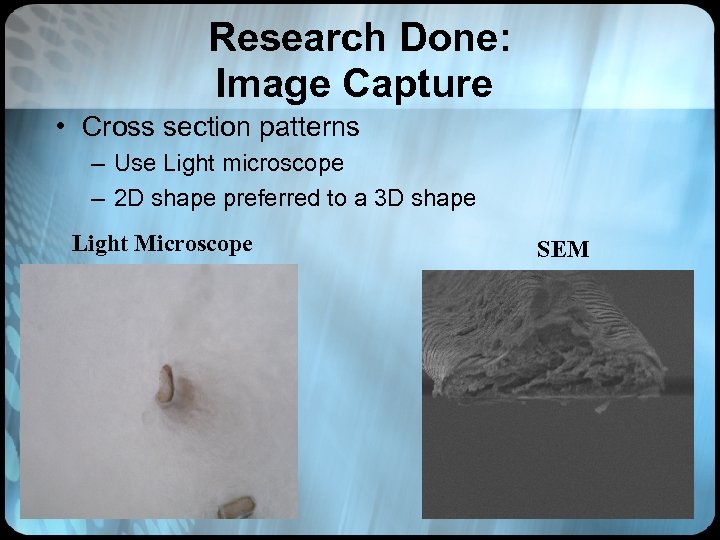 Research Done: Image Capture • Cross section patterns – Use Light microscope – 2 D shape preferred to a 3 D shape Light Microscope SEM
 Research Done: Image Capture • Decisions affecting design – Scale patterns texture based – Cross section patterns shape based – 2 separate sub-processes – Decision not to combine their results
 Research Done: Sensor • What image manipulation techniques are applied in a hair pattern recognition process? – Scale Pattern Processing • User defined ROI • Handle RST variations • No need to cater for reflection variations • Convert to greyscale
 Research Done: Sensor Stage • What image manipulation techniques are applied in a hair pattern recognition process? – Cross section pattern processing • • • User defined ROI Image segmentation and thresholding Challenges
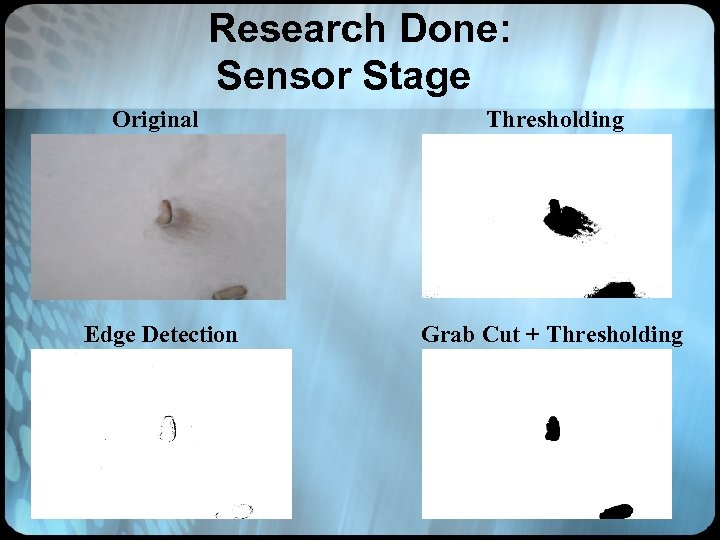 Research Done: Sensor Stage Original Thresholding Edge Detection Grab Cut + Thresholding
 Research Done: Feature Extraction How can features be extracted? • Scale Pattern Processing – Gabor filters – Capture pattern orientation and frequency information – Produces n number of filtered images where n is the size of the Gabor filter-bank
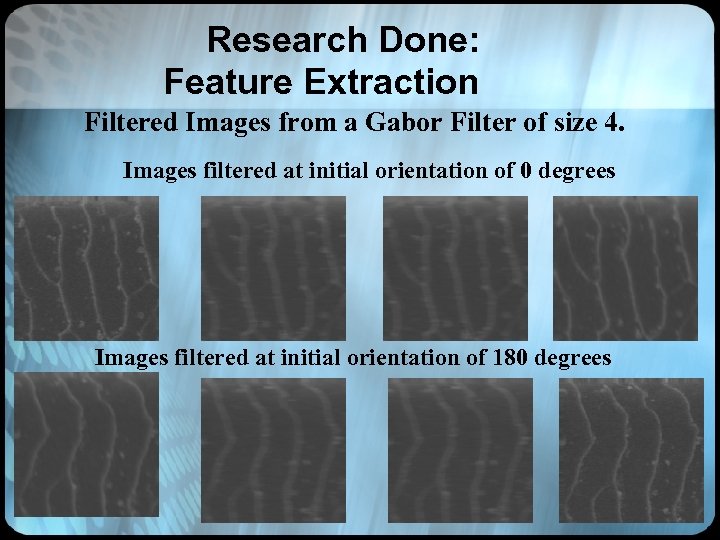 Research Done: Feature Extraction Filtered Images from a Gabor Filter of size 4. Images filtered at initial orientation of 0 degrees Images filtered at initial orientation of 180 degrees
 Research Done: Feature Extraction How can features be extracted? • Cross Section Processing – Hu’s 7 moments – RST invariant shape descriptors – Calculated from central moments – Require black and white image
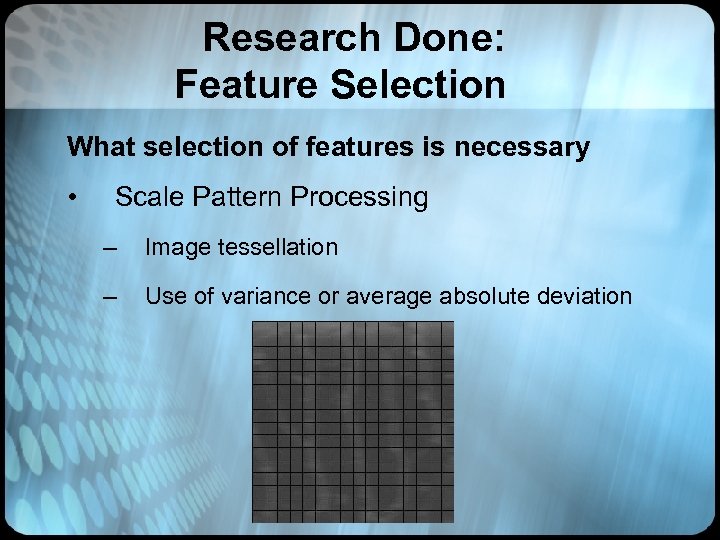 Research Done: Feature Selection What selection of features is necessary • Scale Pattern Processing – Image tessellation – Use of variance or average absolute deviation
 Research Done: Feature Selection What selection of features is necessary? • Cross section processing – None required for Hu’s moments – Would affect scalability of the process
 Research Done: Classifier Design • What mechanisms can be used to classify features? – Scale Pattern Processing • • Euclidean distance measure 3 Scale patterns used to train – Cross Section Processing • • Euclidean distance measure or Hamming distance measure 10 cross section patterns used to train
 Research Done: Results • From implementation using: – Image. J plugins written in Java 1. 4 – 25 scale patterns processed – 50 cross section patterns processed
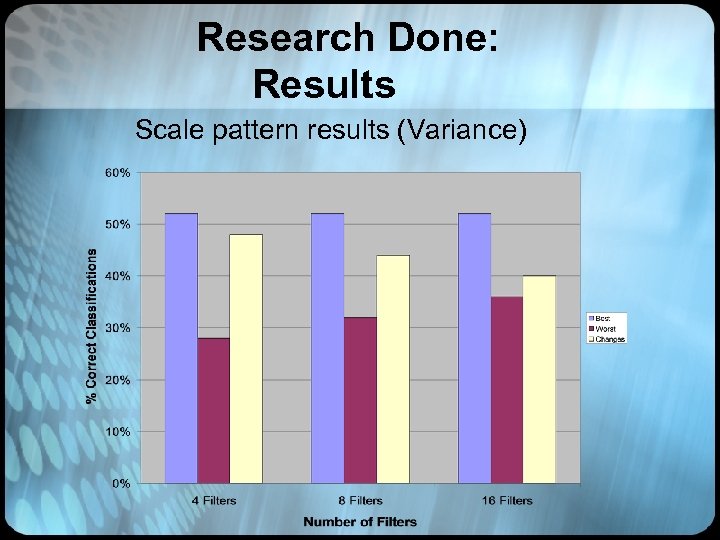 Research Done: Results Scale pattern results (Variance)
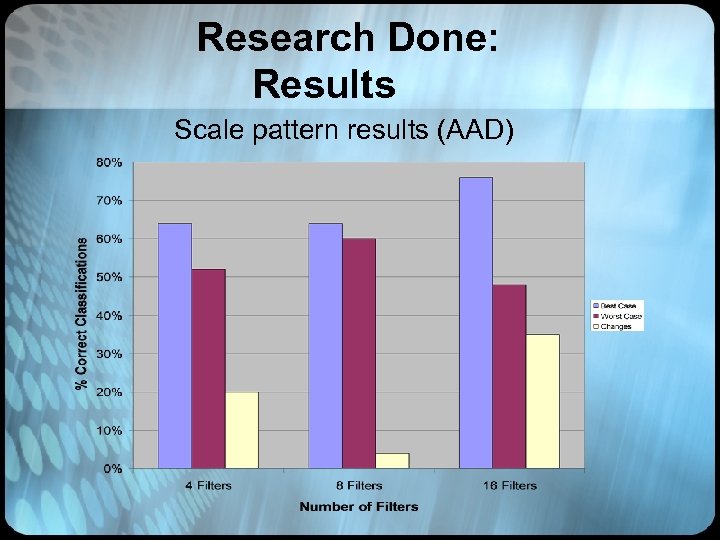 Research Done: Results Scale pattern results (AAD)
 Research Done: Results • Summary of scale pattern results: – AAD is a better feature selection method – Results most stable with 8 filters using AAD as feature selector – Explanation of this result
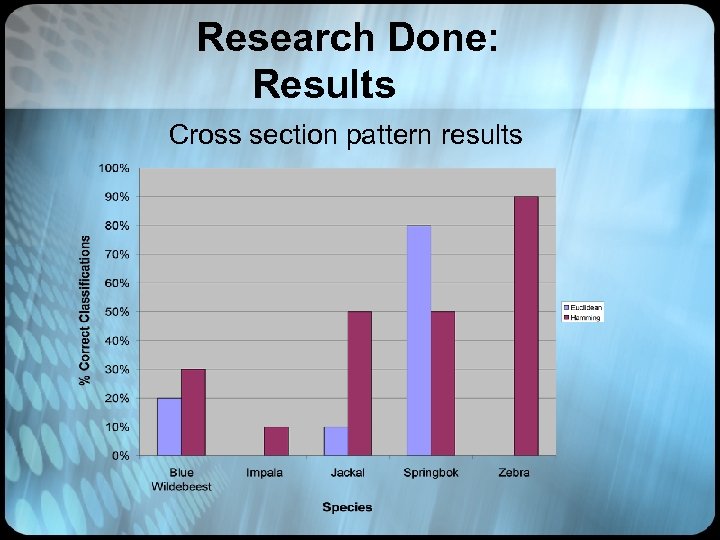 Research Done: Results Cross section pattern results
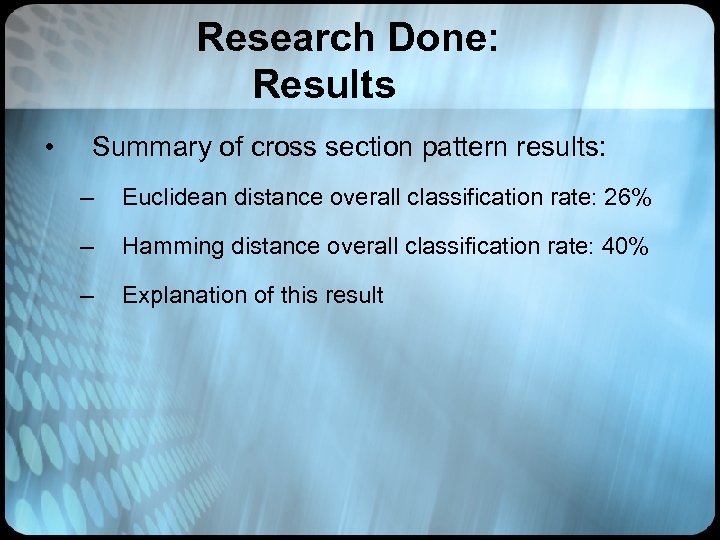 Research Done: Results • Summary of cross section pattern results: – Euclidean distance overall classification rate: 26% – Hamming distance overall classification rate: 40% – Explanation of this result
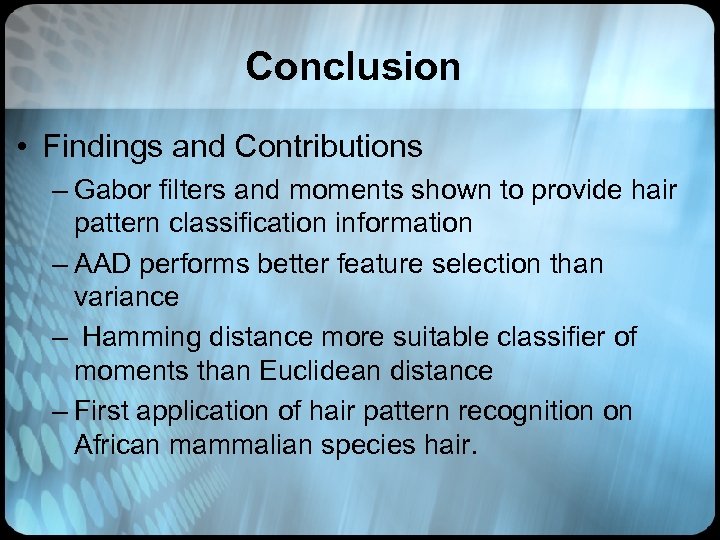 Conclusion • Findings and Contributions – Gabor filters and moments shown to provide hair pattern classification information – AAD performs better feature selection than variance – Hamming distance more suitable classifier of moments than Euclidean distance – First application of hair pattern recognition on African mammalian species hair.
 Questions • • • Manual Preparation Work Sensor Feature extraction Feature Selection Classifier Design Results