


 Скачать презентацию Image and Video Compression Lecture 12 April 28
e89595733a4c8d0199e59e14ead72d38.ppt
- Количество слайдов: 77
 Image and Video Compression Lecture 12, April 28 th, 2008 Lexing Xie EE 4830 Digital Image Processing http: //www. ee. columbia. edu/~xlx/ee 4830/ material sources: David Mc. Kay’s book, Min Wu (UMD), Yao Wang (poly tech), … 1
 Announcements n Evaluations on Course. Works n n please fill in and let us know what you think the last HW – #6, due next Monday n you can choose between doing by hand or simple programming for problem 1 and problem 3 2
 outline n n image/video compression: what and why source coding basics n n compression systems and standards n n n basic idea symbol codes stream codes system standards and quality measures image coding JPEG video coding and MPEG audio coding (mp 3) vs. image coding summary 3
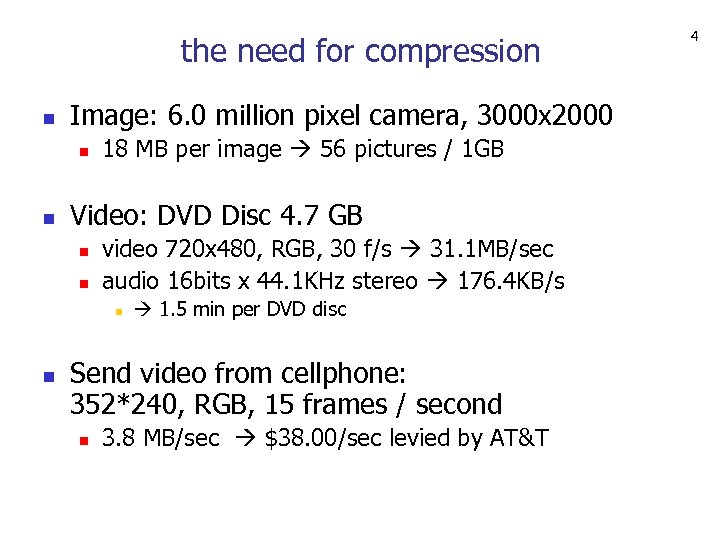 the need for compression n Image: 6. 0 million pixel camera, 3000 x 2000 n n 18 MB per image 56 pictures / 1 GB Video: DVD Disc 4. 7 GB n n video 720 x 480, RGB, 30 f/s 31. 1 MB/sec audio 16 bits x 44. 1 KHz stereo 176. 4 KB/s n n 1. 5 min per DVD disc Send video from cellphone: 352*240, RGB, 15 frames / second n 3. 8 MB/sec $38. 00/sec levied by AT&T 4
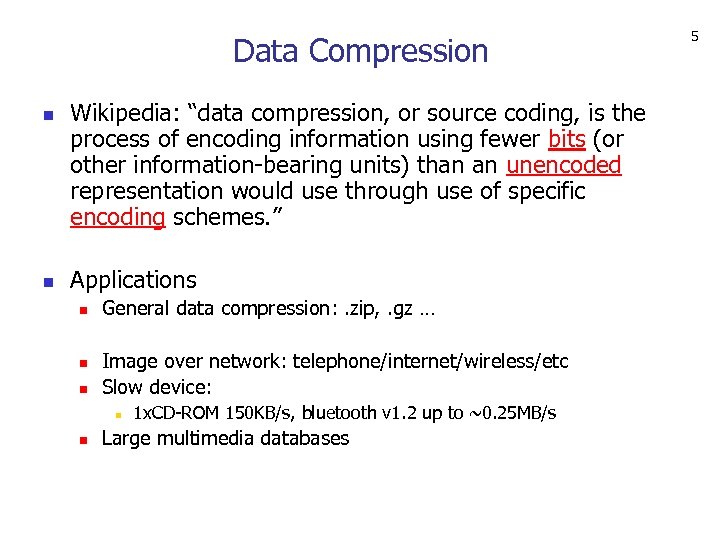 Data Compression n n Wikipedia: “data compression, or source coding, is the process of encoding information using fewer bits (or other information-bearing units) than an unencoded representation would use through use of specific encoding schemes. ” Applications n n n General data compression: . zip, . gz … Image over network: telephone/internet/wireless/etc Slow device: n n 1 x. CD-ROM 150 KB/s, bluetooth v 1. 2 up to ~0. 25 MB/s Large multimedia databases 5
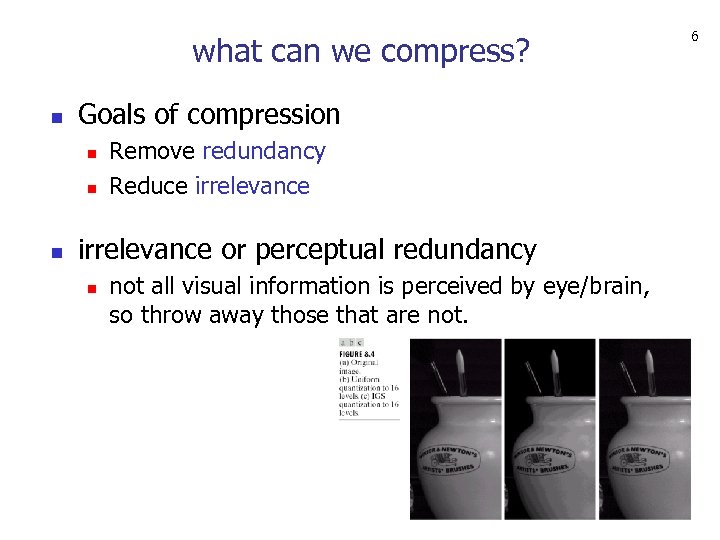 what can we compress? n Goals of compression n Remove redundancy Reduce irrelevance or perceptual redundancy n not all visual information is perceived by eye/brain, so throw away those that are not. 6
 what can we compress? n Goals of compression n Remove redundancy Reduce irrelevance redundant : exceeding what is necessary or normal n symbol redundancy n n the common and uncommon values cost the same to store spatial and temporal redundancy n adjacent pixels are highly correlated. 7
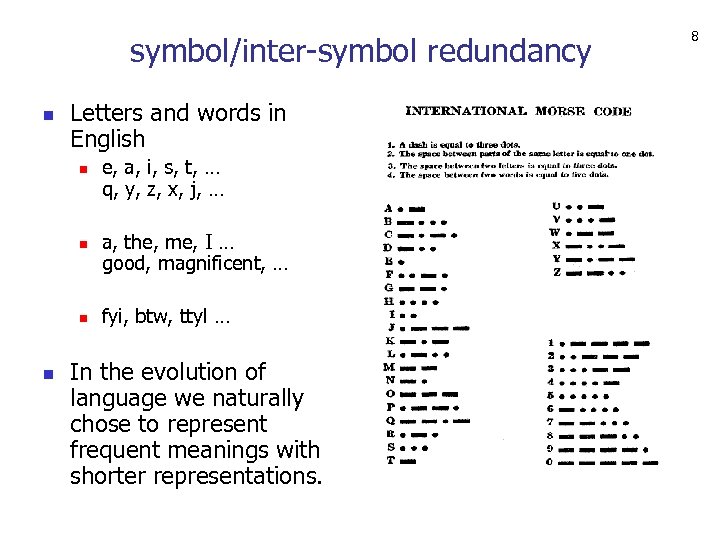 symbol/inter-symbol redundancy n Letters and words in English n n e, a, i, s, t, … q, y, z, x, j, … a, the, me, I … good, magnificent, … fyi, btw, ttyl … In the evolution of language we naturally chose to represent frequent meanings with shorter representations. 8
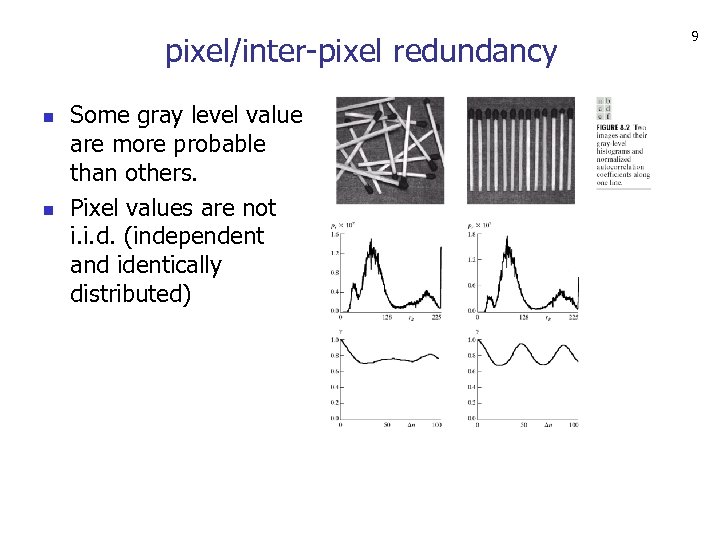 pixel/inter-pixel redundancy n n Some gray level value are more probable than others. Pixel values are not i. i. d. (independent and identically distributed) 9
 modes of compression n Lossless n n n preserve all information, perfectly recoverable examples: morse code, zip/gz Lossy n n throw away perceptually insignificant information cannot recover all bits 10
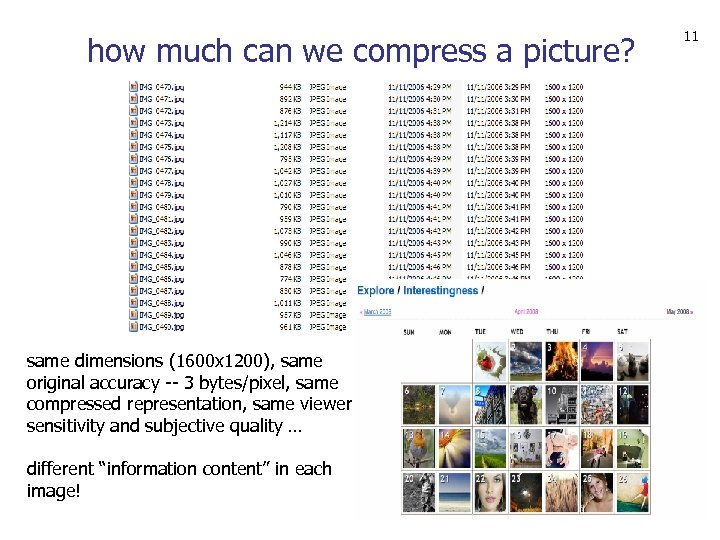 how much can we compress a picture? same dimensions (1600 x 1200), same original accuracy -- 3 bytes/pixel, same compressed representation, same viewer sensitivity and subjective quality … different “information content” in each image! 11
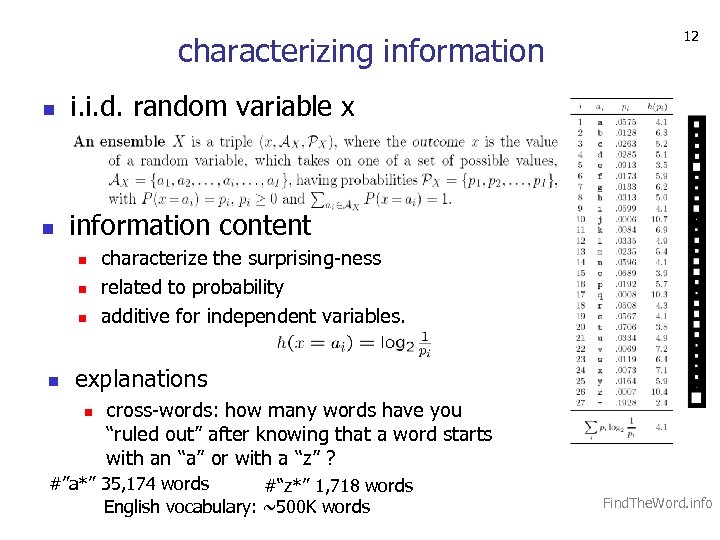 characterizing information n i. i. d. random variable x n 12 information content n n characterize the surprising-ness related to probability additive for independent variables. explanations n cross-words: how many words have you “ruled out” after knowing that a word starts with an “a” or with a “z” ? #”a*” 35, 174 words #“z*” 1, 718 words English vocabulary: ~500 K words Find. The. Word. info
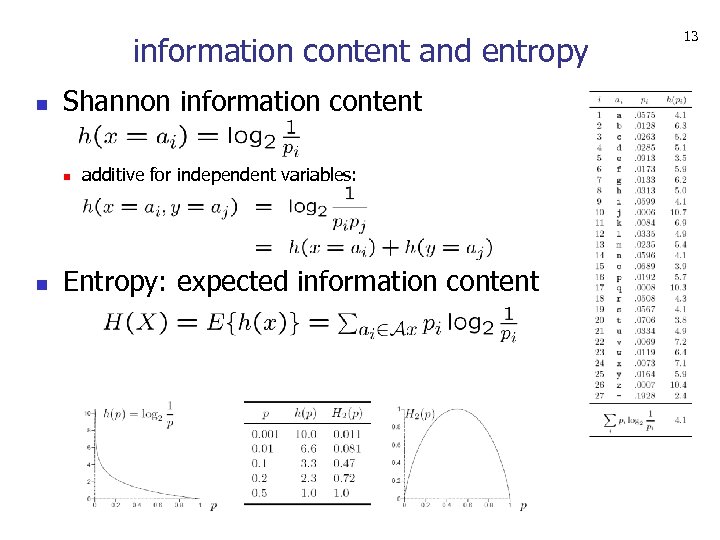 information content and entropy n Shannon information content n n additive for independent variables: Entropy: expected information content 13
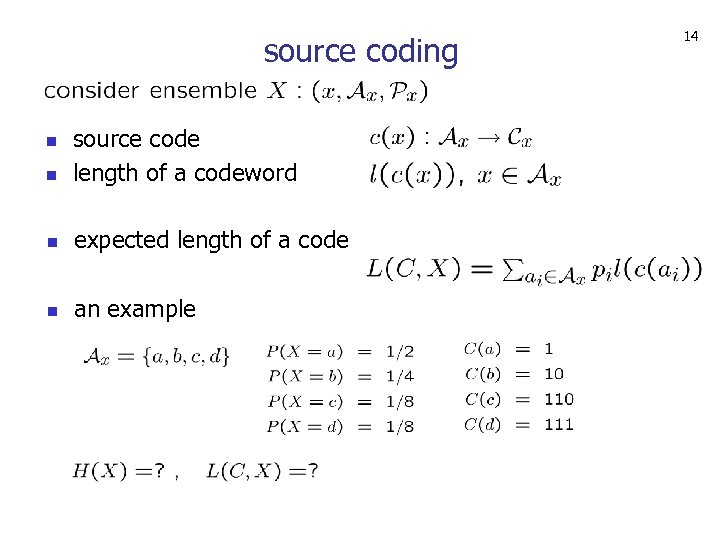 source coding n source code length of a codeword n expected length of a code n an example n 14
![15 source coding theorem informal shorthand: [Shannon 1948]](https://present5.com/presentation/e89595733a4c8d0199e59e14ead72d38/image-15.jpg "15 source coding theorem informal shorthand: [Shannon 1948]") 15 source coding theorem informal shorthand: [Shannon 1948]
15 source coding theorem informal shorthand: [Shannon 1948]
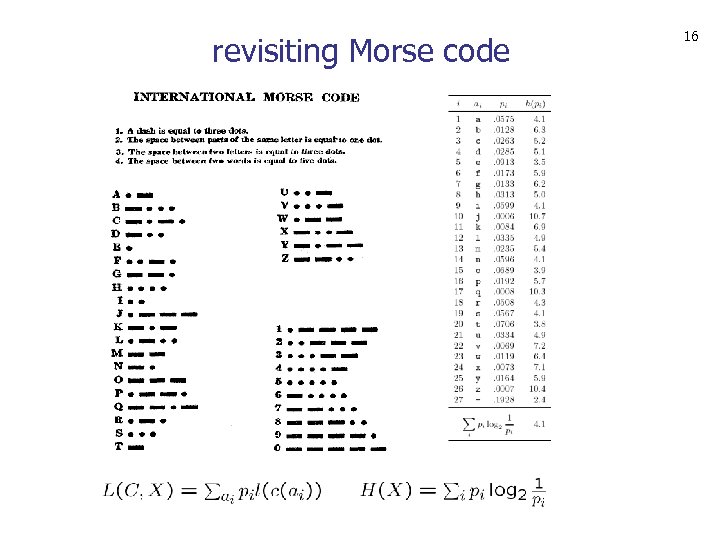 revisiting Morse code 16
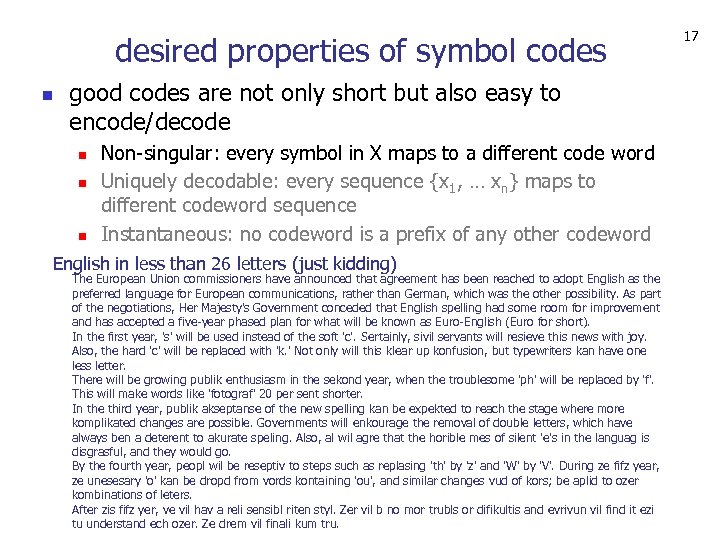 desired properties of symbol codes n good codes are not only short but also easy to encode/decode n n n Non-singular: every symbol in X maps to a different code word Uniquely decodable: every sequence {x 1, … xn} maps to different codeword sequence Instantaneous: no codeword is a prefix of any other codeword English in less than 26 letters (just kidding) The European Union commissioners have announced that agreement has been reached to adopt English as the preferred language for European communications, rather than German, which was the other possibility. As part of the negotiations, Her Majesty's Government conceded that English spelling had some room for improvement and has accepted a five-year phased plan for what will be known as Euro-English (Euro for short). In the first year, 's' will be used instead of the soft 'c'. Sertainly, sivil servants will resieve this news with joy. Also, the hard 'c' will be replaced with 'k. ' Not only will this klear up konfusion, but typewriters kan have one less letter. There will be growing publik enthusiasm in the sekond year, when the troublesome 'ph' will be replaced by 'f'. This will make words like 'fotograf' 20 per sent shorter. In the third year, publik akseptanse of the new spelling kan be expekted to reach the stage where more komplikated changes are possible. Governments will enkourage the removal of double letters, which have always ben a deterent to akurate speling. Also, al wil agre that the horible mes of silent 'e's in the languag is disgrasful, and they would go. By the fourth year, peopl wil be reseptiv to steps such as replasing 'th' by 'z' and 'W' by 'V'. During ze fifz year, ze unesesary 'o' kan be dropd from vords kontaining 'ou', and similar changes vud of kors; be aplid to ozer kombinations of leters. After zis fifz yer, ve vil hav a reli sensibl riten styl. Zer vil b no mor trubls or difikultis and evrivun vil find it ezi tu understand ech ozer. Ze drem vil finali kum tru. 17
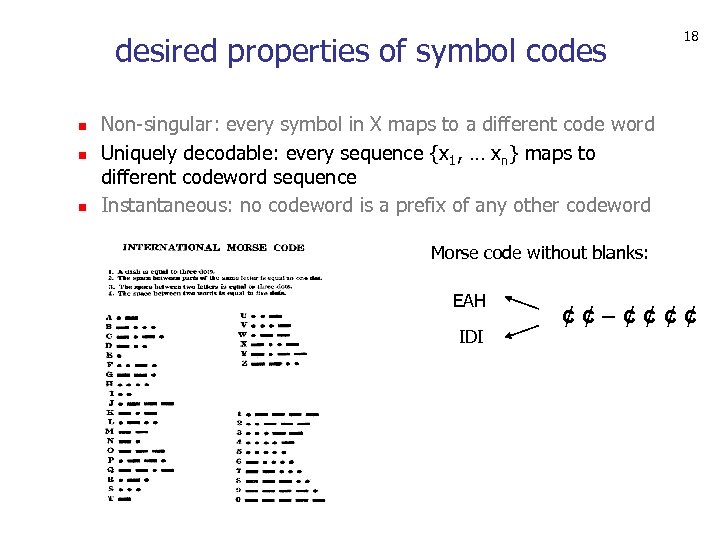 desired properties of symbol codes n n n 18 Non-singular: every symbol in X maps to a different code word Uniquely decodable: every sequence {x 1, … xn} maps to different codeword sequence Instantaneous: no codeword is a prefix of any other codeword Morse code without blanks: EAH IDI ¢¢ ¢¢¢¢
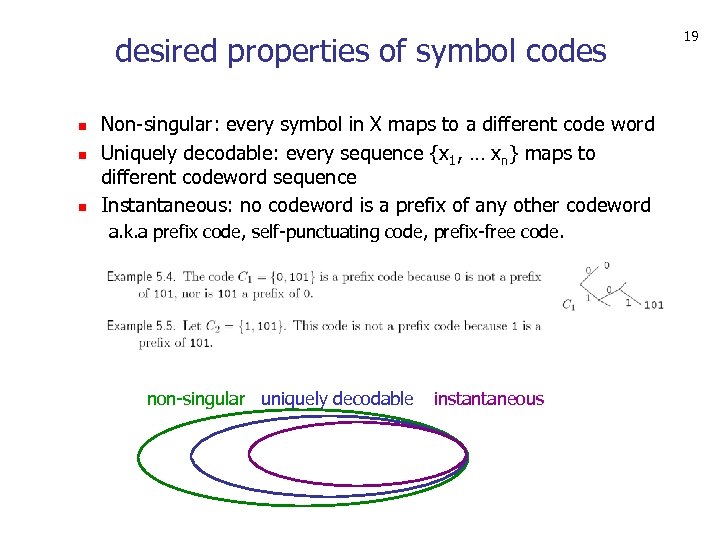 desired properties of symbol codes n n n Non-singular: every symbol in X maps to a different code word Uniquely decodable: every sequence {x 1, … xn} maps to different codeword sequence Instantaneous: no codeword is a prefix of any other codeword a. k. a prefix code, self-punctuating code, prefix-free code. non-singular uniquely decodable instantaneous 19
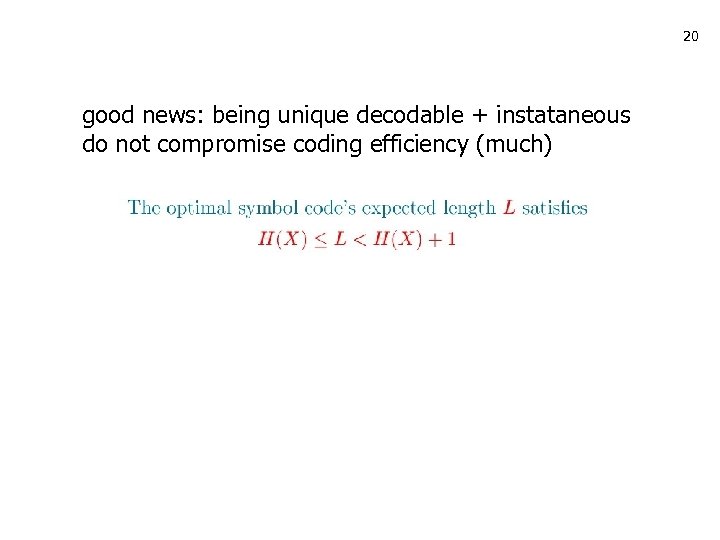 20 good news: being unique decodable + instataneous do not compromise coding efficiency (much)
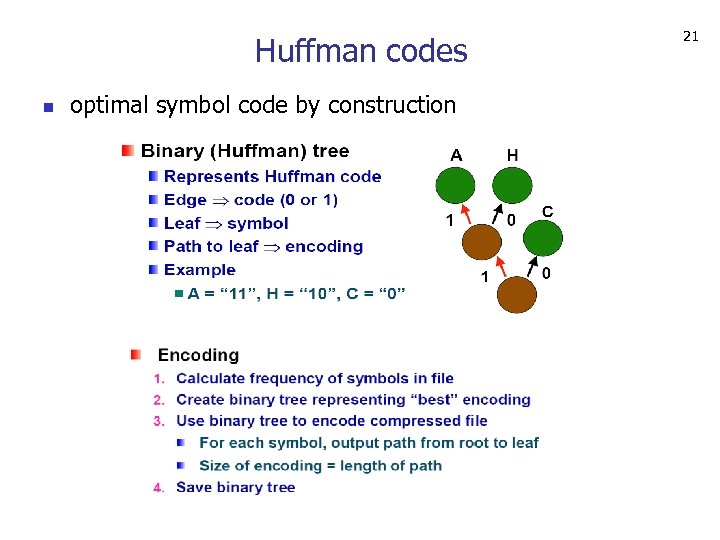 Huffman codes n optimal symbol code by construction 21
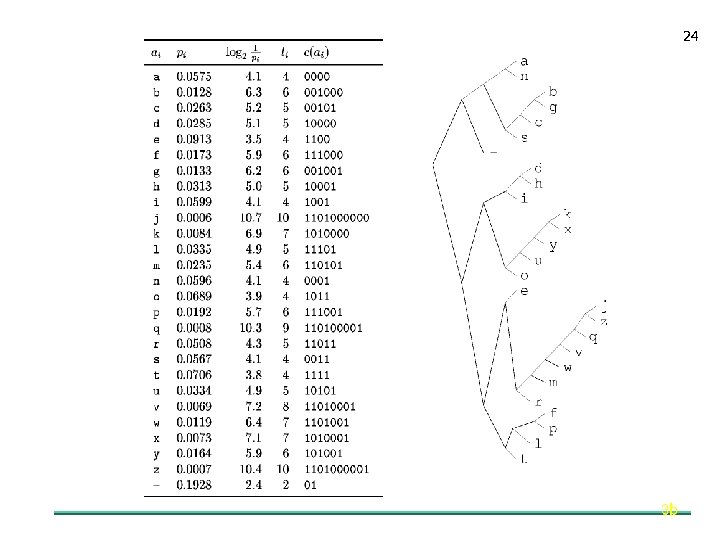
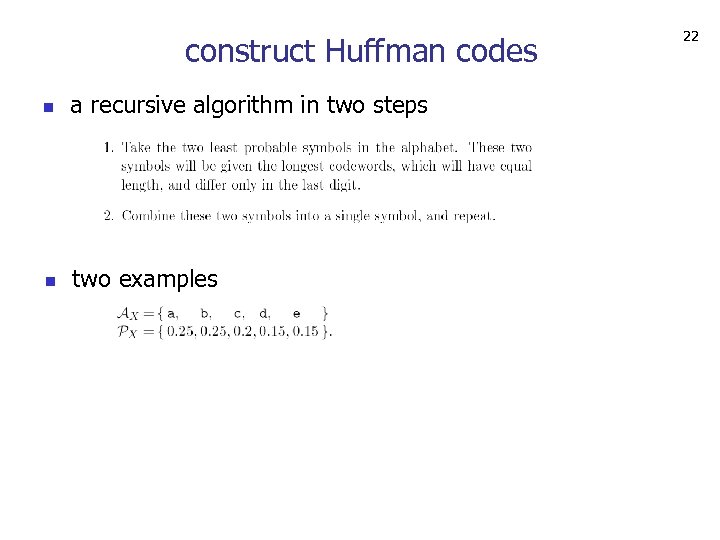 construct Huffman codes n a recursive algorithm in two steps n two examples 22
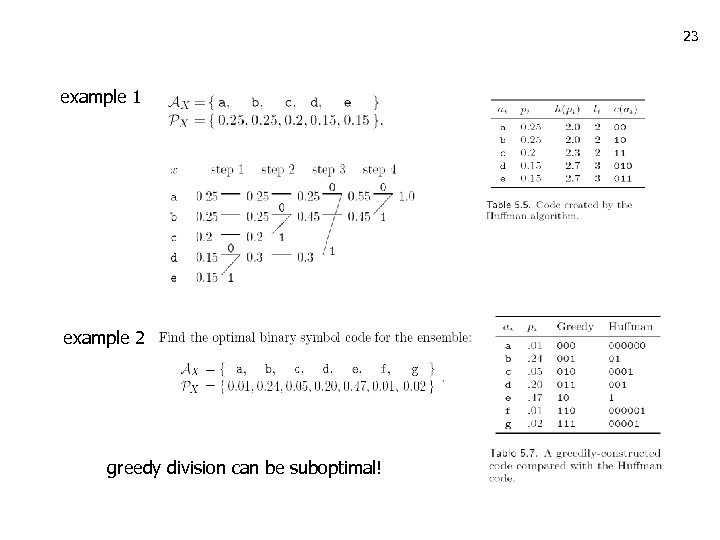 23 example 1 example 2 greedy division can be suboptimal!
 24
24
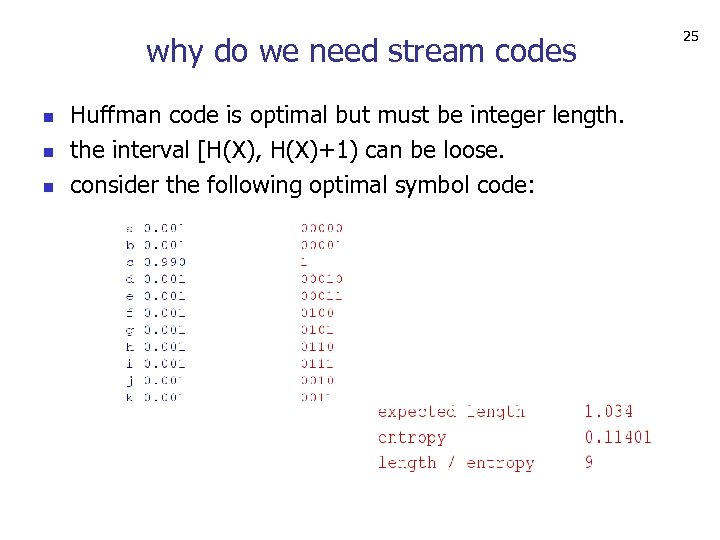 why do we need stream codes n n n Huffman code is optimal but must be integer length. the interval [H(X), H(X)+1) can be loose. consider the following optimal symbol code: 25
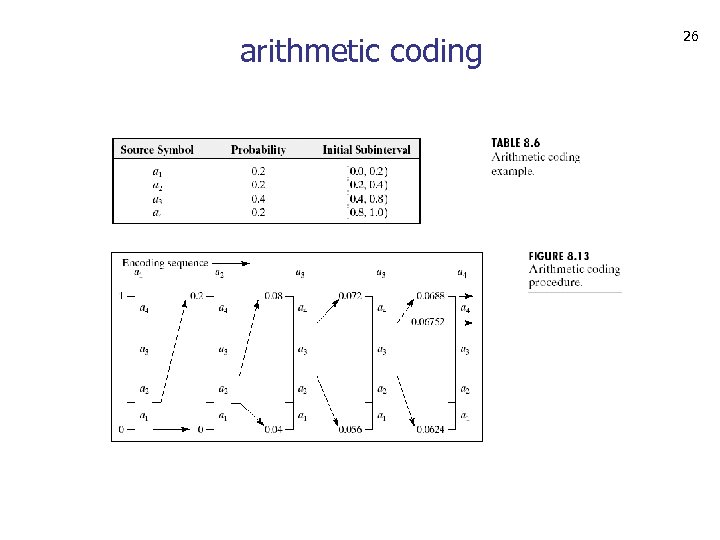 arithmetic coding 26
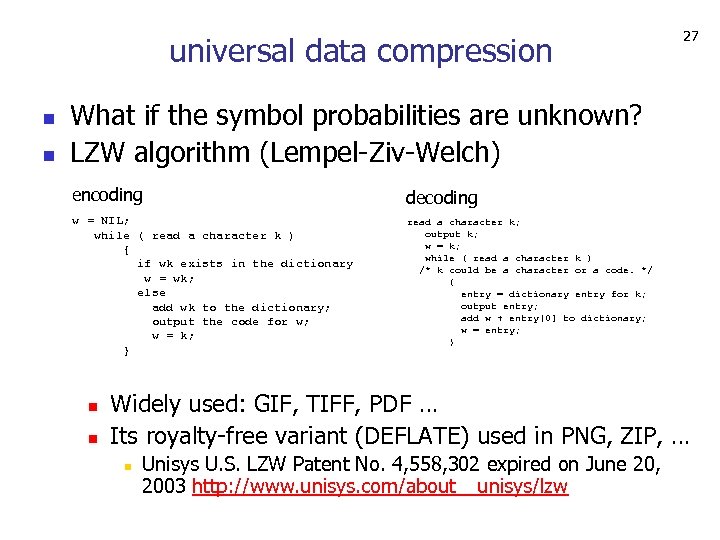 universal data compression n n 27 What if the symbol probabilities are unknown? LZW algorithm (Lempel-Ziv-Welch) encoding decoding w = NIL; while ( read a character k ) { if wk exists in the dictionary w = wk; else add wk to the dictionary; output the code for w; w = k; } read a character k; output k; w = k; while ( read a character k ) /* k could be a character or a code. */ { entry = dictionary entry for k; output entry; add w + entry[0] to dictionary; w = entry; } n n Widely used: GIF, TIFF, PDF … Its royalty-free variant (DEFLATE) used in PNG, ZIP, … n Unisys U. S. LZW Patent No. 4, 558, 302 expired on June 20, 2003 http: //www. unisys. com/about__unisys/lzw
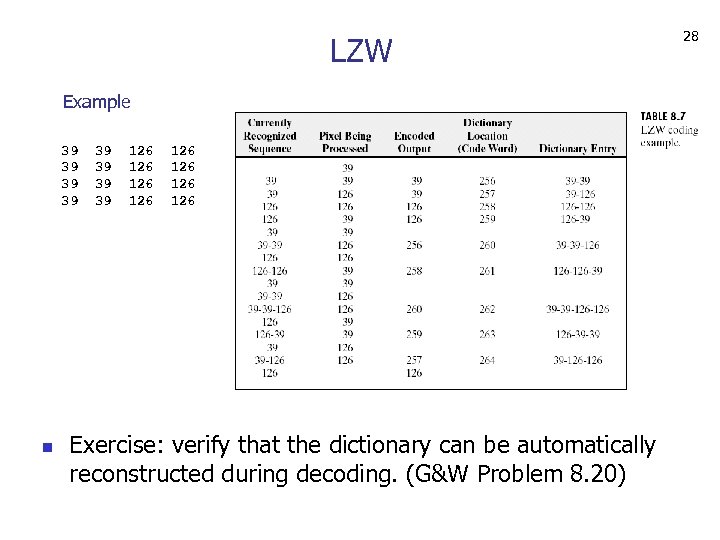 LZW Example 39 39 n 39 39 126 126 Exercise: verify that the dictionary can be automatically reconstructed during decoding. (G&W Problem 8. 20) 28
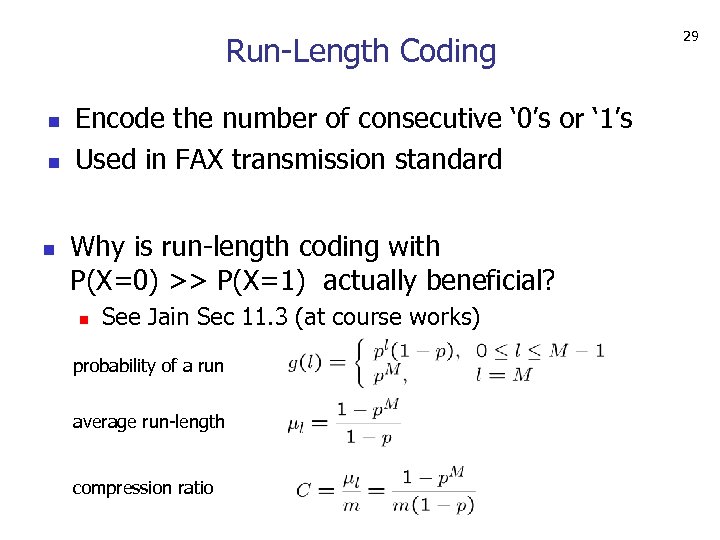 Run-Length Coding n n n Encode the number of consecutive ‘ 0’s or ‘ 1’s Used in FAX transmission standard Why is run-length coding with P(X=0) >> P(X=1) actually beneficial? n See Jain Sec 11. 3 (at course works) probability of a run average run-length compression ratio 29
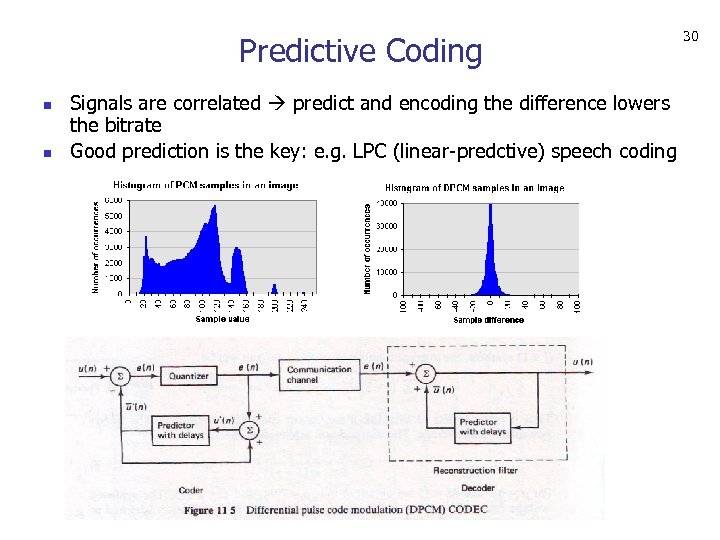 Predictive Coding n n Signals are correlated predict and encoding the difference lowers the bitrate Good prediction is the key: e. g. LPC (linear-predctive) speech coding 30
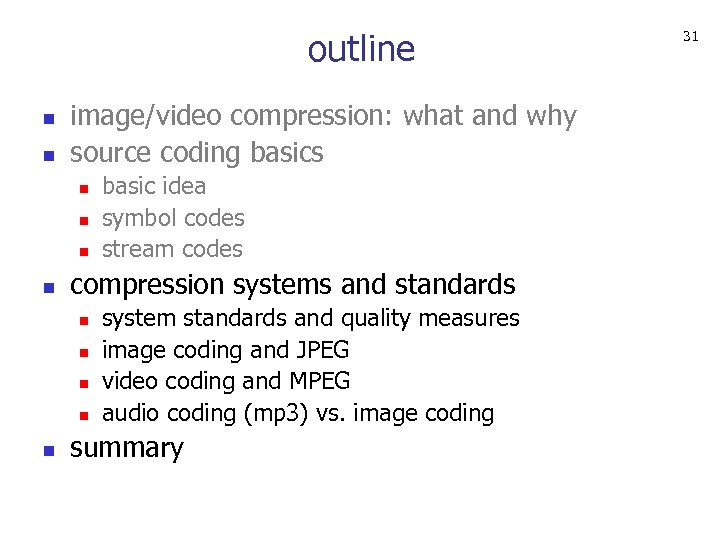 outline n n image/video compression: what and why source coding basics n n compression systems and standards n n n basic idea symbol codes stream codes system standards and quality measures image coding and JPEG video coding and MPEG audio coding (mp 3) vs. image coding summary 31
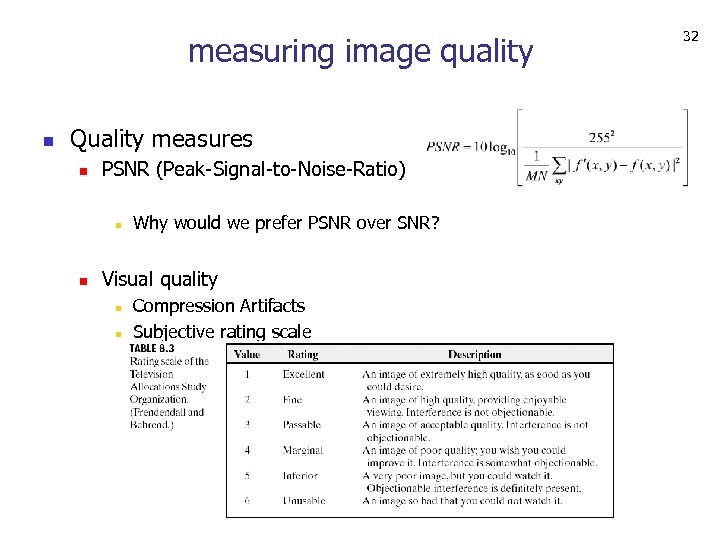 measuring image quality n Quality measures n PSNR (Peak-Signal-to-Noise-Ratio) n n Why would we prefer PSNR over SNR? Visual quality n n Compression Artifacts Subjective rating scale 32
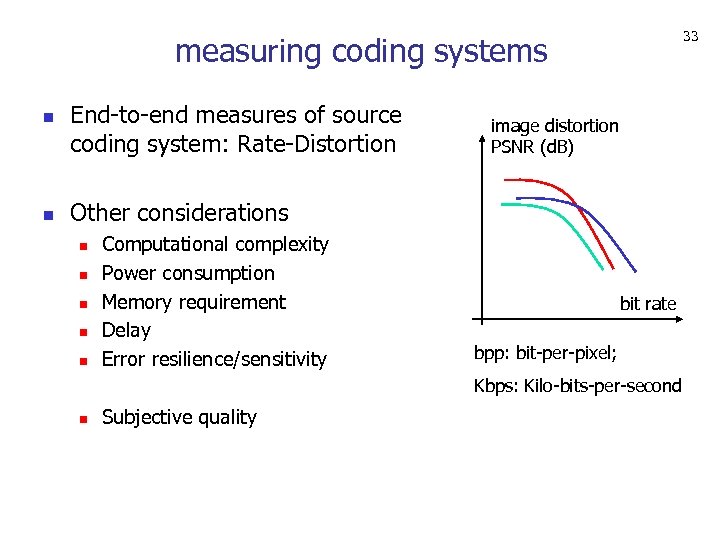 33 measuring coding systems n n End-to-end measures of source coding system: Rate-Distortion image distortion PSNR (d. B) Other considerations n n n Computational complexity Power consumption Memory requirement Delay Error resilience/sensitivity bit rate bpp: bit-per-pixel; Kbps: Kilo-bits-per-second n Subjective quality
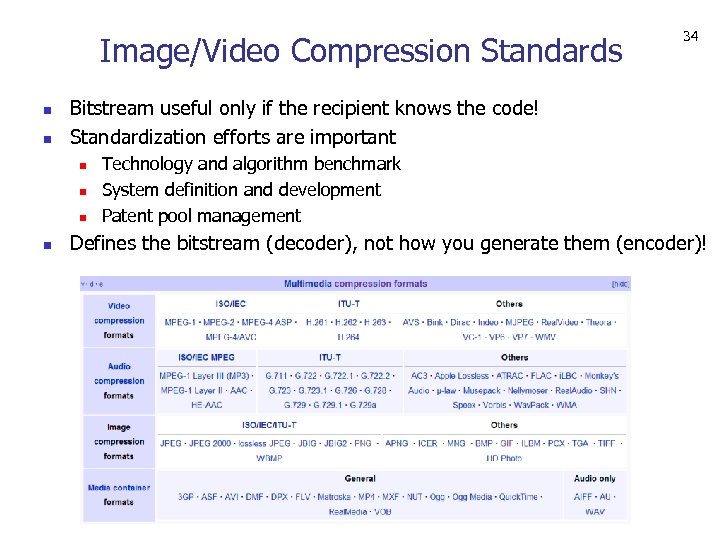 Image/Video Compression Standards n n Bitstream useful only if the recipient knows the code! Standardization efforts are important n n 34 Technology and algorithm benchmark System definition and development Patent pool management Defines the bitstream (decoder), not how you generate them (encoder)!
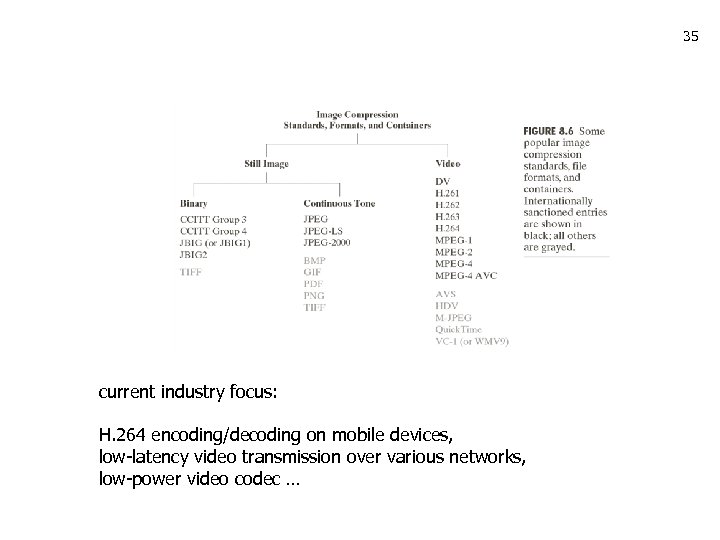 35 current industry focus: H. 264 encoding/decoding on mobile devices, low-latency video transmission over various networks, low-power video codec …
 36
36
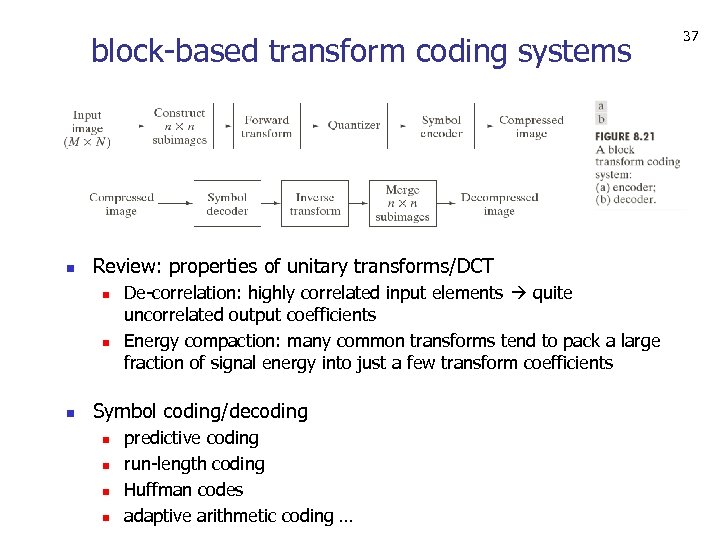 block-based transform coding systems n Review: properties of unitary transforms/DCT n n n De-correlation: highly correlated input elements quite uncorrelated output coefficients Energy compaction: many common transforms tend to pack a large fraction of signal energy into just a few transform coefficients Symbol coding/decoding n n predictive coding run-length coding Huffman codes adaptive arithmetic coding … 37
 JPEG compression standard (early 1990 s) n JPEG - Joint Photographic Experts Group n n n Compression standard of generic continuous-tone still image Became an international standard in 1992 Allow for lossy and lossless encoding of still images n Part-1 DCT-based lossy compression n average compression ratio 15: 1 Part-2 Predictive-based lossless compression Sequential, Progressive, Hierarchical modes n n n Sequential: encoded in a single left-to-right, top-to-bottom scan Progressive: encoded in multiple scans to first produce a quick, rough decoded image when the transmission time is long Hierarchical: encoded at multiple resolution to allow accessing low resolution without full decompression 38
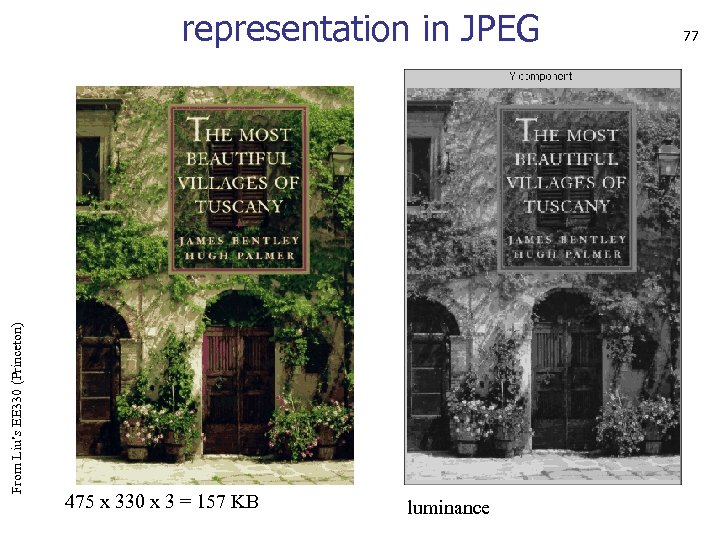
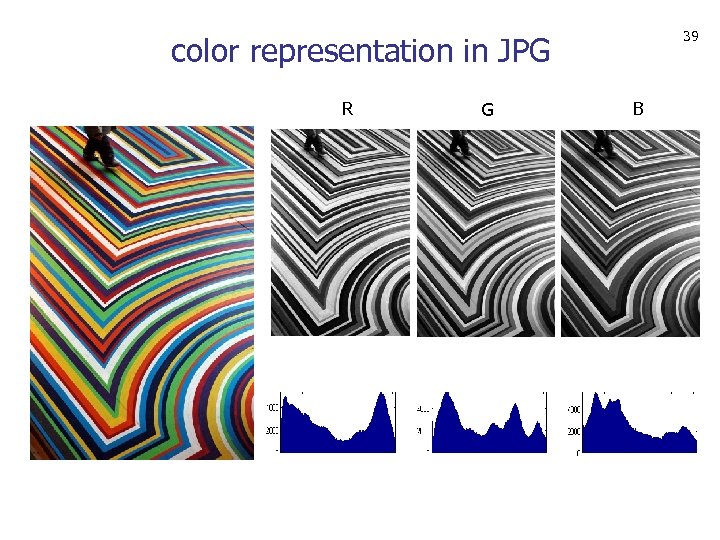 39 color representation in JPG R G B
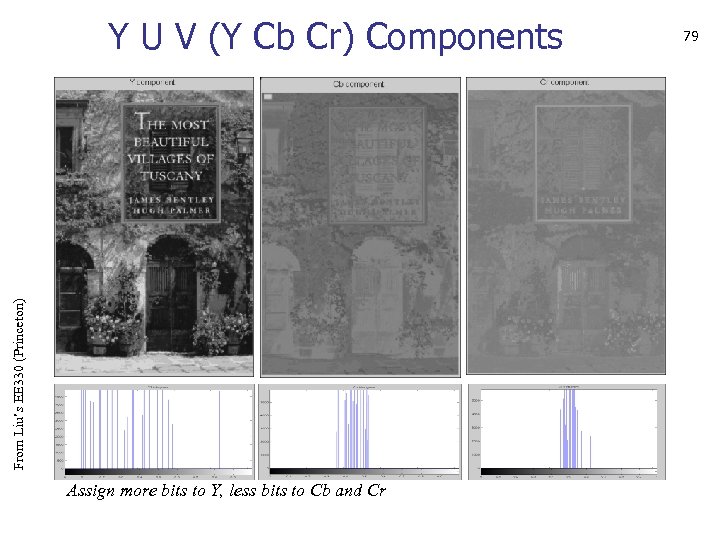
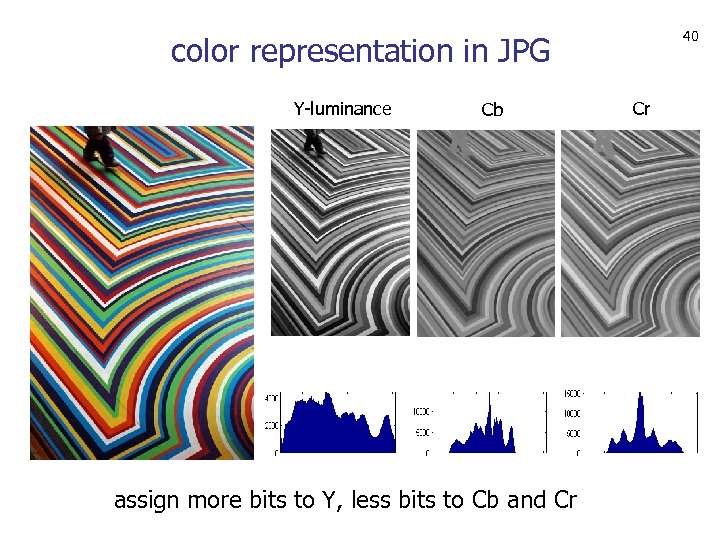 40 color representation in JPG Y-luminance Cb assign more bits to Y, less bits to Cb and Cr Cr
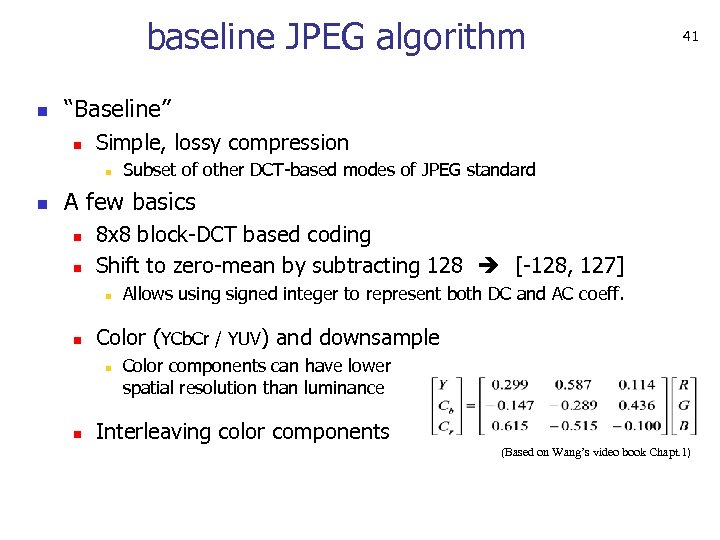 baseline JPEG algorithm n “Baseline” n Simple, lossy compression n n 41 Subset of other DCT-based modes of JPEG standard A few basics n n 8 x 8 block-DCT based coding Shift to zero-mean by subtracting 128 [-128, 127] n n Color (YCb. Cr / YUV) and downsample n n Allows using signed integer to represent both DC and AC coeff. Color components can have lower spatial resolution than luminance Interleaving color components (Based on Wang’s video book Chapt. 1)
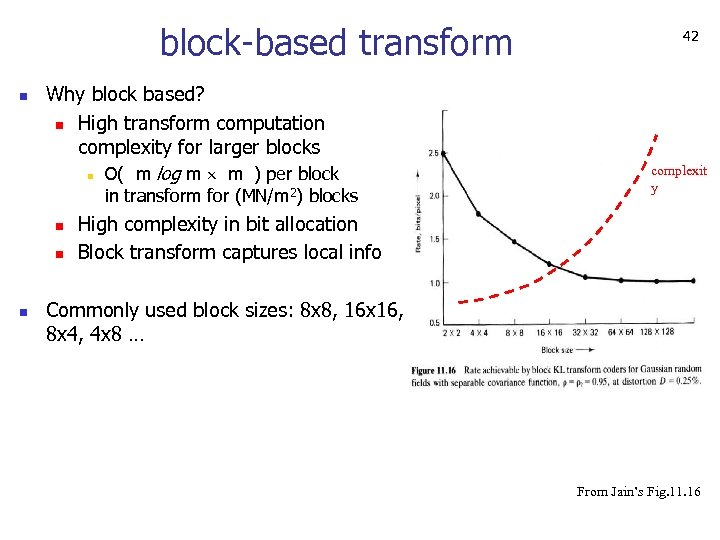 block-based transform n Why block based? n High transform computation complexity for larger blocks n O( m log m m ) per block in transform for (MN/m 2) blocks n n n 42 complexit y High complexity in bit allocation Block transform captures local info Commonly used block sizes: 8 x 8, 16 x 16, 8 x 4, 4 x 8 … From Jain’s Fig. 11. 16
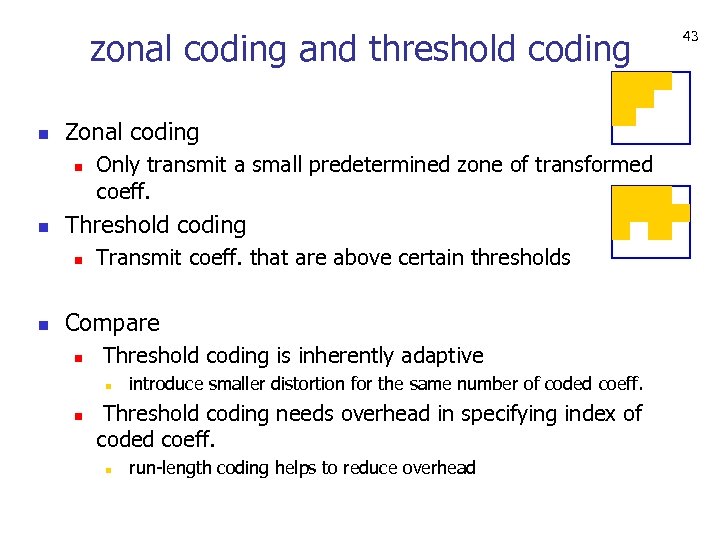 zonal coding and threshold coding n Zonal coding n n Threshold coding n n Only transmit a small predetermined zone of transformed coeff. Transmit coeff. that are above certain thresholds Compare n Threshold coding is inherently adaptive n n introduce smaller distortion for the same number of coded coeff. Threshold coding needs overhead in specifying index of coded coeff. n run-length coding helps to reduce overhead 43
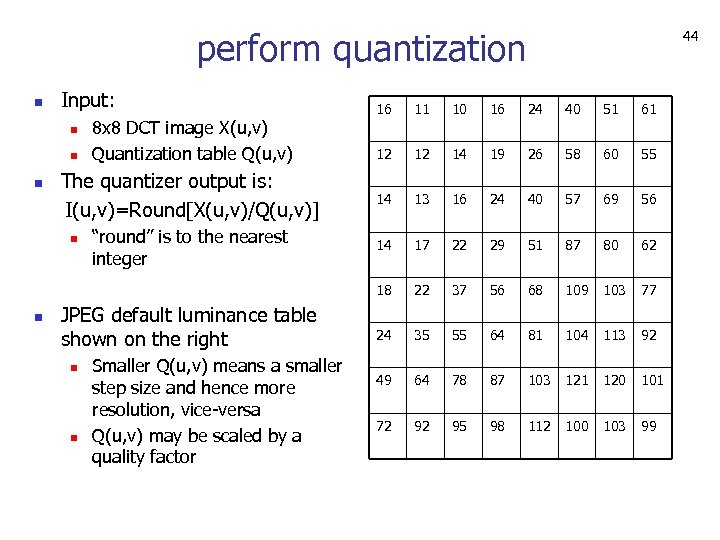 perform quantization n Input: 44 16 11 10 16 24 40 51 61 12 12 14 19 26 58 60 55 The quantizer output is: I(u, v)=Round[X(u, v)/Q(u, v)] 14 13 16 24 40 57 69 56 “round” is to the nearest integer 14 17 22 29 51 87 80 62 18 22 37 56 68 109 103 77 24 35 55 64 81 104 113 92 49 64 78 87 103 121 120 101 72 92 95 98 112 100 103 99 n n n 8 x 8 DCT image X(u, v) Quantization table Q(u, v) JPEG default luminance table shown on the right n n Smaller Q(u, v) means a smaller step size and hence more resolution, vice-versa Q(u, v) may be scaled by a quality factor
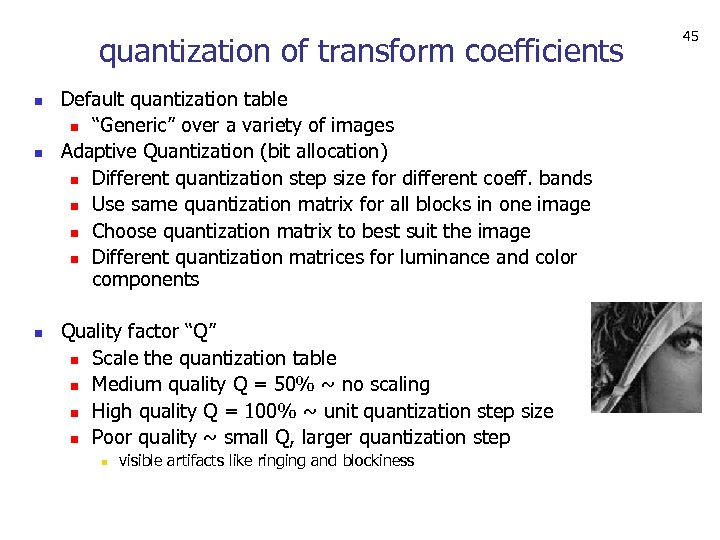 quantization of transform coefficients n n n Default quantization table n “Generic” over a variety of images Adaptive Quantization (bit allocation) n Different quantization step size for different coeff. bands n Use same quantization matrix for all blocks in one image n Choose quantization matrix to best suit the image n Different quantization matrices for luminance and color components Quality factor “Q” n Scale the quantization table n Medium quality Q = 50% ~ no scaling n High quality Q = 100% ~ unit quantization step size n Poor quality ~ small Q, larger quantization step n visible artifacts like ringing and blockiness 45
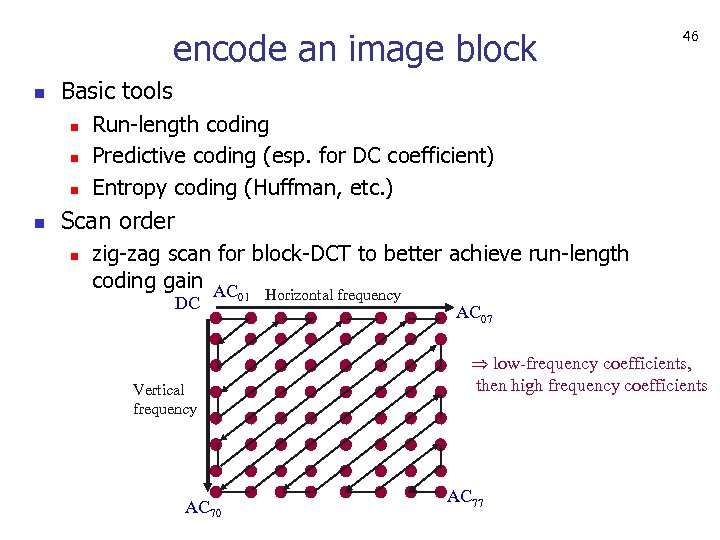 encode an image block n Basic tools n n 46 Run-length coding Predictive coding (esp. for DC coefficient) Entropy coding (Huffman, etc. ) Scan order n zig-zag scan for block-DCT to better achieve run-length coding gain AC DC Vertical frequency AC 70 01 Horizontal frequency AC 07 low-frequency coefficients, then high frequency coefficients AC 77
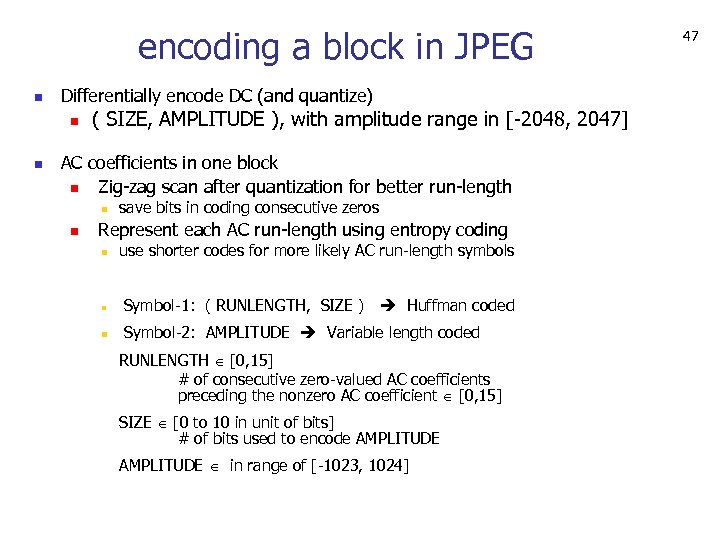 encoding a block in JPEG n Differentially encode DC (and quantize) n n ( SIZE, AMPLITUDE ), with amplitude range in [-2048, 2047] AC coefficients in one block n Zig-zag scan after quantization for better run-length n n save bits in coding consecutive zeros Represent each AC run-length using entropy coding n use shorter codes for more likely AC run-length symbols n Symbol-1: ( RUNLENGTH, SIZE ) Huffman coded n Symbol-2: AMPLITUDE Variable length coded RUNLENGTH [0, 15] # of consecutive zero-valued AC coefficients preceding the nonzero AC coefficient [0, 15] SIZE [0 to 10 in unit of bits] # of bits used to encode AMPLITUDE in range of [-1023, 1024] 47
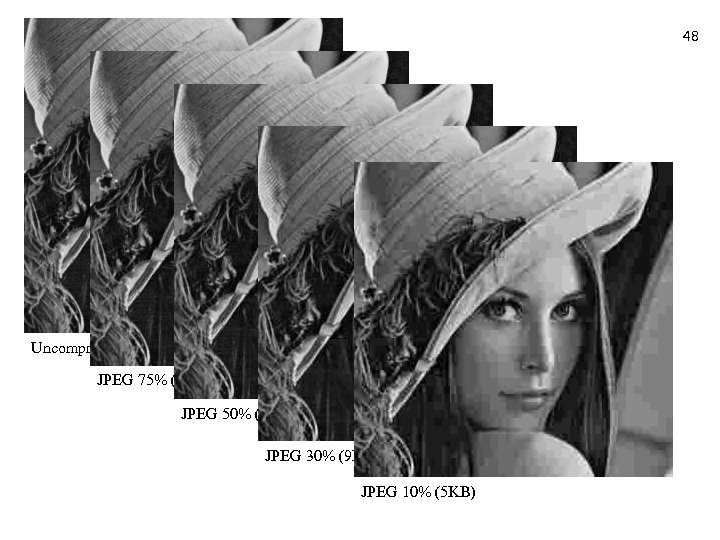 48 Uncompressed (100 KB) JPEG 75% (18 KB) JPEG 50% (12 KB) JPEG 30% (9 KB) JPEG 10% (5 KB)
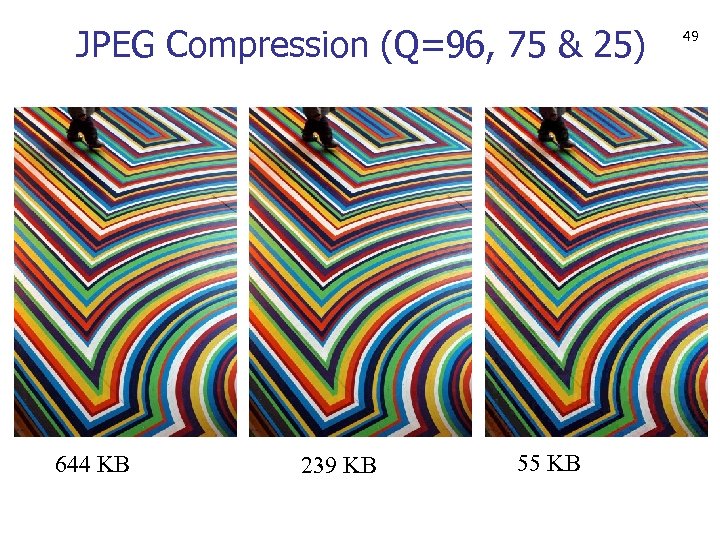 JPEG Compression (Q=96, 75 & 25) 644 KB 239 KB 55 KB 49
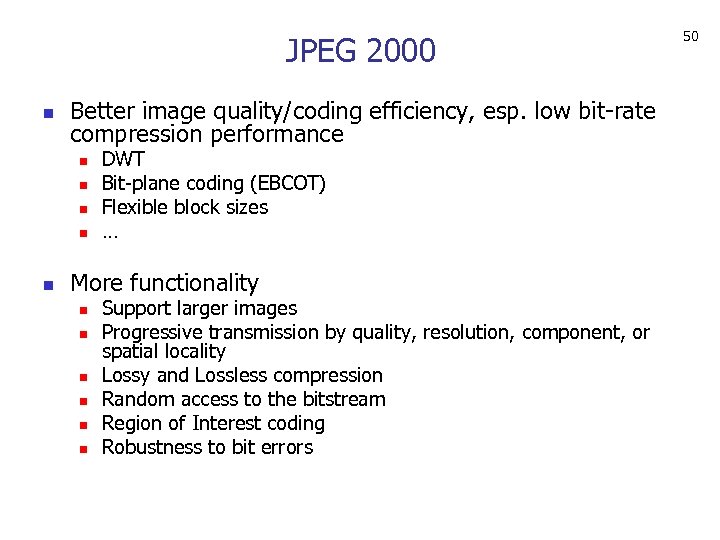 JPEG 2000 n Better image quality/coding efficiency, esp. low bit-rate compression performance n n n DWT Bit-plane coding (EBCOT) Flexible block sizes … More functionality n n n Support larger images Progressive transmission by quality, resolution, component, or spatial locality Lossy and Lossless compression Random access to the bitstream Region of Interest coding Robustness to bit errors 50
 Video ? = Motion Pictures n Capturing video n Frame by frame => image sequence n Image sequence: A 3 -D signal n n n 2 spatial dimensions & time dimension continuous I( x, y, t ) => discrete I( m, n, tk ) Encode digital video n Simplest way ~ compress each frame image individually n n n e. g. , “motion-JPEG” only spatial redundancy is explored and reduced How about temporal redundancy? Is differential coding good? n Pixel-by-pixel difference could still be large due to motion Need better prediction 51
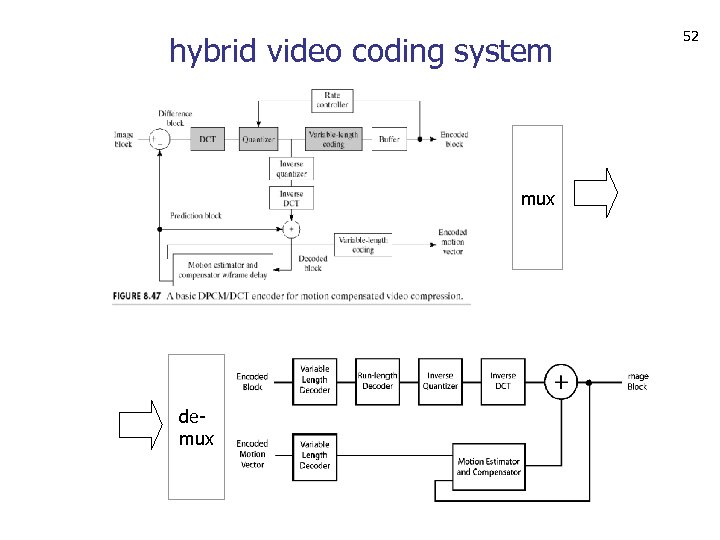 hybrid video coding system mux demux 52
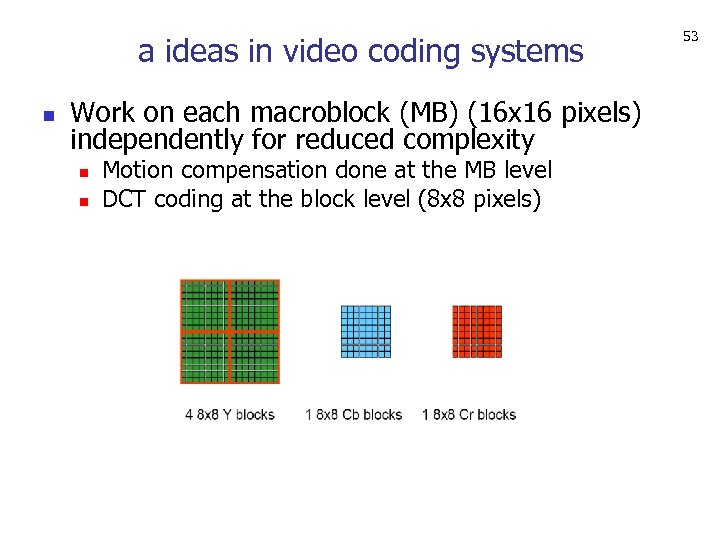 a ideas in video coding systems n Work on each macroblock (MB) (16 x 16 pixels) independently for reduced complexity n n Motion compensation done at the MB level DCT coding at the block level (8 x 8 pixels) 53
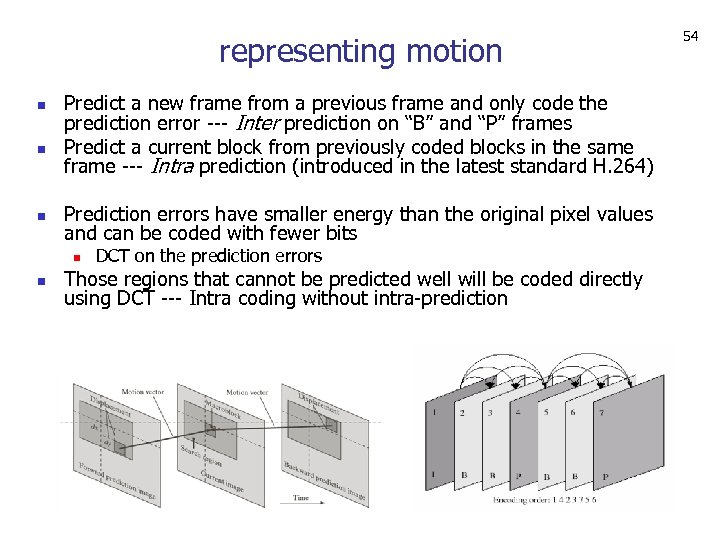 representing motion n Predict a new frame from a previous frame and only code the prediction error --- Inter prediction on “B” and “P” frames Predict a current block from previously coded blocks in the same frame --- Intra prediction (introduced in the latest standard H. 264) Prediction errors have smaller energy than the original pixel values and can be coded with fewer bits n n DCT on the prediction errors Those regions that cannot be predicted well will be coded directly using DCT --- Intra coding without intra-prediction 54
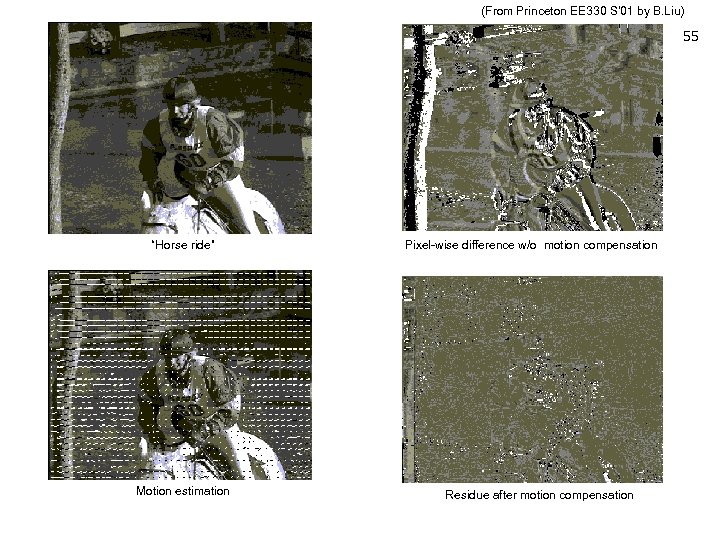 (From Princeton EE 330 S’ 01 by B. Liu) 55 “Horse ride” Motion estimation Pixel-wise difference w/o motion compensation Residue after motion compensation
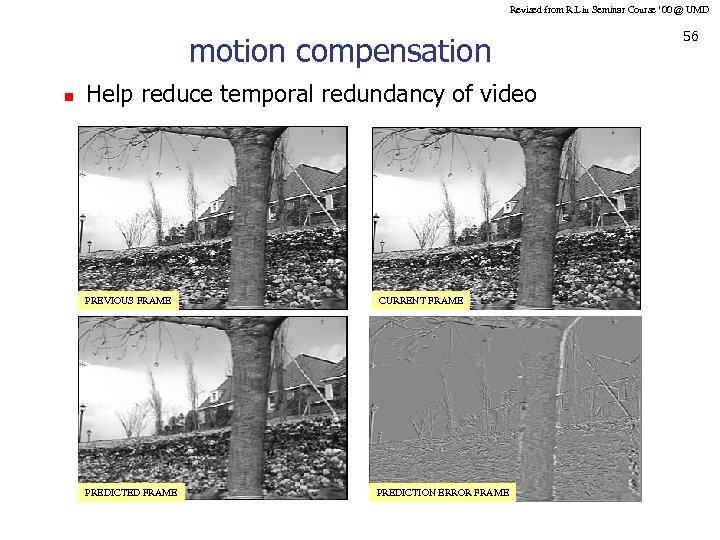 Revised from R. Liu Seminar Course ’ 00 @ UMD motion compensation n Help reduce temporal redundancy of video PREVIOUS FRAME CURRENT FRAME PREDICTED FRAME PREDICTION ERROR FRAME 56
 motion estimation n n Help understanding the content of image sequence Help reduce temporal redundancy of video n For compression Stabilizing video by detecting and removing small, noisy global motions n For building stabilizer in camcorder A hard problem in general! 57
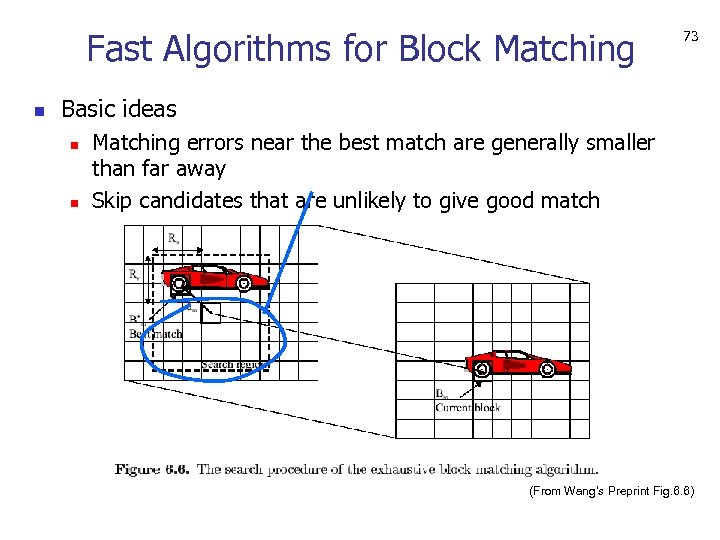
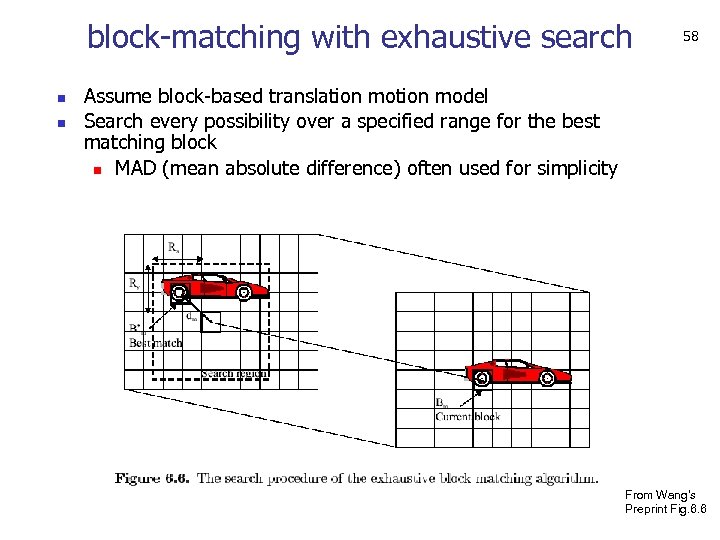 block-matching with exhaustive search n n 58 Assume block-based translation model Search every possibility over a specified range for the best matching block n MAD (mean absolute difference) often used for simplicity From Wang’s Preprint Fig. 6. 6
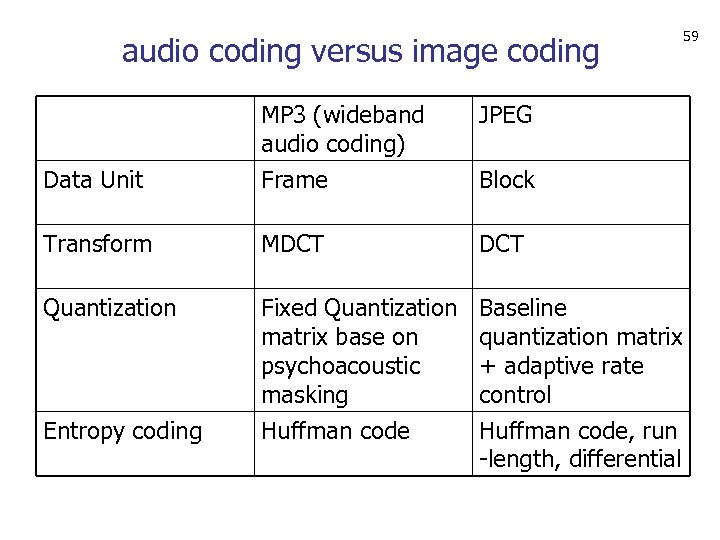 audio coding versus image coding JPEG Data Unit MP 3 (wideband audio coding) Frame Transform MDCT Quantization Fixed Quantization matrix base on psychoacoustic masking Baseline quantization matrix + adaptive rate control Entropy coding Huffman code, run -length, differential Block 59
 VC demo 60
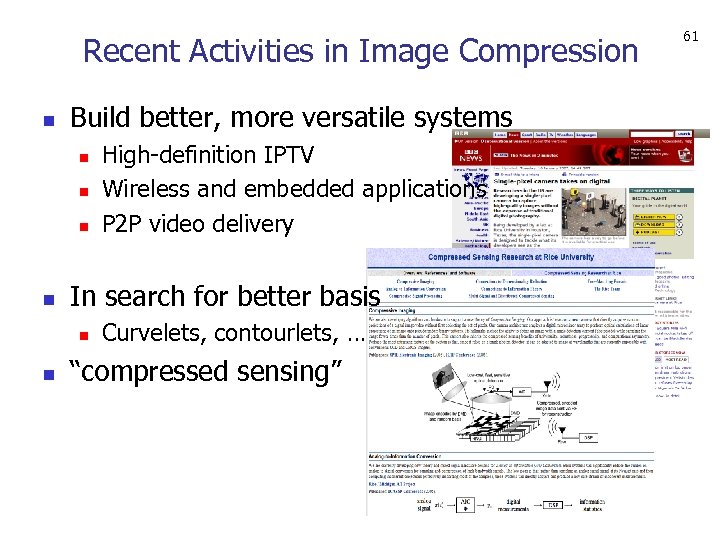 Recent Activities in Image Compression n Build better, more versatile systems n n In search for better basis n n High-definition IPTV Wireless and embedded applications P 2 P video delivery Curvelets, contourlets, … “compressed sensing” 61
 Summary n n The image/video compression problem Source coding n n Image/video compression systems n n n transform coding system for images hybrid coding system for video Readings n n n entropy, source coding theorem, criteria for good codes, huffman coding, stream codes and code for symbol sequences G&W 8. 1 -8. 2 (exclude 8. 2. 2) Mc. Kay book chapter 1, 5 http: //www. inference. phy. cam. ac. uk/mackay/itila/ Next time: reconstruction in medical imaging and multimedia indexing and retrieval 62
 63 http: //www. flickr. com/photos/jmhouse/2250089958/
 jpeg 2000 supplemental slides 64
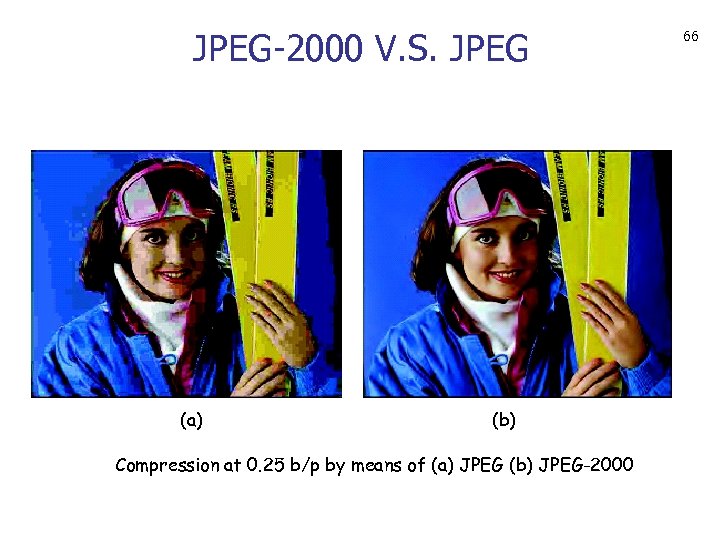 JPEG-2000 V. S. JPEG (a) (b) Compression at 0. 25 b/p by means of (a) JPEG (b) JPEG-2000 66
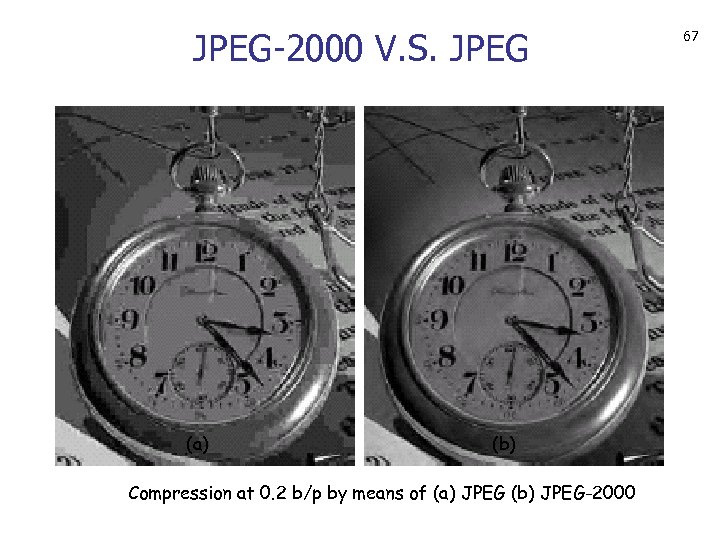 JPEG-2000 V. S. JPEG (a) (b) Compression at 0. 2 b/p by means of (a) JPEG (b) JPEG-2000 67
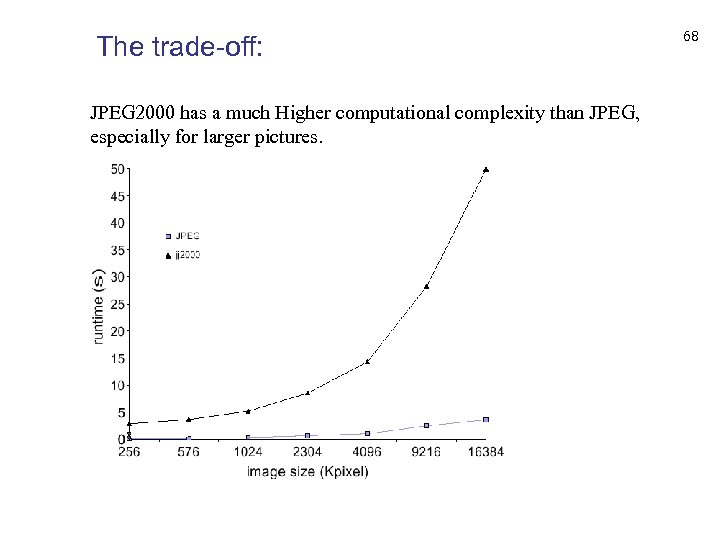 68 The trade-off: JPEG 2000 has a much Higher computational complexity than JPEG, especially for larger pictures. Need parallel implementation to reduce compression time.
 motion estimation supplemental slides 69
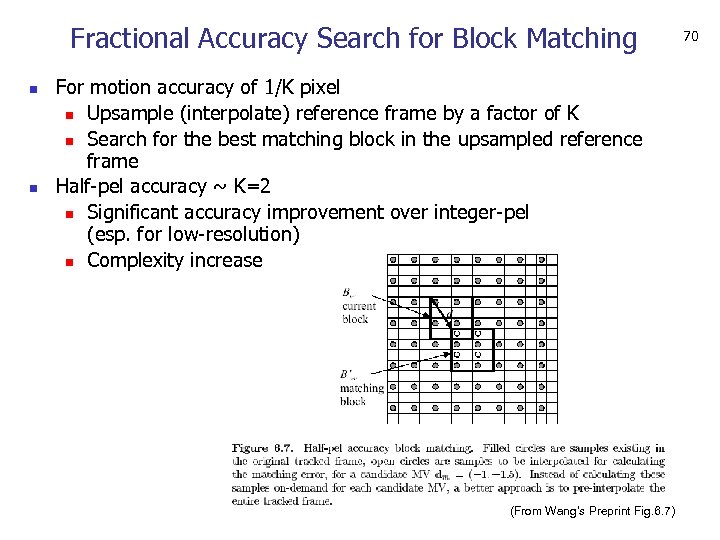 Fractional Accuracy Search for Block Matching n n For motion accuracy of 1/K pixel n Upsample (interpolate) reference frame by a factor of K n Search for the best matching block in the upsampled reference frame Half-pel accuracy ~ K=2 n Significant accuracy improvement over integer-pel (esp. for low-resolution) n Complexity increase (From Wang’s Preprint Fig. 6. 7) 70
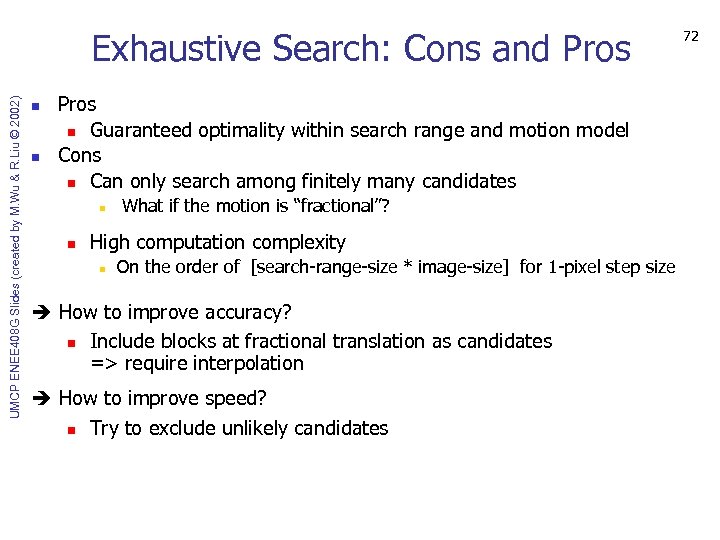
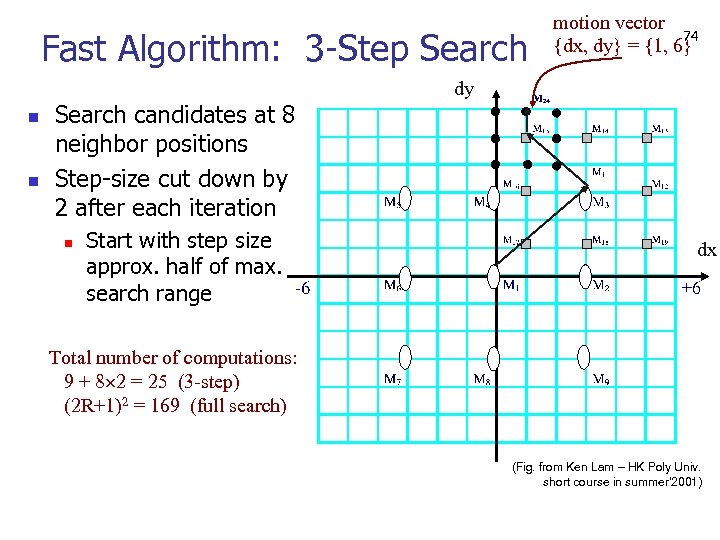
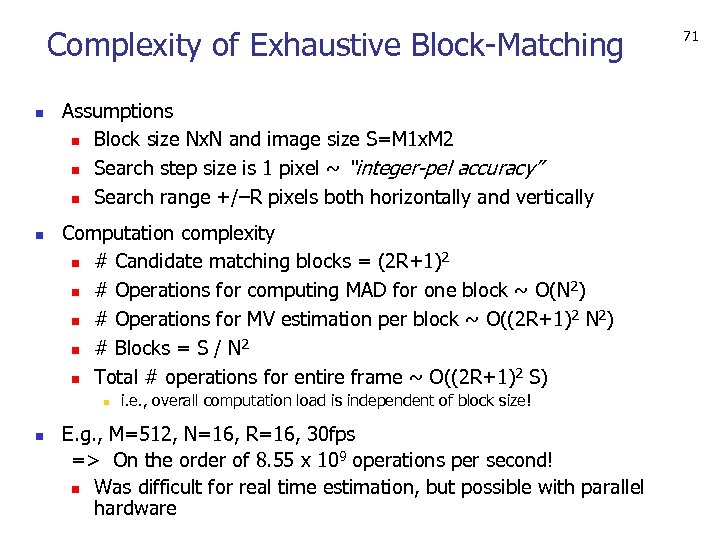 Complexity of Exhaustive Block-Matching n n Assumptions n Block size Nx. N and image size S=M 1 x. M 2 n Search step size is 1 pixel ~ “integer-pel accuracy” n Search range +/–R pixels both horizontally and vertically Computation complexity 2 n # Candidate matching blocks = (2 R+1) 2 n # Operations for computing MAD for one block ~ O(N ) 2 2 n # Operations for MV estimation per block ~ O((2 R+1) N ) 2 n # Blocks = S / N 2 n Total # operations for entire frame ~ O((2 R+1) S) n n i. e. , overall computation load is independent of block size! E. g. , M=512, N=16, R=16, 30 fps => On the order of 8. 55 x 109 operations per second! n Was difficult for real time estimation, but possible with parallel hardware 71
 UMCP ENEE 408 G Slides (created by M. Wu & R. Liu © 2002) Exhaustive Search: Cons and Pros n n Pros n Guaranteed optimality within search range and motion model Cons n Can only search among finitely many candidates n n What if the motion is “fractional”? High computation complexity n On the order of [search-range-size * image-size] for 1 -pixel step size How to improve accuracy? n Include blocks at fractional translation as candidates => require interpolation How to improve speed? n Try to exclude unlikely candidates 72
 Fast Algorithms for Block Matching n 73 Basic ideas n n Matching errors near the best match are generally smaller than far away Skip candidates that are unlikely to give good match (From Wang’s Preprint Fig. 6. 6)
 Fast Algorithm: 3 -Step Search motion vector 74 {dx, dy} = {1, 6} dy n n Search candidates at 8 neighbor positions Step-size cut down by 2 after each iteration n Start with step size approx. half of max. search range dx Total number of computations: 9 + 8 2 = 25 (3 -step) (2 R+1)2 = 169 (full search) (Fig. from Ken Lam – HK Poly Univ. short course in summer’ 2001)
 75
75
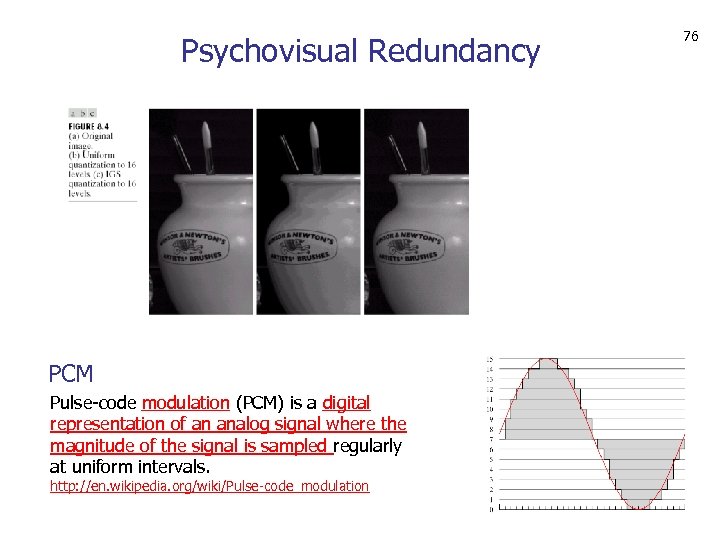 Psychovisual Redundancy PCM Pulse-code modulation (PCM) is a digital representation of an analog signal where the magnitude of the signal is sampled regularly at uniform intervals. http: //en. wikipedia. org/wiki/Pulse-code_modulation 76
 From Liu’s EE 330 (Princeton) representation in JPEG 475 x 330 x 3 = 157 KB luminance 77
 From Liu’s EE 330 (Princeton) Y U V (Y Cb Cr) Components Assign more bits to Y, less bits to Cb and Cr 79