 Скачать презентацию ILC 2013 Agenda Item V on Sustainable Development
b151966640467511b4a2dfc68900c7dd.ppt
- Количество слайдов: 160



ILC 2013 Agenda Item V on Sustainable Development, Decent Work and Green Jobs. Background notes in preparation of the ILC 2013 Discussion on Agenda item V (first version) Vincent Jugault Senior Environment and Decent Work Specialist ILO ROAP Green Jobs 20 May 2013
ILC 2013 Agenda Item V, June 2013, Geneva • General tripartite discussion: – 1 year after Rio+20 UN Conference on Sustainable Development; – 19 months after the Asia & Pacific Labour Conference (APRM, Dec 2011, Kyoto) which provided regional guidance on green/ greener jobs; • Unique opportunity for World of Work to formulate global guidance on issues of Decent Work, Green Jobs and Sustainable Development; 2
Contents 1. The environmental and employment challenges in Asia & the Pacific – a review 2. Decent Work, Green Jobs and Sustainable Development in Asia & the Pacific 3. Challenges and opportunities for green jobs 4. Effective policies and institutions 5. Achievements and lessons learnt from green jobs activities in Asia & the Pacific 6. Scope for a supportive role by the ILO 7. Points for Discussion at ILC 102 (June 2013, Geneva)
1. The environmental and employment challenges in A & P – a review 1. 1 1. 2 1. 3 Key environmental challenges in A & P Asia’s economic growth and employment challenges – a review Section 1 - Sum up
1. 1 Key environmental challenges in A & P Key environmental challenges include: • Climate Change Mitigation. All efforts to reduce emissions of green house gases, including CO 2 emissions. Examples are clean transport, renewable energy, energy efficiency in buildings and industry, sustainable agriculture, prevention of deforestation and forest degradation (REDD+), reforestation, etc. ; • Climate Change Adaptation. All efforts to adapt to the adverse effects of climate change, which include sea rise level, melting of the ice cap, etc. and increased intensity and frequency of extreme weather events such as droughts, floods, storms, etc;
1. 1 Key environmental challenges in A & P • Biodiversity Conservation. All efforts to prevent biodiversity losses. Examples include sustainable agriculture, management/conservation of eco-systems and land use (e. g. primary forests , humid zones, etc. ); • Prevention of Desertification. All efforts to prevent and limit desertification, including river basin management, reforestation, erosion prevention, etc. ; • Pollution Prevention and Control. All efforts to prevent pollution of environmental media such as air, water, waste, and soils. May also include noise prevention; • Natural ressource management including water management, fish stocks management, etc. ;
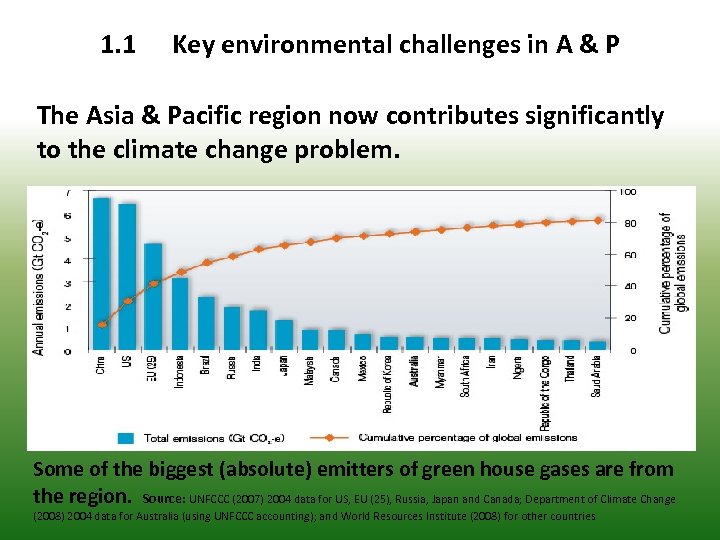
1. 1 Key environmental challenges in A & P The Asia & Pacific region now contributes significantly to the climate change problem. Some of the biggest (absolute) emitters of green house gases are from the region. Source: UNFCCC (2007) 2004 data for US, EU (25), Russia, Japan and Canada; Department of Climate Change (2008) 2004 data for Australia (using UNFCCC accounting); and World Resources Institute (2008) for other countries
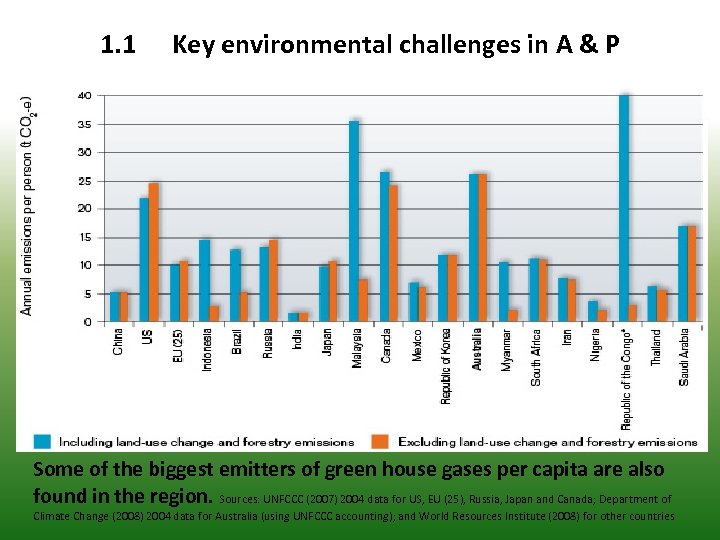
1. 1 Key environmental challenges in A & P Some of the biggest emitters of green house gases per capita are also found in the region. Sources: UNFCCC (2007) 2004 data for US, EU (25), Russia, Japan and Canada; Department of Climate Change (2008) 2004 data for Australia (using UNFCCC accounting); and World Resources Institute (2008) for other countries
1. 1 Key environmental challenges in A & P But Asia & the Pacific is also particularly vulnerable to the effects of climate change. This vulnerability comes from several ‘environmental’ factors; Which combined with other complicating factors make the region even more vulnerable to these challenges, such as: • Increasing demography, in particular Southern Asia; • A booming energy demand : 70% increase in Asia over the next 20 years; • High exposure to price volatility in oil, food;
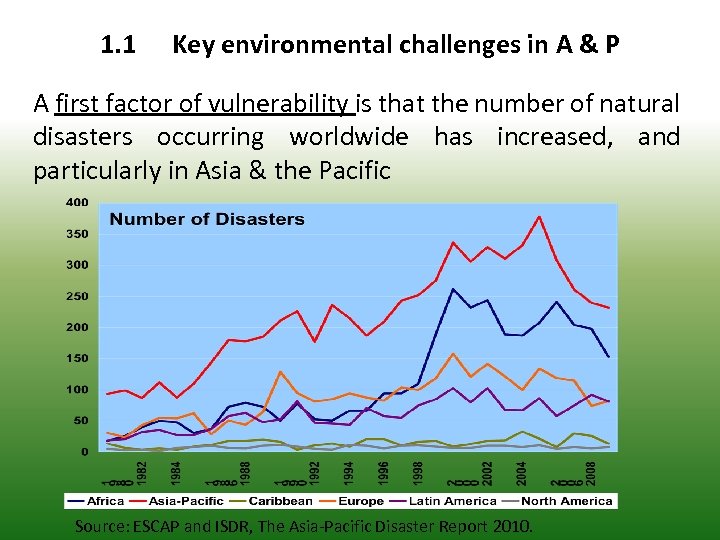
1. 1 Key environmental challenges in A & P A first factor of vulnerability is that the number of natural disasters occurring worldwide has increased, and particularly in Asia & the Pacific Source: ESCAP and ISDR, The Asia-Pacific Disaster Report 2010.
1. 1 Key environmental challenges in A & P A second factor of vulnerability relates to heavily populated coastlines and low-lying islands. The effects include: • The effects of coastal erosion, the intrusion of saline waters and losses are already visible and their impacts felt in many low lying areas of the region; • The rise of the sea level which directly jeopardizes the very existence of a number of low lying islands (Atolls) in the Pacific & Indian Ocean;
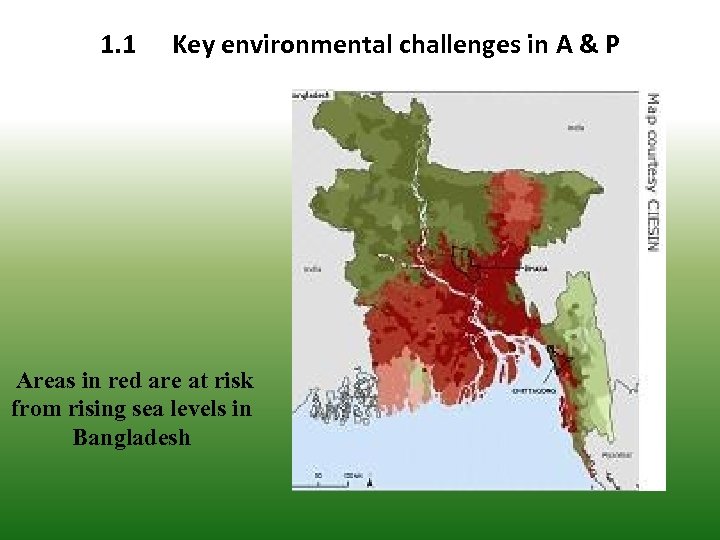
1. 1 Key environmental challenges in A & P Areas in red are at risk from rising sea levels in Bangladesh
1. 1 Key environmental challenges in A & P • Asia is home to almost half of the global urban population and is urbanizing at a pace faster than any other region, • The region will be confronted with even greater environmental challenges, including air pollution, congestion, CO 2 emission, deprivation in water and basic sanitation, and growing vulnerability to natural disasters, • Six of the world’s eight cities most exposed to flooding and damage from unpredictable weather patterns are located in Asia, namely: Mumbai, Guangzhou, Shanghai, Miami, Ho Chi Minh City, Kolkata, Greater New York, Osaka-Kobe
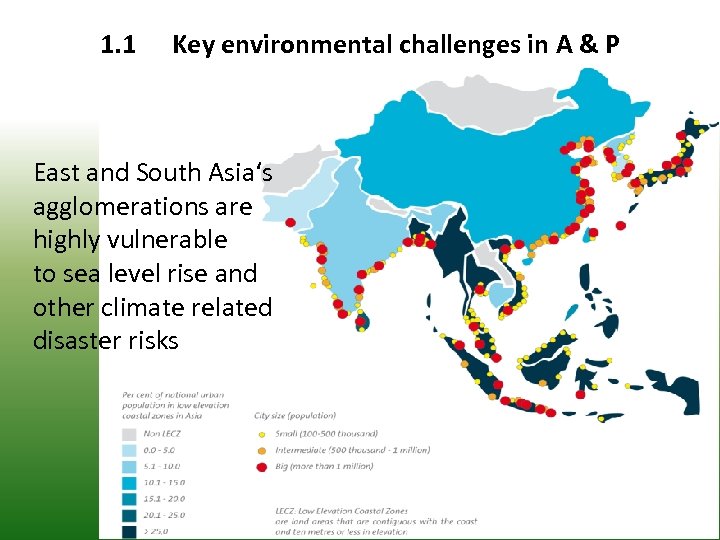
1. 1 Key environmental challenges in A & P East and South Asia‘s agglomerations are highly vulnerable to sea level rise and other climate related disaster risks
1. 1 Key environmental challenges in A & P A third driver of vulnerability is the strong reliance on agriculture for income and employment. • Agriculture in developing Asia is expected to see a decrease of 4 % of GDP share due to climate change (FAO, 5 th World Water Forum). • Rising temperatures and extreme weather events will likely reduce crop yields by as much as 10% as early as 2020, putting 132 million people at risk of extreme hunger by 2050 (ADB, June 2009); • South Asia is expected to be the worst affected region (together with Southern Africa) by the negative impacts on important crops (Lobell et al. , 2008);
1. 1 Key environmental challenges in A & P • The increase in competitive uses of water, changing climatic patterns, deforestation and soil erosion, droughts and melting glaciers, all contribute individually to imposing a major stress on water resources; • An estimated 1. 2 billion people could experience freshwater scarcity by 2020 as the fresh water supply is expected to decrease in Southeast, Central, East and South Asia (ADB, June 2009)
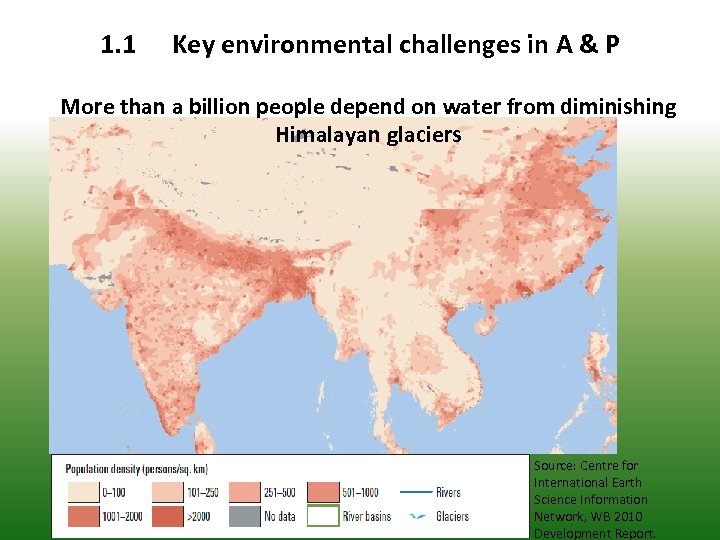
1. 1 Key environmental challenges in A & P More than a billion people depend on water from diminishing Himalayan glaciers Source: Centre for International Earth Science Information Network, WB 2010 Development Report.
1. 1 Key environmental challenges in A & P A fourth driver of vulnerability in the region is the dependence on marine resources affecting primarily, but not limited to, those who depend directly on them. • These highly fragile resources are greatly deteriorating from the effects of municipal, agricultural and industrial pollution, unsustainable costal management practices and over-fishing; • A total of 24 -34 per cent of coral reefs could be lost by 2020 (ADB, June 2009); • The fishing industry will be directly affected by fish stock management, with potentially millions of jobs to be lost in A&P (UNEP, Green Economy report, 2011;
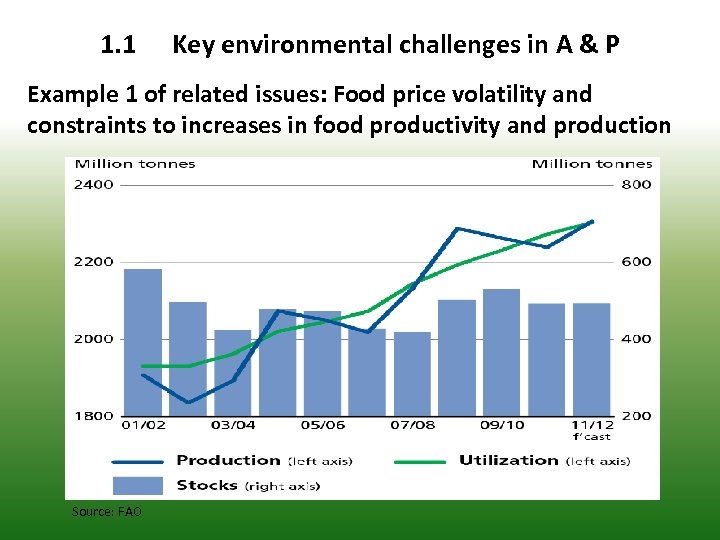
1. 1 Key environmental challenges in A & P Example 1 of related issues: Food price volatility and constraints to increases in food productivity and production Source: FAO
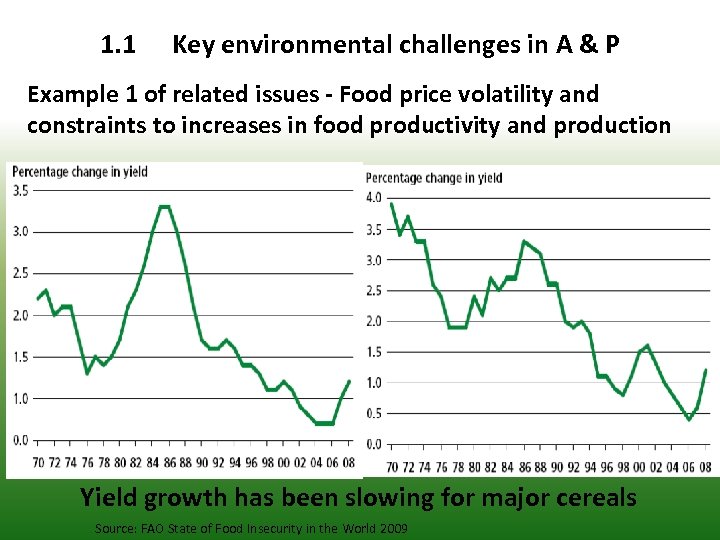
1. 1 Key environmental challenges in A & P Example 1 of related issues - Food price volatility and constraints to increases in food productivity and production Yield growth has been slowing for major cereals Source: FAO State of Food Insecurity in the World 2009
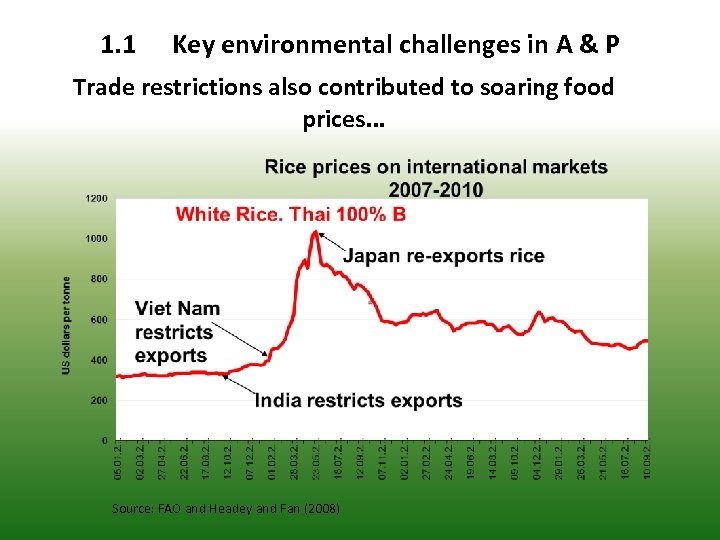
1. 1 Key environmental challenges in A & P Trade restrictions also contributed to soaring food prices. . . Source: FAO and Headey and Fan (2008)
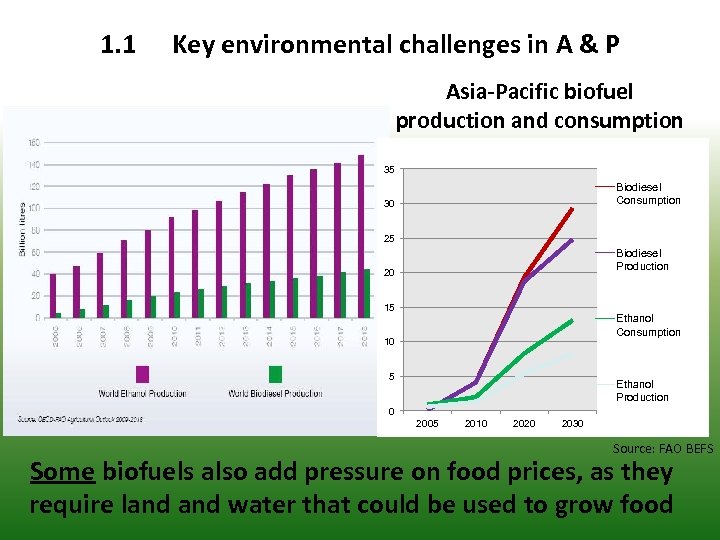
1. 1 Key environmental challenges in A & P Asia-Pacific biofuel production and consumption 35 Biodiesel Consumption 30 25 Biodiesel Production 20 15 Ethanol Consumption 10 5 Ethanol Production 0 2005 2010 2020 2030 Source: FAO BEFS Some biofuels also add pressure on food prices, as they require land water that could be used to grow food
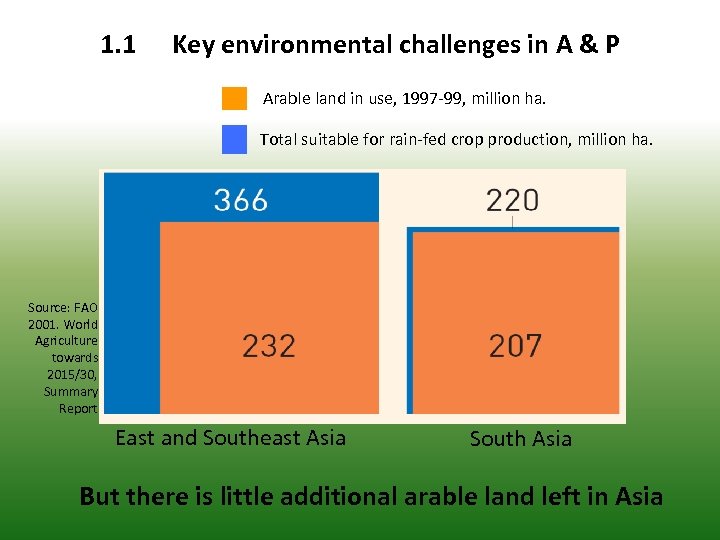
1. 1 Key environmental challenges in A & P Arable land in use, 1997 -99, million ha. Total suitable for rain-fed crop production, million ha. Source: FAO 2001. World Agriculture towards 2015/30, Summary Report East and Southeast Asia South Asia But there is little additional arable land left in Asia
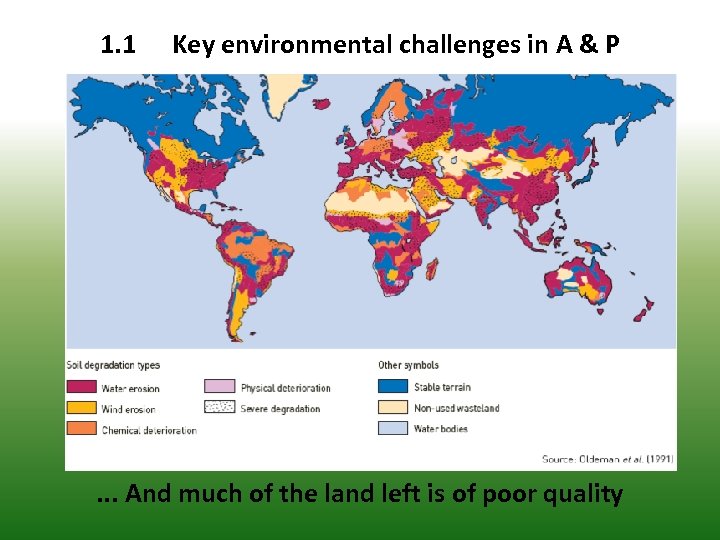
1. 1 Key environmental challenges in A & P . . . And much of the land left is of poor quality
1. The environmental and employment challenges in A & P 1. 1 1. 2 1. 3 Key environmental challenges in A & P Asia’s economic growth and employment challenges – a review Section 1 - Sum up
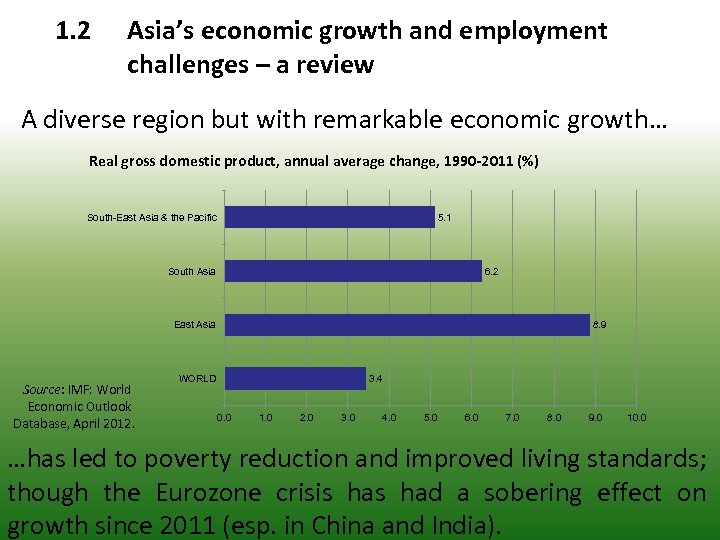
1. 2 Asia’s economic growth and employment challenges – a review A diverse region but with remarkable economic growth… Real gross domestic product, annual average change, 1990 -2011 (%) South-East Asia & the Pacific 5. 1 South Asia 6. 2 East Asia Source: IMF: World Economic Outlook Database, April 2012. 8. 9 WORLD 3. 4 0. 0 1. 0 2. 0 3. 0 4. 0 5. 0 6. 0 7. 0 8. 0 9. 0 10. 0 …has led to poverty reduction and improved living standards; though the Eurozone crisis had a sobering effect on growth since 2011 (esp. in China and India).
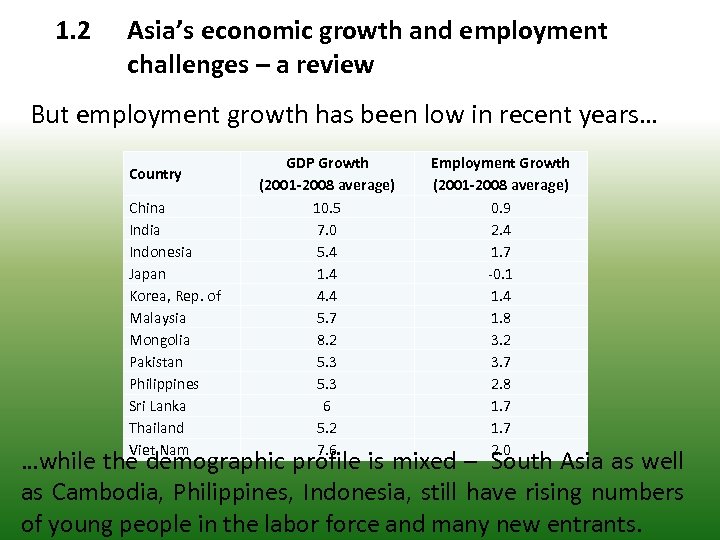
1. 2 Asia’s economic growth and employment challenges – a review But employment growth has been low in recent years… Country China India Indonesia Japan Korea, Rep. of Malaysia Mongolia Pakistan Philippines Sri Lanka Thailand Viet Nam GDP Growth (2001 -2008 average) 10. 5 7. 0 5. 4 1. 4 4. 4 5. 7 8. 2 5. 3 6 5. 2 7. 6 Employment Growth (2001 -2008 average) 0. 9 2. 4 1. 7 -0. 1 1. 4 1. 8 3. 2 3. 7 2. 8 1. 7 2. 0 …while the demographic profile is mixed – South Asia as well as Cambodia, Philippines, Indonesia, still have rising numbers of young people in the labor force and many new entrants.
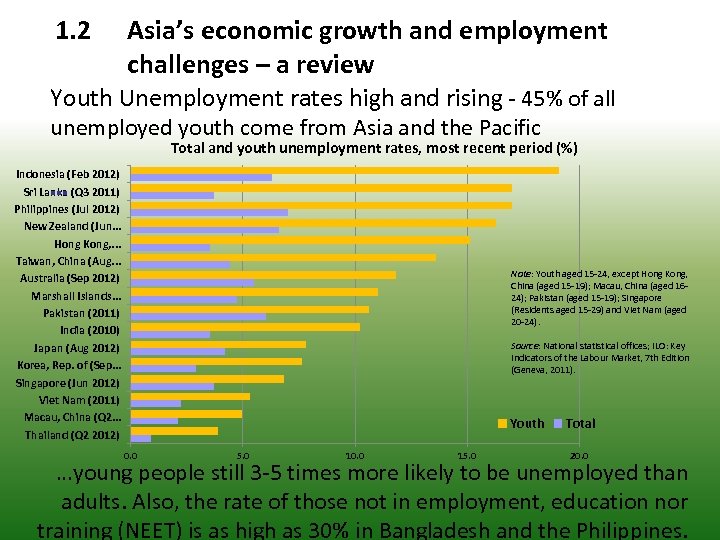
1. 2 Asia’s economic growth and employment challenges – a review Youth Unemployment rates high and rising - 45% of all unemployed youth come from Asia and the Pacific Total and youth unemployment rates, most recent period (%) Indonesia (Feb 2012) Sri Lanka (Q 3 2011) Philippines (Jul 2012) New Zealand (Jun. . . Hong Kong, . . . Taiwan, China (Aug. . . Australia (Sep 2012) Marshall Islands. . . Pakistan (2011) India (2010) Japan (Aug 2012) Korea, Rep. of (Sep. . . Singapore (Jun 2012) Viet Nam (2011) Macau, China (Q 2. . . Thailand (Q 2 2012) … Note: Youth aged 15 -24, except Hong Kong, China (aged 15 -19); Macau, China (aged 1624); Pakistan (aged 15 -19); Singapore (Residents aged 15 -29) and Viet Nam (aged 20 -24). Source: National statistical offices; ILO: Key Indicators of the Labour Market, 7 th Edition (Geneva, 2011). Youth 0. 0 5. 0 10. 0 15. 0 Total 20. 0 …young people still 3 -5 times more likely to be unemployed than adults. Also, the rate of those not in employment, education nor training (NEET) is as high as 30% in Bangladesh and the Philippines.
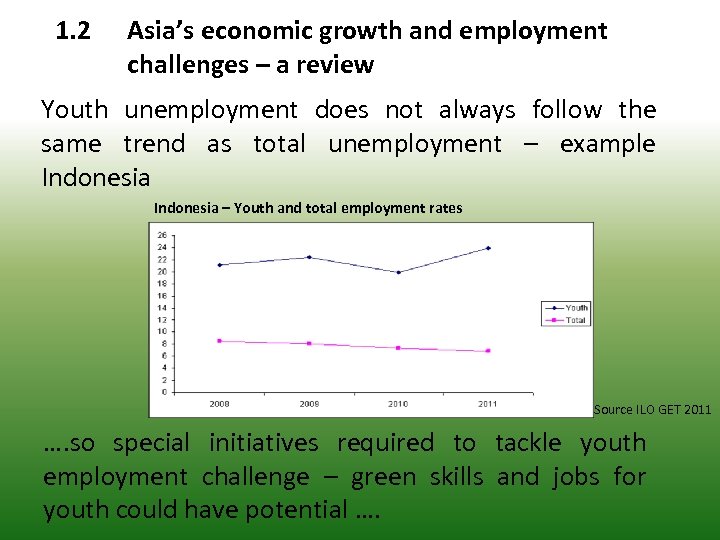
1. 2 Asia’s economic growth and employment challenges – a review Youth unemployment does not always follow the same trend as total unemployment – example Indonesia – Youth and total employment rates Source ILO GET 2011 …. so special initiatives required to tackle youth employment challenge – green skills and jobs for youth could have potential ….
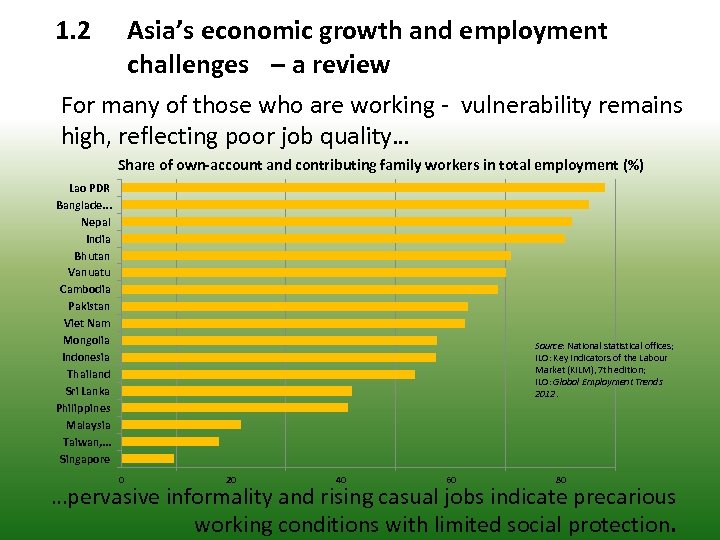
1. 2 Asia’s economic growth and employment challenges – a review For many of those who are working - vulnerability remains high, reflecting poor job quality… Share of own-account and contributing family workers in total employment (%) Lao PDR Banglade. . . Nepal India Bhutan Vanuatu Cambodia Pakistan Viet Nam Mongolia Indonesia Thailand Sri Lanka Philippines Malaysia Taiwan, . . . Singapore Source: National statistical offices; ILO: Key Indicators of the Labour Market (KILM), 7 th edition; ILO: Global Employment Trends 2012. 0 20 40 60 80 …pervasive informality and rising casual jobs indicate precarious working conditions with limited social protection.
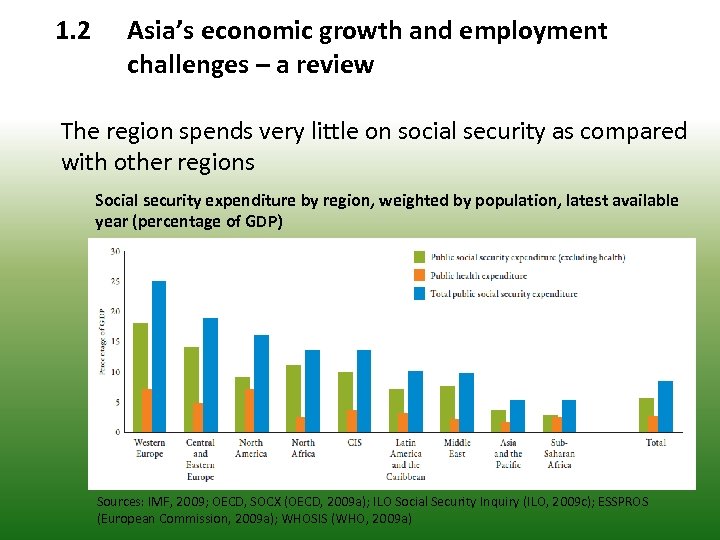
1. 2 Asia’s economic growth and employment challenges – a review The region spends very little on social security as compared with other regions Social security expenditure by region, weighted by population, latest available year (percentage of GDP) Sources: IMF, 2009; OECD, SOCX (OECD, 2009 a); ILO Social Security Inquiry (ILO, 2009 c); ESSPROS (European Commission, 2009 a); WHOSIS (WHO, 2009 a)
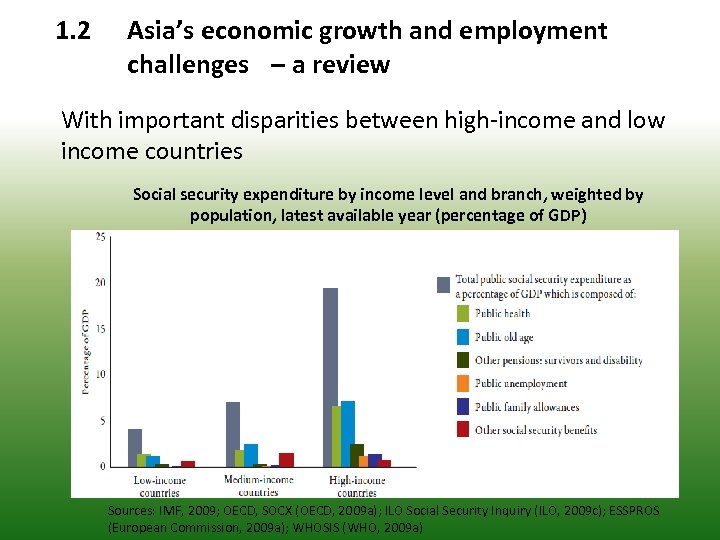
1. 2 Asia’s economic growth and employment challenges – a review With important disparities between high-income and low income countries Social security expenditure by income level and branch, weighted by population, latest available year (percentage of GDP) Sources: IMF, 2009; OECD, SOCX (OECD, 2009 a); ILO Social Security Inquiry (ILO, 2009 c); ESSPROS (European Commission, 2009 a); WHOSIS (WHO, 2009 a)
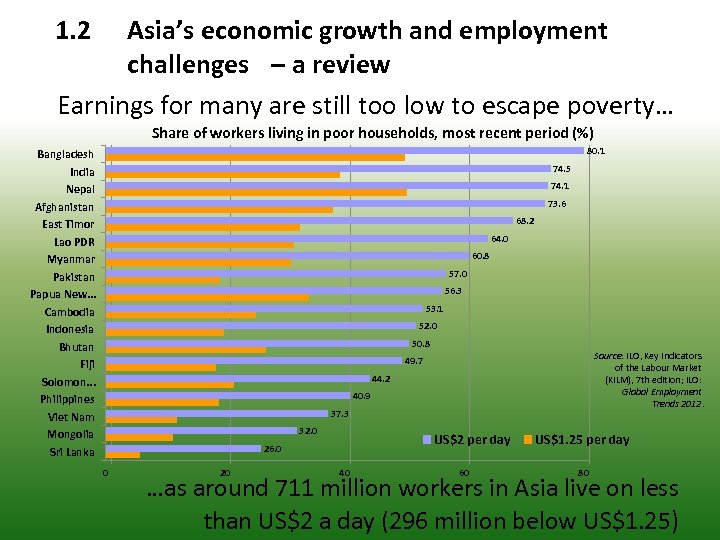
1. 2 Asia’s economic growth and employment challenges – a review Earnings for many are still too low to escape poverty… Share of workers living in poor households, most recent period (%) 80. 1 Bangladesh India Nepal Afghanistan East Timor Lao PDR Myanmar Pakistan Papua New. . . Cambodia Indonesia Bhutan Fiji Solomon. . . Philippines Viet Nam Mongolia Sri Lanka 74. 5 74. 1 73. 6 68. 2 64. 0 60. 8 57. 0 56. 3 53. 1 52. 0 50. 8 Source: ILO, Key Indicators of the Labour Market (KILM), 7 th edition; ILO: Global Employment Trends 2012. 49. 7 44. 2 40. 9 37. 3 32. 0 US$2 per day 26. 0 0 20 40 60 US$1. 25 per day 80 …as around 711 million workers in Asia live on less than US$2 a day (296 million below US$1. 25)
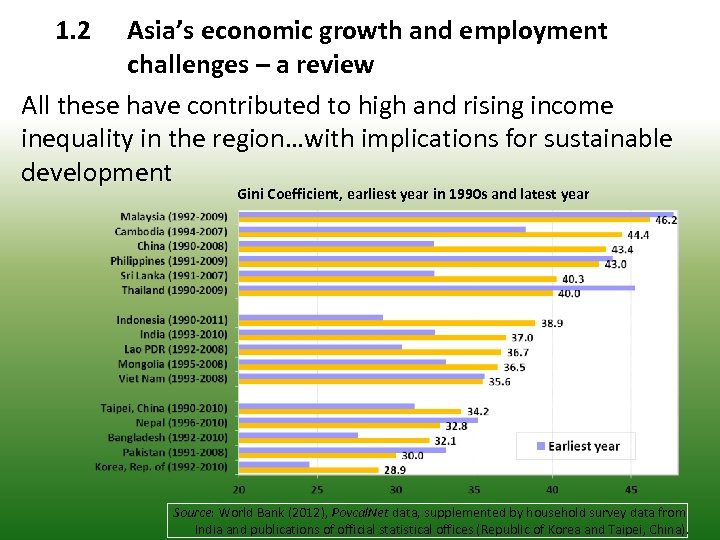
1. 2 Asia’s economic growth and employment challenges – a review All these have contributed to high and rising income inequality in the region…with implications for sustainable development Gini Coefficient, earliest year in 1990 s and latest year Source: World Bank (2012), Povcal. Net data, supplemented by household survey data from India and publications of official statistical offices (Republic of Korea and Taipei, China).
1. The environmental and employment challenges in A & P 1. 1 1. 2 1. 3 Key environmental challenges in A & P Asia’s economic growth and employment challenges – a review Section 1 - Sum up
1. 3 Section 1 - Sum up • Today, the Asia & the Pacific contributes significantly to the global problem of climate change (CO 2 emissions, etc. ); • The Asia & the Pacific is particularly exposed to the regional/local adverse impacts of climate change (individuals, enterprises, infrastructure); • All developed and developing countries in the region are affected one way or another, rural as well as urban areas, • Low-lying SIDS have contributed less to the problem and are affected most; great disparity of situation between countries (including between PICs)
1. 3 Section 1 - Sum up (cont. ) • Climate change and other environmental challenges have become a major threat to sustainable development; Example: Asia’s booming cities must go green or risk disaster (ADB); • The region remains home to two-thirds of the world's poor, their ranks further deepened by loss of employment and reduced incomes from the 2008 global financial crisis; • The economic poor are the most exposed to the adverse effects of climate change and to ‘environmental poverty’;
1. 3 Section 1 - Sum up (cont. ) • In terms of economic benefits and access to social services, large numbers of people are being left behind or left out; • In many developing countries, economic inequality has increased in the past decade; • Without steps to address these disparities and promote inclusive, sustainable growth, the risk this trend poses - including social instability - will continue to grow
Contents 1. The environmental and employment challenges in A & P 2. Decent Work, Green Jobs and Sustainable Development in Asia & the Pacific 3. Challenges and opportunities for green jobs 4. Effective policies and institutions 5. Achievements and lessons learnt from Asia & the Pacific 6. Scope for a supportive role by the ILO 7. Points for Discussion at ILC 102 (June 2013, Geneva)
2. Decent Work, Green Jobs and Sustainable Development in Asia & the Pacific 2. 1 2. 2 2. 3 Decent Work as a pillar of the Sustainable Development Framework Green jobs as decent, environmentally friendly jobs Section 2 – Sum up
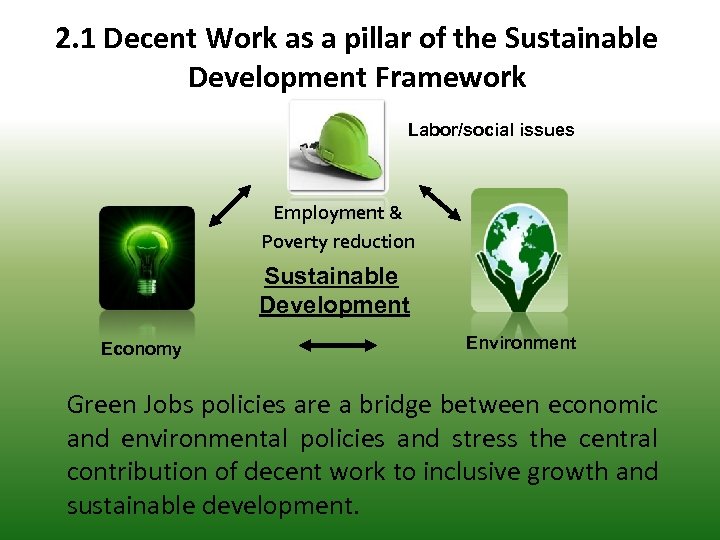
2. 1 Decent Work as a pillar of the Sustainable Development Framework Labor/social issues Employment & Poverty reduction Sustainable Development Economy Environment Green Jobs policies are a bridge between economic and environmental policies and stress the central contribution of decent work to inclusive growth and sustainable development.
2. 1 Decent Work as a pillar of the Sustainable Development Framework In this regard, Green Jobs build upon the shared recognition of the critical role to be played by productive employment in eradicating poverty. Specific actions to be promoted through social dialogue at all levels of decisions making (international, work-place) involving the Constituents include; more sustainable models of production, active labour market policies, economic diversification towards reorienting investments towards job-rich environmentally friendly economic sectors, and universal social protection.
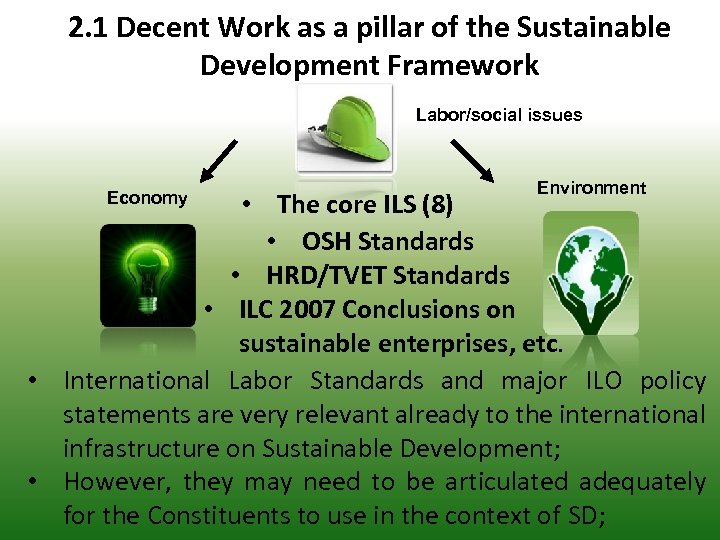
2. 1 Decent Work as a pillar of the Sustainable Development Framework Labor/social issues Environment • The core ILS (8) • OSH Standards • HRD/TVET Standards • ILC 2007 Conclusions on sustainable enterprises, etc. • International Labor Standards and major ILO policy statements are very relevant already to the international infrastructure on Sustainable Development; • However, they may need to be articulated adequately for the Constituents to use in the context of SD; Economy
2. 1 Decent Work as a pillar of the Sustainable Development Framework • There can be more and better jobs in green economies, given the right policies are in place; • Such policies and measures require the full involvement of the actors of the world of work, (workers, enterprises and employers), those actually doing the work on the ground, for a politically, economically and socially sustainable transition;
2. Decent Work, Green Jobs and Sustainable Development in Asia & the Pacific 2. 1 2. 2 2. 3 Decent Work as a pillar of the Sustainable Development Framework Green jobs as decent, environmentally friendly jobs Section 2 – Sum up
2. 2 Green jobs as decent, environmentally friendly jobs • “Green Jobs can be generically defined as the direct employment created in economic sectors and activities, which reduces their environmental impact and ultimately brings it down to levels that are sustainable”. • Green Jobs are based on the two pillars of Decent Work and Environmentally Sustainability; GJ = Decent Work (DW) + Environmental Sustainable (ES) Green jobs pursue the goal of full and productive employment, decent work for all and a low-carbon, environmentally friendly, climate resilient economy;
2. 2 Green jobs as decent, environmentally friendly jobs • Although there is no (yet) international definition of green jobs, green jobs in some countries are counted as the direct employment directly involved in the production of green goods and services (or ecoactivities); • Green goods and services can be defined by: – national legislation/regulations through the adoption of legally binding or voluntary standards and protocols, – international trade regimes; – International voluntary standards from industry, non governmental organizations, etc. ; – Others;
2. 2 Green jobs as decent, environmentally friendly jobs • Green jobs produce green goods and services (e. g. certified organic food, ecotourism, manufacturing and installation of solar panels, water efficient valve, green financial services, etc. ) • Green jobs can also be specialized jobs that help reduce the environmental impact of enterprises and activites in ANY sector (e. g. an energy auditor in the mining sector) • Green Jobs are being counted in an increasing number of countries
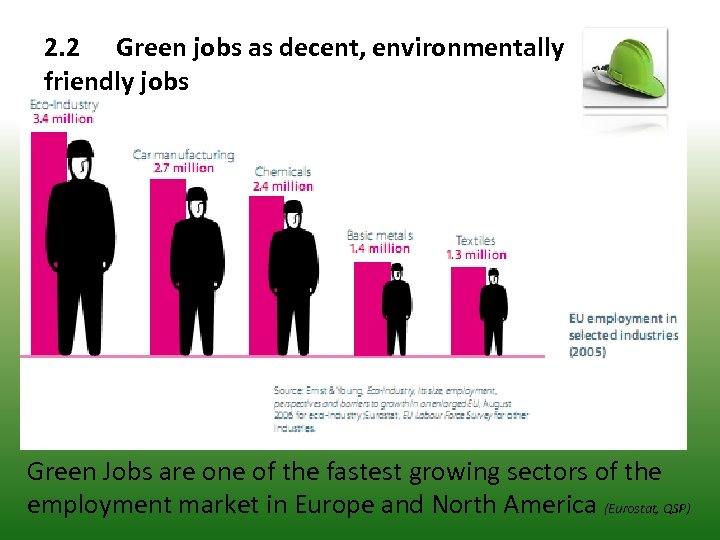
2. 2 Green jobs as decent, environmentally friendly jobs Green Jobs are one of the fastest growing sectors of the employment market in Europe and North America (Eurostat, QSP)
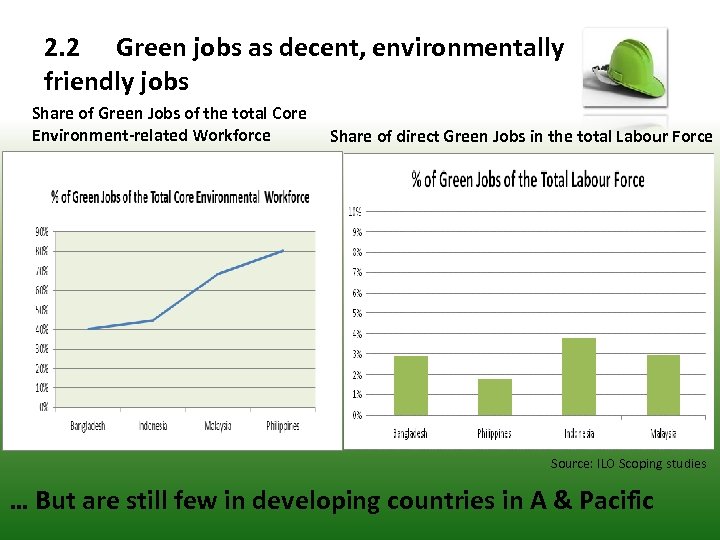
2. 2 Green jobs as decent, environmentally friendly jobs Share of Green Jobs of the total Core Environment-related Workforce Share of direct Green Jobs in the total Labour Force Source: ILO Scoping studies … But are still few in developing countries in A & Pacific
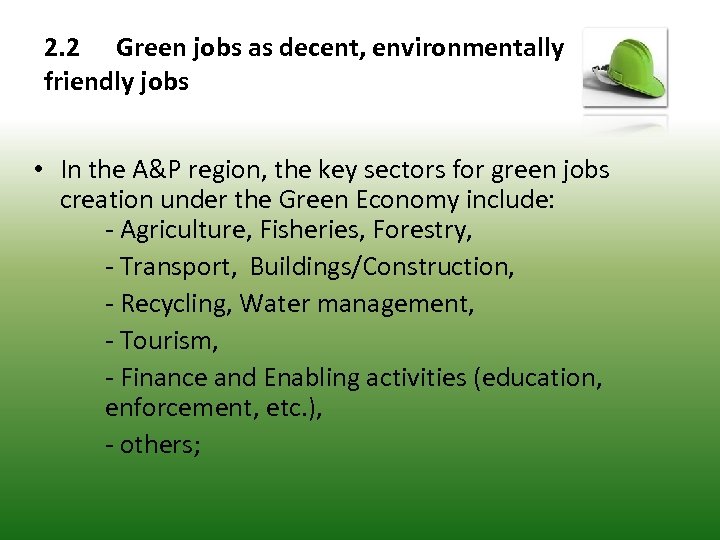
2. 2 Green jobs as decent, environmentally friendly jobs • In the A&P region, the key sectors for green jobs creation under the Green Economy include: - Agriculture, Fisheries, Forestry, - Transport, Buildings/Construction, - Recycling, Water management, - Tourism, - Finance and Enabling activities (education, enforcement, etc. ), - others;
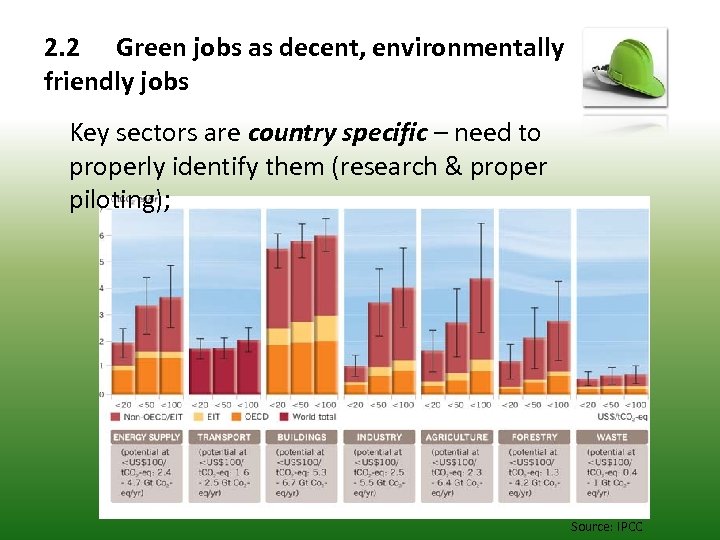
2. 2 Green jobs as decent, environmentally friendly jobs Key sectors are country specific – need to properly identify them (research & proper piloting); Source: IPCC
2. 2 Green jobs as decent, environmentally friendly jobs Green segments for (direct) green jobs creation in Low Carbon Development. . • Mobility: mass transportation • Renewable energy • Green social housing • Energy & resource efficiency in buildings • Sustainable commercial/social forestry, organic agriculture, • Sustainable tourism, eco-tourism …or eco-services • Environmental services (eco-industry) • Recycling, waste management • Ecosystem-services (water, biodiversity, conservation, etc. )
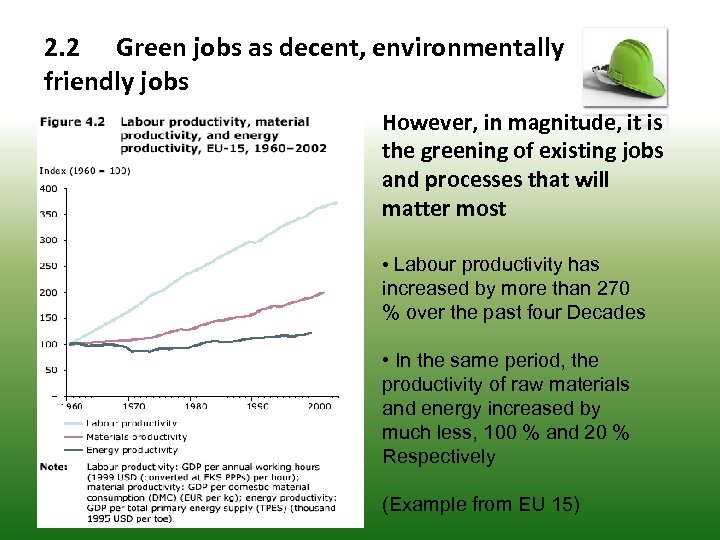
2. 2 Green jobs as decent, environmentally friendly jobs However, in magnitude, it is the greening of existing jobs and processes that will matter most • Labour productivity has increased by more than 270 % over the past four Decades • In the same period, the productivity of raw materials and energy increased by much less, 100 % and 20 % Respectively (Example from EU 15)
2. 2 Green jobs as decent, environmentally friendly jobs Taking into account the discussion under the Climate Change Convention, China’s five year plan (20112016) adopted a carbon productivity target of 17 per cent lower CO 2 emissions per unit of GDP, equivalent to a carbon productivity improvement of 20 per cent. “Carbon productivity is driven by two key levers – energy efficiency, which is about using less energy to generate the same amount of economic wealth; and carbon intensity, which is about emitting less pollution from the energy that you use”.
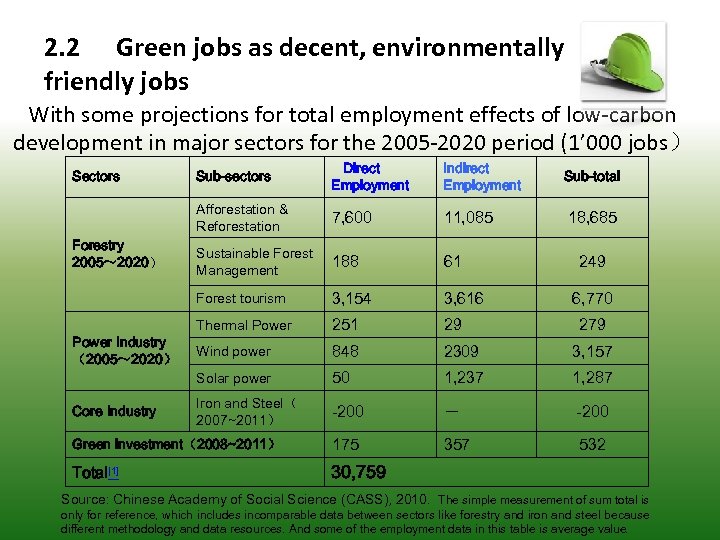
2. 2 Green jobs as decent, environmentally friendly jobs With some projections for total employment effects of low-carbon development in major sectors for the 2005 -2020 period (1’ 000 jobs) Sub-sectors Direct Employment Indirect Employment Sub-total Afforestation & Reforestation 7, 600 11, 085 18, 685 Sustainable Forest Management 188 61 Forest tourism 3, 154 3, 616 Thermal Power 251 29 Wind power 848 2309 3, 157 Solar power 50 1, 237 1, 287 Iron and Steel( 2007~2011) -200 - -200 Green investment(2008~2011) 175 357 532 Total[1] 30, 759 Sectors Forestry 2005~ 2020) Power Industry (2005~ 2020) Core Industry 249 6, 770 279 Source: Chinese Academy of Social Science (CASS), 2010. The simple measurement of sum total is only for reference, which includes incomparable data between sectors like forestry and iron and steel because different methodology and data resources. And some of the employment data in this table is average value.
2. 2 Green jobs as decent, environmentally friendly jobs • ‘Poles of green growth’ exist for job creation, including for the poor in developing countries (UNCTAD, 2010), • However, important Decent Work deficit may exist already in many of these ‘green’ sectors, • Consequently, investment policies in these sectors must also focus on improving working conditions, productivity and sustainable enterprises, • Opportunities for win-win situations exist – they need to be identified, studied and expanded;
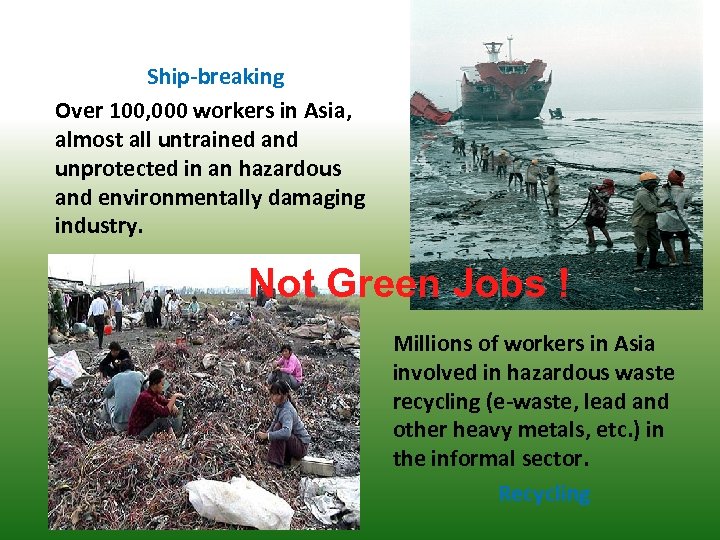
Ship-breaking Over 100, 000 workers in Asia, almost all untrained and unprotected in an hazardous and environmentally damaging industry. Not Green Jobs ! Millions of workers in Asia involved in hazardous waste recycling (e-waste, lead and other heavy metals, etc. ) in the informal sector. Recycling
2. Decent Work, Green Jobs and Sustainable Development in Asia & the Pacific 2. 1 2. 2 2. 3 Decent Work as a pillar of the Sustainable Development Framework Green jobs as decent, environmentally friendly jobs Section 2 – Sum up
2. 3 Section 2 – Sum up • Employment policies can contribute to a smooth transition to more sustainable green growth • by identifying opportunities/challenges for GJs, • greening existing jobs and • easing the phasing out of unsustainable jobs • Inclusive, sustainable growth is required more than ever, that creates and expands economic opportunities, • brings broader access to these opportunities to ensure that members of society can participate and benefit from growth, and • proposes social safety nets to prevent extreme deprivation, including in the context of climate-related events.
Contents 1. The environmental and employment challenges in A & P 2. Decent Work, Green Jobs and Sustainable Development in Asia & the Pacific 3. Challenges and opportunities for green jobs 4. Effective policies and institutions 5. Achievements and lessons learnt from Asia & the Pacific 6. Scope for a supportive role by the ILO 7. Points for Discussion at ILC 102 (June 2013, Geneva)
3. Challenges and opportunities for green jobs 3. 1 3. 2 3. 3 3. 4 Employment creation Greener jobs and the decent work-productivity nexus Impacts on social inclusion Section 3 – Sum up
3. 1 Employment creation 1) Environmental sustainability can be a driver of economic growth – Regulations, market-based mechanisms and other policy instruments can promote green workplace practices and investments in new green products and services • Most studies suggest that net job creation likely to be positive - A greener economy could lead to up to 60 million additional jobs (UNEP Green Economy report, 2011) • Gains may be higher in emerging economies and developing countries than in industrialized ones
3. 1 Employment creation 1) But … – At the costs of shifts in the labor market and across sectors, – With changes in the job competencies that are required, – Direct ‘environment -related jobs’ created in the process must be green and decent i. e. green jobs;
3. 1 Employment creation 2) New Jobs in ‘new’ or existing green sectors/segments can be created through specific policies to support growing labor demand; • Organic food production, ecotourism, agriculture infrastructure (irrigation), mass transport, etc. ;
3. 1 Employment creation Example 1: Global Market Trends in Food Production • Sustainable forestry certification increased by 181 % (last 5 years), 9 per cent of global forested land in 2009 • Certified sustainable coffee increased by 400% (last 5 years). 8 per cent of global coffee exports • Sustainable tea production has grown by 5’ 000% (last 5 years). 7. 7 per cent of global exports • Sustainable banana sales have grown by 63 % (last two years), 20 per cent of global exports in 2009 • So, booming world markets, starting from a very tiny market • Mix of job maintenance and job creation • Africa, Americas, Asia lagging behind UNCTAD, October 2010
3. 1 Employment creation Example 2: Ecotourism, agro-ecotourism • early 1990 s, the fastest growing sector of the tourism industry, expanding globally between 20% and 34% per year. • In 2004, growing 3 times faster than the global tourism industry as a whole (UNWTO) • could grow to 25% of the world’s travel market, by 2012 • Large potential for job creation, youth employment • Need to address DW issues Eco. Tourism World Congress, Ventiane, 2009
3. 1 Employment creation 2) But … - The understanding of the labor market dynamics is critical (research capacity is essential), - Such employment policies require a high level of integration to address the economic, labor and environmental dimensions altogether, - Shortages and gaps of skillful labor can hinder new (green) job creation, - Many of jobs are found in environment-related sectors that have a large share of informality with little enforcement capacity,
3. 1 Employment creation 3) Most surveys and studies indicate that young men and women are most interested and aware of green policies and aspire to obtain jobs such as green-jobs that can fulfill their aspirations (for the same level of income), both in developed and developing countries, • At a time when global youth unemployment has reached an unprecedented scale, promoting green jobs for youth brings a ‘double dividend’ for economic growth and youth
3. 1 Employment creation 3) However, • The youth is not adequately prepared and lacks basic education, as well as effective mechanisms for their smooth entry into the world of work, into green jobs, in particular, including: • skills anticipation/development schemes that can benefit all, in particular young men and women, • Training/apprenticeship programs in the green sector, • partnership agreements with the financial sector to encourage access to green finance for youth and SMEs More information is available @ http: //apgreenjobs. ilo. org/events/green-jobs-team/greengrowth-and-green-jobs-for-youth
3. Challenges and opportunities for green jobs 3. 1 3. 2 3. 3 3. 4 Employment creation Greener jobs and the decent work–productivity nexus Impacts on social inclusion Section 3 – Sum up
3. 2 Greener jobs and the decent work– productivity nexus 1) Greener jobs through energy (and resource) efficiency are good for business and enhance enterprise competitiveness • • “Energy efficiency is a resource that is available today and comes with a strong business case for reducing operating costs and risks, driving operational and technical innovation, and opening opportunities for new products and services”, “In the last decade, rising and volatile energy prices coupled with growing support for action on energy and environmental issues has driven a surge of corporate environmental commitments. Energy efficiency has emerged as a key component of these commitments”, (Source: Best Business Practices in Energy Efficiency, PEW Centre 2010)
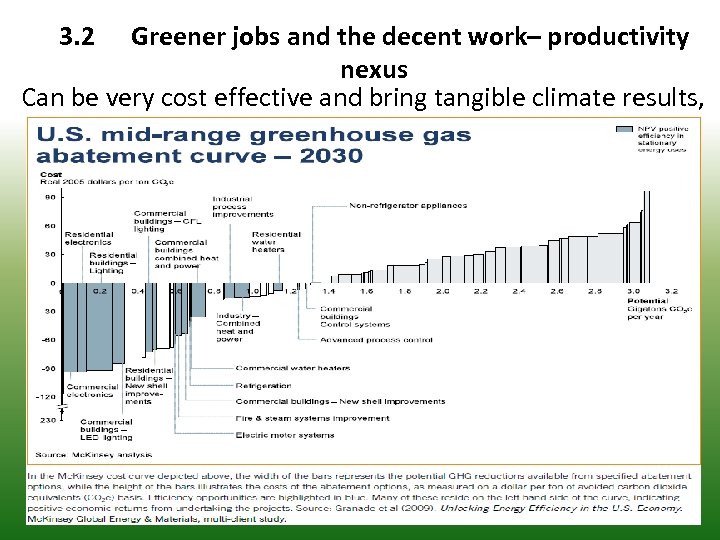
3. 2 Greener jobs and the decent work– productivity nexus Can be very cost effective and bring tangible climate results,
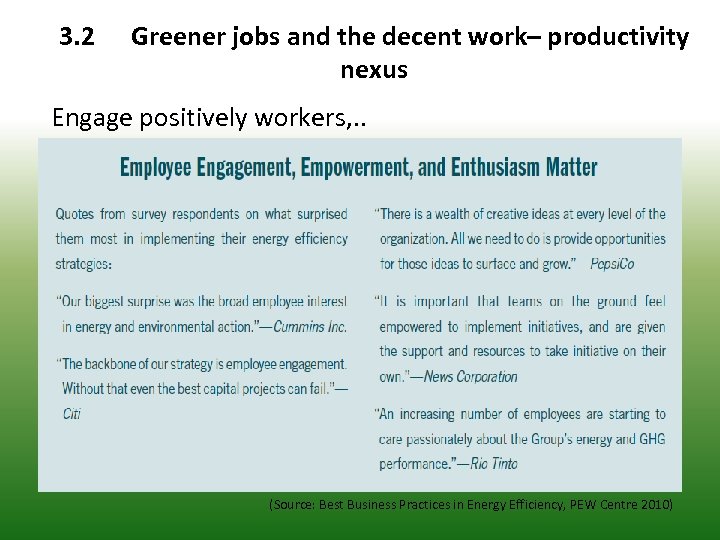
3. 2 Greener jobs and the decent work– productivity nexus Engage positively workers, . . (Source: Best Business Practices in Energy Efficiency, PEW Centre 2010)
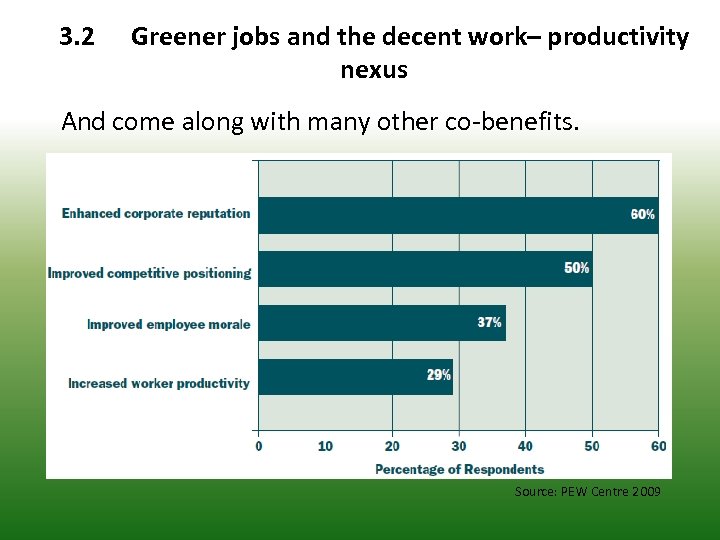
3. 2 Greener jobs and the decent work– productivity nexus And come along with many other co-benefits. Source: PEW Centre 2009
3. 2 Greener jobs and the decent work– productivity nexus Truly: • Greener workplace practices are often a shared concern among workers and employers; • They can trigger a wider process of improvement in enterprises, which extends to different areas of operations, including better workplace conditions, occupational health and safety and mechanisms for cooperation; • Integrated assistance to enterprises (beyond sole focus on resource efficiency) to leverage synergies among different areas of improvement, e. g. better waste management and green procurement leading to better health and safety for workers, improved workplace relations leading to stronger participation in environmental initiatives and vice-versa, etc.
3. 2 Greener jobs and the decent work– productivity nexus Examples of enterprise improvements and results from ILO GBA Project in the hotel sector (Thailand, 2010 -2012) include: • Well-functioning worker-manager teams with regular meetings to identify improvement actions and review implementation, • Safer and better organized workspaces thanks to revived and trained Occupational Safety and Health committees, • Energy savings of 30% thanks to process control and workers’ participation in resource conservation • Water and energy conservation from innovative guest engagement initiatives, with laundry expenses down by 18%. More information available @ http: //apgreenjobs. ilo. org/resources/fact-sheet-green-businessasia-project
3. 2 Greener jobs and the decent work– productivity nexus 2) Greener jobs bring opportunities for safer and productive workplaces. . - In many ‘environment related sectors’, the addressing of OSH and environmental issues in an overall logic of workplace improvement can bring win-win solutions and concrete benefits both in terms of environmental performance and workers’ health and safety, - This requires specific attention to OSH and environmental risks and the integration of relevant tools and assistance
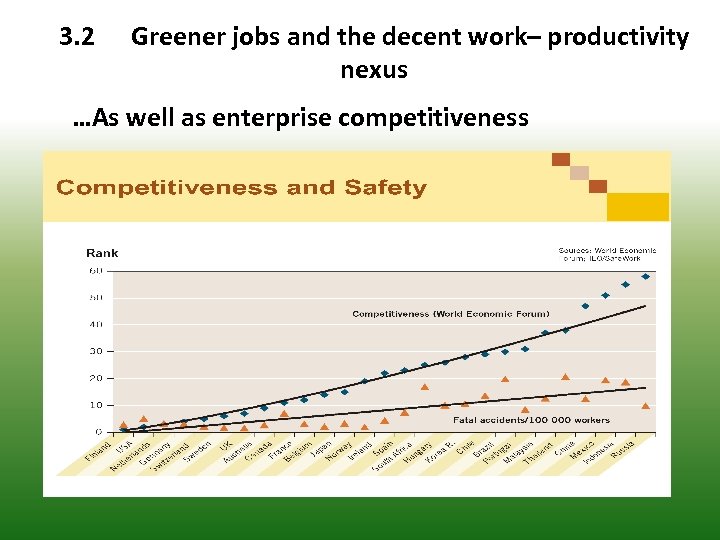
3. 2 Greener jobs and the decent work– productivity nexus …As well as enterprise competitiveness
3. 2 Greener jobs and the decent work– productivity nexus 2) Greener jobs bring opportunities for safer and productive workplaces. . - Labor and environmental standard complement each other in many ‘green’ or hazardous sectors; - Labor and environmental inspectorates can potentially collaborate for more effective combined enforcement of labor and environmental regulations and standards, such as in the manufacturing sector (Cambodia), ewaste recycling (China), forestry (Indonesia), etc. ;
3. Challenges and opportunities for green jobs 3. 1 3. 2 3. 3 3. 4 Employment creation Greener jobs and the decent work–productivity nexus Impacts on social inclusion Section 3 – Sum up
3. 3 Impacts on social inclusion 3) Green technologies and green economy transitions may offer possibilities for greater social inclusion, poverty reduction, in particular for women; • E. g. Improving access to affordable renewable energy to the 1. 3 billion people globally without electricity access and the 2. 7 billion without modern cooking energy; • 70% of the electricity needs are cheapest met through renewable energy powered mini-grids (65%) and offgrid technology (45%) (IFC); • Cooperatives are a powerful social as well as economic enterprise to overcome structural barriers to energy access and development;
3. 3 Impacts on social inclusion 3) Green technologies and green economy transitions may offer possibilities for greater social inclusion, poverty reduction, in particular for women; • Example: Renewable energy are more labor intensive per unit of power produced than fossil based sources; • Manufacturing costs are also decreasing dramatically (from $1. 29 p/W in 2009 to $0. 42 p/W in 2015 for solar panel production costs); • Keeping demand high, despite subsidies progressive removal in many countries; • However, it will take still a few years before solar power (for ex. ) can reach ‘grid parity’;
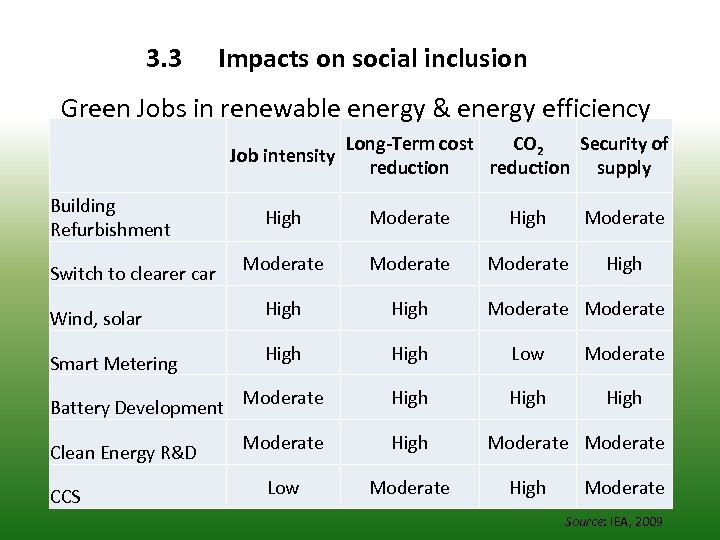
3. 3 Impacts on social inclusion Green Jobs in renewable energy & energy efficiency Job intensity Building Refurbishment Long-Term cost CO 2 Security of reduction supply High Moderate Moderate High Wind, solar High Smart Metering High Low Moderate Battery Development Moderate High Moderate High Low Moderate Switch to clearer car Clean Energy R&D CCS Moderate High Moderate Source: IEA, 2009
3. Challenges and opportunities for green jobs 3. 1 3. 2 3. 3 3. 4 Employment creation Greener jobs and the decent work-productivity nexus Impacts on social inclusion Section 3 – Sum up
3. 4 Section 3 – Sum up • The green race in A&P has started, with great disparity between countries and sectors; • A better understanding of the dynamics of the green economy is required at the regional level and the national level to be able to anticipate shifts in the labor market, and assess demand for changing skills needs, etc. ; • Growing demand for green goods and services in the A&P region brings the prospect of net, although limited, employment benefits. Great care needs to be put on job quality in sectors which traditionally have poor Decent Work records;
3. 4 Section 3 – Sum up • On the labor supply side, employment and skill mismatch, including youth skills mismatch, are of increasing concern; • The greening of enterprises contributes to the building of sustainable enterprises. The ‘greening’ process can bring documented, tangible benefits in terms of productivity, working conditions and involvement of workers at the workplace; • ‘To go green’ is not an option anymore in the A&P region. The greening of enterprises is important for the protection of existing jobs;
Contents 1. The environmental and employment challenges in A & P 2. Decent Work, Green Jobs and Sustainable Development in Asia & the Pacific 3. Challenges and opportunities for green jobs 4. Effective policies and institutions 5. Achievements and lessons learnt from Asia & the Pacific 6. Scope for a supportive role by the ILO 7. Points for Discussion at ILC 102 (June 2013, Geneva)
4. Effective policies and institutions 4. 1 4. 2 4. 3 Country-specific policy mixes for more and better jobs in a green economy Policy coherence through social dialogue Section 4 – Sum up
4. 1 Country-specific policy mixes for more and better jobs in a green economy 1) Key policy areas include Macroeconomic fiscal and monetary policies. • Example, Green policies (carbon tax) could raise employment globally by 14 million in a period of 5 years, - even without technological change, - if carbon tax benefits were used to cut labor taxes (International Labor Institute Annual report, 2009)
4. 1 Country-specific policy mixes for more and better jobs in a green economy But, need coherence between economic, employment and environmental policies to maximise net impact on jobs - Tax incentives to low carbon industries to promote employment - Tax revenue from high carbon sectors used to - Reduce labour tax in low carbon industries - Target specific groups and green sectors, enhancing skills - Subsidized credit, other support to SMEs in the green sector - Skills anticipation and skill development support to green sector
4. 1 Country-specific policy mixes for more and better jobs in a green economy • And, according to ILO estimates, % (2009), Jobs in the high carbon sectors that are directly exposed to low-carbon policies and may evolve with time represent: - 39 % of the global labor force, - and 33 % in developing countries because of the large agricultural sectors which are classified as less carbon intensive • Fossil fuel sources of energy (oil, coal, gas) may be also subsidized in some countries in the region, removal of these subsidies remaining a key challenge;
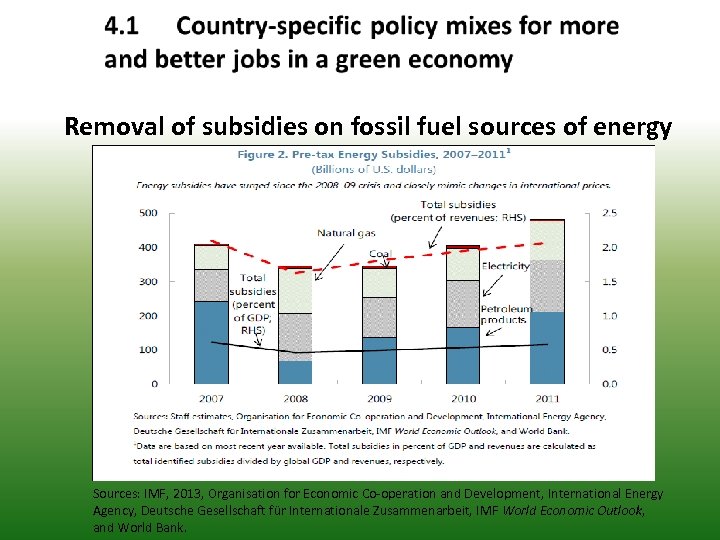
Removal of subsidies on fossil fuel sources of energy Sources: IMF, 2013, Organisation for Economic Co-operation and Development, International Energy Agency, Deutsche Gesellschaft für Internationale Zusammenarbeit, IMF World Economic Outlook, and World Bank.
But subsidies removal may raise concerns regarding the adverse impact on the poor • Although most of the benefits from energy subsidies are captured by higher-income groups, energy price increases can still have a substantial adverse impact on the real incomes of the poor, both through higher energy costs of cooking, heating, lighting, and personal transport, as well as higher prices for other goods and services, including food, • This is an important consideration for countries that do not have a well-functioning social safety net that is capable of effectively protecting the poor from the adverse impact of higher energy prices.
4. 1 Country-specific policy mixes for more and better jobs in a green economy And the need for coherent, progressive subsidy removal strategy: • Experience shows that subsidy reform must be accompanied by specific measures to mitigate the impact of price increases on the poor, • Example: price increases should initially be concentrated on products that are less important for poor household budgets; • Social safety nets need to be tailored to specific needs of the most affected;
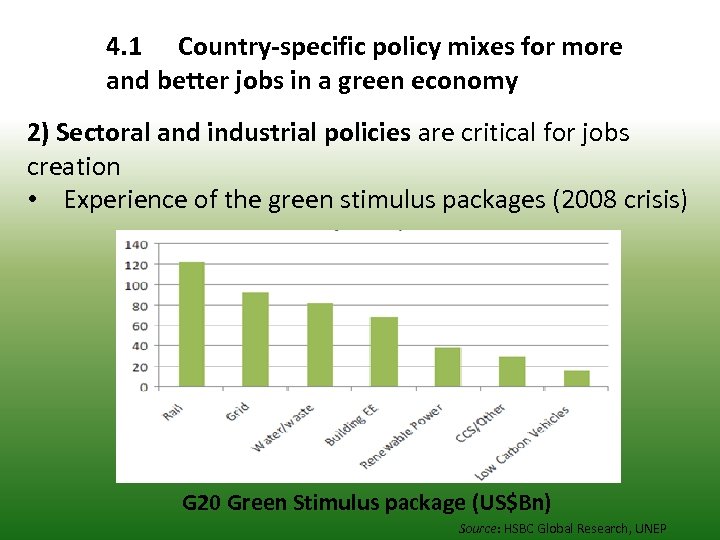
4. 1 Country-specific policy mixes for more and better jobs in a green economy 2) Sectoral and industrial policies are critical for jobs creation • Experience of the green stimulus packages (2008 crisis) G 20 Green Stimulus package (US$Bn) Source: HSBC Global Research, UNEP
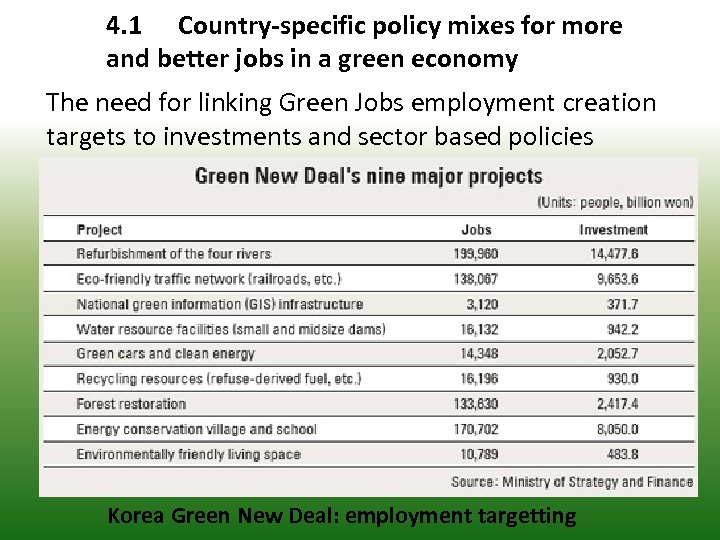
4. 1 Country-specific policy mixes for more and better jobs in a green economy The need for linking Green Jobs employment creation targets to investments and sector based policies Korea Green New Deal: employment targetting
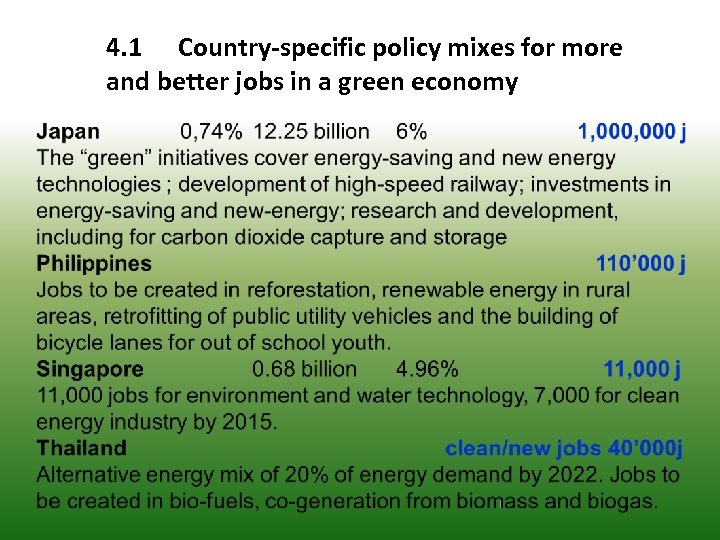
4. 1 Country-specific policy mixes for more and better jobs in a green economy
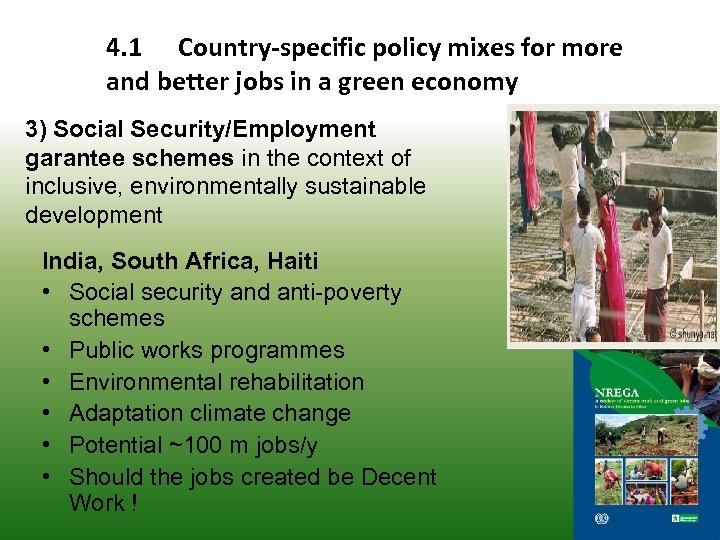
4. 1 Country-specific policy mixes for more and better jobs in a green economy 3) Social Security/Employment garantee schemes in the context of inclusive, environmentally sustainable development India, South Africa, Haiti • Social security and anti-poverty schemes • Public works programmes • Environmental rehabilitation • Adaptation climate change • Potential ~100 m jobs/y • Should the jobs created be Decent Work !
4. 1 Country-specific policy mixes for more and better jobs in a green economy 4) Active labour market policies • Example: Skills for green jobs • • Skills shortages already pose a major barrier to transitions to green economies and green job creation - In certain sectors and occupations - Particular core skills - Multi-skillling requirements Why are there shortages? - Underestimated growth of some sectors, such as for green technologies - General lack of scientists and engineers - National skill structure which does not meet skills demand - Low reputation of sectors – failure to attract trainees
4. 1 Country-specific policy mixes for more and better jobs in a green economy • Example: Skills for green jobs • Quantitative and qualitative changes • Skill content for occupations to become greener is far from being uniform across countries • Many changes relate to knowledge about regulation and new technologies, some to new markets and demand • Emerging occupations more often require higher level qualifications • Changes in existing occupations happen more often at the low and medium-skill level • Gender dimension
4. 1 Country-specific policy mixes for more and better jobs in a green economy • Example: Skills for green jobs • Transitions to greener economies impact skill needs. Skills shortages may prevent successful implementation of environmental policies. • Policy coherence between environment and skills policies have still a long way to go • Most change occurs in the composition of existing occupations. Vocational education and training is caching up less efficiently than higher education • Effective responses are targeted, at industry level, through PPPs, and coherent multi-level cooperation • Key role for identification and anticipation of skill needs!
4. 1 Country-specific policy mixes for more and better jobs in a green economy 5) The piloting of the economy to green labourintensive sectors will be influenced by demographics. • For “labour-poor” countries, the challenge will be to create highly skilled positions and train or find workers in technology driven industries, • the challenge for labour-rich countries will be to create jobs that can absorb the large young labour force in excess, and foster decent work with real income gains, • In this context, ‘green policies’ will need to be adjusted to achieve the objectives of full employment and decent work for all in the region.
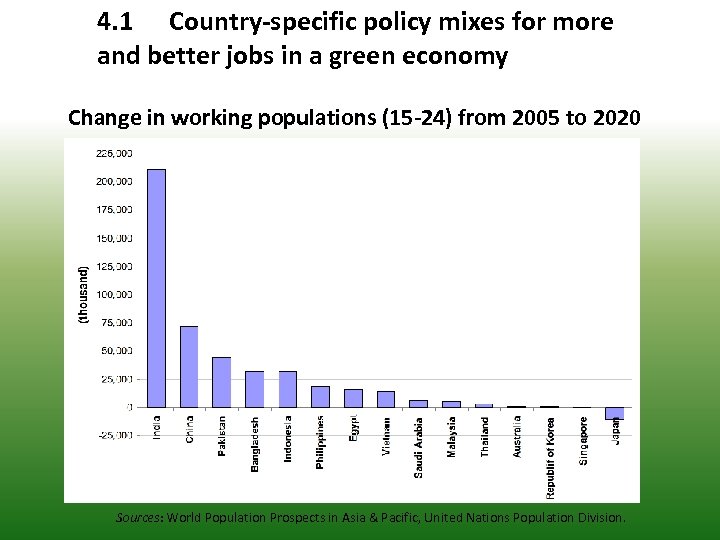
4. 1 Country-specific policy mixes for more and better jobs in a green economy Change in working populations (15 -24) from 2005 to 2020 Sources: World Population Prospects in Asia & Pacific, United Nations Population Division.
4. Effective policies and institutions 4. 1 4. 2 4. 3 Country-specific policy mixes for more and better jobs in a green economy Policy coherence through social dialogue Section 4 – Sum up
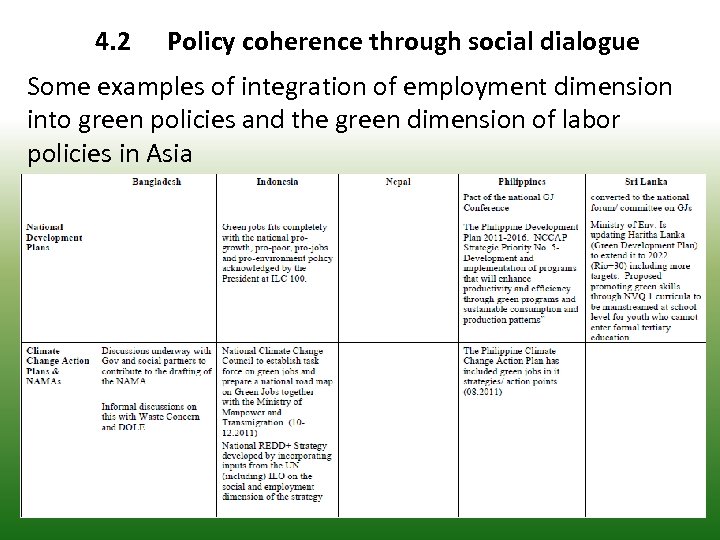
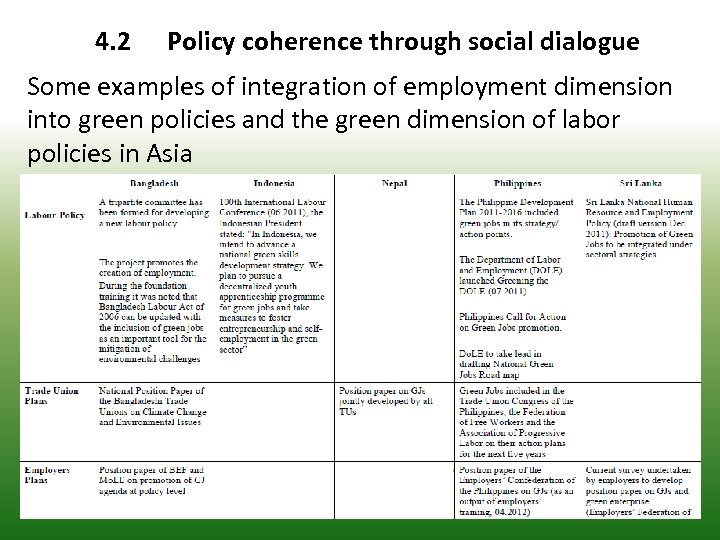
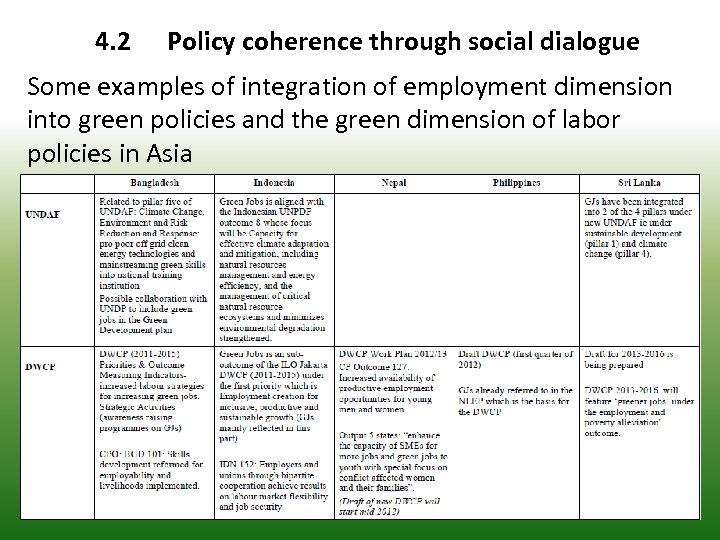
4. 2 Policy coherence through social dialogue • Social dialogue is essential to ensure a just, smooth transition for workers and enterprises towards a jobrich , sustainable economy with Decent Work for All; • Preliminary examples exist in the region of participation of social partners in planning process; • India Green Jobs Task Force chaired by DOLE; • Climate Change Action Plan of The Philippines • Malaysian Road Map on Green Jobs; • Employment Policy in Sri Lanka; • Decret on the creation of Employment Office addressing green jobs, Fiji; • Each country follows its own path;
4. 2 Policy coherence through social dialogue Examples of inter-ministerial working groups or national task forces dedicated to green job promotion • In Malaysia, Ministry of Energy, Green Technology and Water (Ke. TTHA) and Ministry of Human Resources (MOHR) facilitate inter-ministerial coordination on employment issues and green growth through Joint Secretariat of the Working Group on Green Jobs. • In the Philippines, an ad hoc Working Group for a Green Jobs Task Force. • In India a multi-stakeholder Task Force on Green Jobs set up under the chairmanship of the Labour Authorities. • Nepal, 12 -member multi-stakeholder National Task Force (NTF) was formed under the chairmanship of Secretary of Ministry of Labour and Employment.
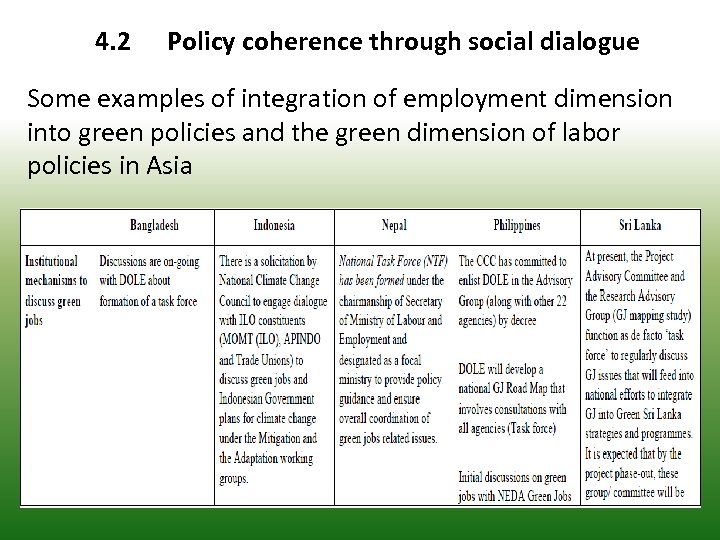
4. 2 Policy coherence through social dialogue Some examples of integration of employment dimension into green policies and the green dimension of labor policies in Asia
4. 2 Policy coherence through social dialogue Some examples of integration of employment dimension into green policies and the green dimension of labor policies in Asia
4. 2 Policy coherence through social dialogue Some examples of integration of employment dimension into green policies and the green dimension of labor policies in Asia
4. 2 Policy coherence through social dialogue Some examples of integration of employment dimension into green policies and the green dimension of labor policies in Asia
4. Effective policies and institutions 4. 1 4. 2 4. 3 Country-specific policy mixes for more and better jobs in a green economy Policy coherence through social dialogue Section 4 – Sum up
4. 3 Section 4 – Sum up • Green Jobs policies require a high degree of policy integration which call upon expertise and mandate which go beyond the competence of the actors of the world of work; • At the same time, well integrated green, labour and economic policies can only be guaranteed if social partners are associated at planning and implementation stages; • Those actually implementing on the ground the climate and other policies are the social partners; • Progress has been made in promoting social dialogue in this new area of work but there is still a long way to go, including on the international stage;
Contents 1. The environmental and employment challenges in in Asia & the Pacific 2. Decent Work, Green Jobs and Sustainable Development in Asia & the Pacific 3. Challenges and opportunities for green jobs 4. Effective policies and institutions 5. Achievements and lessons learnt from Asia & the Pacific 6. Scope for a supportive role by the ILO 7. Points for Discussion at ILC 102 (June 2013, Geneva)
5. Achievements and lessons learnt from green jobs activities in Asia & the Pacific 5. 1 5. 2 5. 3 Conclusions of the 15 th APRM, Kyoto, 03 -07 December 2011; Conclusions of the A&P regional tripartite Green Jobs Conference, Surabaya, August 2012; Lessons learnt from green jobs activities in the region
5. 1 Conclusions of the 15 th APRM, Dec. 2011, Kyoto The meeting was the opportunity for Labor Ministers and Heads of delegations to discuss for the first time in the region the issue of green jobs and greener growth. The following policy conclusions were reached: Meeting the demand for decent work • We are also increasingly aware of the impact economic development is having on our often fragile natural environment. Efforts across the region to address the effects of climate change and the greening of our economies hold great potential for increased opportunities for decent work (Concl. 22);
5. 1 Conclusions of the 15 th APRM, Dec. 2011, Kyoto Economic, employment and social policies • Working to ensure that decent work and full employment are at the heart of polices for strong, sustainable and balanced growth and inclusive development (Concl. 31); Sustainable enterprises, productive employment and skills development • Improving the enabling environment for sustainable enterprises, as important to creating the decent work opportunities our region needs (Concl. 39)
5. 1 Conclusions of the 15 th APRM, Dec. 2011, Kyoto Sustainable enterprises, productive employment and skills development (cont. ) • Promoting a well-designed transparent, accountable and well-communicated regulatory environment for business, including regulations that uphold labour and environmental standards (Concl. 40). • Promoting greener growth and green jobs, consistent with maintaining economic and social sustainability (Concl. 51) • Improving disaster preparedness and response capacity with a particular focus on the employment and social dimensions of relief and reconstruction (Concl. 53)
5. 1 Conclusions of the 15 th APRM, Dec. 2011, Kyoto Rights at work and social dialogue • Making full use of social dialogue to anticipate and address labour market changes, including those that will come with the transition to low-carbon economies (Concl. 58)
Main Outcomes on green jobs from 15 th APRM, Dec. 2011, Kyoto. 1. Green Jobs is prioritized under the labor agenda in Asia & the Pacific (the First/Only ILO region having done so, so far); 2. Today, the challenge in the A&P region is less, - whether constituents should address the need for green/greener jobs, - but rather, how ?
Main Outcomes on green jobs from 15 th APRM, Dec. 2011, Kyoto. 3. ‘Green Jobs’ is understood as a cross-cutting issue, which is relevant to ALL clusters under the regional labor agenda, namely: - Decent work - Economic, employment and social policies - Sustainable enterprises, productive employment and skills development - Rights at work and social dialogue More information is available @ http: //apgreenjobs. ilo. org/events/resources/meeting-resources/ilo 15 th-asia-and-the-pacific-regional-meeting-aprm-december-2011
5. Achievements and lessons learnt from green jobs activities in Asia & the Pacific 5. 1 5. 2 5. 3 Conclusions of the 15 th APRM, Kyoto, 03 -07 December 2011; Conclusions of the A&P regional tripartite Green Jobs Conference, Surabaya, August 2012; Lessons learnt from green jobs activities in the region
5. 2 Conclusions of the A&P regional tripartite Green Jobs Conference, Surabaya, August 2012; The Regional tripartite Green Jobs Conference (Surabaya, August 2012) attended by 11 countries in the region set some “priorities for action” and came up with the following sets of recommendations of each group: Government group 1. Research, and Policy Development, Implementation and Monitoring 2. Mechanisms for policy coordination and dialogue 3. Platforms for social dialogue 4. Mechanisms on sharing/ exchanging knowledge and good practices bilaterally and regionally 5. Guidelines on standard development
5. 2 Conclusions of the A&P regional tripartite Green Jobs Conference, Surabaya, August 2012; Employers group 1. Continued awareness raising and social dialogue 2. Mainstreaming green jobs into policy 3. Build the knowledge infrastructure (research, definitions, metrics, diagnostic, statistics, ISO/ILO working on standards). 4. Document, showcase and replicate best practices. Extend demonstration projects to more sectors. Highlight the business – benefits employers will accrue. 5. Capacity building and training
5. 2 Conclusions of the A&P regional tripartite Green Jobs Conference, Surabaya, August 2012; Workers group On awareness raising and capacity building: 1. Develop tailored materials and activities targeting all social partners, including trade union leadership, union advisers and workers at the shop floor, and rely on local experts. 2. Ensure materials incorporate ‘the basics’ of environmental challenges and their relationship with workers’ interests. 3. Promote integration of informal sector workers in all activities.
5. 2 Conclusions of the A&P regional tripartite Green Jobs Conference, Surabaya, August 2012; Workers group When it comes to demonstration projects, it is key that in the future: 1. There is a consultation with all the three constituents at the country level on the sectors and location of the projects. 2. There is real involvement of unions in all aspects of the project’s implementation, including evaluation and ILO constituents are beneficiaries of the project. 3. Projects support efforts towards formalization of workers and improving working conditions in all the dimensions of the DW agenda.
5. 2 Conclusions of the A&P regional tripartite Green Jobs Conference, Surabaya, August 2012; Workers group When it comes to demonstration projects, it is key that in the future: 4. Focus on sectors which represent a challenge for the environment in the countries, such as manufacturing, mining, etc. 5. There is continuous support for projects until they reach self-sustainability, and there is an ‘exit’ strategy for the ILO. The evaluation should be made public.
5. 2 Conclusions of the A&P regional tripartite Green Jobs Conference, Surabaya, August 2012; Workers group Finally, on policy, the Green Jobs Initiative should 1. Promote public policies on environmental protection which would make real the job potential of green jobs projects and mainstream them in development planning. 2. Assess the employment and distributional impacts of environmental degradation as well as of environmental policies. 3. Support the development and strengthen social protection systems, in order to secure incomes of those whose jobs and livelihoods might be at risk as a consequence of environmental changes/policies.
5. 2 Conclusions of the A&P regional tripartite Green Jobs Conference, Surabaya, August 2012; Workers group Finally, on policy, the Green Jobs Initiative should 4. Bring environmental issues to social dialogue structures, and develop partnerships with communities, NGO and academia. 5. Support local strategies to create alternative sources of jobs and livelihoods for regions that might suffer from the transition towards sustainability. 6. At the international level, it should develop a standard on green jobs which would identify roles and responsibilities in the transition towards sustainability and define the boundaries of green jobs work.
5. 2 Conclusions of the A&P regional tripartite Green Jobs Conference, Surabaya, August 2012; Summary of the conference prepared jointly by the tripartite Constituents In the final wrap-up session at the plenary, the following points were also highlighted. • Policy discussions around the concept and boundaries of green jobs in order to strengthen the awareness of constituents and the general public and further guide actions. • Mapping of green jobs at national level and identification of the potential for the greening of jobs and creation of new jobs 3.
5. 2 Conclusions of the regional tripartite Green Jobs Conference, Surabaya, August 2012; • Reinforced social dialogue as a way to promote green jobs. • Consolidation of examples of good practices and the business case for the promotion of green jobs from governments, trade unions and employers organizations in the region (and beyond). • Training and capacity building targeting ILO constituents • The mainstreaming of green jobs into ILO led activities with constituents, as necessary, i. e. skills, local economic development, social protection and social finance. More information is available @ http: //apgreenjobs. ilo. org/events/green-jobs-team/green-jobs -in-asia-regional-conference
5. Achievements and lessons learnt from Asia & the Pacific 5. 1 5. 2 5. 3 Conclusions of the 15 th APRM, Kyoto, 03 -07 December 2011; Conclusions of the A&P regional tripartite Green Jobs Conference, Surabaya, August 2012; Achievements and lessons learnt from green jobs activities in the region
5. 3 Achievements and lessons learnt from the green jobs activities in the region • Demonstration that Green Jobs can be a good vector of tripartite collaboration when dealing with such issues as working conditions and productivity, skills at the work place, green entrepreneurship, environmental protection & resource efficiency; • The recognition of the importance and relevance of the role of the World of Work at all levels of decision making; • Demonstration that environment and job creation can be mutually supportive;
5. 3 Achievements and lessons learnt from the Green Jobs Initiative in Asia & the Pacific • Green Jobs remains a new topic, requires time for Constituents to absorb, and for new collaborations and partnerships (MENV, Energy, CC Councils, etc. ); • Specific training required for Constituents, tailored to their needs for integrating GJ into national agendas; • Clarification needed on definitions and classifications of green jobs; • Adaptation to climate change is a priority in the region for local communities, enterprises and local governments, including at the work place (climate resilient enterprises);
5. 3 Achievements and lessons learnt from the Green Jobs Initiative in Asia & the Pacific • Opportunities exist in each country for more Green Jobs, including for the poor; • High number of requests from traditional partners, and non traditional ones which can not all be addressed; • Need for ILO to build on existing Tools and programs (greening, create few new ones); • Potential for accessing new sources of funds to the benefit of ILO Constituents (GEF, REDD+, others, );
5. 3 Achievements and lessons learnt from the Green Jobs Initiative in Asia & the Pacific • Recognition of the Need for a Just Transition for workers and enterprises to adapt to a changing environment; • The green transition has started in the region and globally – great disparity in Asia & the Pacific between countries, sectors; • Green jobs is becoming more central to the policy agenda in many countries;
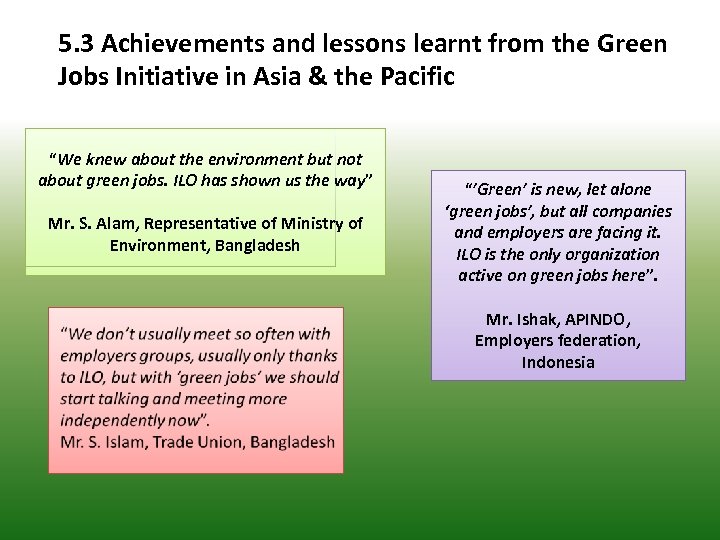
5. 3 Achievements and lessons learnt from the Green Jobs Initiative in Asia & the Pacific “We knew about the environment but not about green jobs. ILO has shown us the way” Mr. S. Alam, Representative of Ministry of Environment, Bangladesh “’Green’ is new, let alone ‘green jobs’, but all companies and employers are facing it. ILO is the only organization active on green jobs here”. Mr. Ishak, APINDO, Employers federation, Indonesia
Contents 1. The environmental and employment challenges in A & P 2. Decent Work, Green Jobs and Sustainable Development in Asia & the Pacific 3. Challenges and opportunities for green jobs 4. Effective policies and institutions 5. Achievements and lessons learnt from Asia & the Pacific 6. Scope for a supportive role by the ILO 7. Points for Discussion at ILC 102 (June 2013, Geneva)
6. Scope for a supportive role by the ILO 6. 1 6. 2 6. 3 Green jobs as a recognized cross-cutting issue and a full component of the labor agenda (APRM 15) ILO Decent Work Country Programs ILO support to South-South Cooperation
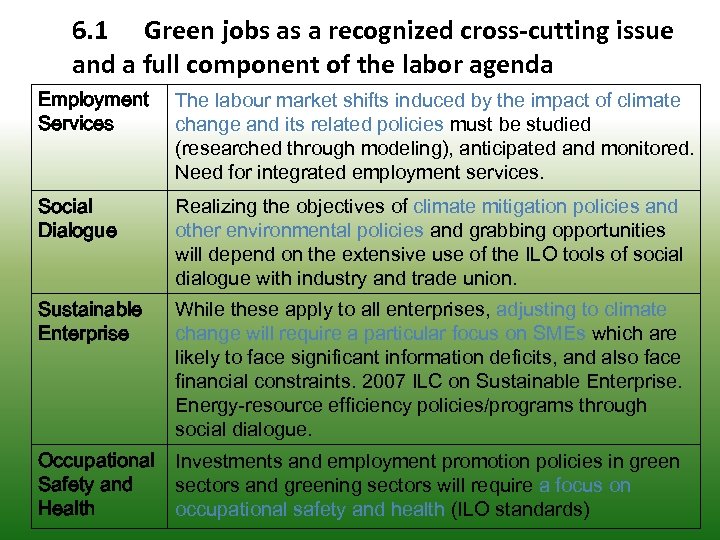
6. 1 Green jobs as a recognized cross-cutting issue and a full component of the labor agenda Employment Services The labour market shifts induced by the impact of climate change and its related policies must be studied (researched through modeling), anticipated and monitored. Need for integrated employment services. Social Dialogue Realizing the objectives of climate mitigation policies and other environmental policies and grabbing opportunities will depend on the extensive use of the ILO tools of social dialogue with industry and trade union. Sustainable Enterprise While these apply to all enterprises, adjusting to climate change will require a particular focus on SMEs which are likely to face significant information deficits, and also face financial constraints. 2007 ILC on Sustainable Enterprise. Energy-resource efficiency policies/programs through social dialogue. Occupational Safety and Health Investments and employment promotion policies in green sectors and greening sectors will require a focus on occupational safety and health (ILO standards)
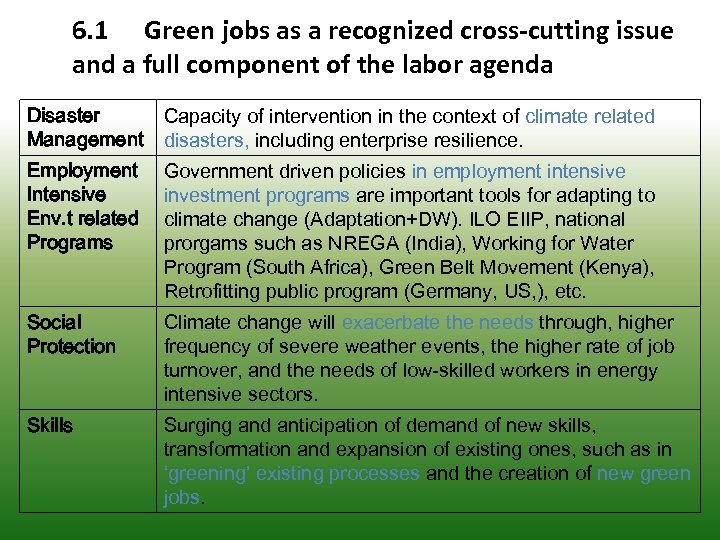
6. 1 Green jobs as a recognized cross-cutting issue and a full component of the labor agenda Disaster Capacity of intervention in the context of climate related Management disasters, including enterprise resilience. Employment Intensive Env. t related Programs Government driven policies in employment intensive investment programs are important tools for adapting to climate change (Adaptation+DW). ILO EIIP, national prorgams such as NREGA (India), Working for Water Program (South Africa), Green Belt Movement (Kenya), Retrofitting public program (Germany, US, ), etc. Social Protection Climate change will exacerbate the needs through, higher frequency of severe weather events, the higher rate of job turnover, and the needs of low-skilled workers in energy intensive sectors. Skills Surging and anticipation of demand of new skills, transformation and expansion of existing ones, such as in ‘greening’ existing processes and the creation of new green jobs.
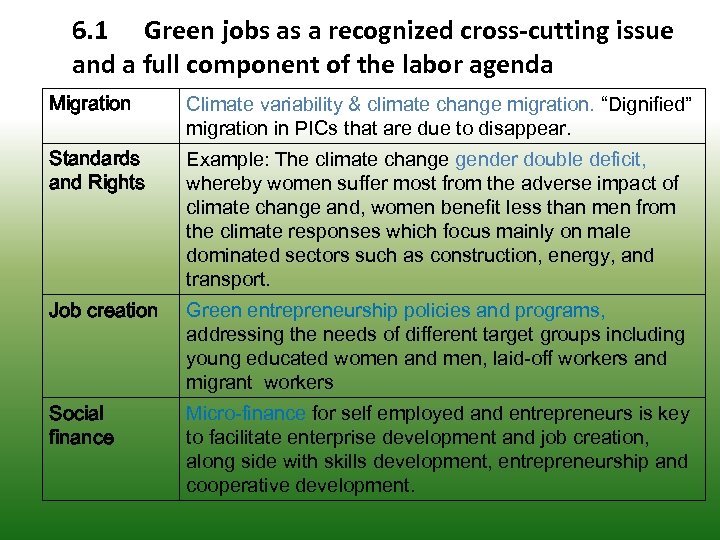
6. 1 Green jobs as a recognized cross-cutting issue and a full component of the labor agenda Migration Climate variability & climate change migration. “Dignified” migration in PICs that are due to disappear. Standards and Rights Example: The climate change gender double deficit, whereby women suffer most from the adverse impact of climate change and, women benefit less than men from the climate responses which focus mainly on male dominated sectors such as construction, energy, and transport. Job creation Green entrepreneurship policies and programs, addressing the needs of different target groups including young educated women and men, laid-off workers and migrant workers Social finance Micro-finance for self employed and entrepreneurs is key to facilitate enterprise development and job creation, along side with skills development, entrepreneurship and cooperative development.
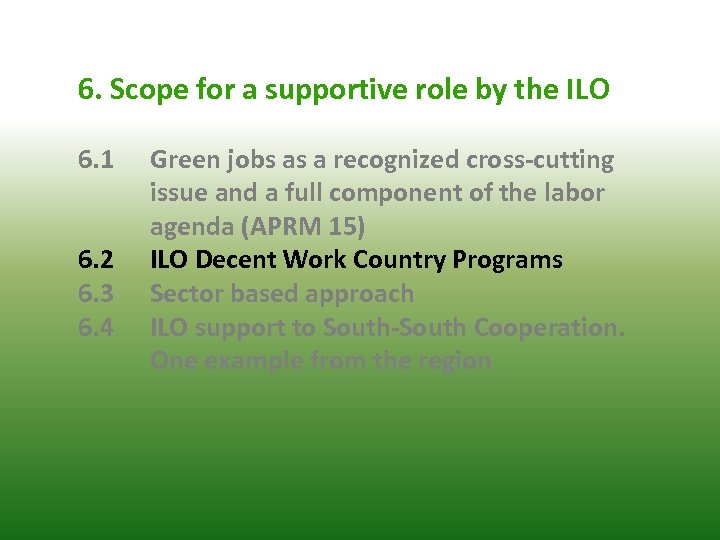
6. Scope for a supportive role by the ILO 6. 1 6. 2 6. 3 6. 4 Green jobs as a recognized cross-cutting issue and a full component of the labor agenda (APRM 15) ILO Decent Work Country Programs Sector based approach ILO support to South-South Cooperation. One example from the region
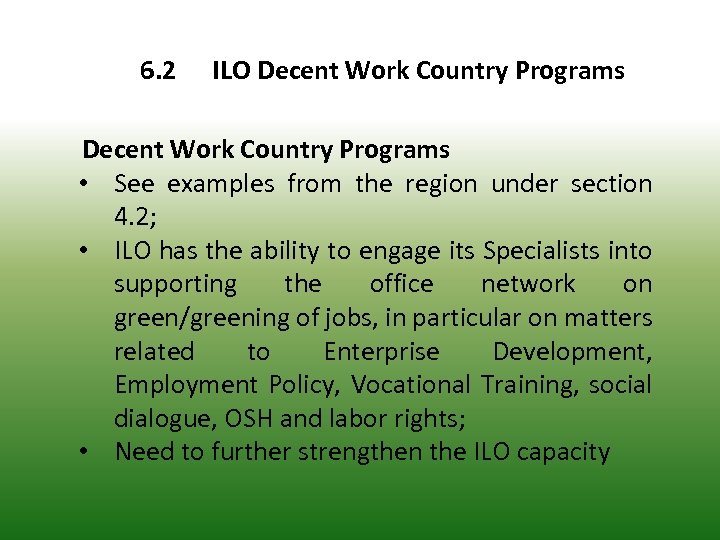
6. 2 ILO Decent Work Country Programs • See examples from the region under section 4. 2; • ILO has the ability to engage its Specialists into supporting the office network on green/greening of jobs, in particular on matters related to Enterprise Development, Employment Policy, Vocational Training, social dialogue, OSH and labor rights; • Need to further strengthen the ILO capacity
6. Scope for a supportive role by the ILO 6. 1 6. 2 6. 3 6. 4 Green jobs as a recognized cross-cutting issue and a full component of the labor agenda (APRM 15) ILO Decent Work Country Programs Sector based approach ILO support to South-South Cooperation. One example from the region
6. 3 Sector based approach • ILO develops a sector based integrated approach regarding greening; • Key priority sectors globally include recycling, construction, energy, tourism; • Integrated product line that includes: • ILO Policy briefs, support to regional integrated policies and programs, country projects, Information material, and training material covering competency based training, OSH, formalization processes and value chain development, entrepreneurship, etc. ;
6. 3 Sector based approach • Example Recycling • ILO Wide/Regional Integrated product line under development includes: • ILO Policy briefs and ILO Global Strategy for decent work in recycling (under development); • 2013 3 Rs Hanoi Declaration (on Reduce, Recycling, and Reuse); • E-waste Study (China), municipal waste VCD Study (Sri Lanka); • Entrepreneurship Training Material in the recycling economy (China GBO, Indonesia IGEP);
6. 3 Sector based approach • Example Recycling • ILO Wide/Regional Integrated product line under development includes: • OSH training, e. g. WARM and WARM II in PICs and Sri Lanka); • Development of OSH regulatory framework and competency based training for recycling (Sri Lanka); • E-waste formalization pilot project (China, pending); • Etc. ;
6. 3 Sector based approach • Example Recycling - 2013 3 Rs Hanoi Declaration (on Reducing, Recycling, and Reuse) • 30 countries from A & P (22+8) expressed their resolve to voluntarily develop, introduce and implement policy options, programmes, and projects towards realizing 33 sustainable 3 R goals in the region, encompassing: • creation of Decent Work; • greening of the value chain; • increase resource efficiency and productivity; • Promote green and socially responsible procurement;
6. 3 Sector based approach • Example Recycling - 2013 3 Rs Hanoi Declaration (cont. ) • gradually improve the working conditions and livelihood security, including mandatory provision of health insurance for all workers; • health and safety aspects; • Eliminate child labor; • Organize labor inspections in the informal sector; • Etc. More information available @ http: //apgreenjobs. ilo. org/events/events/fourth-regional-3 r-forumin-asia-from-18 -to-20 -march-2013 -in-ha-noi-viet-nam
6. Scope for a supportive role by the ILO 6. 1 6. 2 6. 3 6. 4 Green jobs as a recognized cross-cutting issue and a full component of the labor agenda (APRM 15) ILO Decent Work Country Programs Sector based approach ILO support to South-South Cooperation. One example from the region.
6. 3 ILO Support to South-South Cooperation IBSA Meeting, March 2012, Delhi • The International Conference on South-South Cooperation on "Innovations in Public Employment Programs and Sustainable Inclusive Growth" was held in New Delhi, India from 1 -3 March 2012 under the aegis of IBSA. The Conference was organized by the Ministry of Labor & Employment in collaboration with the Ministries of Rural Development and External Affairs, with the technical collaboration of the ILO. • 40 delegates from 22 countries from Asia, Africa and South America participated in the Conference.
6. 3 ILO Support to South-South Cooperation Conclusions of the IBSA Meeting, March 2012, Delhi 1. Recognized the need for promoting Decent Work and more Effective Public Employment and Social Protection Programs through South-South Triangular Cooperation through ILO; 2. Recalled the 4 th IBSA Summit Joint Declaration adopted in Brasilia on 15 April 2010, when the Prime Minister of India, the President of Brazil and the President of South Africa reiterated the need to promote a job-intensive recovery from the downturn and create a framework for sustainable growth and their support for the Global Jobs Pact;
6. 3 ILO Support to South-South Cooperation Conclusions of the IBSA Meeting, March 2012, Delhi 3. (. . ) 4. Recognized progress made in countries of the South in developing innovative solutions to the challenges of poverty and decent work gaps, such as India’s Mahatma Gandhi’s National Rural Employment Guarantee Scheme (MGNREGA), South Africa’s Expanded Public Works Programme (EPWP) and Brazil’s Bolsa Familia;
6. 3 ILO Support to South-South Cooperation Recommendations of the IBSA Meeting, March 2012, Delhi 1. To further develop and promote south-south and triangular cooperation in order to contribute effectively to the implementation of the Decent Work Agenda and its strategic objectives through the building of partnerships and exchanging of experiences in the fields of employment, social protection, rights at work and social dialogue; 2. To enhance policy dialogue and exchanges between India, Brazil, South Africa and all countries of the South and the ILO;
6. 3 ILO Support to South-South Cooperation Recommendations of the IBSA Meeting, March 2012, Delhi 3. To better appreciate the range of policy issues relevant to public employment programs/employment guarantees, green jobs and other innovative social protection schemes; 4. To provide and obtain guidance on the design of effective policies and programs and exchange these experiences among countries of the South; and, 5. To support and work with ILO’s South-South and Triangular Cooperation Initiative to foster greater solidarity and enhance equality among countries and peoples in the world of work.
Contents 1. The environmental and employment challenges in A & P 2. Decent Work, Green Jobs and Sustainable Development in Asia & the Pacific 3. Challenges and opportunities for green jobs 4. Effective policies and institutions 5. Achievements and lessons learnt from Asia & the Pacific 6. Scope for a supportive role by the ILO 7. Points for Discussion at ILC 102 (June 2013, Geneva)
7. Points for Discussion at ILC 102 1. What are the opportunities for more green and decent jobs? 2. What are the challenges arising from new regulations and price increases of energy and scarce resources? How will the incorporation of carbon as a cost (e. g. through eco-tax) affect different groups in the labour market? 3. What lessons from other transitions due to globalization, automation, ICT and related productivity increases?
7. Points for Discussion at ILC 102 (cont. ) 4. What policies and institutions can facilitate a just transition and minimize negative effects on jobs and enterprises? 5. Which priorities for the work of ILO? What means of action? 6. What roles for Member States and the social partners?
For additional information please see: http: //www. ilo. org/asia/areas/green-jobs/lang-en/index. htm http: //apgreenjobs. ilo. org/
Скачать презентацию ILC 2013 Agenda Item V on Sustainable Development
b151966640467511b4a2dfc68900c7dd.ppt