 Скачать презентацию IGS Overview Ruth Neilan IGS Central Bureau at
cac74f7f39a19c25ec8a6de3a873c450.ppt
- Количество слайдов: 31



IGS Overview Ruth Neilan IGS Central Bureau at JPL Pasadena, California USA
Content • Mission & History • Organization of the IGS – – Key Components Working Groups Pilot Projects Applications • Resources, IGS CB Information System
In Support of Science • The accuracies of the IGS data and products are to be sufficient to support scientific requirements – Access to and continued improvement of the ITRF (International Terrestrial Reference Frame) • Station position and velocities • Monitoring Earth rotation parameters – – – Monitoring deformation of the solid Earth and hydrosphere variations Precise time transfer Scientific satellite orbit determination, LEO’s Ionospheric monitoring and research Atmospheric applications - ground and space based for climate research, eventually weather forecasting
Historical Perspective Key factors in formation of IGS • All geodynamics and geodetic organizations realized the potential of GPS by early 90’s • Motivating goal: Millimeter positioning in support of science anywhere in the world • Not one agency can nor should assume the capital investment & recurring operations costs for the entire infrastructure • Join with key international partners to form federation, define cooperation, set standards, science quality driven • IGS History documented in Annual Report Series (1994)
Organization of the International GPS Service
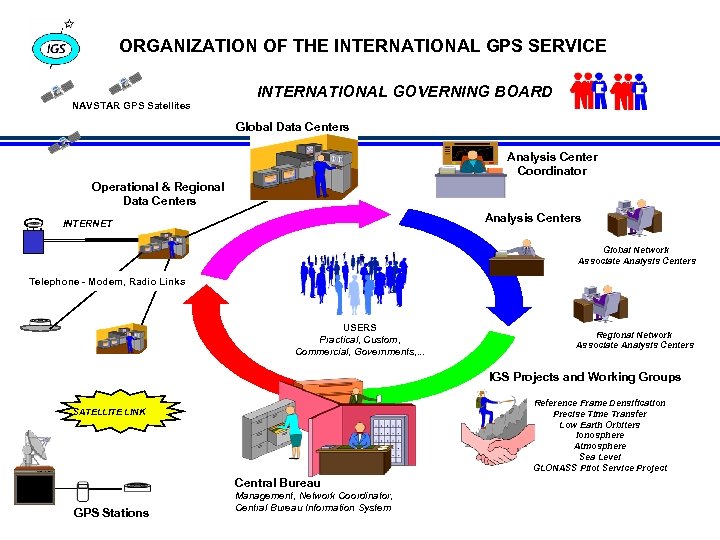
ORGANIZATION OF THE INTERNATIONAL GPS SERVICE NAVSTAR GPS Satellites INTERNATIONAL GOVERNING BOARD Global Data Centers Analysis Center Coordinator Operational & Regional Data Centers Analysis Centers INTERNET Global Network Associate Analysis Centers Telephone - Modem, Radio Links USERS Practical, Custom, Commercial, Governments, . . . Regional Network Associate Analysis Centers IGS Projects and Working Groups Reference Frame Densification Precise Time Transfer Low Earth Orbiters Ionosphere Atmosphere Sea Level GLONASS Pilot Service Project SATELLITE LINK Central Bureau GPS Stations Management, Network Coordinator, Central Bureau Information System
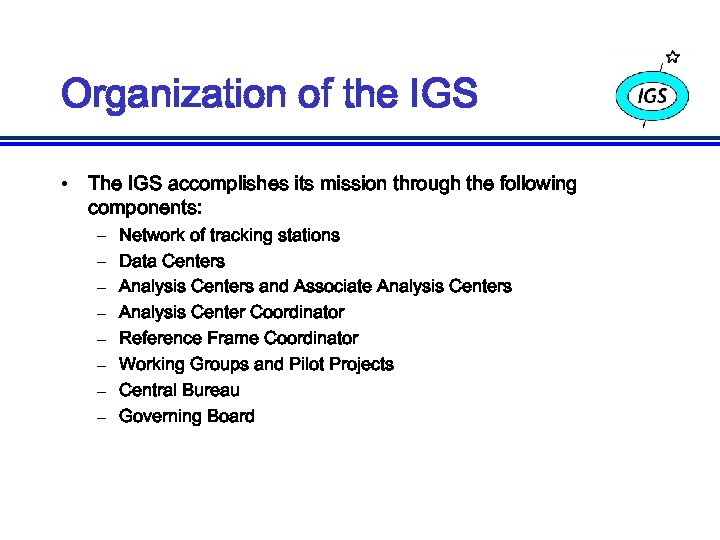
Organization of the IGS • The IGS accomplishes its mission through the following components: – – – – Network of tracking stations Data Centers Analysis Centers and Associate Analysis Centers Analysis Center Coordinator Reference Frame Coordinator Working Groups and Pilot Projects Central Bureau Governing Board
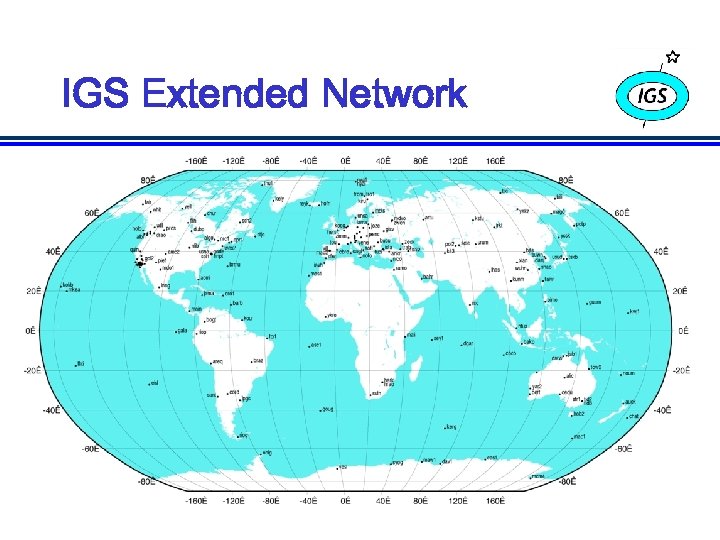
IGS Extended Network
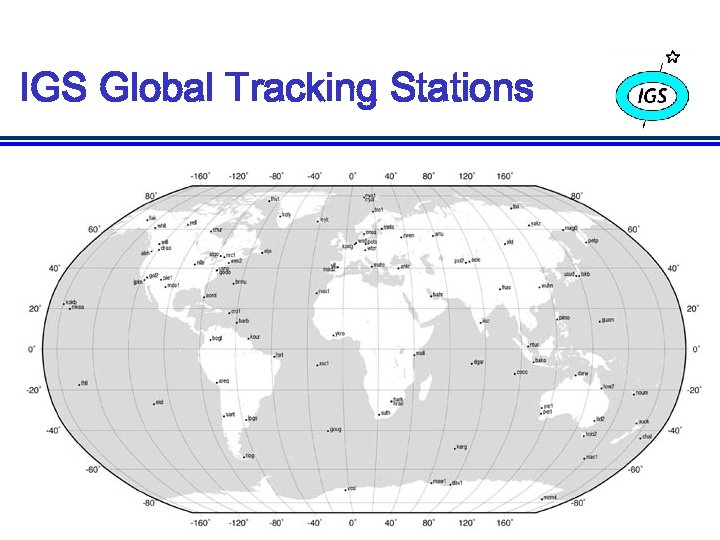
IGS Global Tracking Stations
Data Centers of the IGS Data Centers have three categories (see IGS Data Center Presentation) • Operational Centers have direct contact with the stations • Regional Centers store all data from a geographic region, some for a special application • Global Data Centers (GDC) are the main interface with Analysis Centers and Users, store all data used by Analysis Centers and all IGS products – Crustal Dynamics Data Information System – Institut Geographique National – Scripps Institution of Oceanography
Analysis Centers of the IGS • • Analysis Centers have two categories: – Analysis Centers produce daily products on a continuous basis – Associate Analysis Centers produce unique products such as station coordinates and velocities, tropospheric information; ionosphere information; they may facilitate distributed processing, analyze dense regional networks, combine network solutions, etc. • Global Network Associate Analysis Centers (GNAAC) • Regional Network Associate Analysis Centers (RNAAC) Products and applications of the ACs, see IGS Product presentation.
IGS Analysis Centers • Analysis Centers – Astronomical Institute University of Bern, Switzerland - CODE – European Space Operations Center / European Space Agency, Germany - ESOC – FLINN Analysis Center, Jet Propulsion Laboratory, USA- JPL – Geo. Forschungs. Zentrum, Germany - GFZ – Geosciences Lab, National Geodetic Survey, USA- NGS – Natural Resources Canada, Canada- NRCAN (EMR) – Scripps Institution of Oceanography, USA – SIO – US Naval Observatory, USA - USNO • Analysis Coordinator: Tim Springer, University of Bern, formerly Jan Kouba, Natural Resources Canada
IGS Central Bureau • The Central Bureau is responsible for general management of the IGS and acts as the executive arm of the Governing Board. The CB is located at NASA’s Jet Propulsion Laboratory. • The primary functions of the CB are to: – – – Coordinate and manage IGS activities IGS Network Coordination responsibilities formalized in 1998 Establish and promote compliance to IGS network standards Monitor network operations and quality assurance of data Develop and operate the Central Bureau Information System (CBIS) website Act as day-to-day liaison with external agencies worldwide
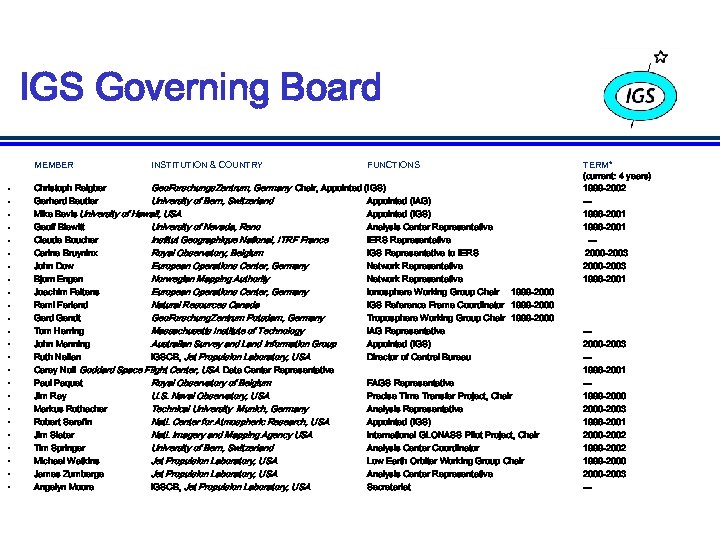
IGS Governing Board MEMBER • • • • • • INSTITUTION & COUNTRY FUNCTIONS Christoph Reigber Geo. Forschungs. Zentrum, Germany Chair, Appointed (IGS) Gerhard Beutler University of Bern, Switzerland Appointed (IAG) Mike Bevis University of Hawaii, USA Appointed (IGS) Geoff Blewitt University of Nevada, Reno Analysis Center Representative Claude Boucher Institut Geographique National, ITRF France IERS Representative Carine Bruyninx Royal Observatory, Belgium IGS Representative to IERS John Dow European Operations Center, Germany Network Representative Bjorn Engen Norwegian Mapping Authority Network Representative Joachim Feltens European Operations Center, Germany Ionosphere Working Group Chair 1999 -2000 Remi Ferland Natural Resources Canada IGS Reference Frame Coordinator 1999 -2000 Gerd Gendt Geo. Forschung. Zentrum Potsdam, Germany Troposphere Working Group Chair 1999 -2000 Tom Herring Massachusetts Institute of Technology IAG Representative John Manning Australian Survey and Land Information Group Appointed (IGS) Ruth Neilan IGSCB, Jet Propulsion Laboratory, USA Director of Central Bureau Carey Noll Goddard Space Flight Center, USA Data Center Representative Paul Paquet Royal Observatory of Belgium FAGS Representative Jim Ray U. S. Naval Observatory, USA Precise Time Transfer Project, Chair Markus Rothacher Technical University Munich, Germany Analysis Representative Robert Serafin Natl. Center for Atmospheric Research, USA Appointed (IGS) Jim Slater Natl. Imagery and Mapping Agency USA International GLONASS Pilot Project, Chair Tim Springer University of Bern, Switzerland Analysis Center Coordinator Michael Watkins Jet Propulsion Laboratory, USA Low Earth Orbiter Working Group Chair James Zumberge Jet Propulsion Laboratory, USA Analysis Center Representative Angelyn Moore IGSCB, Jet Propulsion Laboratory, USA Secretariat TERM* (current: 4 years) 1999 -2002 --1998 -2001 -- 2000 -2003 1998 -2001 --2000 -2003 --1998 -2001 --1999 -2000 -2003 1998 -2001 2000 -2002 1999 -2000 -2003 ---
Contributing Organizations & People • Over 80 Contributing Organizations • 108 Associate Members • More than 1200 Corresponding Members • See Resource Sheets (Pages 4 – 7) for details
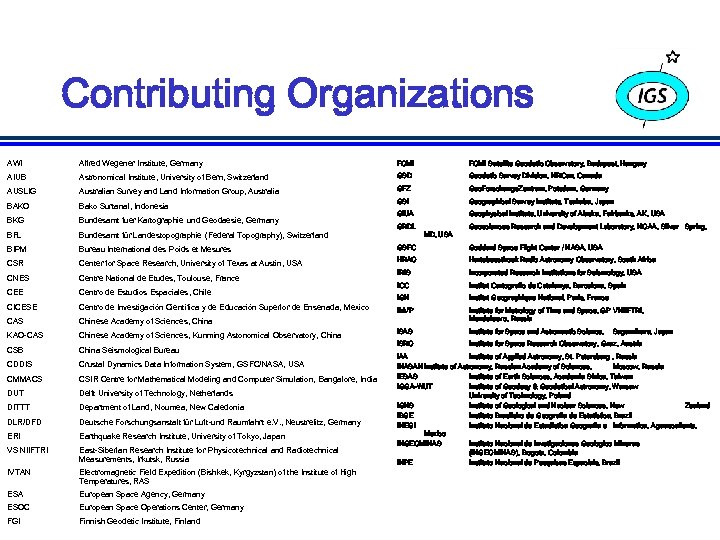
Contributing Organizations AWI Alfred Wegener Institute, Germany FOMI Satellite Geodetic Observatory, Budapest, Hungary Astronomical Institute, University of Bern, Switzerland GSD Geodetic Survey Division, NRCan, Canada AUSLIG Australian Survey and Land Information Group, Australia GFZ Geo. Forschungs. Zentrum, Potsdam, Germany BAKO Bako Surtanal, Indonesia GSI Geographical Survey Institute, Tsukuba, Japan BKG Bundesamt fuer Kartographie und Geodaesie, Germany GIUA Geophysical Institute, University of Alaska, Fairbanks, AK, USA BFL Bundesamt für Landestopographie (Federal Topography), Switzerland BIPM Bureau International des Poids et Mesures GSFC Goddard Space Flight Center / NASA, USA CSR Center for Space Research, University of Texas at Austin, USA HRAO Hartebeesthoek Radio Astronomy Observatory, South Africa CNES Centre National de Etudes, Toulouse, France IRIS Incorporated Research Institutions for Seismology, USA CEE Centro de Estudios Espaciales, Chile ICC Institut Cartografic de Catalunya, Barcelona, Spain CICESE Centro de Investigación Científica y de Educación Superior de Ensenada, Mexico IGN Institut Geographique National, Paris, France IMVP CAS Chinese Academy of Sciences, China Institute for Metrology of Time and Space, GP VNIIFTRI, Mendeleevo, Russia KAO-CAS Chinese Academy of Sciences, Kunming Astonomical Observatory, China ISAS Institute for Space and Astronautic Science, CSB China Seismological Bureau ISRO Institute for Space Research Observatory, Graz, Austria CDDIS Crustal Dynamics Data Information System, GSFC/NASA, USA CMMACS CSIR Centre for Mathematical Modeling and Computer Simulation, Bangalore, India DUT Delft University of Technology, Netherlands DITTT Department of Land, Noumea, New Caledonia DLR/DFD Deutsche Forschungsanstalt für Luft-und Raumfahrt e. V. , Neustrelitz, Germany ERI Earthquake Research Institute, University of Tokyo, Japan VS NIIFTRI East-Siberian Research Institute for Physicotechnical and Radiotechnical Measurements, Irkutsk, Russia IVTAN Electromagnetic Field Expedition (Bishkek, Kyrgyzstan) of the Institute of High Temperatures, RAS ESA European Space Agency, Germany ESOC European Space Operations Center, Germany FGI Finnish Geodetic Institute, Finland AIUB GRDL MD, USA Geosciences Research and Development Laboratory, NOAA, Silver Spring, Sagamihara, Japan IAA Institute of Applied Astronomy, St. Petersburg , Russia INASAN Institute of Astronomy, Russian Academy of Sciences, Moscow, Russia IESAS Institute of Earth Sciences, Academia Sinica, Taiwan IGGA-WUT Institute of Geodesy & Geodetical Astronomy, Warsaw University of Technology, Poland IGNS Institute of Geological and Nuclear Sciences, New Zealand IBGE Instituto Brasileiro de Geografia de Estatistica, Brazil INEGI Instituto Nacional de Estadistica Geografia e Informatica, Aguascaliente, Mexico INGEOMINAS Instituto Nacional de Invetigaciones Geologico Mineras (INGEOMINAS), Bogota, Colombia INPE Instituto Nacional de Pesquisas Espaciais, Brazil
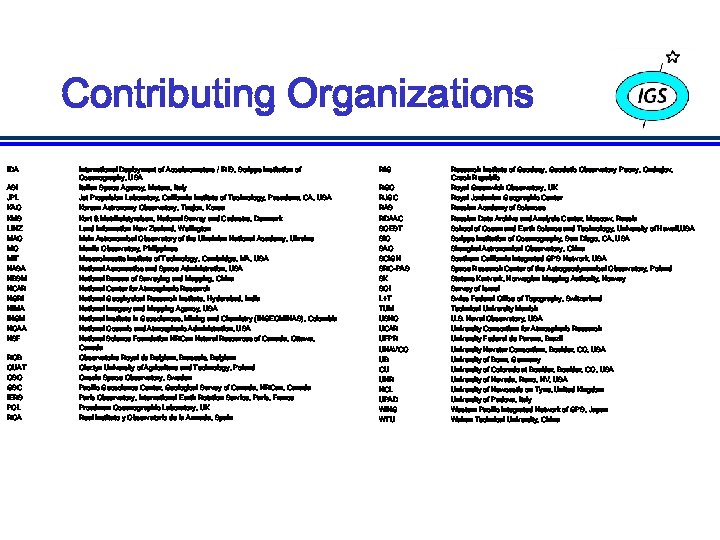
Contributing Organizations IDA ASI JPL KAO KMS LINZ MAO MO MIT NASA NBSM NCAR NGRI NIMA INGM NOAA NSF ROB OUAT OSO GSC IERS POL ROA International Deployment of Accelerometers / IRIS, Scripps Institution of Oceanography, USA Italian Space Agency, Matera, Italy Jet Propulsion Laboratory, California Institute of Technology, Pasadena, CA, USA Korean Astronomy Observatory, Taejon, Korea Kort & Matrikelstyrelsen, National Survey and Cadastre, Denmark Land Information New Zealand, Wellington Main Astronomical Observatory of the Ukrainian National Academy, Ukraine Manila Observatory, Philippines Massachusetts Institute of Technology, Cambridge, MA, USA National Aeronautics and Space Administration, USA National Bureau of Surveying and Mapping, China National Center for Atmospheric Research National Geophysical Research Institute, Hyderabad, India National Imagery and Mapping Agency, USA National Institute in Geosciences, Mining and Chemistry (INGEOMINAS), Colombia National Oceanic and Atmospheric Administration, USA National Science Foundation NRCan Natural Resources of Canada, Ottawa, Canada Observatoire Royal de Belgium, Brussels, Belgium Olsztyn University of Agriculture and Technology, Poland Onsala Space Observatory, Sweden Pacific Geoscience Center, Geological Survey of Canada, NRCan, Canada Paris Observatory, International Earth Rotation Service, Paris, France Proudman Oceanographic Laboratory, UK Real Instituto y Observatorio de la Armada, Spain RIG RGO RJGC RAS RDAAC SOEST SIO SAO SCIGN SRC-PAS SK SOI L+T TUM USNO UCAR UFPR UNAVCO UB CU UNR NCL UPAD WING WTU Research Institute of Geodesy, Geodetic Observatory Pecny, Ondrejov, Czech Republic Royal Greenwich Observatory, UK Royal Jordanian Geographic Center Russian Academy of Sciences Russian Data Archive and Analysis Center, Moscow, Russia School of Ocean and Earth Science and Technology, University of Hawaii, USA Scripps Institution of Oceanography, San Diego, CA, USA Shanghai Astronomical Observatory, China Southern California Integrated GPS Network, USA Space Research Center of the Astrogeodynamical Observatory, Poland Statens Kartverk, Norwegian Mapping Authority, Norway Survey of Israel Swiss Federal Office of Topography, Switzerland Technical University Munich U. S. Naval Observatory, USA University Consortium for Atmospheric Research University Federal de Parana, Brazil University Navstar Consortium, Boulder, CO, USA University of Bonn, Germany University of Colorado at Boulder, CO, USA University of Nevada, Reno, NV, USA University of Newcastle on Tyne, United Kingdom University of Padova, Italy Western Pacific Integrated Network of GPS, Japan Wuhan Technical University, China
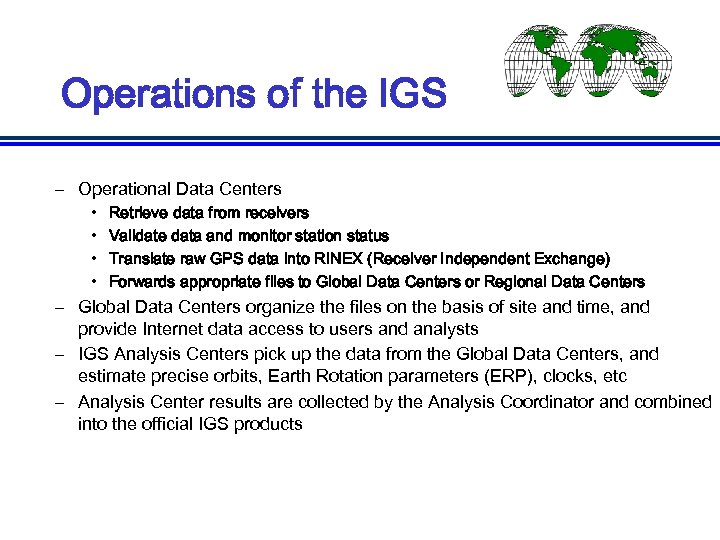
Operations of the IGS – Operational Data Centers • • Retrieve data from receivers Validate data and monitor station status Translate raw GPS data into RINEX (Receiver Independent Exchange) Forwards appropriate files to Global Data Centers or Regional Data Centers – Global Data Centers organize the files on the basis of site and time, and provide Internet data access to users and analysts – IGS Analysis Centers pick up the data from the Global Data Centers, and estimate precise orbits, Earth Rotation parameters (ERP), clocks, etc – Analysis Center results are collected by the Analysis Coordinator and combined into the official IGS products
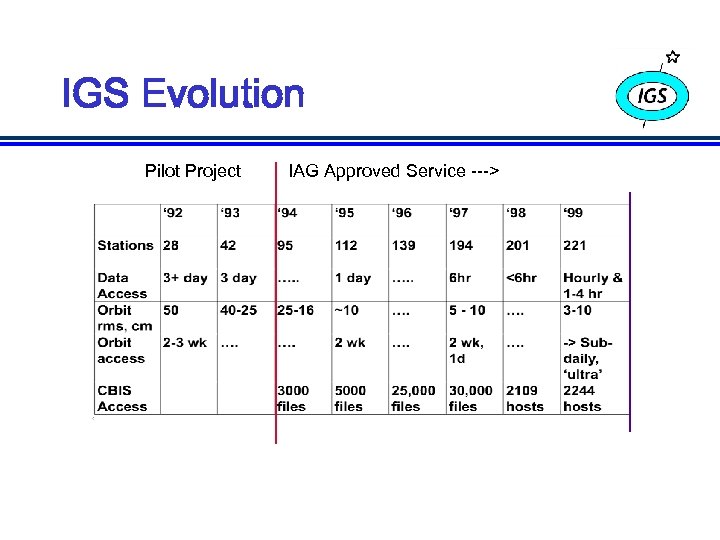
IGS Evolution Pilot Project IAG Approved Service --->
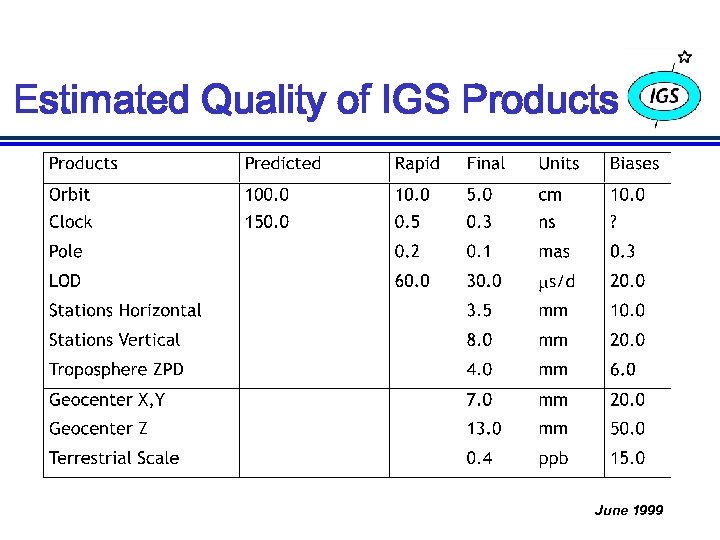
Estimated Quality of IGS Products June 1999
Network Densification • In 1993 the IGS realized that simultaneous processing of many stations was impractical • IGS groups began investigating the rigorous combination of solutions rather than raw data analysis – 1994 Workshop on Densification of the International Terrestrial Reference Frame initiated – SINEX - Solution Independent Exchange Format accepted in 1996 – Combination of global station solutions since late ‘ 96 – Polyhedron Solutions improving (see Annual Report Series) – IGS contribution to ITRF significant • Establish IGS Reference Frame Coordinator June ‘ 99 at Natural Resources of Canada, Remi Ferland
Densification Project Densified IGS network of ~200 - 250 globally well distributed sites -- goal that any user is within 1500 - 2000 km of a precise reference station – Regional analyses produced by Associate Analysis Centers called RNAACs (Regional Network Analysis Center) who • produce solutions for regional network using IGS products Solutions written into an ascii format call SINEX, Solution Independent Exchange format – Regional solution is made available to Global Network Analysis Centers (GNAACs) who • combine and compare solutions from all regional analysis centers • Result is a dense homogeneous network of stations in unique, consistent reference frame (ITRF)
IGS/BIPM Precise Time Transfer • Chaired by J. Ray, USNO (USA) & F. Arias, BIPM (France) Study accurate time and frequency comparisons – Develop operational strategies to exploit GPS measurements for improved accurate time and frequency comparisons world • Significant to maintaining UTC as new generation of frequency standards emerge – New/upgrade receivers at time labs – Data analysis – Key issue is calibration of instrumental delays to relate GPS clock estimates to external standards – Time transfer comparisons, simultaneously with independent techniques
Ionosphere Working Group • Chaired by J. Feltens, ESA-ESOC, Germany • Working group, active through increasing solar maximum – Calibration of Radio Signals (GPS and others) – Ionosphere Maps • Develop combined IGS global ION maps • Validation of maps, may lead to improved IGS ionosphere model – Assessing stochastic behavior of the Ionosphere – Supported high rate GPS data acquisition and analysis during August 11, 1999 solar eclipse • IONEX is the ascii file exchange format; these files can be accessed at the Global Data Centers
LEO (Low Earth Orbiters) • Working Group chaired by M. Watkins, JPL, USA – Determine role of IGS in future GPS LEO missions, POD +? – Oersted, Sunsat, SAC-C, CHAMP, GRACE, GLAS, … – Support of LEO occultation experiments for atmospheric profiling • IGS Network component, obvious infrastructure to support robust, high-rate, low latency data requirements – Other applications require timely availability of data (seconds to hourly) • Discussing LEO data as element of IGS – Analyze effects of inclusion in analysis, improve IGS Products? – Evaluate potential contribution of AC’s to LEO effort • Use early missions as case studies and analysis proof of concept
Troposphere Project • Chaired by G. Gendt, GFZ, Germany • Continuous well distributed measurements of water vapor are of great interest for numerical weather prediction, climate research and atmospheric studies – Collocation of precise meteorological instruments to convert Zenith Path Delay (ZPD) to Percipitable Water Vapor (PWV), need dry delay from barometric pressure, more meteorological instruments needed – Zenith Path Delay (ZPD) estimated by all IGS AC – ~100 sites, combined ZPD at 2 hour interval – Consistency of Combination among Acs at 4 mm level – Comparison to Water Vapor Radiometer (WVR) at Potsdam agree to 1 mm of Precipitable Water Vapor (PWV) • Official product available at GDC’s & CBIS
GLONASS Pilot Service • International GLONASS experiment IGEX, Investigated uses of GLONASS for geodetic and geophysical applications – – October’ 98 - April’ 99, 61 GLONASS sites, 30 SLR stations Interoperability of GPS/GLONASS Precise Orbit determination and reference frame: PZ 90 - ITRF 96/97 Time offsets between GPS and GLONASS systems to UTC – Orbits average throughout ~ 20 - 30 cm between ACs – 1 m level comparisons GPS-SLR solutions • Demonstrates the extensibility of IGS to accommodate other microwave systems, e. g. GALILEO, GNSS • Pilot Service charter approved by IGSCB, effort led by J. Slater, NIMA USA
Sea Level Monitoring • GPS for monitoring tide gauge benchmarks (TGBM) and altimeter calibration – Decouple crustal deformation effects at tide gauge benchmarks from ‘true’ long term sea level trends • IGS/PSMSL (Permanent Service for Mean Sea Level) -- Cross discipline, joint activity • Currently an seed initiative, not yet a full working group in IGS • Recommendations stemming from 1997 workshop, see IGS publications • Technical specifications development led by M. Bevis, University of Hawaii, USA, member IGS GB, Chair of IAG Subcommission VIII – Recent list prepared of GPS at TGBM (IGSMail #2501)
IGS Web Site The Central Bureau Information System is a key resource for all users • One of the first websites in 1993, originally developed with W. Gurtner , AIUB • IGSMail, IGS Reports • IGS Directory, Calendar • On-line Publications • Links to IGS sites and other locations of interest • Rich FTP archives • Tracking station information, site logs, network information • FAQ
Summary • The economics of GPS make the measurement technology available to all IGS users • The organization and outreach of the IGS enables users to take advantage of data, systems, and products developed cooperatively with the top international GPS experts • Through the IGS standards are developed and adopted worldwide, contributing to robust, homogenous reference frame and implementing common processes • IGS is a supporting foundation for nearly all GPS projects and numerous applications
Conclusion • Tutorial development is our approach to promote extended and appropriate use of IGS products – Plan to continue developing tutorial – Many thanks to those involved in preparing the tutorial – Special thanks to Jan Kouba for coordinating this effort • It is the dedicated contribution of many people and organizations that make the IGS so successful!
Скачать презентацию IGS Overview Ruth Neilan IGS Central Bureau at
cac74f7f39a19c25ec8a6de3a873c450.ppt