


 Скачать презентацию IGARSS 2001 Earth Science System of the Future
ae364893196d64ebf4a9407581cd9169.ppt
- Количество слайдов: 8
 IGARSS 2001 Earth Science System of the Future: Observing, Processing, and Delivering Data Products Directly to Users David Crisp, Kevin Delin, Yi Chao, Loren Lemmerman Jet Propulsion Laboratory/California Institute of Technology Eduardo Torres, NASA Goddard Space Flight Center, Granville Paules, NASA Headquarters July 10, 2001
 Overview • Advances in our understanding and ability to predict changes in our environment will require – more comprehensive and coordinated measurements, – End-to-end data delivery systems – Advanced data assimilation and modeling tools. • The advanced Earth observing system will incorporate an integrated web of sensors deployed on the surface, in the air, and in space. – The space-based assets will include • Active and passive sensors in low Earth orbit, • Large aperture sensors in geostationary orbits • Sentinel satellites at L 1 and L 2. – Data from these platforms will be coordinated by an advanced, semiautonomous, network • links these systems each other • provides a seamless interface with data processing centers. • Advanced numerical modeling tools will be used to rapidly assimilate, evaluate, and disseminate this information directly to users. • To illustrate utility of this system architecture, we describe its application to studies of rapidly evolving natural hazards.
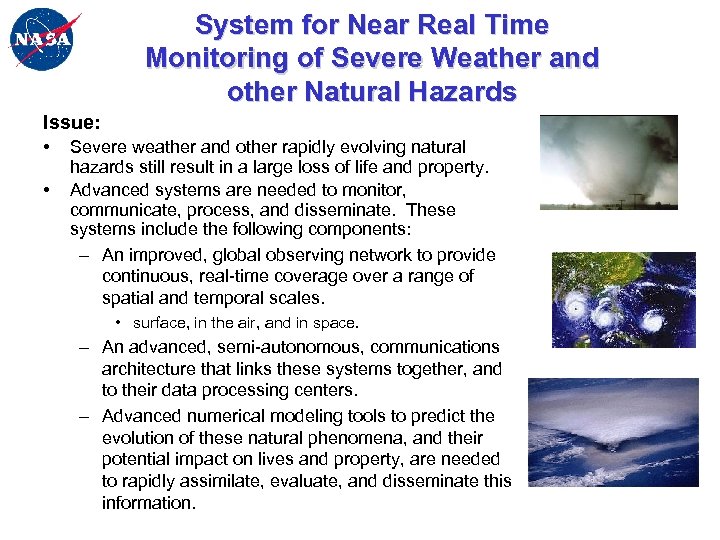 System for Near Real Time Monitoring of Severe Weather and other Natural Hazards Issue: • • Severe weather and other rapidly evolving natural hazards still result in a large loss of life and property. Advanced systems are needed to monitor, communicate, process, and disseminate. These systems include the following components: – An improved, global observing network to provide continuous, real-time coverage over a range of spatial and temporal scales. • surface, in the air, and in space. – An advanced, semi-autonomous, communications architecture that links these systems together, and to their data processing centers. – Advanced numerical modeling tools to predict the evolution of these natural phenomena, and their potential impact on lives and property, are needed to rapidly assimilate, evaluate, and disseminate this information.
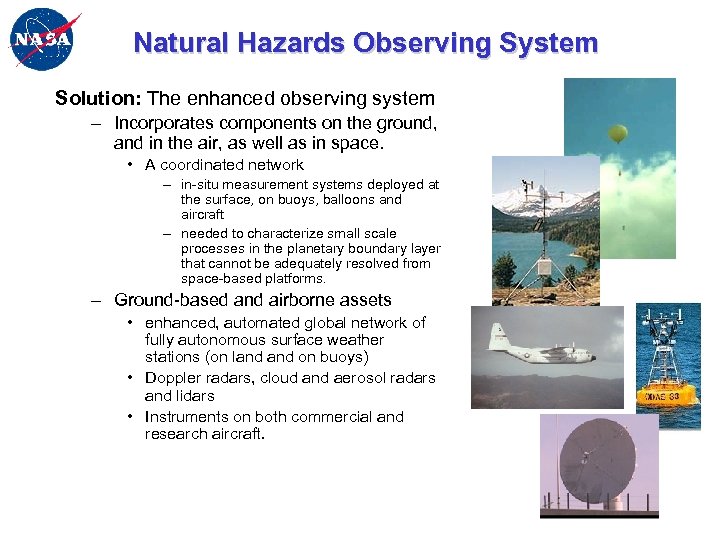 Natural Hazards Observing System Solution: The enhanced observing system – Incorporates components on the ground, and in the air, as well as in space. • A coordinated network – in-situ measurement systems deployed at the surface, on buoys, balloons and aircraft – needed to characterize small scale processes in the planetary boundary layer that cannot be adequately resolved from space-based platforms. – Ground-based and airborne assets • enhanced, automated global network of fully autonomous surface weather stations (on land on buoys) • Doppler radars, cloud and aerosol radars and lidars • Instruments on both commercial and research aircraft.
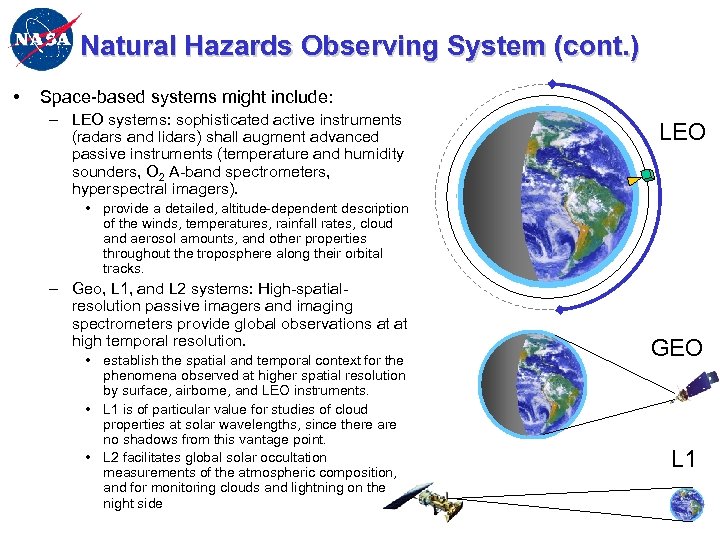 Natural Hazards Observing System (cont. ) • Space-based systems might include: – LEO systems: sophisticated active instruments (radars and lidars) shall augment advanced passive instruments (temperature and humidity sounders, O 2 A-band spectrometers, hyperspectral imagers). LEO • provide a detailed, altitude-dependent description of the winds, temperatures, rainfall rates, cloud and aerosol amounts, and other properties throughout the troposphere along their orbital tracks. – Geo, L 1, and L 2 systems: High-spatialresolution passive imagers and imaging spectrometers provide global observations at at high temporal resolution. • establish the spatial and temporal context for the phenomena observed at higher spatial resolution by surface, airborne, and LEO instruments. • L 1 is of particular value for studies of cloud properties at solar wavelengths, since there are no shadows from this vantage point. • L 2 facilitates global solar occultation measurements of the atmospheric composition, and for monitoring clouds and lightning on the night side GEO L 1
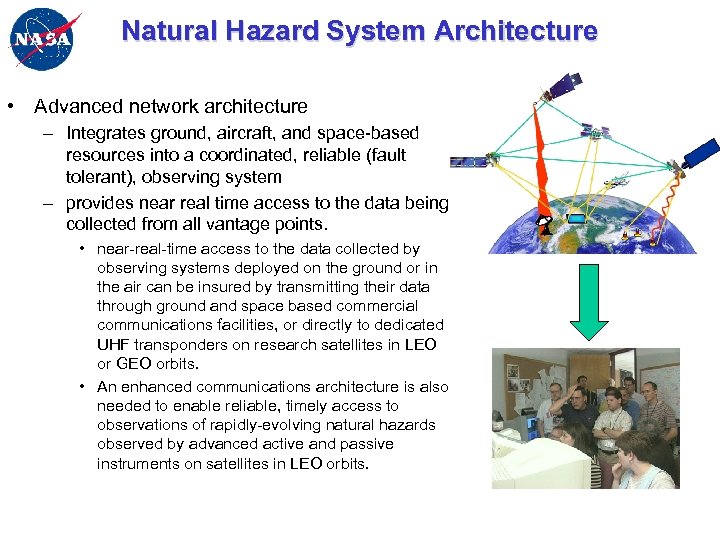 Natural Hazard System Architecture • Advanced network architecture – Integrates ground, aircraft, and space-based resources into a coordinated, reliable (fault tolerant), observing system – provides near real time access to the data being collected from all vantage points. • near-real-time access to the data collected by observing systems deployed on the ground or in the air can be insured by transmitting their data through ground and space based commercial communications facilities, or directly to dedicated UHF transponders on research satellites in LEO or GEO orbits. • An enhanced communications architecture is also needed to enable reliable, timely access to observations of rapidly-evolving natural hazards observed by advanced active and passive instruments on satellites in LEO orbits.
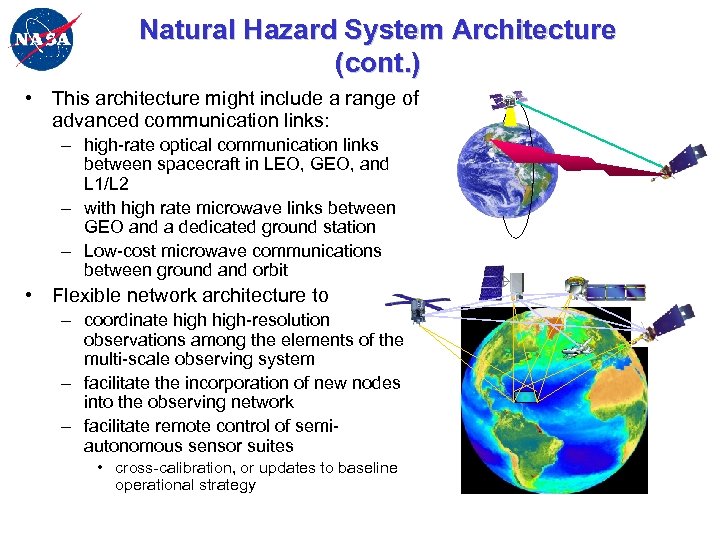 Natural Hazard System Architecture (cont. ) • This architecture might include a range of advanced communication links: – high-rate optical communication links between spacecraft in LEO, GEO, and L 1/L 2 – with high rate microwave links between GEO and a dedicated ground station – Low-cost microwave communications between ground and orbit • Flexible network architecture to – coordinate high-resolution observations among the elements of the multi-scale observing system – facilitate the incorporation of new nodes into the observing network – facilitate remote control of semiautonomous sensor suites • cross-calibration, or updates to baseline operational strategy
 Conclusions and Other Applications • An approach that employs coordinated observations, analysis, and data delivery from a distributed sensor web, would also be of great value for studying other aspects of Earth system science. – Ideal for studying the spatially and temporally varying processes that control the Earth’s solar and thermal radiation budgets. – Both in-situ measurements and remote sensing observations are needed to study the carbon and hydrological cycles. – Sub-surface and surface measurements acquired by moored and drifting buoys, with global satellite measurements of sea surface temperatures and winds are needed for more detailed investigations of the role of the oceans in the climate system. • In each application, advanced modeling tools are needed to validate, assimilate, and analyze the data from diverse range of sources. • Finally, advanced data delivery and archiving methods are needed to insure that these products are available to their intended users.