


 Скачать презентацию IFTLC s 57 TH ANNUAL CONFERENCE Recovering Lost Profits
cf2ca3cfb55f2b8f50be1cc354c39f09.ppt
- Количество слайдов: 26
 IFTLC’s 57 TH ANNUAL CONFERENCE Recovering Lost Profits By Improving Reverse Logistics Presented by: Tony Nuzio Founder/CEO ICC Logistics Services, Inc. May 17, 2017
 Reverse Logistics Defined “The process of moving goods from their typical “final destination” for the purpose of capturing value, or proper disposal” --Wikipedia “All activity associated with a product/service “after” the point of sale, the ultimate goal to optimize aftermarket activity, thus saving money and environmental resources” --Reverse Logistics Association “A specialized segment of logistics focusing on the movement and management of products and resources after the sale and after delivery to the customer. Includes product returns for repair and/or credit” --CSCMP
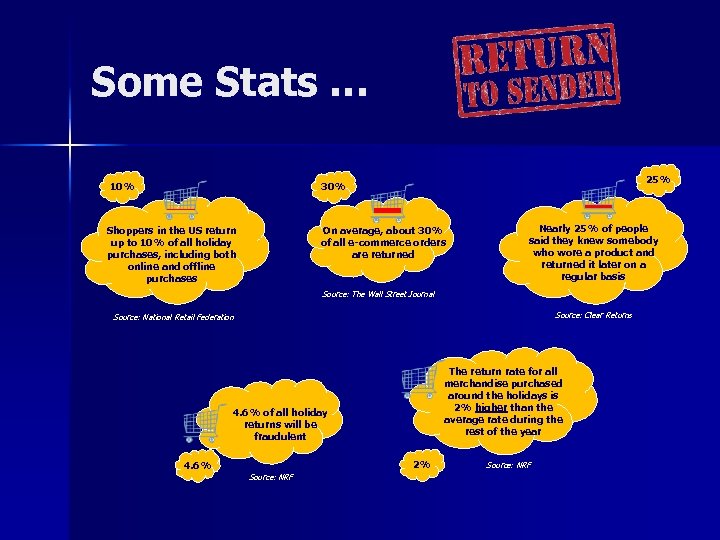 Some Stats … 10% 25% 30% Shoppers in the US return up to 10% of all holiday purchases, including both online and offline purchases On average, about 30% of all e-commerce orders are returned Nearly 25% of people said they knew somebody who wore a product and returned it later on a regular basis Source: The Wall Street Journal Source: Clear Returns Source: National Retail Federation The return rate for all merchandise purchased around the holidays is 2% higher than the average rate during the rest of the year 4. 6% of all holiday returns will be fraudulent 2% 4. 6% Source: NRF
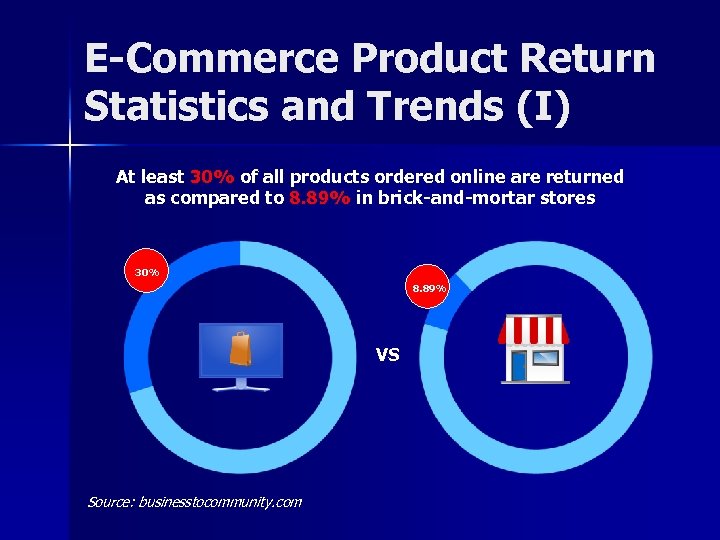 E-Commerce Product Return Statistics and Trends (I) At least 30% of all products ordered online are returned as compared to 8. 89% in brick-and-mortar stores 30% 8. 89% VS Source: businesstocommunity. com
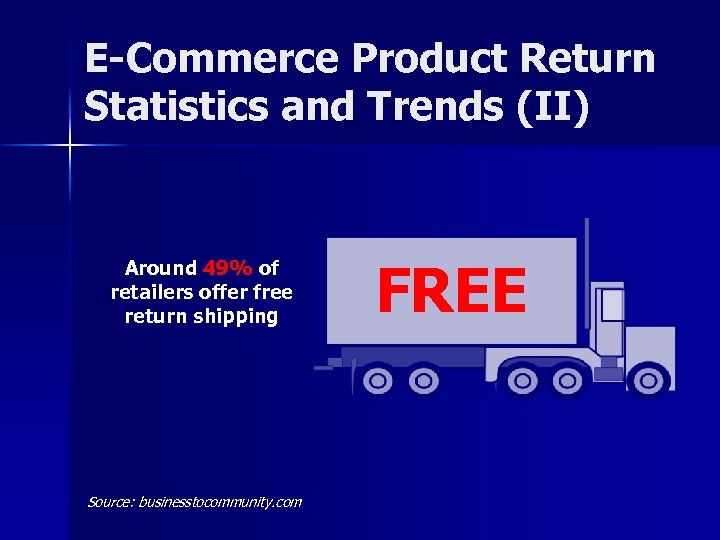 E-Commerce Product Return Statistics and Trends (II) Around 49% of retailers offer free return shipping Source: businesstocommunity. com FREE
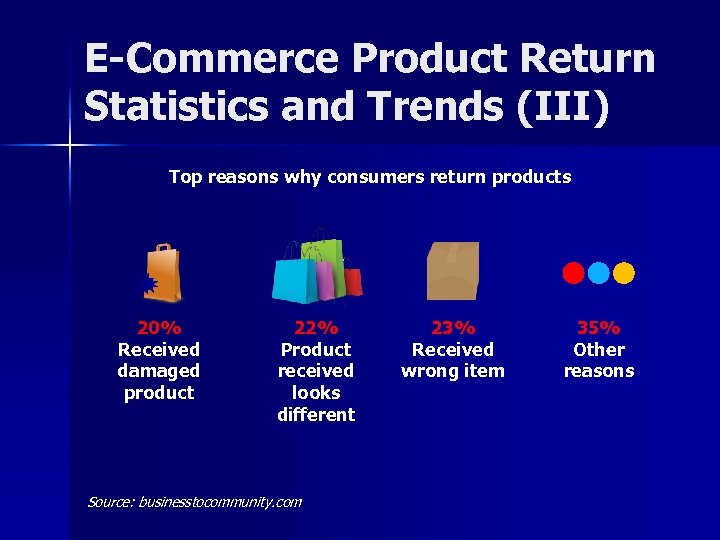 E-Commerce Product Return Statistics and Trends (III) Top reasons why consumers return products 20% Received damaged product 22% Product received looks different Source: businesstocommunity. com 23% Received wrong item 35% Other reasons
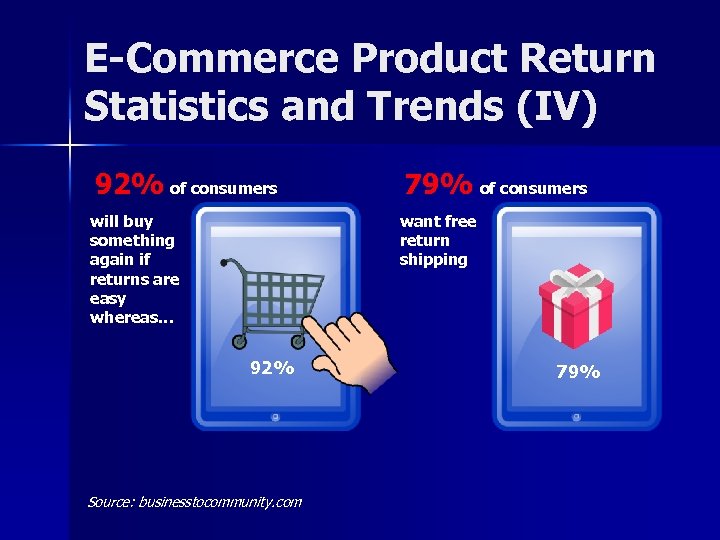 E-Commerce Product Return Statistics and Trends (IV) 92% of consumers will buy something again if returns are easy whereas… 79% of consumers want free return shipping 92% Source: businesstocommunity. com 79%
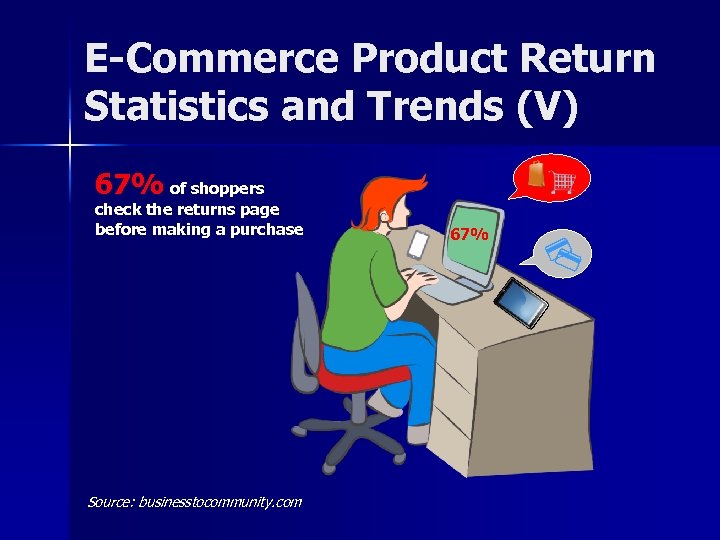 E-Commerce Product Return Statistics and Trends (V) 67% of shoppers check the returns page before making a purchase Source: businesstocommunity. com 67%
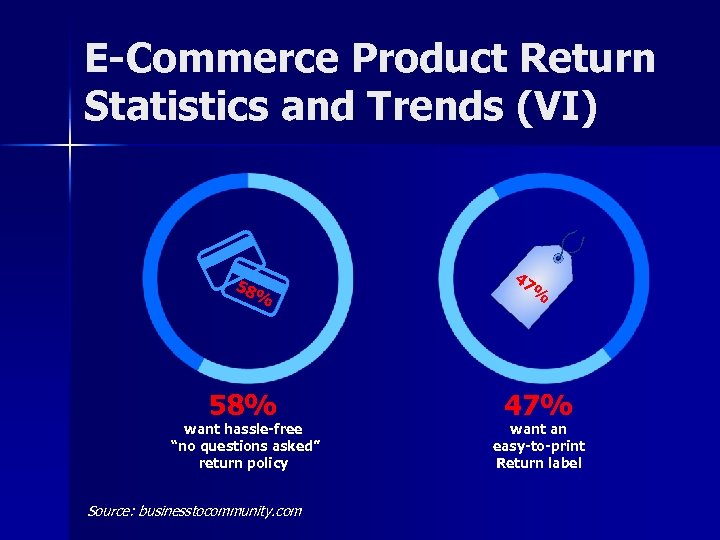 E-Commerce Product Return Statistics and Trends (VI) 58 % 58% want hassle-free “no questions asked” return policy Source: businesstocommunity. com 47 % 47% want an easy-to-print Return label
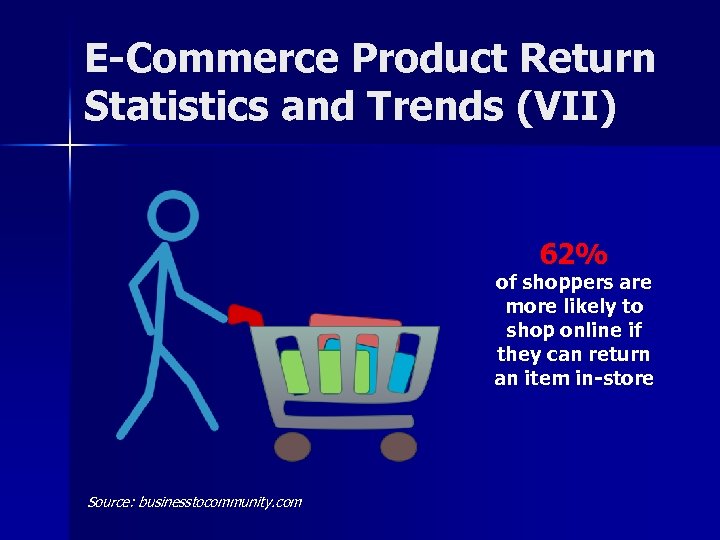 E-Commerce Product Return Statistics and Trends (VII) 62% of shoppers are more likely to shop online if they can return an item in-store Source: businesstocommunity. com
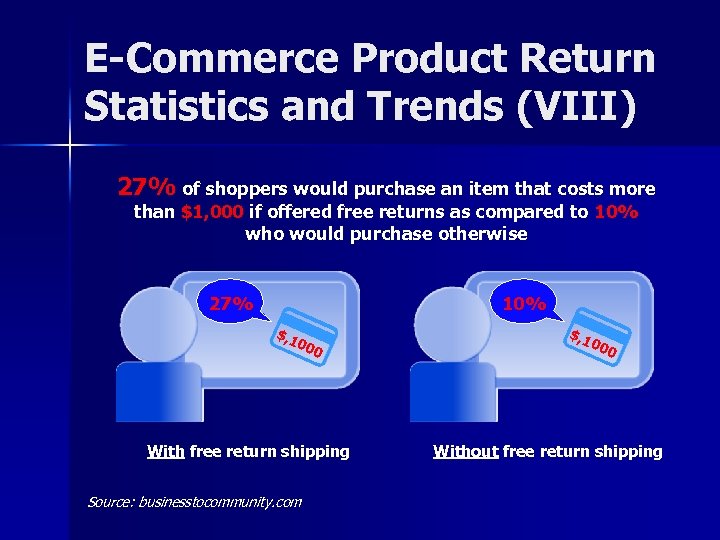 E-Commerce Product Return Statistics and Trends (VIII) 27% of shoppers would purchase an item that costs more than $1, 000 if offered free returns as compared to 10% who would purchase otherwise 27% 10% $, 1 00 0 With free return shipping Source: businesstocommunity. com $, 1 00 0 Without free return shipping
 Business Implications Of Reverse Logistics Senior management frequently unaware of: Size of RL operations Cost of RL operations Impact of RL operations on bottom line Impact of RL operations on customer service Many line/staff managers don’t know RL operations even exist
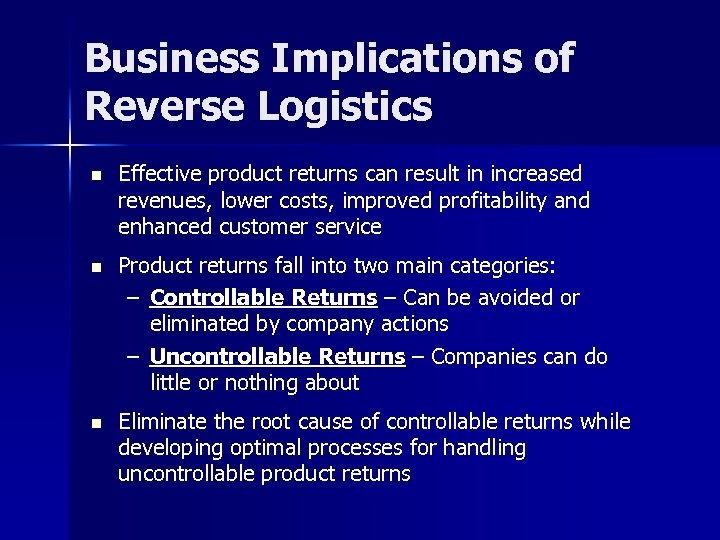 Business Implications of Reverse Logistics Effective product returns can result in increased revenues, lower costs, improved profitability and enhanced customer service Product returns fall into two main categories: – Controllable Returns – Can be avoided or eliminated by company actions – Uncontrollable Returns – Companies can do little or nothing about Eliminate the root cause of controllable returns while developing optimal processes for handling uncontrollable product returns
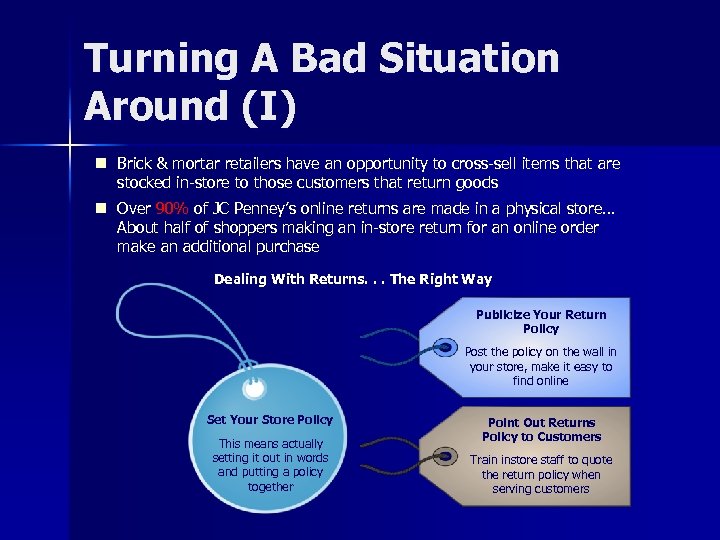 Turning A Bad Situation Around (I) Brick & mortar retailers have an opportunity to cross-sell items that are stocked in-store to those customers that return goods Over 90% of JC Penney’s online returns are made in a physical store… About half of shoppers making an in-store return for an online order make an additional purchase Dealing With Returns. . . The Right Way Publicize Your Return Policy Post the policy on the wall in your store, make it easy to find online Set Your Store Policy This means actually setting it out in words and putting a policy together Point Out Returns Policy to Customers Train instore staff to quote the return policy when serving customers
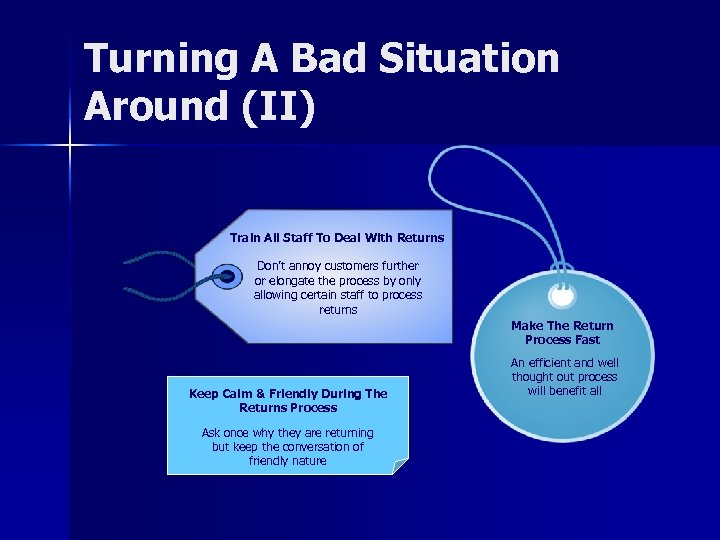 Turning A Bad Situation Around (II) Train All Staff To Deal With Returns Don’t annoy customers further or elongate the process by only allowing certain staff to process returns Make The Return Process Fast Keep Calm & Friendly During The Returns Process Ask once why they are returning but keep the conversation of friendly nature An efficient and well thought out process will benefit all
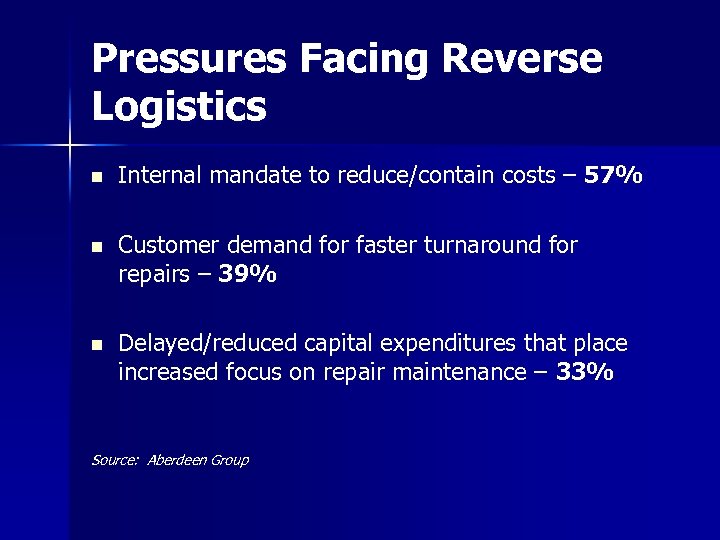 Pressures Facing Reverse Logistics Internal mandate to reduce/contain costs – 57% Customer demand for faster turnaround for repairs – 39% Delayed/reduced capital expenditures that place increased focus on repair maintenance – 33% Source: Aberdeen Group
 The RL Impact RL Affects The Bottom Line Finance v What are the true costs / benefits to the organization? Actual costs vs. retained asset value Operations v How is RL affecting operational efficiency? Quality improvements based on RL Sales & Marketing v What is the effect of RL on sales? Customer satisfaction, brand reputation, remanufactured goods impacting prices
 Transforming Product Returns Into A Profit Center (I) Minimize return costs and maximize recovery value of all returned merchandise Returns are an excellent source of information on buying expectations and habits of customers Fine tuned Reverse Logistics operations is a competitive weapon against other companies marketing to the same customers Outsource product returns processes if a 3 PL is better equipped to handle the entire process
 Transforming Product Returns Into A Profit Center (II) 1. Goods Flow: ‒ Maintain efficient flow and handling of customer returned merchandise ‒ Create a Reverse Logistics flow chart with documented procedures 2. Implement a “Perfect Delivery” System: ‒ Eliminate need for damage returns ‒ Track all complaints that are delivery/shipping related 3. Credits and Rebates: ‒ Offer customer credits or rebates for no returns 4. Recycle: ‒ Implement programs to recycle packaging materials 5. Inventory Control: ‒ Use ongoing inventory reduction systems and do not let returned merchandise remain idle
 Transforming Product Returns Into A Profit Center (III) Only accept “authorized returns” to ensure “recoverable value” Process returns promptly to return to inventory, return to vendor, sell in secondary market, issue prompt credit to customer Analysis of returns requires the most highly trained staff to assure proper disposition Recover the highest value of all returned products
 Transforming Product Returns Into A Profit Center (IV) An effective returns policy must be fully understood throughout the entire organization Customers expect the returns policy to be clear cut and easy to follow Look beyond costs to the bigger picture – understanding the cause and effect of the return Cost and the customer clearly drive the importance of efficiently managing the reverse supply chain
 How To Make A Difference Ownership within Enterprise v Who owns the RL function? Distributed across functions “Hidden” in operations or customer service Measurement v Tools to measure the performance of RL? Few, specialized software tools Financially absorbed in other departmental budgets
 Impacting The Bottom Line Returns to Revenue – Timely delivery & processing; refurbish, repackage, resell; secondary discount market Protecting profits – Track all activities; avoid fines, penalties; avoid liability issues/competing with one’s self Customer Loyalty – Customers return experience; advantage over competition Disposal Benefits – What’s returned, why; where is it; disposal avoids inventory carrying costs; minimizes taxes, staff level requirements
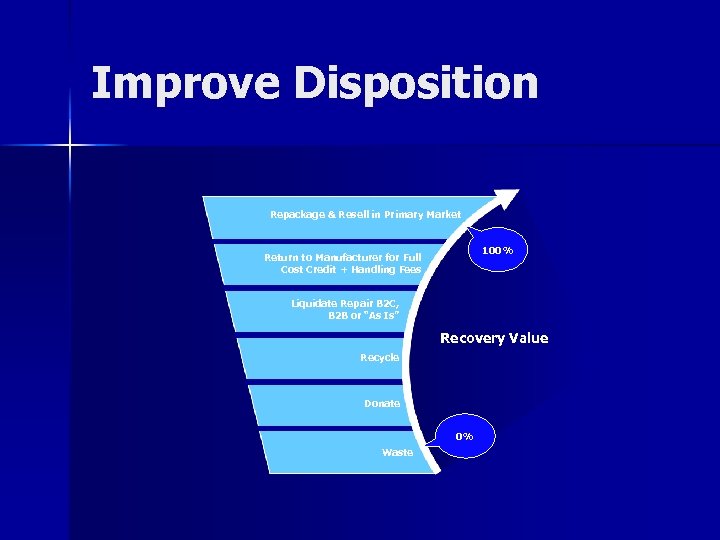 Improve Disposition Repackage & Resell in Primary Market 100% Return to Manufacturer for Full Cost Credit + Handling Fees Liquidate Repair B 2 C, B 2 B or “As Is” Recovery Value Recycle Donate 0% Waste
 Summary Returns are a necessary evil that must be dealt with Companies adept at Reverse Logistics create processes that provide top line sales and bottom line profits from savings Continually seek out ways to leverage Reverse Logistics to extract hidden value
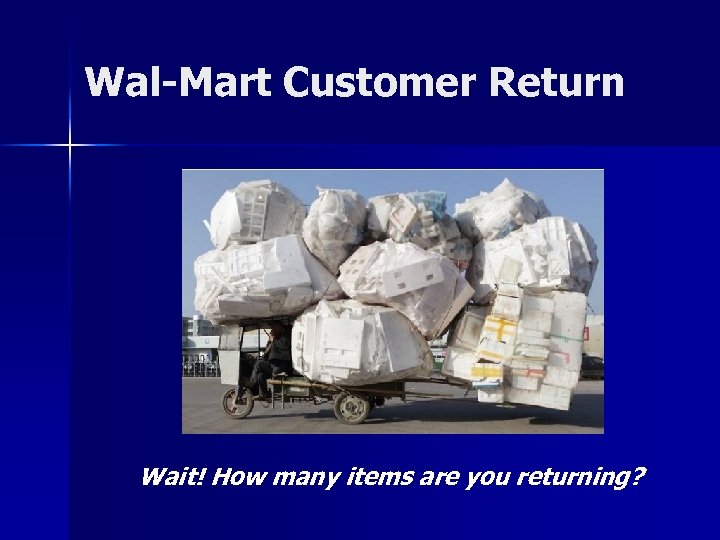 Wal-Mart Customer Return Wait! How many items are you returning?