 Скачать презентацию IFFTI Conference November 2005 Tokyo SIZING and LABELLING
f695d676064a317df51f94c5aac29bbb.ppt
- Количество слайдов: 35



IFFTI Conference, November 2005, Tokyo SIZING and LABELLING Dr. Alistair Knox Nottingham Trent University School of Art & Design
Overview: sizing & labelling • background to size – shape issues • NTU research • European initiatives • proposal for a global scheme Knox/IFFTI Nov 2005 2
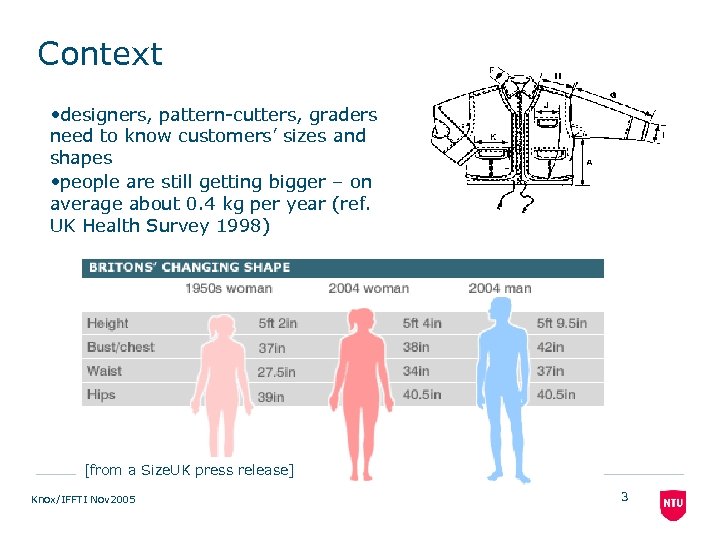
Context • designers, pattern-cutters, graders need to know customers’ sizes and shapes • people are still getting bigger – on average about 0. 4 kg per year (ref. UK Health Survey 1998) [from a Size. UK press release] Knox/IFFTI Nov 2005 3
![Related NTU research [image taken from E-Tailor project report IST-1999 -10549] Knox/IFFTI Nov 2005](https://present5.com/presentation/f695d676064a317df51f94c5aac29bbb/image-4.jpg "Related NTU research [image taken from E-Tailor project report IST-1999 -10549] Knox/IFFTI Nov 2005")
Related NTU research [image taken from E-Tailor project report IST-1999 -10549] Knox/IFFTI Nov 2005 4
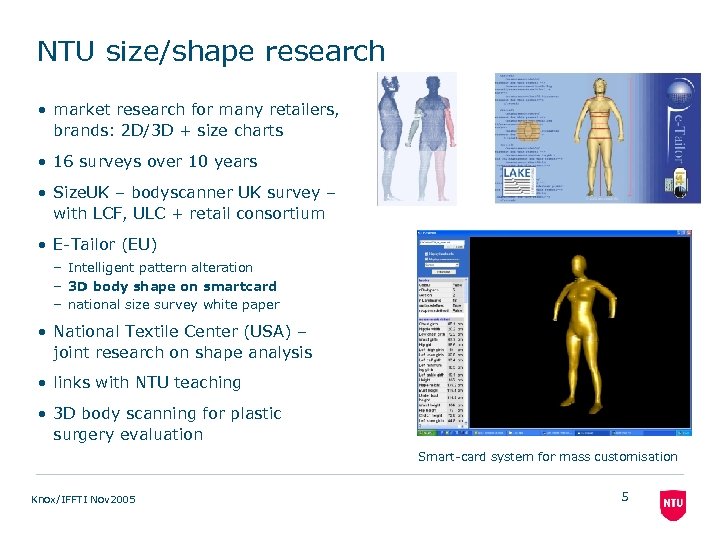
NTU size/shape research • market research for many retailers, brands: 2 D/3 D + size charts • 16 surveys over 10 years • Size. UK – bodyscanner UK survey – with LCF, ULC + retail consortium • E-Tailor (EU) – Intelligent pattern alteration – 3 D body shape on smartcard – national size survey white paper • National Textile Center (USA) – joint research on shape analysis • links with NTU teaching • 3 D body scanning for plastic surgery evaluation Smart-card system for mass customisation Knox/IFFTI Nov 2005 5
Ready to wear sizing issues Knox/IFFTI Nov 2005 6
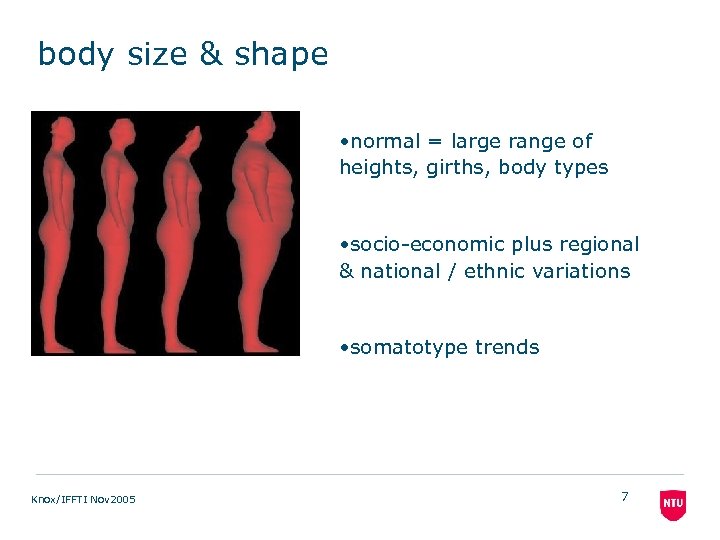
body size & shape • normal = large range of heights, girths, body types • socio-economic plus regional & national / ethnic variations • somatotype trends Knox/IFFTI Nov 2005 7
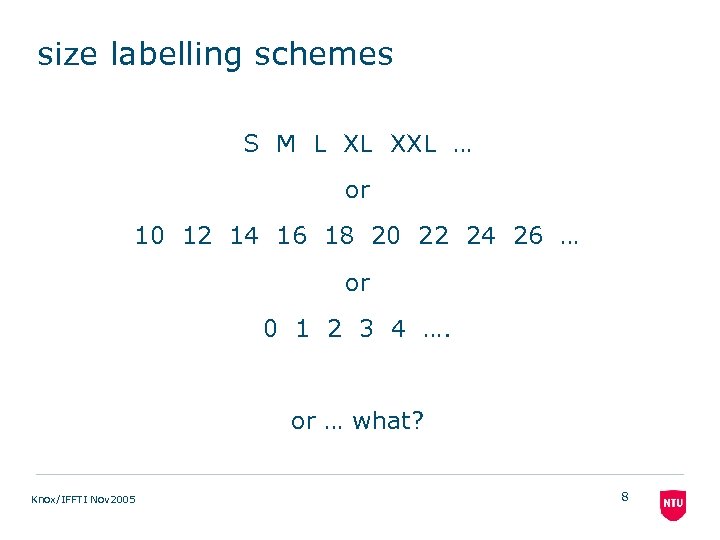
size labelling schemes S M L XL XXL … or 10 12 14 16 18 20 22 24 26 … or 0 1 2 3 4 …. or … what? Knox/IFFTI Nov 2005 8
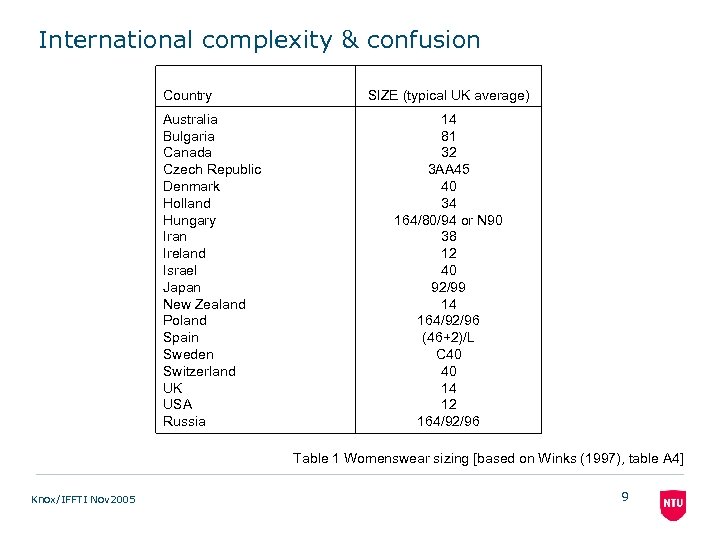
International complexity & confusion Country Australia Bulgaria Canada Czech Republic Denmark Holland Hungary Iran Ireland Israel Japan New Zealand Poland Spain Sweden Switzerland UK USA Russia SIZE (typical UK average) 14 81 32 3 AA 45 40 34 164/80/94 or N 90 38 12 40 92/99 14 164/92/96 (46+2)/L C 40 40 14 12 164/92/96 Table 1 Womenswear sizing [based on Winks (1997), table A 4] Knox/IFFTI Nov 2005 9
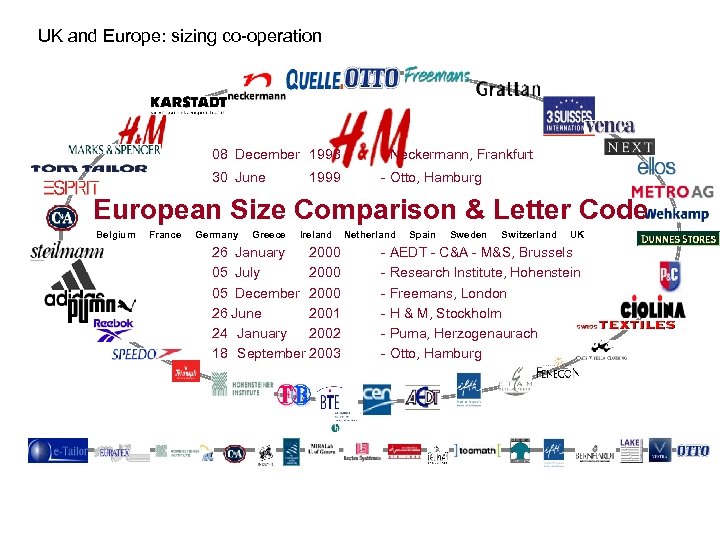
UK and Europe: sizing co-operation 08 December 1998 - Neckermann, Frankfurt 30 June - Otto, Hamburg 1999 European Size Comparison & Letter Code Belgium France Germany Greece Ireland 26 January 2000 05 July 2000 05 December 2000 26 June 2001 24 January 2002 18 September 2003 Netherland Spain Sweden Switzerland UK - AEDT - C&A - M&S, Brussels - Research Institute, Hohenstein - Freemans, London - H & M, Stockholm - Puma, Herzogenaurach - Otto, Hamburg
CEN proposal - aim to improve international standards • National standards, e. g. BS 3666; new standard BS EN 13402 • European standards: CEN 13402 – technical committee TC 248 – drafts for definitions, measuring standards, sizing • ISO standards Knox/IFFTI Nov 2005 11
![Aims Ø based on standard definitions and body measurement procedures [EN 13402] Ø logical](https://present5.com/presentation/f695d676064a317df51f94c5aac29bbb/image-12.jpg "Aims Ø based on standard definitions and body measurement procedures [EN 13402] Ø logical")
Aims Ø based on standard definitions and body measurement procedures [EN 13402] Ø logical system using the minimum number of digits Ø one code system for most clothing products Ø easy to understand for the consumer Ø to be implemented Europe-wide Knox/IFFTI Nov 2005 12
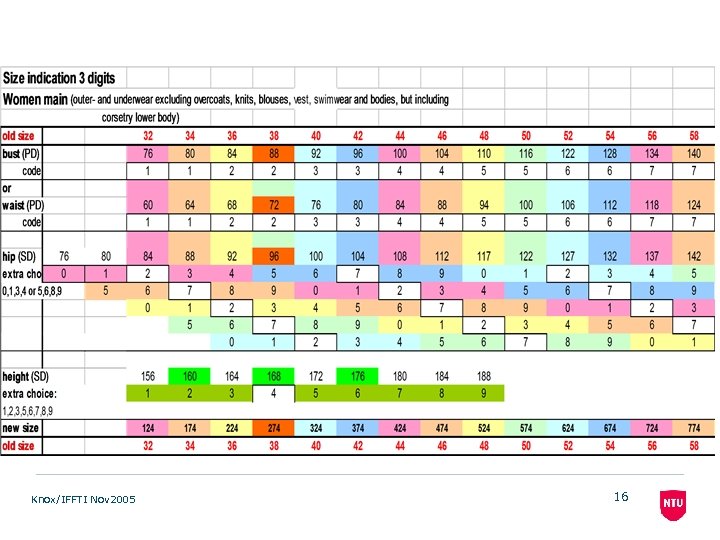
CEN Proposal Ø 3 digit specification code for buying, computer processing, consumer ordering Ø each digit is a code for • primary dimension [girth] • secondary dimension [e. g. 1(narrow hip). . 5(wide)] • height indicator [e. g. 1(short) …. 9 (tall)] Ø code can be supplemented on a size label by the prime dimension in cms (for communication) and a pictogram Knox/IFFTI Nov 2005 13
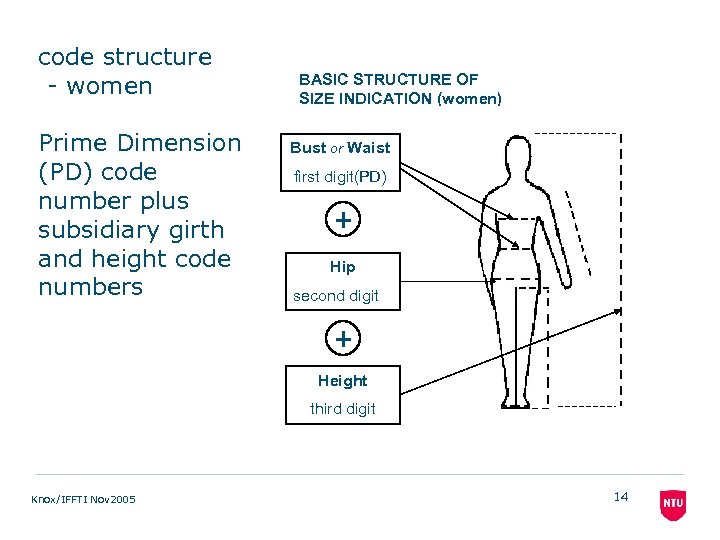
code structure - women Prime Dimension (PD) code number plus subsidiary girth and height code numbers BASIC STRUCTURE OF SIZE INDICATION (women) Bust or Waist first digit(PD) + Hip second digit + Height third digit Knox/IFFTI Nov 2005 14
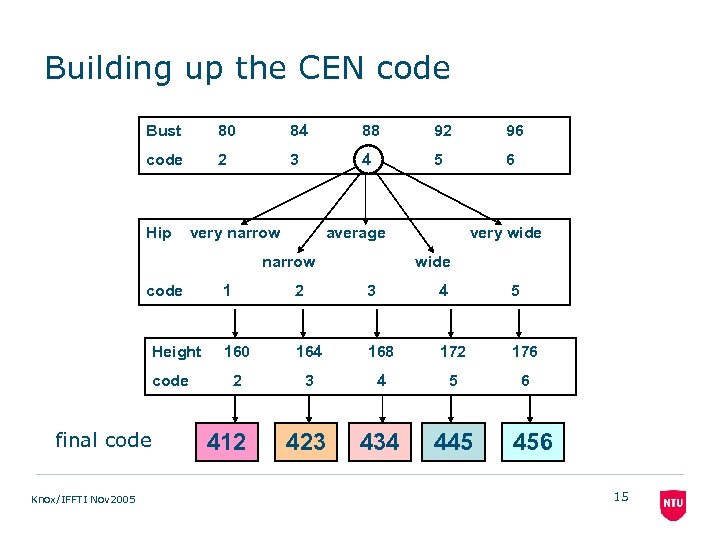
Building up the CEN code Bust 80 84 88 92 96 code 2 3 4 5 6 Hip very narrow average narrow code Height code final code Knox/IFFTI Nov 2005 very wide 1 2 3 4 5 160 164 168 172 176 2 3 4 5 6 423 434 445 412 456 15
Knox/IFFTI Nov 2005 16
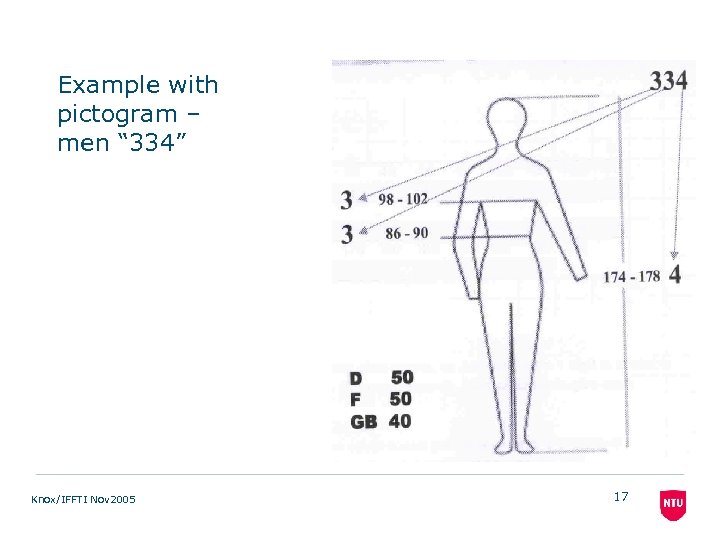
Example with pictogram – men “ 334” Knox/IFFTI Nov 2005 17
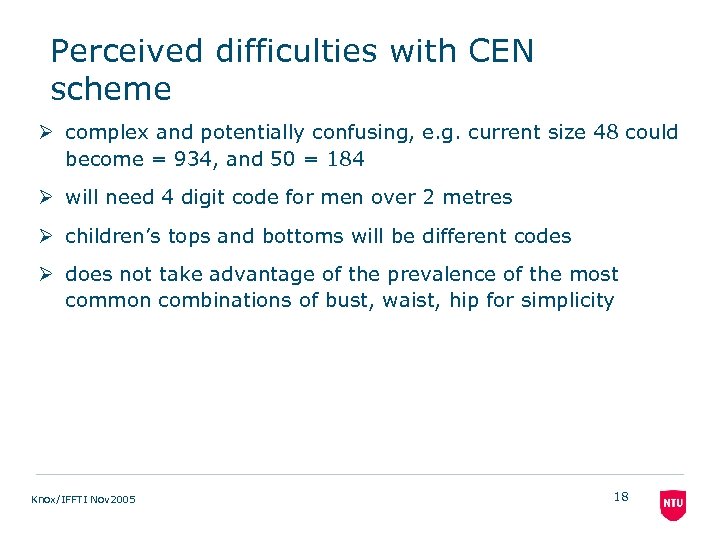
Perceived difficulties with CEN scheme Ø complex and potentially confusing, e. g. current size 48 could become = 934, and 50 = 184 Ø will need 4 digit code for men over 2 metres Ø children’s tops and bottoms will be different codes Ø does not take advantage of the prevalence of the most common combinations of bust, waist, hip for simplicity Knox/IFFTI Nov 2005 18
![‘German’ counter-proposal 1 st digit – Prime dimension [PD], 8 cm interval e. g.](https://present5.com/presentation/f695d676064a317df51f94c5aac29bbb/image-19.jpg "‘German’ counter-proposal 1 st digit – Prime dimension [PD], 8 cm interval e. g.")
‘German’ counter-proposal 1 st digit – Prime dimension [PD], 8 cm interval e. g. bust 76 – 152 cm 2 nd digit – secondary girth dimension, 5 options [std + 2 up, 2 down] e. g. hips 0 – 4 [std 2] or alternate PD band 5 – 9 [std 7]; waist – chest drop for men in 8 cms code digit 1 - 8 waist 60 - 136 3 rd digit – height – 4 cm e. g. women 156 = 1 to intervals 188 cm = 9 code digit 2 or 7 for standard, higher digit for wider, lower for narrower code digit 0 – 9 for body height band men 0– 9 = 160 – 196 cm Knox/IFFTI Nov 2005 19
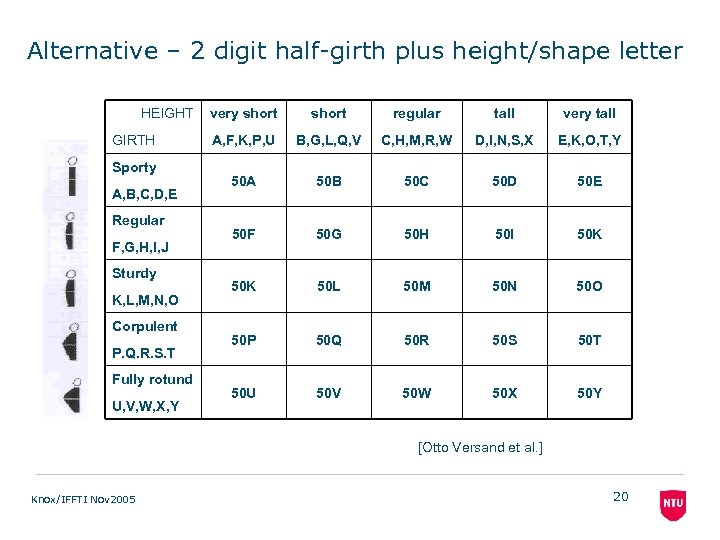
Alternative – 2 digit half-girth plus height/shape letter HEIGHT GIRTH Sporty A, B, C, D, E Regular F, G, H, I, J Sturdy K, L, M, N, O Corpulent P. Q. R. S. T Fully rotund U, V, W, X, Y very short regular tall very tall A, F, K, P, U B, G, L, Q, V C, H, M, R, W D, I, N, S, X E, K, O, T, Y 50 A 50 B 50 C 50 D 50 E 50 F 50 G 50 H 50 I 50 K 50 L 50 M 50 N 50 O 50 P 50 Q 50 R 50 S 50 T 50 U 50 V 50 W 50 X 50 Y [Otto Versand et al. ] Knox/IFFTI Nov 2005 20
None of these proposals gained wide acceptance by commercial representatives Need for a simplified global scheme “more research needed” Knox/IFFTI Nov 2005 21
Market research for Designers, Buyers and Merchandisers • what size are our customers? • what shape? • what is “good fit” for our products? - ANSWERS FROM SURVEYS AND ANALYSIS Knox/IFFTI Nov 2005 22
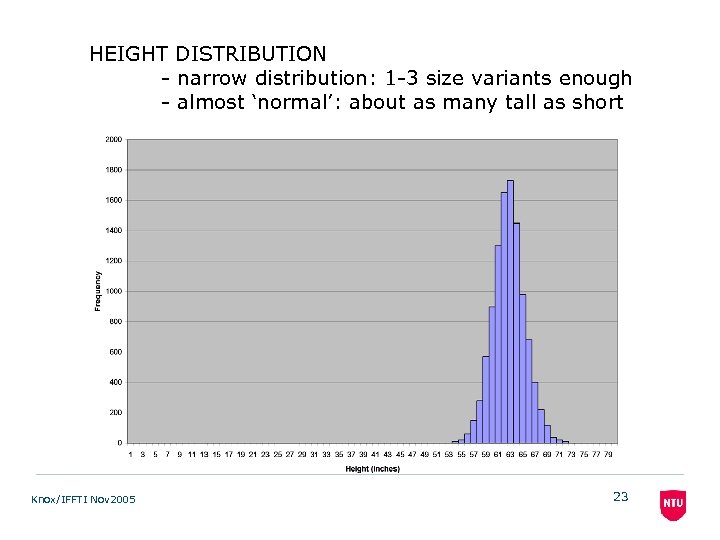
HEIGHT DISTRIBUTION - narrow distribution: 1 -3 size variants enough - almost ‘normal’: about as many tall as short Knox/IFFTI Nov 2005 23
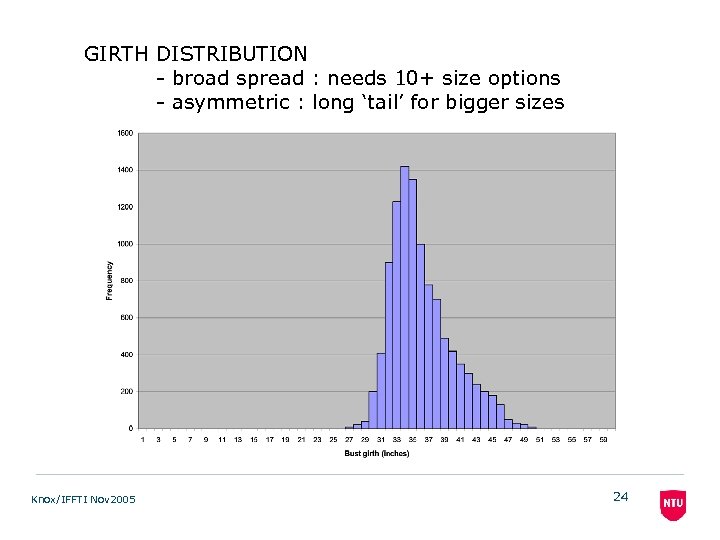
GIRTH DISTRIBUTION - broad spread : needs 10+ size options - asymmetric : long ‘tail’ for bigger sizes Knox/IFFTI Nov 2005 24
Market research for designers, Buyers and merchandisers • what size are our customers? • what shape? • what is “good fit” for our products? - ANSWERS FROM SURVEYS AND ANALYSIS • how many size / shape / height options is it economical to offer? • is there a simple, universal labelling scheme which communicates the offer options? Knox/IFFTI Nov 2005 25
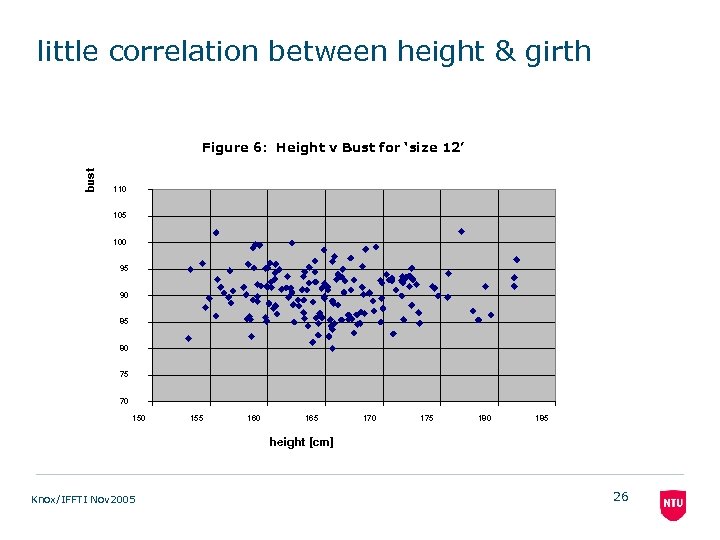
little correlation between height & girth bust Figure 6: Height v Bust for ‘size 12’ 110 105 100 95 90 85 80 75 70 155 160 165 170 175 180 185 height [cm] Knox/IFFTI Nov 2005 26
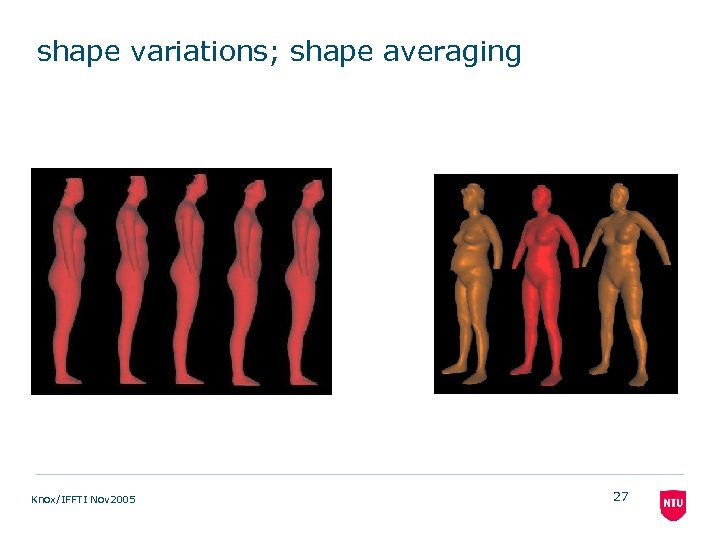
shape variations; shape averaging Knox/IFFTI Nov 2005 27
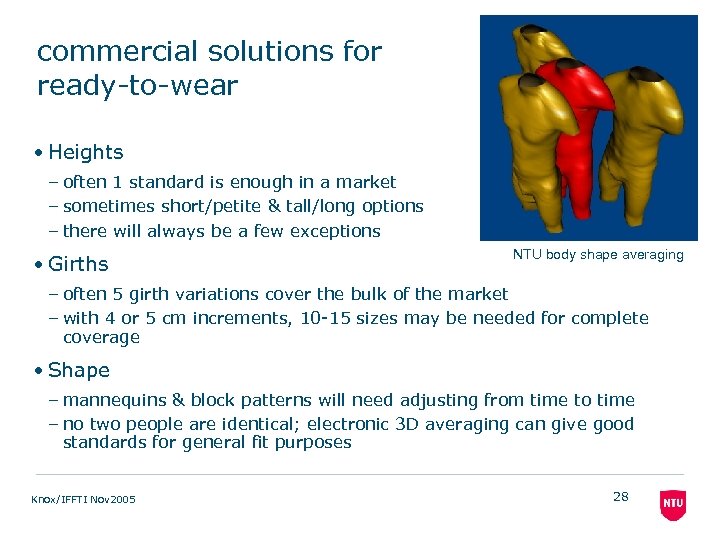
commercial solutions for ready-to-wear • Heights – often 1 standard is enough in a market – sometimes short/petite & tall/long options – there will always be a few exceptions • Girths NTU body shape averaging – often 5 girth variations cover the bulk of the market – with 4 or 5 cm increments, 10 -15 sizes may be needed for complete coverage • Shape – mannequins & block patterns will need adjusting from time to time – no two people are identical; electronic 3 D averaging can give good standards for general fit purposes Knox/IFFTI Nov 2005 28
Options / issues for any proposed new standard • simple versus complex code – should be meaningful to customers and suppliers: simpler the better • ‘meaningless’ size label code? [e. g. “ 14”] – could be redefined as required (as now), but non-standard confusion • Actual girth: metric measurements used globally – “just” some Anglo-Saxons may need to adjust! • Dual labelling; conversion tables – a new system can run in parallel with any existing • Pictogram: visual communication including other key measurements for easy understanding Knox/IFFTI Nov 2005 29
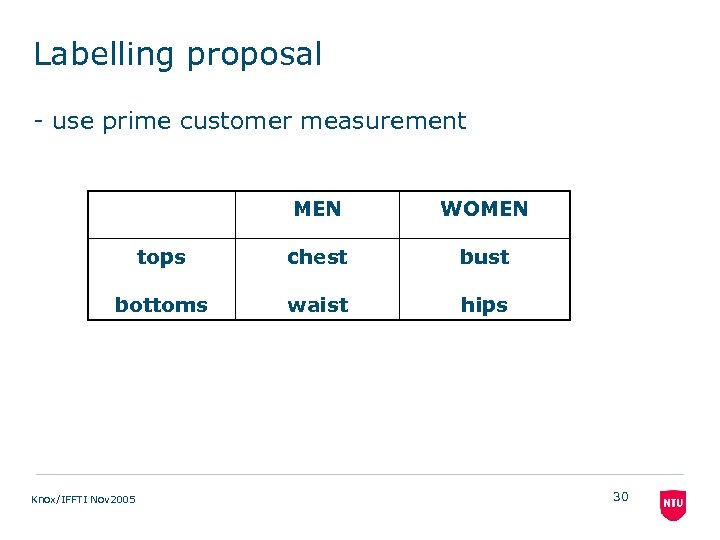
Labelling proposal - use prime customer measurement MEN WOMEN tops chest bust bottoms waist hips Knox/IFFTI Nov 2005 30
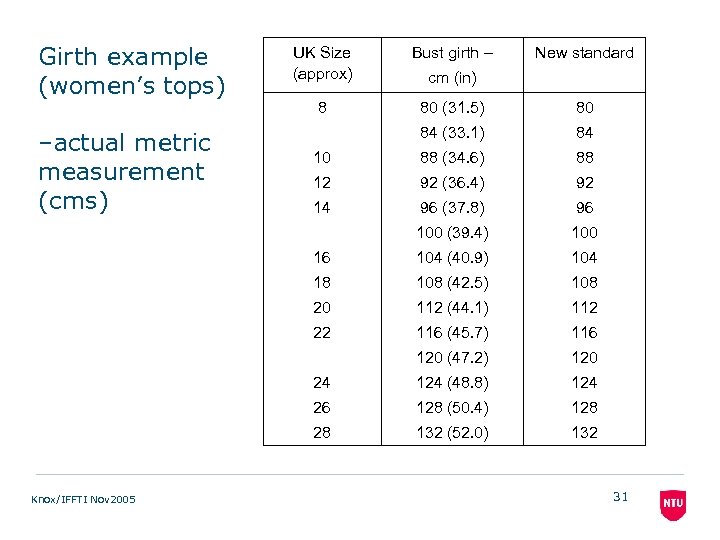
Girth example (women’s tops) 80 (31. 5) 80 84 (33. 1) 84 10 88 (34. 6) 88 12 92 (36. 4) 92 14 96 (37. 8) 96 100 (39. 4) 100 16 104 (40. 9) 104 18 108 (42. 5) 108 20 112 (44. 1) 112 22 116 (45. 7) 116 120 (47. 2) 120 24 124 (48. 8) 124 26 128 (50. 4) 128 28 Knox/IFFTI Nov 2005 Bust girth – 8 –actual metric measurement (cms) UK Size (approx) New standard 132 (52. 0) 132 cm (in) 31
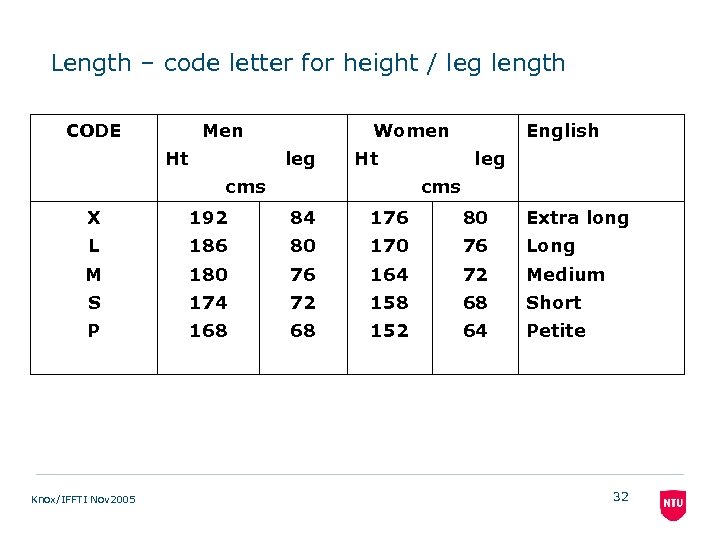
Length – code letter for height / leg length CODE Men Ht Women leg Ht cms English leg cms X 192 84 176 80 Extra long L 186 80 170 76 Long M 180 76 164 72 Medium S 174 72 158 68 Short P 168 68 152 64 Petite Knox/IFFTI Nov 2005 32
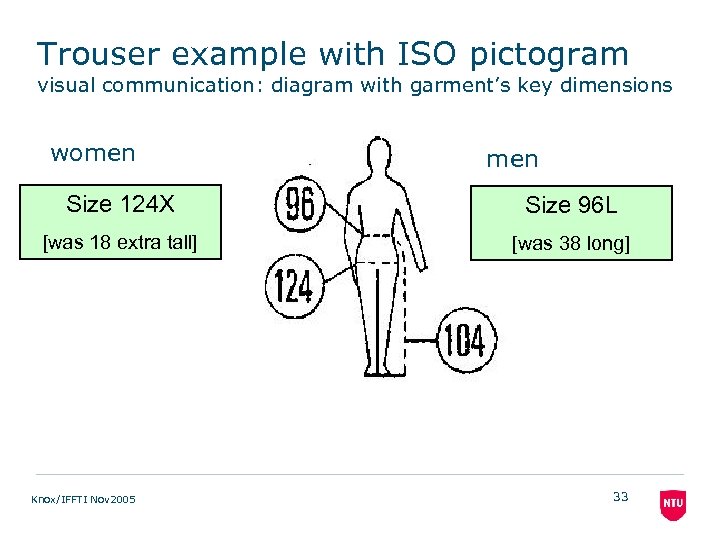
Trouser example with ISO pictogram visual communication: diagram with garment’s key dimensions women Size 124 X Size 96 L [was 18 extra tall] [was 38 long] Knox/IFFTI Nov 2005 33
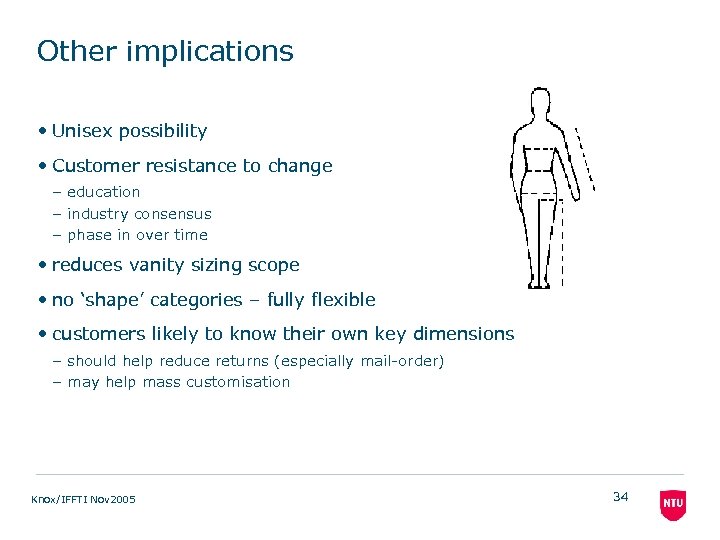
Other implications • Unisex possibility • Customer resistance to change – education – industry consensus – phase in over time • reduces vanity sizing scope • no ‘shape’ categories – fully flexible • customers likely to know their own key dimensions – should help reduce returns (especially mail-order) – may help mass customisation Knox/IFFTI Nov 2005 34
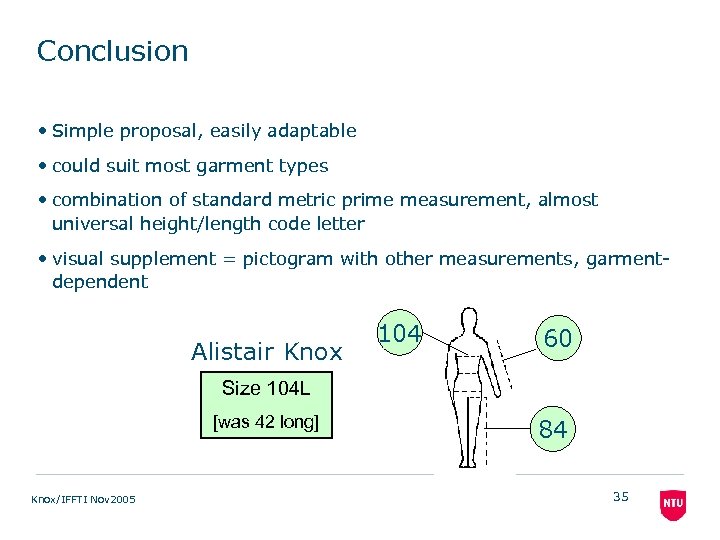
Conclusion • Simple proposal, easily adaptable • could suit most garment types • combination of standard metric prime measurement, almost universal height/length code letter • visual supplement = pictogram with other measurements, garmentdependent Alistair Knox 104 60 Size 104 L [was 42 long] Knox/IFFTI Nov 2005 84 35
Скачать презентацию IFFTI Conference November 2005 Tokyo SIZING and LABELLING
f695d676064a317df51f94c5aac29bbb.ppt