 Скачать презентацию If Ignorance is Bliss Why Did We Ask
489a9f949c26d85c9a7868623d93c13e.ppt
- Количество слайдов: 38



If Ignorance is Bliss, Why Did We Ask the State Bar That Ethics Question? BY JASON A. MCGRATH, ESQ. FL, NC, TN, FEDERAL COURT MCGRATH & SPIELBERGER, PLLC WWW. MCGRATHSPIELBERGER. COM JASON@MCGRATHSPIELBERGER. COM 6201 FAIRVIEW RD. , SUITE 330 CHARLOTTE, NC 28210 704. 271. 5000 FIRM PRACTICES IN FL, GA, NC, OH, SC, TN
About Jason A. Mc. Grath, Esq. 2 Licensure: Florida, North Carolina, Tennessee, Federal Court Legal Career Experience: Mc. Grath & Spielberger, PLLC (2011 – current). General practice with focuses on business law (transactions and disputes) & real property (including foreclosure and other disputes). Firm practices in FL, GA, NC, OH, SC, & TN; headquartered in Charlotte. Solo practitioner, primarily in Charlotte (2009 -2011). Medium-sized private law firm (2001 – 2009). Managing partner of West Palm Beach office (2005 – 2009). Primarily defended hospitals & doctors in wrongful death/medical malpractice cases. Assistant District Attorney, West Palm Beach, FL (1996 – 2001). Consistently among leaders in trials completed and won. Most Relevant Professional Associations: Mecklenburg County Bar: past Chair of Social and Networking Committee; past Chair of Solo & Small Firm Section. NC State Bar, NC Bar Association, FL Bar Association, TN Bar Association. American Bar Association: member of ELawyering Task Force and Law Practice Management Section. Most Relevant Education : Florida State University, Bachelor’s in political science, Bachelor’s in international affairs, Minor in Spanish (1993). Florida State University, J. D. , national Moot Court champion (1996). Recent Publications: Foreclosures When Missing the Loan Note: Yes, No, or Maybe? (ABA GP Solo magazine, 2016); Dos and Don’ts of Growing a Small Law Firm (MCB Newsletter, 2013). Initial Consultations: Free or Fee? (MCB Newsletter, 2013). Did Atticus Finch Commit Malpractice? (NC State Bar Journal, 2011). Other Items of Interest: Chairperson of City of Charlotte’s Civil Service Board: the CSB has certain quasi-judicial and administrative powers relating to Charlotte-Mecklenburg Police Department and Charlotte Fire Department. work product of Jason A. Mc. Grath, Esq.
The “Don’t Blame Me” Cautionary Note 3 As indicated in these materials, these questions and scenarios posed to the NCSB Ethics Counsel occurred over a course of years, and there is always a chance that the answer would be somewhat different if answered today. Seeking guidance from the NCSB as to any particular ethical scenario you may face should be considered, even if the scenario is similar to one of the ones discussed herein. work product of Jason A. Mc. Grath, Esq.
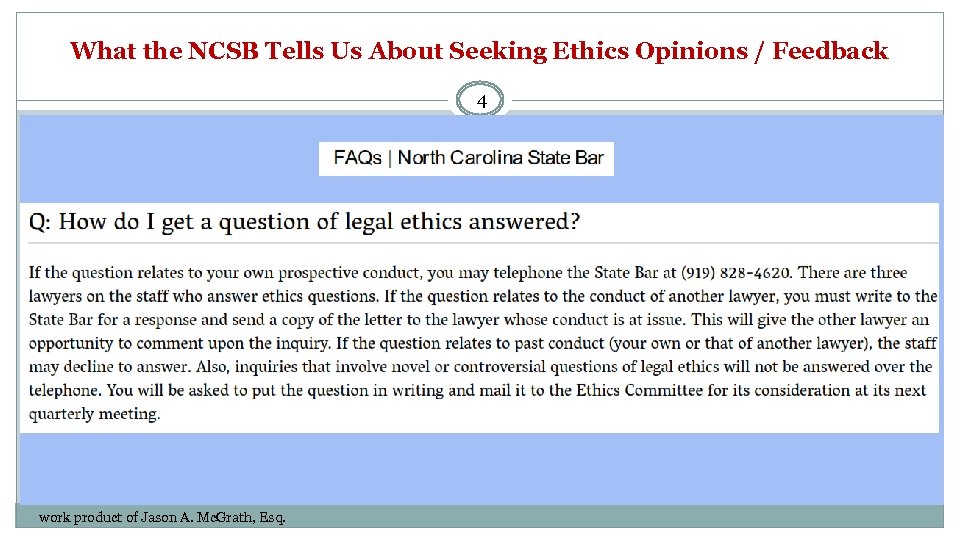
What the NCSB Tells Us About Seeking Ethics Opinions / Feedback 4 work product of Jason A. Mc. Grath, Esq.
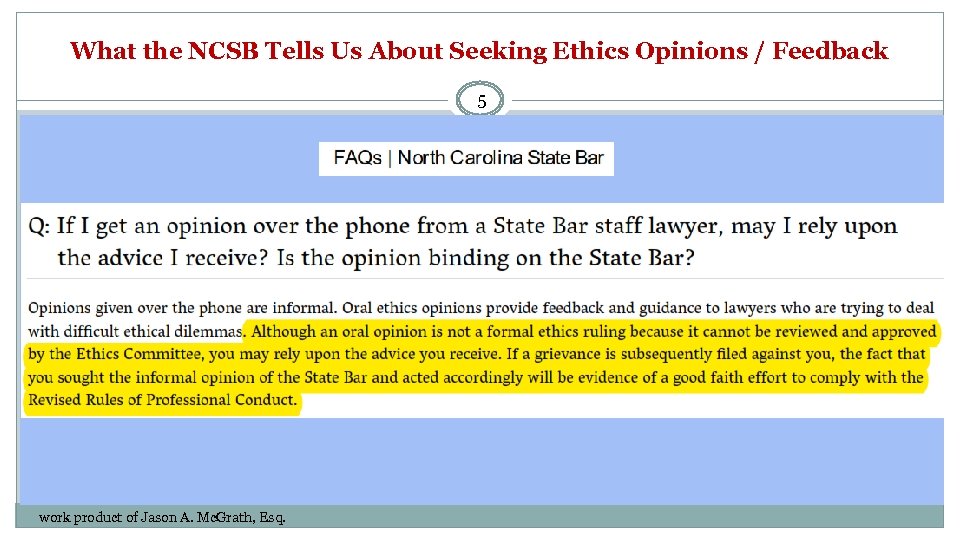
What the NCSB Tells Us About Seeking Ethics Opinions / Feedback 5 work product of Jason A. Mc. Grath, Esq.
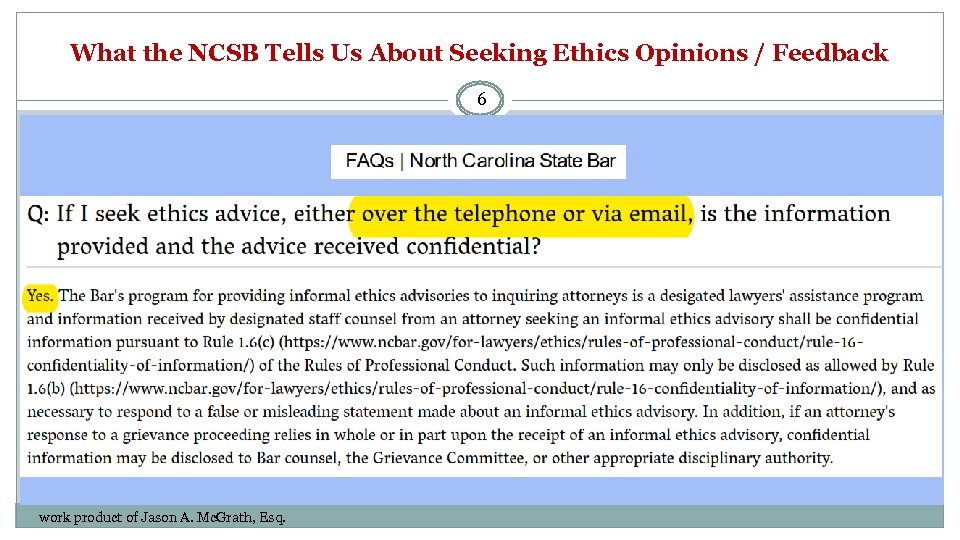
What the NCSB Tells Us About Seeking Ethics Opinions / Feedback 6 work product of Jason A. Mc. Grath, Esq.
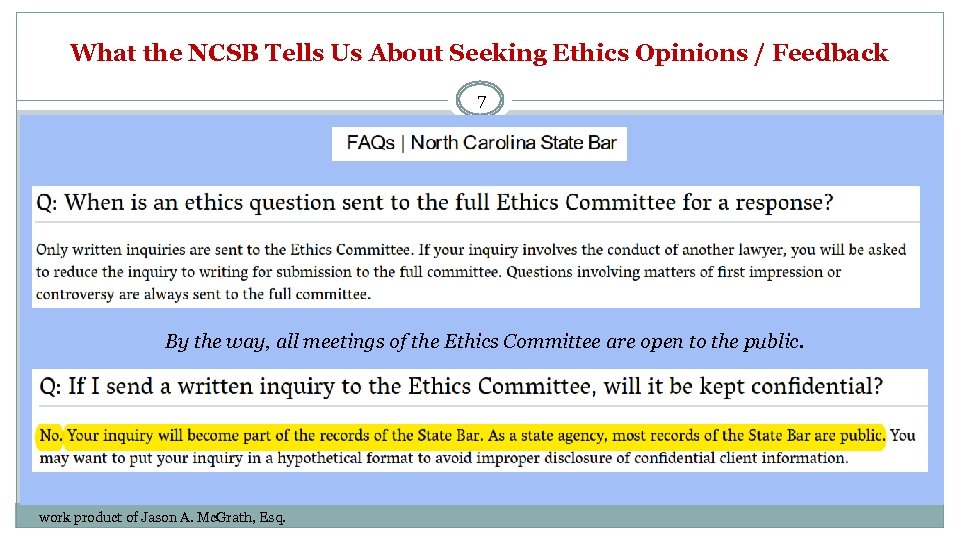
What the NCSB Tells Us About Seeking Ethics Opinions / Feedback 7 By the way, all meetings of the Ethics Committee are open to the public. work product of Jason A. Mc. Grath, Esq.
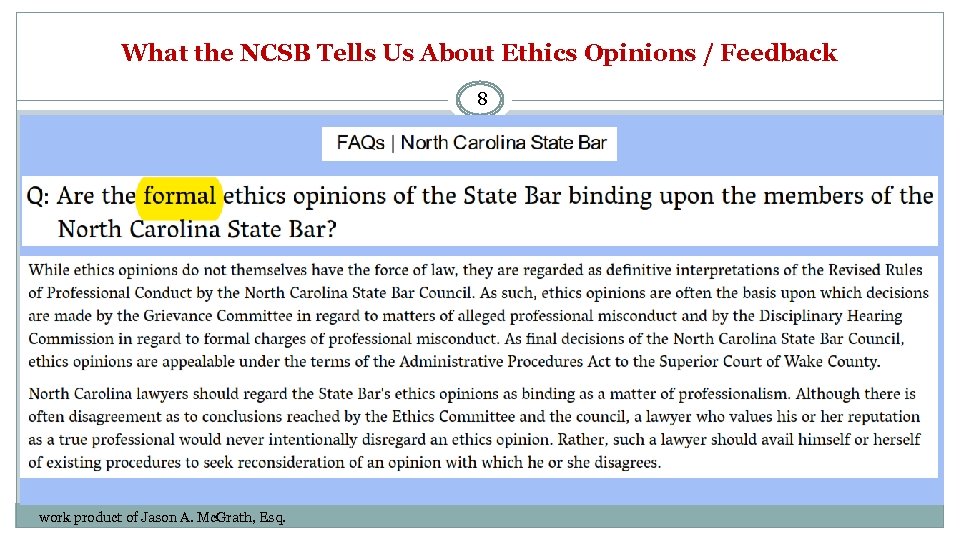
What the NCSB Tells Us About Ethics Opinions / Feedback 8 work product of Jason A. Mc. Grath, Esq.
Scenario 1: Calling a Prospective Client Who “Wants You to Call” 9 You’re outside your house, trimming the hedges for the first time in a year or so. Your neighbor of 20 years (whose hedges, of course, are perfectly manicured) makes her way on over to speak to you. “You handle real estate disputes, right? ” “Yep. ” “One of my friends at work has a problem. He was about to close on a house but the seller backed out at the last minute, after my friend already agreed to sell his current house. I told him you can probably help him, and he wants you to give him a call. ” Let’s assume you’re potentially interested. What do you do? work product of Jason A. Mc. Grath, Esq.
Scenario 1: Calling a Potential Client Who “Wants You to Call” 10 When this scenario was presented to the NC State Bar in 2013, Ethics Counsel replied that Rule 7. 3(a) clearly applies. Even when a trusted third party delivers the message that a potential client wants you to contact him/her, you can’t. The potential client has to initiate the contact directly. RULE 7. 3 DIRECT CONTACT WITH POTENTIAL CLIENTS (a) A lawyer shall not by in-person, live telephone, or real-time electronic contact solicit professional employment when a significant motive for the lawyer’s doing so is the lawyer’s pecuniary gain, unless the person contacted: (1) is a lawyer; or (2) has a family, close personal, or prior professional relationship with the lawyer. work product of Jason A. Mc. Grath, Esq.
Scenario 2: Suing / Making Allegations Against Your Own Current Client 11 You are sub-leasing office space from Company X, a non-law firm. The master landlord is aware of this and has approved it. You have done a bit of legal work for Company X, including representing it in a minor lawsuit which is dormant, but still in existence. You’re current on rent paid to Company X. It turns out that Company X has not paid its rent in months, including not forwarding the rent you’ve paid to it pursuant to your sublease. Landlord sues both you and Company X. You would want to assert claims against Company X since you’ve done nothing wrong. However, Company X is your client. The insight you have into Company X pursuant to the small amount of work you’ve done for it isn’t really relevant to this breach of lease lawsuit you find yourself in. Can you pursue legal claims against Company X? work product of Jason A. Mc. Grath, Esq.
Scenario 2: Suing Your Own Current Client 12 When presented with this scenario in 2014, Ethics Counsel stated that it is “generally a conflict of interest for a lawyer to sue a current client”. The NCSB advised that, of course, a motion to withdraw from the representation of Company X could be filed. Presenter note / question: if the judge refused to allow withdrawal, does this mean the attorney would be unable to pursue otherwise valid legal claims against Company X? Presenter note / question: would the answer to this be any different if the intended legal claims were for unpaid fees to the attorney for work performed? work product of Jason A. Mc. Grath, Esq.
Scenario 3: Taking or Returning Repeated Calls From a Represented Party 13 In a mortgage loan dispute, lender has outside counsel who has indicated to borrower’s counsel that all communications should be directed to him. Lender knows it has retained counsel in the matter. Lender repeatedly calls borrower’s counsel. Lender sends letters to borrower’s counsel, letters which list deadlines to respond. Lender’s counsel is aware that his client is initiating these communications but doesn’t seem to be passing relevant, case-related information on to his own client. Borrower’s counsel is concerned that lender may not be aware that borrower, though counsel, is responding / trying to resolve the matter, and borrower’s counsel is concerned that failing to respond directly to lender is hurting borrower’s own client. Can borrower’s counsel take lender’s calls or respond to lender? Can borrower’s counsel do so as long as lender’s counsel is copied on any responsive letters? work product of Jason A. Mc. Grath, Esq.
Scenario 3: Taking or Returning Repeated Calls From a Represented Party 14 When presented with this scenario in 2012, Ethics Counsel stated that Rule 4. 2 applies no matter who initiates the communication and applies in this scenario. RULE 4. 2 COMMUNICATION WITH PERSON REPRESENTED BY COUNSEL (a) During the representation of a client, a lawyer shall not communicate about the subject of the representation with a person the lawyer knows to be represented by another lawyer in the matter, unless the lawyer has the consent of the other lawyer or is authorized to do so by law or a court order. . Presenter note: interesting in that it’s the party who can/must authorize direct communications with opposing counsel, so proactively contacting opposing counsel seems to be doing just that, but that authorization must come through the party’s attorney. work product of Jason A. Mc. Grath, Esq.
Scenario 4: the Frivolous Bar Complaint – Does it go “On My Record”? 15 You’re retained to collect a debt or for a situation which involves money related to the client passing through your office in some form. A sequence of events leads to you ending up with money, or at least the appearance of money (a check), which supposedly is owed to your new client by a third party. You’re suspicious of the entire situation at this point, including whether the “bank check” from the third party (which has been made payable to your trust account, so you can then pay your new client) is valid or not. Your client says he is in desperate need of the money. You want to slow things down and double check all your Ps and Qs. work product of Jason A. Mc. Grath, Esq.
Scenario 4: the Frivolous Bar Complaint – Does it go “On My Record”? 16 You advise the NCSB of the situation. There is at least a small chance that the situation and the client turn out to be legitimate. What if it turns out not to be legitimate, and the Bar determines or recognizes that, but the “client” files a Bar complaint? work product of Jason A. Mc. Grath, Esq.
Scenario 4: the Frivolous Bar Complaint – Does it go “On My Record”? 17 When presented with this scenario in 2013, NCSB advised of the following: a frivolous Bar complaint is often dismissed by the chair of the grievance committee without the lawyer even knowing it was filed; the public would not be aware of it; and in a situation like this one, such a complaint would “not see the light of day”. work product of Jason A. Mc. Grath, Esq.
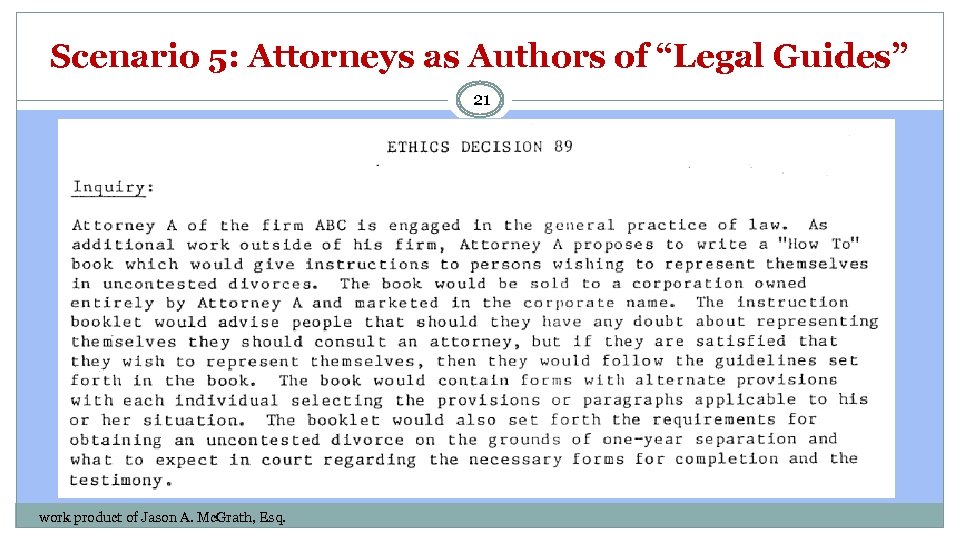
Scenario 5: Attorneys as Authors of “Legal Guides” 18 An attorney wants to write and sell a book entitled “Legal Issues to be Mindful of When Forming and Operating an LLC. ” Not being completely clueless, the attorney realizes that from a certain perspective: 1. readers may rely on what they read; 2. readers may believe it to be legal advice; and 3. there could be an argument that the attorney has liability (whether legal or ethical) for any incorrect statements or arguably “bad advice” in the book. Other than provide appropriate disclaimers within the book itself, what should the attorney do? What must the attorney do? Is there any Bar guidance on this? work product of Jason A. Mc. Grath, Esq.
Scenario 5: Attorneys as Authors of “Legal Guides” 19 Further, what about the proceeds from the book sales? Are those monies “legal fees” in some sense? Are they subject to Bar rules, etc. ? work product of Jason A. Mc. Grath, Esq.
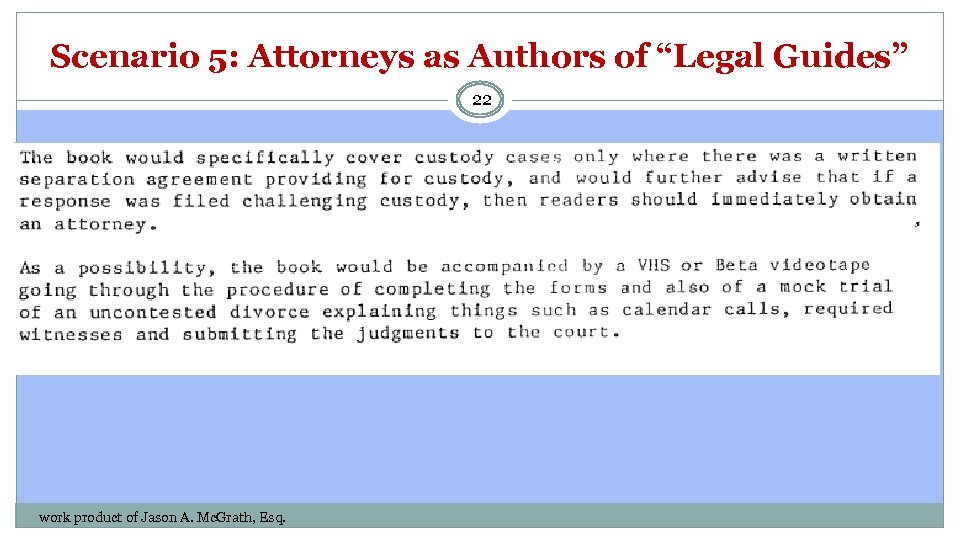
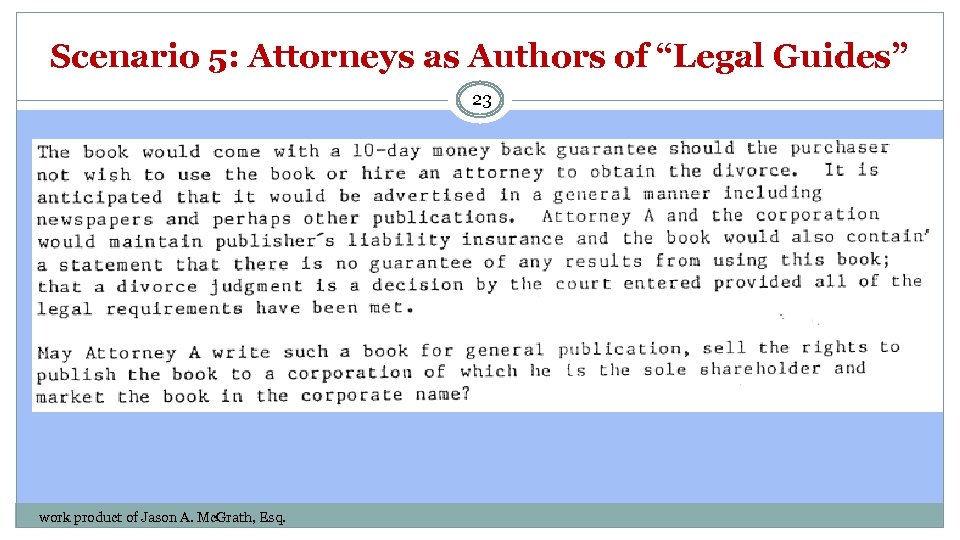
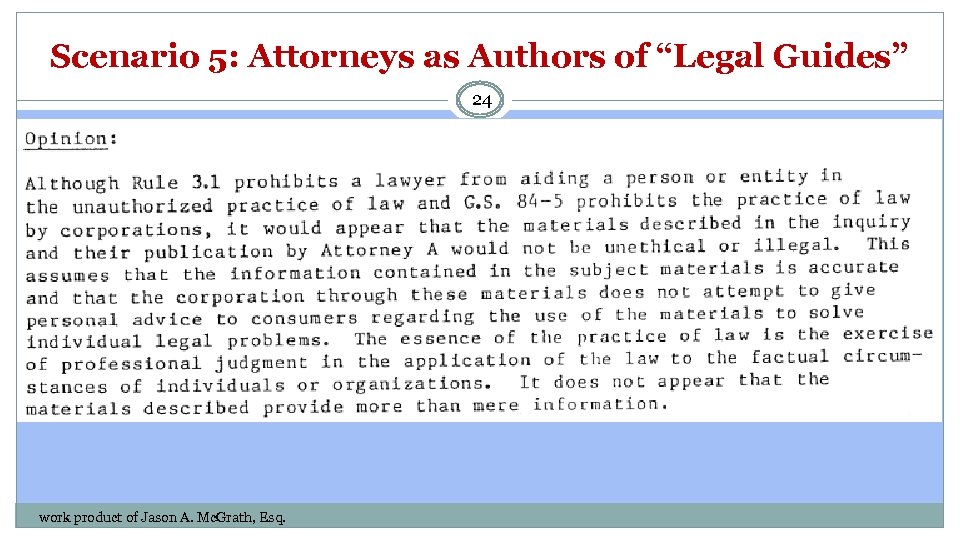
Scenario 5: Attorneys as Authors of “Legal Guides” 20 When presented with this scenario in 2012, Ethics Counsel stated that the proceeds from the book sale are not subject to the Bar rules regarding fees. Further, authoring and selling such a book is permissible as long as appropriate disclaimers are made. As to ethics opinions, a well-dated one (not available via the Bar website? ) was provided but not characterized one way or the other as to whether it is still applicable. work product of Jason A. Mc. Grath, Esq.
Scenario 5: Attorneys as Authors of “Legal Guides” 21 work product of Jason A. Mc. Grath, Esq.
Scenario 5: Attorneys as Authors of “Legal Guides” 22 work product of Jason A. Mc. Grath, Esq.
Scenario 5: Attorneys as Authors of “Legal Guides” 23 work product of Jason A. Mc. Grath, Esq.
Scenario 5: Attorneys as Authors of “Legal Guides” 24 work product of Jason A. Mc. Grath, Esq.
Scenario 6: Paying the Firm via Lump Sum Transfers from Trust Account? 25 This issue, in part, arose due to the new trust account rules which have just recently gone into effect. Is it allowable for an attorney / firm to make one lump sum transfer each month in relation to monies earned and thus now payable from a client trust account? Is the answer different depending on what type of transaction is contemplated (e. g. , check vs. electronic transfer, etc. )? This assumes the attorney / firm would keep detailed records which allow it to be known and proved how much of those transferred funds belonged to each case, each client, etc. work product of Jason A. Mc. Grath, Esq.
Scenario 6: Paying the Firm via Lump Sum Transfers from Trust Account? 26 When presented with these questions in 2016, Ethics Counsel answered that there must be a separate transfer for every single disbursement – one per client matter. Even with proper record keeping, you cannot write one lump sum check or make one lump sum transfer. work product of Jason A. Mc. Grath, Esq.
Scenario 7: Ceasing Work due to Client’s Failure to Pay 27 Client has failed to pay you as agreed in your written attorney-client agreement. That agreement states that you can cease work if client violates the terms of the agreement, including by failing to pay. Can you cease work, or must you now provide what amounts to free legal services? work product of Jason A. Mc. Grath, Esq.
Scenario 7: Ceasing Work due to Client’s Failure to Pay 28 The instruction from Ethics Counsel in 2014 included the need to comply with Rule 1. 16 (Declining or Terminating Representation). Regardless of whether this results in free legal work being provided, and regardless of what your attorney-client agreement says on this topic, an attorney must: comply with all applicable law requiring notice to or permission of a tribunal; and take steps to the extent reasonably practicable to protect a client’s interest. work product of Jason A. Mc. Grath, Esq.
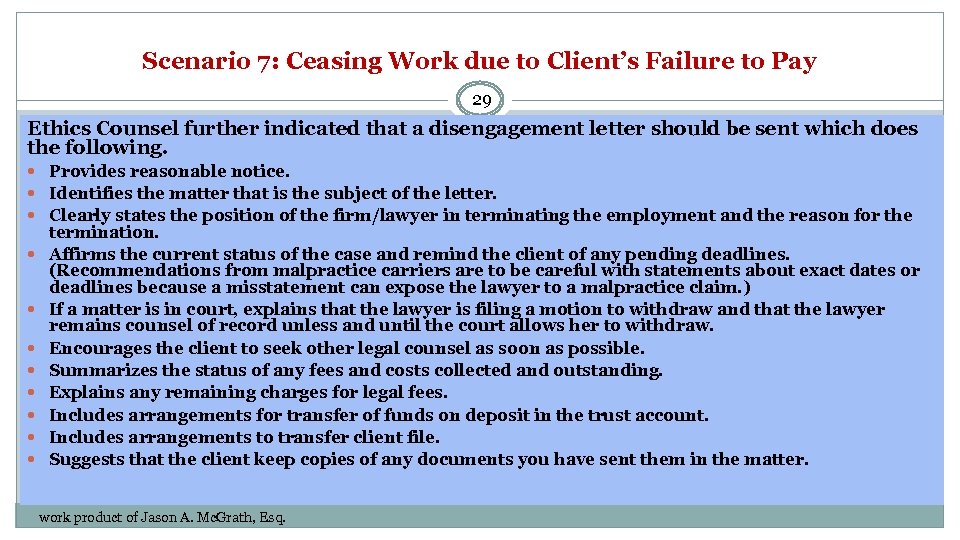
Scenario 7: Ceasing Work due to Client’s Failure to Pay 29 Ethics Counsel further indicated that a disengagement letter should be sent which does the following. Provides reasonable notice. Identifies the matter that is the subject of the letter. Clearly states the position of the firm/lawyer in terminating the employment and the reason for the termination. Affirms the current status of the case and remind the client of any pending deadlines. (Recommendations from malpractice carriers are to be careful with statements about exact dates or deadlines because a misstatement can expose the lawyer to a malpractice claim. ) If a matter is in court, explains that the lawyer is filing a motion to withdraw and that the lawyer remains counsel of record unless and until the court allows her to withdraw. Encourages the client to seek other legal counsel as soon as possible. Summarizes the status of any fees and costs collected and outstanding. Explains any remaining charges for legal fees. Includes arrangements for transfer of funds on deposit in the trust account. Includes arrangements to transfer client file. Suggests that the client keep copies of any documents you have sent them in the matter. work product of Jason A. Mc. Grath, Esq.
Scenario 8: Opinions Regarding Another Lawyer’s Conduct 30 You present NCSB Ethics Counsel with a set of facts and circumstances and ask if the actions / inactions of the attorney are ethical. NCSB correctly intuits that the actions / inactions are not yours, but rather those of another attorney. work product of Jason A. Mc. Grath, Esq.
Scenario 8: Opinions Regarding Another Lawyer’s Conduct 31 Ethics Counsel: “I cannot offer an informal opinion as to whether another lawyer’s conduct violates the rules. ” work product of Jason A. Mc. Grath, Esq.
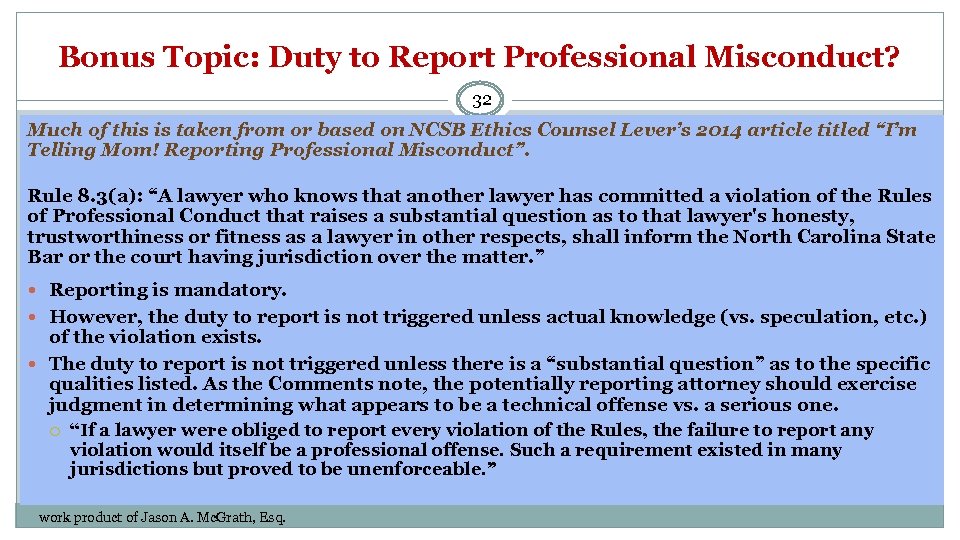
Bonus Topic: Duty to Report Professional Misconduct? 32 Much of this is taken from or based on NCSB Ethics Counsel Lever’s 2014 article titled “I’m Telling Mom! Reporting Professional Misconduct”. Rule 8. 3(a): “A lawyer who knows that another lawyer has committed a violation of the Rules of Professional Conduct that raises a substantial question as to that lawyer's honesty, trustworthiness or fitness as a lawyer in other respects, shall inform the North Carolina State Bar or the court having jurisdiction over the matter. ” Reporting is mandatory. However, the duty to report is not triggered unless actual knowledge (vs. speculation, etc. ) of the violation exists. The duty to report is not triggered unless there is a “substantial question” as to the specific qualities listed. As the Comments note, the potentially reporting attorney should exercise judgment in determining what appears to be a technical offense vs. a serious one. “If a lawyer were obliged to report every violation of the Rules, the failure to report any violation would itself be a professional offense. Such a requirement existed in many jurisdictions but proved to be unenforceable. ” work product of Jason A. Mc. Grath, Esq.
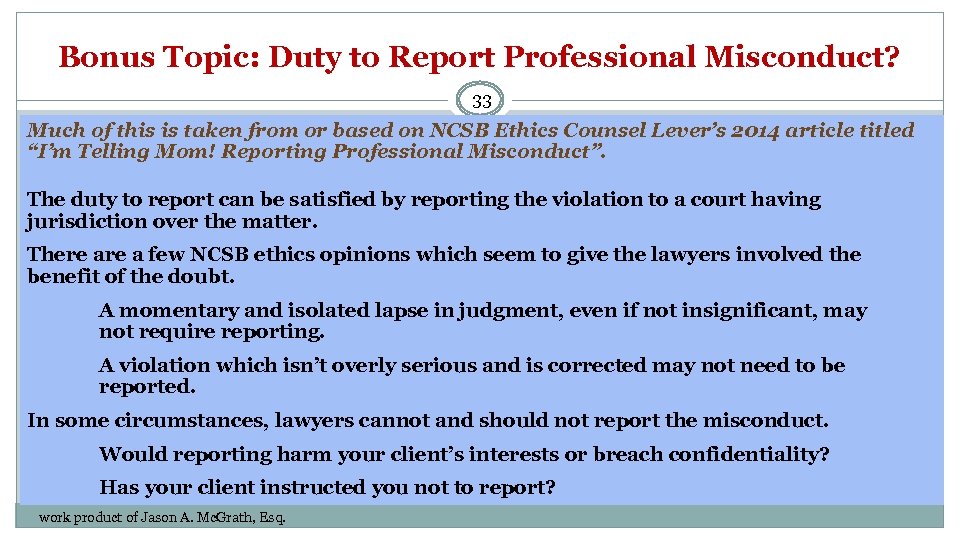
Bonus Topic: Duty to Report Professional Misconduct? 33 Much of this is taken from or based on NCSB Ethics Counsel Lever’s 2014 article titled “I’m Telling Mom! Reporting Professional Misconduct”. The duty to report can be satisfied by reporting the violation to a court having jurisdiction over the matter. There a few NCSB ethics opinions which seem to give the lawyers involved the benefit of the doubt. A momentary and isolated lapse in judgment, even if not insignificant, may not require reporting. A violation which isn’t overly serious and is corrected may not need to be reported. In some circumstances, lawyers cannot and should not report the misconduct. Would reporting harm your client’s interests or breach confidentiality? Has your client instructed you not to report? work product of Jason A. Mc. Grath, Esq.
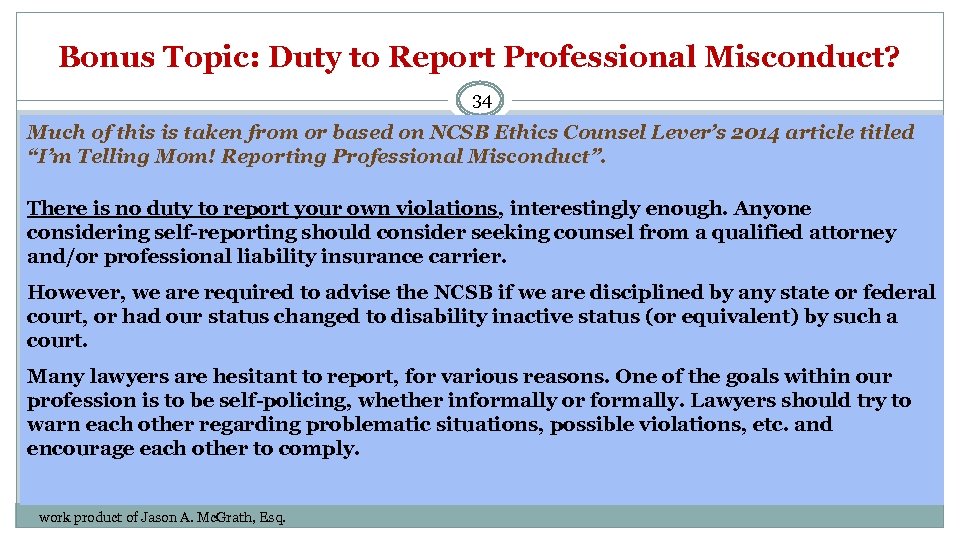
Bonus Topic: Duty to Report Professional Misconduct? 34 Much of this is taken from or based on NCSB Ethics Counsel Lever’s 2014 article titled “I’m Telling Mom! Reporting Professional Misconduct”. There is no duty to report your own violations, interestingly enough. Anyone considering self-reporting should consider seeking counsel from a qualified attorney and/or professional liability insurance carrier. However, we are required to advise the NCSB if we are disciplined by any state or federal court, or had our status changed to disability inactive status (or equivalent) by such a court. Many lawyers are hesitant to report, for various reasons. One of the goals within our profession is to be self-policing, whether informally or formally. Lawyers should try to warn each other regarding problematic situations, possible violations, etc. and encourage each other to comply. work product of Jason A. Mc. Grath, Esq.
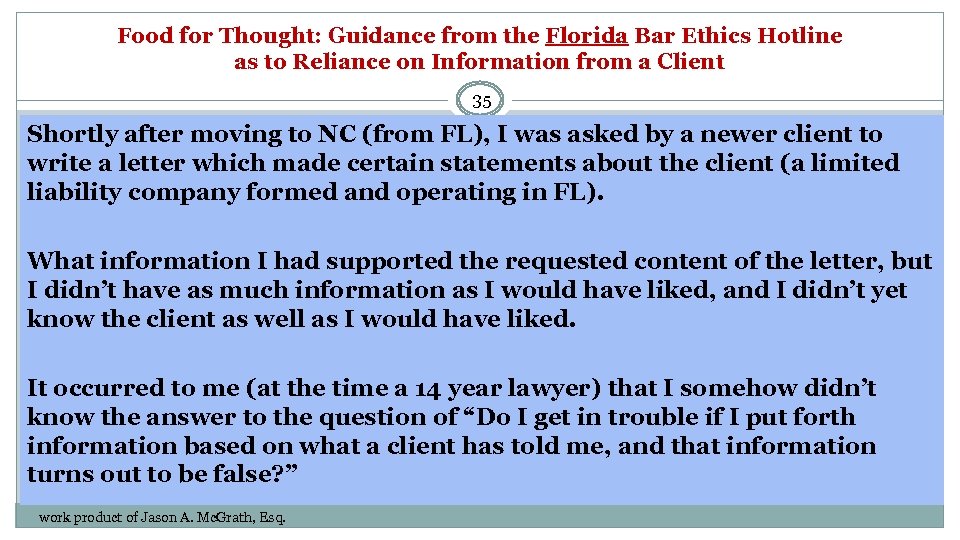
Food for Thought: Guidance from the Florida Bar Ethics Hotline as to Reliance on Information from a Client 35 Shortly after moving to NC (from FL), I was asked by a newer client to write a letter which made certain statements about the client (a limited liability company formed and operating in FL). What information I had supported the requested content of the letter, but I didn’t have as much information as I would have liked, and I didn’t yet know the client as well as I would have liked. It occurred to me (at the time a 14 year lawyer) that I somehow didn’t know the answer to the question of “Do I get in trouble if I put forth information based on what a client has told me, and that information turns out to be false? ” work product of Jason A. Mc. Grath, Esq.
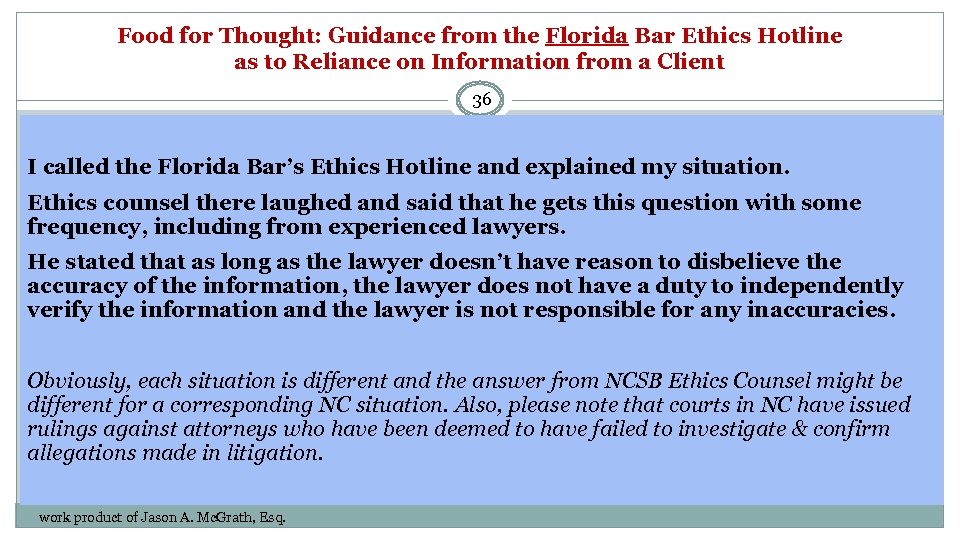
Food for Thought: Guidance from the Florida Bar Ethics Hotline as to Reliance on Information from a Client 36 I called the Florida Bar’s Ethics Hotline and explained my situation. Ethics counsel there laughed and said that he gets this question with some frequency, including from experienced lawyers. He stated that as long as the lawyer doesn’t have reason to disbelieve the accuracy of the information, the lawyer does not have a duty to independently verify the information and the lawyer is not responsible for any inaccuracies. Obviously, each situation is different and the answer from NCSB Ethics Counsel might be different for a corresponding NC situation. Also, please note that courts in NC have issued rulings against attorneys who have been deemed to have failed to investigate & confirm allegations made in litigation. work product of Jason A. Mc. Grath, Esq.
Food for Thought: Guidance from the Florida Bar Ethics Hotline as to Advising Your NC Client Regarding Possible Activities in FL 37 In 2011, I asked the Florida Bar Ethics Hotline if an attorney licensed in NC but not in FL could give general advice to a NC client regarding the client’s possible expansion of business to FL. Ethics counsel there said that only a FL-licensed attorney can give any advice regarding FL law, regardless of the remainder of the circumstances. This includes a non-FL attorney not being allowed to comment to a client regarding a FL statute, FL case law, etc. work product of Jason A. Mc. Grath, Esq.
Food for Thought: Guidance from the Florida Bar Ethics Hotline as to Advising Your NC Client Regarding Possible Activities in FL 38 Every single attorney with whom I’ve shared that information has been surprised to some extent, with some refusing to believe it (or at least accept it) and with others commenting that they’ve apparently violated the FL Rules hundreds of times. The prevailing comment was “I always thought you could informally advise your client, you just couldn’t author an opinion letter or similar. ” A Florida judge who had just retired went so far as to emphatically state “That’s absolutely ridiculous, it’s {bleep}. ” Obviously, each situation is different and the answer from NCSB Ethics Counsel might be different for a corresponding NC situation. work product of Jason A. Mc. Grath, Esq.
Скачать презентацию If Ignorance is Bliss Why Did We Ask
489a9f949c26d85c9a7868623d93c13e.ppt