


 Скачать презентацию IETF 72 SIP WG meeting SIP Identity issues
d610bc66df4d6223055d1868d8adc1f6.ppt
- Количество слайдов: 9
 IETF 72 SIP WG meeting SIP Identity issues John Elwell et alia 1
 SIP Identity - do we have a problem? • 7 drafts cited in corresponding presentation at IETF 71 • 3 more drafts since then: – draft-elwell-sip-e 2 e-identity-important-00 – draft-kaplan-sip-asserter-identity-00 – draft-kaplan-sip-uris-change-00 • Huge amount of email traffic since IETF 71 – by far the largest discussion topic based on list traffic • So is there a problem? – It seems there must be, but disagreement on exactly what the problem is – Focus today on what the problem is – ignore solutions for now – Look at broader picture – what do UAS and called user need? – Ignore related issues of PSTN interworking and response identity 2
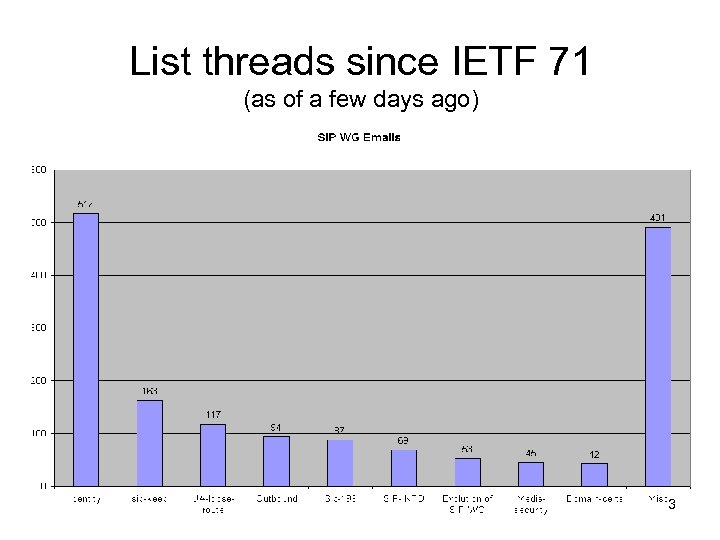 List threads since IETF 71 (as of a few days ago) 3
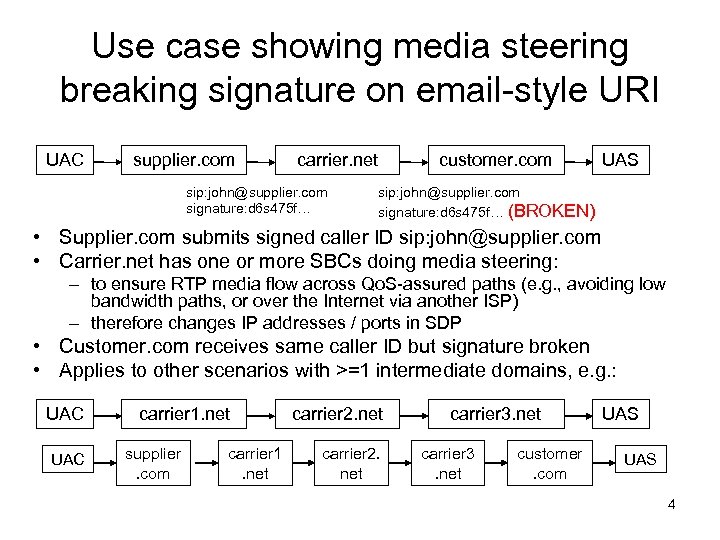 Use case showing media steering breaking signature on email-style URI UAC supplier. com carrier. net sip: john@supplier. com signature: d 6 s 475 f… customer. com UAS sip: john@supplier. com signature: d 6 s 475 f… (BROKEN) • Supplier. com submits signed caller ID sip: john@supplier. com • Carrier. net has one or more SBCs doing media steering: – to ensure RTP media flow across Qo. S-assured paths (e. g. , avoiding low bandwidth paths, or over the Internet via another ISP) – therefore changes IP addresses / ports in SDP • Customer. com receives same caller ID but signature broken • Applies to other scenarios with >=1 intermediate domains, e. g. : UAC carrier 1. net supplier. com carrier 1. net carrier 2. net carrier 3. net customer. com UAS 4
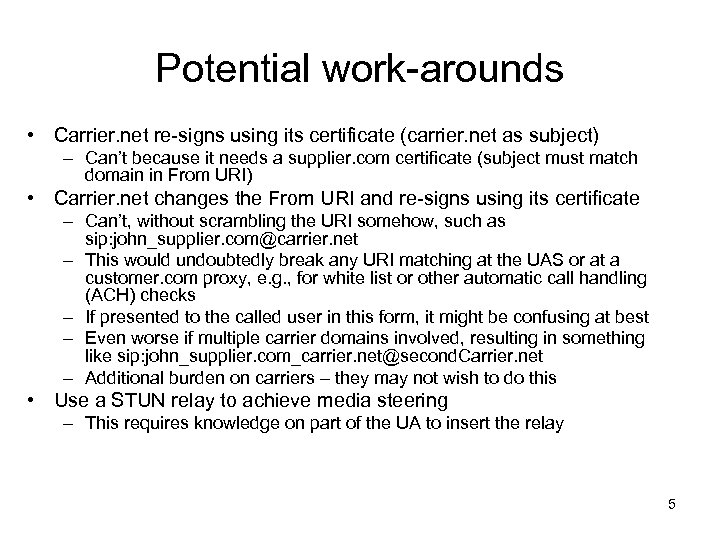 Potential work-arounds • Carrier. net re-signs using its certificate (carrier. net as subject) – Can’t because it needs a supplier. com certificate (subject must match domain in From URI) • Carrier. net changes the From URI and re-signs using its certificate – Can’t, without scrambling the URI somehow, such as sip: john_supplier. com@carrier. net – This would undoubtedly break any URI matching at the UAS or at a customer. com proxy, e. g. , for white list or other automatic call handling (ACH) checks – If presented to the called user in this form, it might be confusing at best – Even worse if multiple carrier domains involved, resulting in something like sip: john_supplier. com_carrier. net@second. Carrier. net – Additional burden on carriers – they may not wish to do this • Use a STUN relay to achieve media steering – This requires knowledge on part of the UA to insert the relay 5
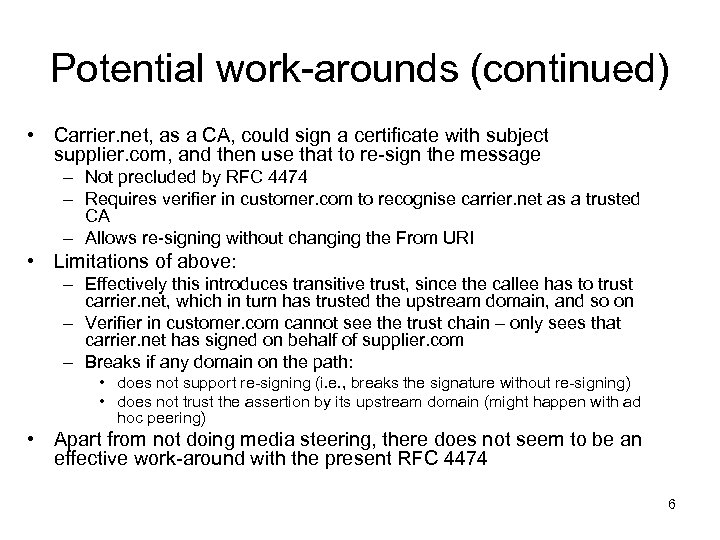 Potential work-arounds (continued) • Carrier. net, as a CA, could sign a certificate with subject supplier. com, and then use that to re-sign the message – Not precluded by RFC 4474 – Requires verifier in customer. com to recognise carrier. net as a trusted CA – Allows re-signing without changing the From URI • Limitations of above: – Effectively this introduces transitive trust, since the callee has to trust carrier. net, which in turn has trusted the upstream domain, and so on – Verifier in customer. com cannot see the trust chain – only sees that carrier. net has signed on behalf of supplier. com – Breaks if any domain on the path: • does not support re-signing (i. e. , breaks the signature without re-signing) • does not trust the assertion by its upstream domain (might happen with ad hoc peering) • Apart from not doing media steering, there does not seem to be an effective work-around with the present RFC 4474 6
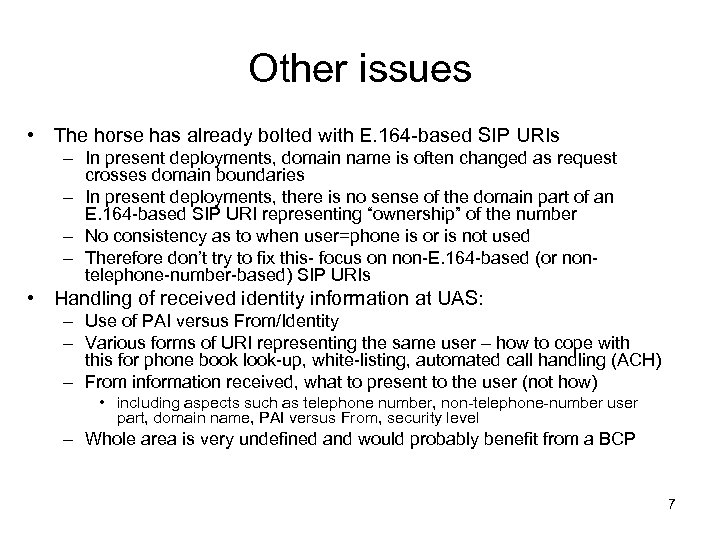 Other issues • The horse has already bolted with E. 164 -based SIP URIs – In present deployments, domain name is often changed as request crosses domain boundaries – In present deployments, there is no sense of the domain part of an E. 164 -based SIP URI representing “ownership” of the number – No consistency as to when user=phone is or is not used – Therefore don’t try to fix this- focus on non-E. 164 -based (or nontelephone-number-based) SIP URIs • Handling of received identity information at UAS: – Use of PAI versus From/Identity – Various forms of URI representing the same user – how to cope with this for phone book look-up, white-listing, automated call handling (ACH) – From information received, what to present to the user (not how) • including aspects such as telephone number, non-telephone-number user part, domain name, PAI versus From, security level – Whole area is very undefined and would probably benefit from a BCP 7
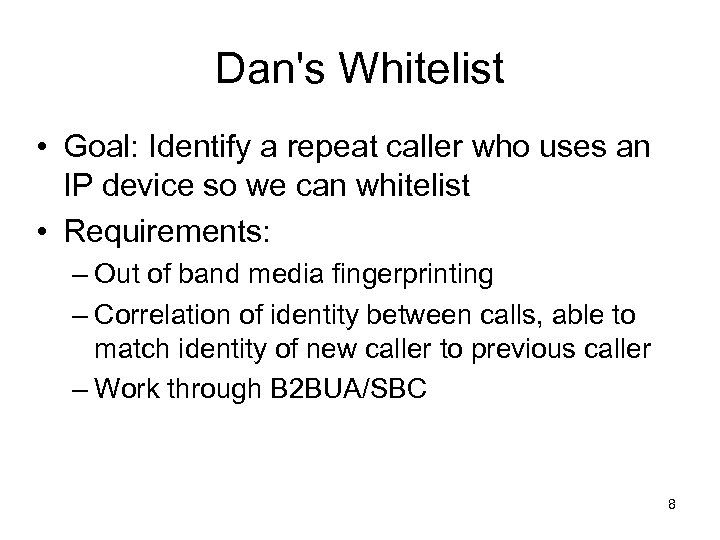 Dan's Whitelist • Goal: Identify a repeat caller who uses an IP device so we can whitelist • Requirements: – Out of band media fingerprinting – Correlation of identity between calls, able to match identity of new caller to previous caller – Work through B 2 BUA/SBC 8
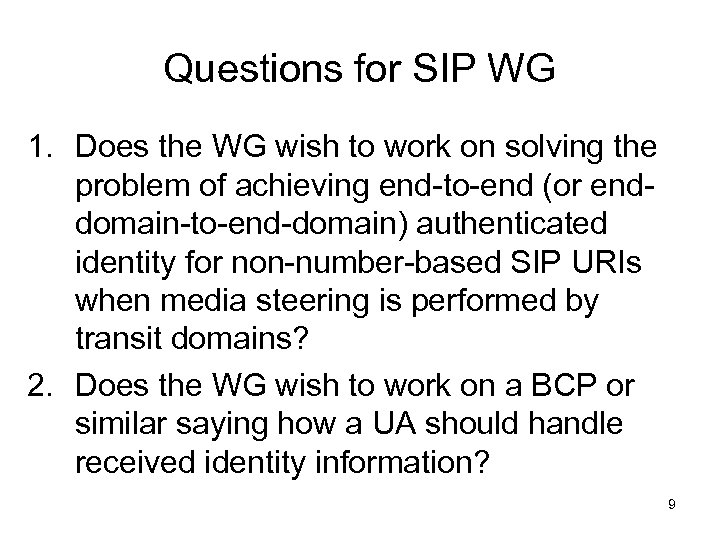 Questions for SIP WG 1. Does the WG wish to work on solving the problem of achieving end-to-end (or enddomain-to-end-domain) authenticated identity for non-number-based SIP URIs when media steering is performed by transit domains? 2. Does the WG wish to work on a BCP or similar saying how a UA should handle received identity information? 9