


 Скачать презентацию IEP Training Module Developing IEPs to Improve Student
c95326528d29c973e8c80e93973ad4ab.ppt
- Количество слайдов: 157
 IEP Training Module: Developing IEPs to Improve Student Performance Developed by the Kentucky Special Education Cooperative Network
 Focus Questions • How do we improve the performance of students with disabilities? • How do we link the curricular documents and IEPs so they work together? • How will we meet the child’s other educational needs that result from the disability? • How will we teach the goals/benchmarks/objectives? • How can we use student data to guide instructional decision-making?
 Purpose of the Training • Provide time for developing a resultsdriven IEP • Provide a process for developing IEPs • Provide an opportunity to practice developing IEPs • Provide a connection between the General Curriculum, the IEP, and instructional planning
 Activity One
 Nothing worth learning is learned quickly, except parachuting. David S. Brown
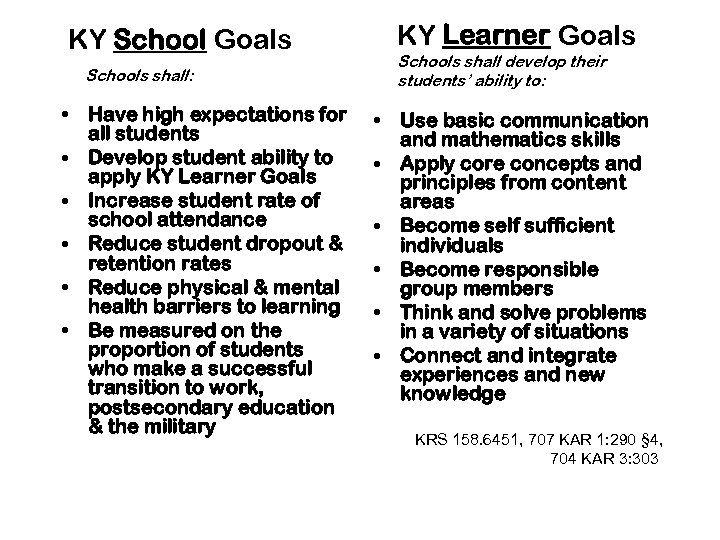 KY School Goals Schools shall: • Have high expectations for all students • Develop student ability to apply KY Learner Goals • Increase student rate of school attendance • Reduce student dropout & retention rates • Reduce physical & mental health barriers to learning • Be measured on the proportion of students who make a successful transition to work, postsecondary education & the military KY Learner Goals Schools shall develop their students’ ability to: • Use basic communication and mathematics skills • Apply core concepts and principles from content areas • Become self sufficient individuals • Become responsible group members • Think and solve problems in a variety of situations • Connect and integrate experiences and new knowledge KRS 158. 6451, 707 KAR 1: 290 § 4, 704 KAR 3: 303
 Kentucky Learner Goals 1. Use basic communication and mathematics skills 2. Apply core concepts and principles from content areas 3. Become self-sufficient individuals 4. Become responsible group members 5. Think and solve problems in a variety of situations 6. Connect and integrate experiences and new knowledge
 Academic Expectations • Example: Learner Goal 1 1. 1 Students use reference tools… to find the information they need to meet specific demands, explore interests, or solve specific problems. • Example: Learner Goal 2 2. 7 Students understand number concepts and use numbers appropriately and accurately.
 Program of Studies (POS) (Kentucky’s Mandated Curriculum) • Outlines the minimum content required for all students before graduating • Provides all students with common content and opportunities to learn at high levels • Serves as the basis for establishing and revising curriculum at the local level
 Core Content for Assessment 4. 1 • Is essential for all students to know • Is included in state assessment • Addresses the following content areas: – – – – Reading Writing Social Studies Science Math Practical Living/Vocational Studies Arts and Humanities
 Character Education This document offers additional instructional tools for teaching… altruism, citizenship, courtesy, honesty, human worth, justice, knowledge, respect, responsibility, and self-discipline.
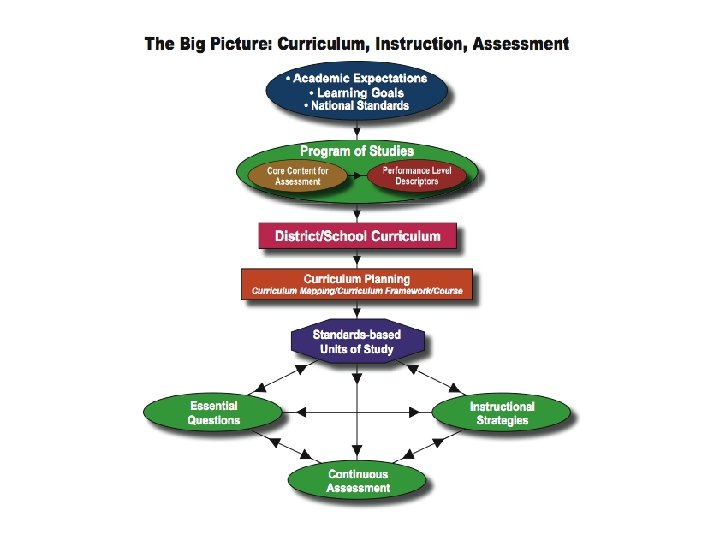
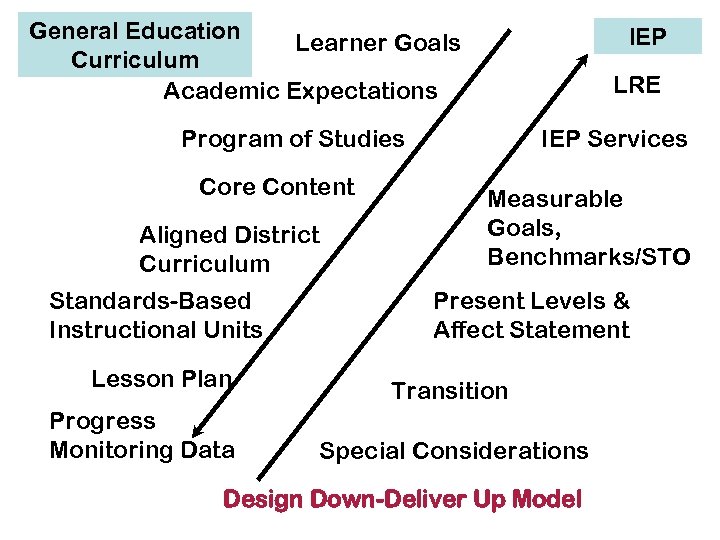 General Education Learner Goals Curriculum Academic Expectations IEP LRE Program of Studies Core Content Aligned District Curriculum Standards-Based Instructional Units Lesson Plan Progress Monitoring Data IEP Services Measurable Goals, Benchmarks/STO Present Levels & Affect Statement Transition Special Considerations Design Down-Deliver Up Model
 Purpose of the IEP To support educational performance 707 KAR 1: 320 § 5 (7)(b)1 & 2 34 CFR 300. 320 (a)
 The IEP supports educational performance by: • Providing access to the general curriculum. • Ensuring the student will make progress in the general curriculum. • Addressing the student’s other unique educational needs. • Preparing the student for further education, employment, and independent living, if needed. 707 KAR 1: 320 § 5 (7)(b)1 & 2 34 CFR 300. 320(a)(2)(A)
 Who Contributes to the IEP? • General and special educators • Parents • Students, when appropriate • Evaluation specialists • Related service providers
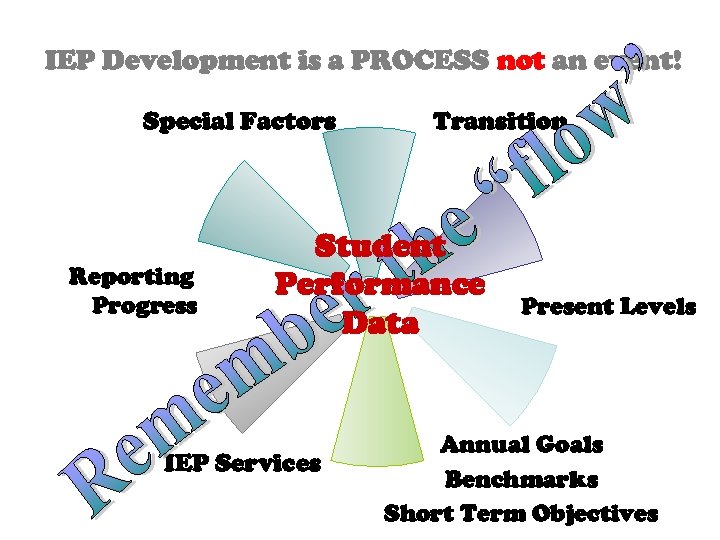 IEP Development is a PROCESS not an event! Special Factors Reporting Progress Transition Student Performance Data IEP Services Present Levels Annual Goals Benchmarks Short Term Objectives
 Purpose of Student Performance Data Write the IEP Plan instruction Evaluate and report progress Determine the effectiveness of instructional services § Determine if the child continues to need SDI and/or related services § Revise the IEP § Document implementation of the IEP § §
 Student Performance Data Sources • pre-referral intervention results • work samples (e. g. , portfolios, daily assignments, etc. ) • behavioral observations • results of standardized individual assessments • culminating products/projects • state and district-wide assessment results • progress monitoring data (including baseline data) • interviews • classroom tests • formal/informal assessment • journal writing • ILP (IGP) • student & parent surveys
 IEP DEVELOPMENT CONSIDERATIONS The ARC shall consider in the development of an IEP: a) the strengths of the child; b) the concerns of the parents for enhancing the education of their child; c) the results of the initial or most recent evaluation of the child; d) the academic, developmental, and functional needs of the child; and e) as appropriate, the results of the child’s performance on any general state or districtwide assessment programs. 707 KAR 1: 320 § 5 (1) 34 CFR 300. 324 (a)(1)
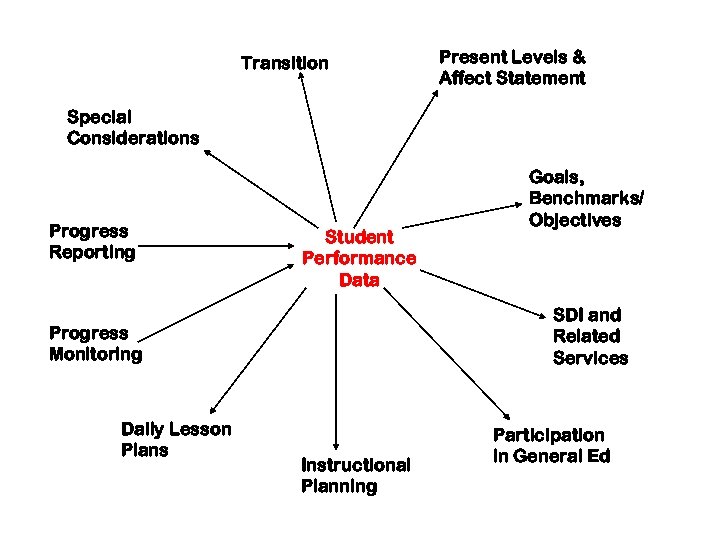 Transition Present Levels & Affect Statement Special Considerations Progress Reporting Student Performance Data SDI and Related Services Progress Monitoring Daily Lesson Plans Goals, Benchmarks/ Objectives Instructional Planning Participation in General Ed
 IEP Development Process • Consideration of Special Factors • Post-secondary Transition • Present Level of Academic Achievement and Functional Performance • Annual Goals, Benchmarks & Objectives • IEP Services • Participation
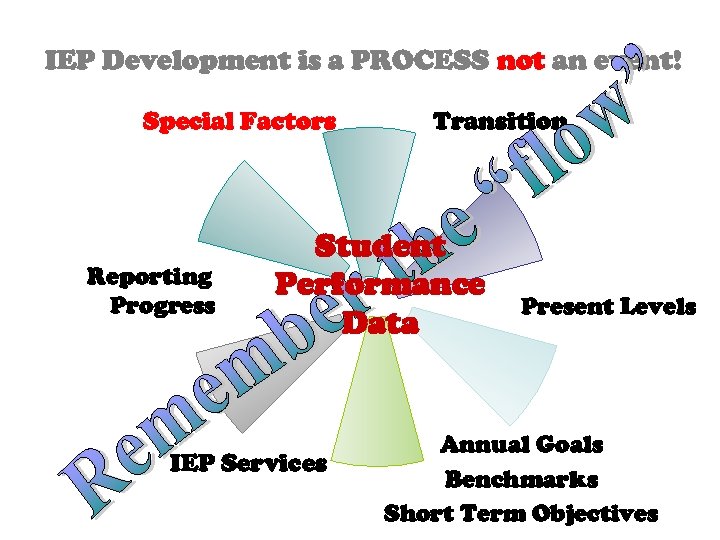 IEP Development is a PROCESS not an event! Special Factors Reporting Progress Transition Student Performance Data IEP Services Present Levels Annual Goals Benchmarks Short Term Objectives
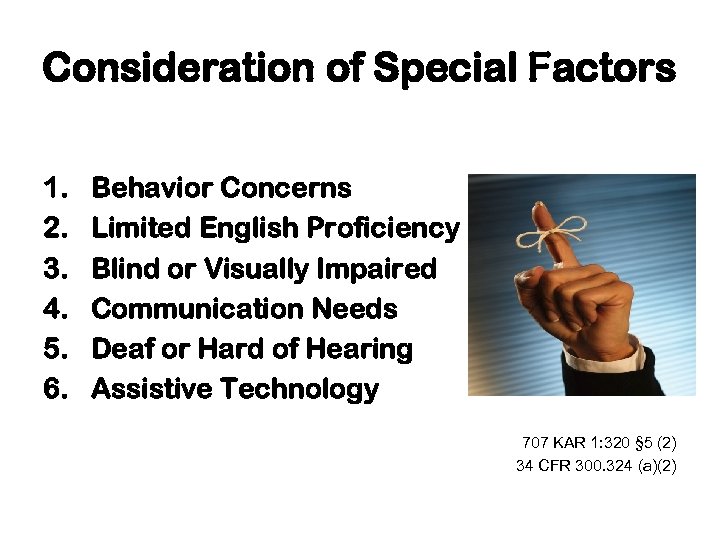 Consideration of Special Factors 1. 2. 3. 4. 5. 6. Behavior Concerns Limited English Proficiency Blind or Visually Impaired Communication Needs Deaf or Hard of Hearing Assistive Technology 707 KAR 1: 320 § 5 (2) 34 CFR 300. 324 (a)(2)
 Anita
Anita
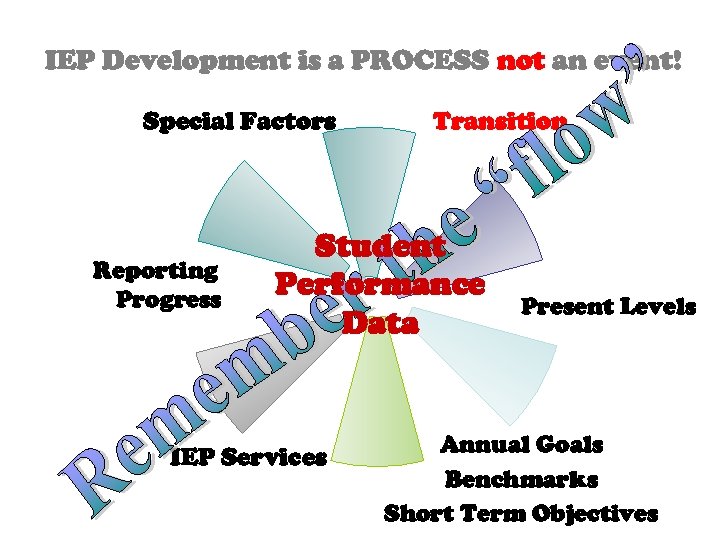 IEP Development is a PROCESS not an event! Special Factors Reporting Progress Transition Student Performance Data IEP Services Present Levels Annual Goals Benchmarks Short Term Objectives
 Post-Secondary Transition Needs • In the child’s eighth grade year or when the child has reached age 14 (or younger if determined appropriate) the IEP includes a statement of transition service needs • The statement is updated annually • Focuses on the child’s course of study 707 KAR 1: 320 § 7 (1) 34 CFR 300. 320 (b)(2)
 Measurable Postsecondary Goals • Beginning no later than the first IEP to be in effect when the child is 16, the IEP includes appropriate measurable postsecondary goals • Postsecondary goals are updated annually • Postsecondary goals are based upon age appropriate transition assessment related to 1) training/education, 2) employment, and, where appropriate, 3) independent living skills • IEP includes the transition services (including courses of study) needed to assist the child in reaching those postsecondary goals • IEP includes annual goals that will reasonably enable the student to reach the postsecondary goals. 707 KAR 1: 320 § 7 (2) 34 CFR 300. 320 (6) (1)
 Individual Learning Plan or Individual Graduation Plan?
 Transfer of Rights • Beginning at least one year before the age of majority • Statement that the student and their parents have been informed of the rights that will transfer to the student upon reaching the age of majority • Upon the student reaching the age of majority, parents must continue to receive the Conference Summary 707 KAR 1: 320 § 6 (4) 707 KAR 1: 320 § 5 (14) CFR 320 (c)
 Transition Tips • The Transition needs of the student must be discussed first • Have the Individual Learning Plan (ILP) at all ARC meetings • Update the transition surveys annually (parent and student) • Review other transition assessments
 Write Your Own • Transition Needs Statement • Post-Secondary Goal • Transition Services (including statement of interagency linkages and responsibilities)
 Other Transition Considerations • Part C (Preschool) to Part B (IDEA) • Different levels (preschool – elementary; elementary – middle; middle – high) • Different building (physical access issues, building layout) • Different program (pull-out setting to general ed setting)
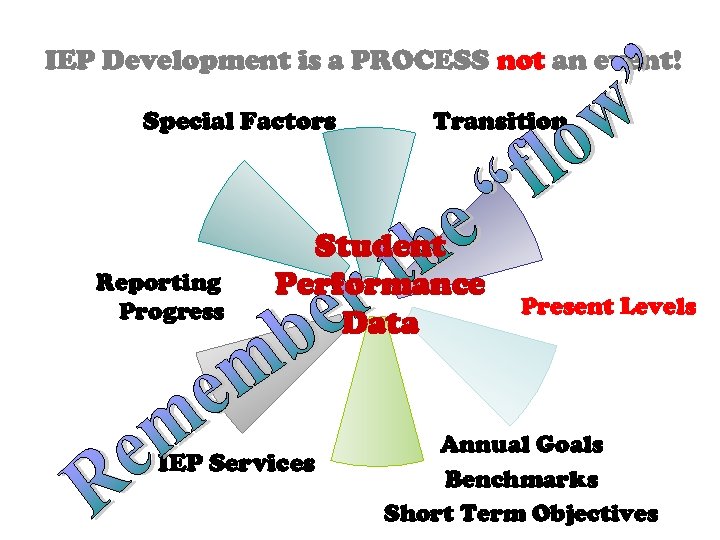 IEP Development is a PROCESS not an event! Special Factors Reporting Progress Transition Student Performance Data IEP Services Present Levels Annual Goals Benchmarks Short Term Objectives
 Let the Rabbits Run: A Parable
 Present Level of Academic Achievement and Functional Performance • A statement of the child’s present levels of academic achievement and functional performance, including: – How the child’s disability affects the child’s involvement and progress in the general curriculum as provided in the Kentucky POS; or – For preschool children, as appropriate, how the disability affects the child’s participation in appropriate activities. 707 KAR 1: 320 § 5 (7)(a) 34 CFR 320 (a)(1)
 Academic Achievement and Functional Performance Areas to Consider • • Communication Academic Performance Social and Emotional General Intelligence Health, Vision, Hearing, and Motor Transition to Post-Secondary Functional Vision/Learning Media Assessment 707 KAR 1: 320 § 5 (2) (c) 707 KAR 1: 320 § 7 (1) 707 KAR 1: 300 § 4 (10) 34 CFR 300. 304 (c) (4)
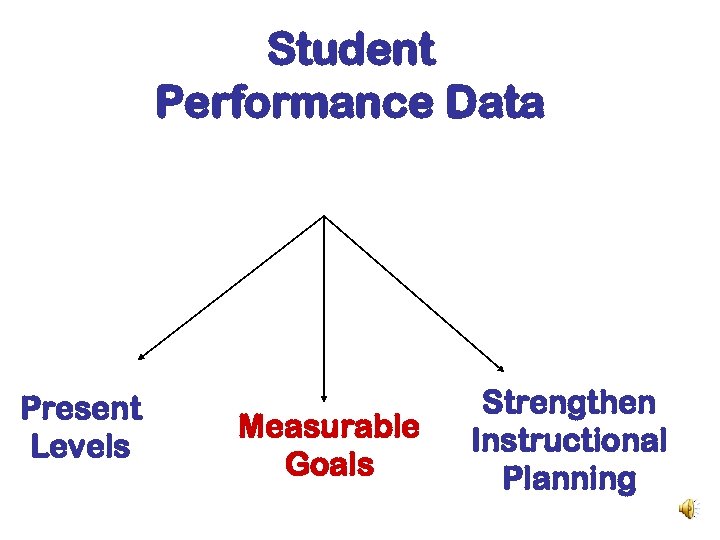
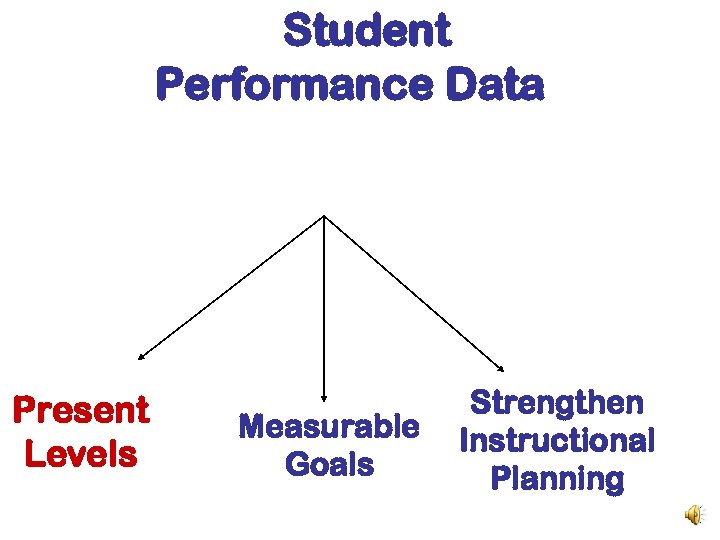 Student Performance Data Present Levels Measurable Goals Strengthen Instructional Planning
 Activity • What information would help the ARC develop the Present Levels? • What are some specific sources for this information?
 Sources of Information Present Levels of Academic Achievement and Functional Performance may include information collected about the child including: • pre-referral intervention results • work samples (e. g. , portfolios, daily assignments etc. ) • behavioral observations • results of standardized individualized assessments • culminating products/projects • state and district-wide assessment results • progress monitoring data (including baseline data) • interviews • classroom tests • formal/informal assessment • journal writing • ILP (IGP) • student & parent surveys
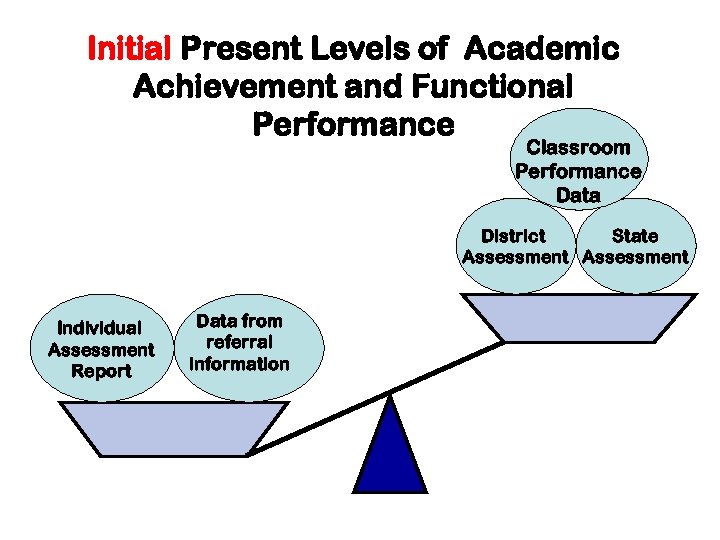 Initial Present Levels of Academic Achievement and Functional Performance Classroom Performance Data District State Assessment Individual Assessment Report Data from referral information
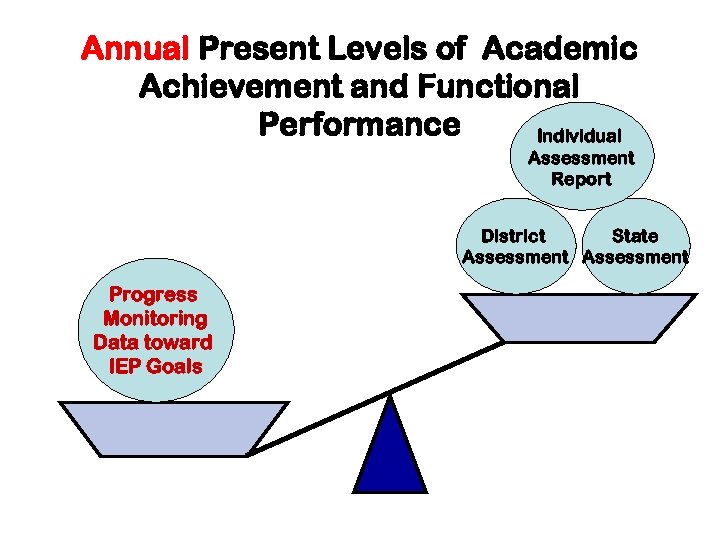 Annual Present Levels of Academic Achievement and Functional Performance Individual Assessment Report District State Assessment Progress Monitoring Data toward IEP Goals
 How do you Write the Present Levels?
 Present Levels Planning Process The ARC must know: • What skills the student has and what content the student knows (student performance data) • What students in this grade are expected to know and do (from the curricular documents) • What needs the student has that are not addressed through the curricular documents
 Steps to Write the Present Levels 1. Review the student’s performance information to plot where the student is in the general curriculum 2. Locate the student’s grade level in the Program of Studies or district curriculum 3. Determine the skills and content the student needs to learn from the curriculum 4. Determine what the student needs to learn that is not addressed through the curricular documents (to address the child’s other needs)
 How the disability affects the child’s involvement and progress in the general curriculum… 707 KAR 1: 320 § 5 (7)(a) 34 CFR 300. 320 (a)(1)(i)
 Affect on Involvement and Progress in the General Curriculum Based on the statements in the Present Level: • What are the student’s challenges related to the disability? • How will the challenges related to the disability affect day-to-day life?
 Present Level Statement • Grade 4 (Student) uses phonetic clues to pronounce one syllable words. He has a sight word vocabulary of approximately 150 words, produces rhyming words, and uses context clues to understand text. He learns best when words are paired with visual cues and when information is highlighted. He is unable to use text features and organizational patterns to distinguish the difference between reading for information and reading for enjoyment. He cannot interpret the authors intent or opinions, or use details to support the author’s opinions.
 Affect Statement • (Student’s) inability to read highfrequency/grade appropriate words affects his performance in language arts and content areas when given grade-level reading materials, written directions, completing homework assignments, reading for information, answering open response requests, and responding to on-demand writing tasks.
 • (Student’s) inability to read highfrequency/grade appropriate words affects his performance in language arts and content areas when given grade-level reading materials, written directions, completing homework assignments, reading for information, answering open response requests, and responding to on-demand writing tasks.
 • (Student’s) inability to read highfrequency/grade appropriate words affects his performance in language arts and content areas when given grade-level reading materials, written directions, completing homework assignments, reading for information, answering open response requests, and responding to on-demand writing tasks.
 Present Level Statement • (Student) demonstrates above average cognitive abilities and below average academic abilities. In timed situations, she refuses to complete the work and tries to leave class, curses, and will bite and kick at the adult, resulting in interruptions of learning experiences for herself and others. She is more successful at interacting with younger students. She enjoys working on the computer, games involving individual effort, and physical education class.
 Affect Statement • (Student’s) loss of time in the learning environment and unwillingness to complete assignments have resulted in the student’s performing below same age peers, and affects her ability to progress in the general education curriculum by working cooperatively in groups, participating in class discussions, completing timed assignments, accepting redirection, and complying with adult directions.
 • (Student’s) loss of time in the learning environment and unwillingness to complete assignments have resulted in the student’s performing below same age peers, and affects her ability to progress in the general education curriculum by working cooperatively in groups, participating in class discussions, completing timed assignments, accepting redirection, and complying with adult directions.
 • (Student’s) loss of time in the learning environment and unwillingness to complete assignments have resulted in the student’s performing below same age peers, and affects her ability to progress in the general education curriculum by working cooperatively in groups, participating in class discussions, completing timed assignments, accepting redirection, and complying with adult directions.
 Present Level Statement • Grade 5 (Student) shows an understanding of place value of numbers to 1, 000 but cannot read, write, and model whole numbers to 100, 000; can add, subtract, and multiply without regrouping, but he cannot use the skill of regrouping in these operations, and cannot do simple division. He can use manipulatives to show ½ and ¼ but he cannot compare and apply the sizes of common and mixed fractions. He cannot collect, organize, or display data, or choose an appropriate way to collect and represent data.
 Affect Statement • (Student’s) difficulty in math affects his performance in his ability to organize, collect, and interpret information to complete content assignments; to think, predict, and problem-solve in content assignments and real-life situations.
 Tips for Writing the Present Levels • Use information from student performance data • Describe what the student can and cannot do • Remember to include an affect statement • Cite the source of information obtained from outside the school (e. g. , parent , medical information) • Use parent-friendly language
 Write Your Own • Present Level of Academic Achievement and Functional Performance • Affect Statement
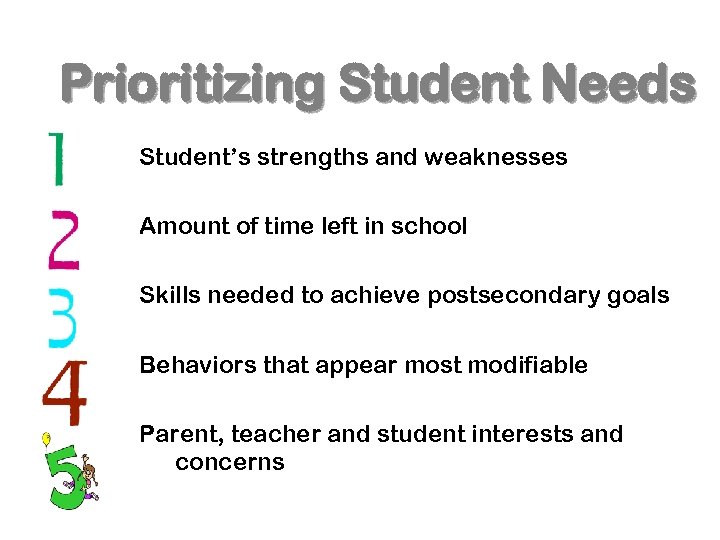 Prioritizing Student Needs Student’s strengths and weaknesses Amount of time left in school Skills needed to achieve postsecondary goals Behaviors that appear most modifiable Parent, teacher and student interests and concerns
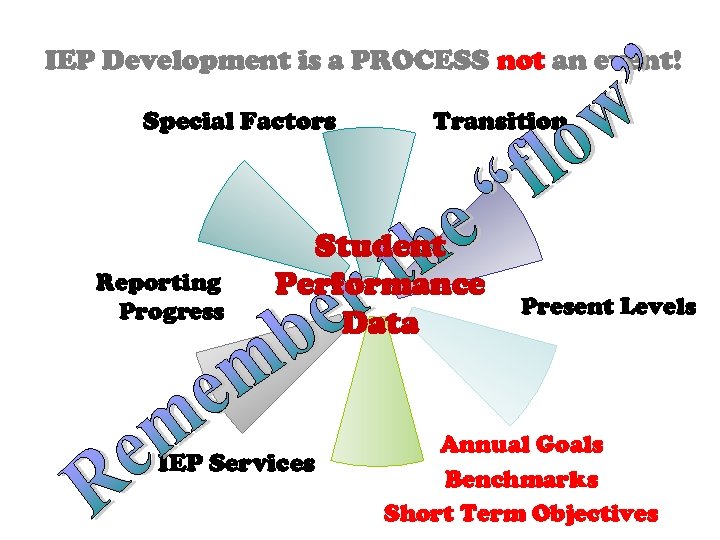 IEP Development is a PROCESS not an event! Special Factors Reporting Progress Transition Student Performance Data IEP Services Present Levels Annual Goals Benchmarks Short Term Objectives
 Measurable Annual Goals A statement of measurable annual goals, including academic and functional goals and benchmarks or short-term objectives, designed to: – Meet the child’s needs that result from the child’s disability to enable the child to be involved in and make progress in the general curriculum; and – Meet each of the child’s other educational needs that result from the child’s disability. 707 KAR 1: 320 § 5 (7)(b) 34 CFR 300. 320 (a)(2)
 What is Measurable? Measurable means it must be possible to evaluate and document whether the student is making progress toward the goal.
 Measurable Annual Goals • Are written to ensure access and enable progress in the general curriculum • Relate to the needs identified in the Present Levels • For students age 16 and older, reasonably enable the student to reach his/her postsecondary goals • Include a method of measurement • Describe performance anticipated within ONE year
 Setting IEP Goals • Step A: Determine the Skills Needed • Step B: Determine “How Far By When” • Step C: Determine Short-term instructional objectives/Benchmarks
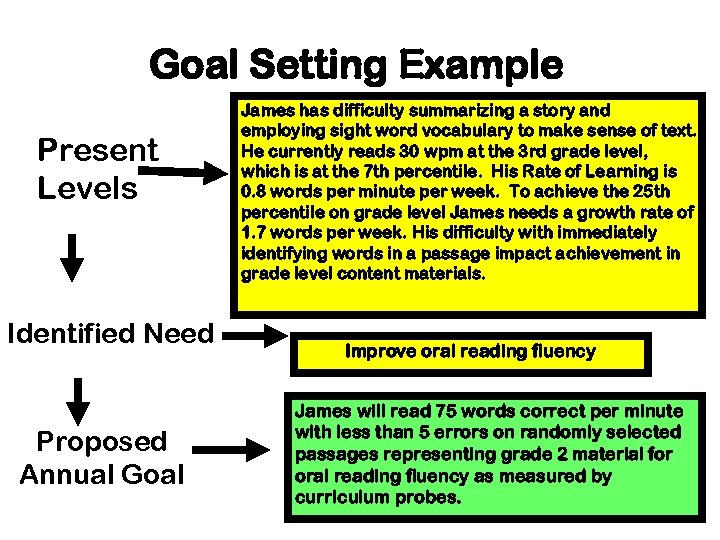 Goal Setting Example Present Levels Identified Need Proposed Annual Goal James has difficulty summarizing a story and employing sight word vocabulary to make sense of text. He currently reads 30 wpm at the 3 rd grade level, which is at the 7 th percentile. His Rate of Learning is 0. 8 words per minute per week. To achieve the 25 th percentile on grade level James needs a growth rate of 1. 7 words per week. His difficulty with immediately identifying words in a passage impact achievement in grade level content materials. Improve oral reading fluency James will read 75 words correct per minute with less than 5 errors on randomly selected passages representing grade 2 material for oral reading fluency as measured by curriculum probes.
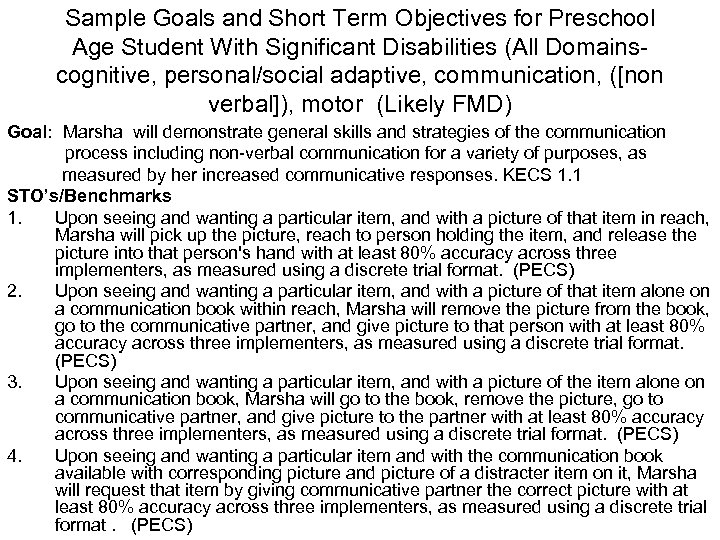 Sample Goals and Short Term Objectives for Preschool Age Student With Significant Disabilities (All Domains- cognitive, personal/social adaptive, communication, ([non verbal]), motor (Likely FMD) Goal: Marsha will demonstrate general skills and strategies of the communication process including non-verbal communication for a variety of purposes, as measured by her increased communicative responses. KECS 1. 1 STO’s/Benchmarks 1. Upon seeing and wanting a particular item, and with a picture of that item in reach, Marsha will pick up the picture, reach to person holding the item, and release the picture into that person's hand with at least 80% accuracy across three implementers, as measured using a discrete trial format. (PECS) 2. Upon seeing and wanting a particular item, and with a picture of that item alone on a communication book within reach, Marsha will remove the picture from the book, go to the communicative partner, and give picture to that person with at least 80% accuracy across three implementers, as measured using a discrete trial format. (PECS) 3. Upon seeing and wanting a particular item, and with a picture of the item alone on a communication book, Marsha will go to the book, remove the picture, go to communicative partner, and give picture to the partner with at least 80% accuracy across three implementers, as measured using a discrete trial format. (PECS) 4. Upon seeing and wanting a particular item and with the communication book available with corresponding picture and picture of a distracter item on it, Marsha will request that item by giving communicative partner the correct picture with at least 80% accuracy across three implementers, as measured using a discrete trial format. (PECS)
 Marsha’s Specially Designed Instruction • verbal cues, hand over hand assistance, system of least prompts, visual cues, & immediate reinforcement for correct responses
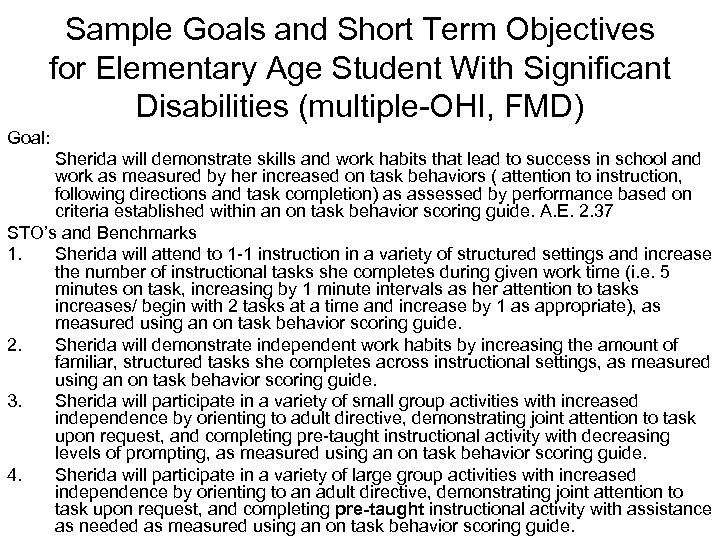 Sample Goals and Short Term Objectives for Elementary Age Student With Significant Disabilities (multiple-OHI, FMD) Goal: Sherida will demonstrate skills and work habits that lead to success in school and work as measured by her increased on task behaviors ( attention to instruction, following directions and task completion) as assessed by performance based on criteria established within an on task behavior scoring guide. A. E. 2. 37 STO’s and Benchmarks 1. Sherida will attend to 1 -1 instruction in a variety of structured settings and increase the number of instructional tasks she completes during given work time (i. e. 5 minutes on task, increasing by 1 minute intervals as her attention to tasks increases/ begin with 2 tasks at a time and increase by 1 as appropriate), as measured using an on task behavior scoring guide. 2. Sherida will demonstrate independent work habits by increasing the amount of familiar, structured tasks she completes across instructional settings, as measured using an on task behavior scoring guide. 3. Sherida will participate in a variety of small group activities with increased independence by orienting to adult directive, demonstrating joint attention to task upon request, and completing pre-taught instructional activity with decreasing levels of prompting, as measured using an on task behavior scoring guide. 4. Sherida will participate in a variety of large group activities with increased independence by orienting to an adult directive, demonstrating joint attention to task upon request, and completing pre-taught instructional activity with assistance as needed as measured using an on task behavior scoring guide.
 Sherida’s Specially Designed Instruction • Visual cues, visual work system, first___, then___ visual support, system of least prompts/cueing, modeling, guided practice, direct instruction, peer support, frequent reinforcement for appropriate attention and completion of tasks
 Sample Goals and Short Term Objectives for Middle School Student With Significant Disabilities (Autism-moderate) Goal: Tiffany will demonstrate her ability to become a responsible member of a group at home or in the community as measured by her increased use of interpersonal skills to initiate various social interactions across settings, with different people, as assessed by interpersonal skills checklist. (A. E. 4, 4. 1) STO’s and Benchmarks: 1. Tiffany will demonstrate her ability to use effective interpersonal skills by initiating or responding to a greeting from a peer or adult, on 4 out of 5 occasions across a 4 week period, as assessed using an interpersonal skills checklist. 2. Tiffany will demonstrate her ability to use effective interpersonal skills by initiating a simple conversation (2 exchanges) with a familiar peer or adult on a topic of her choice with no more than 2 prompt/cues, on 4 out of 5 occasions for 4 weeks, across a variety of settings, as assessed using an interpersonal skills checklist. 3. Tiffany will maintain conversation with familiar peer or adult on preferred topic for a minimum of 4 exchanges with no more than 2 prompts/cues, on 4 out of 5 occasions for 4 weeks, across a variety of settings, as assessed using an interpersonal skills checklist. 4. Tiffany will terminate a conversation appropriately by offering an age appropriate salutation (i. e. bye, goodbye, see you later, see ya’, etc. ) to peer or adult across a variety of settings, as assessed using an interpersonal skills checklist.
 Tiffany’s Specially Designed Instruction • positive practice across social settings, peer modeling of appropriate conversational skills, simplified verbiage, prior teaching/preparation of topic with rehearsal, video self modeling as applicable, modeling, system of least prompts/cues, scripting, social stories, comic book conversations, direct social skills instruction
 Sample Goals and Short Term Objectives for High School Student With Significant Disabilities (Multiple-OHI [medically fragile], FMD) Goal: Cheryl will use the verbal, reading and writing processes to communicate ideas and information for a variety of purposes, as measured by performance on criteria established on reading running record checklist. (POS-LA) STO’s and Benchmarks: 1. Cheryl will use combinations of pictures, symbols, letters and words to convey meaning as she constructs sentences with increasing complexity across various content areas. 2. Cheryl will interpret specialized vocabulary (words and terms specific to understanding the content) found in practical workplace passages including recipes, household labels, newspapers, forms, applications, etc. ) 3. Cheryl will use correct and appropriate spelling, punctuation grammar and capitalization, as she constructs sentences or sentences she is given to edit 4. Cheryl will write transactive pieces (writing produced for authentic purposes and audiences) that demonstrate self-sufficiency and practical living skills observed in the practical workplace (i. e. forms, applications, letters resume, etc. ) 5. Given weekly vocabulary words from various content areas that are practicably applicable, Cheryl will be able to match the appropriate words to the correct picture and identify at least one practical application for each using words, pictures, photos etc.
 Cheryl’s Specially Designed Instruction • One to one instruction, pictorial graphic organizers, pictures, objects, pictorial word processor (fading physical and verbal prompts, pictorially supported reference guides, community referenced activities, modeling, system of least prompts, keyboarding instruction including use of spell check, and other editing devices, guided practice,
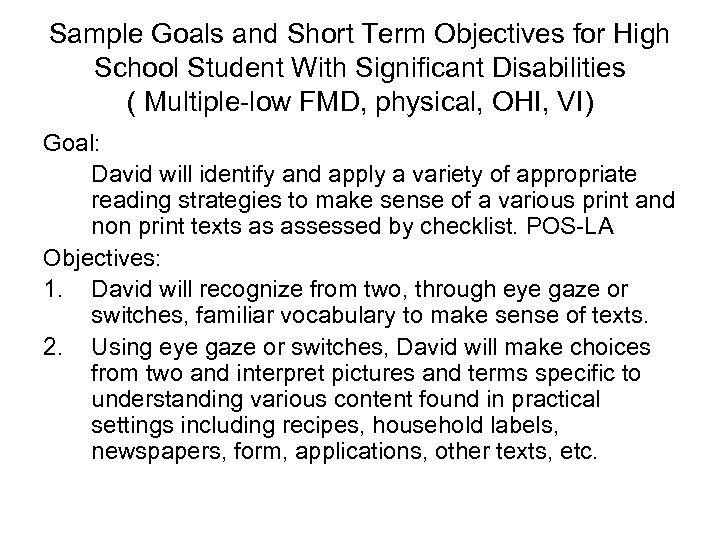 Sample Goals and Short Term Objectives for High School Student With Significant Disabilities ( Multiple-low FMD, physical, OHI, VI) Goal: David will identify and apply a variety of appropriate reading strategies to make sense of a various print and non print texts as assessed by checklist. POS-LA Objectives: 1. David will recognize from two, through eye gaze or switches, familiar vocabulary to make sense of texts. 2. Using eye gaze or switches, David will make choices from two and interpret pictures and terms specific to understanding various content found in practical settings including recipes, household labels, newspapers, form, applications, other texts, etc.
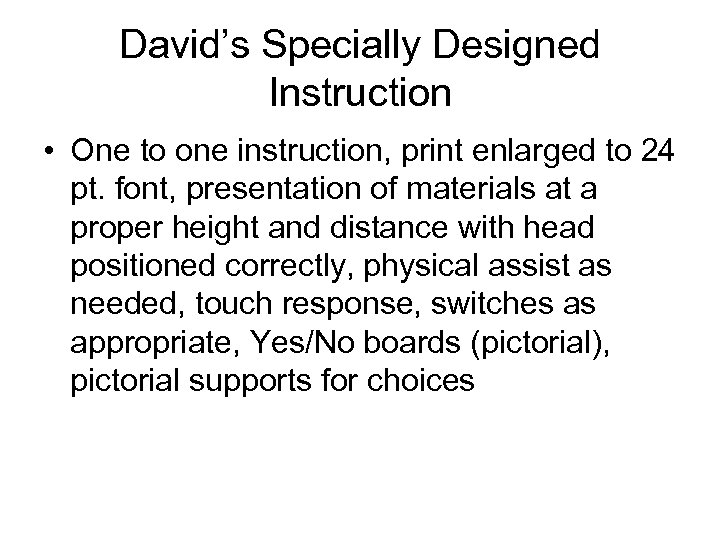 David’s Specially Designed Instruction • One to one instruction, print enlarged to 24 pt. font, presentation of materials at a proper height and distance with head positioned correctly, physical assist as needed, touch response, switches as appropriate, Yes/No boards (pictorial), pictorial supports for choices
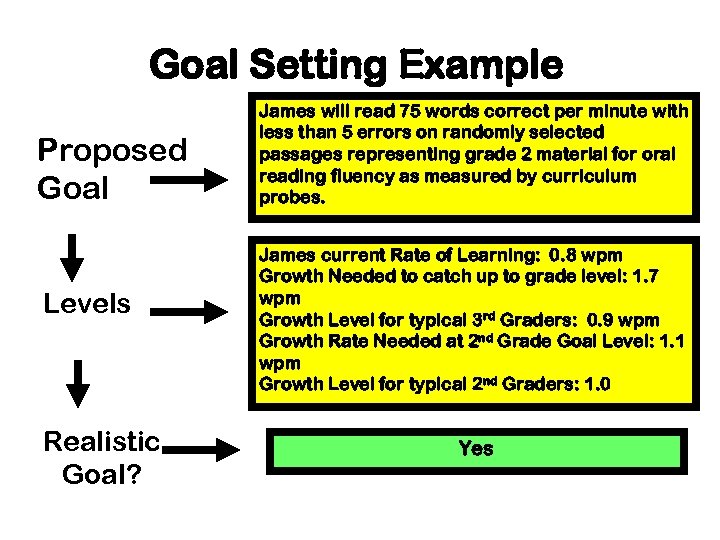 Goal Setting Example Proposed Goal Levels Realistic Goal? James will read 75 words correct per minute with less than 5 errors on randomly selected passages representing grade 2 material for oral reading fluency as measured by curriculum probes. James current Rate of Learning: 0. 8 wpm Growth Needed to catch up to grade level: 1. 7 wpm Growth Level for typical 3 rd Graders: 0. 9 wpm Growth Rate Needed at 2 nd Grade Goal Level: 1. 1 wpm Growth Level for typical 2 nd Graders: 1. 0 Yes
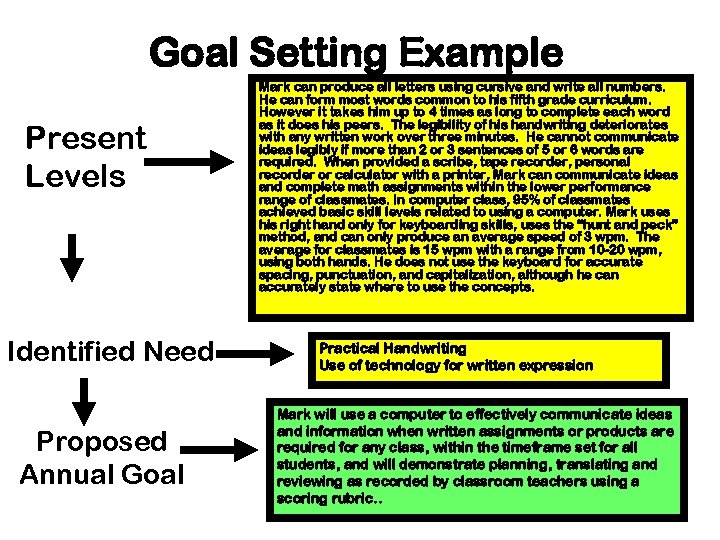 Goal Setting Example Present Levels Identified Need Proposed Annual Goal Mark can produce all letters using cursive and write all numbers. He can form most words common to his fifth grade curriculum. However it takes him up to 4 times as long to complete each word as it does his peers. The legibility of his handwriting deteriorates with any written work over three minutes. He cannot communicate ideas legibly if more than 2 or 3 sentences of 5 or 6 words are required. When provided a scribe, tape recorder, personal recorder or calculator with a printer, Mark can communicate ideas and complete math assignments within the lower performance range of classmates. In computer class, 95% of classmates achieved basic skill levels related to using a computer. Mark uses his right hand only for keyboarding skills, uses the “hunt and peck” method, and can only produce an average speed of 3 wpm. The average for classmates is 15 wpm with a range from 10 -20 wpm, using both hands. He does not use the keyboard for accurate spacing, punctuation, and capitalization, although he can accurately state where to use the concepts. Practical Handwriting Use of technology for written expression Mark will use a computer to effectively communicate ideas and information when written assignments or products are required for any class, within the timeframe set for all students, and will demonstrate planning, translating and reviewing as recorded by classroom teachers using a scoring rubric. .
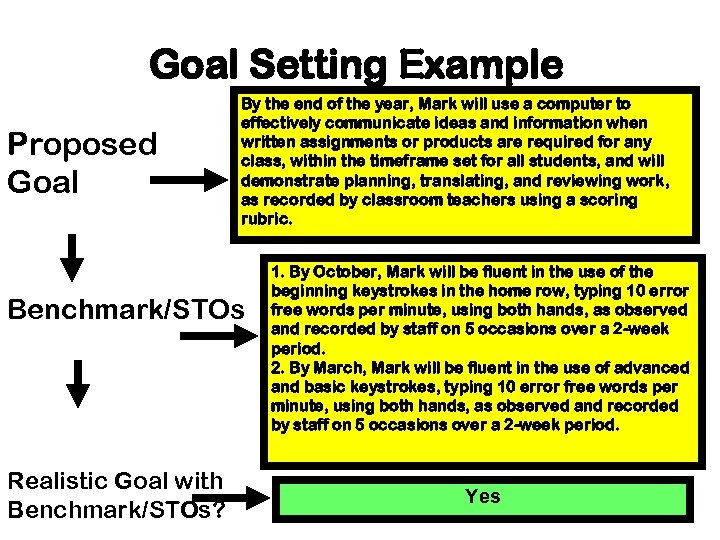 Goal Setting Example Proposed Goal By the end of the year, Mark will use a computer to effectively communicate ideas and information when written assignments or products are required for any class, within the timeframe set for all students, and will demonstrate planning, translating, and reviewing work, as recorded by classroom teachers using a scoring rubric. Benchmark/STOs Realistic Goal with Benchmark/STOs? 1. By October, Mark will be fluent in the use of the beginning keystrokes in the home row, typing 10 error free words per minute, using both hands, as observed and recorded by staff on 5 occasions over a 2 -week period. 2. By March, Mark will be fluent in the use of advanced and basic keystrokes, typing 10 error free words per minute, using both hands, as observed and recorded by staff on 5 occasions over a 2 -week period. Yes
 Reporting to Parents must be informed of: • How progress toward annual goals is measured • When periodic progress reports will be provided 707 KAR 1: 320 § 5 (13)(a-b) 34 CFR 300. 320 (a)(3)
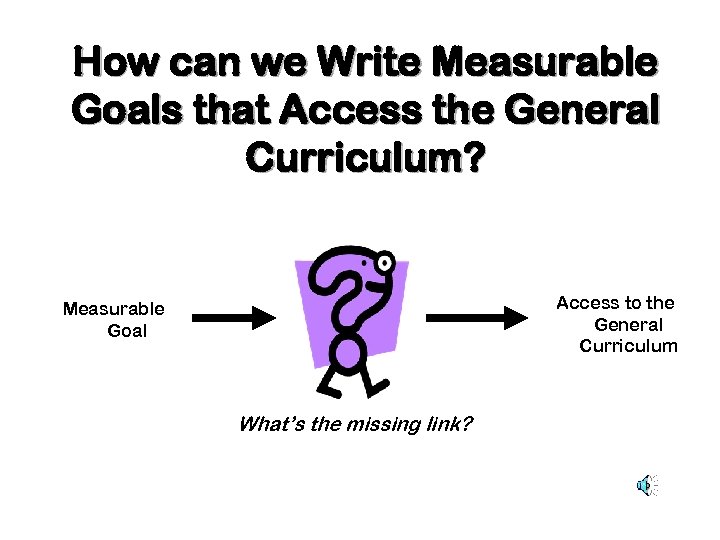 How can we Write Measurable Goals that Access the General Curriculum? Access to the General Curriculum Measurable Goal What’s the missing link?
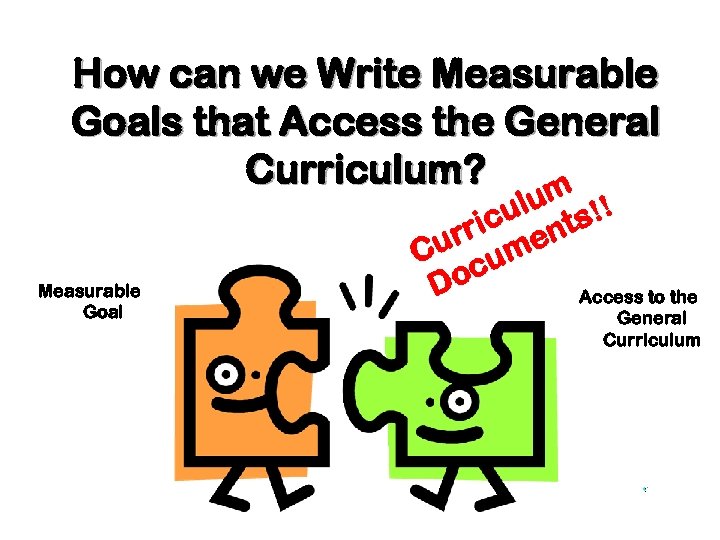 How can we Write Measurable Goals that Access the General Curriculum? m Measurable Goal ulu ts!! ric en ur m C cu Do Access to the General Curriculum
 Measurable Goals How Do We Know?
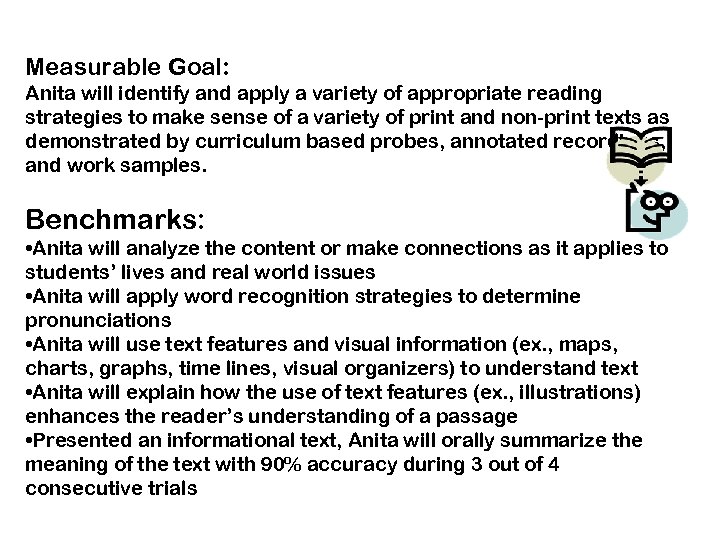 Measurable Goal: Anita will identify and apply a variety of appropriate reading strategies to make sense of a variety of print and non-print texts as demonstrated by curriculum based probes, annotated recordings, and work samples. Benchmarks: • Anita will analyze the content or make connections as it applies to students’ lives and real world issues • Anita will apply word recognition strategies to determine pronunciations • Anita will use text features and visual information (ex. , maps, charts, graphs, time lines, visual organizers) to understand text • Anita will explain how the use of text features (ex. , illustrations) enhances the reader’s understanding of a passage • Presented an informational text, Anita will orally summarize the meaning of the text with 90% accuracy during 3 out of 4 consecutive trials
 Student Performance Data Present Levels Measurable Goals Strengthen Instructional Planning
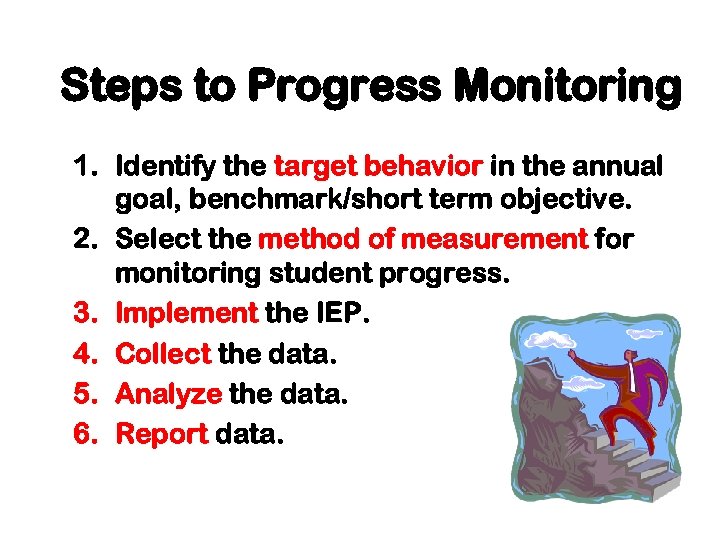 Steps to Progress Monitoring 1. Identify the target behavior in the annual goal, benchmark/short term objective. 2. Select the method of measurement for monitoring student progress. 3. Implement the IEP. 4. Collect the data. 5. Analyze the data. 6. Report data.
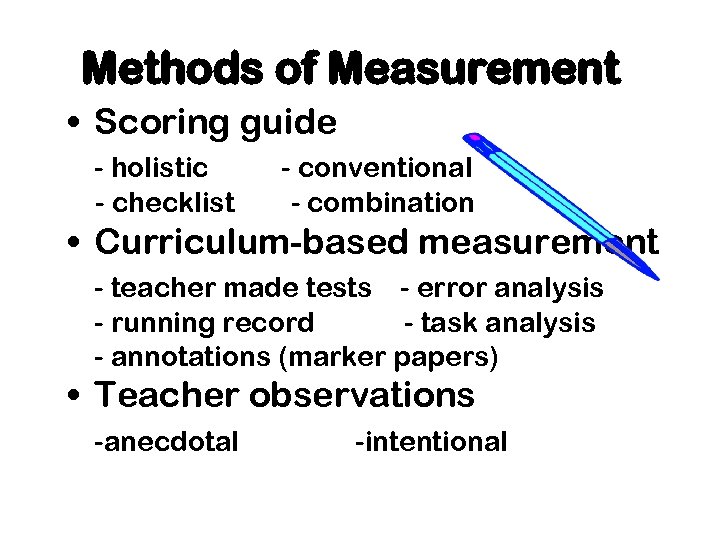 Methods of Measurement • Scoring guide - holistic - checklist - conventional - combination • Curriculum-based measurement - teacher made tests - error analysis - running record - task analysis - annotations (marker papers) • Teacher observations -anecdotal -intentional
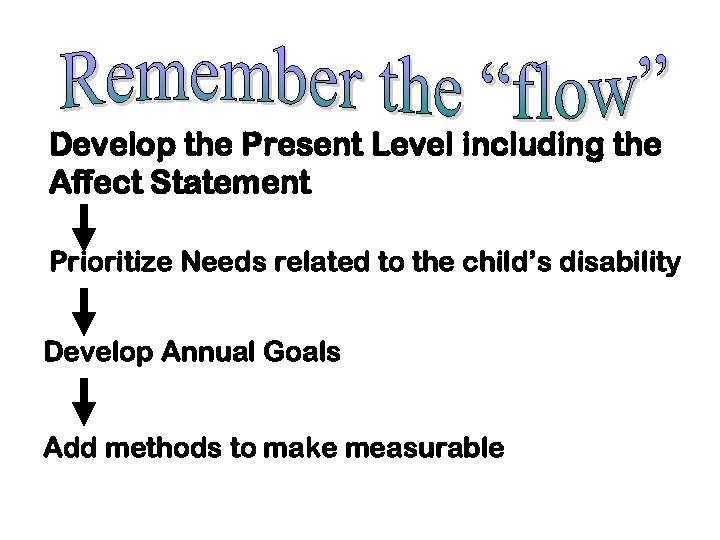 Develop the Present Level including the Affect Statement Prioritize Needs related to the child’s disability Develop Annual Goals Add methods to make measurable
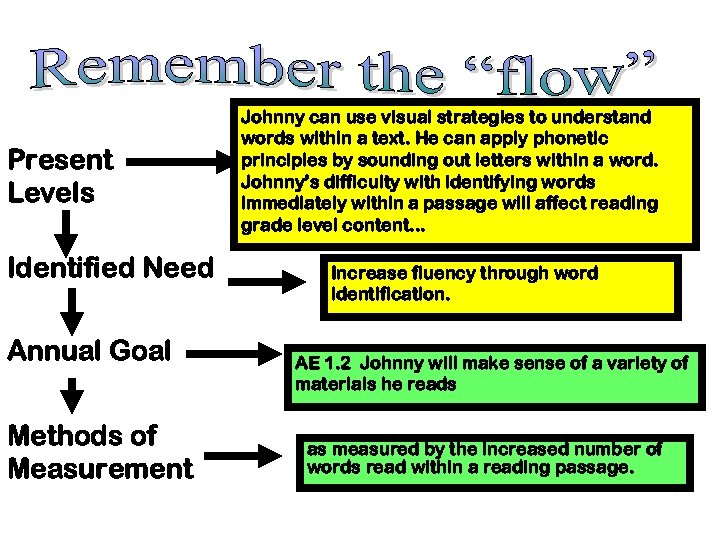 Present Levels Identified Need Annual Goal Methods of Measurement Johnny can use visual strategies to understand words within a text. He can apply phonetic principles by sounding out letters within a word. Johnny’s difficulty with identifying words immediately within a passage will affect reading grade level content. . . Increase fluency through word identification. AE 1. 2 Johnny will make sense of a variety of materials he reads as measured by the increased number of words read within a reading passage.
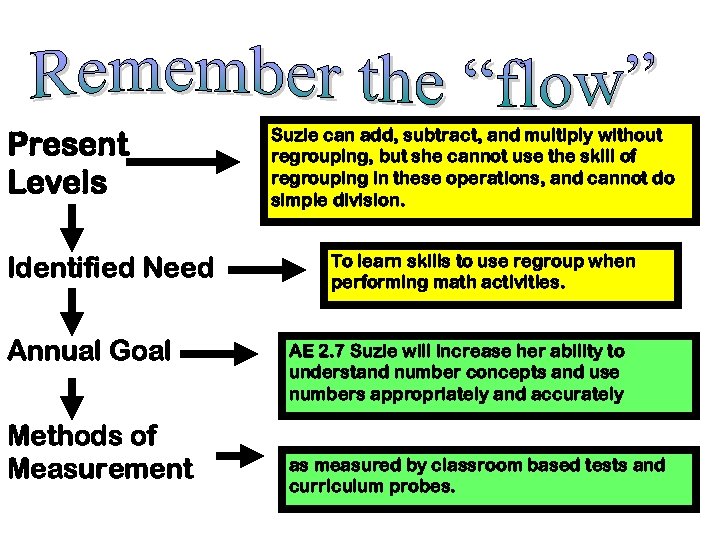 Present Levels Identified Need Annual Goal Methods of Measurement Suzie can add, subtract, and multiply without regrouping, but she cannot use the skill of regrouping in these operations, and cannot do simple division. To learn skills to use regroup when performing math activities. AE 2. 7 Suzie will increase her ability to understand number concepts and use numbers appropriately and accurately as measured by classroom based tests and curriculum probes.
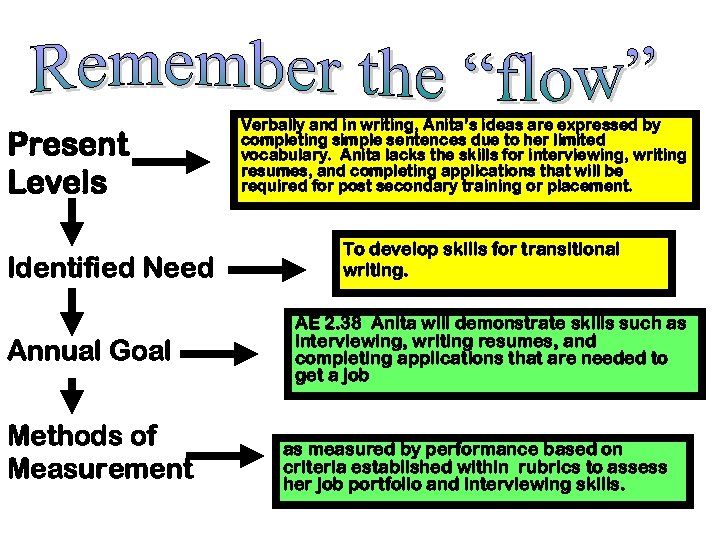 Present Levels Identified Need Annual Goal Methods of Measurement Verbally and in writing, Anita’s ideas are expressed by completing simple sentences due to her limited vocabulary. Anita lacks the skills for interviewing, writing resumes, and completing applications that will be required for post secondary training or placement. To develop skills for transitional writing. AE 2. 38 Anita will demonstrate skills such as interviewing, writing resumes, and completing applications that are needed to get a job as measured by performance based on criteria established within rubrics to assess her job portfolio and interviewing skills.
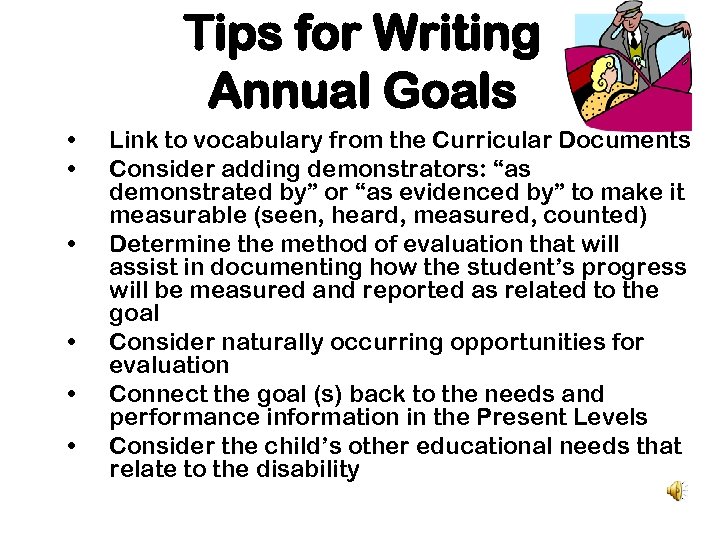 Tips for Writing Annual Goals • • • Link to vocabulary from the Curricular Documents Consider adding demonstrators: “as demonstrated by” or “as evidenced by” to make it measurable (seen, heard, measured, counted) Determine the method of evaluation that will assist in documenting how the student’s progress will be measured and reported as related to the goal Consider naturally occurring opportunities for evaluation Connect the goal (s) back to the needs and performance information in the Present Levels Consider the child’s other educational needs that relate to the disability
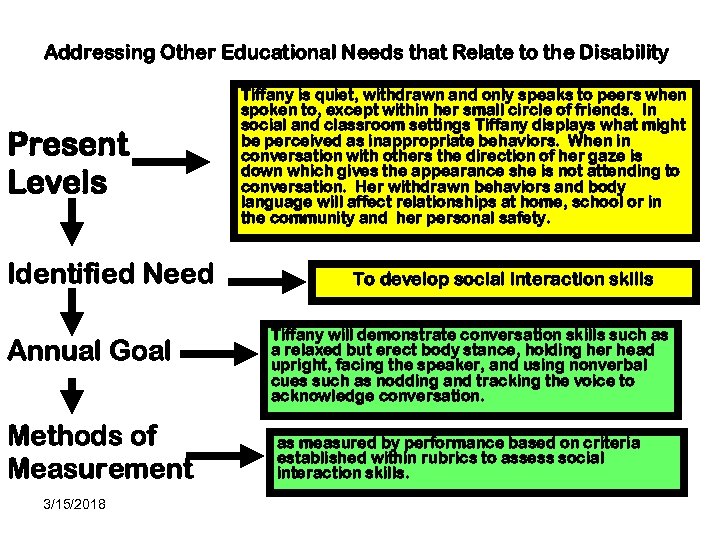 Addressing Other Educational Needs that Relate to the Disability Present Levels Identified Need Annual Goal Methods of Measurement 3/15/2018 Tiffany is quiet, withdrawn and only speaks to peers when spoken to, except within her small circle of friends. In social and classroom settings Tiffany displays what might be perceived as inappropriate behaviors. When in conversation with others the direction of her gaze is down which gives the appearance she is not attending to conversation. Her withdrawn behaviors and body language will affect relationships at home, school or in the community and her personal safety. To develop social interaction skills Tiffany will demonstrate conversation skills such as a relaxed but erect body stance, holding her head upright, facing the speaker, and using nonverbal cues such as nodding and tracking the voice to acknowledge conversation. as measured by performance based on criteria established within rubrics to assess social interaction skills.
 Write Your Own • Annual Measurable Goal • Method of Measurement
 Benchmarks and Short Term Objectives • milestones for measuring progress • written for each annual goal
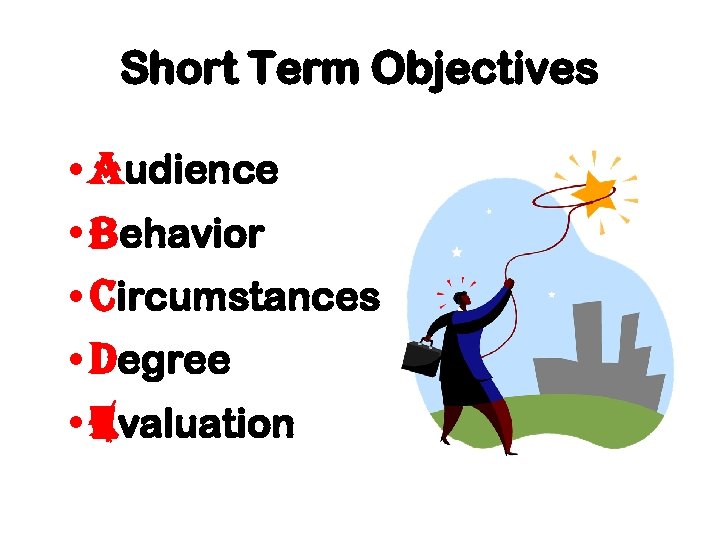 Short Term Objectives • Audience • Behavior • Circumstances • Degree • Evaluation
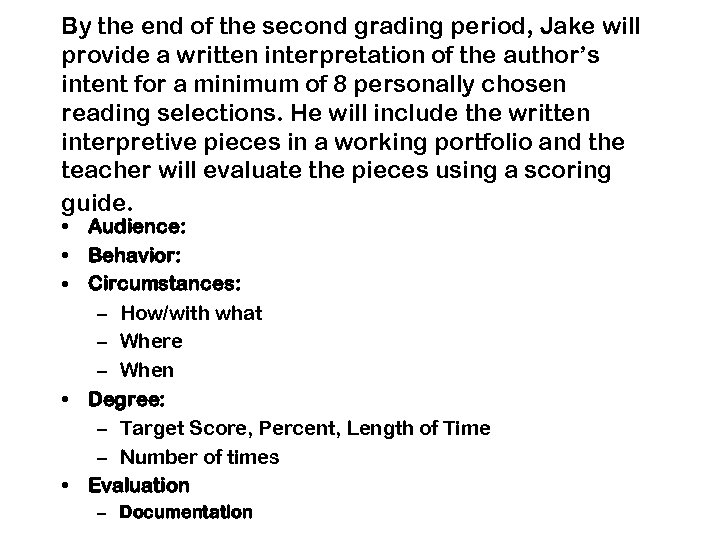 By the end of the second grading period, Jake will provide a written interpretation of the author’s intent for a minimum of 8 personally chosen reading selections. He will include the written interpretive pieces in a working portfolio and the teacher will evaluate the pieces using a scoring guide. • Audience: • Behavior: • Circumstances: – How/with what – Where – When • Degree: – Target Score, Percent, Length of Time – Number of times • Evaluation – Documentation
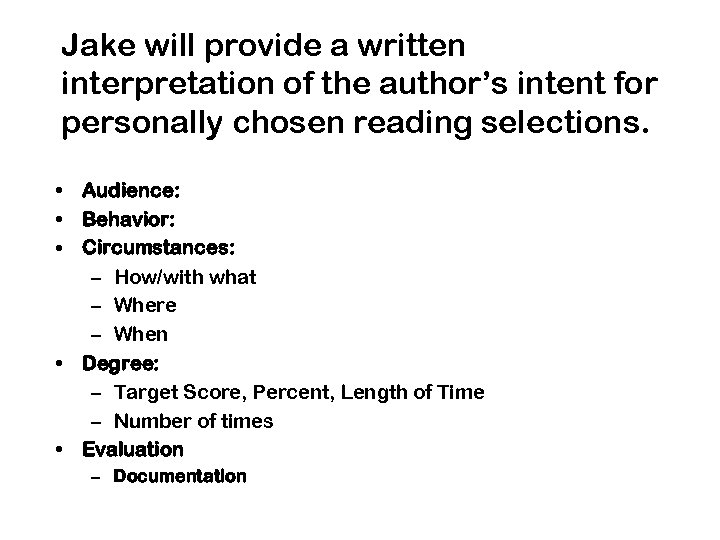 Jake will provide a written interpretation of the author’s intent for personally chosen reading selections. • Audience: • Behavior: • Circumstances: – How/with what – Where – When • Degree: – Target Score, Percent, Length of Time – Number of times • Evaluation – Documentation
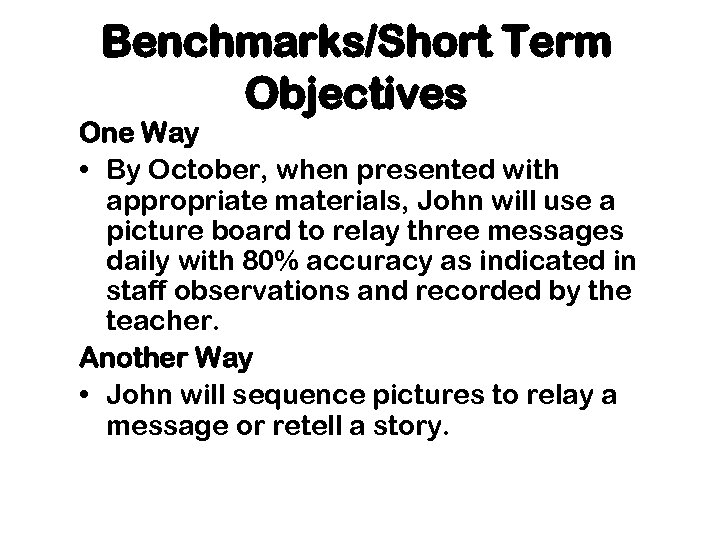 Benchmarks/Short Term Objectives One Way • By October, when presented with appropriate materials, John will use a picture board to relay three messages daily with 80% accuracy as indicated in staff observations and recorded by the teacher. Another Way • John will sequence pictures to relay a message or retell a story.
 Benchmark & STO Tips • Refer to the Annual Goals for specific skills, both academic and functional skills • Use curricular documents to guide the benchmark/STO • Use appropriate grade level expectations • Ensure the benchmark/STO matches the goal
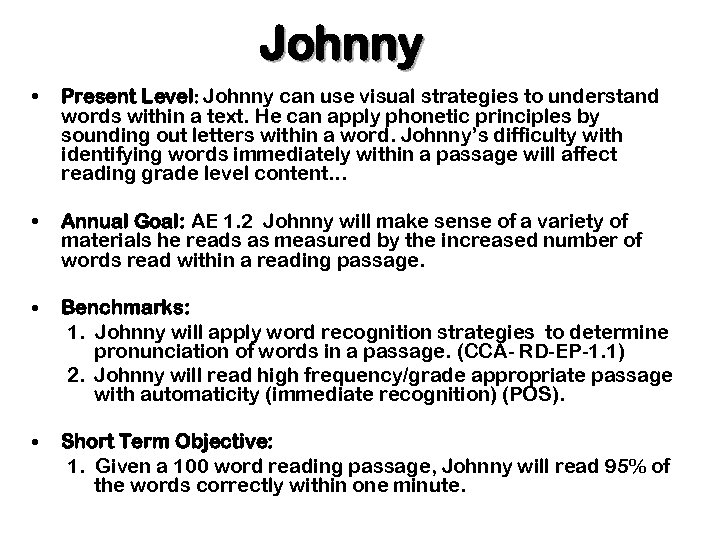 Johnny • Present Level: Johnny can use visual strategies to understand words within a text. He can apply phonetic principles by sounding out letters within a word. Johnny’s difficulty with identifying words immediately within a passage will affect reading grade level content. . . • Annual Goal: AE 1. 2 Johnny will make sense of a variety of materials he reads as measured by the increased number of words read within a reading passage. • Benchmarks: 1. Johnny will apply word recognition strategies to determine pronunciation of words in a passage. (CCA- RD-EP-1. 1) 2. Johnny will read high frequency/grade appropriate passage with automaticity (immediate recognition) (POS). • Short Term Objective: 1. Given a 100 word reading passage, Johnny will read 95% of the words correctly within one minute.
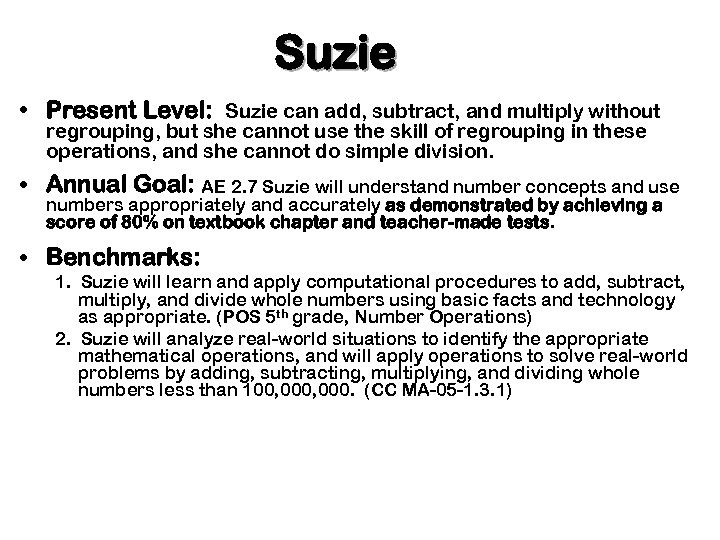 Suzie • Present Level: Suzie can add, subtract, and multiply without regrouping, but she cannot use the skill of regrouping in these operations, and she cannot do simple division. • Annual Goal: AE 2. 7 Suzie will understand number concepts and use numbers appropriately and accurately as demonstrated by achieving a score of 80% on textbook chapter and teacher-made tests. • Benchmarks: 1. Suzie will learn and apply computational procedures to add, subtract, multiply, and divide whole numbers using basic facts and technology as appropriate. (POS 5 th grade, Number Operations) 2. Suzie will analyze real-world situations to identify the appropriate mathematical operations, and will apply operations to solve real-world problems by adding, subtracting, multiplying, and dividing whole numbers less than 100, 000. (CC MA-05 -1. 3. 1)
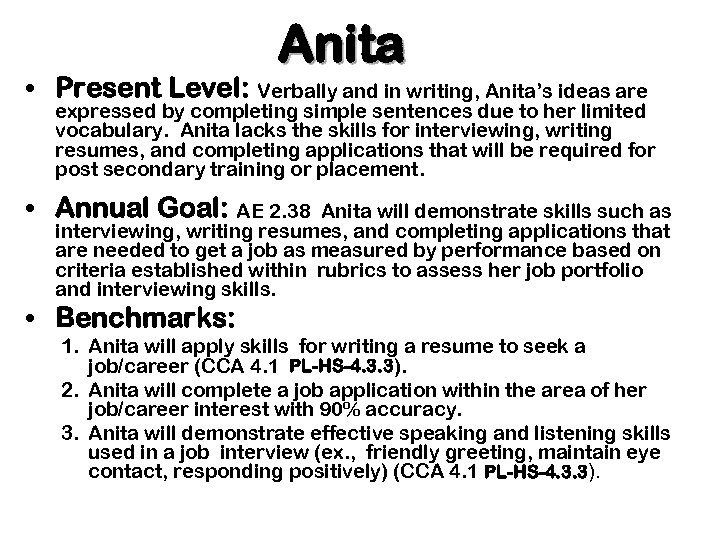 Anita • Present Level: Verbally and in writing, Anita’s ideas are expressed by completing simple sentences due to her limited vocabulary. Anita lacks the skills for interviewing, writing resumes, and completing applications that will be required for post secondary training or placement. • Annual Goal: AE 2. 38 Anita will demonstrate skills such as interviewing, writing resumes, and completing applications that are needed to get a job as measured by performance based on criteria established within rubrics to assess her job portfolio and interviewing skills. • Benchmarks: 1. Anita will apply skills for writing a resume to seek a job/career (CCA 4. 1 PL-HS-4. 3. 3). 2. Anita will complete a job application within the area of her job/career interest with 90% accuracy. 3. Anita will demonstrate effective speaking and listening skills used in a job interview (ex. , friendly greeting, maintain eye contact, responding positively) (CCA 4. 1 PL-HS-4. 3. 3).
 Write Your Own • Benchmarks and/or short term objectives
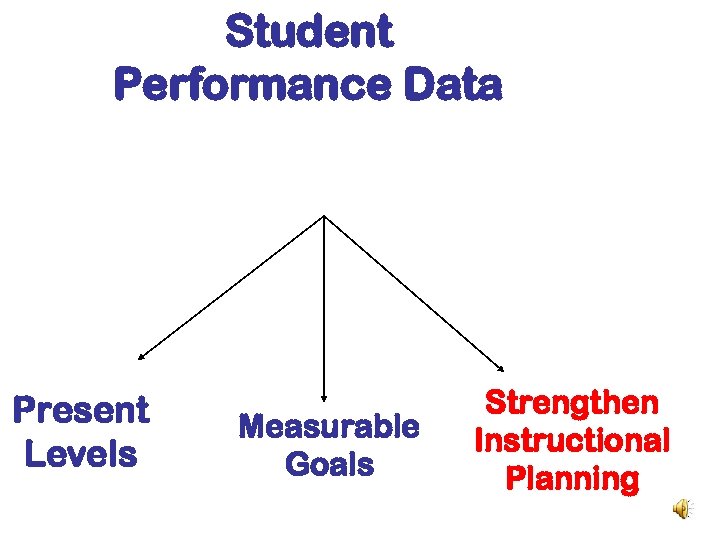 Student Performance Data Present Levels Measurable Goals Strengthen Instructional Planning
 What’s Special about Special Education? IEP services address unique needs: – Specially-designed instruction – Supplementary aids and services – Related services – Program modifications – Supports for school personnel
 Specially Designed Instruction, Related Services, Supplementary Aids and Services, Program Modifications and Supports for School Personnel Services are provided to the child or on behalf of the child… • to advance appropriately toward attaining annual goals; • be involved and progress in the general curriculum and to participate in extracurricular and other nonacademic activities; and • to be educated and participate with other children with disabilities and nondisabled children. 707 KAR 1: 320 Section 5 (8) 34 CFR 300. 320 (a) (4)
 SDI: The Definition Specially-designed instruction (SDI) means adapting, as appropriate, the content, methodology, or delivery of instruction to address the unique needs of the child with a disability and to ensure access of the child to the general curriculum included in the Program of Studies. 707 KAR 1: 280 § 1 (58) 34 CFR 300. 39 (b)(3)
 Activity Brainstorm several different forms of specially designed instruction.
 Examples of SDI Instruction in the use of: • • Text/Screen readers Advanced organizers Signed instruction Word identification strategies • Use of talking calculator • Manipulatives • Oral presentation of printed material • • • Paraphrasing strategies Use of talking calculator Procedural prompts Use of Visual cues Multi-sensory approach to reading • Use of Reinforcement strategies
 Supplementary Aids and Services Are… Aids, services, and other supports that are provided in regular education classes or other education-related settings to enable children with disabilities to be educated with non-disabled children to the maximum extent appropriate. 707 KAR 1: 280 § 1 (61) 34 CFR 300. 42
 Activity Brainstorm several different types of supplementary aids and services
 Examples of Supplementary Aids and Services • • Manipulatives Calculators Extra time Preferential seating Adapted test format Behavior contracts Shortened assignments • • • Use of computer Text/Screen readers Enlarged text Self-monitoring Augmentative communication • Scribe
 Program Modifications Support for School Personnel Support to meet the unique needs of the child may include… • Specialized Training – Use and maintenance of specialized equipment • Use of school time – Shared planning time • Use of school staff – Additional adult supervision (note when & where) 707 KAR 1: 320 § 5 (8) 34 CFR 300. 320 (a)(4)
 Assessment Accommodations and Modifications • Related to verified disability (with evaluation data to support it) • Documented as a part of the IEP • Part of regular instructional routine • Purpose of accessing general curriculum (demonstrating what student knows) 703 KAR 5: 070 707 KAR 1: 320 § 5 (10) 34 CFR 300. 320(a)(6)
 Alternate Assessment If the ARC determines that the child shall take an alternate assessment for state or district-wide assessment, the ARC includes a statement of why: • The child cannot participate in the regular assessment; and § The particular alternate assessment selected is appropriate for the child. 707 KAR 1: 320 § 5 (11) 34 CFR 300. 320 (a)(6)(ii)
 Related Services Transportation and such developmental, corrective, or supportive services as are required to assist a child with a disability to benefit from special education. 707 KAR 1: 280 § 1 (51) 34 CFR 300. 34
 Related Services. . . • facilitate provision of specially designed instruction • facilitate participation in the regular education program • need to be provided in school facilities • facilitate access to public school • are not needed solely for aesthetic, medical, or health reasons
 Activity In small groups, brainstorm a list of related services
 Examples of Related Services • transportation • psychological services • counseling • parent education • interpreting • orientation and mobility • occupational therapy • physical therapy • recreational therapy • speech and language therapy 707 KAR 1: 280 § 1 (51) 34 CFR 300. 34(a)
 Write Your Own • • • IEP Services including: Specially Designed Instruction Supplementary Aids and Services Program Modifications and Support for School Personnel Assessment Accommodations and Modifications Alternate Assessment Related Services
 Beginning Date, Frequency, Location, & Duration • Stated for services & modifications • Anticipated frequency= how often • Anticipated duration = anticipated amount of time & beginning date • Location 707 KAR 1: 320 § 5 (12) 34 CFR 300. 320 (a)(7)
 Participation in the General Education Program
 Physical Education The district shall make available to every child with a disability: 1. physical education services, specially designed if necessary; or 2. the opportunity to participate in the regular physical education program available to children without disabilities unless: a. the child is enrolled full time in a separate facility in which case the agency responsible for the education of the child in that facility shall ensure the child receives appropriate physical education; or b. the child needs specially designed physical education as prescribed in the child’s IEP 707 KAR 1: 350 § 1(9) 34 CFR 300. 108
 Making a Placement Decision • Review the services in the IEP • Consider placement in general education classes FIRST • Remove the student from general education only when the nature and severity of the disability cannot be accommodated for the student’s success in general education classes, even with the use of supplementary aids and services 707 KAR 1: 350 § 1 (9) 34 CFR 300. 117
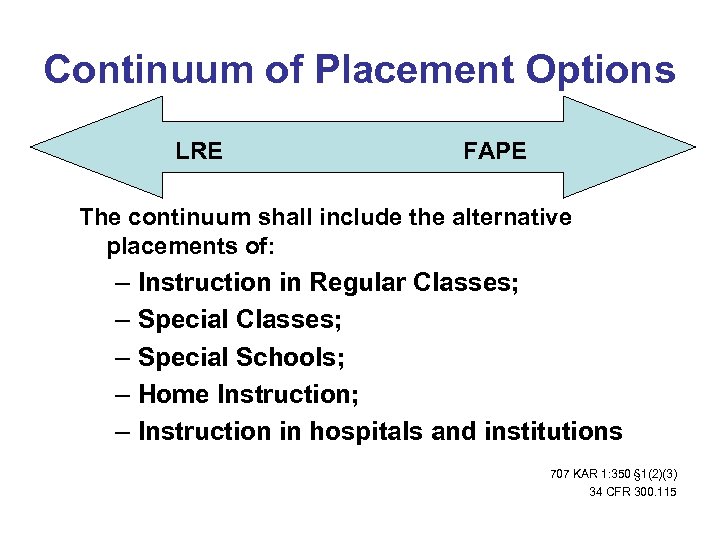 Continuum of Placement Options LRE FAPE The continuum shall include the alternative placements of: – Instruction in Regular Classes; – Special Schools; – Home Instruction; – Instruction in hospitals and institutions 707 KAR 1: 350 § 1(2)(3) 34 CFR 300. 115
 Delivery of Services
 Collaboration Models • • Lead and Support Co-teaching Speak and Add Speak and Chart Station Teaching Skill Groups Parallel Teaching Show Teaching/Alternative Teaching
 IEP in Effect • For each child with a disability at the beginning of the school year • Before specially designed instruction and related services are provided • Implemented as soon as possible following an ARC meeting • For all eligible children ages 3 through 5 707 KAR 1: 320 § 1(3)(4)(7) 34 CFR 300. 323(a)
 No delay due to payment 707 KAR 1: 320 § 1 (5) 34 CFR 300. 323(c) (2)
 Minor Changes to an IEP 707 KAR 1: 320 § 2 (2) 34 CFR 300. 324 (a) (4) (ii)
 Student Transfers 707 KAR 1: 320 § 6 34 CFR 300. 323 (e) (f)
 IEP Accountability Good Faith Effort 707 KAR 1: 320 § 9 (1)(3)
 Assurance after IEP written • Accessibility to implementers • Implementers informed of specific responsibilities related to IEP implementation • Specific accommodation, modification and supports are provided in accordance with the IEP 707 KAR 1: 320 § 1 (6) 34 CFR 300. 323 (d)
 Implementers Qualified personnel are selected based on: • Services as stated in the IEP • Qualifications of the service provider (i. e. , licensure, certification 707 KAR 1: 320 § 1 (6) (a) 34 CFR 300. 323 (d)
 Implementer Responsibilities • Instructional planning • Monitor progress on goals & objectives • Maintain records of progress • Report progress
 Progress Monitoring Decisions That Must Be Made • • • Who will collect the data? Where will data be collected? How often will data be collected? How will data be recorded? Where will progress data be kept? What actions should the teacher take if a student is not progressing as expected? 707 KAR 1: 320 § 2 (6) (b) 34 CFR 300. 324 (b) (A)
 Collect Data 3/15/2018
 Progress Monitoring Data is Collected: – In an on-going manner – At least as often as indicated in local procedures – According to the frequency of the services – With indicators of date and criteria of work completed 3/15/2018
 Setting Baseline Determine a Baseline before the delivery of Specially Designed Instruction: • Administer multiple probes • Score the probes • Plot the scores 3/15/2018
 Example: Edward Goal 1: Using a list of high frequency words, Edward will correctly identify 40 words in one minute.
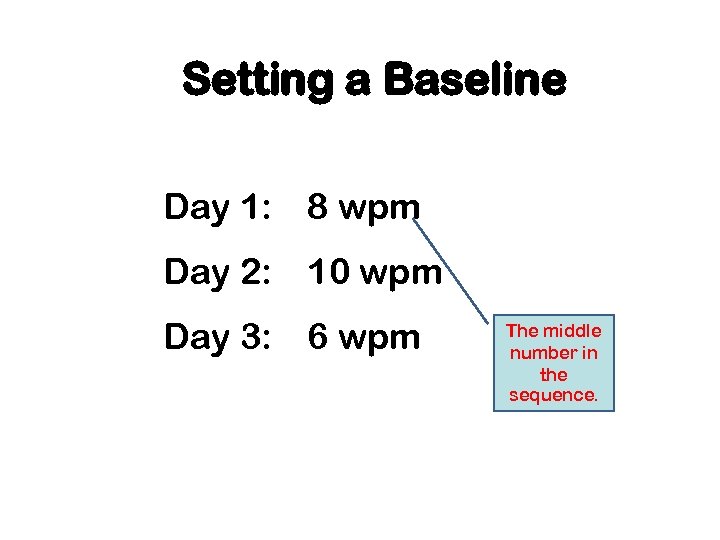 Setting a Baseline Day 1: 8 wpm Day 2: 10 wpm Day 3: 6 wpm The middle number in the sequence.
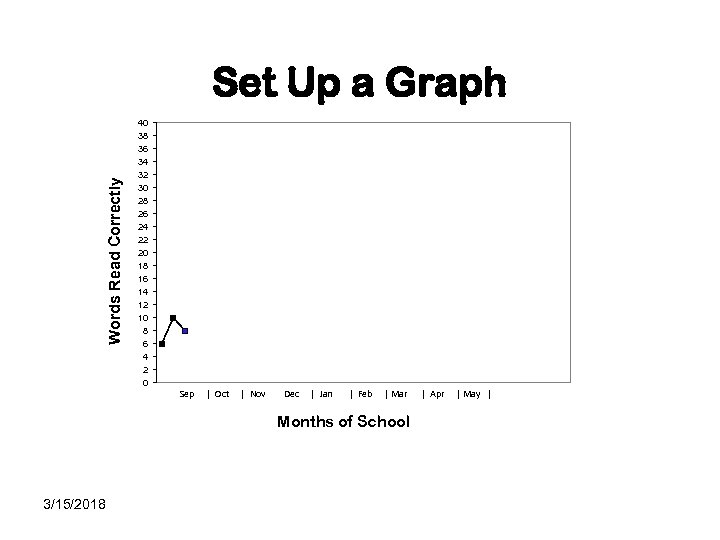 Words Read Correctly Set Up a Graph 40 38 36 34 32 30 28 26 24 22 20 18 16 14 12 10 8 6 4 2 0 Sep | Oct | Nov Dec | Jan | Feb | Mar Months of School 3/15/2018 | Apr | May |
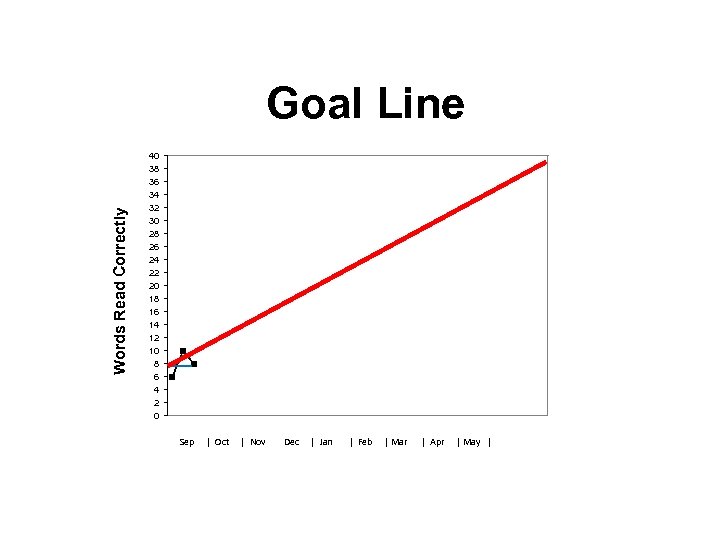 Words Read Correctly Goal Line 40 38 36 34 32 30 28 26 24 22 20 18 16 14 12 10 8 6 4 2 0 Sep | Oct | Nov Dec | Jan | Feb | Mar | Apr | May |
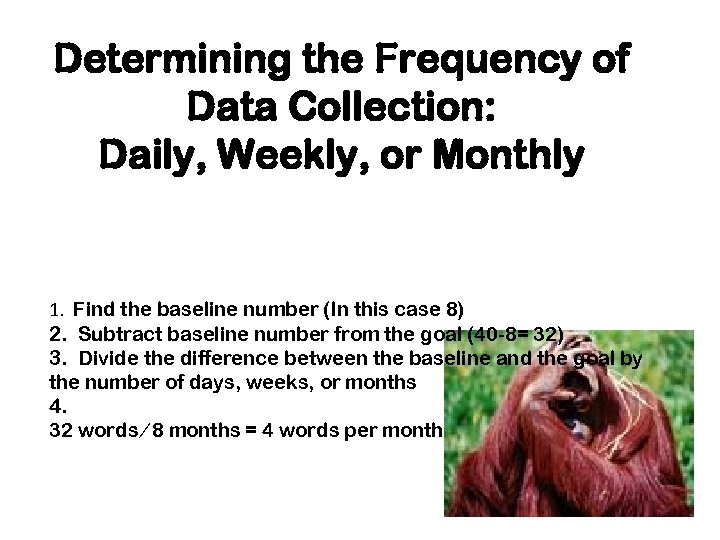 Determining the Frequency of Data Collection: Daily, Weekly, or Monthly 1. Find the baseline number (In this case 8) 2. Subtract baseline number from the goal (40 -8= 32) 3. Divide the difference between the baseline and the goal by the number of days, weeks, or months 4. 32 words ⁄ 8 months = 4 words per month
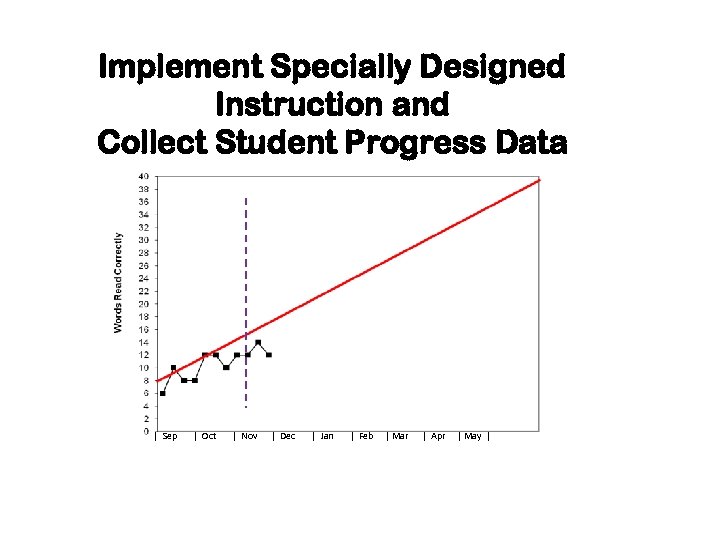 Implement Specially Designed Instruction and Collect Student Progress Data | Sep | Oct | Nov | Dec | Jan | Feb | Mar | Apr | May |
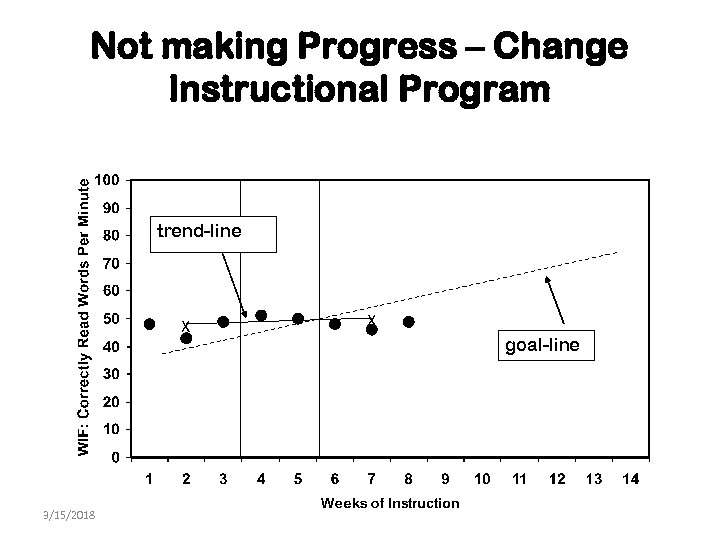 Not making Progress – Change Instructional Program trend-line X 3/15/2018 X goal-line
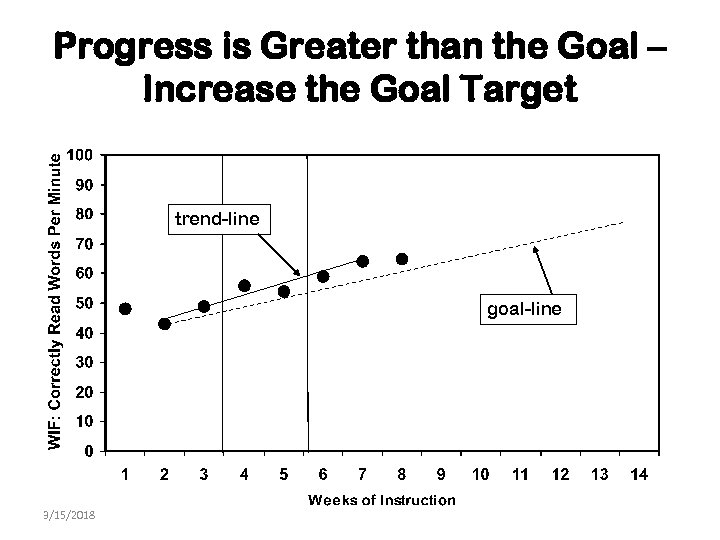 Progress is Greater than the Goal – Increase the Goal Target trend-line goal-line 3/15/2018
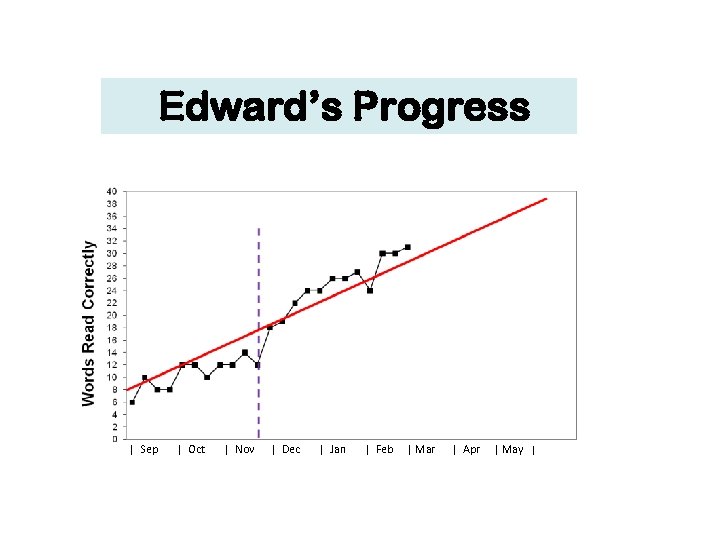 Edward’s Progress | Sep | Oct | Nov | Dec | Jan | Feb | Mar | Apr | May |
 Annual Review: Report the Data • Review the IEP • Make decisions about the IEP • Plan for reevaluation, if necessary • Determine the need for 707 KAR 1: 320 § 2 (6) (c) ESY 34 CFR 300. 324 (b) 3/15/2018
 Annual Review Decisions • Did not make progress as expected & still needs SDI – develop new IEP • Made progress as expected and no longer needs SDI -Release child from SDI • Did not make progress as expected or may no longer need but reevaluation information is needed – develop new IEP
 Extended School Year ESY services are provided: Beyond the district’s normal school year At no cost to parents In accordance with the IEP Determination of need and level of service: An ARC decision Based on individual need Not based on disability category Not “one size fits all”
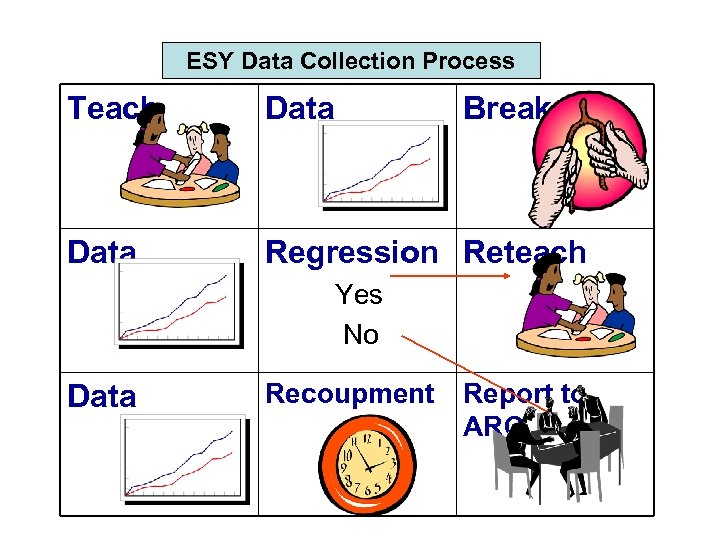 ESY Data Collection Process Teach Data Break Data Regression Reteach Yes No Data Recoupment Report to ARC
 Reflect on the IEP • Can you articulate this to staff and parents? • Do you know what it means? • Do you know how to teach it? • Does it clearly explain what you are going to work on? • Do you know how to evaluate it? • Can you teach this tomorrow?
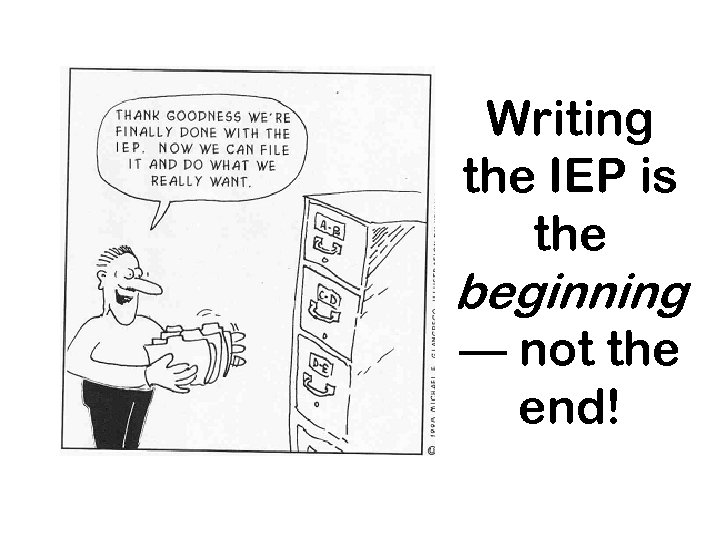 Writing the IEP is the beginning — not the end!