


 Скачать презентацию IELTS Speaking Strategies and Practice DAY 1 -2
ieltsspeakingstrategiesandpracticeday1-2-141007174333-conversion-gate01.pptx
- Количество слайдов: 50
 IELTS Speaking Strategies and Practice DAY 1 -2
 Today you will learn: Speaking frames to memorize How to extend your speaking Tips for each part of the interview process
 Speaking Warm UP ALL ABOUT YOU! Where are you from originally? How long have you been living in your current city? How long have you been studying English? Why do you think English is important? What do you do (work/study)? What are some of your short terms goals for school, work, or personal life? What are some of your hobbies and interests besides work/school? PRIORITIES: Look at these topics. Put them in order from 1 -most important to 8 least important. Discuss your reasoning behind your answers. FAMILY/FRIENDS RELIGION HOBBIES/FREE TIME SCHOOL/WORK TRAVELING MONEY/FINANCES PERSONAL GROWTH HEALTH/SPORTS
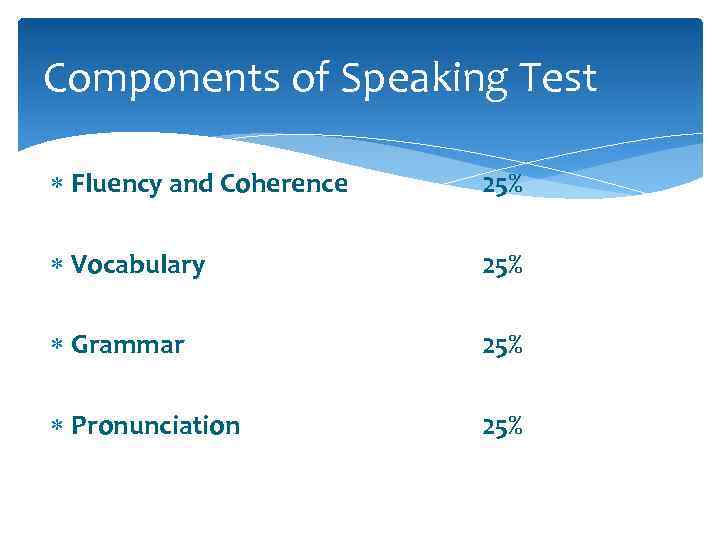 Components of Speaking Test Fluency and Coherence 25% Vocabulary 25% Grammar 25% Pronunciation 25%
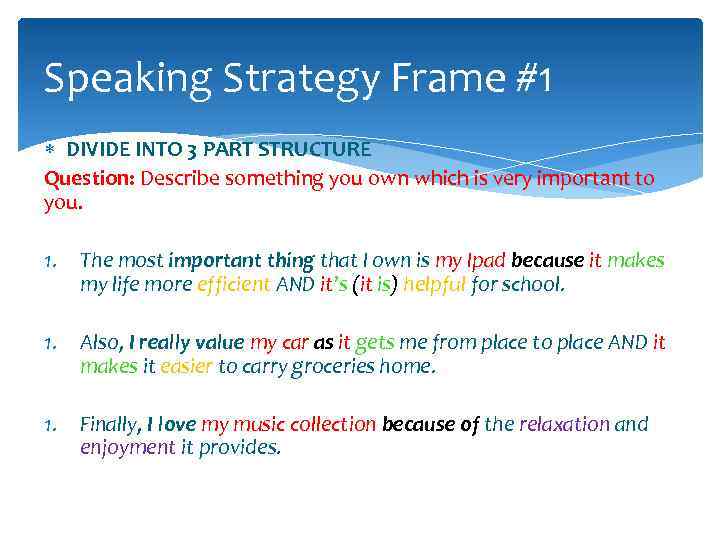 Speaking Strategy Frame #1 DIVIDE INTO 3 PART STRUCTURE Question: Describe something you own which is very important to you. 1. The most important thing that I own is my Ipad because it makes my life more efficient AND it’s (it is) helpful for school. 1. Also, I really value my car as it gets me from place to place AND it makes it easier to carry groceries home. 1. Finally, I love my music collection because of the relaxation and enjoyment it provides.
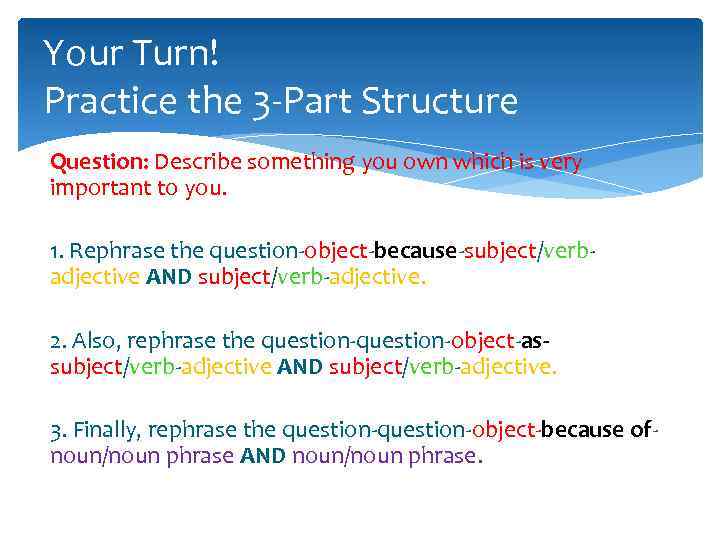 Your Turn! Practice the 3 -Part Structure Question: Describe something you own which is very important to you. 1. Rephrase the question-object-because-subject/verbadjective AND subject/verb-adjective. 2. Also, rephrase the question-object-assubject/verb-adjective AND subject/verb-adjective. 3. Finally, rephrase the question-object-because ofnoun/noun phrase AND noun/noun phrase.
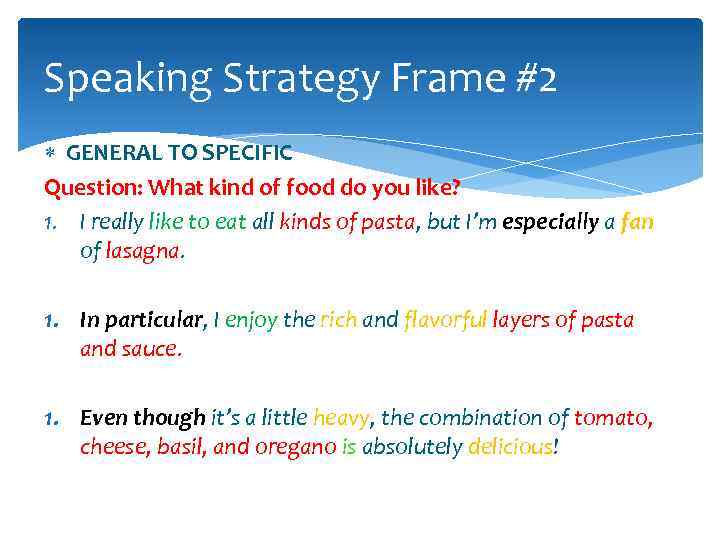 Speaking Strategy Frame #2 GENERAL TO SPECIFIC Question: What kind of food do you like? 1. I really like to eat all kinds of pasta, but I’m especially a fan of lasagna. 1. In particular, I enjoy the rich and flavorful layers of pasta and sauce. 1. Even though it’s a little heavy, the combination of tomato, cheese, basil, and oregano is absolutely delicious!
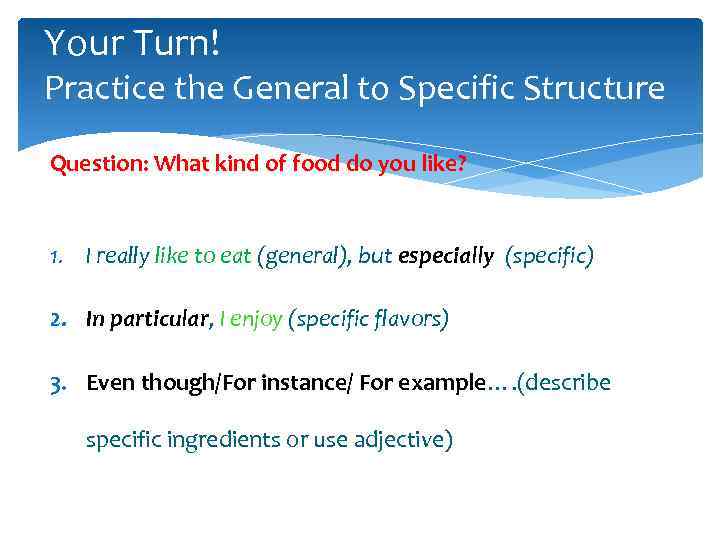 Your Turn! Practice the General to Specific Structure Question: What kind of food do you like? 1. I really like to eat (general), but especially (specific) 2. In particular, I enjoy (specific flavors) 3. Even though/For instance/ For example…. (describe specific ingredients or use adjective)
 Interview Part One Tip 1: Avoid one word answers. Lie if needed, but expand say something specific. Wrong: Question “What kind of music do you like? ” “Oh, well I like everything really. ” Tip 2: Focus on using words you know. It’s good to use higher vocabulary, but if you can’t pronounce it correctly or don’t know the correct use, then choose a simpler word. `Wrong: “I would ensure him that he can solve his problem” Tip 3: Don’t think too much! Follow the structures, but don’t memorize answers word-for-word or you will sound robotic and probably stressed out. Tip 4: Speak slowly (not too slowly) and clearly. Focusing on speed will result in more errors.
 Interview Part One: Structure On the real test, the examiner will start by asking your identity and then continue as an interview. He or she will then ask general questions on familiar topics such as home, family, work, studies and interests. Part 1 of the test will last 4 -5 minutes We will practice part one as a simulation of the test. I will ask you 2 -4 questions to fill the time limit. You will be recorded as you speak. Then we will listen to the recording to listen your fluency and coherence, vocabulary, grammar, and pronunciation. I will give you a sample grade for your speaking task.
 Interview Part One Rubric You get a score out of 9 for each of the criteria, they are added together and then that score is divided by 4. An example: So let’s take an example. Here is someone who has forgotten to think about coherence and hasn’t fully answered the question. S/he has good general English so does well in grammar and vocabulary, but sadly that is not enough. grammar 7 vocabulary 7 pronunciation 6 coherence 4 7+7+6+4 = 24 and 24 divided by 4 equals 6. The message is grammar and vocabulary are not enough – you need to focus on all the criteria throughout the exam.
 Interview Part One: Speaking Test Hometown/Accommodation Sample Questions will include: Let’s talk about your home town or village: what kind of place is it? what’s the most interesting part of your town/village? what kind of jobs do the people in your town/village do? would you say it’s a good place to live? (why? ) Let’s move on to talk about accommodation: tell me about the kind of accommodation you live in? how long have you lived there? what do you like about living there? what sort of accommodation would you most like to live in?
 Interview Part I: Hometown/Accommodation Listen to the recording of yourself. Write down or type any errors in pronunciation, grammar, or vocabulary that you hear. Then your teacher will give you feedback and tips
 Interview Part One: Your Score. Hometown/Accommodation Fluency/Coherence: Vocabulary: Grammar: Pronunciation Total:
 Interview Part One: Speaking Test Family Sample Questions will include: Let’s talk about your family: Describe your family Do you have a large or small family? How much time do you spend with your family? What do you like to do together as a family? Do you get along well with your family? Let’s talk other families in your country: Are people in your country generally close to their families? What are the typical traditions a family in your country has?
 Interview Part One: Speaking Test Family Listen to the recording of yourself. Write down or type any errors in pronunciation, grammar, or vocabulary that you hear. Then your teacher will give you feedback and tips
 Interview Part One: Your Score. Families Fluency/Coherence: Vocabulary: Grammar: Pronunciation Total:
 Day 2 -IELTS Speaking Interview Part 2 Strategies Speaking Practice
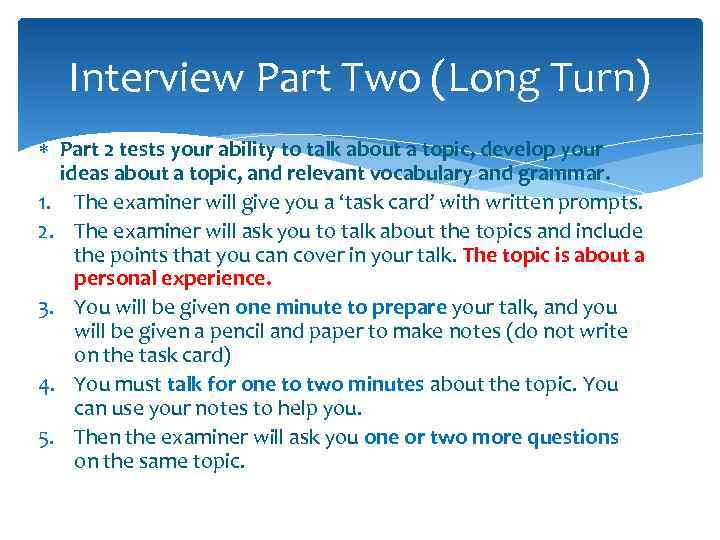 Interview Part Two (Long Turn) Part 2 tests your ability to talk about a topic, develop your ideas about a topic, and relevant vocabulary and grammar. 1. The examiner will give you a ‘task card’ with written prompts. 2. The examiner will ask you to talk about the topics and include the points that you can cover in your talk. The topic is about a personal experience. 3. You will be given one minute to prepare your talk, and you will be given a pencil and paper to make notes (do not write on the task card) 4. You must talk for one to two minutes about the topic. You can use your notes to help you. 5. Then the examiner will ask you one or two more questions on the same topic.
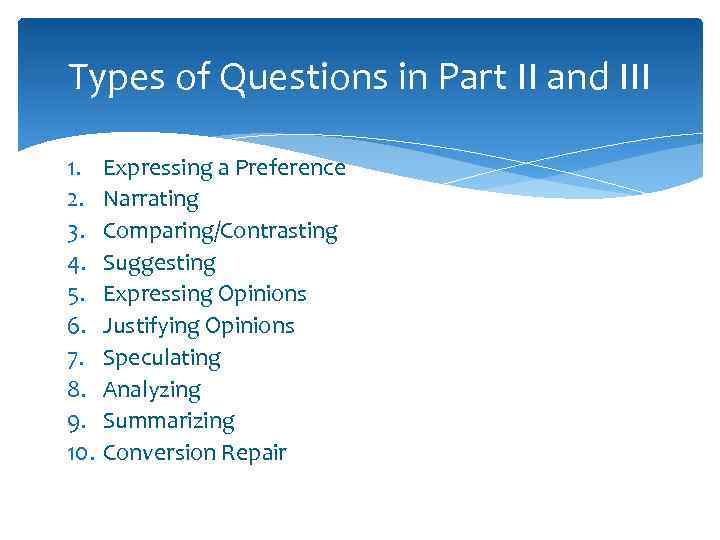 Types of Questions in Part II and III 1. 2. 3. 4. 5. 6. 7. 8. 9. 10. Expressing a Preference Narrating Comparing/Contrasting Suggesting Expressing Opinions Justifying Opinions Speculating Analyzing Summarizing Conversion Repair
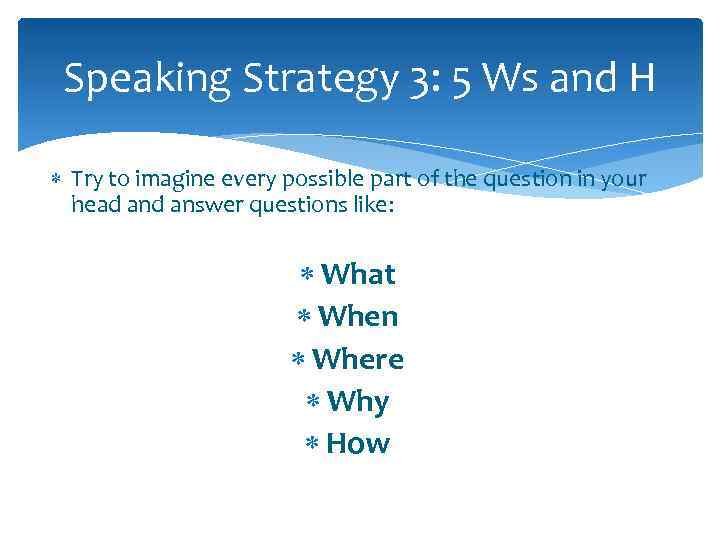 Speaking Strategy 3: 5 Ws and H Try to imagine every possible part of the question in your head answer questions like: What When Where Why How
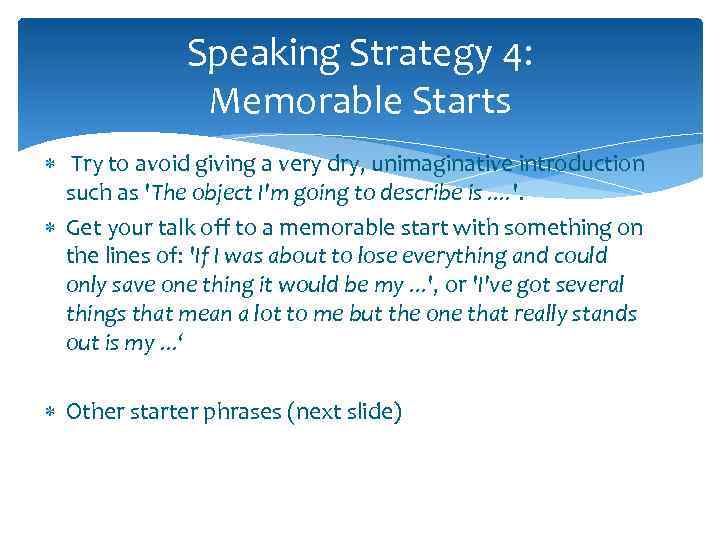 Speaking Strategy 4: Memorable Starts Try to avoid giving a very dry, unimaginative introduction such as 'The object I'm going to describe is. . '. Get your talk off to a memorable start with something on the lines of: 'If I was about to lose everything and could only save one thing it would be my. . . ', or 'I've got several things that mean a lot to me but the one that really stands out is my. . . ‘ Other starter phrases (next slide)
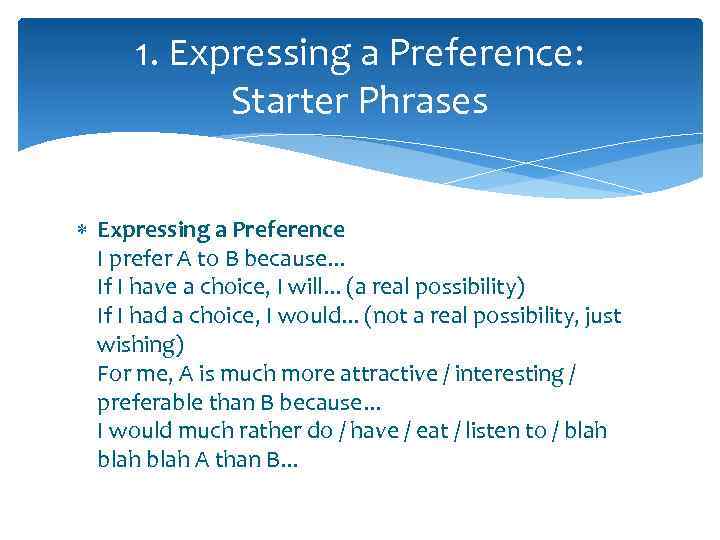 1. Expressing a Preference: Starter Phrases Expressing a Preference I prefer A to B because. . . If I have a choice, I will. . . (a real possibility) If I had a choice, I would. . . (not a real possibility, just wishing) For me, A is much more attractive / interesting / preferable than B because. . . I would much rather do / have / eat / listen to / blah A than B. . .
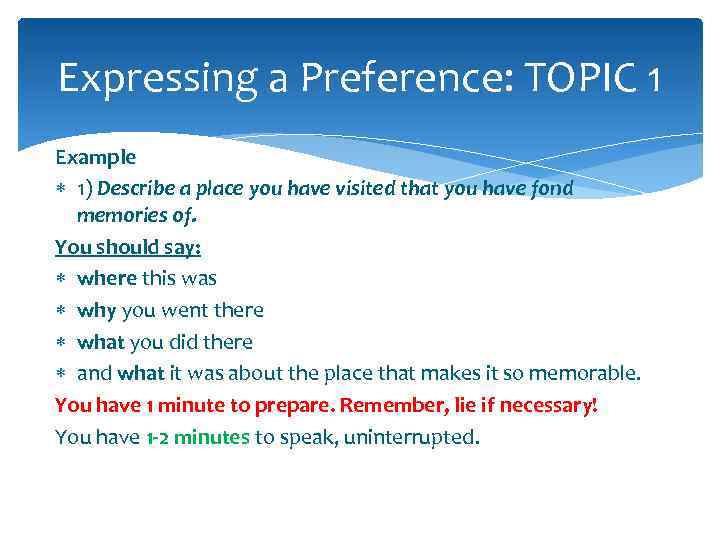 Expressing a Preference: TOPIC 1 Example 1) Describe a place you have visited that you have fond memories of. You should say: where this was why you went there what you did there and what it was about the place that makes it so memorable. You have 1 minute to prepare. Remember, lie if necessary! You have 1 -2 minutes to speak, uninterrupted.
 Expressing a Preference: Topic 1 Listen to the recording of yourself. Write down or type any errors in pronunciation, grammar, or vocabulary that you hear. Then your teacher will give you feedback and tips
 Expressing a Preference: Topic 2 Example 2) Describe your favorite personal possession. You should say: what this possession is when you first got it when you use it and why it's so important to you. You have 1 minute to prepare. Remember, lie if necessary! You have 1 -2 minutes to speak, uninterrupted.
 Expressing a Preference: Topic 2 Listen to the recording of yourself. Write down or type any errors in pronunciation, grammar, or vocabulary that you hear. Then your teacher will give you feedback and tips
 2. Narrating: Starter Phrases When I was a high school student, I went to Guizhou to visit some friends. After I graduated from high school, I. . . During my visit to Guizhou last year, I. . . Last year during the Spring Festival, I went to Guizhou to visit some friends. (Also use "Whenever" or "While")
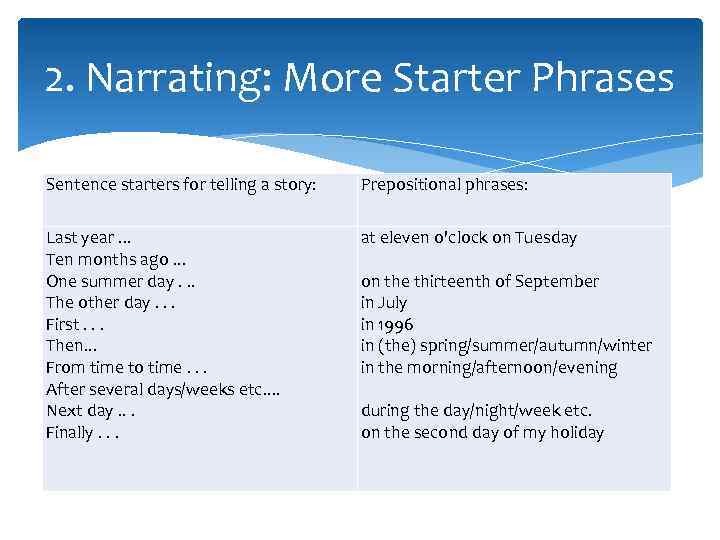 2. Narrating: More Starter Phrases Sentence starters for telling a story: Prepositional phrases: Last year. . . Ten months ago. . . One summer day. . . The other day. . . First. . . Then. . . From time to time. . . After several days/weeks etc. . Next day. . . Finally. . . at eleven o'clock on Tuesday on the thirteenth of September in July in 1996 in (the) spring/summer/autumn/winter in the morning/afternoon/evening during the day/night/week etc. on the second day of my holiday
 Narrating: Topic 3 -PEOPLE EXAMPLE: Describe a well-known person. You should say: Who he/she is What makes him/her famous Why you admire him/her Discussion: Do you want to become famous? How to become a well-known person in your country? What kind of people can become famous in your country? What are the advantages and disadvantages of being famous? What do you think of the privacy of a well-known person? What do you think of the relationship between a well-know person and advertising? Would you be influenced by the well-known persons in TV commercials? Do you often talk about singers with your friends? What do you often talk about?
 FEEDBACK/RUBRIC SCORE Listen to the recording of yourself. Write down or type any errors in pronunciation, grammar, or vocabulary that you hear. Then your teacher will give you feedback and tips
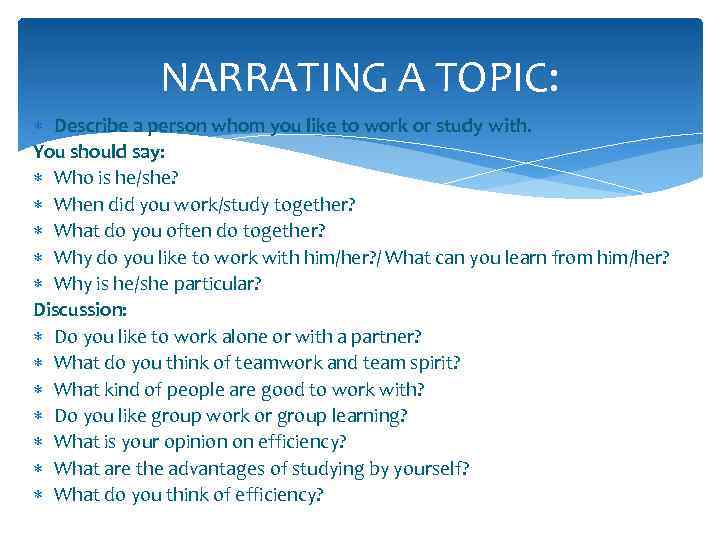 NARRATING A TOPIC: Describe a person whom you like to work or study with. You should say: Who is he/she? When did you work/study together? What do you often do together? Why do you like to work with him/her? / What can you learn from him/her? Why is he/she particular? Discussion: Do you like to work alone or with a partner? What do you think of teamwork and team spirit? What kind of people are good to work with? Do you like group work or group learning? What is your opinion on efficiency? What are the advantages of studying by yourself? What do you think of efficiency?
 Feedback Rubric Score Listen to the recording of yourself. Write down or type any errors in pronunciation, grammar, or vocabulary that you hear. Then your teacher will give you feedback and tips
 Describing Places Question 1 Describe a restaurant or a cafe. You should say: Where it is What it looks like What kind of services are provided What kind of food you like there/ What kind of food is famous? Why you like it Discussion: Do you like cooking? Will you cook for your friends when they visit you? Who cooks in a Chinese family? What do you think of the advantages and disadvantages of fast food? Why is fast food so popular? Where would Chinese go when they eat out? What changes would take place in terms of Chinese eating habits? What food is popular? What is the difference between fresh food and canned food? What can we do to solve the problem of food shortage? What are the advantages and disadvantages of family food?
 Feedback Listen to the recording of yourself. Write down or type any errors in pronunciation, grammar, or vocabulary that you hear. Then your teacher will give you feedback and tips
 Describing Places Question 2 Describe an interesting building. You should say: Where it is located What it looks like What services are provided Why you like it Discussion: What role do old buildings and new buildings play in modern society? What changes have taken place in architecture in the past two decades? Do you think it necessary to protect old buildings?
 Feedback Rubric Score Listen to the recording of yourself. Write down or type any errors in pronunciation, grammar, or vocabulary that you hear. Then your teacher will give you feedback and tips
 Speaking Style: Using correct emphasis A common mistake on the IELTS is using flat intonation. Try to sound natural by moving your voice up and down. Try to vary your pitch, volume, speech and intonation Complete the following lessons from Pronunciation in Use to improve your intonation (emphatic stress, lessons 49 -53)
 Describing Media and Communications: Topic 1 -Books Describe a kind of book you like. You should say: What kind of books you like most What they are about Why you like them most What effect have books brought on you? Discussion: What is the difference between men and women when choosing what to read? What kind books do children like? Why do they like reading? What is the difference between reading and watching TV? What is the relationship between reading and computer? What are the advantages of reading books? Why do children like pictorials? What books are popular in your country?
 Feedback Rubric Score Listen to the recording of yourself. Write down or type any errors in pronunciation, grammar, or vocabulary that you hear. Then your teacher will give you feedback and tips
 Describing Media and Communications: Topic 2 -Music Describe a kind of music. You should say: Whether you like music What kind of music you like best What role music plays in people’s life Discussion: How long do you listen to music everyday? Why is it easier for children to learn playing a musical instrument? What are the benefits of learning to play musical instruments? Discuss the impact of western music on the world music?
 Feedback Rubric Score Listen to the recording of yourself. Write down or type any errors in pronunciation, grammar, or vocabulary that you hear. Then your teacher will give you feedback and tips
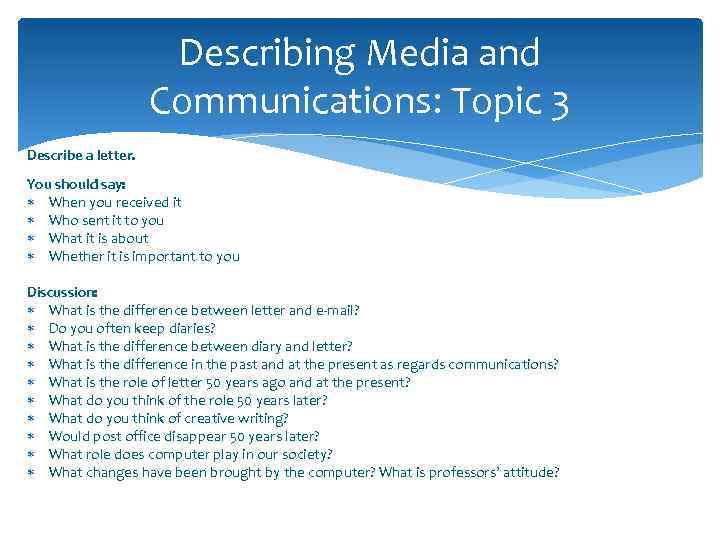 Describing Media and Communications: Topic 3 Describe a letter. You should say: When you received it Who sent it to you What it is about Whether it is important to you Discussion: What is the difference between letter and e-mail? Do you often keep diaries? What is the difference between diary and letter? What is the difference in the past and at the present as regards communications? What is the role of letter 50 years ago and at the present? What do you think of the role 50 years later? What do you think of creative writing? Would post office disappear 50 years later? What role does computer play in our society? What changes have been brought by the computer? What is professors’ attitude?
 Feedback Rubric Score Listen to the recording of yourself. Write down or type any errors in pronunciation, grammar, or vocabulary that you hear. Then your teacher will give you feedback and tips
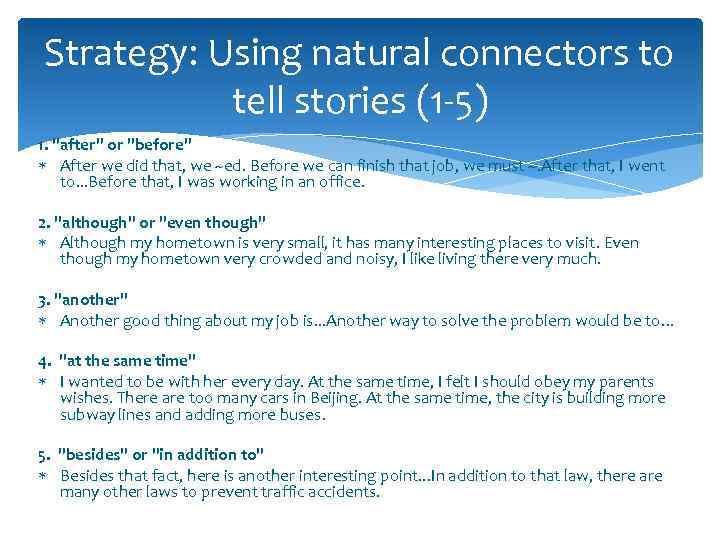 Strategy: Using natural connectors to tell stories (1 -5) 1. "after" or "before" After we did that, we ~ed. Before we can finish that job, we must ~. After that, I went to. . . Before that, I was working in an office. 2. "although" or "even though" Although my hometown is very small, it has many interesting places to visit. Even though my hometown very crowded and noisy, I like living there very much. 3. "another" Another good thing about my job is. . . Another way to solve the problem would be to. . . 4. "at the same time" I wanted to be with her every day. At the same time, I felt I should obey my parents wishes. There are too many cars in Beijing. At the same time, the city is building more subway lines and adding more buses. 5. "besides" or "in addition to" Besides that fact, here is another interesting point. . . In addition to that law, there are many other laws to prevent traffic accidents.
 Connectors Application/Practice 1. Describe what kind of jobs you have had over the past decade (1 o years). Use “before, after that”. 2. Describe three good things about your current job. Use “another, besides, and in addition”. 3. Describe a negative and positive point relating to your job. Use “even though” or “although”. 4. Describe a time when you were in a tough position at work (had a problem and didn’t know what to do). Use “at the same time”.
 Describing Celebration and Leisure Time 1. Describe a traditional festival in YOUR country. Apply some of the connectors you just learned in your speaking. You should say: What it is When is it celebrated? How to celebrate? / what you usually do on that day What you like and what you don’t like Discussion: What is the concept of holiday in your country? Why is holiday so important to modern people? Do you think it is necessary to observe the traditional customs? What changes in terms of spending festivals and holidays have taken place in the past decade? What is the difference as regards celebration in different part of the country?
 Feedback Rubric Score Listen to the recording of yourself. Write down or type any errors in pronunciation, grammar, or vocabulary that you hear. Then your teacher will give you feedback and tips
 Strategy: More Connectors (6 -10) 6. "but”, “however”, “yet” This is usually true, but. . . In most cases that is true, but. . . In a typical situation that may happen, but. . . In an ideal situation we can do it that way, but. . . I basically agree with you. However, I don't know if that will be true in the future. That is what I have thought most of my life. Yet I wonder if I am wrong. 7. "except for" Except for that one case, I do not know of any other problems. Except for the main character, all the others were bad people. 8. "rather than" Rather than repeat that process, the hero of the story decided to do something different. Rather than just accept the decision, I decided to change my job. 9. "when" or "whenever" When I think about such a topic, I think about. . . When I remember how I grew up, I realize. . . Whenever I think about my studies, I wonder how I survived! 10. "for example”, “because”, “the reason is” I believe ~ is true. For example. . . I believe that ~ is the best way. Let me give you an example. . . Many people believe that is true. I disagree because. . . My point of view is. . . The reason I believe that is because. . . I don't agree with that at all. The reason is. . . The reason I doubt that is. .
 Connectors Application/Practice 1. Disagree with this statement: A huge increase in tourism is a positive thing for this country because it will help the economy. -Use “however” or “but” in your response. 2. Describe a time when you had to go against the crowd and do something different than everyone else was doing. Use “rather than” or “except for”. 3. Should husbands and wives have different roles within the family? . Use “when”. 4. Describe a time when you were in a tough position at work (had a problem and didn’t know what to do). Use “at the same time”.