


 Скачать презентацию IEEE 802 21 MEDIA INDEPENDENT HANDOVER DCN 21
a07be7012bb28ab3eb25c6df9bfade96.ppt
- Количество слайдов: 36
 IEEE 802. 21 MEDIA INDEPENDENT HANDOVER DCN: 21 -07 -0360 -00 -0000 Title: IEEE 802. 21 – DVB Integration Date Submitted: November, 2007 Presented at IEEE 802. 21 session #23 in Atlanta Authors or Source(s): Burak Simsek (Fraunhofer Institute) Jens Mödeker (Fraunhofer Institute) Teodor Buburuzan (Technical University of Braunschweig) Michael Grigat (Deutsche Telekom) Patrick Stupar (NEC) Peter Pogrzeba (Deutsche Telekom) Michelle Wetterwald (Eurecom) Andreas Sieber (IRT) Abstract: This presentation recommends an extension to the IEEE 802. 21 standard for including DVB technologies. 21 -07 -0360 -00 -0000 1 DAIDALOS
 IEEE 802. 21 presentation release statements This document has been prepared to assist the IEEE 802. 21 Working Group. It is offered as a basis for discussion and is not binding on the contributing individual(s) or organization(s). The material in this document is subject to change in form and content after further study. The contributor(s) reserve(s) the right to add, amend or withdraw material contained herein. The contributor grants a free, irrevocable license to the IEEE to incorporate material contained in this contribution, and any modifications thereof, in the creation of an IEEE Standards publication; to copyright in the IEEE’s name any IEEE Standards publication even though it may include portions of this contribution; and at the IEEE’s sole discretion to permit others to reproduce in whole or in part the resulting IEEE Standards publication. The contributor also acknowledges and accepts that this contribution may be made public by IEEE 802. 21. The contributor is familiar with IEEE patent policy, as stated in Section 6 of the The contributor is familiar with IEEE patent policy, as outlined in Section 6. 3 of IEEE-SA Standards Board bylaws the IEEE-SA Standards Board Operations Manual
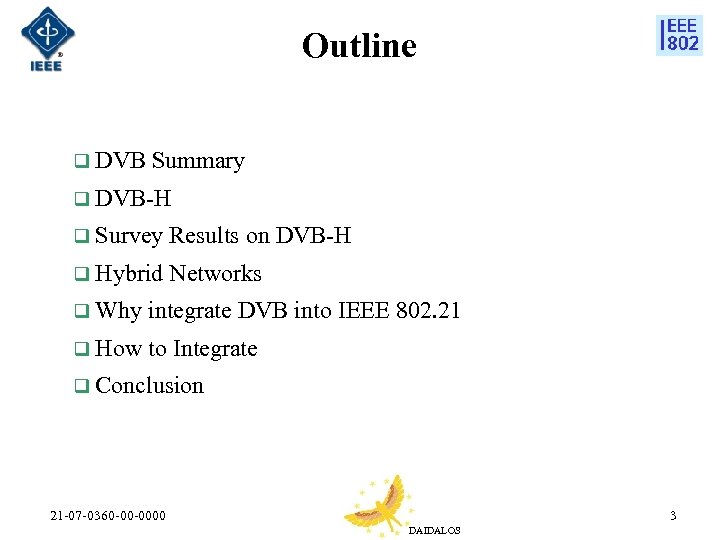 Outline q DVB Summary q DVB-H q Survey Results on DVB-H q Hybrid Networks q Why integrate DVB into IEEE 802. 21 q How to Integrate q Conclusion 21 -07 -0360 -00 -0000 3 DAIDALOS
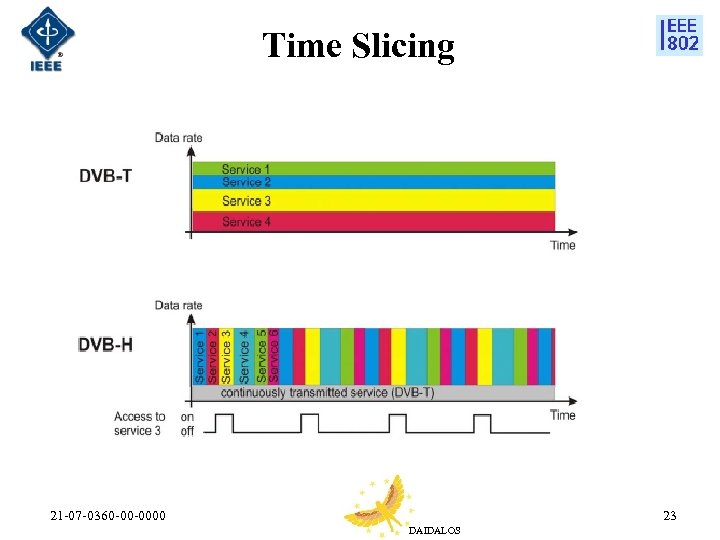
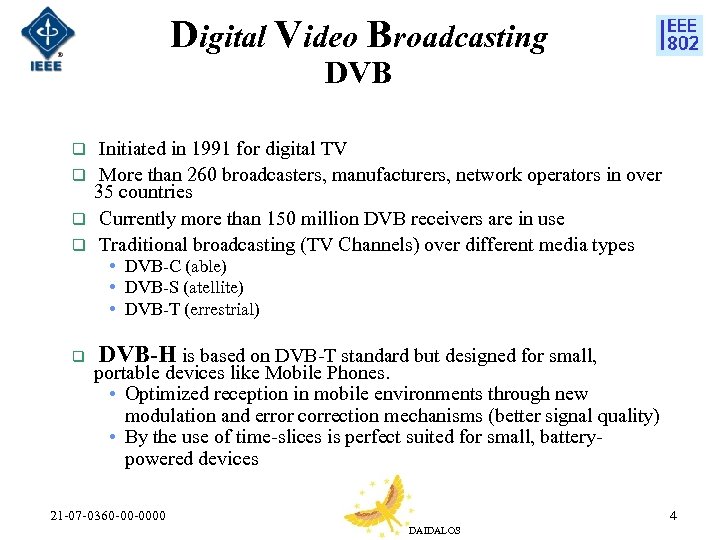 Digital Video Broadcasting DVB Initiated in 1991 for digital TV q More than 260 broadcasters, manufacturers, network operators in over 35 countries q Currently more than 150 million DVB receivers are in use q Traditional broadcasting (TV Channels) over different media types q • DVB-C (able) • DVB-S (atellite) • DVB-T (errestrial) q DVB-H is based on DVB-T standard but designed for small, portable devices like Mobile Phones. • Optimized reception in mobile environments through new modulation and error correction mechanisms (better signal quality) • By the use of time-slices is perfect suited for small, batterypowered devices 21 -07 -0360 -00 -0000 4 DAIDALOS
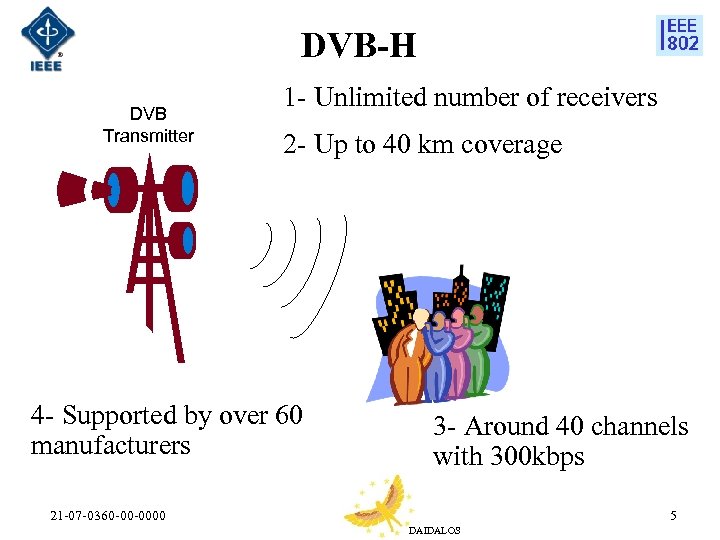 DVB-H DVB Transmitter 1 - Unlimited number of receivers 2 - Up to 40 km coverage 4 - Supported by over 60 manufacturers 3 - Around 40 channels with 300 kbps 21 -07 -0360 -00 -0000 5 DAIDALOS
 DVB-H q Mobile TV with DVB-H has been tested in more than 40 countries • 7 countries launched commercial services • Finland, Italy, India, Albania, Philippines, Vietnam, Nigeria • Other countries are planning initial services for 2008 (Germany, Russia, Spain, USA, UK…) q Example United Kingdom (Arqiva - Oxford) : • 85% satisfied customers, 72% willing to pay for the service within 12 months • 37% of usage while commuting to and from work • An average of 24 minutes of view per session / 4 hours per week • Traditional TV programs more attractive than made-for-mobile content • Customized and interactive services are demanded such as video Blogging 21 -07 -0360 -00 -0000 6 DAIDALOS
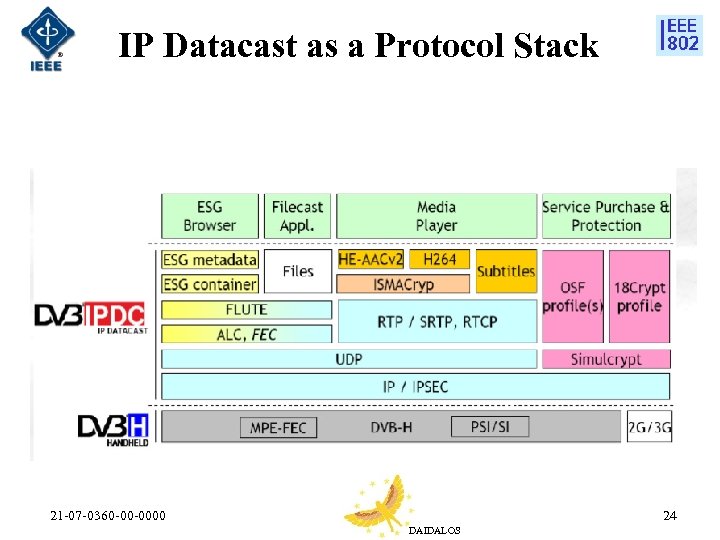
 IP Datacast q DVB was initially designed for Digital TV reception • One-to-many unidirectional connections § No Interactivity, passive TV watchers • MPEG 2 streams § No IP, no other service q IP Datacast • Developed by the DVB CBMS (Convergence of Broadcast and Mobile Services ) Working Group • Enables traditional IP based services over DVB • Defines service enabler for broadcast services § Purchase, Service Description, schedule and acquisition… • Supports the integration of cellular networks as service enablers § Return Channel 21 -07 -0360 -00 -0000 7 DAIDALOS
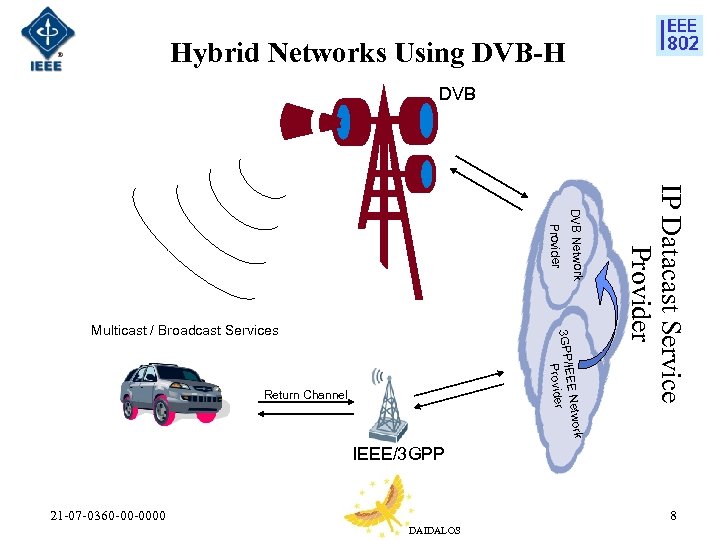 Hybrid Networks Using DVB-H DVB o EE Netw 3 GPP/IE Provider Return Channel IP Datacast Service Provider DVB Network Provider Multicast / Broadcast Services rk IEEE/3 GPP 21 -07 -0360 -00 -0000 8 DAIDALOS
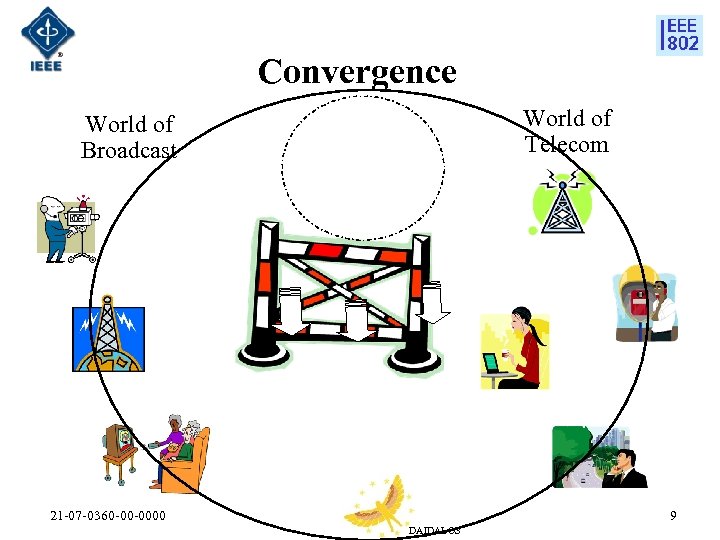 Convergence World of Telecom World of Broadcast 21 -07 -0360 -00 -0000 9 DAIDALOS
 The missing part q In the following years we will dominantly witness services using hybrid networks • • • Devices capable of UMTS, DVB-H, WLAN… are already there For a common user interface an interactive mobile TV standard with a media independent Java API (JSR 272) is also there Open Mobile Alliance (OMA) Mobile Broadcast Services Enabler Suite (BCAST) • Supports DVB-H, 3 GPP MBMS, 3 GPP 2 and mobile unicast streaming systems at the application layer q Interaction with other technologies at the network and data link layer is missing and needed • IEEE 802. 21 is currently the best candidate to fill in this gap! Different than other networks: Hybrid Networks fundamentally need cooperation among existing technologies hence need IEEE 802. 21 more than others 21 -07 -0360 -00 -0000 10 DAIDALOS
 DVB and Handover q Intra-technology handover for DVB is already defined q Inter-technology handover reasons given in the current draft are also true for DVB deployments • Qo. S concerns, service availability, mobility, price, power management, network selection… q Some handover scenarios: • Especially in suburban and intra-urban areas handover between DVB and UMTS/WIMAX is needed • • • Automobiles equipped with DVB - UMTS- WIMAX already being tested by some manufacturers Price issues might foster use of WLAN when available In case of service unavailability on a specific DVB network choose UMTS or WIMAX… 21 -07 -0360 -00 -0000 11 DAIDALOS
 How to Integrate q IEEE 802. 21 assumes bidirectional connection • Information can be exchanged between peer MIHF entities q This is not directly possible for DVB • • • Needs an uplink channel for bidirectional connection Communication with own MIHF is possible in all cases Integrate unidirectional DVB 21 -07 -0360 -00 -0000 12 DAIDALOS
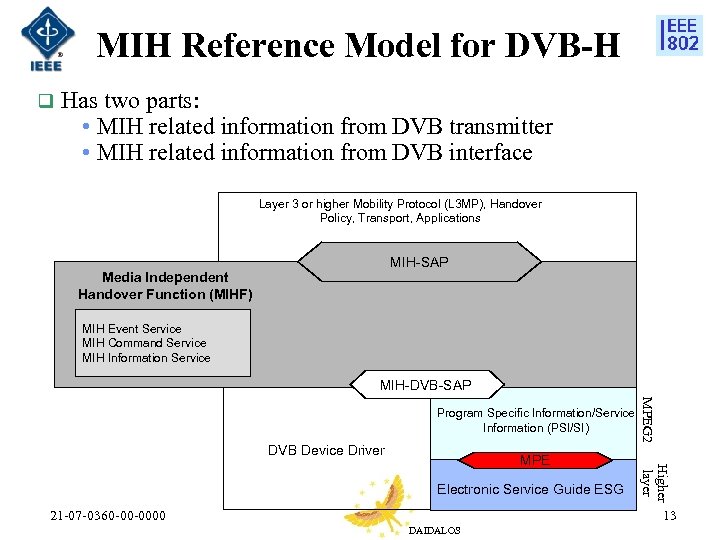 MIH Reference Model for DVB-H q Has two parts: • MIH related information from DVB transmitter • MIH related information from DVB interface Layer 3 or higher Mobility Protocol (L 3 MP), Handover Policy, Transport, Applications MIH-SAP Media Independent Handover Function (MIHF) MIH Event Service MIH Command Service MIH Information Service MIH-DVB-SAP DVB Device Driver Electronic Service Guide ESG 21 -07 -0360 -00 -0000 Higher layer MPEG 2 Program Specific Information/Service Information (PSI/SI) 13 DAIDALOS
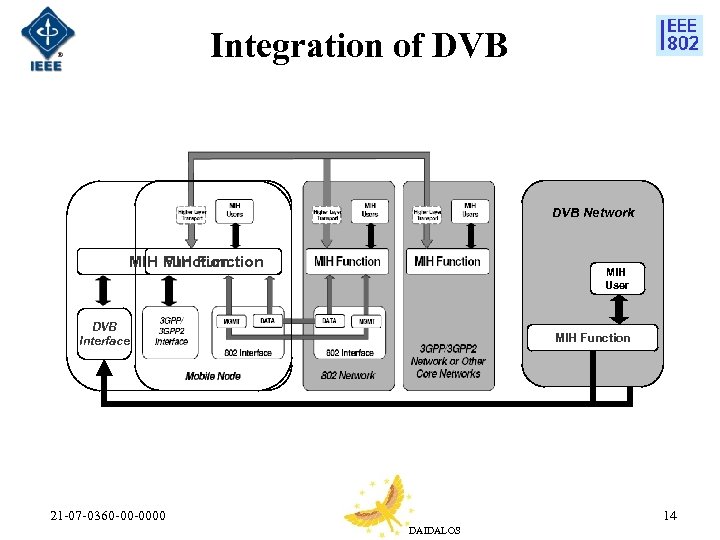 Integration of DVB Network MIH Function MIH User DVB Interface MIH Function 21 -07 -0360 -00 -0000 14 DAIDALOS
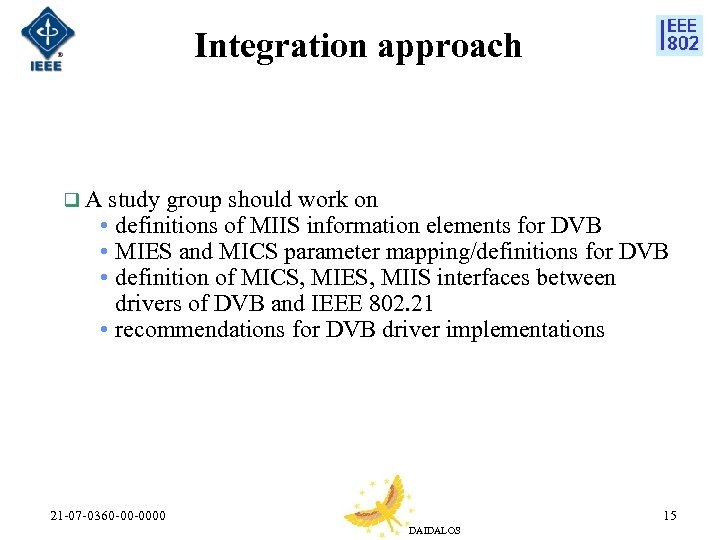 Integration approach q A study group should work on • definitions of MIIS information elements for DVB • MIES and MICS parameter mapping/definitions for DVB • definition of MICS, MIES, MIIS interfaces between drivers of DVB and IEEE 802. 21 • recommendations for DVB driver implementations 21 -07 -0360 -00 -0000 15 DAIDALOS
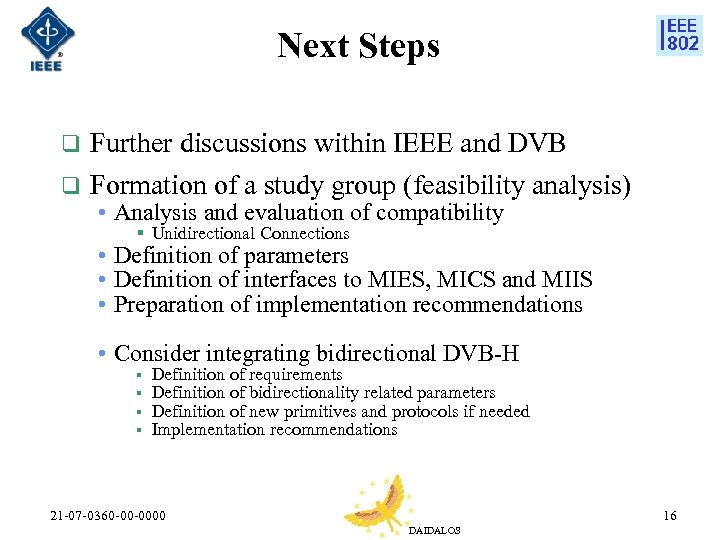 Next Steps q Further discussions within IEEE and DVB q Formation of a study group (feasibility analysis) • Analysis and evaluation of compatibility § Unidirectional Connections • Definition of parameters • Definition of interfaces to MIES, MICS and MIIS • Preparation of implementation recommendations • Consider integrating bidirectional DVB-H § § Definition of requirements Definition of bidirectionality related parameters Definition of new primitives and protocols if needed Implementation recommendations 21 -07 -0360 -00 -0000 16 DAIDALOS
 Relevant Studies and References DAIDALOS http: //www. ist-daidalos. org/default. htm 1. Ilka Miloucheva, Jens Moedeker, Dirk Hetzer, "Handover and resource management of mobile nodes with unidirectional links", IEEE ICWMC, Guadeloupe, 2007 2. Kornfeld, M. ; May, G. “DVB-H and IP Datacast - Broadcast to Handheld Devices” IEEE Transactions on Broadcasting, Special Issue on "Mobile Multimedia Broadcasting", vol. 53, no. 1, S. 161 -170, Invited Paper 3. Buburuzan, T. ; May, G. ; Melia, T. ; Mödeker, J. ; Wetterwald, M. “Integration of Broadcast Technologies with Heterogeneous Networks - An IEEE 802. 21 Centric Approach” IEEE International Conference on Consumer Electronics (ICCE) 2007, Las Vegas, 12. 01. -14. 01. 2007 4. Teodor Buburuzan, Nikos Koutsouris, Krzysztof Loziak , “An end-to-end Qo. S architecture for ensuring the reliable delivery of broadband applications” IEEE International Conference on Consumer Electronics (ICCE) 2008, Las Vegas, 11. 01. -13. 01. 2008 5. Pedro A. Aranda Gutierrez, Ilka Miloucheva, and Sathya Rao, “Automated Qo. S policy adaptation for heterogeneous access network environments” In Proceedings of The Second International Conference on Systems and Networks Communications (ICSNC 2007), Cap Esterel, French Riviera, France, 2007 6. S. Sargento, T. Melia , A. Banchs, I. Soto, J. Moedeker, L. Marchetti, "Mobility through Heterogeneous Networks in a 4 G Environment", WWRF 17, Heidelberg, 2006 7. The Economics of Mobile Broadcast TV http: //www. mdtvalliance. org/imwp/download. asp? Content. ID=10295 21 -07 -0360 -00 -0000 17 DAIDALOS
 Conclusion q Hybrid Broadcast/Mobile Networks composed of 3 GPP and IEEE technologies have significant financial advantages for all mobile network operators • Initial mobile TV services using hybrid networks in different countries have shown that customer acceptance is very high • We will witness more and more hybrid networks in the following years q Hybrid Networks need more cooperation among different technologies than vertical handovers do q IEEE 802. 21 is the best candidate to provide with the required cooperation q An amendment of IEEE 802. 21 supporting vertical handovers with DVB will have high impact on offered services, hence on the market value of hybrid networks! 21 -07 -0360 -00 -0000 18 DAIDALOS
 Thank You! burak. simsek@fokus. fraunhofer. de 21 -07 -0360 -00 -0000 19 DAIDALOS
 MIH In the case of a system with multiple network interfaces of arbitrary type, the MIH Users may use the Event Service, Command Service and Information Service provided by MIHF to manage, determine, and control the state of the underlying interfaces. These services provided by MIHF help the MIH Users in maintaining service continuity, service adaptation to varying quality of service, battery life conservation, network discovery, and link selection. 21 -07 -0360 -00 -0000 20 DAIDALOS
 MIH • Handover: the process by which a mobile node obtains facilities and preserves traffic flows upon occurrence of a link switch event. • The scope of the IEEE 802. 21 (Media Independent Handover) standard is to develop a standard that provides link layer intelligence and other related network information to upper layers to optimize handovers between heterogeneous networks. • The purpose of the IEEE 802. 21 standard is to enhance the user experience of mobile devices by supporting handovers between heterogeneous networks. The standard addresses the support of handovers for both mobile and stationary users. 21 -07 -0360 -00 -0000 21 DAIDALOS
 MIH • For the stationary user, handovers may become imminent when the surrounding environment changes, making one network more attractive than another. Another possibility is that the user may choose an application which requires a handover to a higher data rate channel, for example during download of a large data file. In all cases service continuity should be maximized during the handover. • Various applications have different tolerance characteristic for delay and data loss. Application aware handover decisions may be enabled by making a provision for such characteristics. • Network discovery is essential to provide new possibilities for network selection to suit the need of the applications and mobility. The IEEE 802. 21 standard defines the network information and specifies the means by which such information may be obtained for supported access networks and made available to the MIH Users. The network information could include information about link type, link identifier, link availability, link quality, etc. 21 -07 -0360 -00 -0000 22 DAIDALOS
 Time Slicing 21 -07 -0360 -00 -0000 23 DAIDALOS
 IP Datacast as a Protocol Stack 21 -07 -0360 -00 -0000 24 DAIDALOS
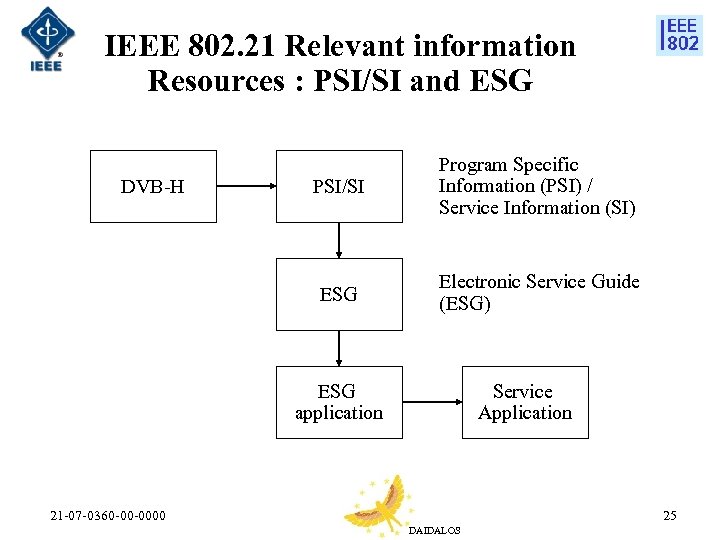 IEEE 802. 21 Relevant information Resources : PSI/SI and ESG PSI/SI ESG DVB-H Program Specific Information (PSI) / Service Information (SI) Electronic Service Guide (ESG) ESG application Service Application 21 -07 -0360 -00 -0000 25 DAIDALOS
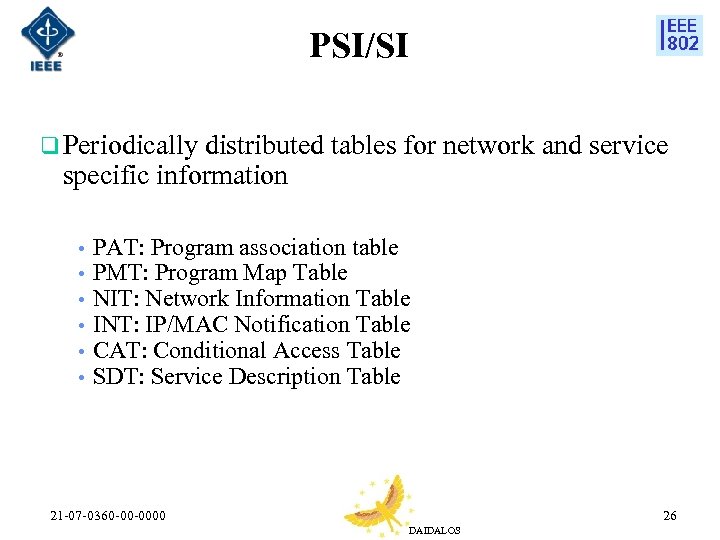 PSI/SI q Periodically distributed tables for network and service specific information • • • PAT: Program association table PMT: Program Map Table NIT: Network Information Table INT: IP/MAC Notification Table CAT: Conditional Access Table SDT: Service Description Table 21 -07 -0360 -00 -0000 26 DAIDALOS
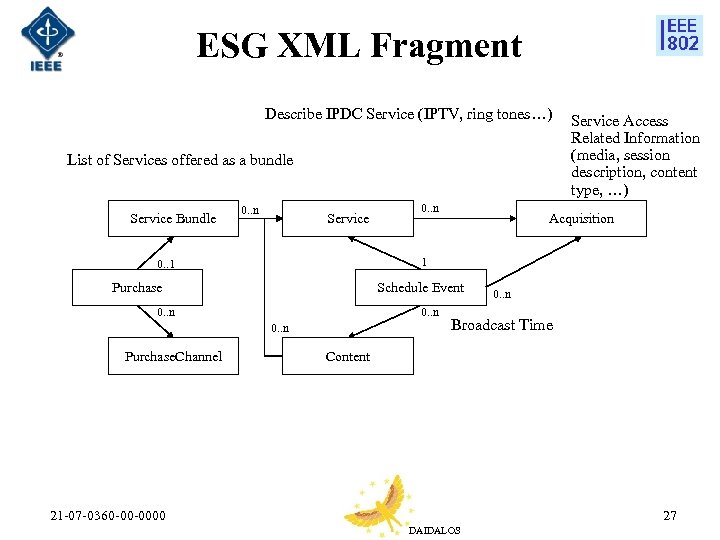 ESG XML Fragment Describe IPDC Service (IPTV, ring tones…) List of Services offered as a bundle Service Bundle 0. . n Service Acquisition 1 0. . 1 Purchase Schedule Event 0. . n Purchase. Channel 0. . n Service Access Related Information (media, session description, content type, …) 0. . n Broadcast Time Content 21 -07 -0360 -00 -0000 27 DAIDALOS
 DVB-H Development in Nord America q MDA : Mobile DTV Alliance qpromote the adoption of Mobile TV technology via DVB-H q. Disney, Hi. Wire, Intel, Microsoft, Modeo, Motorola, Nokia and Texas Instruments qcurrently two broadcasters in North America (Modeo and Hi. Wire) building out mobile TV broadcast networks based on DVB-H. q Media. FLO the only serious competitor 21 -07 -0360 -00 -0000 28 DAIDALOS
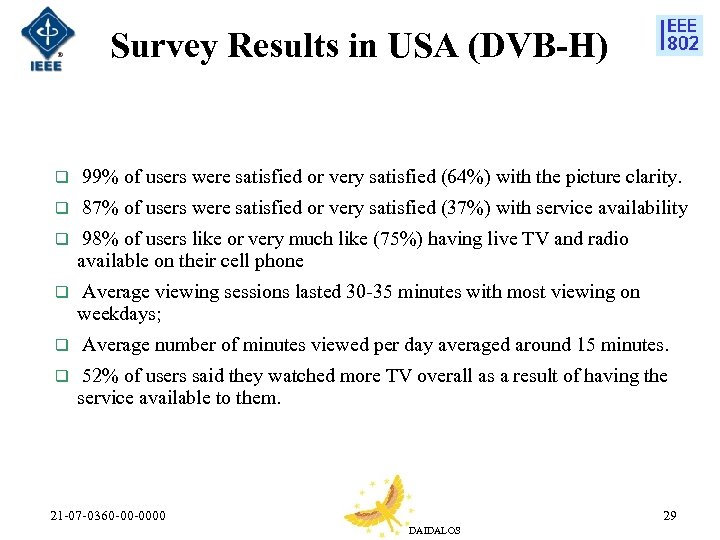 Survey Results in USA (DVB-H) q 99% of users were satisfied or very satisfied (64%) with the picture clarity. q 87% of users were satisfied or very satisfied (37%) with service availability q 98% of users like or very much like (75%) having live TV and radio available on their cell phone q Average viewing sessions lasted 30 -35 minutes with most viewing on weekdays; q Average number of minutes viewed per day averaged around 15 minutes. q 52% of users said they watched more TV overall as a result of having the service available to them. 21 -07 -0360 -00 -0000 29 DAIDALOS
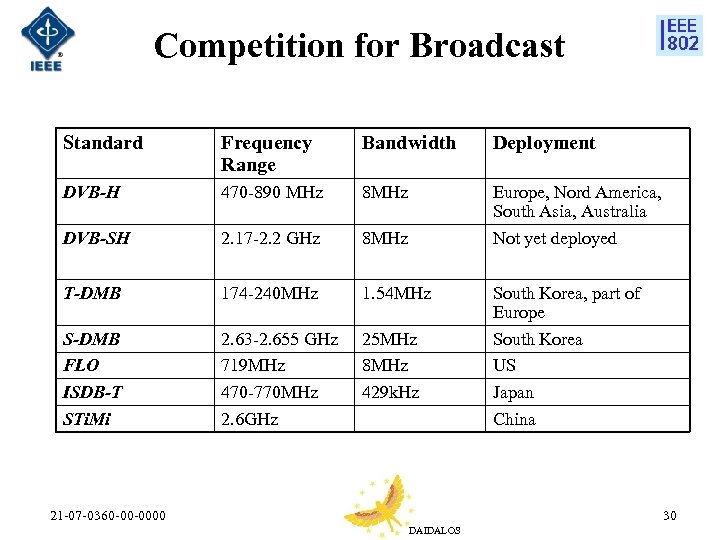 Competition for Broadcast Standard Frequency Range Bandwidth Deployment DVB-H 470 -890 MHz 8 MHz DVB-SH 2. 17 -2. 2 GHz 8 MHz Europe, Nord America, South Asia, Australia Not yet deployed T-DMB 174 -240 MHz 1. 54 MHz S-DMB FLO ISDB-T STi. Mi 2. 63 -2. 655 GHz 719 MHz 470 -770 MHz 2. 6 GHz 25 MHz 8 MHz 429 k. Hz 21 -07 -0360 -00 -0000 South Korea, part of Europe South Korea US Japan China 30 DAIDALOS
 21 -07 -0360 -00 -0000 31 DAIDALOS
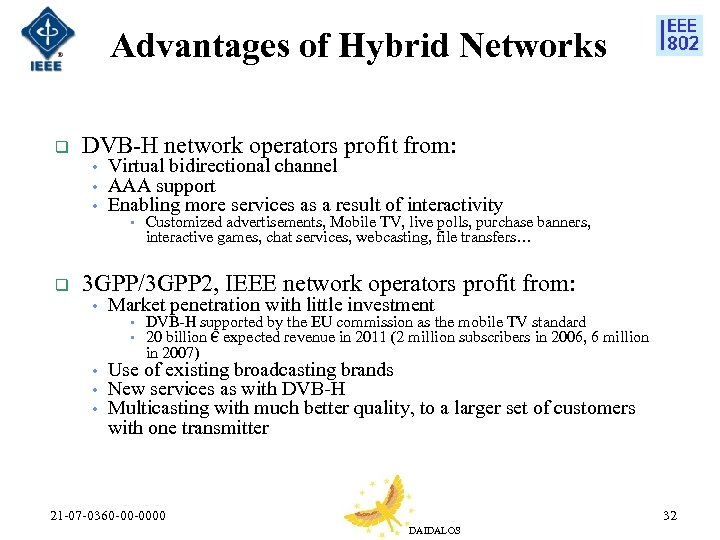 Advantages of Hybrid Networks q DVB-H network operators profit from: • Virtual bidirectional channel • AAA support • Enabling more services as a result of interactivity • q Customized advertisements, Mobile TV, live polls, purchase banners, interactive games, chat services, webcasting, file transfers… 3 GPP/3 GPP 2, IEEE network operators profit from: • Market penetration with little investment • • • DVB-H supported by the EU commission as the mobile TV standard 20 billion € expected revenue in 2011 (2 million subscribers in 2006, 6 million in 2007) Use of existing broadcasting brands New services as with DVB-H Multicasting with much better quality, to a larger set of customers with one transmitter 21 -07 -0360 -00 -0000 32 DAIDALOS
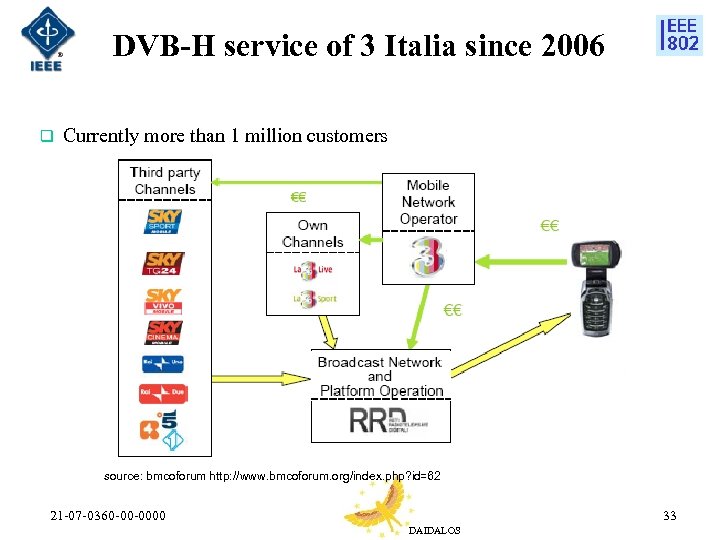 DVB-H service of 3 Italia since 2006 q Currently more than 1 million customers source: bmcoforum http: //www. bmcoforum. org/index. php? id=62 21 -07 -0360 -00 -0000 33 DAIDALOS
 Step 2: DVB with virtual bidirectional link q No changes needed in the standard as long as L 3 is used for interaction with peer MIHF entities q Handover with DVB in virtual bidirectional case includes • • handover of the downlink channel handover of the uplink channel (other technologies) q Task group should define required interfaces in order to: • • • determine the need for virtual bidirectional channel manage the choice of the uplink channel for DVB build virtual bidirectional channel for interactive services manage handovers of the uplink channel (stable virtual bidirectional link) manage changes from virtual bidirectional to bidirectional or vice versa 21 -07 -0360 -00 -0000 34 DAIDALOS
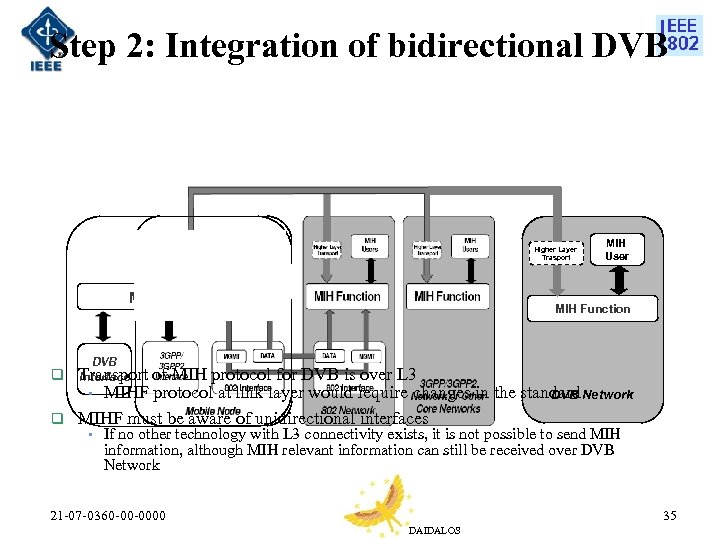 Step 2: Integration of bidirectional DVB Higher Layer Trasport MIH Function q MIH User MIH Function DVB Transport of MIH protocol for DVB is over L 3 Interface MIHF protocol at link layer would require changes in the standard Network DVB q MIHF must be aware of unidirectional interfaces • • If no other technology with L 3 connectivity exists, it is not possible to send MIH information, although MIH relevant information can still be received over DVB Network 21 -07 -0360 -00 -0000 35 DAIDALOS
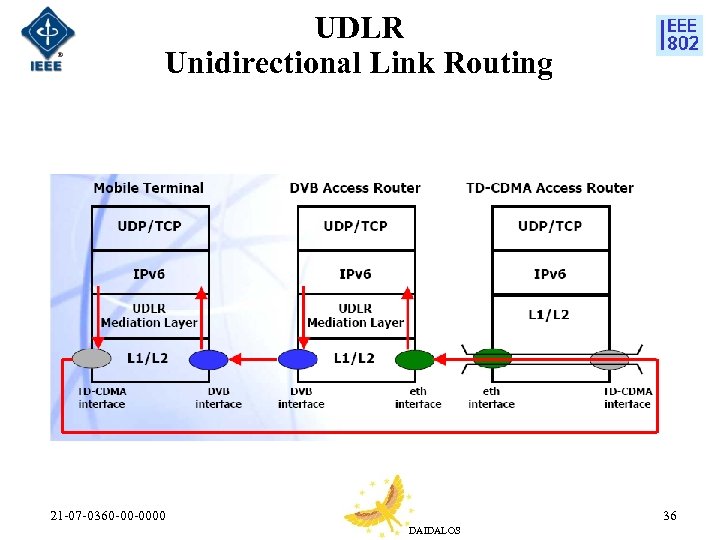 UDLR Unidirectional Link Routing 21 -07 -0360 -00 -0000 36 DAIDALOS