


 Скачать презентацию IEEE 802 16 Working Group Wireless Metropolitan Area
757168b382bc33359d61cbd993958493.ppt
- Количество слайдов: 35
 IEEE 802. 16 Working Group: Wireless Metropolitan Area Networks Roger B. Marks Chair, IEEE 802. 16 Working Group r. b. marks@ieee. org 2011 -03 -12 Presenter: Matthew J. Sherman Vice Chair, IEEE 802 Version 1. 0 IEEE 802 March 2011 workshop EEE 802 Page 1
 Disclaimer from IEEE Perspective • “At lectures, symposia, seminars, or educational courses, an individual presenting information on IEEE standards shall make it clear that his or her views should be considered the personal views of that individual rather than the formal position, explanation, or interpretation of the IEEE. ” – IEEE-SA Standards Board Operation Manual (subclause 5. 9. 3) EEE 802 Version 1. 0 IEEE 802 March 2011 workshop Page 2
 Outline • IEEE 802. 16 • IMT-Advanced status • Performance characteristics of Wireless. MAN-Advanced as evaluated by ITU-R • Active projects in IEEE 802. 16 – P 802. 16 n: GRIDMAN – P 802. 16 p: Machine-to-Machine EEE 802 Version 1. 0 IEEE 802 March 2011 workshop Page 3
 IEEE 802. 16 is: • A Working Group (WG): – The IEEE 802. 16 Working Group on Broadband Wireless Access – Develops and maintain a set of standards • The Working Group’s core standard – IEEE Std 802. 16: Air Interface for Broadband Wireless Access Systems – The Wireless. MAN® standard for Wireless Metropolitan Area Networks EEE 802 Version 1. 0 IEEE 802 March 2011 workshop Page 4
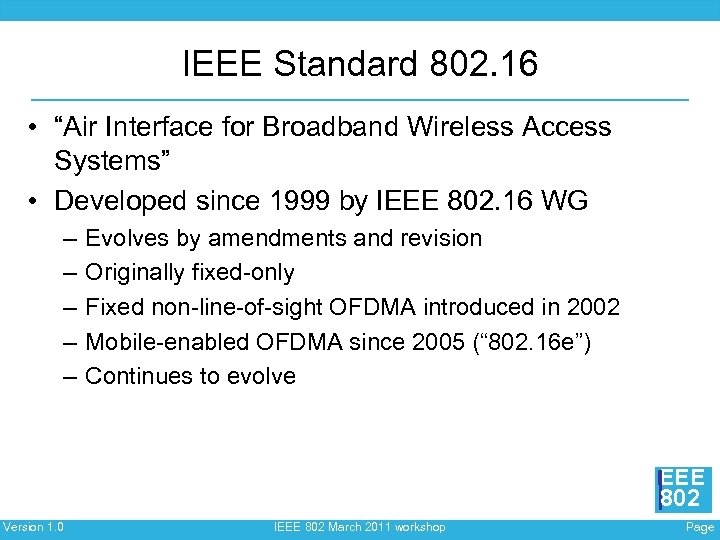 IEEE Standard 802. 16 • “Air Interface for Broadband Wireless Access Systems” • Developed since 1999 by IEEE 802. 16 WG – – – Evolves by amendments and revision Originally fixed-only Fixed non-line-of-sight OFDMA introduced in 2002 Mobile-enabled OFDMA since 2005 (“ 802. 16 e”) Continues to evolve EEE 802 Version 1. 0 IEEE 802 March 2011 workshop Page 5
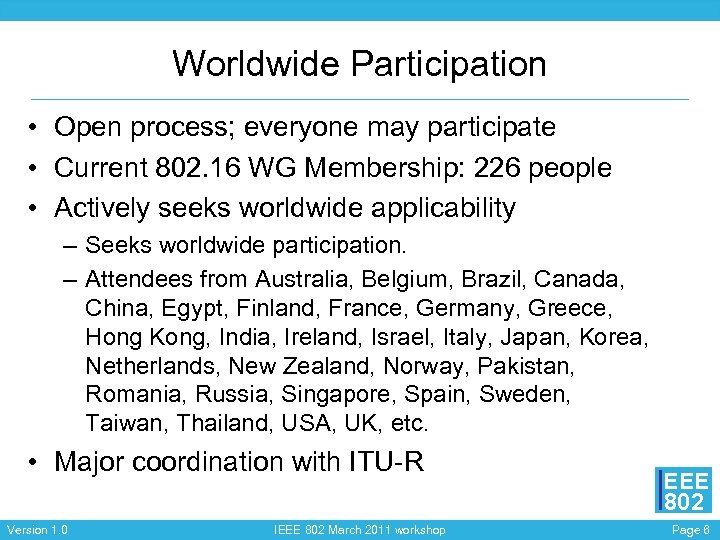 Worldwide Participation • Open process; everyone may participate • Current 802. 16 WG Membership: 226 people • Actively seeks worldwide applicability – Seeks worldwide participation. – Attendees from Australia, Belgium, Brazil, Canada, China, Egypt, Finland, France, Germany, Greece, Hong Kong, India, Ireland, Israel, Italy, Japan, Korea, Netherlands, New Zealand, Norway, Pakistan, Romania, Russia, Singapore, Spain, Sweden, Taiwan, Thailand, USA, UK, etc. • Major coordination with ITU-R Version 1. 0 IEEE 802 March 2011 workshop EEE 802 Page 6
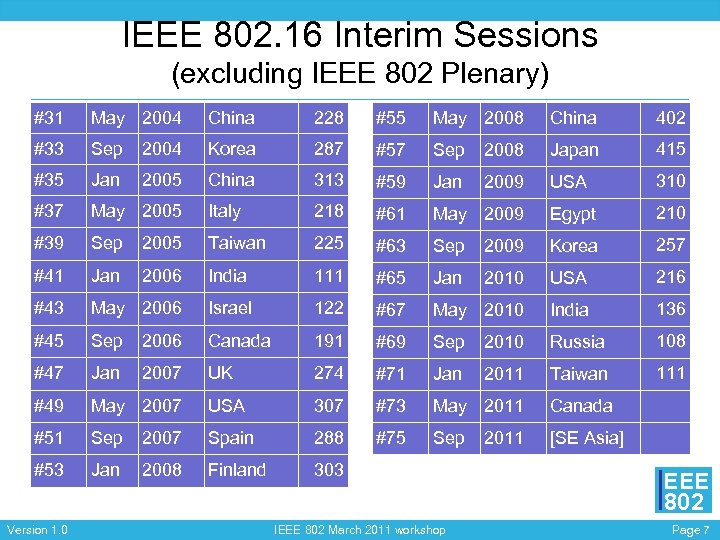 IEEE 802. 16 Interim Sessions (excluding IEEE 802 Plenary) #31 May 2004 China 228 #55 May 2008 China 402 #33 Sep 2004 Korea 287 #57 Sep 2008 Japan 415 #35 Jan 2005 China 313 #59 Jan 2009 USA 310 #37 May 2005 Italy 218 #61 May 2009 Egypt 210 #39 Sep 2005 Taiwan 225 #63 Sep 2009 Korea 257 #41 Jan 2006 India 111 #65 Jan 2010 USA 216 #43 May 2006 Israel 122 #67 May 2010 India 136 #45 Sep 2006 Canada 191 #69 Sep 2010 Russia 108 #47 Jan 2007 UK 274 #71 Jan 2011 Taiwan 111 #49 May 2007 USA 307 #73 May 2011 Canada #51 Sep 2007 Spain 288 #75 Sep [SE Asia] #53 Jan 2008 Finland 303 Version 1. 0 IEEE 802 March 2011 workshop 2011 EEE 802 Page 7
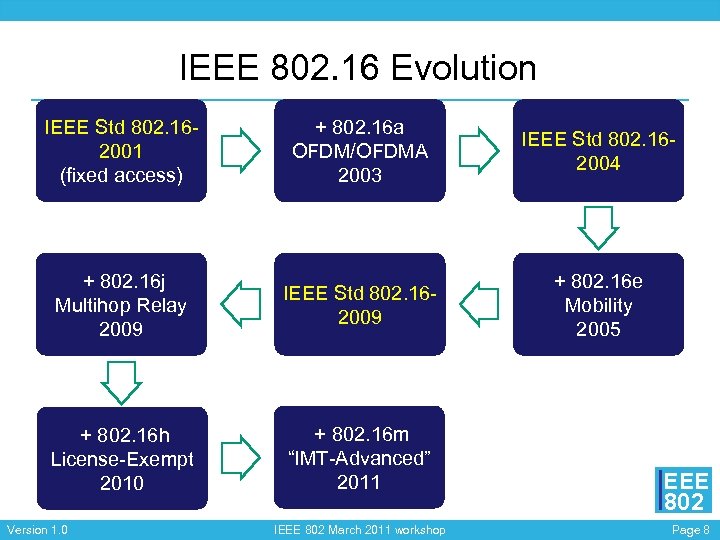 IEEE 802. 16 Evolution IEEE Std 802. 162001 (fixed access) + 802. 16 a OFDM/OFDMA 2003 IEEE Std 802. 162004 + 802. 16 j Multihop Relay 2009 IEEE Std 802. 162009 + 802. 16 e Mobility 2005 + 802. 16 h License-Exempt 2010 + 802. 16 m “IMT-Advanced” 2011 Version 1. 0 IEEE 802 March 2011 workshop EEE 802 Page 8
 IEEE 802. 16 and the Wi. MAX Forum • IEEE 802. 16 Working Group – Open standards for broadband wireless access • Wi. MAX Forum – Industry association – Certification of open standards • Certifying conformance to IEEE 802. 16 • Cooperative coordination in many areas – Including ITU Version 1. 0 EEE 802 IEEE 802 March 2011 workshop Page 9
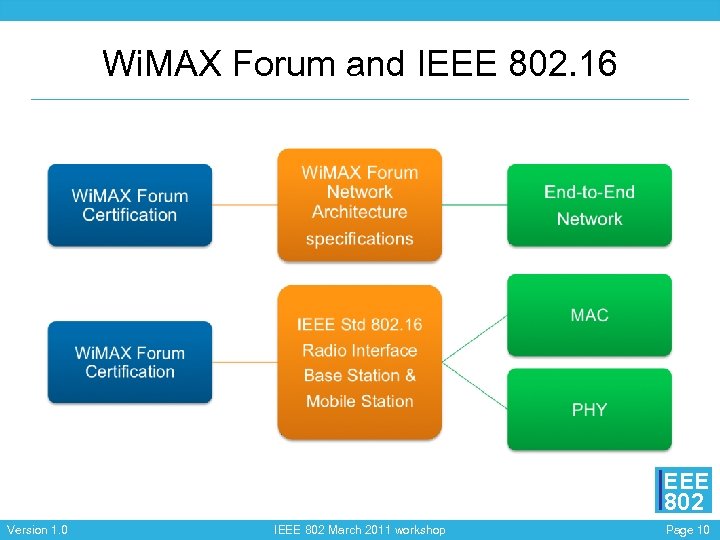 Wi. MAX Forum and IEEE 802. 16 EEE 802 Version 1. 0 IEEE 802 March 2011 workshop Page 10
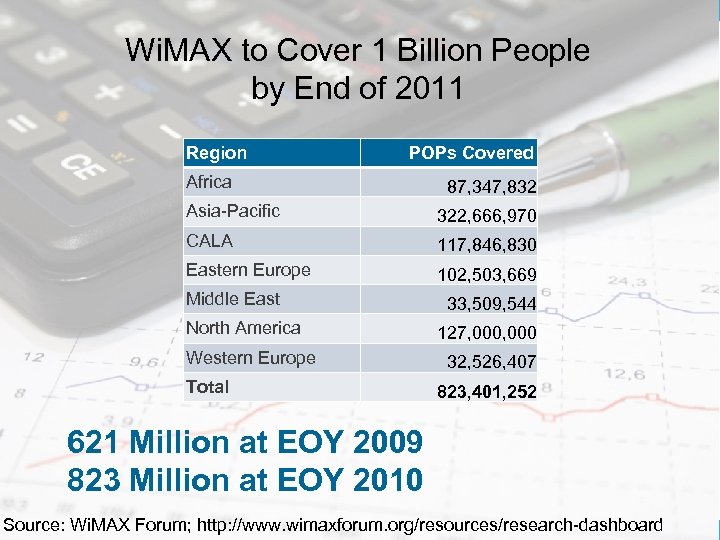 Wi. MAX to Cover 1 Billion People by End of 2011 Region POPs Covered Africa 87, 347, 832 Asia-Pacific 322, 666, 970 CALA 117, 846, 830 Eastern Europe 102, 503, 669 Middle East North America Western Europe Total 621 Million at EOY 2009 823 Million at EOY 2010 33, 509, 544 127, 000 32, 526, 407 823, 401, 252 EEE 802 Source: Version 1. 0 Wi. MAX Forum; http: //www. wimaxforum. org/resources/research-dashboard Page 11 Page IEEE 802 March 2011 workshop Version 1. 0 IEEE 802 March 2011 workshop
 Internationalization of IEEE 802. 16 • International Telecommunication Union (ITU) – organized under United Nations – membership by national governments • Radiocommunication Sector (ITU-R) – private organizations hold memberships • Including Wi. MAX Forum, IEEE, companies • 802. 16 WG seeks “Internationalization” – though it is, in many ways, “international” to begin with – strategy since the beginning in 1999 – ITU-R Liaison Group Version 1. 0 IEEE 802 March 2011 workshop EEE 802 Page 12
 IEEE 802. 16, Wi. MAX Forum, and ITU • IEEE: Member of ITU-R – “Regional and other International Organizations” • Relevant ITU-R Engagement: – fixed wireless access • Rec. F. 1763: IEEE 802. 16 in the fixed service – land mobile radio: • Rec. M. 1801 IEEE 802. 16 in mobile service – IMT-2000 EEE 802 Version 1. 0 IEEE 802 March 2011 workshop Page 13
 IMT-2000: “International Mobile Telecommunications” • Under ITU-R Study Group 5/Working Party 5 D – known as Working Party 8 F before 2008 • the international cellular standard since ~1998 – significant impact on spectrum allocations • Since 1998, 5 evolving terrestrial air interfaces – inc. 3 GPP (W-CDMA) & 3 GPP 2 (cdma 2000) • M. 1457 -7 (Oct 2007) adds “OFDMA TDD WMAN” – Based on IEEE Std 802. 16 (including 802. 16 e) – Implementation profile developed by Wi. MAX Forum • M. 1457 -9 (2009) added FDD as well Version 1. 0 IEEE 802 March 2011 workshop EEE 802 Page 14
 IMT-Advanced • To develop “Beyond IMT-2000” recommendation • “to be developed around the year 2010, capable of supporting high data rates with high mobility, which could be widely deployed around the year 2015 in some countries. ” • ITU-R Working Party 5 D developed background materials – Announced in July 2008 • IEEE contributed to defining the process and requirements EEE 802 Version 1. 0 IEEE 802 March 2011 workshop Page 15
 “IMT” Spectrum • IMT-2000 Identifications – 800/900 MHz bands – 1700/2100 MHz bands – 2500 -2690 MHz • World Radiocommunication Conference 2007 – Identified additional spectrum • • 450 -470 MHz globally 2300 -2400 MHz globally 790 -862 MHz in much of world 3400 -3600 MHz in much of world – changed spectrum identification to “IMT” – includes “IMT-2000” and “IMT-Advanced” Version 1. 0 IEEE 802 March 2011 workshop EEE 802 Page 16
 IEEE 802. 16 m Project • amendment project, initiated December 2006 • Scope: – amend the IEEE 802. 16 Wireless. MAN-OFDMA specification to provide an advanced air interface for operation in licensed bands – meet the cellular layer requirements of IMT-Advanced next generation mobile networks – continuing support for legacy Wireless. MAN-OFDMA equipment (i. e. , backward compatibility) – Provide performance improvements to support future advanced services and applications • “Wireless. MAN-Advanced” air interface Version 1. 0 IEEE 802 March 2011 workshop EEE 802 Page 17
 Participation in IEEE 802. 16 m • Since 802. 16 m project began, 802. 16 WG participation includes: – Over 1200 professionals – From about 240 organizations – From 23 countries • Contributed documents to 802. 16 m Task Group – – 2007: >300 documents 2008: >1500 documents 2009: > 2700 documents 2010: > 1400 documents EEE 802 Version 1. 0 IEEE 802 March 2011 workshop Page 18
 IEEE 802. 16 m – Key Features • New Subframe-based Frame Structure • New Subchannelization Schemes and More Efficient Pilot Structures • New and Improved Control Channel Structures • Extended and Improved MIMO Modes • Increased Vo. IP Capacity • Multi-Hop Relay Version 1. 0 • • • Femto BS Self-organization Multi-carrier Operation Interference Mitigation Multi-BS MIMO Improved Intra-RAT and Inter-RAT Handover • Multi-Radio Coexistence • Location Based Services • Enhanced Multicast and Broadcast Service IEEE 802 March 2011 workshop EEE 802 Page 19
 Wireless. MAN-Advanced Proposal for IMT-Advanced • IEEE submitted detailed proposal on Wireless. MAN-Advanced air interface in Oct 2009 • Two other entities submitted proposals of the same technology: – Administration of Japan – TTA (Korean SDO) • All 3 included self-evaluation demonstrating that all IMT-Advanced requirements are met • Nine worldwide experts groups conducted extensive technical studies that support results EEE 802 Version 1. 0 IEEE 802 March 2011 workshop Page 20
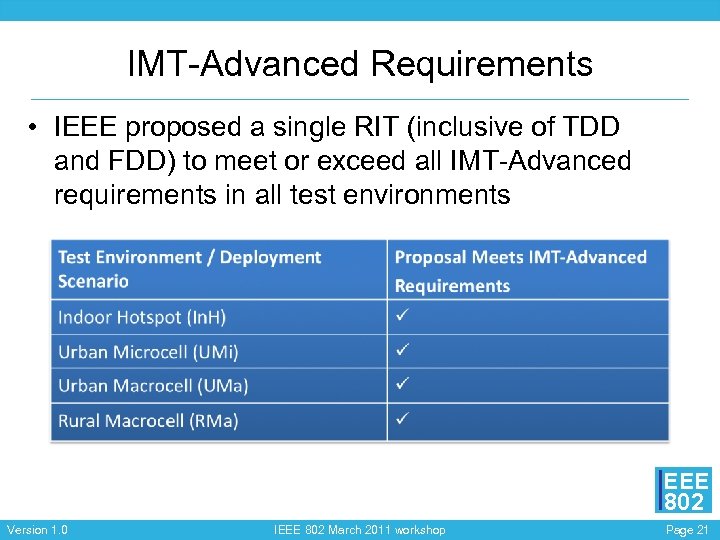 IMT-Advanced Requirements • IEEE proposed a single RIT (inclusive of TDD and FDD) to meet or exceed all IMT-Advanced requirements in all test environments EEE 802 Version 1. 0 IEEE 802 March 2011 workshop Page 21
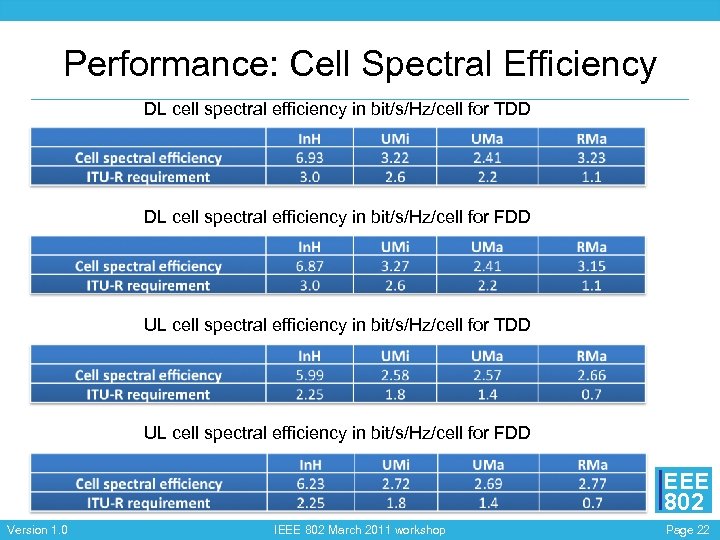 Performance: Cell Spectral Efficiency DL cell spectral efficiency in bit/s/Hz/cell for TDD DL cell spectral efficiency in bit/s/Hz/cell for FDD UL cell spectral efficiency in bit/s/Hz/cell for TDD UL cell spectral efficiency in bit/s/Hz/cell for FDD EEE 802 Version 1. 0 IEEE 802 March 2011 workshop Page 22
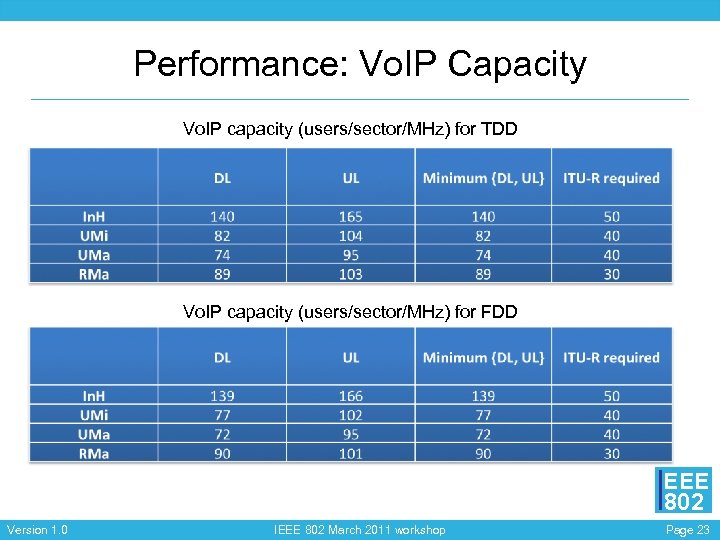 Performance: Vo. IP Capacity Vo. IP capacity (users/sector/MHz) for TDD Vo. IP capacity (users/sector/MHz) for FDD EEE 802 Version 1. 0 IEEE 802 March 2011 workshop Page 23
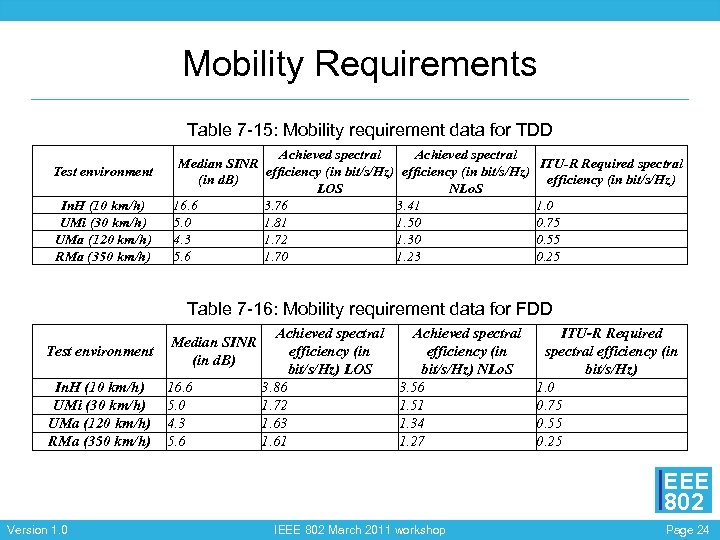 Mobility Requirements Table 7 -15: Mobility requirement data for TDD Test environment In. H (10 km/h) UMi (30 km/h) UMa (120 km/h) RMa (350 km/h) Achieved spectral Median SINR efficiency (in bit/s/Hz) (in d. B) NLo. S LOS 16. 6 3. 76 3. 41 5. 0 1. 81 1. 50 4. 3 1. 72 1. 30 5. 6 1. 70 1. 23 ITU-R Required spectral efficiency (in bit/s/Hz) 1. 0 0. 75 0. 55 0. 25 Table 7 -16: Mobility requirement data for FDD Test environment Median SINR (in d. B) In. H (10 km/h) UMi (30 km/h) UMa (120 km/h) RMa (350 km/h) 16. 6 5. 0 4. 3 5. 6 Achieved spectral efficiency (in bit/s/Hz) LOS 3. 86 1. 72 1. 63 1. 61 Achieved spectral efficiency (in bit/s/Hz) NLo. S 3. 56 1. 51 1. 34 1. 27 ITU-R Required spectral efficiency (in bit/s/Hz) 1. 0 0. 75 0. 55 0. 25 EEE 802 Version 1. 0 IEEE 802 March 2011 workshop Page 24
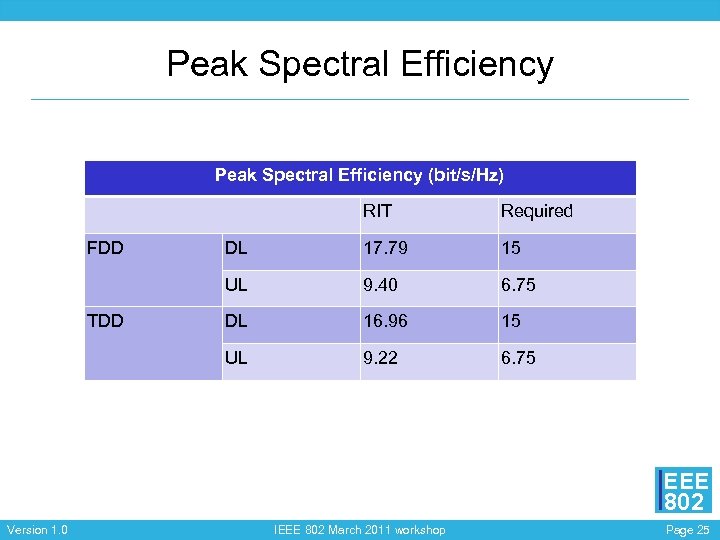 Peak Spectral Efficiency (bit/s/Hz) RIT 17. 79 15 9. 40 6. 75 DL 16. 96 15 UL TDD DL UL FDD Required 9. 22 6. 75 EEE 802 Version 1. 0 IEEE 802 March 2011 workshop Page 25
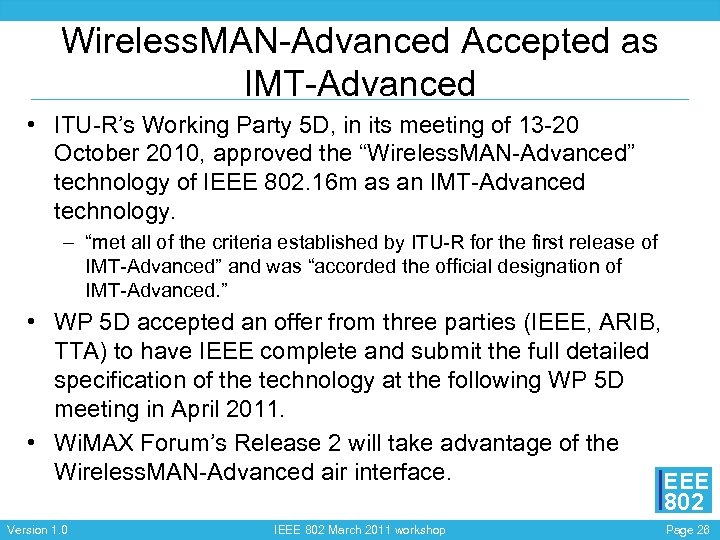 Wireless. MAN-Advanced Accepted as IMT-Advanced • ITU-R’s Working Party 5 D, in its meeting of 13 -20 October 2010, approved the “Wireless. MAN-Advanced” technology of IEEE 802. 16 m as an IMT-Advanced technology. – “met all of the criteria established by ITU-R for the first release of IMT-Advanced” and was “accorded the official designation of IMT-Advanced. ” • WP 5 D accepted an offer from three parties (IEEE, ARIB, TTA) to have IEEE complete and submit the full detailed specification of the technology at the following WP 5 D meeting in April 2011. • Wi. MAX Forum’s Release 2 will take advantage of the Wireless. MAN-Advanced air interface. EEE 802 Version 1. 0 IEEE 802 March 2011 workshop Page 26
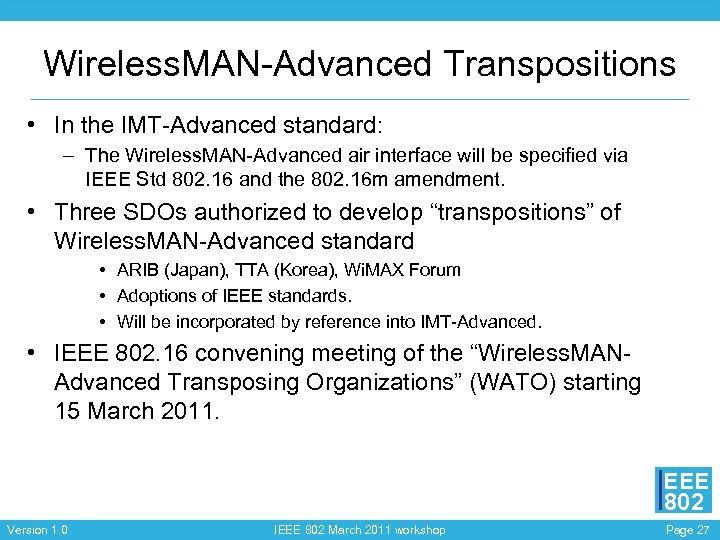 Wireless. MAN-Advanced Transpositions • In the IMT-Advanced standard: – The Wireless. MAN-Advanced air interface will be specified via IEEE Std 802. 16 and the 802. 16 m amendment. • Three SDOs authorized to develop “transpositions” of Wireless. MAN-Advanced standard • ARIB (Japan), TTA (Korea), Wi. MAX Forum • Adoptions of IEEE standards. • Will be incorporated by reference into IMT-Advanced. • IEEE 802. 16 convening meeting of the “Wireless. MANAdvanced Transposing Organizations” (WATO) starting 15 March 2011. EEE 802 Version 1. 0 IEEE 802 March 2011 workshop Page 27
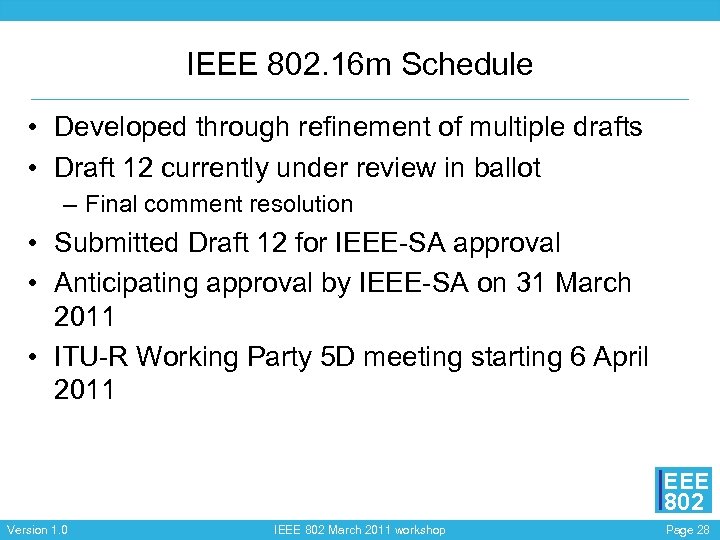 IEEE 802. 16 m Schedule • Developed through refinement of multiple drafts • Draft 12 currently under review in ballot – Final comment resolution • Submitted Draft 12 for IEEE-SA approval • Anticipating approval by IEEE-SA on 31 March 2011 • ITU-R Working Party 5 D meeting starting 6 April 2011 EEE 802 Version 1. 0 IEEE 802 March 2011 workshop Page 28
 IMT-Advanced Schedule • 2010 -10: approved two technologies for IMTAdvanced • 2011 -04: Review of detailed specifications of two technologies • 2011 -09: Transpositions due • 2011 -10: Final WP 5 D agreement on IMTAdvanced standard • 2011 -11: Final Study Group 5 agreement • 2012 -02: ITU-R approval at Radiocommunication Assembly Version 1. 0 IEEE 802 March 2011 workshop EEE 802 Page 29
 Is IMT-Advanced = 4 G? • No. • ITU-R acts through a formal process. • The development of IMT-Advanced was authorized by resolutions of the Radiocommunication Assembly • Resolutions ITU-R 56 and 57 (2007) specified the use of the unique name “IMT-Advanced” for systems beyond IMT-2000. – The term “ 4 G” is not used. EEE 802 Version 1. 0 IEEE 802 March 2011 workshop Page 30
 ITU Announcements on 4 G • On 21 Oct 2010, ITU announced that Wireless. MAN-Advanced and LTE-Advanced were “accorded the official designation of IMTAdvanced, ” suggesting also that “IMT-Advanced” is the “true 4 G. ” • On 6 Dec 2010, ITU revised its position on 4 G: – 4 G is “undefined”. – “IMT-Advanced is considered as ‘ 4 G’”. – “ 4 G may also be applied to” forerunner technologies, such as Wi. MAX EEE 802 Version 1. 0 IEEE 802 March 2011 workshop Page 31
 IEEE Project 802. 16 n: GRIDMAN • GRIDMAN: “Greater Reliability In Disrupted Metropolitan Area Networks” • IEEE Project 802. 16 n (Amendment: Higher Reliability Networks) authorized 2010 -06 -17 • increased robustness and alternate radio path establishment in degraded network conditions • direct communication between subscriber stations • mobile base stations and mobile relay stations • licensed, unlicensed and lightly licensed spectrum bands below 6 GHz • System Requirements Document completed Jan 2011 EEE 802 Version 1. 0 IEEE 802 March 2011 workshop Page 32
 IEEE Project 802. 16 p: M 2 M • IEEE Project 802. 16 p (Amendment: Enhancements to Support Machine-to-Machine Applications) authorized 2010 -09 -30 • lower power consumption at the device • significantly larger numbers of devices • efficient support for small burst transmissions • improved device authentication • System Requirements Document updated Jan 2011 EEE 802 Version 1. 0 IEEE 802 March 2011 workshop Page 33
 Tutorial • • • Title: IEEE 802. 16 in IMT-Advanced Date: 14 March 2011 Time: 21: 00 -22: 30 Location: Marina Bay Sands, Singapore Registration fee: None • http: //ieee 802. org/Tutorials. shtml EEE 802 Version 1. 0 IEEE 802 March 2011 workshop Page 34
 Resources • IEEE 802. 16 web site – http: //Wireless. MAN. org EEE 802 Version 1. 0 IEEE 802 March 2011 workshop Page 35