 Скачать презентацию IEEE 802 11 b Wireless LANs Carey Williamson
2e0748c76c9767eda0ea187766b6095b.ppt
- Количество слайдов: 17



IEEE 802. 11 b Wireless LANs Carey Williamson Department of Computer Science University of Calgary CPSC 641 Winter 2011
The Basics • In many respects, the IEEE 802. 11 b wireless LAN (WLAN) standard is similar to that for classic IEEE 802. 3 (Ethernet) LANs • Similarities: – – – LAN with limited geographic coverage multiple stations, with 48 -bit MAC addresses shared transmission medium (broadcast technology) CSMA-based Medium Access Control protocol comparable data rates (11 Mbps vs 10 Mbps) CPSC 641 Winter 2011 Copyright © 2005 Department of Computer Science 2
The Basics (Cont’d) • But there also many distinct differences: – – – – – wireless (air interface) versus wired (coax) wireless propagation environment (multipath) higher error rate due to interference, etc. successful frames are ACKed by receiver mobile stations versus fixed stations half-duplex versus full-duplex operation “hidden node” and “exposed node” problems potential asymmetries of links CSMA/CA versus CSMA/CD multiple data transmission rates (1, 2, 5. 5, 11) CPSC 641 Winter 2011 Copyright © 2005 Department of Computer Science 3
Some Wi. Fi Features • Infrastructure mode vs “ad hoc” mode • Access Point (AP) sends “beacon frames” – Mobiles choose AP based on signal strength • Multiple channel access protocols supported – CSMA/CA (DCF); PCF; RTS/CTS • MAC-layer can provide error control, retransmission, rate adaptation, etc. • Direct Sequence Spread Spectrum (DSSS) – signal spread across 14 22 -MHz channels CPSC 641 Winter 2011 Copyright © 2005 Department of Computer Science 4
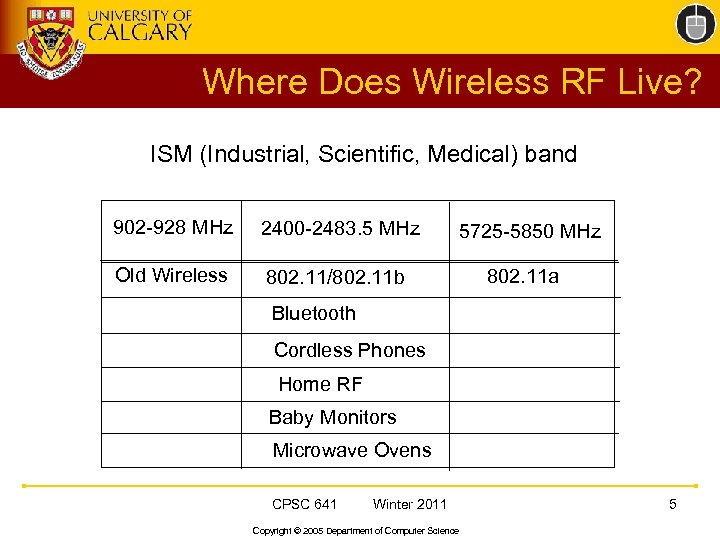
Where Does Wireless RF Live? ISM (Industrial, Scientific, Medical) band 902 -928 MHz 2400 -2483. 5 MHz Old Wireless 802. 11/802. 11 b 5725 -5850 MHz 802. 11 a Bluetooth Cordless Phones Home RF Baby Monitors Microwave Ovens CPSC 641 Winter 2011 Copyright © 2005 Department of Computer Science 5
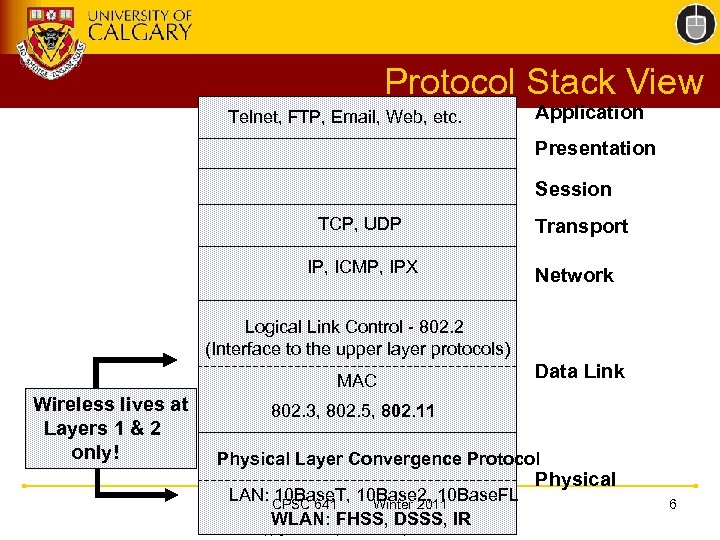
Protocol Stack View Telnet, FTP, Email, Web, etc. Application Presentation Session TCP, UDP IP, ICMP, IPX Transport Network Logical Link Control - 802. 2 (Interface to the upper layer protocols) MAC Wireless lives at Layers 1 & 2 only! Data Link 802. 3, 802. 5, 802. 11 Physical Layer Convergence Protocol LAN: CPSC 641 10 Base 2, 10 Base. FL 10 Base. T, Winter 2011 WLAN: FHSS, DSSS, IR Copyright © 2005 Department of Computer Science Physical 6
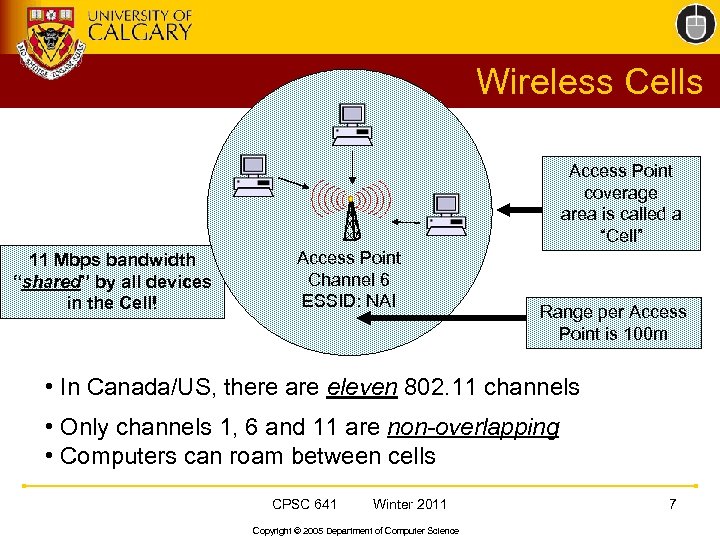
Wireless Cells Access Point coverage area is called a “Cell” 11 Mbps bandwidth “shared” by all devices in the Cell! Access Point Channel 6 ESSID: NAI Range per Access Point is 100 m • In Canada/US, there are eleven 802. 11 channels • Only channels 1, 6 and 11 are non-overlapping • Computers can roam between cells CPSC 641 Winter 2011 Copyright © 2005 Department of Computer Science 7
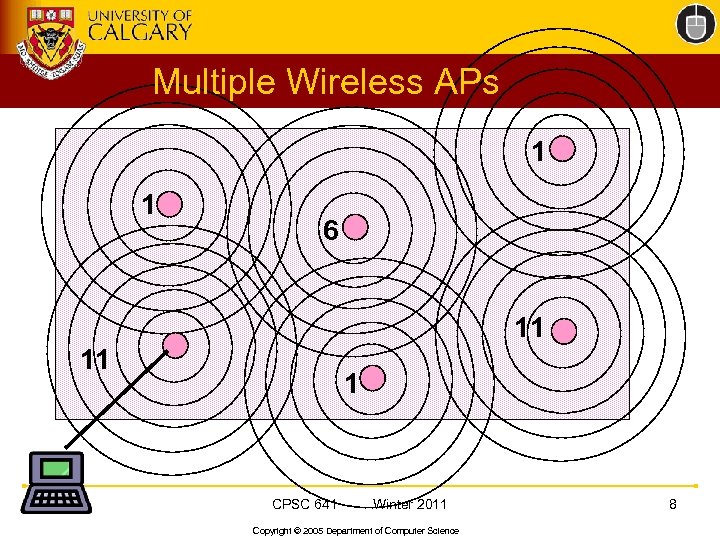
Multiple Wireless APs 1 1 6 11 11 1 CPSC 641 Winter 2011 Copyright © 2005 Department of Computer Science 8
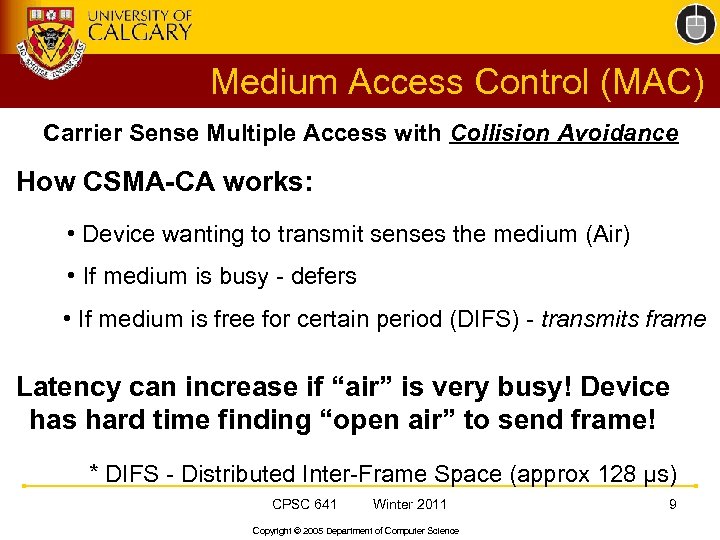
Medium Access Control (MAC) Carrier Sense Multiple Access with Collision Avoidance How CSMA-CA works: • Device wanting to transmit senses the medium (Air) • If medium is busy - defers • If medium is free for certain period (DIFS) - transmits frame Latency can increase if “air” is very busy! Device has hard time finding “open air” to send frame! * DIFS - Distributed Inter-Frame Space (approx 128 µs) CPSC 641 Winter 2011 Copyright © 2005 Department of Computer Science 9
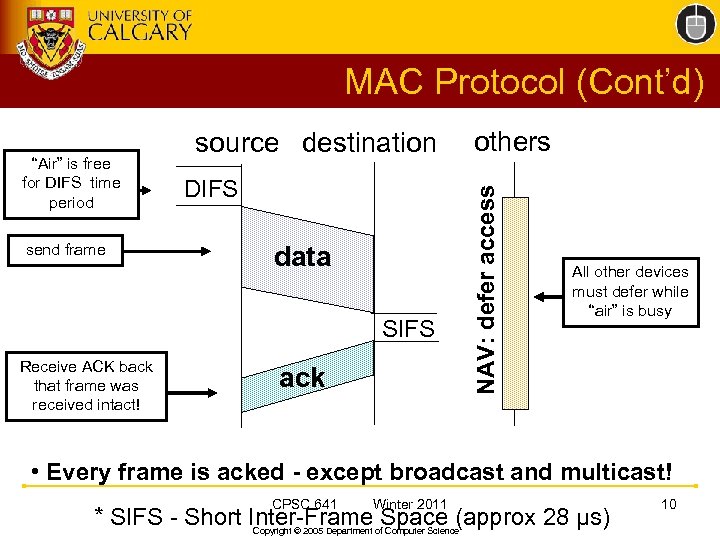
MAC Protocol (Cont’d) send frame DIFS data SIFS Receive ACK back that frame was received intact! ack others NAV: defer access “Air” is free for DIFS time period source destination All other devices must defer while “air” is busy • Every frame is acked - except broadcast and multicast! CPSC 641 Winter 2011 * SIFS - Short Inter-Frame Space (approx 28 µs) Copyright © 2005 Department of Computer Science 10
MAC-Layer Retransmission • If no ACK received “right away”, then the sender retransmits the frame again at the MAC layer – indicates frame (or ACK) was lost/corrupted – very short timeout (e. g. , 1 msec) – exponential backoff (doubling) if repeated loss • Typically recovers before TCP would notice • Max retransmission limit (e. g. , 8) • May do MAC-layer rate adaptation or frame fragmentation if channel error rate is high CPSC 641 Winter 2011 Copyright © 2005 Department of Computer Science 11
Other MAC Protocols Supported • Point Coordination Function (PCF) – AP polls stations in turn to see if frames to send – useful for real-time traffic • Request-To-Send/Clear-To-Send (RTS/CTS) – – – reservation-based approach (ask permission) useful for very large frames useful for solving the “hidden node” problem request asks for clearance (permission) to send request also indicates time required for transmit CPSC 641 Winter 2011 Copyright © 2005 Department of Computer Science 12
Frame Formats • Two frame formats available: – long preamble – short preamble • Configuration option for NIC and AP • Variable-size frames (max 2312 data bytes) • 16 -bit Cyclic Redundancy Code (CRC) for error checking of frames CPSC 641 Winter 2011 Copyright © 2005 Department of Computer Science 13
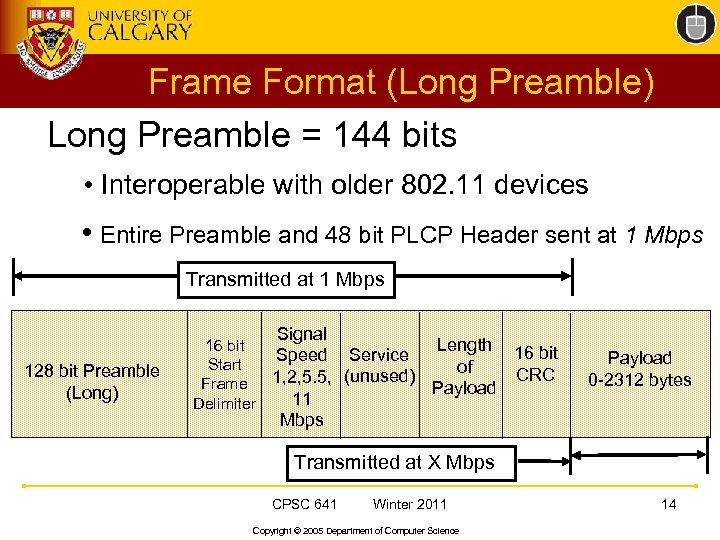
Frame Format (Long Preamble) Long Preamble = 144 bits • Interoperable with older 802. 11 devices • Entire Preamble and 48 bit PLCP Header sent at 1 Mbps Transmitted at 1 Mbps Signal 128 bit Preamble (Long) 16 bit Speed Service Start 1, 2, 5. 5, (unused) Frame 11 Delimiter Length 16 bit of CRC Payload 0 -2312 bytes Mbps Transmitted at X Mbps CPSC 641 Winter 2011 Copyright © 2005 Department of Computer Science 14
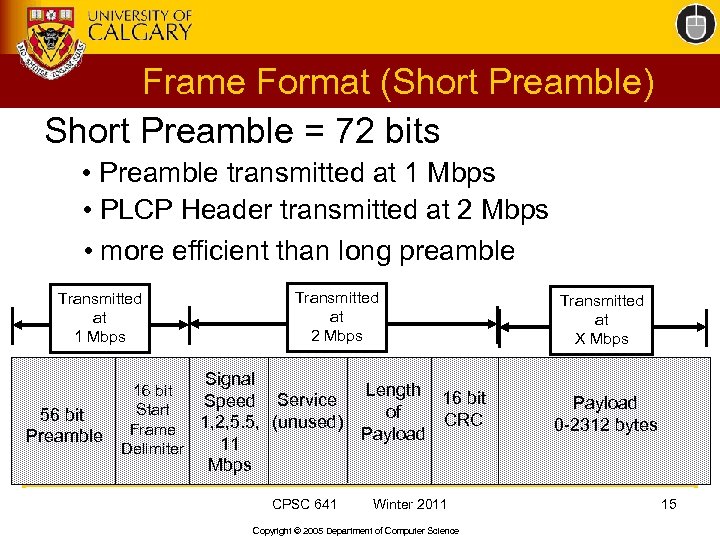
Frame Format (Short Preamble) Short Preamble = 72 bits • Preamble transmitted at 1 Mbps • PLCP Header transmitted at 2 Mbps • more efficient than long preamble Transmitted at 2 Mbps Transmitted at 1 Mbps Signal 56 bit Preamble 16 bit Speed Service Start 1, 2, 5. 5, (unused) Frame 11 Delimiter Length 16 bit of CRC Payload Transmitted at X Mbps Payload 0 -2312 bytes Mbps CPSC 641 Winter 2011 Copyright © 2005 Department of Computer Science 15
Even More Features • Power Management – mobile nodes can “sleep” to save power – AP will buffer frames until client requests them – AP can use virtual bitmap field in beacons to indicate which stations have data waiting • Security – Wired Equivalent Privacy (WEP) – not very secure at all! CPSC 641 Winter 2011 Copyright © 2005 Department of Computer Science 16
Summary • IEEE 802. 11 b (Wi. Fi) is a wireless LAN technology that is rapidly growing in popularity • Convenient, inexpensive, easy to use • Growing number of “hot spots” everywhere – airports, hotels, bookstores, Starbucks, etc • Estimates: 70% of WLANs are insecure! CPSC 641 Winter 2011 Copyright © 2005 Department of Computer Science 17
Скачать презентацию IEEE 802 11 b Wireless LANs Carey Williamson
2e0748c76c9767eda0ea187766b6095b.ppt