


 Скачать презентацию IEA Annex 59 Low temperature heating high
31f020501244db8a95f318566ea37160.ppt
- Количество слайдов: 53
 IEA Annex 59 Low temperature heating & high temperature cooling Reducing cooling energy by system innovation Yi Jiang Operating agency of EBC Annex 59 Building energy Research center Tsinghua University
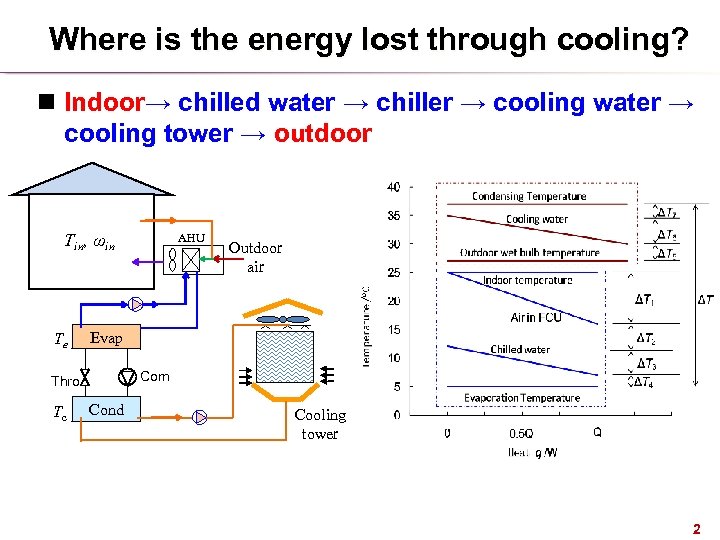 Where is the energy lost through cooling? n Indoor→ chilled water → chiller → cooling water → cooling tower → outdoor Tin, ωin Te Outdoor air Evap Com Thro Tc AHU Cond Cooling tower 2
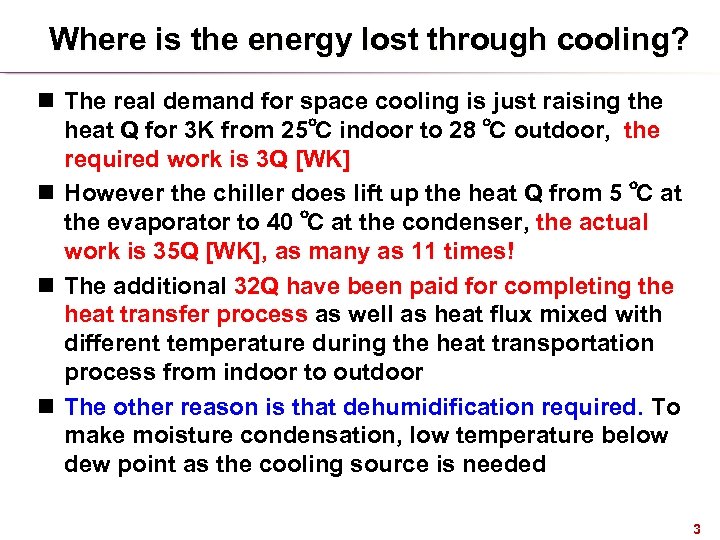 Where is the energy lost through cooling? n The real demand for space cooling is just raising the heat Q for 3 K from 25℃ indoor to 28 ℃ outdoor, the required work is 3 Q [WK] n However the chiller does lift up the heat Q from 5 ℃ at the evaporator to 40 ℃ at the condenser, the actual work is 35 Q [WK], as many as 11 times! n The additional 32 Q have been paid for completing the heat transfer process as well as heat flux mixed with different temperature during the heat transportation process from indoor to outdoor n The other reason is that dehumidification required. To make moisture condensation, low temperature below dew point as the cooling source is needed 3
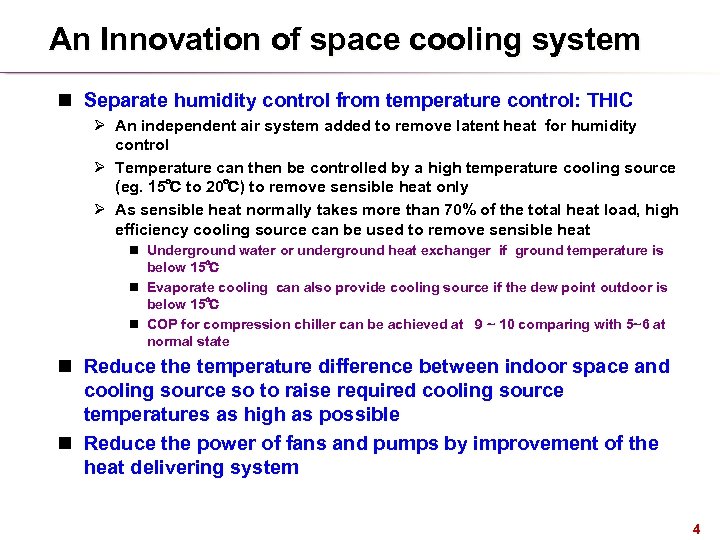 An Innovation of space cooling system n Separate humidity control from temperature control: THIC Ø An independent air system added to remove latent heat for humidity control Ø Temperature can then be controlled by a high temperature cooling source (eg. 15℃ to 20℃) to remove sensible heat only Ø As sensible heat normally takes more than 70% of the total heat load, high efficiency cooling source can be used to remove sensible heat n Underground water or underground heat exchanger if ground temperature is below 15℃ n Evaporate cooling can also provide cooling source if the dew point outdoor is below 15℃ n COP for compression chiller can be achieved at 9 ~ 10 comparing with 5~6 at normal state n Reduce the temperature difference between indoor space and cooling source so to raise required cooling source temperatures as high as possible n Reduce the power of fans and pumps by improvement of the heat delivering system 4
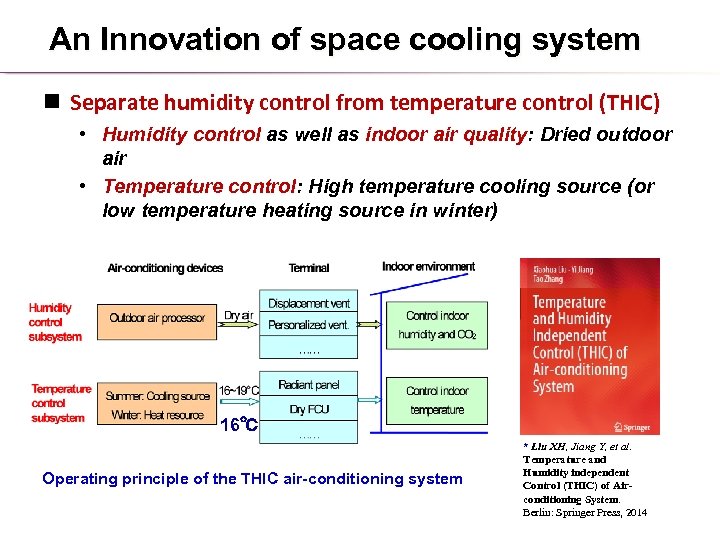 An Innovation of space cooling system n Separate humidity control from temperature control (THIC) • Humidity control as well as indoor air quality: Dried outdoor air • Temperature control: High temperature cooling source (or low temperature heating source in winter) 16℃ Operating principle of the THIC air-conditioning system * Liu XH, Jiang Y, et al. Temperature and Humidity independent Control (THIC) of Airconditioning System. Berlin: Springer Press, 2014 5
 Sensible heat removal for Temp. control n In more than 40% of cooling applications in the world the outdoor dew point is below 15℃. Moisture can be removed by air exchange with outdoor. Space cooling is just to remove sensible heat n To raise the cooling source temperature for high efficiency cooling, the key approach is to reduce the Δt during heat delivering process Ø Avoid the mixing loss of heat collection process at indoor terminals Ø Avoid Δt loss of heat exchange process Ø Avoid the mixing loss of heat fluxes with different temperature 6
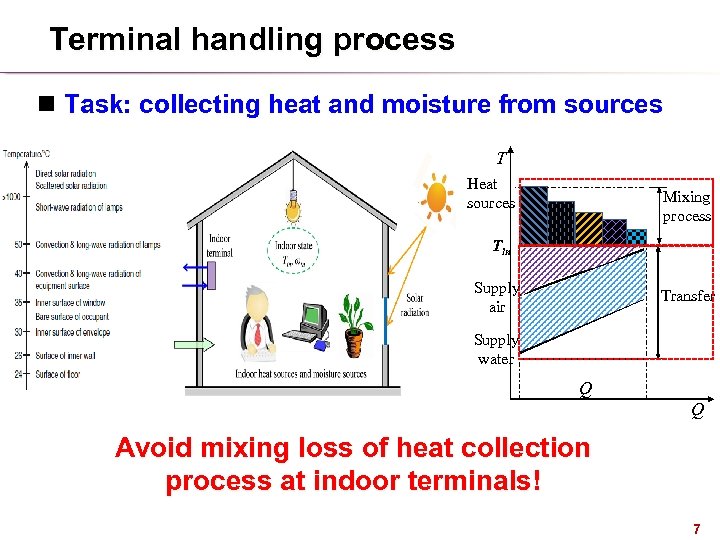 Terminal handling process n Task: collecting heat and moisture from sources T Heat sources Mixing process Tin Supply air Transfer Supply water Q Q Avoid mixing loss of heat collection process at indoor terminals! 7
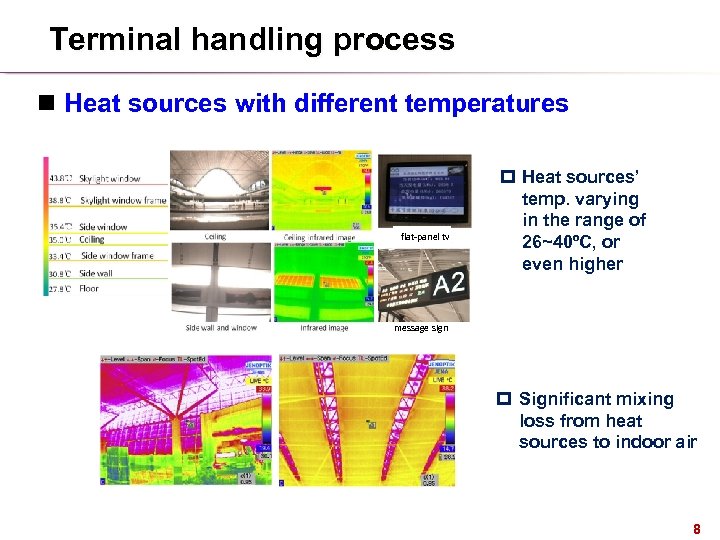 Terminal handling process n Heat sources with different temperatures flat-panel tv p Heat sources’ temp. varying in the range of 26~40ºC, or even higher message sign p Significant mixing loss from heat sources to indoor air 8
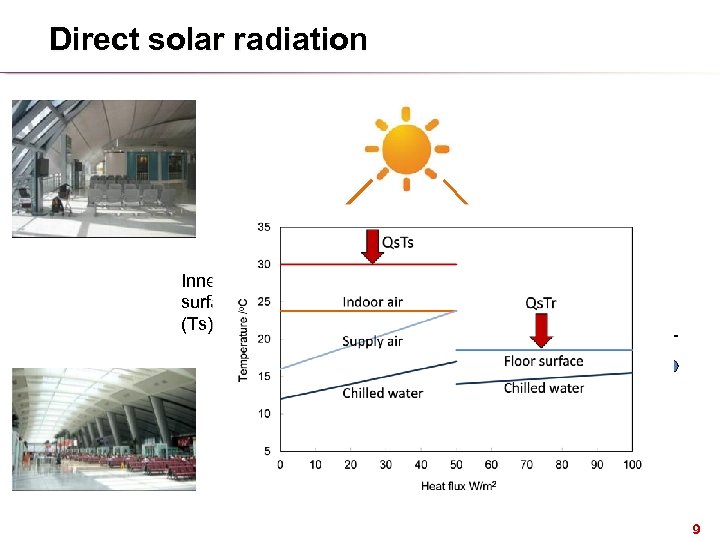 Direct solar radiation Inner surface (Ts) Qs. Tr Qs. Ts Indoor air (Ta) Radiant floor surface (Tr) 9
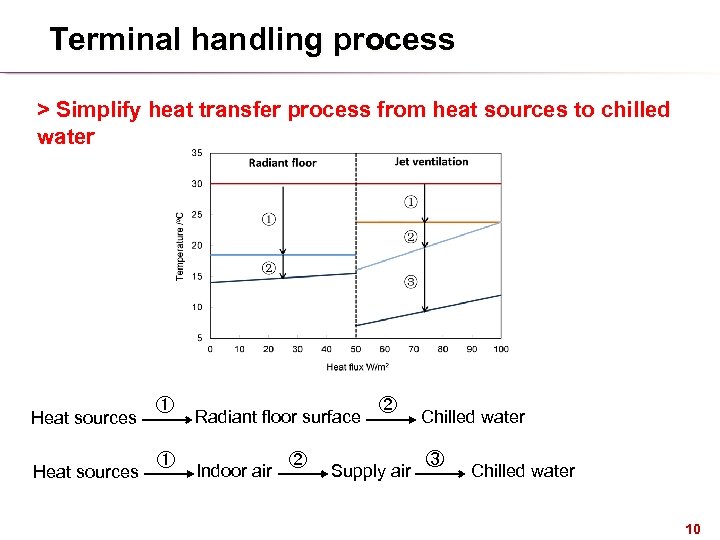 Terminal handling process > Simplify heat transfer process from heat sources to chilled water Heat sources ① ① Radiant floor surface Indoor air ② ② Supply air Chilled water ③ Chilled water 10
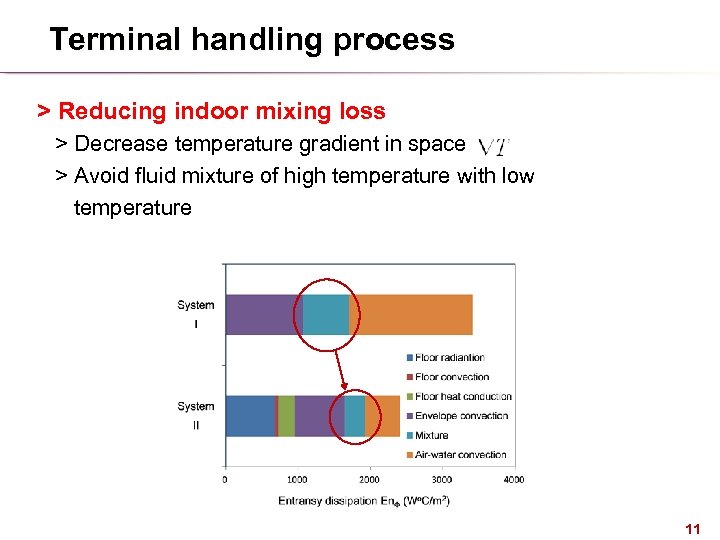 Terminal handling process > Reducing indoor mixing loss > Decrease temperature gradient in space > Avoid fluid mixture of high temperature with low temperature 11
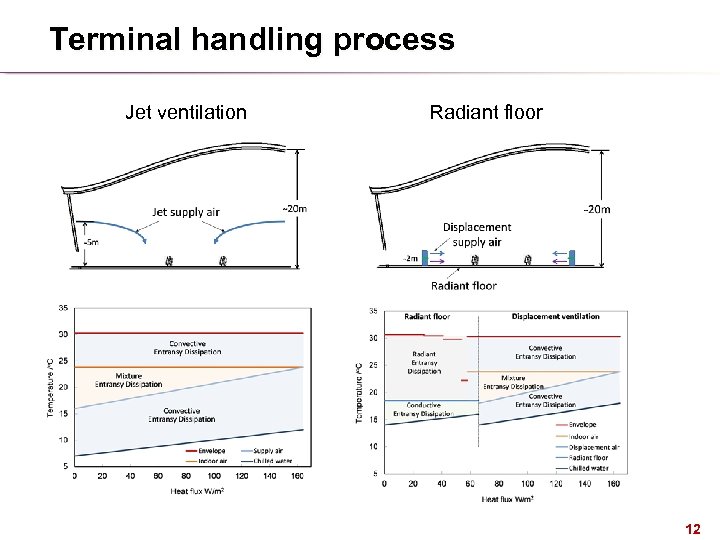 Terminal handling process Jet ventilation Radiant floor 12
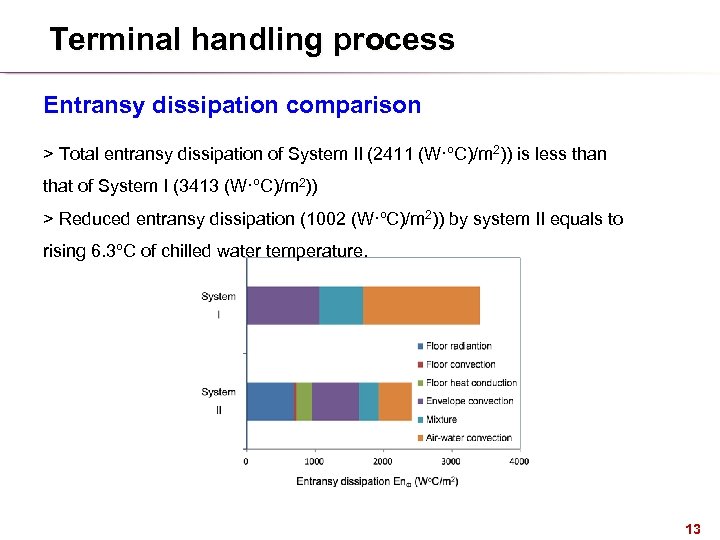 Terminal handling process Entransy dissipation comparison > Total entransy dissipation of System II (2411 (W·ºC)/m 2)) is less than that of System I (3413 (W·ºC)/m 2)) > Reduced entransy dissipation (1002 (W·ºC)/m 2)) by system II equals to rising 6. 3ºC of chilled water temperature. 13
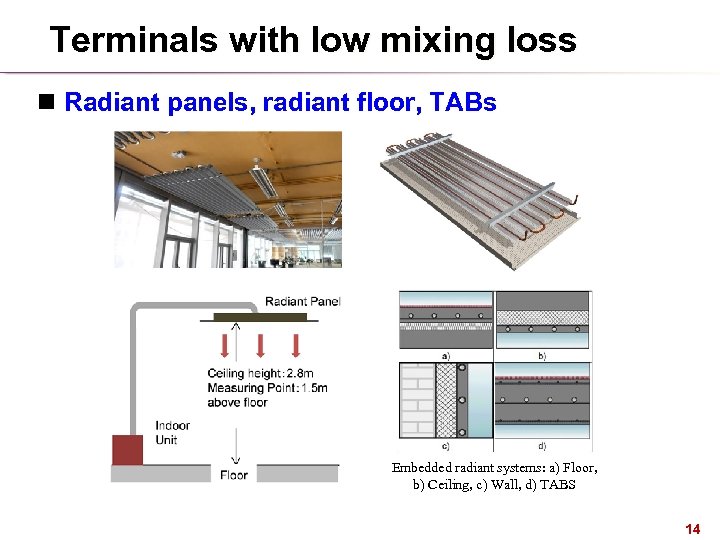 Terminals with low mixing loss n Radiant panels, radiant floor, TABs Embedded radiant systems: a) Floor, b) Ceiling, c) Wall, d) TABS 14
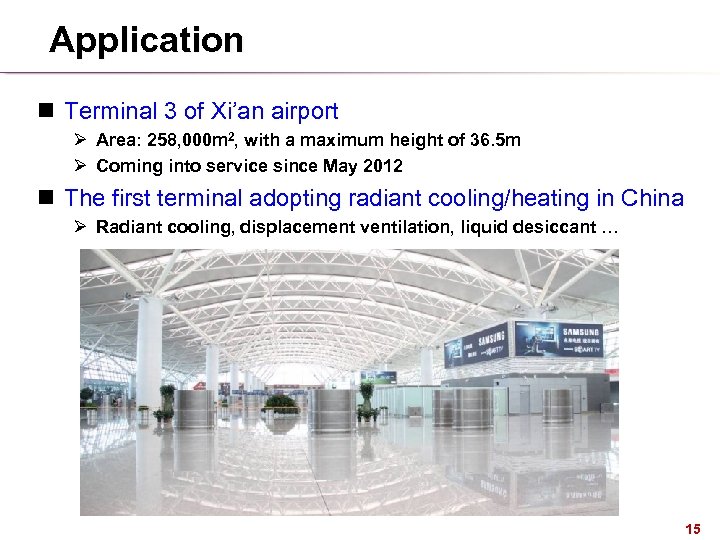 Application n Terminal 3 of Xi’an airport Ø Area: 258, 000 m 2, with a maximum height of 36. 5 m Ø Coming into service since May 2012 n The first terminal adopting radiant cooling/heating in China Ø Radiant cooling, displacement ventilation, liquid desiccant … 15
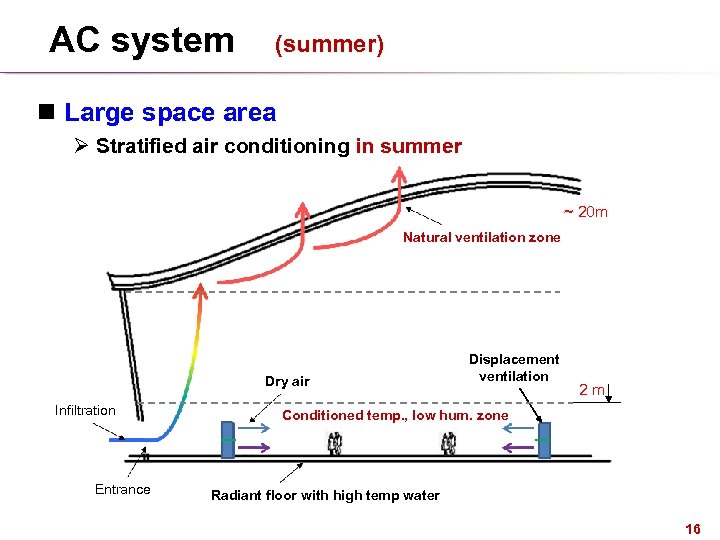 AC system (summer) n Large space area Ø Stratified air conditioning in summer ~ 20 m Natural ventilation zone Dry air Infiltration Entrance Displacement ventilation 2 m Conditioned temp. , low hum. zone Radiant floor with high temp water 16
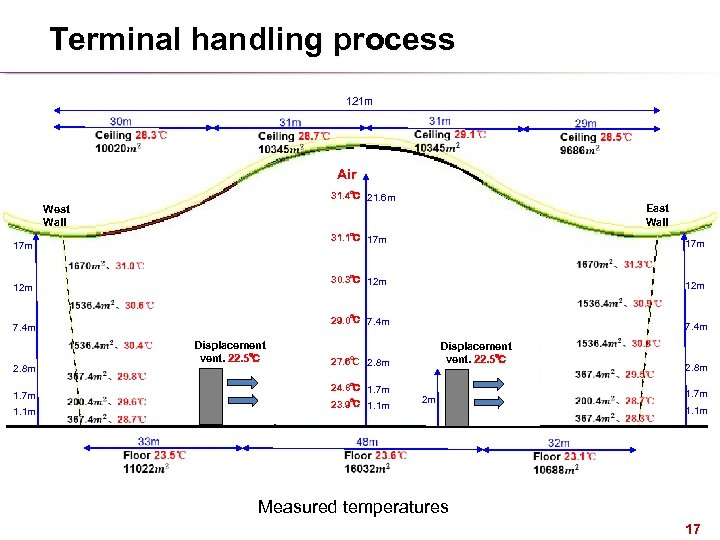 Terminal handling process 121 m Air 31. 4℃ 21. 6 m East Wall West Wall 31. 1℃ 17 m Displacement vent. 22. 5℃ 1. 1 m 12 m 29. 0℃ 7. 4 m 1. 7 m 30. 3℃ 12 m 2. 8 m 17 m 23. 9℃ 1. 1 m Displacement vent. 22. 5℃ 27. 6℃ 2. 8 m 24. 8℃ 1. 7 m 7. 4 m 2 m 2. 8 m 1. 7 m 1. 1 m Measured temperatures 17
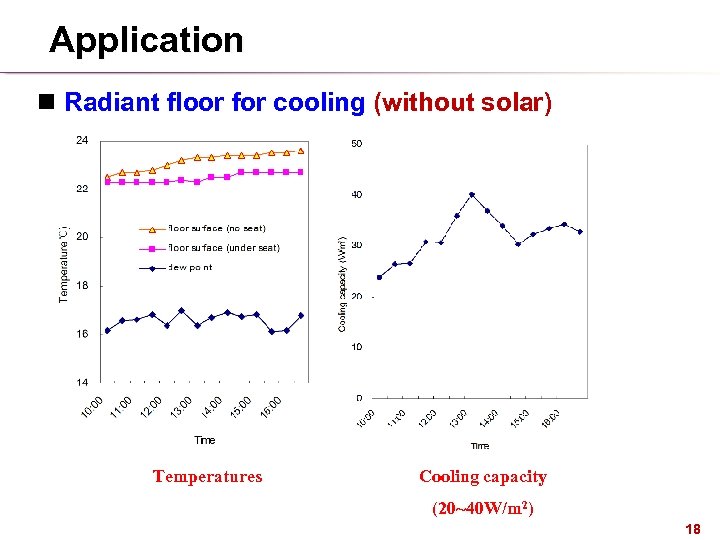 Application n Radiant floor for cooling (without solar) Temperatures Cooling capacity (20~40 W/m 2) 18
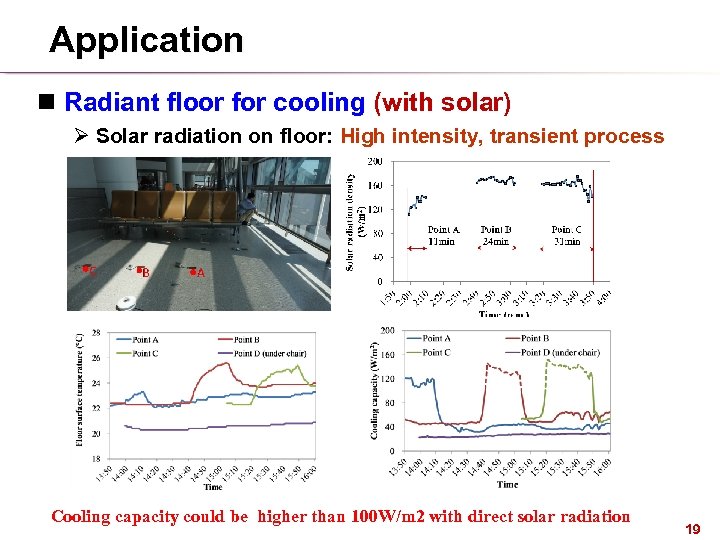 Application n Radiant floor for cooling (with solar) Ø Solar radiation on floor: High intensity, transient process Cooling capacity could be higher than 100 W/m 2 with direct solar radiation 19
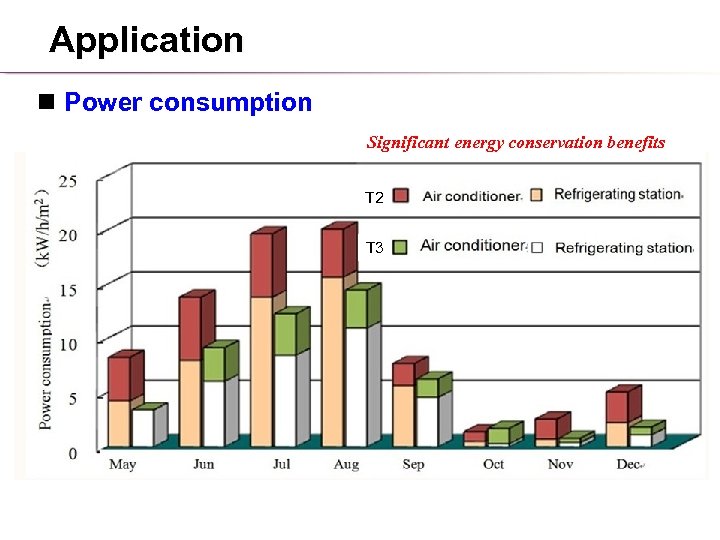 Application n Power consumption Significant energy conservation benefits T 2 T 3 T 2: 20
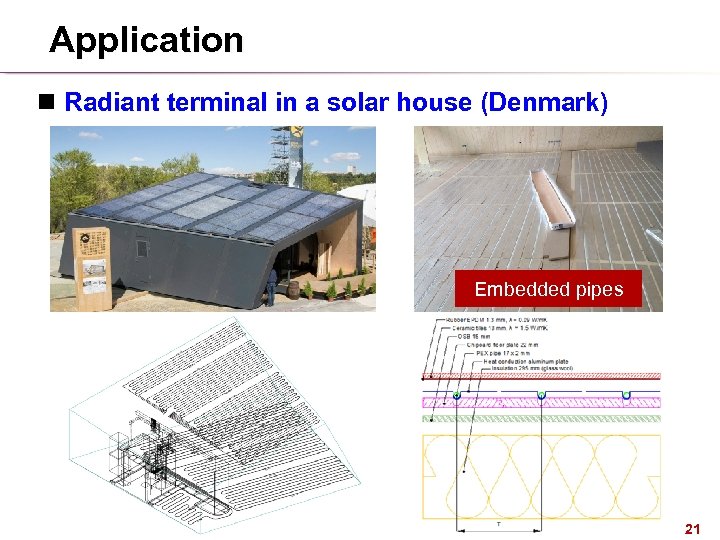 Application n Radiant terminal in a solar house (Denmark) Embedded pipes 21
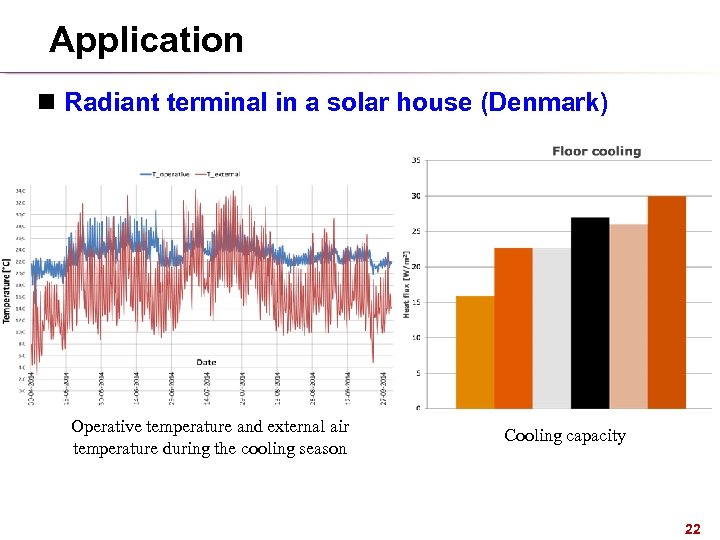 Application n Radiant terminal in a solar house (Denmark) Operative temperature and external air temperature during the cooling season Cooling capacity 22
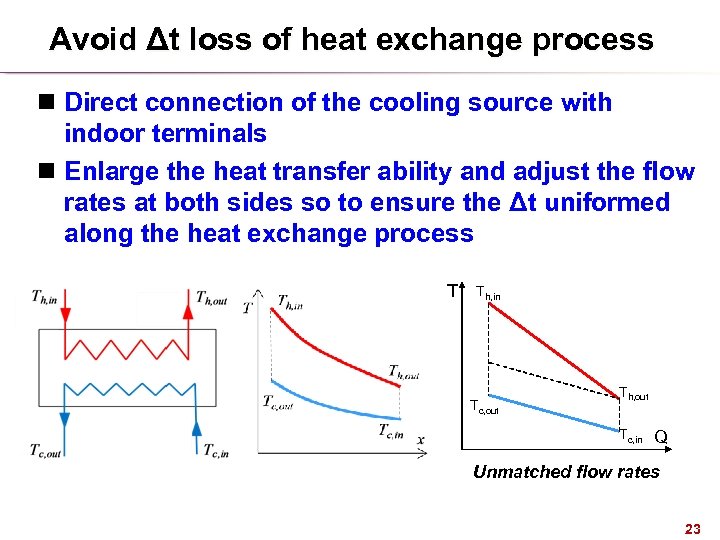 Avoid Δt loss of heat exchange process n Direct connection of the cooling source with indoor terminals n Enlarge the heat transfer ability and adjust the flow rates at both sides so to ensure the Δt uniformed along the heat exchange process T Th, in Tc, out Th, out Tc, in Q Unmatched flow rates 23
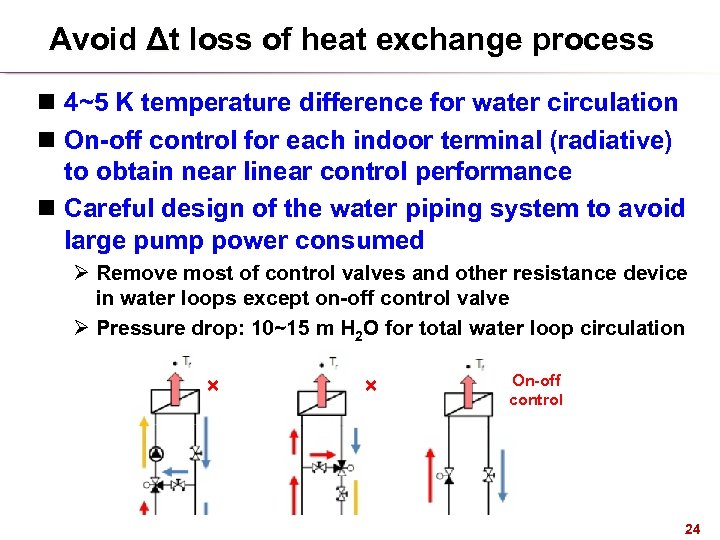 Avoid Δt loss of heat exchange process n 4~5 K temperature difference for water circulation n On-off control for each indoor terminal (radiative) to obtain near linear control performance n Careful design of the water piping system to avoid large pump power consumed Ø Remove most of control valves and other resistance device in water loops except on-off control valve Ø Pressure drop: 10~15 m H 2 O for total water loop circulation × × On-off control 24
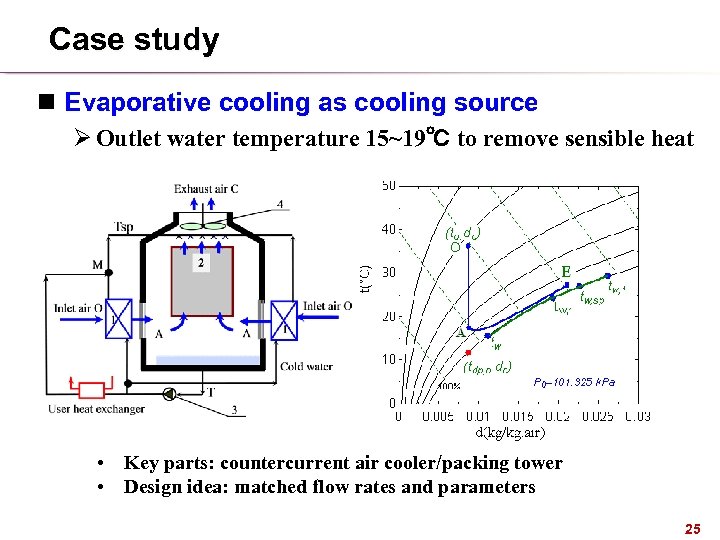 Case study n Evaporative cooling as cooling source Ø Outlet water temperature 15~19℃ to remove sensible heat • Key parts: countercurrent air cooler/packing tower • Design idea: matched flow rates and parameters 25
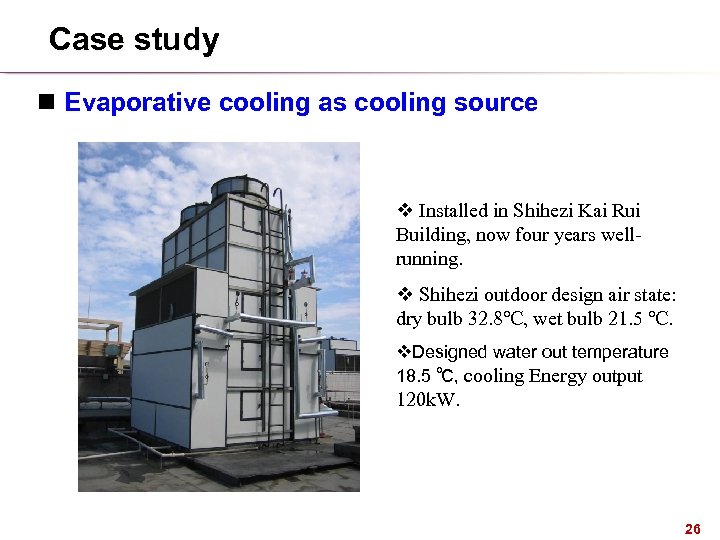 Case study n Evaporative cooling as cooling source v Installed in Shihezi Kai Rui Building, now four years wellrunning. v Shihezi outdoor design air state: dry bulb 32. 8℃, wet bulb 21. 5 ℃. v. Designed water out temperature 18. 5 ℃, cooling Energy output 120 k. W. 26
 Case study n Evaporative cooling as cooling source l Out water Temperature lower than inlet Wet Bulb Temperature. l Tested COP (sensible heat removed/power of fan and pump) higher than 10. 27
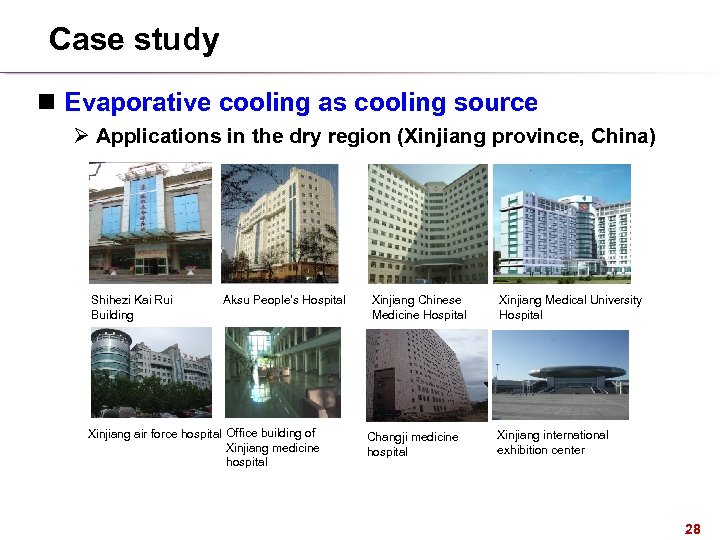 Case study n Evaporative cooling as cooling source Ø Applications in the dry region (Xinjiang province, China) Shihezi Kai Rui Building Aksu People’s Hospital Xinjiang air force hospital Office building of Xinjiang medicine hospital Xinjiang Chinese Medicine Hospital Changji medicine hospital Xinjiang Medical University Hospital Xinjiang international exhibition center 28
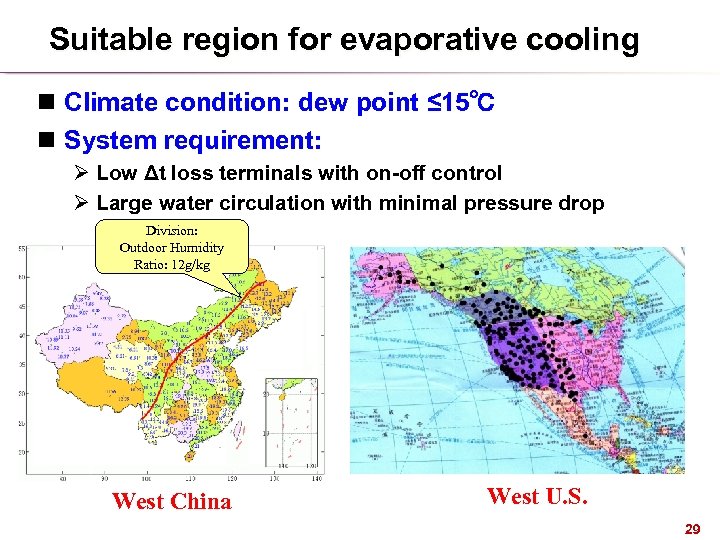 Suitable region for evaporative cooling n Climate condition: dew point ≤ 15℃ n System requirement: Ø Low Δt loss terminals with on-off control Ø Large water circulation with minimal pressure drop Division: Outdoor Humidity Ratio: 12 g/kg West China West U. S. 29
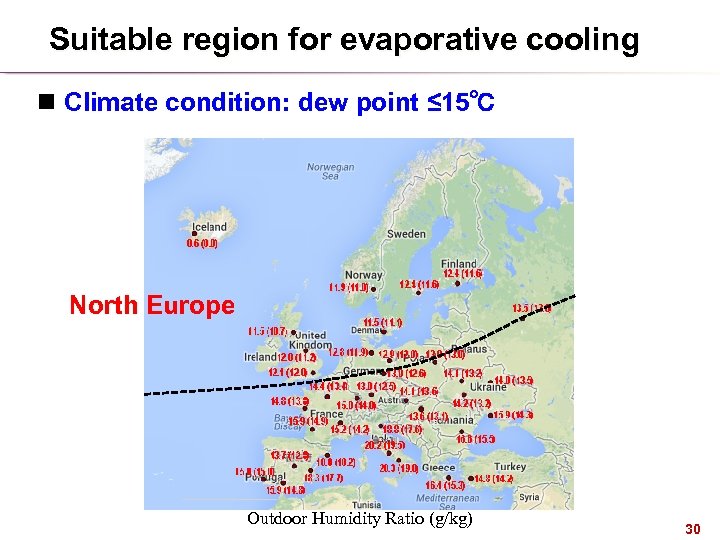 Suitable region for evaporative cooling n Climate condition: dew point ≤ 15℃ North Europe Outdoor Humidity Ratio (g/kg) 30
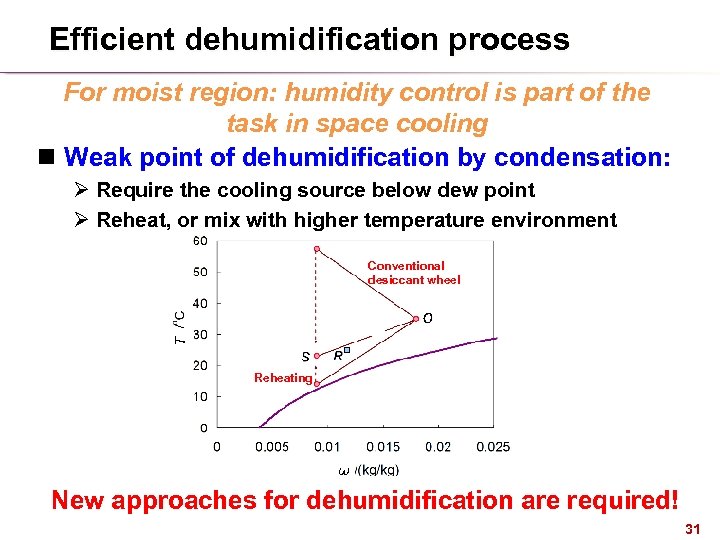 Efficient dehumidification process For moist region: humidity control is part of the task in space cooling n Weak point of dehumidification by condensation: Ø Require the cooling source below dew point Ø Reheat, or mix with higher temperature environment T Conventional desiccant wheel Reheating ω New approaches for dehumidification are required! 31
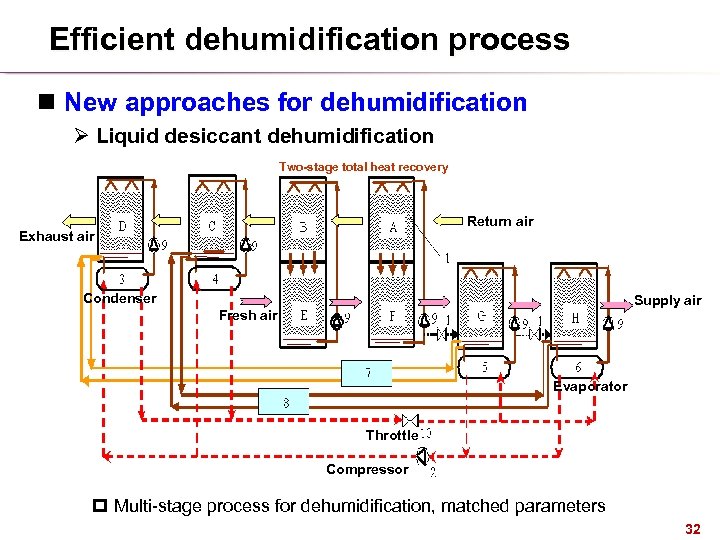 Efficient dehumidification process n New approaches for dehumidification Ø Liquid desiccant dehumidification Two-stage total heat recovery Return air Exhaust air Condenser Supply air Fresh air Evaporator Throttle Compressor p Multi-stage process for dehumidification, matched parameters 32
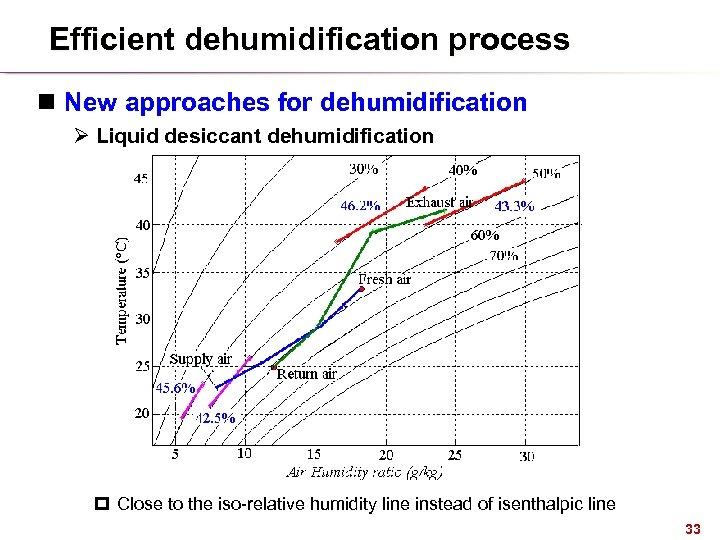 Efficient dehumidification process n New approaches for dehumidification Ø Liquid desiccant dehumidification p Close to the iso-relative humidity line instead of isenthalpic line 33
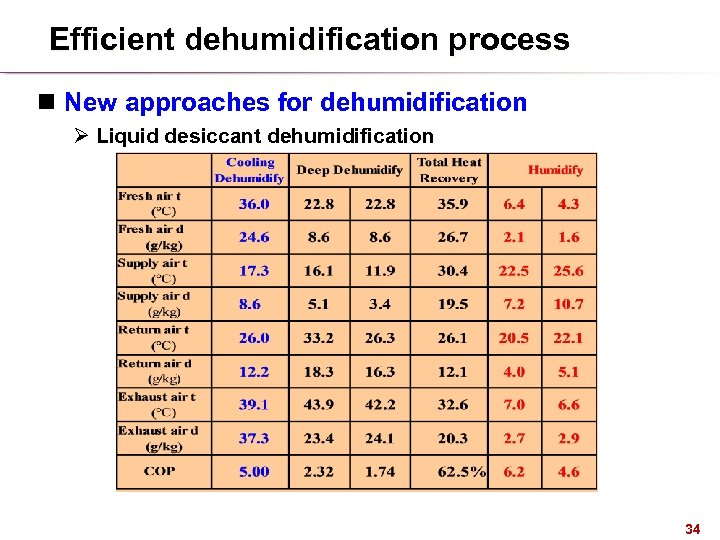 Efficient dehumidification process n New approaches for dehumidification Ø Liquid desiccant dehumidification 34
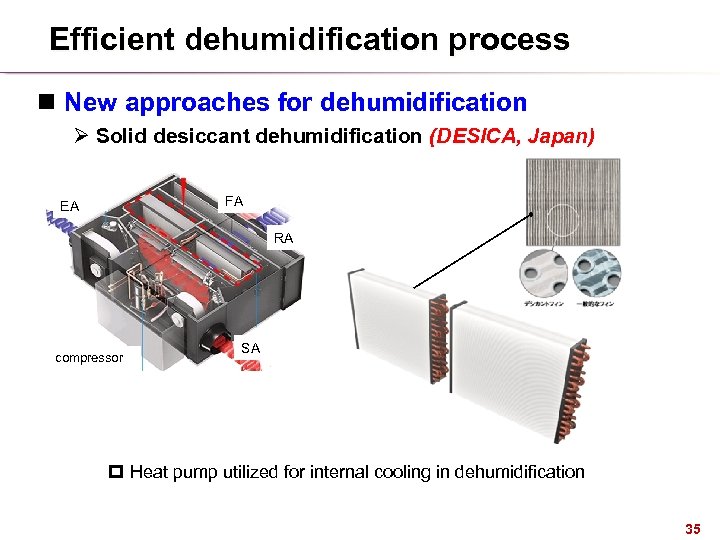 Efficient dehumidification process n New approaches for dehumidification Ø Solid desiccant dehumidification (DESICA, Japan) FA EA RA compressor SA p Heat pump utilized for internal cooling in dehumidification 35
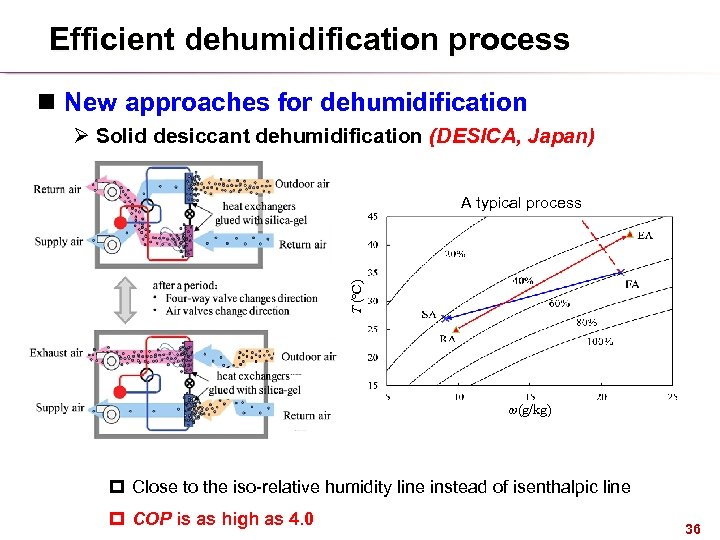 Efficient dehumidification process n New approaches for dehumidification Ø Solid desiccant dehumidification (DESICA, Japan) T (℃) A typical process ω(g/kg) p Close to the iso-relative humidity line instead of isenthalpic line p COP is as high as 4. 0 36
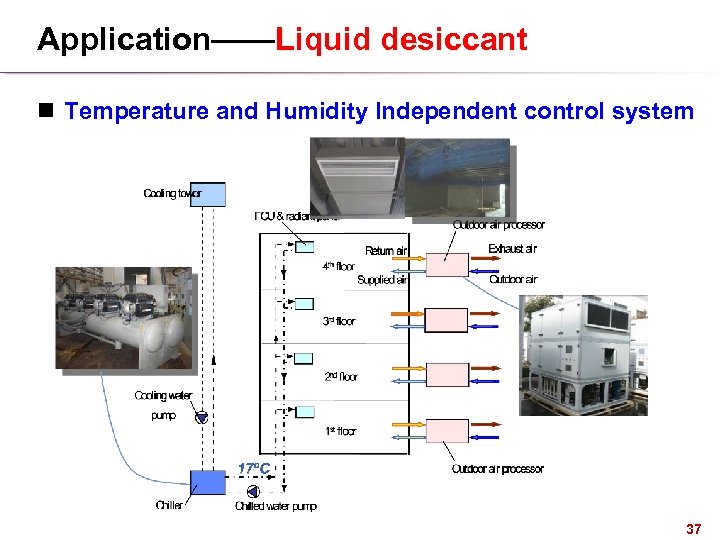 Application——Liquid desiccant n Temperature and Humidity Independent control system 37
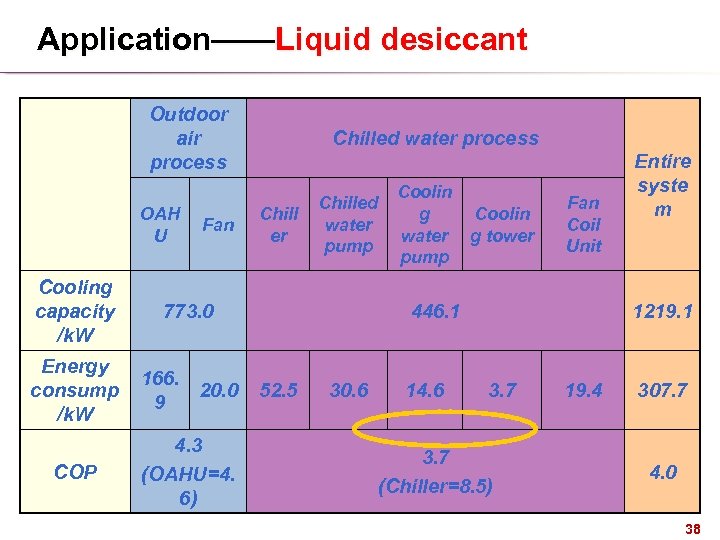 Application——Liquid desiccant Outdoor air process OAH U Fan Cooling capacity /k. W 166. 20. 0 9 COP 4. 3 (OAHU=4. 6) Chill er Chilled water pump 773. 0 Energy consump /k. W Chilled water process Coolin g Coolin water g tower pump Fan Coil Unit 446. 1 52. 5 30. 6 14. 6 Entire syste m 1219. 1 3. 7 (Chiller=8. 5) 19. 4 307. 7 4. 0 38
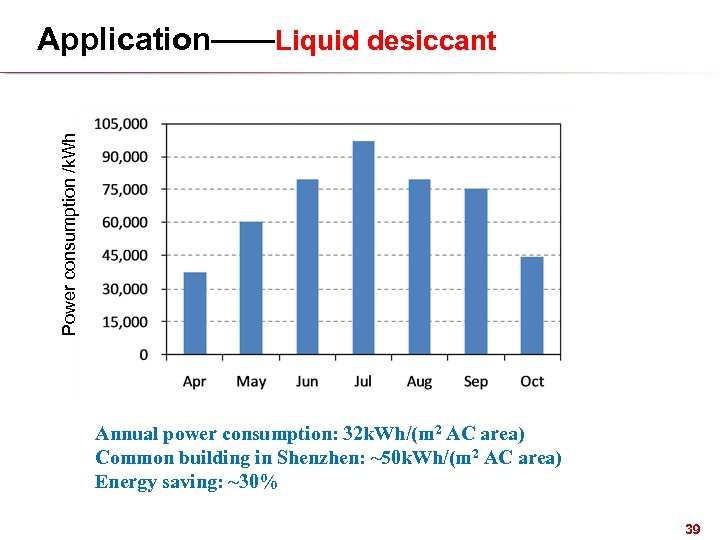 Power consumption /k. Wh Application——Liquid desiccant Annual power consumption: 32 k. Wh/(m 2 AC area) Common building in Shenzhen: ~50 k. Wh/(m 2 AC area) Energy saving: ~30% 39
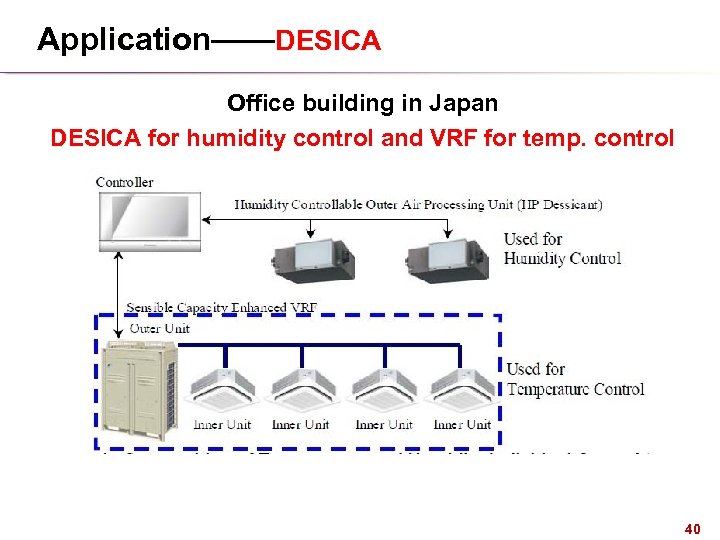 Application——DESICA Office building in Japan DESICA for humidity control and VRF for temp. control 40
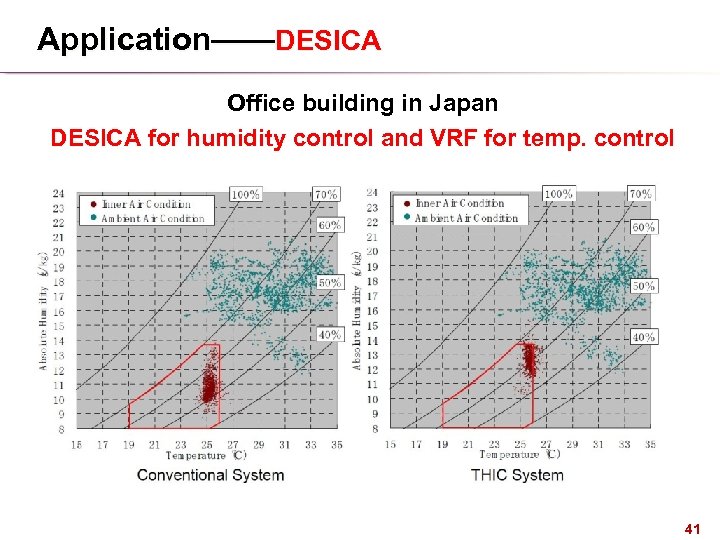 Application——DESICA Office building in Japan DESICA for humidity control and VRF for temp. control 41
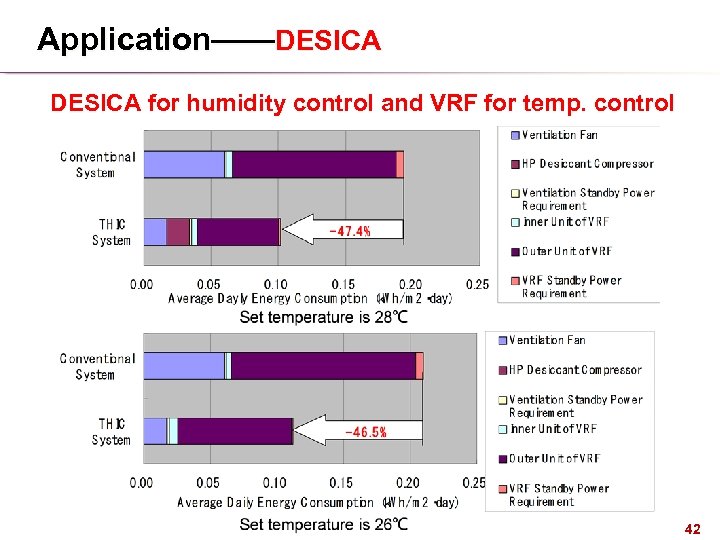 Application——DESICA for humidity control and VRF for temp. control 42
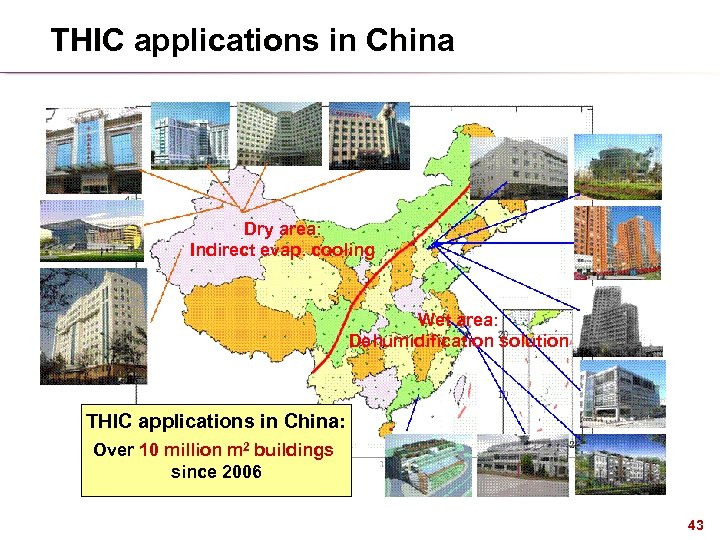 THIC applications in China Dry area: Indirect evap. cooling Wet area: Dehumidification solution THIC applications in China: Over 10 million m 2 buildings since 2006 43
 How much energy can be saved? n Office building in dry climate Ø Conventional system for cooling: electricity used 50 k. Wh/㎡, n Total cooling: 100 k. Wh/㎡, COP=2, fans: 17 k. Wh/㎡, pumps: 11 k. Wh/㎡, chiller: 22 k. Wh/㎡ Ø Evaporate cooling with the innovative system: electricity used 23 k. Wh/ ㎡, 54% saved n Total cooling 100 k. Wh/㎡, COP=5, fans: 8 k. Wh/㎡, pumps: 15 k. Wh/㎡ n Office building in moist region Ø Conventional HVAC system for cooling: electricity used 65 k. Wh/㎡ n Total cooling: 130 k. Wh/㎡,COP=2, fans: 22 k. Wh/㎡, pumps: 14 k. Wh/㎡, chiller: 29 k. Wh/㎡ Ø THIC system: electricity used 44 k. Wh/㎡, 32% saved n Total cooling: 130 k. Wh/㎡, dehumidifier with fan: 14 k. Wh/㎡, pumps: 15 k. Wh/㎡, chiller: 15 k. Wh/㎡ n Latent heat: 35 k. Wh/㎡,COPL=2. 5, sensible heat: 95 k. Wh/㎡,COPs=3. 2 44
 Conclusion n Huge potential saving in space cooling technology! n Dry regions, ~40% of current cooling applications Ø Direct/indirect evaporative cooling instead of mechanical chillers Ø System should be well designed both for indoor terminal and heat delivering to adapt “high temperature cooling” Ø More than 50% energy can be saved! n Moist regions: east China and US, Japan, south India Ø Humidity should be treated independently with temperature Ø Desiccant humidity control techniques should be applied for dehumidification Ø Sensible heat should be removed with high temperature cooling source Ø About 30% saving can be achieved! 45
 IEA EBC Annex 59 n High Temperature Cooling & Low Temperature Heating In Buildings (2012 -2016) 46
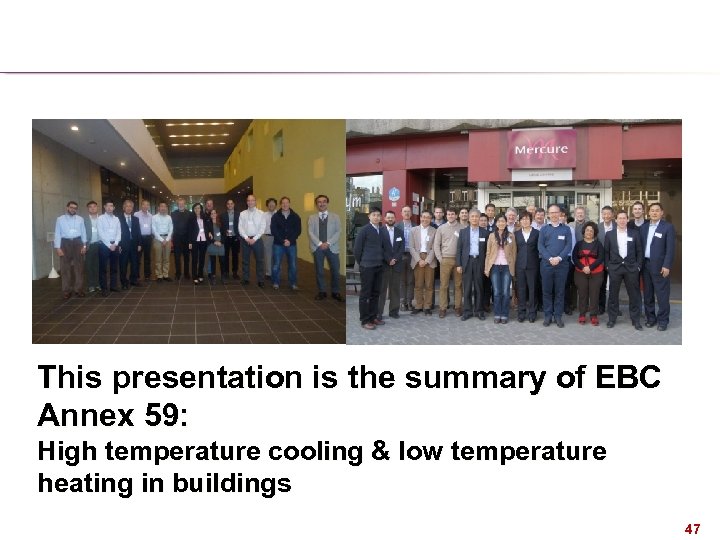 This presentation is the summary of EBC Annex 59: High temperature cooling & low temperature heating in buildings 47
 THANKS For more information: jiangyi@mail. tsinghua. edu. cn
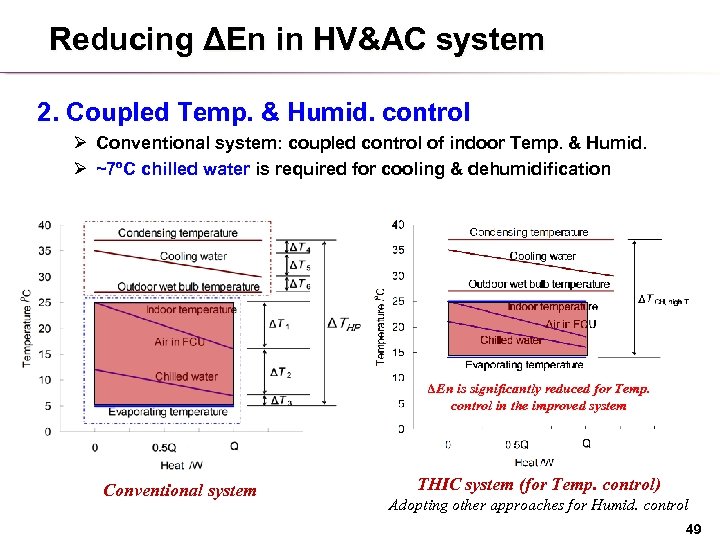 Reducing ΔEn in HV&AC system 2. Coupled Temp. & Humid. control Ø Conventional system: coupled control of indoor Temp. & Humid. Ø ~7ºC chilled water is required for cooling & dehumidification ΔEn is significantly reduced for Temp. control in the improved system Conventional system THIC system (for Temp. control) Adopting other approaches for Humid. control 49
 Application in buildings——Data center Return air CR un AC its Co ld a Ple isle nu m ly Supp air sle Hot ai Temperature Q Racks Conventional system Rack Tchip Tout Air flow Tin Treturn Tsupply HEX Tex Outdoor Environment Tcoldsource Q Entransy dissipation of rack cooling process Entransy dissipation of air mixing process Entransy dissipation of heat exchanging process Entransy dissipation of heat flow into outdoor environment Q Heat 50
 Application in buildings——Data center Internal cooled new system Temp ℃ Rack temp distribution Room temp 51
 Former CRAC Compressor power k. W Fan power k. W Server power k. W EER Indoor air temp ℃ Evaporative temp℃ Supply/ Return air temp℃ Rack inlet/exhaust air temp ℃ Outdoor air dry/wet bulb temp ℃ January 2 nd 16. 8 4. 5 58 2. 7 23. 5 8. 7 14/24 24/33 6 / 0. 2℃ May 7 th 18. 0 4. 2 56 2. 5 24. 6 8. 5 15/25 24/33 22 /13℃ August 10 th 21. 0 4. 6 58 2. 3 25. 0 8. 2 14/25 25/34 29 /19℃ Current distributed cooling Cooling tower k. W Chiller 1 power k. W Chiller 2 power k. W Pump power k. W Rack fan k. W Server power k. W January 2 nd 2. 2 0 0 2 2. 9 May 7 th 2. 2 7. 6 0 2 August 10 th 0 6. 4 6. 8 2 Former:rack exhaust T=indoor T +9℃ Current:rack exhaust T≈indoor T Indoor air Supply/Ret Rack EER temp ℃ urn water temp ℃ inlet/exhaust air temp℃ 58 8. 2 23. 5 9. 5/18 23. 8/24. 2 3. 1 58 4. 0 24. 6 12. 5/21 24. 9/25. 3 3. 1 59 3. 2 23. 0 9. 2/19 23. 2/23. 8 52
 Former CRAC Compressor power k. W Fan power k. W Server power k. W EER Indoor air temp ℃ Evaporative temp℃ Supply/ Return air temp℃ Rack inlet/exhaust air temp ℃ Outdoor air dry/wet bulb temp ℃ January 2 nd 16. 8 4. 5 58 2. 7 23. 5 8. 7 14/24 24/33 6 / 0. 2℃ May 7 th 18. 0 4. 2 56 2. 5 24. 6 8. 5 15/25 24/33 22 /13℃ August 10 th 21. 0 4. 6 58 2. 3 25. 0 8. 2 14/25 25/34 29 /19℃ EER:Increased from 2. 6 to 5. 7 PUE: Decreased from 1. 6 to 1. 35 Current distributed cooling Cooling tower k. W Chiller 1 power k. W Chiller 2 power k. W Pump power k. W Rack fan k. W Server power k. W EER Indoor air temp ℃ Supply/Ret urn water temp ℃ Rack inlet/exhaust air temp℃ January 2 nd 2. 2 0 0 2 2. 9 58 8. 2 23. 5 9. 5/18 23. 8/24. 2 May 7 th 2. 2 7. 6 0 2 3. 1 58 4. 0 24. 6 12. 5/21 24. 9/25. 3 August 10 th 0 6. 4 6. 8 2 3. 1 59 3. 2 23. 0 9. 2/19 23. 2/23. 8 53