


 Скачать презентацию IEA Advanced Fuel Cells Implementing Agreement IA U
693075c649c3a2925934f7ad940242ec.ppt
- Количество слайдов: 29
 IEA Advanced Fuel Cells Implementing Agreement (IA) U. S. Senate July 31, 2009 Dr. Mark C. Williams Visiting Professor, Fellow of the Electrochemical Society 1
 New Industrial Revolution • We will always have chemical energy from sunlight on this planet – Coal, petroleum and natural gas are stored chemical energy from the past – Methane from human, animal and plant residues and wastes captured from sunlight will be available for tomorrow • Fuel cells technology transforms electricity production in stationary and transportation applications because it is the most efficient way to convert chemical energy to electricity • Fuel cells are the enabler for all types of primary energy - coal, NG, biomass. When fuel cells are placed in systems converting the chemical energy of these primary energies to electricity, fuel cells make all the systems more efficient. 2
 IA Aims, scope & participation • The IA aims to advance knowledge in the field of (advanced) fuel cells. • Task shared R&D + information exchange • Covers technologies and applications for: – Polymer Fuel Cells (PEFC) – Solid Oxide Fuel Cells (SOFC) – Molten Carbonate Fuel Cells (MCFC) • 19 participating countries including USA, EU members, Japan 3
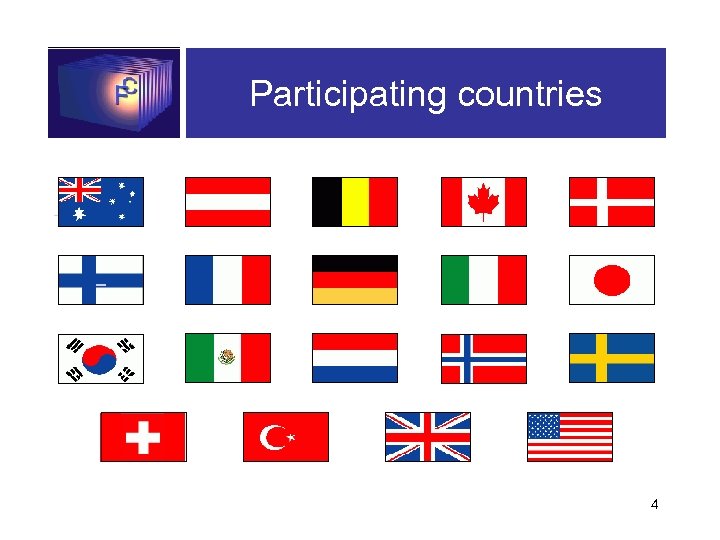 Participating countries 4
 Annexes List/Sponsor – 2008 • Annex XVI Polymer Electrolyte Fuel Cells (US DOE, Argonne National Laboratory) • Annex XVII Molten Carbonate Fuel Cells (KIST, Korea) • Annex XVIII Solid Oxide Fuel Cells (varies between the member countries – now Finland) • Annex XIX Fuel Cells for Stationary Applications (Eon, Sweden – SOFC, MCFC, PEFC) • Annex XX Fuel Cells for Transportation (ECN, Netherlands [1] PEFC and SOFC (APU)) • Annex XXI Fuel Cells for Portable Power (Forschungszentrum Jülich, Germany - PEFC) [1] Operating Agent for Annex XX was TU Berlin, Germany until November 2006 5
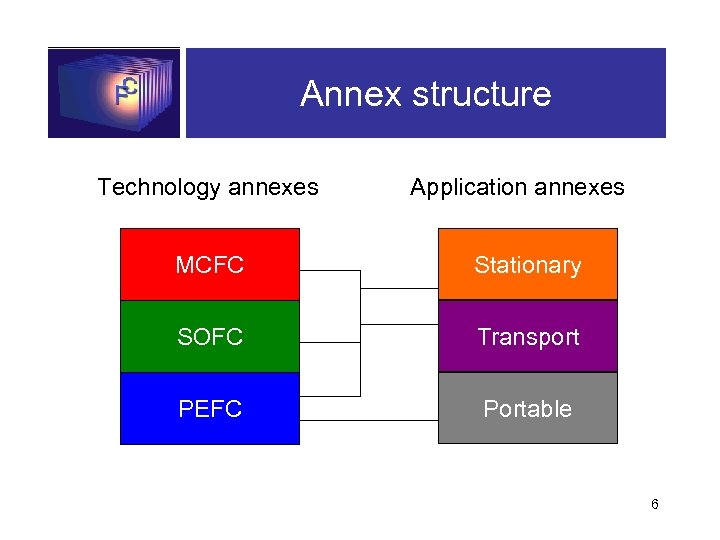 Annex structure Technology annexes Application annexes MCFC Stationary SOFC Transport PEFC Portable 6
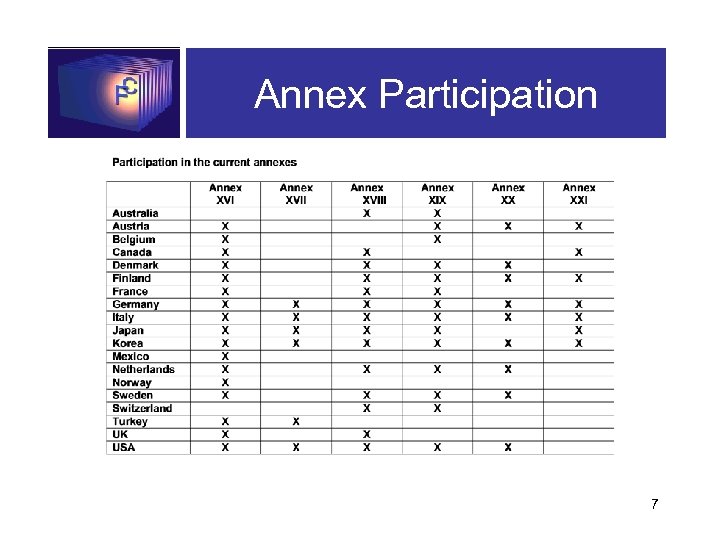 Annex Participation 7
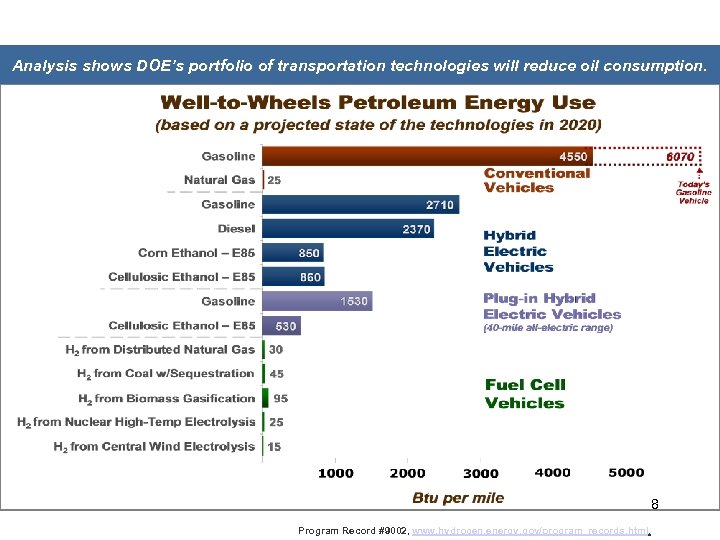 Systems Analysis — Petroleum Use Analysis shows DOE’s portfolio of transportation technologies will reduce oil consumption. 8 Program Record #9002, www. hydrogen. energy. gov/program_records. html.
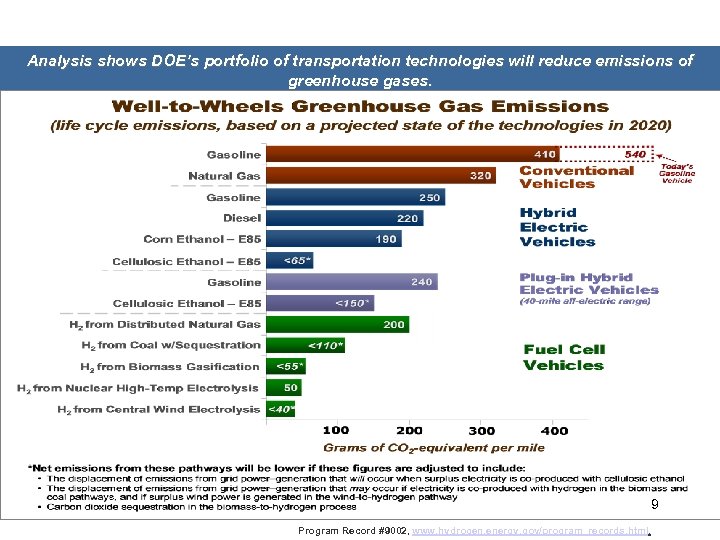 Systems Analysis — Greenhouse Gas Emissions Analysis shows DOE’s portfolio of transportation technologies will reduce emissions of greenhouse gases. 9 Program Record #9002, www. hydrogen. energy. gov/program_records. html.
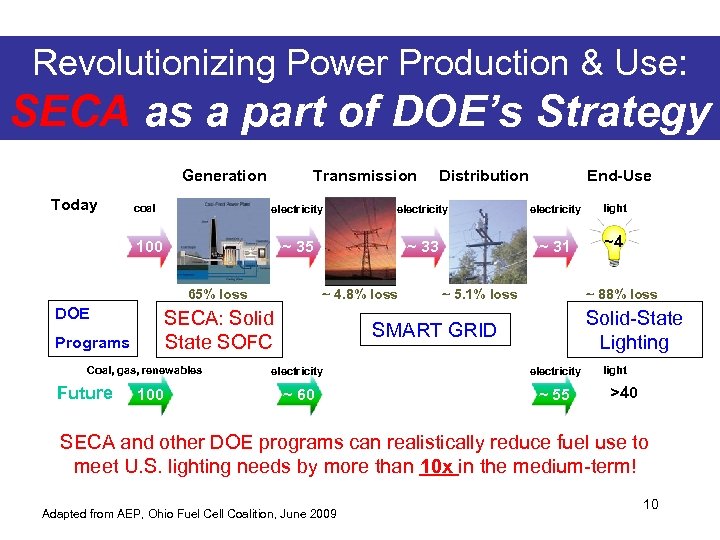 Revolutionizing Power Production & Use: SECA as a part of DOE’s Strategy Generation Today coal Transmission electricity light ~ 35 ~ 33 ~ 31 ~4 65% loss Coal, gas, renewables Future ~ 4. 8% loss SECA: Solid State SOFC Programs 100 End-Use electricity 100 DOE Distribution ~ 5. 1% loss ~ 88% loss Solid-State Lighting SMART GRID electricity ~ 60 ~ 55 light >40 SECA and other DOE programs can realistically reduce fuel use to meet U. S. lighting needs by more than 10 x in the medium-term! Adapted from AEP, Ohio Fuel Cell Coalition, June 2009 10
 Technical Achievements 2004 -2008 • Technology annexes: – Materials & process development – Stack development & testing – System modelling • Applications annexes: – Learning from demonstration projects – Market studies – Well to wheel studies 11
 USA Benefits Information exchange “One of Best forum for understanding world R&D status of fuel cell technology – pace and direction; discussion of difficulties and obstacles in fuel cell commercialization; Identification of markets for USA products. 12
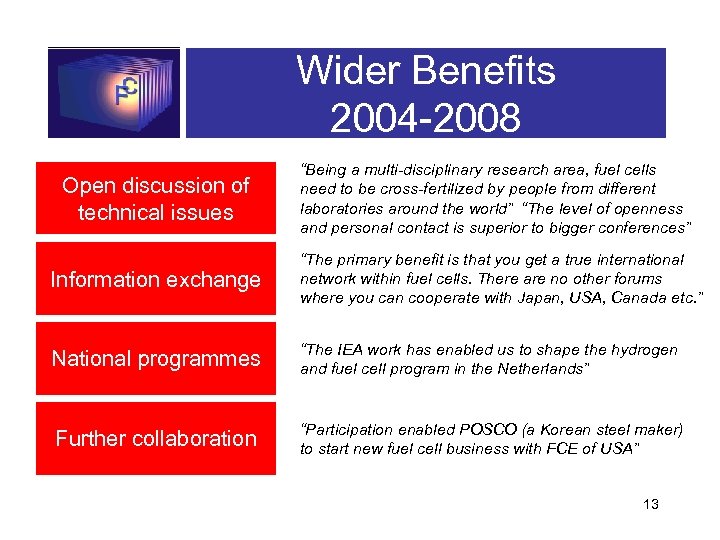 Wider Benefits 2004 -2008 Open discussion of technical issues “Being a multi-disciplinary research area, fuel cells need to be cross-fertilized by people from different laboratories around the world” “The level of openness and personal contact is superior to bigger conferences” Information exchange “The primary benefit is that you get a true international network within fuel cells. There are no other forums where you can cooperate with Japan, USA, Canada etc. ” National programmes “The IEA work has enabled us to shape the hydrogen and fuel cell program in the Netherlands” Further collaboration “Participation enabled POSCO (a Korean steel maker) to start new fuel cell business with FCE of USA” 13
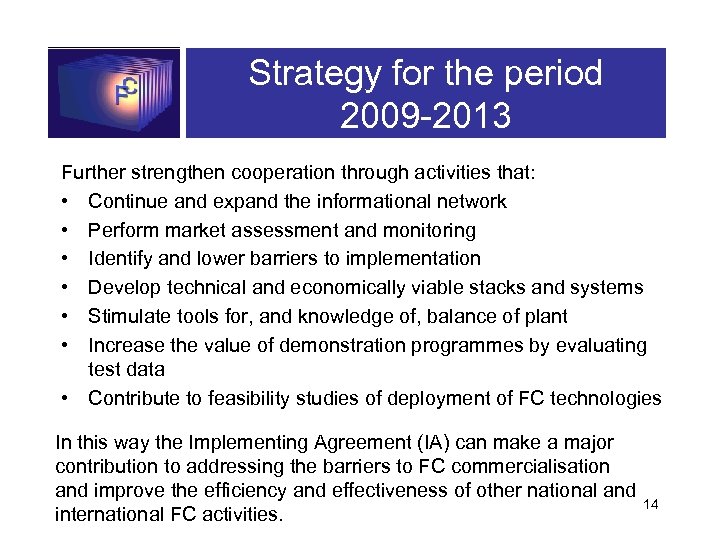 Strategy for the period 2009 -2013 Further strengthen cooperation through activities that: • Continue and expand the informational network • Perform market assessment and monitoring • Identify and lower barriers to implementation • Develop technical and economically viable stacks and systems • Stimulate tools for, and knowledge of, balance of plant • Increase the value of demonstration programmes by evaluating test data • Contribute to feasibility studies of deployment of FC technologies In this way the Implementing Agreement (IA) can make a major contribution to addressing the barriers to FC commercialisation and improve the efficiency and effectiveness of other national and 14 international FC activities.
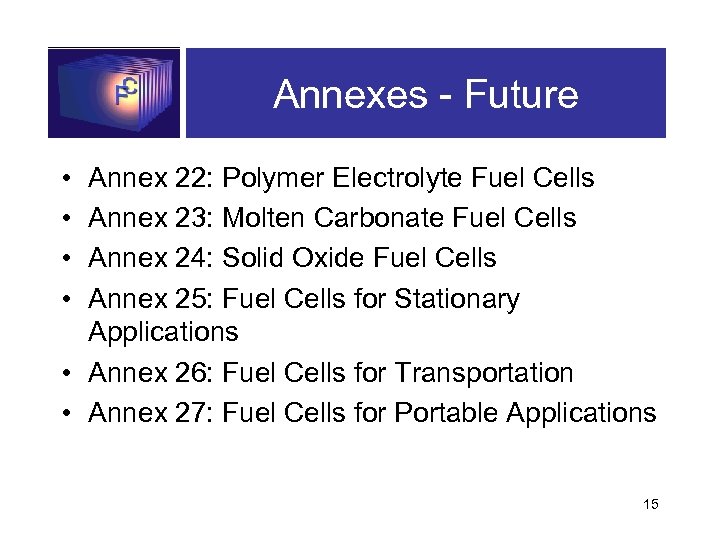 Annexes - Future • • Annex 22: Polymer Electrolyte Fuel Cells Annex 23: Molten Carbonate Fuel Cells Annex 24: Solid Oxide Fuel Cells Annex 25: Fuel Cells for Stationary Applications • Annex 26: Fuel Cells for Transportation • Annex 27: Fuel Cells for Portable Applications 15
 Thank you for your attention For further information please contact: Mrs Heather Haydock Secretary, IEA Advanced Fuel Cells Executive Committee heather. haydock@aeat. co. uk Or see the web site at www. ieafuelcell. com 16
 Backups 17
 Annex Accomplishments • Annex XX: Fuel Cells for Transportation – Information has been shared on targets, status and projections for automotive fuel cell systems, including results from a study of the cost breakdown of components of a PEMFC stack. A review has been undertaken of hydrogen storage options and their status, characteristics and challenges. Information has been exchanged on the progress and future plans of fuel cell vehicle development programmes in participant countries. • Annex XXI: Fuel Cells for Portable Applications – Two expert meetings were held in 2005 and 2006, at which information was exchanged on system analysis, system, stack and cell development, and materials innovation. 18
 Annex Accomplishments • Annex XIX: Fuel Cells for Stationary Applications – – – A study has been completed on the market prospects for fuel cells in different countries based on the latest available information regarding the development of and the market conditions for stationary fuel cell systems. One of the important outcomes from this market study is that the different conditions in different countries and regions like energy prices, grid stability, demand pattern for heating and cooling domestic energy sources etc are very important for the introduction of fuel cells. The conditions are not at all the same and this is especially valid for the small stationary fuel cells. For the larger fuel cells it is not so sensitive as they operate for longer periods with base load characteristics and can ideally use locally produced fuels. In that case is the investment costs not that important but the high efficiency and reliability of the fuel cells plant are major advantages. The environmental advantages are also one of the major factors for the decision to invest in a stationary fuel cells plant. The Annex XIX subtask describing fuels for fuel cells has developed a comprehensive library of different possible fuels for stationary fuel cells. In almost any country or region, biofuels and waste gases can be used with significant advantage in stationary fuel cells. Biogas produced from anaerobic digester plants based on sewage or agriculture waste, manure etc can be used in high temperature fuel cells with significantly higher efficiency than other conventional technologies. This technology is now demonstrated at several sites in different countries. The biogas as such is an aggressive greenhouse gas that now can be as fuel for production of electricity and heat. About two thirds of the costs for a fuel cell plant is related to the balance of plant. As a significant cost reduction is needed if stationary fuel cells are to be commercially competitive, the costs of balance of plant components must be reduced. Annex XIX has started to investigate if this is feasible. It was a difficult task, as the developers of fuel cell systems and components considered this to be proprietary information. The focus of the task was then changed to concentrate more on the specification of balance of plant components. 19
 Annex Accomplishments • Annex XVI: Polymer Electrolyte Fuel Cells – Technical achievements in Annex XVI have included sharing of information on: • • new methods for making lower-cost, higher durability platinum electrodes, development of an ammonia-fuelled PEFC, development of an 80 k. W system for fuel cell locomotives, understanding of the degradation mechanisms involved when cells are started up and shut down, and when they are exposed to sub zero temperatures, development of a PEFC stack simulator for system studies, studies on the effect of air impurities on the performance of cell components, and performance modelling of high temperature PEFCs. Annex XVII: Molten Carbonate Fuel Cells – The latest R&D data on MCFC stack and system performance have been presented and discussed at annual workshops. Discussions have centred on reducing stack degradation rates and costs through better design and improved materials. • Annex XVIII: Solid Oxide Fuel Cells – Annex XIII has held a series of successful annual workshops to exchange information on SOFC cells, stacks and systems. Workshops held to date have addressed low cost manufacture and design; low temperature operation; systems, and; modelling of cell and stack operation and electrode processes. They have also provided an opportunity to share information on national programmes and industry activities. 20
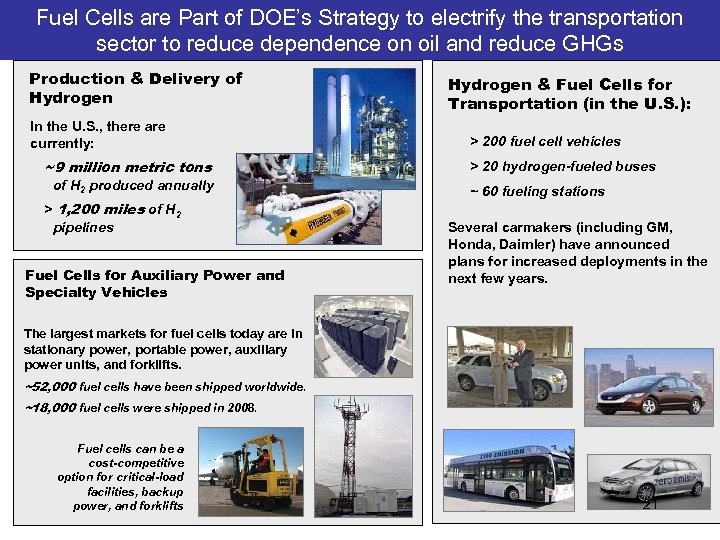 Fuel Cells are Part of DOE’s Strategy to electrify the transportation H 2 & Fuel Cells — Where are we today? sector to reduce dependence on oil and reduce GHGs Production & Delivery of Hydrogen In the U. S. , there are currently: ~9 million metric tons of H 2 produced annually > 1, 200 miles of H 2 pipelines Fuel Cells for Auxiliary Power and Specialty Vehicles Hydrogen & Fuel Cells for Transportation (in the U. S. ): > 200 fuel cell vehicles > 20 hydrogen-fueled buses ~ 60 fueling stations Several carmakers (including GM, Honda, Daimler) have announced plans for increased deployments in the next few years. The largest markets for fuel cells today are in stationary power, portable power, auxiliary power units, and forklifts. ~52, 000 fuel cells have been shipped worldwide. ~18, 000 fuel cells were shipped in 2008. Fuel cells can be a cost-competitive option for critical-load facilities, backup power, and forklifts 21
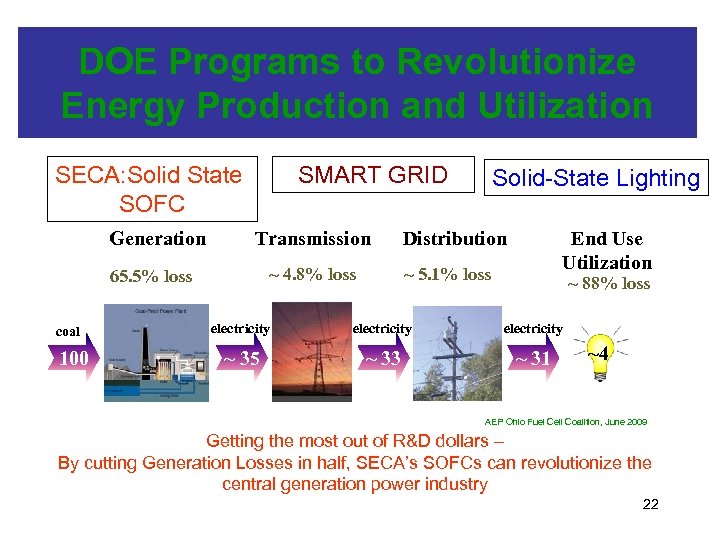 DOE Programs to Revolutionize Energy Production and Utilization SECA: Solid State SOFC Generation SMART GRID Transmission ~ 4. 8% loss 65. 5% loss coal 100 Solid-State Lighting Distribution End Use Utilization ~ 5. 1% loss ~ 88% loss electricity ~ 35 ~ 33 ~ 31 ~4 AEP Ohio Fuel Cell Coalition, June 2009 Getting the most out of R&D dollars – By cutting Generation Losses in half, SECA’s SOFCs can revolutionize the central generation power industry 22
 23
23
 Overview of presentation • Introduction to the programme • Achievements 2004 -2008 • Strategy 2009 -2013 24
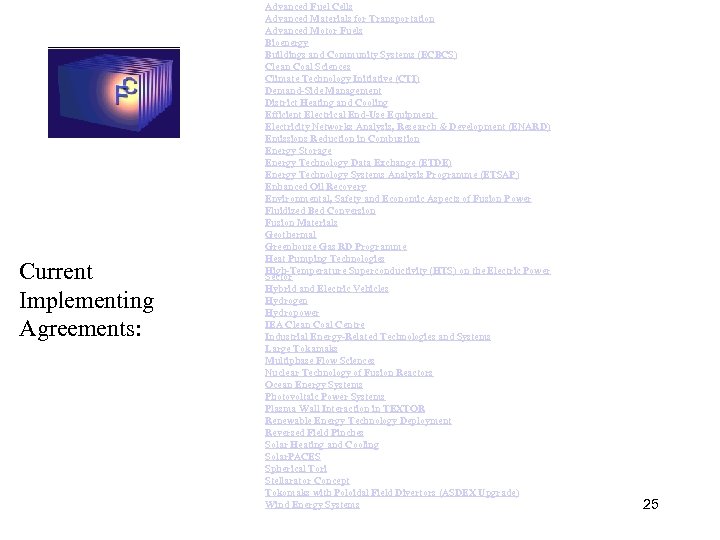 Current Implementing Agreements: Advanced Fuel Cells Advanced Materials for Transportation Advanced Motor Fuels Bioenergy Buildings and Community Systems (ECBCS) Clean Coal Sciences Climate Technology Initiative (CTI) Demand-Side Management District Heating and Cooling Efficient Electrical End-Use Equipment Electricity Networks Analysis, Research & Development (ENARD) Emissions Reduction in Combustion Energy Storage Energy Technology Data Exchange (ETDE) Energy Technology Systems Analysis Programme (ETSAP) Enhanced Oil Recovery Environmental, Safety and Economic Aspects of Fusion Power Fluidized Bed Conversion Fusion Materials Geothermal Greenhouse Gas RD Programme Heat Pumping Technologies High-Temperature Superconductivity (HTS) on the Electric Power Sector Hybrid and Electric Vehicles Hydrogen Hydropower IEA Clean Coal Centre Industrial Energy-Related Technologies and Systems Large Tokamaks Multiphase Flow Sciences Nuclear Technology of Fusion Reactors Ocean Energy Systems Photovoltaic Power Systems Plasma Wall Interaction in TEXTOR Renewable Energy Technology Deployment Reversed Field Pinches Solar Heating and Cooling Solar. PACES Spherical Tori Stellarator Concept Tokomaks with Poloidal Field Divertors (ASDEX Upgrade) Wind Energy Systems 25
 Annexes Reports 26
 Proposed programme 2009 -2013 • Continuation of the programme with a similar content and structure • Strategy for all Annexes in place • 16 of 19 current participants have confirmed they will continue (and the others are likely to) • Additional cross-annex activities being considered • Co-ordination with other IAs will continue 27
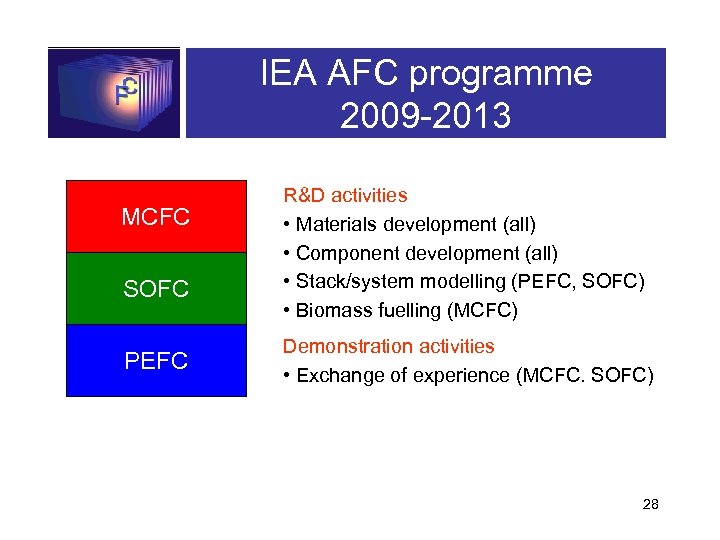 IEA AFC programme 2009 -2013 MCFC SOFC PEFC R&D activities • Materials development (all) • Component development (all) • Stack/system modelling (PEFC, SOFC) • Biomass fuelling (MCFC) Demonstration activities • Exchange of experience (MCFC. SOFC) 28
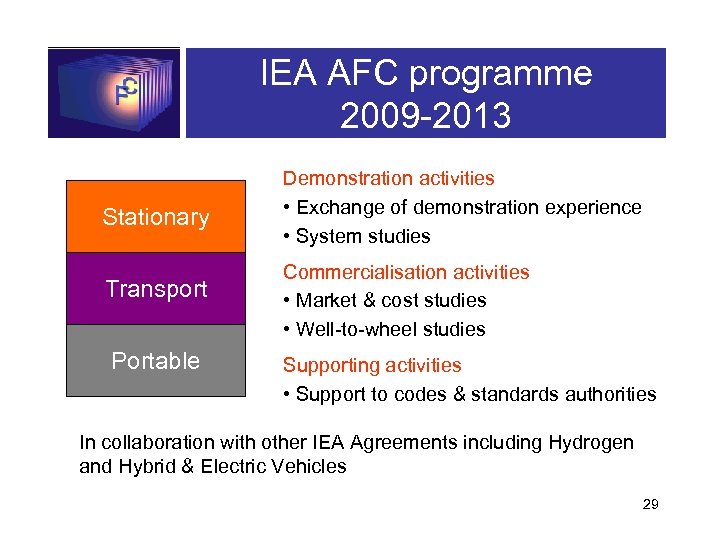 IEA AFC programme 2009 -2013 Stationary Transport Portable Demonstration activities • Exchange of demonstration experience • System studies Commercialisation activities • Market & cost studies • Well-to-wheel studies Supporting activities • Support to codes & standards authorities In collaboration with other IEA Agreements including Hydrogen and Hybrid & Electric Vehicles 29