


 Скачать презентацию Identifying the key push-pull factors in medical careers
118fee4fe586ef8ac531c098cb8e860a.ppt
- Количество слайдов: 16
 Identifying the key "push-pull" factors in medical careers decision making Cleland J 1, Johnston PW 2, Skatun D 3 et al 1 Division of Medical and Dental Education, University of Aberdeen, UK. 2 NHS Education for Scotland, North Deanery, Forestgrove House, Foresterhill, Aberdeen, UK 3 Health Economics Research Unit, Division of Applied Health Sciences, University of Aberdeen, UK
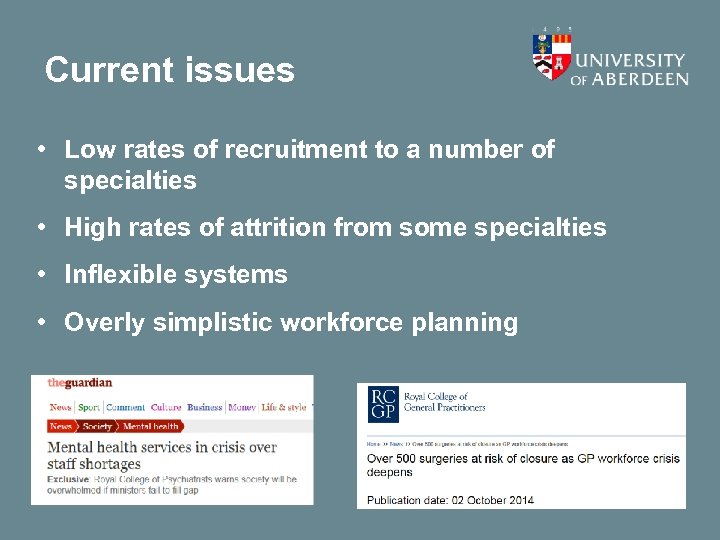 Current issues • Low rates of recruitment to a number of specialties • High rates of attrition from some specialties • Inflexible systems • Overly simplistic workforce planning
 Key influences – the literature • Many studies of careers decision making • Various factors seem to influence the career decisions made by medical students and young doctors e. g. , • individual preferences (1) • the perceived benefits of particular specialties (2) • exposure/experience (3) • demographic factors e. g. , gender (4), origin (5) • Which medical school they attended (6 -8) • Over-reliance on quantitative surveys • Neglect to address system and societal change
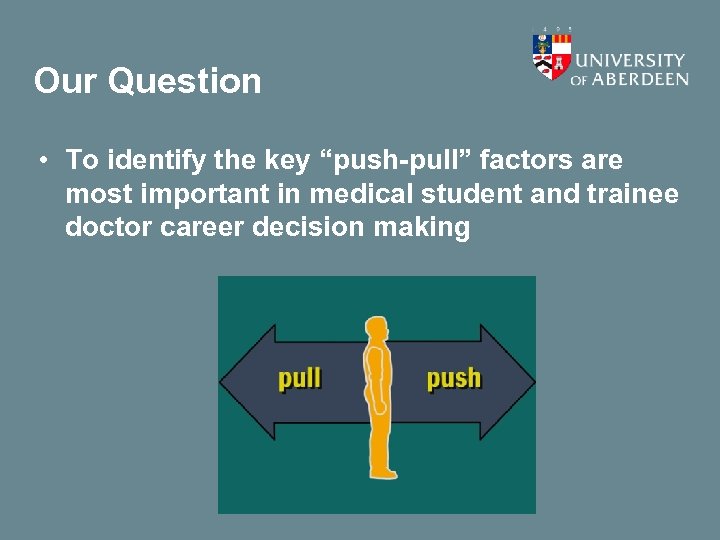 Our Question • To identify the key “push-pull” factors are most important in medical student and trainee doctor career decision making
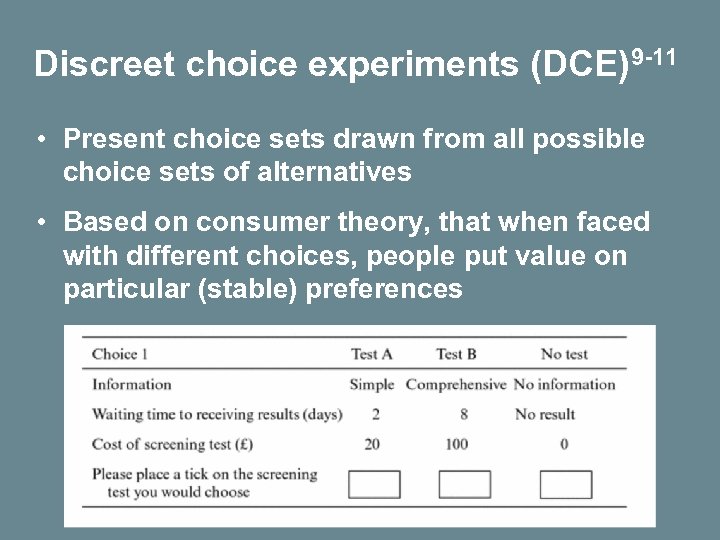 Discreet choice experiments (DCE)9 -11 • Present choice sets drawn from all possible choice sets of alternatives • Based on consumer theory, that when faced with different choices, people put value on particular (stable) preferences
 Populating the DCE • What three things are most/least important to you when making a decision re your medical career • Open questions • Question asked separately for each move/stage
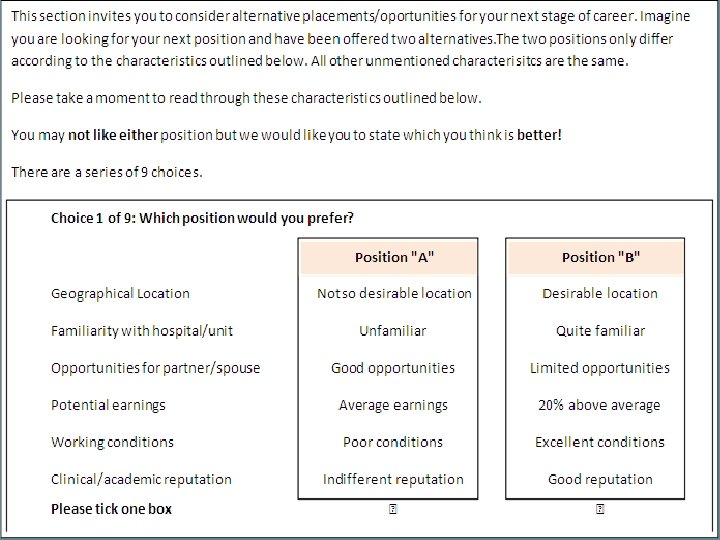
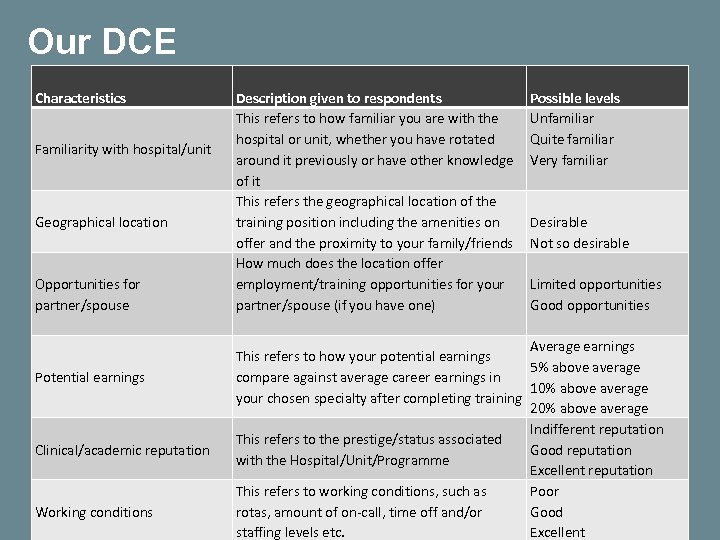 Our DCE Characteristics Familiarity with hospital/unit Geographical location Opportunities for partner/spouse Potential earnings Clinical/academic reputation Working conditions Description given to respondents Possible levels This refers to how familiar you are with the Unfamiliar hospital or unit, whether you have rotated Quite familiar around it previously or have other knowledge Very familiar of it This refers the geographical location of the Desirable training position including the amenities on offer and the proximity to your family/friends Not so desirable How much does the location offer employment/training opportunities for your Limited opportunities partner/spouse (if you have one) Good opportunities Average earnings This refers to how your potential earnings 5% above average compare against average career earnings in 10% above average your chosen specialty after completing training 20% above average Indifferent reputation This refers to the prestige/status associated Good reputation with the Hospital/Unit/Programme Excellent reputation Poor This refers to working conditions, such as Good rotas, amount of on-call, time off and/or Excellent staffing levels etc.
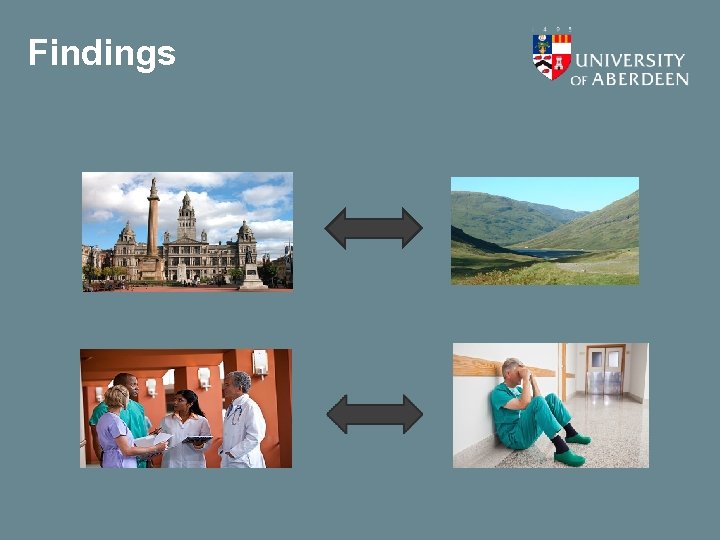 Findings
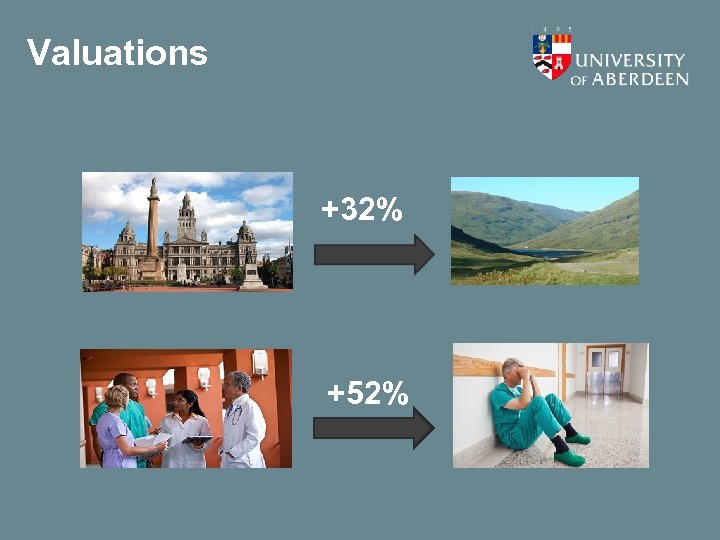 Valuations +32% +52%
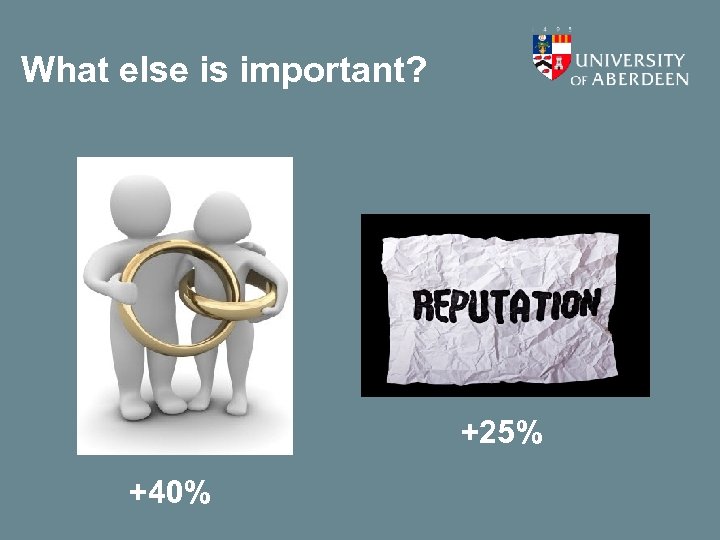 What else is important? +25% +40%
 Young doctors, young people
 Implications • Addressing the issues • Locality • Working conditions … • Opportunities for medical partners • Reputation
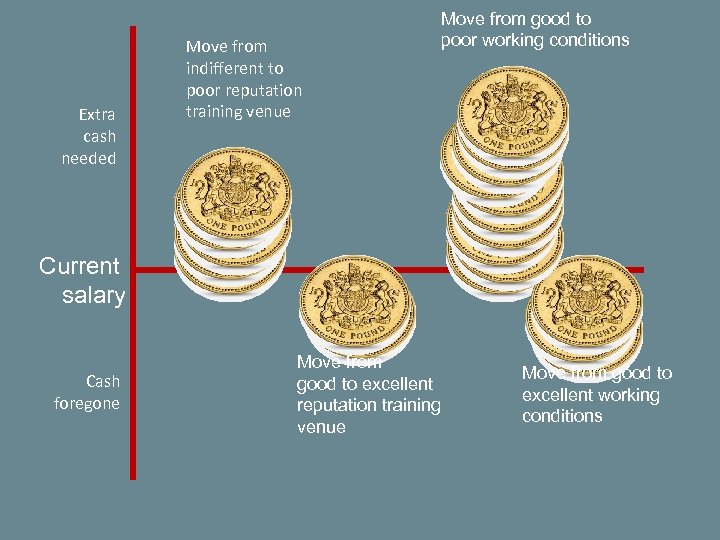 Extra cash needed Move from indifferent to poor reputation training venue Move from good to poor working conditions poor working conditionx xxxxxxxxxs Current salary Cash foregone Move from good to excellent reputation training venue Move from good to excellent working conditions
 References (1) Mc. Manus et al. Career preference and personality differences in medical school applicants. Psych, Health Med 1996; 1: 235 -248. (2) Kiker BF, Zeh M. Relative income expectations, expected malpractice premium costs, and other determinants of physician specialty choice. J Health Soc Behav 1998; 39: 152 -167. (3) Goldacre MJ, Turner G, Lambert TW. Variation by medical school in career choices of UK graduates of 1999 and 2000. Medical Education 2004; 38: 249 -258. (4) Van der Horst et al. Residents’ reasons for specialty choice: influence of gender, time, patient and career. Med Educ 2010; 44: 595 -602. (5) Jones M, Humphreys J, Prideaux D. Predicting medical students’ intentions to take up rural practice after graduation. Med Educ 2009; 43: 1001 -1009. (6) Brosnan C. Making sense of differences between medical schools through Bourdieu’s concept of ‘field’. Med Educ 2010; 44: 645 -652. (7) Mc. Manus et al. Graduates of different UK medical schools show substantial differences in performance on MRCP(UK) Part 1, Part 2 and PACES examinations. BMC Medicine 2008; 6: 5. (8) Cleland et al. Associations between medical school and career preferences in first year medical students in Scotland. Medical Education 2012; 46: 473 -484. (9) Ryan M, Gerard K, Amaya-Amaya M. 2008. Using Discrete Choice Experiments to Value Health and Health Care, vol. 11. Springer: Dordrecht, The Netherlands. (10) Scott A. Eliciting GPs’ preferences for pecuniary and non-pecuniary job characteristics. Journal of Health Economics 2001; 20: 329– 347. (11) Ubach C, Scott A, French F, Awramenko M, Needham G. What do hospital consultants value about their jobs? A discrete choice experiment. BMJ 2003; 326: 1432.
 Publications to date: Cleland, J. , Leaman, J & Billett, S (2014 in press) Developing medical capacities and dispositions through practice-based experiences, in Harteis, C. , Rausch, A. & Seifried, J (Eds. ) Discourses on Professional Learning: On the Boundary between Learning and Working, Springer, Dordrecht, The Netherlands Cleland JA, Johnston et al. (2014). A survey of factors influencing career preference in new-entrant and exiting medical students from four UK medical schools. BMC Medical Education. Cleland JA and Johnston PG. (2012). Enculturation into medicine: power for teachers or empowering learners. Medical Education; 46: 835 -37. Cleland et al. (2012). Associations between medical school and career preferences in first year medical students in Scotland. Medical Education; 46: 473 -484. Cleland et al. (2012) Attracting healthcare professionals to remote and rural medicine: learning from doctors in training. Medical Teacher ; 34: e 476 -e 482 Cleland et al. (2011). A Mixed-methods study exploring students’ views of the UKCAT. Medical Teacher; 33: 244 -249. My thanks to: NHS Education for Scotland for funding much of this programme Health Economics Research Unit, University of Aberdeen, for their expertise All the universities and colleagues who have worked with us on specific projects