


 Скачать презентацию Identifying Research Needs for Risk Assessment of U
8285443a275a30900c8306327759b5eb.ppt
- Количество слайдов: 18
 Identifying Research Needs for Risk Assessment of U. S. Food Supply Security Bruce Hope Oregon Department of Environmental Quality Portland, Oregon v Society of Toxicology v Risk Assessment Specialty Section (RASS) v Monthly Teleconference v April 13, 2005
 Why risk? v Much is possible, not all is probable. l l Hazard is about possibility Risk is about probability v Risk is l Probability that exposure to a pathogen will result in a negative consequence of some magnitude. v When probability is ignored… l l High & low priority scenarios may appear equal Scarce resources may go to low priority scenarios Confusion over priorities = decision paralysis Caveat: unconventional improbable SOT Telecon (4/05)
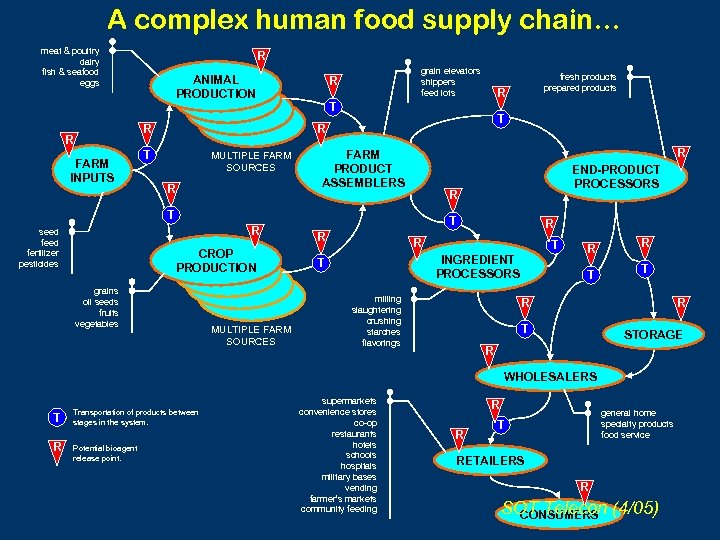 A complex human food supply chain… meat & poultry dairy fish & seafood eggs R ANIMAL PRODUCTION grain elevators shippers feed lots R R T R R FARM INPUTS T R T MULTIPLE FARM SOURCES R R FARM PRODUCT ASSEMBLERS R CROP PRODUCTION grains oil seeds fruits vegetables MULTIPLE FARM SOURCES END-PRODUCT PROCESSORS R T seed fertilizer pesticides fresh products prepared products T R R R INGREDIENT PROCESSORS T milling slaughtering crushing starches flavorings R R T T T R R T STORAGE R WHOLESALERS T Transportation of products between stages in the system. R Potential bioagent release point. supermarkets convenience stores co-op restaurants hotels schools hospitals military bases vending farmer’s markets community feeding R R general home specialty products food service T RETAILERS R SOT Telecon (4/05) CONSUMERS
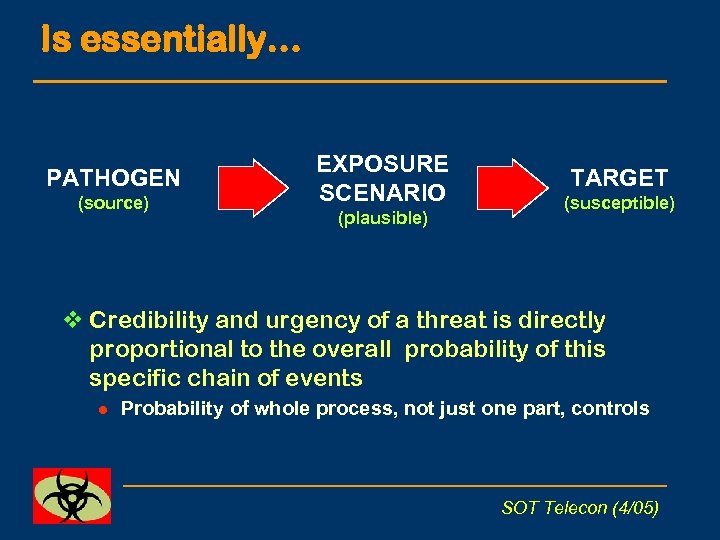 Is essentially… PATHOGEN (source) EXPOSURE SCENARIO (plausible) TARGET (susceptible) v Credibility and urgency of a threat is directly proportional to the overall probability of this specific chain of events l Probability of whole process, not just one part, controls SOT Telecon (4/05)
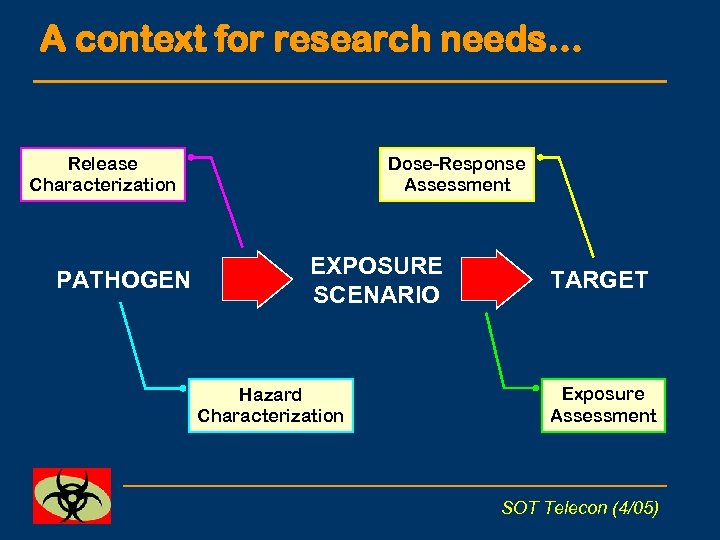 A context for research needs… Release Characterization PATHOGEN Dose-Response Assessment EXPOSURE SCENARIO Hazard Characterization TARGET Exposure Assessment SOT Telecon (4/05)
 So we need to consider… v The probability of their being a source and a target, connected by a plausible chain of events. v The probabilities associated with the actuality of source, target, and connecting events. v The biological, environmental, and cultural factors which influence these probabilities. v Research to identify, understand, and quantify, as well as help alter, these probabilities. SOT Telecon (4/05)
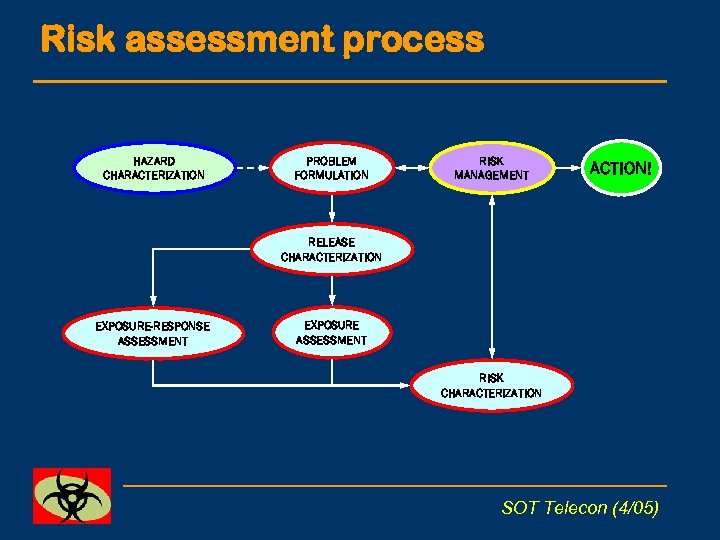 Risk assessment process HAZARD CHARACTERIZATION PROBLEM FORMULATION RISK MANAGEMENT ACTION! RELEASE CHARACTERIZATION EXPOSURE-RESPONSE ASSESSMENT EXPOSURE ASSESSMENT RISK CHARACTERIZATION SOT Telecon (4/05)
 Hazard characterization v Factors affecting probability of a pathogen being chosen as a bioweapon, then obtained, handled, deployed, and transported successfully. l l l l Virulence and pathogenicity Pathologic characteristics and diseases caused Survival and multiplication Resistance to environmental control measures Host specificity Infection mechanism and route; portal of entry Ecology and natural history; potential for 2° spread v More attention to non-weaponized agents. SOT Telecon (4/05)
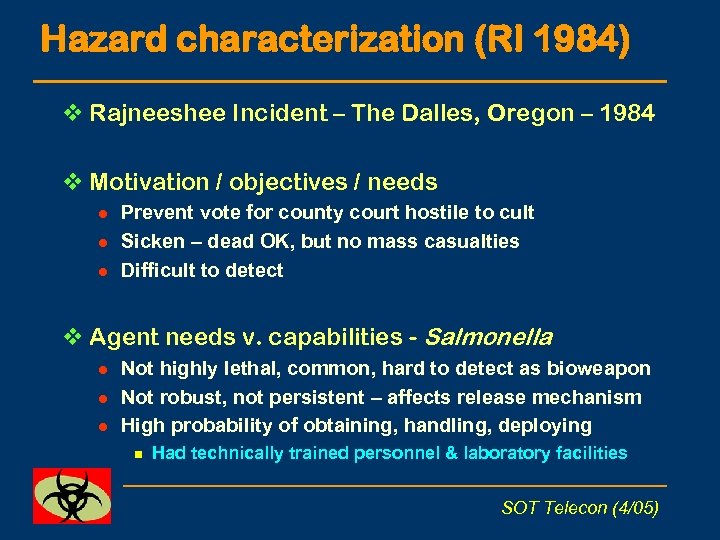 Hazard characterization (RI 1984) v Rajneeshee Incident – The Dalles, Oregon – 1984 v Motivation / objectives / needs l l l Prevent vote for county court hostile to cult Sicken – dead OK, but no mass casualties Difficult to detect v Agent needs v. capabilities - Salmonella l l l Not highly lethal, common, hard to detect as bioweapon Not robust, not persistent – affects release mechanism High probability of obtaining, handling, deploying n Had technically trained personnel & laboratory facilities SOT Telecon (4/05)
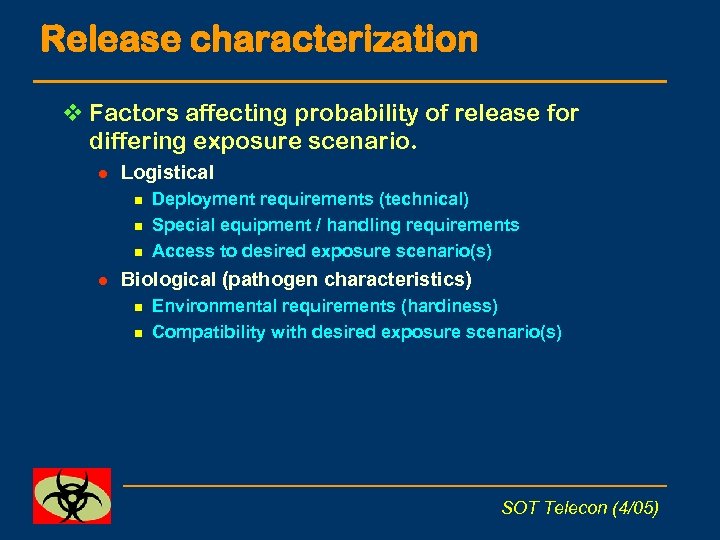 Release characterization v Factors affecting probability of release for differing exposure scenario. l Logistical n n n l Deployment requirements (technical) Special equipment / handling requirements Access to desired exposure scenario(s) Biological (pathogen characteristics) n n Environmental requirements (hardiness) Compatibility with desired exposure scenario(s) SOT Telecon (4/05)
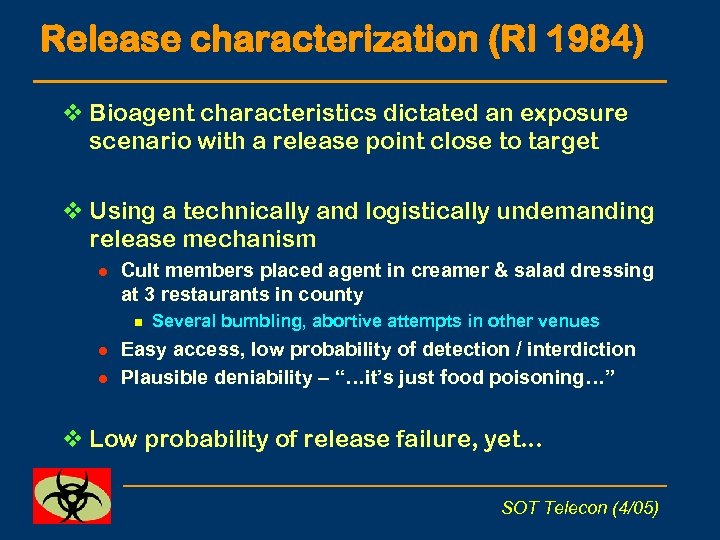 Release characterization (RI 1984) v Bioagent characteristics dictated an exposure scenario with a release point close to target v Using a technically and logistically undemanding release mechanism l Cult members placed agent in creamer & salad dressing at 3 restaurants in county n l l Several bumbling, abortive attempts in other venues Easy access, low probability of detection / interdiction Plausible deniability – “…it’s just food poisoning…” v Low probability of release failure, yet. . . SOT Telecon (4/05)
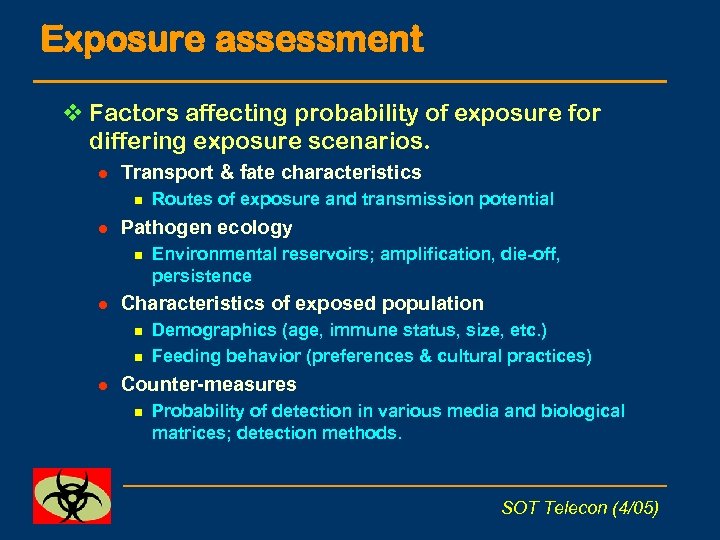 Exposure assessment v Factors affecting probability of exposure for differing exposure scenarios. l Transport & fate characteristics n l Pathogen ecology n l Environmental reservoirs; amplification, die-off, persistence Characteristics of exposed population n n l Routes of exposure and transmission potential Demographics (age, immune status, size, etc. ) Feeding behavior (preferences & cultural practices) Counter-measures n Probability of detection in various media and biological matrices; detection methods. SOT Telecon (4/05)
 Exposure assessment (RI 1984) v Transport & fate characteristics l l l Direct ingestion exposure, limited transport ability Not persist, no environmental reservoirs Exposed population assume food is clean, salad is not processed further v Counter-measures l Low probability of detection, high probability of interdiction if detected v Actual exposure dose impossible to quantify SOT Telecon (4/05)
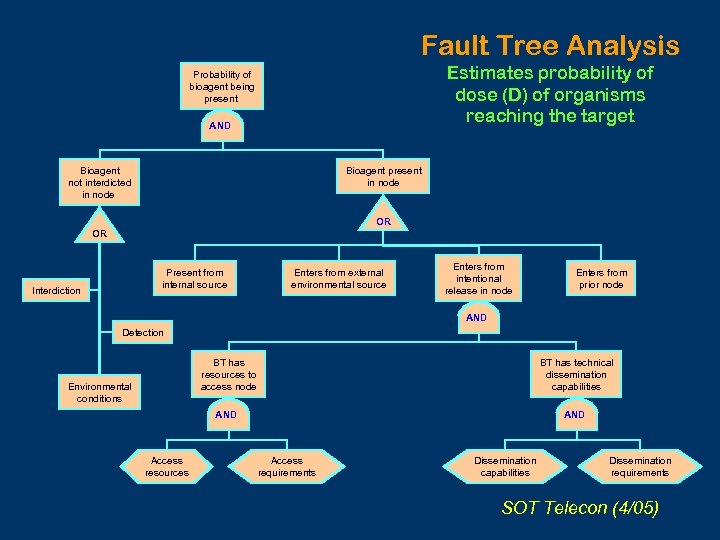 Fault Tree Analysis Estimates probability of dose (D) of organisms reaching the target Probability of bioagent being present AND Bioagent not interdicted in node Bioagent present in node OR OR Present from internal source Interdiction Enters from external environmental source Enters from intentional release in node Enters from prior node AND Detection BT has resources to access node AND Environmental conditions Access resources BT has technical dissemination capabilities AND Access requirements Dissemination capabilities Dissemination requirements SOT Telecon (4/05)
 Exposure – response assessment v Improved quantification of dose-response for known pathogens. l l l Model fit to data Applicability of animal models Assessing multiple exposures Development of mechanistic (v. empirical) models Differential response by sensitive sub-populations v Dose-response studies for new and emerging pathogens. l Only a few of 150+ enteric viruses studied for doseresponse in human volunteers. SOT Telecon (4/05)
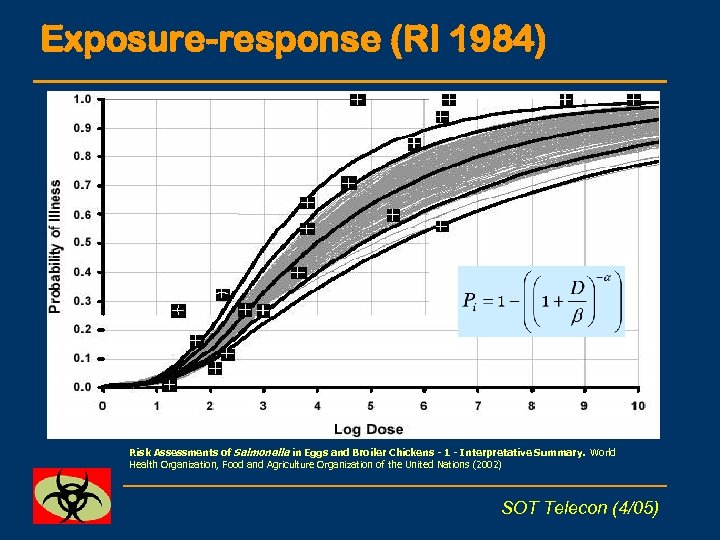 Exposure-response (RI 1984) Risk Assessments of Salmonella in Eggs and Broiler Chickens - 1 - Interpretative Summary. World Health Organization, Food and Agriculture Organization of the United Nations (2002) SOT Telecon (4/05)
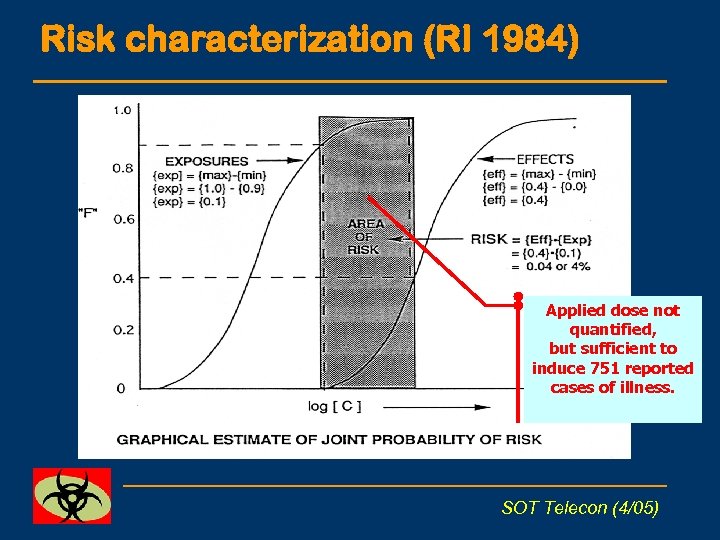 Risk characterization (RI 1984) Applied dose not quantified, but sufficient to induce 751 reported cases of illness. SOT Telecon (4/05)
 Suggestions v Bioagent of choice need not be: l l Weaponized Restricted to a particular pathway (e. g. , inhalation) Harmful to humans or difficult to handle Hard to obtain v Food supply as a delivery system l Good for localized impact, poor for mass casualties n Possibly with a “specialized” bioagent? v Food supply as the target l l Loss of system services Loss of confidence in system n Significant 2° health and economic impacts SOT Telecon (4/05)