


 Скачать презентацию Identifying Research Gaps in Implementation of Zero Energy
78da7914b8ad9f529a3f5f52699b03f9.ppt
- Количество слайдов: 1
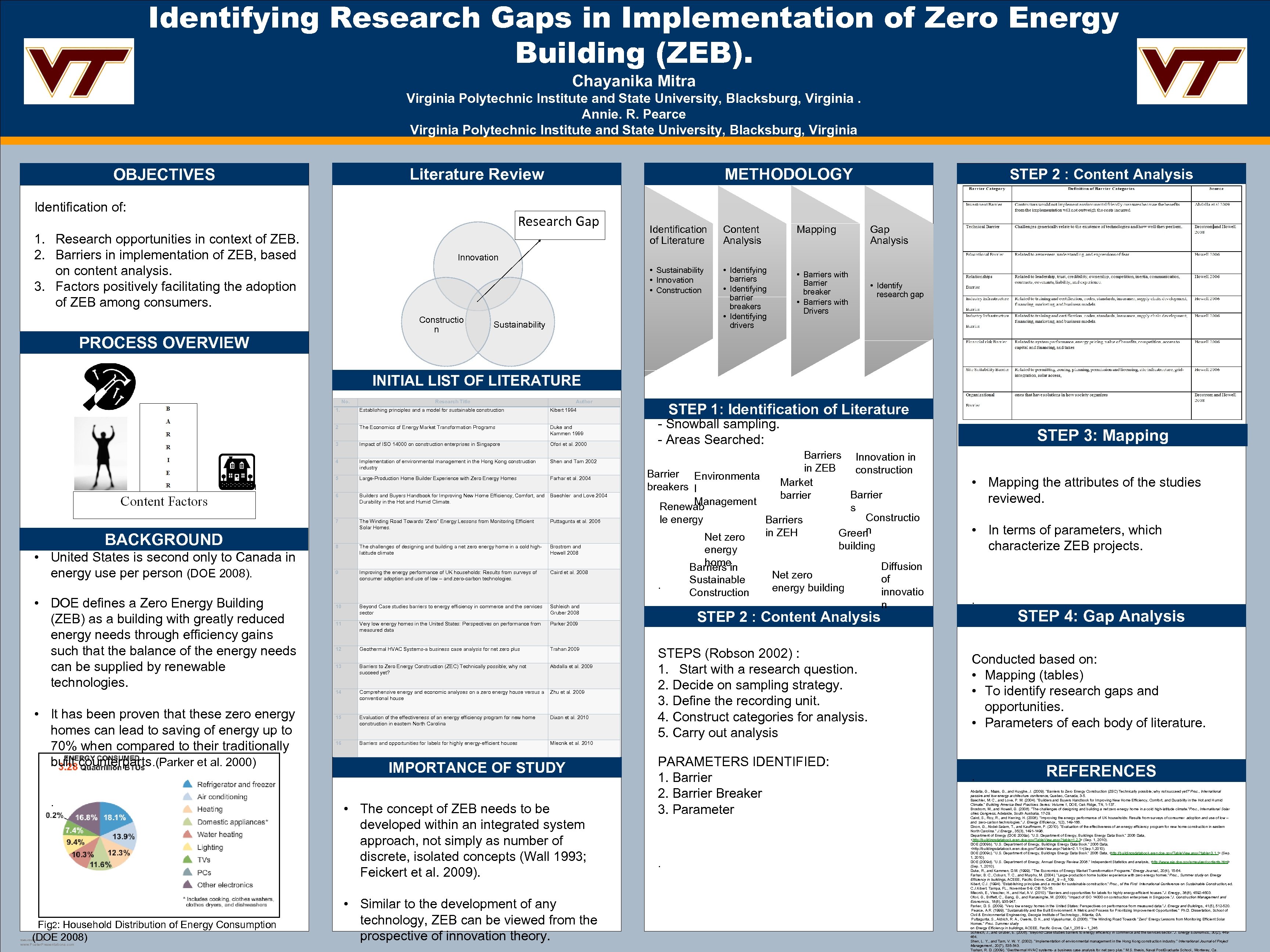 Identifying Research Gaps in Implementation of Zero Energy Building (ZEB). Chayanika Mitra Virginia Polytechnic Institute and State University, Blacksburg, Virginia. Annie. R. Pearce Virginia Polytechnic Institute and State University, Blacksburg, Virginia Literature Review OBJECTIVES Identification of: METHODOLOGY Research Gap 1. Research opportunities in context of ZEB. 2. Barriers in implementation of ZEB, based on content analysis. 3. Factors positively facilitating the adoption of ZEB among consumers. Identification of Literature • Sustainability • Innovation • Construction PROCESS OVERVIEW Mapping Gap Analysis Innovation Constructio n Content Analysis STEP 2 : Content Analysis Sustainability • Identifying barriers • Identifying barrier breakers • Identifying drivers • Barriers with Barrier breaker • Barriers with Drivers • Identify research gap INITIAL LIST OF LITERATURE No. Research Title Author 1. TEMPLATE DESIGN © 2008 www. Poster. Presentations. com Shen and Tam 2002 Large-Production Home Builder Experience with Zero Energy Homes Farhar et al. 2004 Builders and Buyers Handbook for Improving New Home Efficiency, Comfort, and Baechler and Love 2004 Durability in the Hot and Humid Climate. 7 Fig 2: Household Distribution of Energy Consumption (DOE 2008) Implementation of environmental management in the Hong Kong construction industry 6 . Ofori et al. 2000 5 • It has been proven that these zero energy homes can lead to saving of energy up to 70% when compared to their traditionally built counterparts. (Parker et al. 2000) Impact of ISO 14000 on construction enterprises in Singapore 4 • DOE defines a Zero Energy Building (ZEB) as a building with greatly reduced energy needs through efficiency gains such that the balance of the energy needs can be supplied by renewable technologies. Duke and Kammen 1999 3 • United States is second only to Canada in energy use person (DOE 2008). The Economics of Energy Market Transformation Programs The Winding Road Towards “Zero” Energy: Lessons from Monitoring Efficient Solar Homes. Puttagunta et al. 2006 8 The challenges of designing and building a net zero energy home in a cold highlatitude climate Brostrom and Howell 2008 9 Improving the energy performance of UK households: Results from surveys of consumer adoption and use of low – and zero-carbon technologies. Caird et al. 2008 STEP 1: Identification of Literature Kibert 1994 2 BACKGROUND Establishing principles and a model for sustainable construction 10 Beyond Case studies barriers to energy efficiency in commerce and the services sector Very low energy homes in the United States: Perspectives on performance from measured data Parker 2009 12 Geothermal HVAC Systems-a business case analysis for net zero plus Trahan 2009 13 Barriers to Zero Energy Construction (ZEC) Technically possible; why not succeed yet? Abdalla et al. 2009 14 Comprehensive energy and economic analyses on a zero energy house versus a Zhu et al. 2009 conventional house 15 Evaluation of the effectiveness of an energy efficiency program for new home construction in eastern North Carolina Dixon et al. 2010 16 Barriers and opportunities for labels for highly energy-efficient houses STEP 3: Mapping Barriers Innovation in in ZEB construction Barrier Environmenta Market breakers l Barrier barrier Management Renewab s Constructio le energy Barriers n in ZEH Green Net zero building energy home Diffusion Barriers in Net zero of Sustainable . energy building innovatio Construction Schleich and Gruber 2008 11 - Snowball sampling. - Areas Searched: n • Mapping the attributes of the studies reviewed. • In terms of parameters, which characterize ZEB projects. . Mlecnik et al. 2010 IMPORTANCE OF STUDY • The concept of ZEB needs to be developed within an integrated system approach, not simply as number of discrete, isolated concepts (Wall 1993; Feickert et al. 2009). • Similar to the development of any technology, ZEB can be viewed from the prospective of innovation theory. STEP 2 : Content Analysis STEPS (Robson 2002) : 1. Start with a research question. 2. Decide on sampling strategy. 3. Define the recording unit. 4. Construct categories for analysis. 5. Carry out analysis PARAMETERS IDENTIFIED: 1. Barrier 2. Barrier Breaker 3. Parameter . STEP 4: Gap Analysis Conducted based on: • Mapping (tables) • To identify research gaps and opportunities. • Parameters of each body of literature. . REFERENCES Abdalla, G. , Maas, G. , and Huyghe, J. (2009). “Barriers to Zero Energy Construction (ZEC) Technically possible; why not succeed yet? ” roc. , International P passive and low energy architecture conference, Quebec, Canada, 3 -5. Baechler, M. C. , and Love, P. M. (2004). “Builders and Buyers Handbook for Improving New Home Efficiency, Comfort, and Durability in the Hot and Humid Climate. ” Building America Best Practices Series: Volume 1, DOE, Oak Ridge, TN, 1 -137. Brostrom, M. , and Howell, G. (2008). “The challenges of designing and building a net zero energy home in a cold high-latitude climate. ” roc. , International Solar P cities Congress, Adelaide, South Australia, 17 -29. Caird, S. , Roy, R. , and Herring, H. (2008). “Improving the energy performance of UK households: Results from surveys of consumer adoption and use of low – and zero-carbon technologies. ” J. Energy Efficiency. , 1(2), 149 -166. Dixon, G. , Abdel-Salam, T. , and Kauffmann, P. (2010). “Evaluation of the effectiveness of an energy efficiency program for new home construction in eastern North Carolina. ” J. Energy. , 35(3), 1491 -1496. Department of Energy (DOE 2009 a). “U. S. Department of Energy, Buildings Energy Data Book. ” 2006 Data,