 Скачать презентацию Identifying Changes to Stream Condition caused by Urbanization
66ca5eb8c51994557c0125eb7d1a2031.ppt
- Количество слайдов: 29



Identifying Changes to Stream Condition caused by Urbanization How understanding the responses can improve ecological risk characterization --------------------James Coles – USGS Thomas Cuffney – USGS Cornell Rosiu – EPA
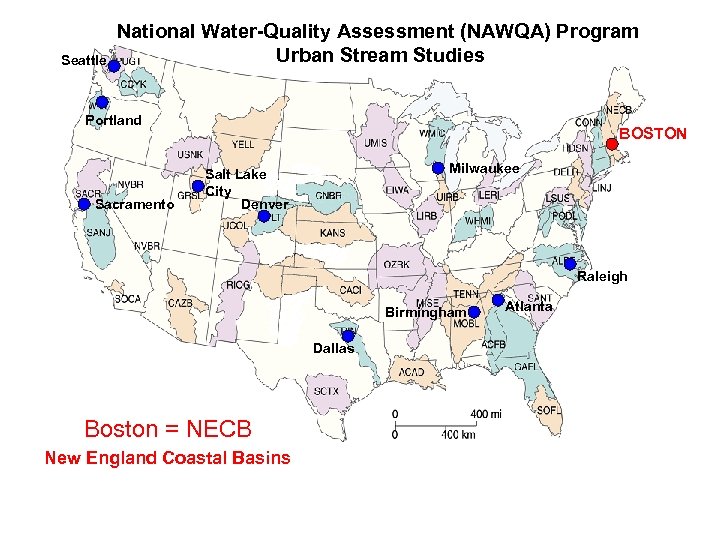
Seattle National Water-Quality Assessment (NAWQA) Program Urban Stream Studies Portland Sacramento BOSTON Milwaukee Salt Lake City Denver Raleigh Birmingham Dallas Boston = NECB New England Coastal Basins Atlanta
Setting up the Study Design • Define homogeneous environmental setting. – minimize natural variability • Determine watershed indicators of urbanization. – related to human presence • Select sites to represent urban intensity gradient. – minimal to high levels of urbanization • Establish consistent sampling reaches – 150 meters, riffles, riparian cover, stable channel
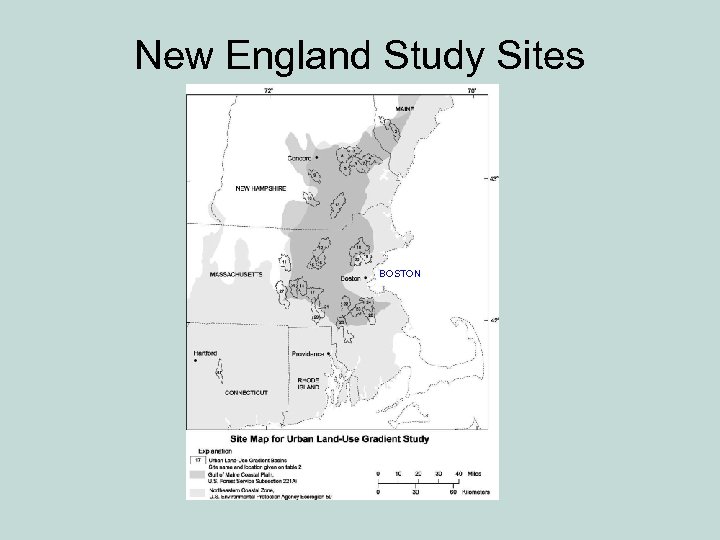
New England Study Sites BOSTON
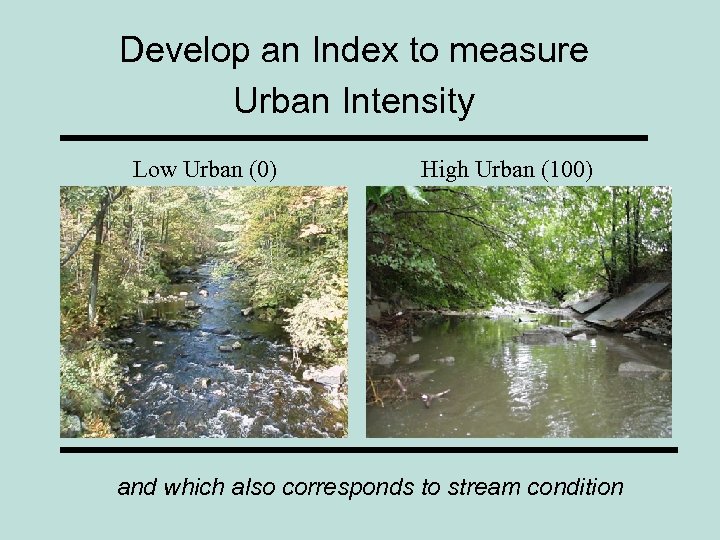
Develop an Index to measure Urban Intensity Low Urban (0) High Urban (100) and which also corresponds to stream condition
Original (a priori) Index of Urban Intensity (UII) used 24 landuse and demographic variables to characterize an urbanizing landscape. • Infrastructure (Dams, Roadways, TRI sites) • Land cover (Forest, Developed land) • Census statistics (Population, Socioeconomic factors)
Perhaps an Index of Urban Intensity (UII) could be derived that is as effective, but uses fewer than 24 variables Revised UII • Road Density – Expansion of Infrastructure • Percentage of Buffer in Forest – Encroachment along riparian zone • Percentage of Developed land – Change from natural landscape • Population Density – Human presence on landscape
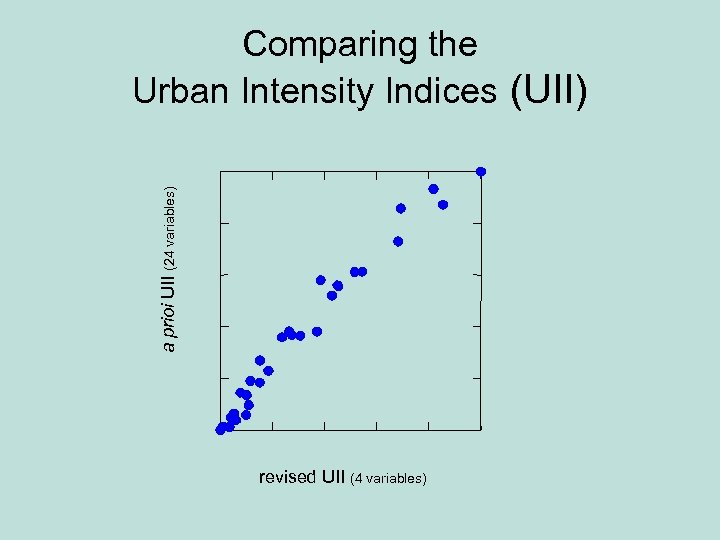
a prioi UII (24 variables) Comparing the Urban Intensity Indices (UII) revised UII (4 variables)
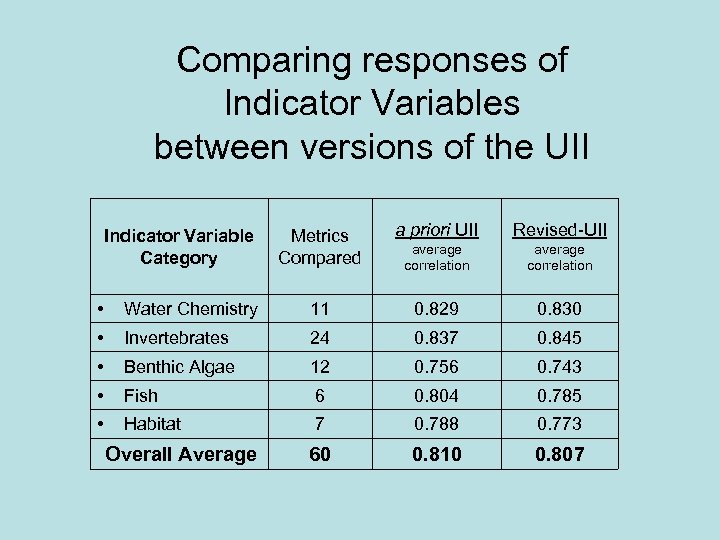
Comparing responses of Indicator Variables between versions of the UII Indicator Variable Category Metrics Compared a priori UII Revised-UII average correlation • Water Chemistry 11 0. 829 0. 830 • Invertebrates 24 0. 837 0. 845 • Benthic Algae 12 0. 756 0. 743 • Fish 6 0. 804 0. 785 • Habitat 7 0. 788 0. 773 60 0. 810 0. 807 Overall Average
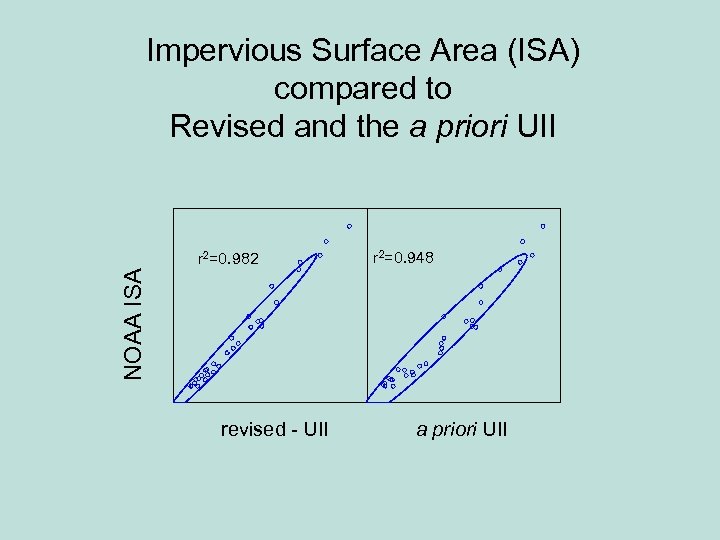
Impervious Surface Area (ISA) compared to Revised and the a priori UII r 2=0. 948 NOAA ISA r 2=0. 982 revised - UII a priori UII
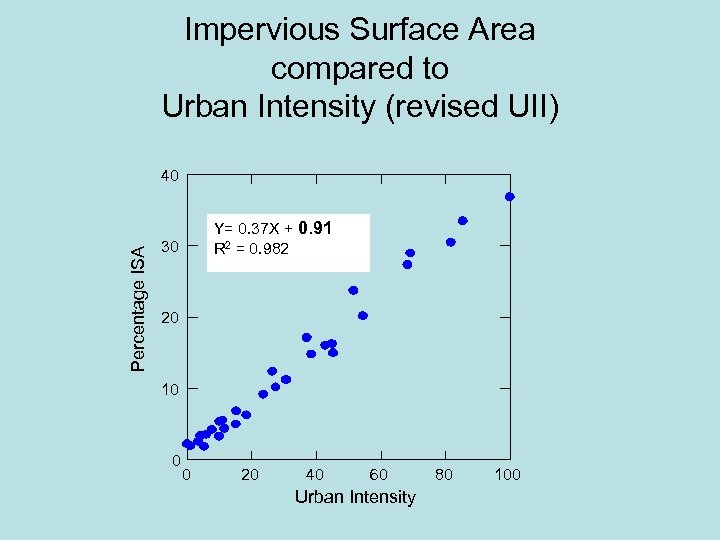
Impervious Surface Area compared to Urban Intensity (revised UII) Percentage ISA 40 Y= 0. 37 X + 0. 91 R 2 = 0. 982 30 20 10 0 0 20 40 60 Urban Intensity 80 100
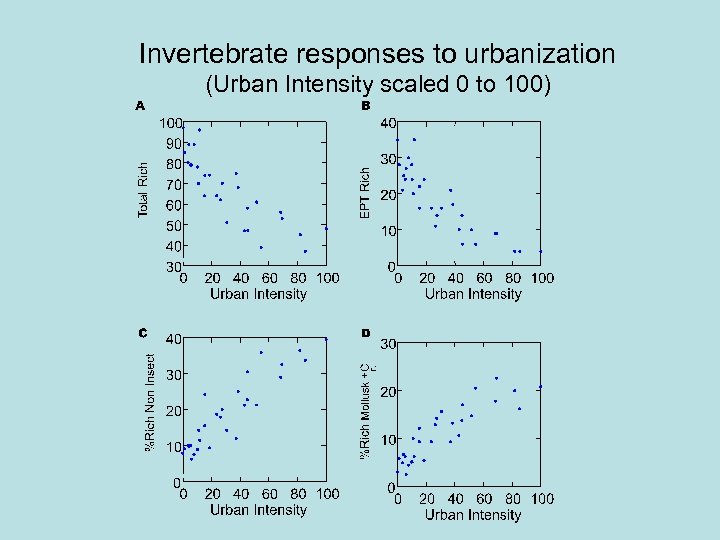
Invertebrate responses to urbanization (Urban Intensity scaled 0 to 100)
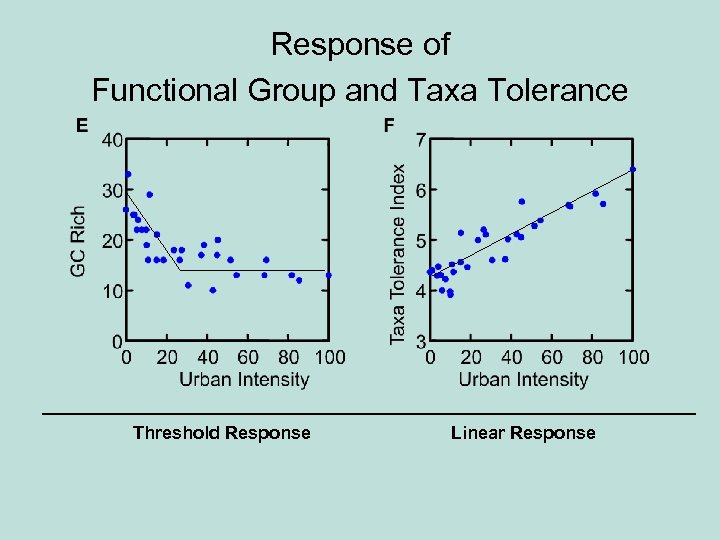
Response of Functional Group and Taxa Tolerance Threshold Response Linear Response
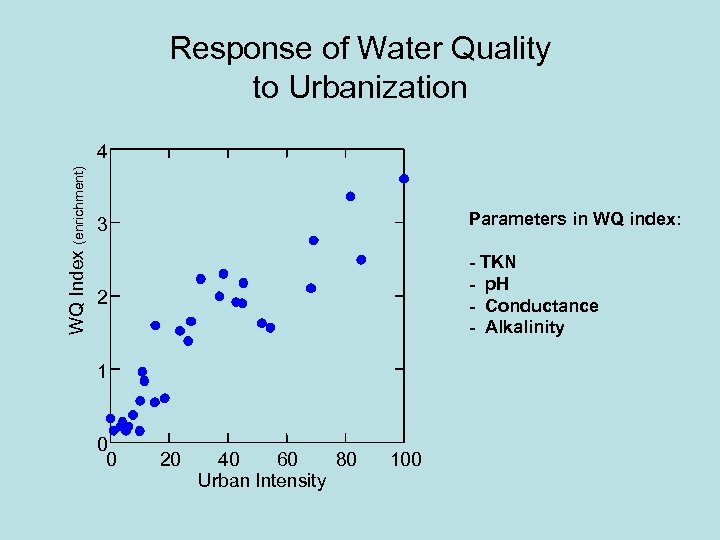
Response of Water Quality to Urbanization WQ Index (enrichment) 4 3 Parameters in WQ index: 2 - TKN - p. H - Conductance - Alkalinity 1 0 0 20 40 60 80 Urban Intensity 100
Improving Ecological Risk Assessments The value of knowing the urban intensity of a site where contamination occurs. (Is it urban intensity or the Superfund-site that is affecting stream condition? )
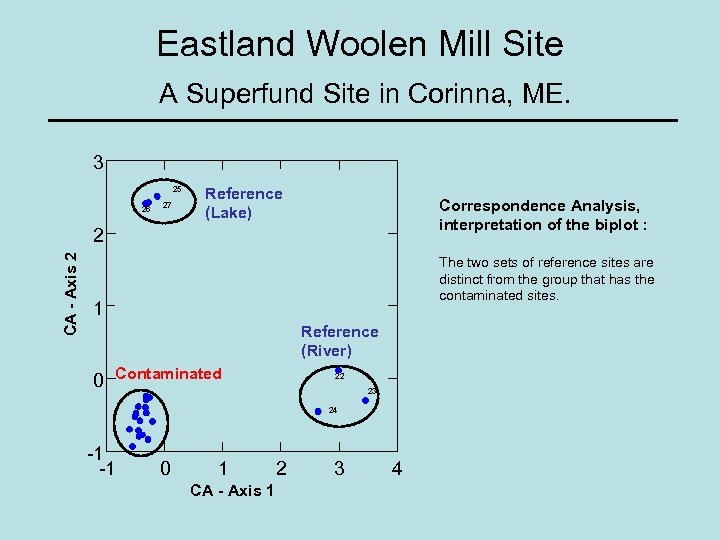
Eastland Woolen Mill Site A Superfund Site in Corinna, ME. 3 25 26 27 Reference (Lake) Correspondence Analysis, interpretation of the biplot : CA - Axis 2 2 The two sets of reference sites are distinct from the group that has the contaminated sites. 1 Reference (River) 0 Contaminated 22 23 24 -1 -1 0 1 CA - Axis 1 2 3 4
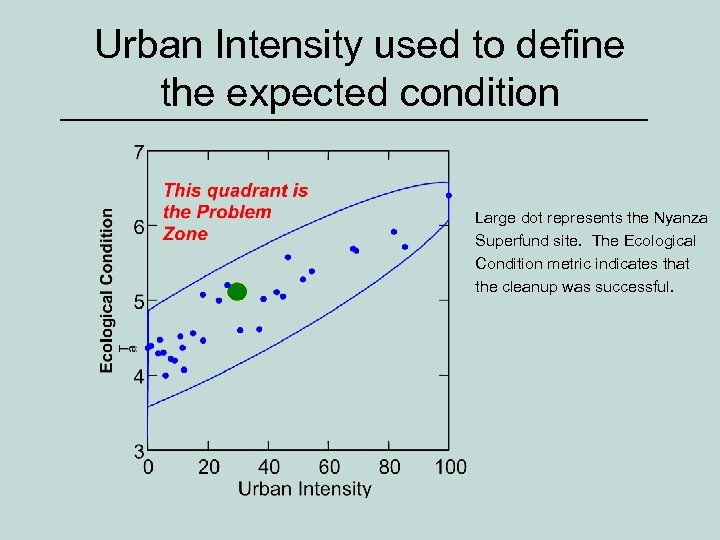
Urban Intensity used to define the expected condition Large dot represents the Nyanza Superfund site. The Ecological Condition metric indicates that the cleanup was successful.
Developing Applications of the Urban intensity Index Addressing the details • Variables used in an urban index can be somewhat esoteric: Socioeconomic factors • The Urban Intensity Index is standardized over the range of study sites, scaled 0 -100. • Results from a single study of 30 sites may be tentative. Other data could be used to corroborate the Urban Intensity Index and the ecological responses.
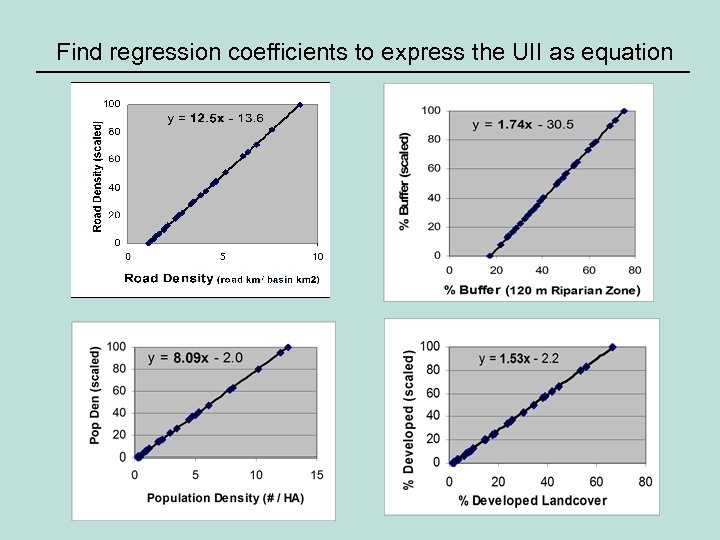
Find regression coefficients to express the UII as equation
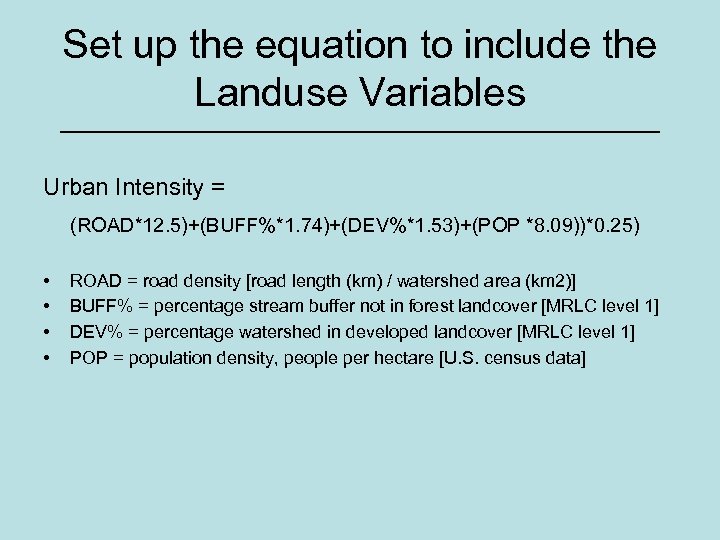
Set up the equation to include the Landuse Variables Urban Intensity = (ROAD*12. 5)+(BUFF%*1. 74)+(DEV%*1. 53)+(POP *8. 09))*0. 25) • • ROAD = road density [road length (km) / watershed area (km 2)] BUFF% = percentage stream buffer not in forest landcover [MRLC level 1] DEV% = percentage watershed in developed landcover [MRLC level 1] POP = population density, people per hectare [U. S. census data]
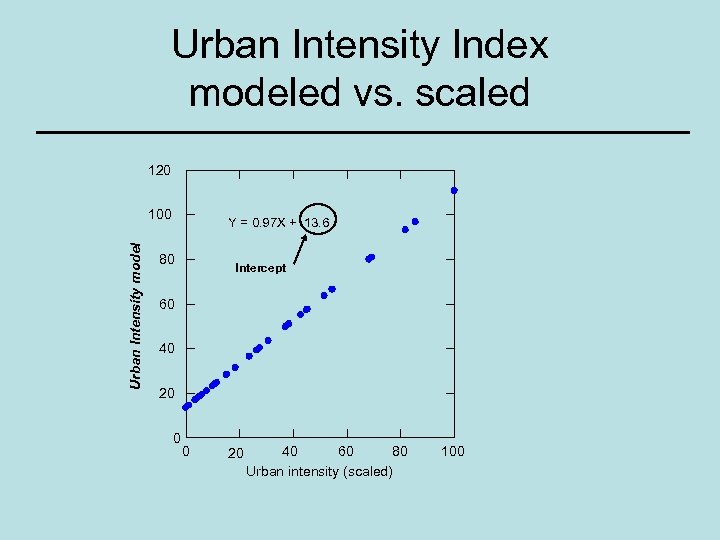
Urban Intensity Index modeled vs. scaled 120 Urban Intensity model 100 Y = 0. 97 X + 13. 6 80 Intercept 60 40 20 0 0 20 40 60 80 Urban intensity (scaled) 100
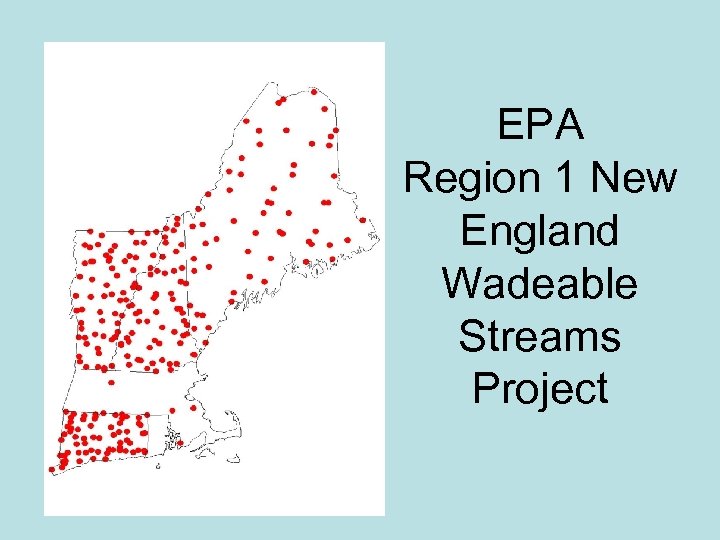
EPA Region 1 New England Wadeable Streams Project
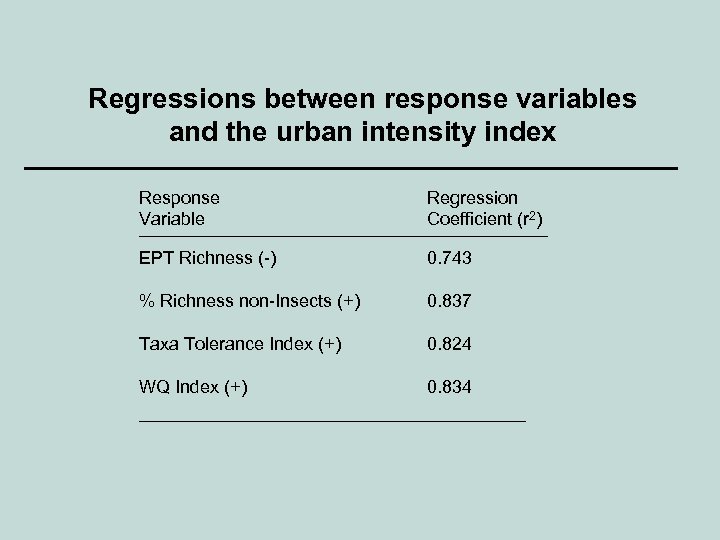
Regressions between response variables and the urban intensity index Response Variable Regression Coefficient (r 2) _____________________________________________________ EPT Richness (-) 0. 743 % Richness non-Insects (+) 0. 837 Taxa Tolerance Index (+) 0. 824 WQ Index (+) 0. 834 _____________________________
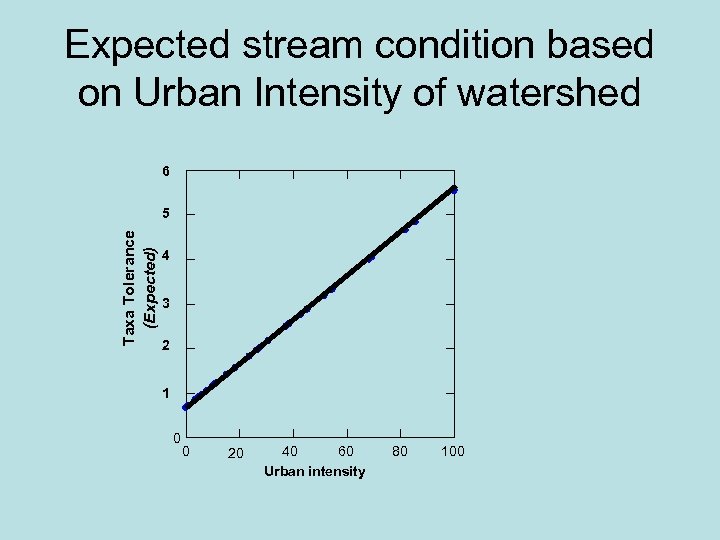
Expected stream condition based on Urban Intensity of watershed 6 Taxa Tolerance (Expected) 5 4 3 2 1 0 0 20 40 60 Urban intensity 80 100
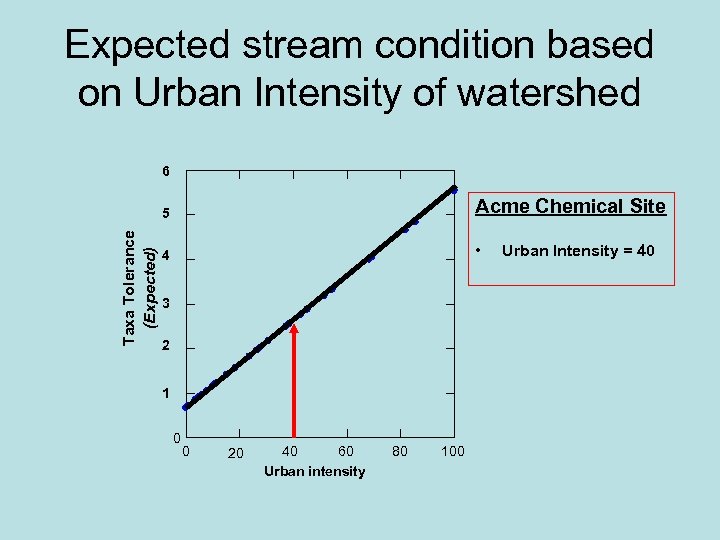
Expected stream condition based on Urban Intensity of watershed 6 Taxa Tolerance (Expected) 5 Acme Chemical Site 4 • 3 2 1 0 0 20 40 60 Urban intensity 80 100 Urban Intensity = 40
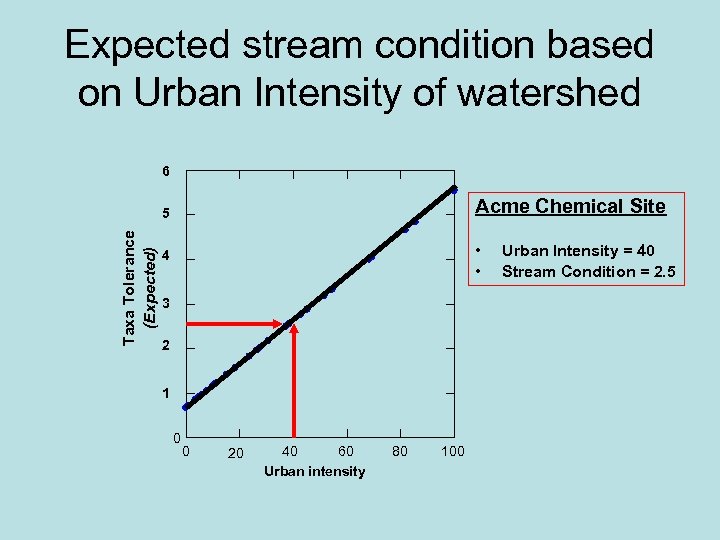
Expected stream condition based on Urban Intensity of watershed 6 Taxa Tolerance (Expected) 5 Acme Chemical Site 4 • • 3 2 1 0 0 20 40 60 Urban intensity 80 100 Urban Intensity = 40 Stream Condition = 2. 5
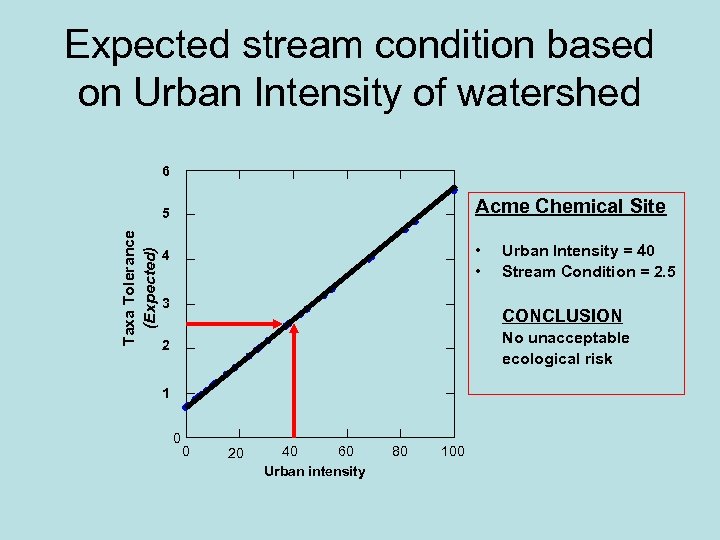
Expected stream condition based on Urban Intensity of watershed 6 Taxa Tolerance (Expected) 5 Acme Chemical Site 4 • • 3 Urban Intensity = 40 Stream Condition = 2. 5 CONCLUSION No unacceptable ecological risk 2 1 0 0 20 40 60 Urban intensity 80 100
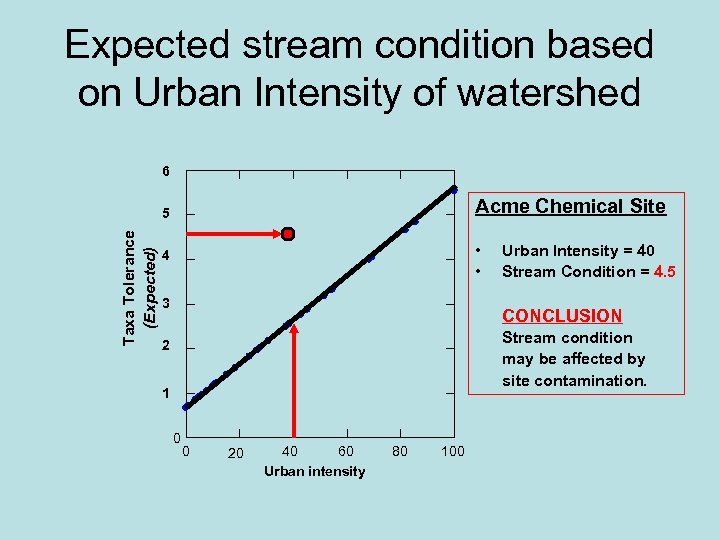
Expected stream condition based on Urban Intensity of watershed 6 Taxa Tolerance (Expected) 5 Acme Chemical Site 4 • • 3 Urban Intensity = 40 Stream Condition = 4. 5 CONCLUSION Stream condition may be affected by site contamination. 2 1 0 0 20 40 60 Urban intensity 80 100
Concluding Points • Study currently being funded by EPA Region I (New England) to use this approach, which is expected to improve Ecological Risk Characterizations. • Even a general awareness of the urban intensity of a basin is useful in making an interpretation of stream condition at a site.
Скачать презентацию Identifying Changes to Stream Condition caused by Urbanization
66ca5eb8c51994557c0125eb7d1a2031.ppt