 Скачать презентацию IDEAS Model for Coalition Architecture Interoperability The
1b0d29cdd7bc3f8f164a0c32c76a46bb.ppt
- Количество слайдов: 24



IDEAS Model for Coalition Architecture Interoperability
The IDEAS Group • International Defense Enterprise Architecture Specification for exchange • Australia, Canada, UK, USA • Sweden & NATO (observers) • Established 2005 • UK is leading the technical work, using UK methodology (BORO) and joint MOD/Contractor team Objective — To deliver a unified specification for the exchange of military architectures between coalition partners.
The Requirement • Australia, Canada, UK and USA have a history of military coalition • Each nation is pursuing its own version of net-centric warfare • How do we ensure coalition interoperability ? • Need to understand: • Each others’ capability and functionality • How to interface with coalition systems • To do this we need to be able to share architectures • Each nation has its own architecture framework • Requirement to share architectural information between nations to enable interoperability at the operational and system levels • Need a standard data format for architectural interoperability • Nations using different tools and data formats
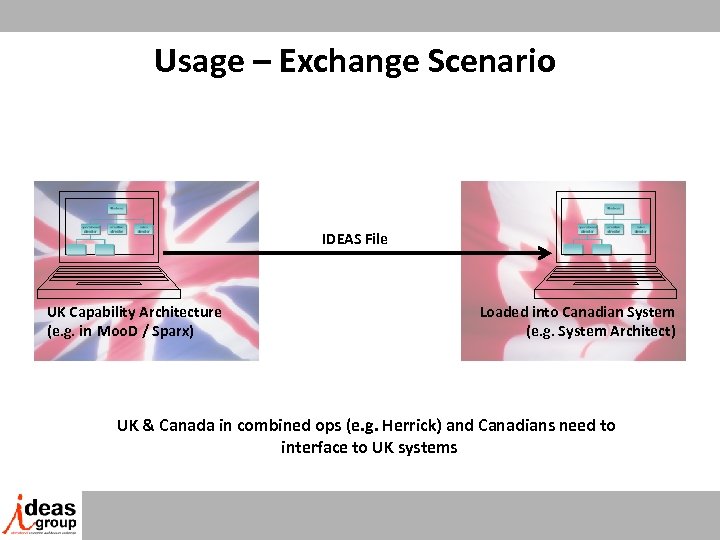
Usage – Exchange Scenario IDEAS File UK Capability Architecture (e. g. in Moo. D / Sparx) Loaded into Canadian System (e. g. System Architect) UK & Canada in combined ops (e. g. Herrick) and Canadians need to interface to UK systems
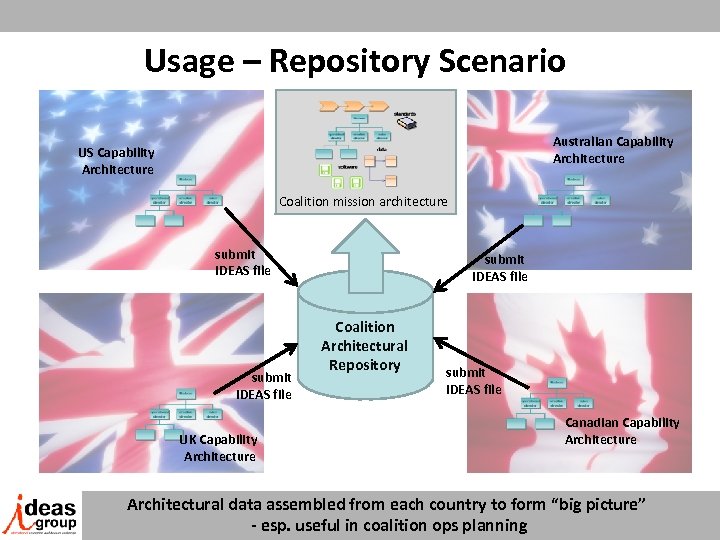
Usage – Repository Scenario Australian Capability Architecture US Capability Architecture Coalition mission architecture submit IDEAS file UK Capability Architecture submit IDEAS file Coalition Architectural Repository submit IDEAS file Canadian Capability Architecture Architectural data assembled from each country to form “big picture” - esp. useful in coalition ops planning
Approach • Use each nation’s architecture framework as input • Analyse the common elements between frameworks • Using the BORO Methodology to de-conflict the different national approaches • Develop integration model (ontology) • Re-apply national terminology • Provides an interfacing mechanism – each nation can continue to work with their own terminology and data whilst still conforming to IDEAS • Implement • Repository (US Experimenting on IDEAS Repository) • XML Data Exchange
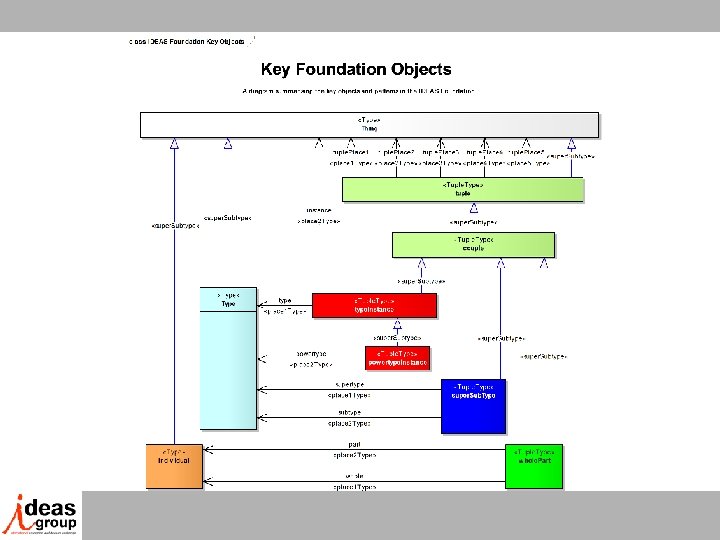
Progress • IDEAS Model is modular and extensible. • Model currently covers: • Foundation – fundamental concepts and relationships • Common objects – re-usable structures and patterns • Subject areas – people & organisations, processes, systems, data models • Prototype interface development has begun in Australia, Canada and USA. • Heavy investment from US – two contractor companies developing IDEAS implementations • UK currently providing technical lead, but no prototyping
Side Benefits • UK requirement for a standard dictionary to support MODAF architectures • Being developed as the “MOD Ontology” by ICAD • Plan is to leverage the IDEAS model to provide the top level of the ontology • Interest in ontology is developing all over Govt. • DG-Info uniquely placed with expertise in formal ontology development • Usage being investigated for data integration in Logs and Casualty tracking – i. e. the benefits and possible uses go well beyond enterprise architecture • BORO methodology being used to re-engineer and de-conflict legacy systems • Again, DG-Info (through ICAD) are thought leaders in MOD

Backup Slide - How is IDEAS Different ? • MOD’s IT history is littered with grand plans for data integration • Failures due to insufficient stakeholder engagement – i. e. attempting to “foist” a data architecture on unwilling parties • Failures due to inadequate analysis techniques – usually based on process modelling • Failures due to inability to properly compare different sources of information • Failures due to “MOD-Centric” approach ignoring coalition partners • IDEAS is different because: • It does not seek to impose a particular terminology, way of working, or data architecture on the users and stakeholders • It brings in the opportunity for international coalition interoperability • It fosters a “view from nowhere” approach – soft systems practitioners will be familiar with this idea • It is strongly founded in set theory, allowing it to provide a more accurate representation of real-world
Backup Slide - What Makes IDEAS Different ? • The BORO Methodology - http: //www. boroprogram. org/ • Provides a precise, mathematical approach to comparing information • Very easy to understand, and stakeholders readily commit to use the methodology • Guaranteed to produce a correct representation, and is fully transparent at every stage – stakeholders are involved so buy-in is kept all the way through • Set Theory • Traditional data modelling is generally not founded in mathematic principles • IDEAS uses formal set theoretic tools to accurately represent the structure of real-world concepts • The Naming Pattern • Once the analysis is complete, the terminology used by the stakeholders is mapped back onto the resulting model • Enables stakeholders to continue working with their own terminology • Allows seamless integration of legacy systems
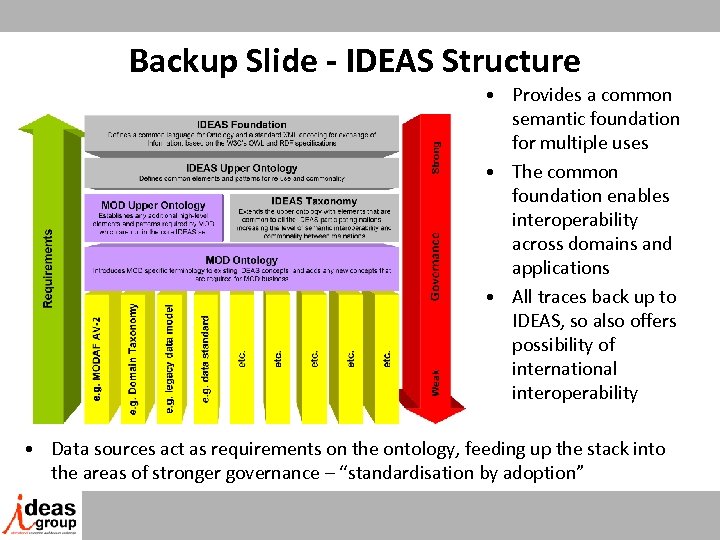
Backup Slide - IDEAS Structure • Provides a common semantic foundation for multiple uses • The common foundation enables interoperability across domains and applications • All traces back up to IDEAS, so also offers possibility of international interoperability • Data sources act as requirements on the ontology, feeding up the stack into the areas of stronger governance – “standardisation by adoption”
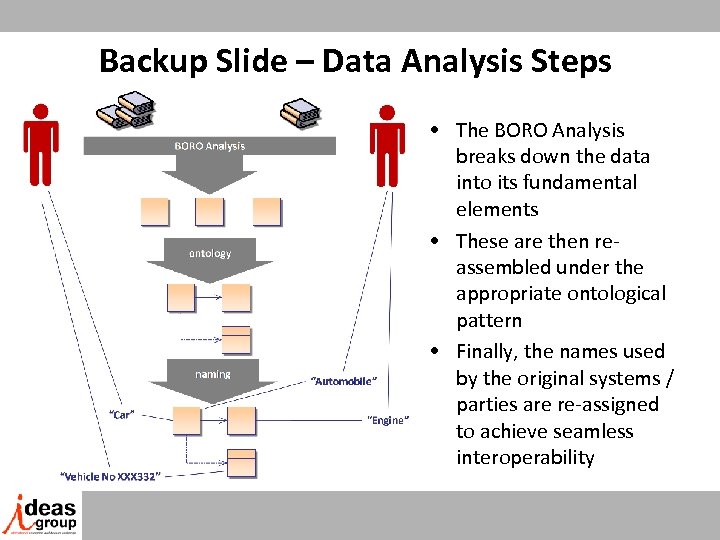
Backup Slide – Data Analysis Steps • The BORO Analysis breaks down the data into its fundamental elements • These are then reassembled under the appropriate ontological pattern • Finally, the names used by the original systems / parties are re-assigned to achieve seamless interoperability
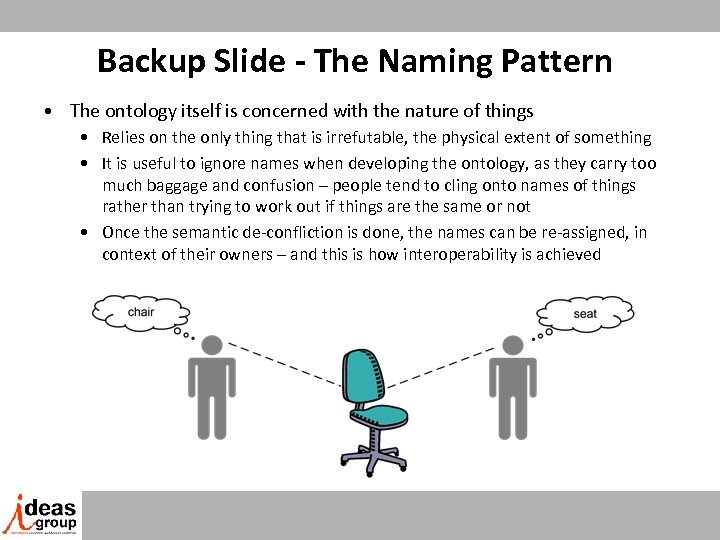
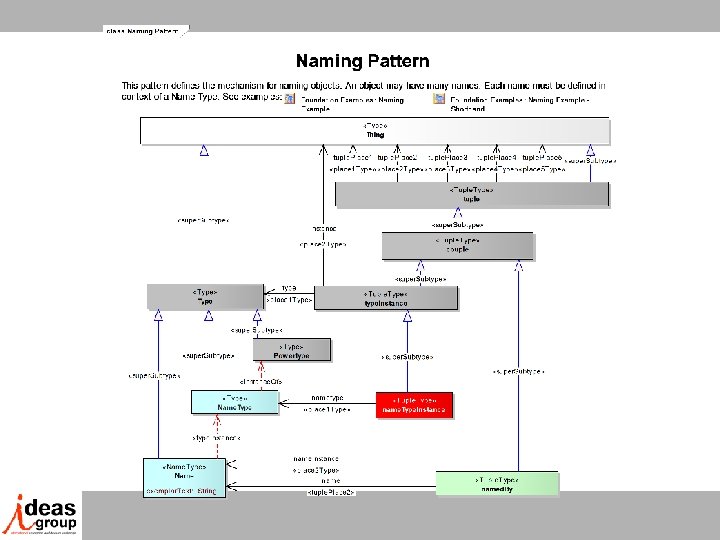
Backup Slide - The Naming Pattern • The ontology itself is concerned with the nature of things • Relies on the only thing that is irrefutable, the physical extent of something • It is useful to ignore names when developing the ontology, as they carry too much baggage and confusion – people tend to cling onto names of things rather than trying to work out if things are the same or not • Once the semantic de-confliction is done, the names can be re-assigned, in context of their owners – and this is how interoperability is achieved
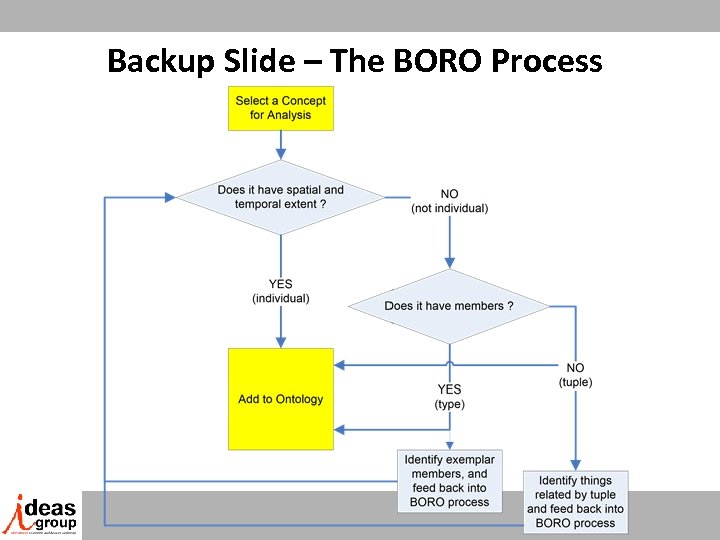
Backup Slide – The BORO Process
 Скачать презентацию IDEAS Model for Coalition Architecture Interoperability The
1b0d29cdd7bc3f8f164a0c32c76a46bb.ppt