


 Скачать презентацию IDEA 2004 Where Are We Now CASP Convention
c57ae3ca1e1c0a8b26c734daad86d97c.ppt
- Количество слайдов: 90
 IDEA 2004: Where Are We Now? CASP Convention 2006 Presented By Howard J. Fulfrost, Esq. Copyright© Lozano Smith 2003
 Presentation Overview v How Did We Get Here? : A Brief History v Where Are We Now? : A Comparison of IDEA 2004, AB 1662 & the Proposed IDEA 2004 Regulations v What’s Left to Do? : Reviving AB 1092 as Clean- Up Legislation Copyright© Lozano Smith 2003
 Part I How Did We Get Here? : A Brief History Copyright© Lozano Smith 2003
 A Brief History: The President’s Commission v President’s Commission on Excellence in Special Education issues report on July 1, 2002 – “This report represents the thoughts, recommendations, and wisdom – spoken and written – of more than 100 recognized special education experts, educational finance experts, education and medical researchers, parents of children with disabilities, individuals with disabilities, and others with expertise in the field of special education. ” – “In addition, the commission heard from hundreds of other individuals and organizations at 13 public meetings held in cities nationwide. Interested individuals, including and parents of students with disabilities, also submitted letters and other written comments. ” (Letter of Transmittal from Terry E. Branstad to President Bush dated July 1, 2002) Copyright Lozano Smith 2003 ©
 A Brief History: Congress Acts v Part C of IDEA 1997 to be reauthorized in 2002 v President’s Commission recommends changes to IDEA 1997 beyond Part C v Senate & House Sponsor Reauthorization Bills – Senate & House bills seek to address recommendations of President’s Commission – Senate & House seek additional & Copyright Lozano Smith 2003 extensive input from all constituent groups ©
 A Brief History: IDEA 2004 Signed v President signs Individuals with Disabilities Education Improvement Act 2004 on December 3, 2004 – Title 20 United States Code (USC) § 1400 et seq. – Title 20 USC § 1401(a) provides that “[t]his title may be cited as the ‘Individuals with Disabilities Education Act’. ” – We call it “IDEA 2004” – Most IDEA 2004 provisions are effective July Copyright Lozano Smith 2003 1, 2005 ©
 A Brief History: IDEA 2004 in California v As things stood in December 2004, IDEA 2004 would have no impact in California v Why? – State law will control where it grants greater protections to children with disabilities – Then current California law could be interpreted to grant greater protections to children with disabilities than IDEA 2004 – Therefore, then current California would control Copyright© Lozano Smith 2003
 A Brief History: AB 1092 v January 2005: – CSBA formed a work group to develop a state conformity bill: • • Authored by Assemblywoman Lynn Daucher Formally sponsored by CSBA & ACSA Supported by many education organizations Designated Assembly Bill 1092 Copyright© Lozano Smith 2003
 A Brief History: AB 1092 v The AB 1092 work group included, but was not limited to: – SELPA Directors – School district attorneys – CSBA, ACSA, School Services of California, and CTA representatives – Lobbyists and government relations representatives – Assemblywoman Daucher’s representatives Copyright© Lozano Smith 2003
 A Brief History: AB 1662 v Initially, the CDE sought to introduce three bills: – – – v One bill would be “too hot” The second bill would be “too cold” And the third bill would be “just right” January 2005: – The CDE hired a consultant to develop one state conformity bill in collaboration with CDE representatives: • Authored by Assemblywoman Sally Lieber • Formally sponsored by CDE • Designated Assembly Bill 1662 Copyright© Lozano Smith 2003
 A Brief History: Full Conformity AB 1092 & AB 1662 both purportedly sought “full conformity” with IDEA 2004 v What is “full conformity? ” v “Full conformity” means that California law would be identical to IDEA 2004 v – AB 1092 sought to replace California law with IDEA 2004 in all regards – AB 1662 did not seek to replace California law with IDEA 2004 in all regards: • AB 1662 replaced California law with IDEA 2004 citations • AB 1662 replaced California law with IDEA 2004 • AB 1662 kept California law unchanged Copyright© Lozano Smith 2003
 A Brief History: Full Conformity v Why “full conformity? ” – IDEA 2004 was the product of thousands of hours of debate and input from experts & all stakeholders – IDEA 2004 conforms with NCLB (i. e. , presumably reducing the number of students referred for, and receiving, special education services) – IDEA 2004 allows school districts to provide more service to students with disabilities • • Fewer evaluations Fewer IEP team meetings Fewer attendees at IEP team meetings Reduces paperwork burdens Copyright© Lozano Smith 2003
 A Brief History: Full Conformity v Why “full conformity? ” – IDEA 2004 reduces disputes between parents and school districts • No liability when parents won’t consent to initial provision of special education services • Advance notice of due process issues • Opportunity to resolve disputes early • Allows districts to recoup attorney fees in specified cases • Allows districts to remove dangerous students – IDEA 2004 limits the number of students considered eligible for special education Copyright Lozano Smith 2003 services ©
 A Brief History: Full Conformity v Why not “full conformity? ” – IDEA 2004 sets minimum standards – States may set standards higher than the minimum – IDEA 2004 is not how we’ve done business in California – IDEA 2004 would undo, in certain respects, the “years of work” put into creating California’s special education system Copyright© Lozano Smith 2003
 A Brief History: The Political Machinery At Work v April 2005: – AB 1662 was passed out of the Assembly Education Committee – AB 1092 was tabled and re-designated as a two-year bill v May through September 2005: – A coalition of education organizations formally opposed AB 1662 – The CDE negotiated changes to AB 1662 with this education coalition so that AB 1662 more closely conformed to IDEA 2004 Copyright© Lozano Smith 2003
 A Brief History: AB 1662 Signed into Law v On October 7, 2005, Governor Schwarzenegger signed AB 1662 into law – AB 1662 was urgency legislation – AB 1662 was effective October 7, 2005 – AB 1662 brings California law into conformity with IDEA 2004 in many – but not all – respects Copyright© Lozano Smith 2003
 Part II Where Are We Now? : A Comparison of IDEA 2004, AB 1662 & the Proposed IDEA 2004 Regulations Copyright© Lozano Smith 2003
 Current State of Affairs v Actually in Effect – IDEA 2004 – Education Code § 56000 et seq. as amended by AB 1662 – IDEA 1997 regulations to the extent they do not conflict with IDEA 2004 – SEHO and OAH rulings and decisions v Non-Authoritative Guidance – Proposed IDEA 2004 regulations (June 21, 2005) – At least one CDE advisory with one on the Copyright Lozano Smith 2003 way ©
 Key Definitions – Assistive Technology v IDEA 2004: Excludes medical device that is surgically implanted (or its replacement) from definition of “assistive technology” or “related services” v AB 1662: Follows IDEA 2004 v Proposed CFR: Follows IDEA 2004 v What do we do? Follow IDEA 2004 Copyright© Lozano Smith 2003
 Key Definitions – Highly Qualified Teacher v IDEA 2004: Borrows definition from NCLB as it relates to special ed teachers. v AB 1662: Follows IDEA 2004 v Proposed CFR: Follows IDEA 2004 v What do we do? Follow IDEA 2004 Copyright© Lozano Smith 2003
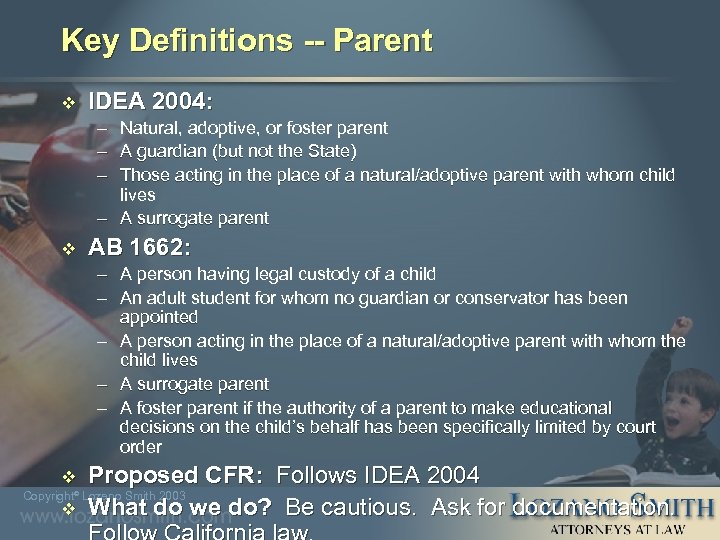 Key Definitions -- Parent v IDEA 2004: – Natural, adoptive, or foster parent – A guardian (but not the State) – Those acting in the place of a natural/adoptive parent with whom child lives – A surrogate parent v AB 1662: – – A person having legal custody of a child An adult student for whom no guardian or conservator has been appointed – A person acting in the place of a natural/adoptive parent with whom the child lives – A surrogate parent – A foster parent if the authority of a parent to make educational decisions on the child’s behalf has been specifically limited by court order Proposed CFR: Follows IDEA 2004 Copyright Lozano Smith 2003 v What do we do? Be cautious. Ask for documentation. v ©
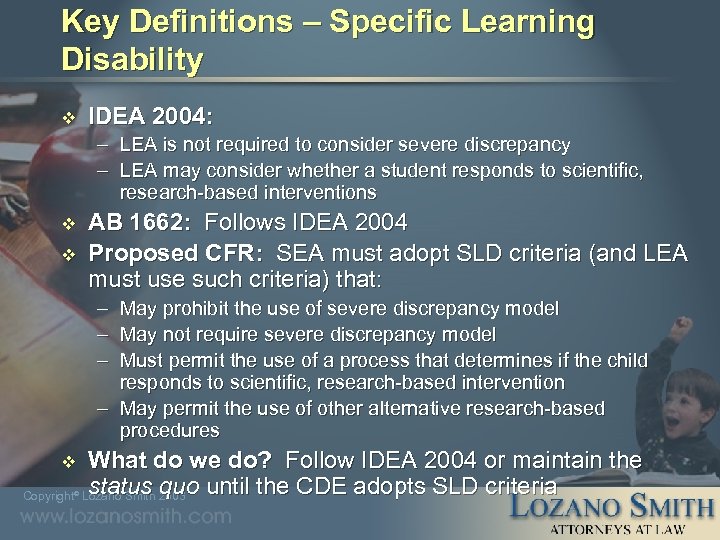 Key Definitions – Specific Learning Disability v IDEA 2004: – LEA is not required to consider severe discrepancy – LEA may consider whether a student responds to scientific, research-based interventions v v AB 1662: Follows IDEA 2004 Proposed CFR: SEA must adopt SLD criteria (and LEA must use such criteria) that: – – – May prohibit the use of severe discrepancy model May not require severe discrepancy model Must permit the use of a process that determines if the child responds to scientific, research-based intervention – May permit the use of other alternative research-based procedures What do we do? Follow IDEA 2004 or maintain the status quo until the CDE adopts SLD criteria Copyright Lozano Smith 2003 v ©
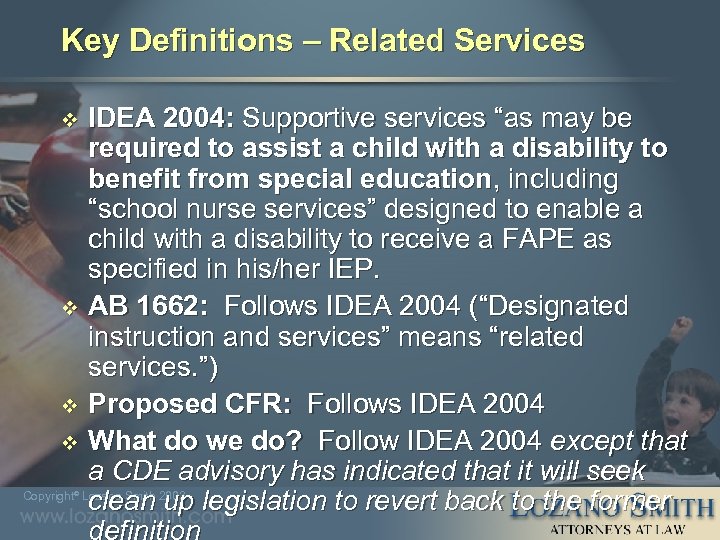 Key Definitions – Related Services IDEA 2004: Supportive services “as may be required to assist a child with a disability to benefit from special education, including “school nurse services” designed to enable a child with a disability to receive a FAPE as specified in his/her IEP. v AB 1662: Follows IDEA 2004 (“Designated instruction and services” means “related services. ”) v Proposed CFR: Follows IDEA 2004 v What do we do? Follow IDEA 2004 except that a CDE advisory has indicated that it will seek Copyright Lozano Smith 2003 clean up legislation to revert back to the former v ©
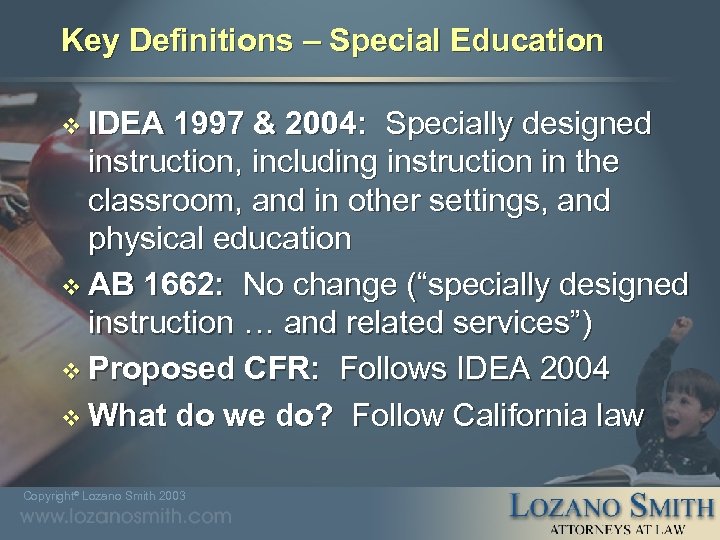 Key Definitions – Special Education v IDEA 1997 & 2004: Specially designed instruction, including instruction in the classroom, and in other settings, and physical education v AB 1662: No change (“specially designed instruction … and related services”) v Proposed CFR: Follows IDEA 2004 v What do we do? Follow California law Copyright© Lozano Smith 2003
 Key Definitions – Transition Services v IDEA 2004: “A coordinated set of activities … within a “results oriented process, that is focused on improving the academic and functional achievement of the child with a disability. . . ” v AB 1662: Cites IDEA 2004, but then requires an “outcome-oriented process” v Proposed CFR: Follows IDEA 2004 v What do we do? Follow IDEA 2004 Copyright© Lozano Smith 2003
 Parentally Placed Private Schools Students – Child Find v IDEA 2004: LEA where child attends private school responsible for child find, including assessment – Child find process should include activities, and be completed in a time period, similar to those undertaken for public school students – Process must be designed to ensure “equitable participation” of parentally placed private school children and an accurate count of such children – Proportionate share of federal funds may not be used for child find activities AB 1662: LEA where child resides responsible for child find, including assessment, but cites to federal law for what child find activities must Copyright Lozano Smith 2003 include v Proposed CFR: Follows IDEA 2004 v ©
 Parentally Placed Private Schools Students – Services v IDEA 2004: LEA where child attends private school responsible for providing services v AB 1662: Cites to IDEA 2004, suggesting that the LEA where the child attends private school is responsible for providing services v Proposed CFR: Follows IDEA 2004 v What do we do? Follow IDEA 2004 Copyright© Lozano Smith 2003
 Parentally Placed Private Schools Students – Consultation v IDEA 2004: LEA should ensure timely and meaningful consultation regarding: – – – The child find process The determination of the proportionate share of federal funds The consultation process (including how it will operate throughout the school year) – How, where, and by whom special education and related services will be provided – How the LEA will provide an explanation of the reasons why the LEA chose to provide particular services if the private school officials disagree AB 1662: Cites to IDEA 2004 v Proposed CFR: Follows IDEA 2004 v What do we do? Follow IDEA 2004 Copyright Lozano Smith 2003 v ©
 Parentally Placed Private Schools Students – Written Affirmation & Compliance v IDEA 2004: – LEA must obtain written affirmation from private school officials that consultation has occurred. – Private school officials may file compliance complaints if LEA did not: • Timely or meaningfully consult; or • Give “due consideration to the views of the private school official. ” AB 1662: Cites to, and reiterates language of, IDEA 2004 v Proposed CFR: Follows IDEA 2004 v What do we do? Follow IDEA 2004 Copyright Lozano Smith 2003 v ©
 Initial Evaluation -- Timeline v v IDEA 2004: LEA must determine eligibility within 60 days of parental consent to assess (or within Stateestablished timeline) AB 1662: – LEA must convene an IEP team meeting to determine eligibility and educational needs within 60 days of parental consent to assess (possibly excluding days between the student’s regular school sessions or vacations in excess of five school days) – LEA must convene an IEP team meeting within 30 days from the date the LEA determines that the student needs special education & related services v v Proposed CFR: Follows IDEA 2004 What do we do? Follow IDEA 2004 since the CDE has indicated that it will seek clean up legislation to clarify that it intended a 60 -day timeline for all evaluations Copyright© Lozano Smith 2003
 Initial Evaluation -- Exceptions to Timeline v IDEA 2004: The 60 -day timeline will not apply if: – The child enrolls in another LEA after the timeframe has begun to run only if the subsequent LEA is making sufficient progress to ensure a prompt completion of the evaluation and the parent and subsequent LEA agree to a specific time when the evaluation will be completed; or – The parent repeatedly fails or refuses to produce the child for the evaluation AB 1662: Follows IDEA 2004 v Proposed CFR: Follows IDEA 2004 v What do we do? Follow IDEA 2004 Copyright Lozano Smith 2003 v ©
 Initial Evaluation – Parental Consent v IDEA 2004: LEA must obtain informed parental consent before an initial evaluation – Not construed as consent for services – If parent fails to provide consent, LEA may pursue due process to override lack of consent v AB 1662: Cites to, and reiterates, IDEA 2004 v Proposed CFR: Follows IDEA 2004 v What do we do? Follow IDEA 2004 Copyright© Lozano Smith 2003
 Reevaluation -- Frequency v IDEA 2004: LEA must reassess: – If LEA determines that the educational or related services needs of the child warrant a reevaluation; or – If the child’s parents or teacher requests a reevaluation – Not more than once a year unless parent and LEA agree otherwise – At least every three years unless parent and LEA agree that “a reevaluation is unnecessary. ” AB 1662: Cites to, and reiterates language of, IDEA 2004 except that it requires written agreement not to conduct triennial reevaluation v Proposed CFR: Follows IDEA 2004 v What do we do? Follow IDEA 2004 except obtain written agreement not to conduct triennial Copyright Lozano Smith 2003 reevaluations v ©
 Revaluation -- Procedures v IDEA 2004: – The IEP team and other qualified professionals must: (1) review existing data on the child; and (2) on the basis of that review and input from the student’s parents, identify what additional data, if any, are needed to determine eligibility, identify the student’s educational needs, and develop the student’s IEP. – If no additional data are needed to determine eligibility and identify the student’s educational needs, the LEA: • Must notify the student’s parents of that determination, the reasons for it, and the right to request an assessment anyway • Will not be required to complete an evaluation unless requested by the student’s parents. AB 1662: Follows IDEA 2004 v Proposed CFR: Follows IDEA 2004 v What do we do? Follow IDEA 2004 v Copyright© Lozano Smith 2003
 Reevaluation – Parental Consent v IDEA 2004: LEA must obtain informed parental consent before a reevaluation except when – The parent fails or refuses to respond after LEA’s documented diligent attempts to obtain consent – The LEA prevails in a due process hearing on assessment v AB 1662: Follows IDEA 2004 v Proposed CFR: Follows IDEA 2004 v What do we do? Follow IDEA 2004 Copyright© Lozano Smith 2003
 Reevaluation -- Timeline v IDEA 2004: No timeline for reevaluation v AB 1662: LEA must convene an IEP team meeting within 60 days of parental consent to reevaluation – Excluding days between the student’s regular school sessions or vacations in excess of five school days – An IEP must be developed within 30 days after the start of the subsequent regular school year for students for whom a referral has been made within 20 days or less prior to the end of the regular school year v Proposed CFR: Follows IDEA 2004 v What do we do? Follow California law Copyright© Lozano Smith 2003
 Reevaluation – Before Graduation or “Aging Out” v IDEA 2004: – LEA is not required to reevaluate before the termination of a student’s eligibility due to graduating with a regular high school diploma or “aging out. ” – In such cases, LEA must provide the student with a summary of the student’s academic achievement and functional performance, including recommendations on how to assist the student in meeting postsecondary goals. AB 1662: Cites to, and reiterates, IDEA 2004 v Proposed CFR: Follows IDEA 2004 v What do we do? Follow IDEA 2004 Copyright Lozano Smith 2003 v ©
 Reevaluation – Before Exiting v IDEA 2004: LEA must evaluate a child with a disability before determining that the child is no longer a child with a disability v AB 1662: Cites to, and reiterates, IDEA 2004 v Proposed CFR: Follows IDEA 2004 v What do we do? Follow IDEA 2004 Copyright© Lozano Smith 2003
 Screening IDEA 2004: “The screening of a student by a teacher or specialist to determine appropriate instructional strategies for curriculum implementation shall not be considered to be an evaluation for eligibility for special education and related services. ” v AB 1662: Cites to, and reiterates, IDEA 2004 v Proposed CFR: Follows IDEA 2004 v What do we do? Follow IDEA 2004, and, as screening is not an evaluation, it does not therefore require informed parental consent Copyright Lozano Smith 2003 v ©
 Parental Consent – Initiation of Services v IDEA 2004: If a parent refuses the initial provision of special education services, the LEA cannot request due process – The LEA will not be considered to be in violation of the requirement to make FAPE available for failing to provide those services for which the LEA seeks consent – The LEA will not be required to convene an IEP team meeting or develop an IEP for the child for the special education and related services for which the LEA requests such consent AB 1662: Reiterates IDEA 2004 v Proposed CFR: Follows IDEA 2004 Copyright Lozano Smith 2003 v What do we do? Follow IDEA 2004 v ©
 Parental Consent – Continuation of Services IDEA 2004: No parental consent requirement for continuation of services v AB 1662: v – If parent refuses all services, having consented in the past, LEA must file for due process. – If parent consents to some IEP components, but not others, LEA shall provide those services to which consent has been provided and initiate due process regarding the others, if necessary to provide FAPE. Proposed CFR: Follows IDEA 2004 v What do we do? Follow California law v Copyright© Lozano Smith 2003
 Eligibility v IDEA 2004: A determinant factor cannot be lack of appropriate instruction in reading, including the essential components of reading instruction as defined in NCLB v AB 1662: Follows IDEA 2004 v Proposed CFR: Follows IDEA 2004 v What do we do? Follow IDEA 2004 Copyright© Lozano Smith 2003
 IEP Team Meetings -- Attendance v IDEA 2004: – Parent and LEA may agree in writing not to require attendance if team member’s area not topic of meeting – Parent and LEA may agree in writing to excuse attendance if team member’s area is topic of meeting, but submits written input to parent and IEP team prior to meeting AB 1662: Follows IDEA 2004, but requires parent and LEA to consent to excusal after conferring with the team member v Proposed CFR: Follows IDEA 2004 Copyright Lozano Smith 2003 v What do we do? Follow California law v ©
 IEP Team Meetings – Revisions v IDEA 2004: – After annual review, IEP revisions may be made • By the entire IEP team; or • By developing a written document amending the IEP, if the parent and LEA agree – Upon request, the parent must be provided a copy of the revised IEP with the amendments incorporated. AB 1662: Cites to, and reiterates, IDEA 2004, but requires the written document to be signed by the parent and a LEA representative v Proposed CFR: Follows IDEA 2004. v What do we do? Follow California law v Copyright© Lozano Smith 2003
 IEP Team Meetings – Goals & Objectives v IDEA 2004: – IEPs must include measurable annual goals – For students who take alternate assessments aligned to alternate achievement standards, the IEP must include a description of benchmarks or short-term objectives. v AB 1662: Reiterates IDEA 2004 v Proposed CFR: Follows IDEA 2004 v What do we do? Follow IDEA 2004 Copyright© Lozano Smith 2003
 IEP Team Meetings -- Transition Services v IDEA 2004: Not later than the first IEP in effect when the student reaches 16, and updated annually thereafter, IEP must include: – Appropriate measurable postsecondary goals based on age-appropriate transition assessments – Transition services to assist the student in reaching the goals – Beginning not later than one year before the child reaches 18 years old, a statement that the student has been informed of his/her rights, if any, that will transfer on reaching 18 years old AB 1662: Reiterates IDEA 2004 v Proposed CFR: Identical to IDEA 2004 Copyright Lozano Smith 2003 v What do we do? Follow IDEA 2004 v ©
 IEP Team Meetings -- Extended School Year v IDEA 2004: No provision regarding ESY v AB 1662: Reiterates IDEA 1997 and proposed CFR v Proposed CFR: Reiterates IDEA 1997 CFR (ESY services must be included in IEP, and provided to student, if necessary for FAPE) v What do we do? Follow California law Copyright© Lozano Smith 2003
 Students Transferring Mid-Year v IDEA 2004: – Within the same state: LEA must provide “services comparable to those described in the previously held IEP … in consultation with the parents until such time as the LEA adopts the previously held IEP or develops, adopts, and implements a new IEP. ” – Between states: LEA must provide “services comparable to those described in the previously held IEP … in consultation with the parents until such time as the LEA conducts an evaluation, if necessary, and develops a new IEP, if appropriate. ” – Records: The new LEA must promptly obtain the student’s records; and the previous LEA must Copyright Lozano Smith 2003 promptly respond to a records request. ©
 Students Transferring Mid-Year (Continued) v AB 1662: – Within SELPA: New LEA must continue, without delay, to provide services comparable to those described in the existing approved IEP, unless the parent and the new LEA agree to develop, adopt, and implement a new IEP. – Within state, different SELPA: New LEA must provide “services comparable to those described in the previously approved IEP, in consultation with the parents, for a period not to exceed 30 days, by which time the LEA must adopt the previously approved IEP, or must develop, adopt, and implement a new IEP. ” – Between states: Cites to, and reiterates, IDEA 2004 – Records: Reiterates IDEA 2004. v Proposed CFR: Follows IDEA 2004 v What do we do? Follow California law Copyright© Lozano Smith 2003
 Notice of Procedural Rights v IDEA 2004: – Parents must receive one copy per year and upon initial referral or parental request for evaluation, upon first due process request, and upon request. – May receive by e-mail, if LEA makes available. AB 1662: Reiterates IDEA 2004, except that the parent must still receive a copy with an assessment plan v Proposed CFR: Follows IDEA, but clarifies that parent must also receive a copy upon first State complaint Copyright Lozano Smith 2003 we do? Follow state law v What do v ©
 Prior Written Notice v IDEA 2004: Prior written notice must now include description of other options considered by IEP team and reasons for rejection and description of relevant factors in LEA’s decision. v AB 1662: Cites to IDEA 2004 v Proposed CFR: Follows IDEA 2004 v What do we do? Follow IDEA 2004 Copyright© Lozano Smith 2003
 Compliance Complaints – Statute of Limitations v IDEA 2004: It may require a complaint to set forth “an alleged violation that occurred not more than two years before the date the parent or public agency knew or should have known about the alleged violation, ” or “in such time as the State law allows” except if the parent was prevented from filing a complaint due to: – Specific misrepresentations by the LEA that it had resolved the problem forming the basis of the complaint; or – The LEA’s withholding of information from the parent that was required to be provided to the parent. AB 1662: Follows Proposed CFR (A compliance complaint must “allege a violation that occurred not more than one year prior to the date that the complaint is received by the CDE. ”), but references IDEA 1997 CFR which has an exception for continuing violations Copyright Lozano Smith 2003 v Proposed CFR: See AB 1662, above. v ©
 Due Process – Complaints v IDEA 2004: – Must contain: • The child’s name, address (or available contact info if homeless child), and attending school; • A description of the nature of the problem relating to proposed initiation or change, including facts; and • Proposed resolution of the problem. – A party may not have a due process hearing until the party files a complaint that meets these requirements – A party may not raise issues in a due process hearing that were not included in the complaint, unless the other party agrees otherwise. v v v AB 1662: Follows IDEA 2004 Proposed CFR: Follows IDEA 2004 What do we do? Follow IDEA 2004 Copyright© Lozano Smith 2003
 Due Process – Statute of Limitations IDEA 2004: Two years from the date the parent or agency knew or should have known about the alleged action (with exceptions for parent delay due to LEA’s misrepresentation or withholding information) v AB 1662: v – Three years until October 9, 2006, if parent participates in resolution session or mediation; otherwise, two years – After October 9, 2006, two years from the date the parent or agency knew or should have known about the alleged action (with exceptions for parent delay due to LEA’s misrepresentation or withholding information) Copyright Lozano Smith 2003 © v Proposed CFR: Follows IDEA 2004.
 Due Process – Response to Complaint v IDEA 2004: – Prior Written Notice: LEA must provide prior written notice within 10 days of receipt of the DP complaint if LEA has not previously provided such notice. response – Other Party Response: LEA must respond to the DP complaint (by specifically addressing the issues in the DP complaint) within 10 days of receipt of the DP complaint – Notice of Insufficiency – Responding party must provide Notice of Insufficiency within 15 days of receipt of the DP complaint • Hearing Officer must decide whether DP complaint is sufficient within five days of receiving Notice of Insufficiency AB 1662: Cites to, and reiterates, IDEA 2004 Copyright© Lozano Smith 2003 v
 Due Process – Amended Complaint v IDEA 2004: A party may amend its DP complaint only if: – The other party consents in writing and is given the opportunity to resolve the complaint through the resolution meeting process; or – The hearing officer grants permission, except that the hearing officer may only grant permission at any time not later than five days before a due process hearing occurs The applicable due process hearing timelines will recommence at the time the party files an amended DP complaint. v AB 1662: Cites to, and reiterates, IDEA 2004 v Proposed CFR: Follows IDEA 2004 Copyright Lozano Smith 2003 we do? Follow IDEA 2004 v What do v ©
 Due Process – Resolution Meeting v IDEA 2004: LEA required to convene resolution session within 15 days of receipt of due process complaint with parent and relevant team, including LEA decision-maker – – – No LEA attorney unless parent brings attorney Parents discuss issues and facts forming basis of DP complaint LEA has opportunity to resolve the matter By agreement can waive, or agree to use mediation If no agreement after 30 days, hearing can occur and DP hearing timelines commence – If issues are resolved, the parties must execute a legally binding agreement (signed by both parties and enforceable in court), voidable within 3 business days. AB 1662: Reiterates IDEA 2004 v Proposed CFR: Follows IDEA 2004 except that it provides that the parent and LEA will determine the Copyright Lozano Smith 2003 relevant team members v What do we do? Follow IDEA 2004 v ©
 Due Process – Hearing Officer Decision v IDEA 2004: – A hearing officer decision must be made on substantive grounds based on a determination of whether the child received a FAPE. – In matters alleging a procedural violation, a hearing officer may find that a child did not receive a FFAPE only if the procedural violations: • Impeded child’s right to FAPE; • Significantly impeded parents’ opportunity to participate in the decision-making process regarding the provision of a FAPE; or • Caused a deprivation of educational benefits AB 1662: Reiterates IDEA 2004, except also keeps old language in Education Code § Copyright Lozano Smith 2003 56505(j) v ©
 Due Process – Attorney Fees for LEA v IDEA 2004: Court may award if LEA prevails against – Parent attorney for filing that is frivolous, unreasonable, without foundation – Parent attorney who continues litigation that is frivolous, unreasonable, without foundation v Court may award fees to LEA against – Parent attorney/parent, if filing presented for improper purpose such as to harass, cause unnecessary delay, or needlessly increase the cost AB 1662: Reiterates IDEA 2004 v Proposed CFR: Follows IDEA 2004 Copyright Lozano Smith 2003 v What do we do? Follow IDEA 2004 v ©
 Student Discipline – Current Status IDEA 2004: Special education students may be disciplined in accordance with IDEA 2004 (20 USC § 1415(k)) v California Law (EC § 48915. 5): Special education students may be disciplined in accordance with: v – IDEA (20 USC § 1415(k)); – IDEA 1997 regulations (34 CFR §§ 300. 519 – 300. 529); and – Other applicable California Education Code provisions 1997 CFR: IDEA 1997 regulations (34 CFR §§ 300. 519 – 300. 529) remain in effect to the Copyright Lozano Smith 2003 extent they are consistent with IDEA 2004 v ©
 Student Discipline: Authority of School Personnel v IDEA 2004: School personnel may consider: – any unique circumstances – on a case-by-case basis – when determining whether to order a change in placement for a special education student – who violates a code of student conduct Copyright© Lozano Smith 2003
 Student Discipline: Authority of School Personnel v IDEA 2004: School personnel: – – – May remove a special education student Who violates a code of student conduct From his/her current placement to • An appropriate interim alternative educational setting (IAES) as determined by the IEP team; • Another setting; or • A suspension – – For not more than 10 school days To the extent that such alternatives are applied to students without disabilities – In such cases, the same procedural protections that apply to non-disabled students apply to special education students Copyright Lozano Smith 2003 ©
 Student Discipline – Removal v 1997 CFR: – Children are “removed” when they cannot continue to: • Progress in the general curriculum; • Receive the services specified on their IEP; and/or • Participate with nondisabled children to the extent they would have in their current placement. – Removals may include: • In-school suspensions • Bus suspensions Copyright© Lozano Smith 2003
 Student Discipline – Change of Placement v 1997 CFR: – A “removal” that constitutes a “change of placement” triggers significant procedural protections. – A “removal” is a “change of placement” when it: • Is for more than 10 consecutive school days (i. e. , an expulsion). • Is for more than 10 cumulative school days and constitutes a pattern because: – They cumulate to more than 10 school days in a school year; and – Because of factors such as: » The length of each removal; » The total amount of time the child is removed; and Copyright Lozano Smith 2003 » The proximity of the removals to one another. ©
 Student Discipline – No Change of Placement v 1997 CFR: – What happens when a student is removed for more than 10 cumulative school days and the conduct does not constitute a pattern? – The IDEA 1997 regulations provide that: • General disciplinary rules apply • The student has the right to educational services on the 11 th day of removal in order to enable him/her to: – Continue to participate in the general education curriculum, although in another setting; and – Continue to receive those educational services contained in the child’s IEP, so that the child can progress toward achieving IEP goals • School personnel are to consult with at least one of the student’s teachers to determine the scope of services and location, if any Copyright Lozano Smith 2003 ©
 Student Discipline – Authority of School Personnel v IDEA 2004: If school personnel seek to: – Order a change in placement that would exceed 10 school days, and – The behavior that gave rise to disciplinary action is determined not to be a manifestation of the student’s disability – The relevant disciplinary procedures applicable to students without disabilities may be applied to the special education student in the same manner and for the same duration in which the procedures would be applied to students without disabilities – Except that the student is entitled to a free appropriate public education (FAPE) despite the disciplinary action (although it may be provided Copyright Lozano Smith 2003 in an appropriate IAES) ©
 Student Discipline – Authority of School Personnel v IDEA 2004: Educational Services. A special education student removed from his/her current placement for more than 10 school days and/or removed to an appropriate IAES: – Irrespective of whether the behavior is determined to be a manifestation of the student’s disability – Must: • Continue to receive FAPE, so as to enable the student to continue to participate in the general education curriculum, although in another setting, and to progress toward meeting the goals set out in the student’s IEP • Receive, as appropriate, a functional behavior assessment, behavior intervention services, and modifications, that are designed to address the behavior violation so that it does not recur. Copyright Lozano Smith 2003 ©
 Student Discipline – Authority of School Personnel v IDEA 2004: Manifestation Determination. – Within 10 school days of any decision to change a special education student’s placement for disciplinary reasons – The school district, the parent, and relevant IEP team members (as determined by the parent and the school district) – Shall review all relevant information in the student’s file including • The student’s IEP • Any teacher observations, and • Any relevant information provided by the parents Copyright© Lozano Smith 2003
 Student Discipline – Authority of School Personnel v IDEA 2004: Manifestation Determination. – Based on that review, the school district, parents, and other IEP team members shall determine: • If the conduct in question was caused by, or had a direct and substantial relationship to, the student’s disability; or • If the conduct in question was the direct result of the school district’s failure to implement the IEP – The conduct must be determined to be a Copyright Lozano Smith 2003 manifestation of the student’s disability if ©
 Student Discipline – Authority of School Personnel v IDEA 2004: Behavior Was a Manifestation. If the conduct was a manifestation of the student’s disability, the IEP team must: – Conduct a functional behavior assessment (FBA), and implement a behavior intervention plan (BIP), provided that the school district had not conducted a FBA before the behavior that resulted in a change in placement; – If a BIP has already been developed, review and modify the BIP, as necessary, to address the behavior – Return the child to the placement from which the child was removed, unless the parent and the school district agree to a change in placement as part of Copyright Lozano Smith 2003 modifying the BIP (except if the student is moved to ©
 Student Discipline – Authority of School Personnel v Functional Behavior Assessment (FBA) – – v This is a federal requirement. It may be an assessment requiring parental consent or a review of existing data by the IEP team. Functional Analysis Assessment (FAA) – This is a state requirement. – It is an assessment requiring parental consent conducted when a student exhibits a serious behavior problem that significantly interferes with implementing IEP goals and objectives. One component of a FBA may be to determine whether the student’s behavioral history warrants a FAA Copyright Lozano Smith 2003 v ©
 Student Discipline – Authority of School Personnel v IDEA 2004: Special Circumstances. School personnel may remove a student to an IAES for not more than 45 school days without regard to whether the behavior is determined to be a manifestation of the student’s disability, in cases where a student, while at school, on school premises, or at a school function: – Carries or possesses a weapon – Knowingly possesses or uses illegal drugs, or sells or solicits the sale of a controlled substance – Has inflicted serious bodily injury upon another person v The IEP team must determine the appropriate IAES Copyright© Lozano Smith 2003
 Student Discipline – Authority of School Personnel A “weapon” is “a weapon, device, instrument, material, or substance, animate or inanimate, that is used for, or is readily capable of, causing death or serious bodily injury, except that such term does not include a pocket knife with a blade less than 2 ½ inches in length. ” (18 USC § 930(g)(2). ) v A “controlled substance” is “a drug or other substance identified under Schedules I, III, IV, or V in section 202(c) of the Controlled Substances Act. ” (21 USC § 812(c). ) v An “illegal drug” is “a controlled substance; but does not include a substance that is legal possessed or used under the supervision of a licensed health-care professional or. . . under any other authority under the Controlled Substances Act or under any other provision of Federal law. ” v “Serious bodily injury” is “bodily injury which involves a substantial risk of death, extreme physical pain, protracted and obvious disfigurement or protracted loss or impairment of the function of a bodily member, organ or mental faculty. ” (18 U. S. C. § Copyright(h)(3). ) Lozano Smith 2003 v ©
 Student Discipline – Authority of School Personnel v Notification. Not later than the date on which the decision to take disciplinary action is made, the school district must notify the parents: – Of that decision; and – All procedural safeguards accorded under IDEA 2004 Copyright© Lozano Smith 2003
 Student Discipline – IAES v IDEA 2004 & 1997 CFR: An IAES must be selected so as to enable the student to: – Continue to participate in the general education curriculum (although in another setting); and – Continue to receive those educational services contained in the child’s current IEP, that will enable the child to meet the goals set out in that IEP – Include services and modifications to address the misconduct that are designed to prevent the behavior from recurring Only the last IAES component (i. e. , services to prevent the behavior from recurring) is different from a district’s educational placement Copyright Lozano Smith 2003 obligation for expelled special education students. v ©
 Student Discipline – Appeal v A hearing may be requested by: – A parent of a special education student who disagrees with any decision regarding • The placement, or • The manifestation determination – A school district that believes that maintaining the current placement of the student is substantially likely to result in injury to the student or to others Copyright© Lozano Smith 2003
 Student Discipline -- Appeal v The appeal must occur on an expedited basis: – The hearing must occur within 20 school days of the date the hearing is requested – The decision must be rendered within 10 school days after the hearing v An ALJ may order a change in placement by: – Returning the student to the placement from which he/she was removed – Ordering a change in placement to an appropriate IAES for not more than 45 school days if the ALJ determines that maintaining the current placement is substantially likely to result in injury to the child or to others The student must remain in the IAES pending the decision of the ALJ, or until the expiration of the 45 -day Copyright Lozano Smith 2003 time period, whichever occurs first, unless the parent v ©
 Student Discipline – Stay Put v 1997 CFR: The student must remain in his/her “stay put” placement pending resolution of due process proceedings unless the district and parent agree otherwise. – If the parent disagrees with the IAES and requests due process, the stay put placement is the IAES until the decision is issued or 45 school days expires, whichever comes first – If the parent disagrees with any other IEP team decision and requests due process, the stay put placement is the student’s last agreed upon and implemented educational placement. The “stay put” placement is “the placement called for in the student’s IEP which has been implemented prior to the dispute arising. ” (Thomas v. Cincinnati Bd. of Ed. , 918 F. 2 d 618 (6 th Cir. 1990); Alameda USD, Copyright Lozano Smith 2003 32 IDELR 159 (2000). ) v ©
 Student Discipline – Stay Put Federal law does not interpret “current placement” to include a specific school or classroom. v California regulations defines “specific educational placement” as “that unique combination of facilities, personnel, location, or equipment necessary to provide instructional services. ” v Our old hearing office has interpreted this regulation to require districts to maintain children at particular school sites (and/or in particular classrooms) to comply with the “stay Copyright Lozano Smith 2003 put” provision of the law. (Vista USD, 29 IDELR 749 (1998). ) v ©
 Student Discipline – Children Not Yet Eligible v A student not determined eligible for special education – Who engaged in behavior subject to disciplinary action – May assert IDEA protections – If the district had knowledge that the student is disabled before the behavior that precipitated the disciplinary action occurred Copyright© Lozano Smith 2003
 Student Discipline – Children Not Yet Eligible v A district will be deemed to have knowledge that a student is disabled if, before the behavior that precipitated the disciplinary action occurred: – The student’s parent expressed concern in writing to district supervisory or administrative personnel, or a teacher of the student, that the student is in need of special education and related services; – The student’s parent requested a special education evaluation. – A teacher of the student, or other district personnel, expressed specific concerns about a pattern of behavior demonstrated by the child, directly to the director of special education or to other district Copyright Lozano Smith 2003 supervisory personnel ©
 Student Discipline – Children Not Yet Eligible v. A district will not be deemed to have knowledge if: – The parent of the child has not allowed an evaluation of the child or has refused services; or – The child has been evaluated and it was determined that the child was not a child with a disability. Copyright© Lozano Smith 2003
 Student Discipline – Children Not Yet Eligible v If a district did not have knowledge that the student is disabled before taking disciplinary action, the child – May not assert IDEA protections; and – May be disciplined like his/her general education peers. Copyright© Lozano Smith 2003
 Student Discipline – Children Not Yet Eligible v If a parent requests a special education evaluation when the student is subjected to disciplinary measures, the district must: – Complete the evaluation in an expedited manner – Notice and convene an IEP team meeting to determine eligibility; and, if the child is determined to be eligible, develop an IEP that offers FAPE We recommend that the district stay disciplinary proceedings pending completion of the IEP process v Pending the evaluation results, the student must remain in the placement determined by Copyright Lozano Smith 2003 the district (i. e. , the “stay put” provision does not apply to a child not yet eligible) v ©
 Student Discipline – Children Not Yet Eligible v If the child is determined to be eligible for special education, the district will likely decide to: – Dismiss its disciplinary proceedings; and – Proceed with the IEP process. v If the child is determined not to be eligible for special education: – The parent may request a due process hearing on the issue of eligibility (and the manifestation determination); and – The district may proceed with its disciplinary proceedings. Copyright Lozano Smith 2003 ©
 Student Discipline – Reporting a Crime IDEA 2004 does not: v – Prohibit a district from reporting a crime committed by a special education student to appropriate authorities, or – Prevent State law enforcement and judicial authorities from exercising their responsibilities with regard to the application of federal and state law to crimes committed by special education students The district must ensure that copies of the student’s special education and disciplinary records are transmitted for consideration by the appropriate authorities to whom it reports the crime Records may be transmitted only to the extent permissible under the Federal Educational Rights & Privacy Act (FERPA) v v – The extent to which FERPA allows such disclosure without Copyright Lozano Smith 2003 parental consent, court order, or lawfully issued subpoena is unclear ©
 Part III What’s Left to Do? : Reviving AB 1092 as Clean-Up Legislation Copyright© Lozano Smith 2003
 What’s Left to Do? v Use IDEA Terms: – – – v Evaluation instead of assessment Child with a disability instead of IWEN Related services instead of DIS Definition of Special Education: Unlike IDEA 1997 & 2004, California law defines “special education” to include “related services. ” – Eligibility in California is expanded to children who have a disability and need related services only Initial Evaluation Timelines v Parental Consent Requirement for Continued Provision of Special Education Services v Copyright© Lozano Smith 2003
 What’s Left to Do? Private School Students: Unlike IDEA 2004, California law requires the LEA of residence to conduct child find activities, including assessment, for parentally placed private school children with disabilities. (Ed. Code § 56171) v Procedural Notice: Unlike IDEA 2004, California law requires that a copy of the LEA’s parental rights notice accompany each assessment plan. (Ed. Code 56321(a). ) v Compliance Complaints v Statute of Limitations: Unlike IDEA 2004, California law currently has a three-year statute of limitations for due process cases. California law should be updated to Copyright Lozano Smith 2003 indicate that the two-year statute of limitations will v ©
 What’s Left to Do? 10 -day Statement of Issues: Unlike IDEA 2004, California law continues to require a tenday statement of issues. (Ed. Code §§ 56043(u) and 56505(e). ) v Decisions Based on Procedural Violations: Unlike IDEA 2004, California law allows a hearing officer to base a decision on procedural grounds if he/she “finds that the nonsubstantive procedural errors resulted in the loss of educational opportunity to the pupil or interfered with the opportunity of the parent or guardian of the pupil to participation in the formulation process of the [IEP]. ” (Ed. Code § 56505(j). ) Copyright Lozano Smith 2003 v ©