 Скачать презентацию IDDS Rules-based Expert Systems 02 21 05 References Artificial Intelligence
035d9a15da3ab9880282a01ef40063d7.ppt
- Количество слайдов: 32



IDDS: Rules-based Expert Systems 02/21/05 References: Artificial Intelligence: A Modern Approach by Russell & Norvig, chapter 10 Knowledge-Based Systems in Business Workshop (2003), by Aronson http: //www. aaai. org/AITopics/html/expert. html
AI Research Focuses • • Natural Language Processing Speech Understanding (Smart) Robotics and Sensory Systems Neural Computing Genetic Algorithms Intelligent Software Agents Machine Learning Expert Systems
What is an Expert System • Web definition: A computer program that contains expert knowledge about a particular problem, often in the form of a set of if-then rules, that Expert System is problems at a level is able to solve Most Popular equivalent or. Applied AI human experts greater than Technology!!!
Building Expert Systems • Objective of an expert system – To transfer expertise from human experts to a computer system and – Then on to other humans (non-experts) • Activities – – Knowledge acquisition Knowledge representation Knowledge inferencing Knowledge transfer to the user
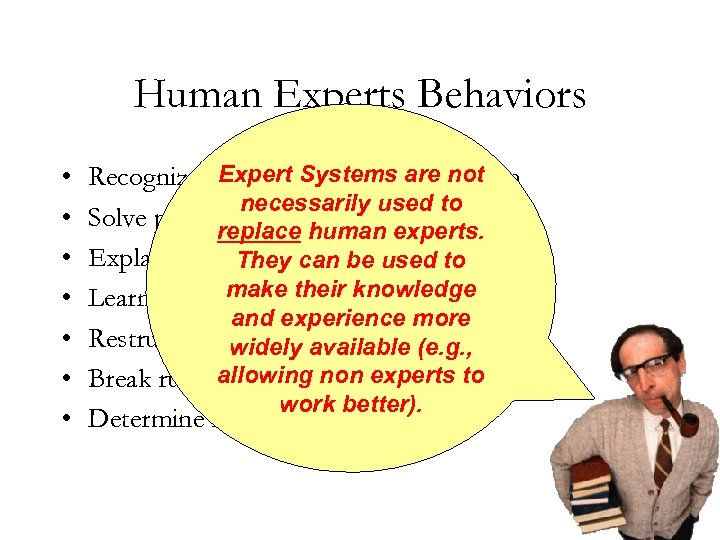
Human Experts Behaviors • • Expert Systems are not Recognize and formulating the problem necessarily used to Solve problems quickly and experts. properly replace human Explain the solution be used to They can make their Learn from experience knowledge and experience more Restructure knowledge widely available (e. g. , Break rules allowing non experts to work better). Determine relevance
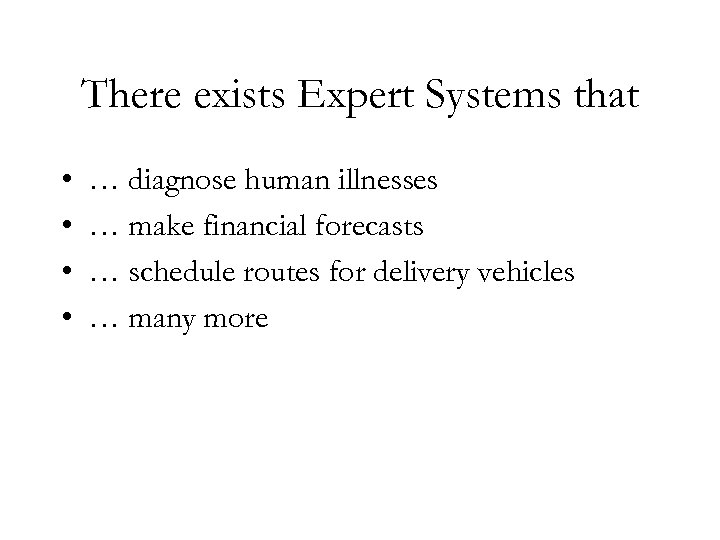
There exists Expert Systems that • • … diagnose human illnesses … make financial forecasts … schedule routes for delivery vehicles … many more
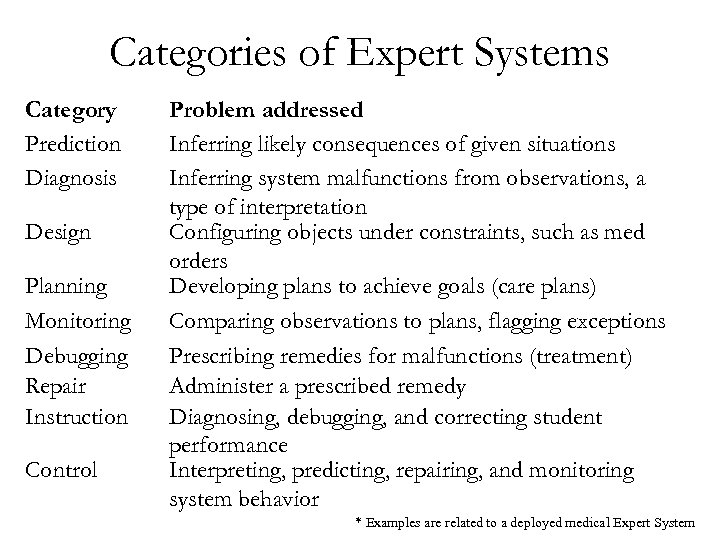
Categories of Expert Systems Category Prediction Diagnosis Design Planning Monitoring Debugging Repair Instruction Control Problem addressed Inferring likely consequences of given situations Inferring system malfunctions from observations, a type of interpretation Configuring objects under constraints, such as med orders Developing plans to achieve goals (care plans) Comparing observations to plans, flagging exceptions Prescribing remedies for malfunctions (treatment) Administer a prescribed remedy Diagnosing, debugging, and correcting student performance Interpreting, predicting, repairing, and monitoring system behavior * Examples are related to a deployed medical Expert System
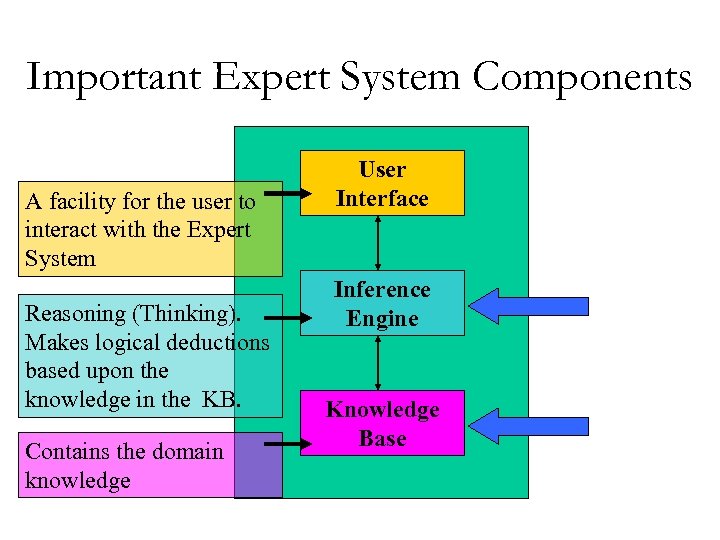
Important Expert System Components A facility for the user to interact with the Expert System Reasoning (Thinking). Makes logical deductions based upon the knowledge in the KB. Contains the domain knowledge User Interface Inference Engine Knowledge Base
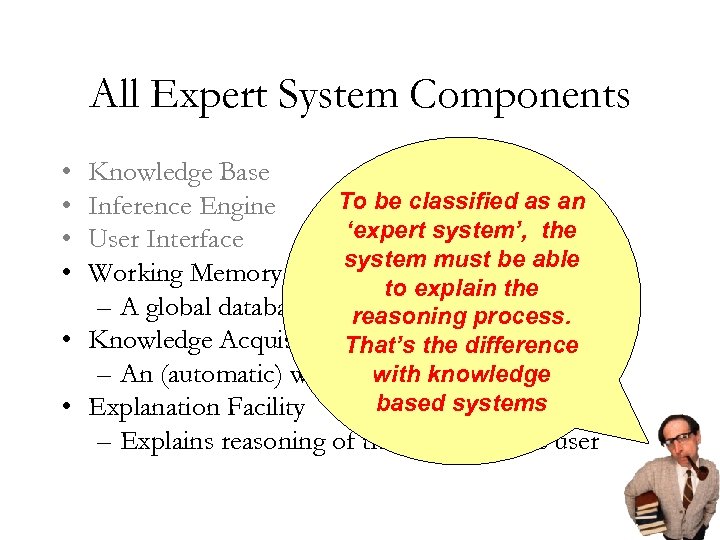
All Expert System Components • • Knowledge Base To be classified as an Inference Engine ‘expert system’, the User Interface system must be able Working Memory / Blackboard / Workplace to explain the – A global database of facts used by the system reasoning process. • Knowledge Acquisition That’s the difference Facility – An (automatic) way to acquire knowledge with knowledge based systems • Explanation Facility – Explains reasoning of the system to the user
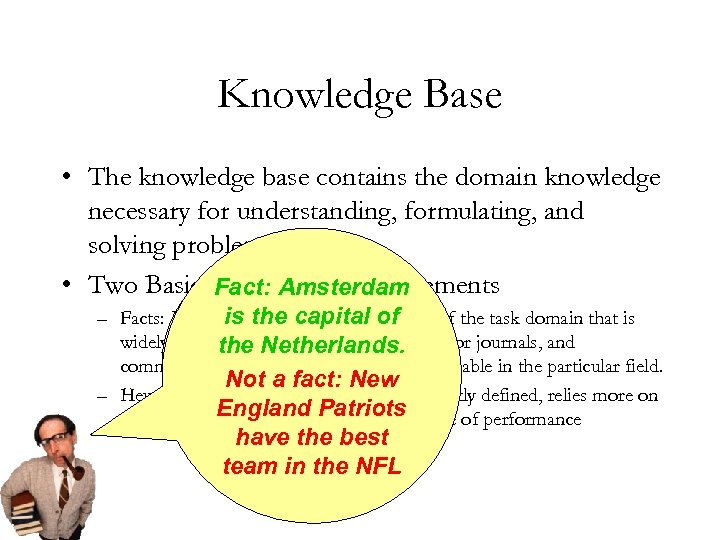
Knowledge Base • The knowledge base contains the domain knowledge necessary for understanding, formulating, and solving problems • Two Basic Knowledge. If New. Elements Fact: Amsterdam Heuristic: Base – Facts: Factual is the capital of knowledge is that knowledge England Patriots of the task domain that is widely shared, typically found in textbooks or journals, and the Netherlands. win Super Bowl commonly agreed upon by those knowledgeable in the particular field. for a straight Not 3 rdfact: New – Heuristics: Heuristic knowledge is the less strictly defined, relies more on England Patriots empirical data, time, they are more judgmental knowledge of performance probably the best have the best team in the NFL
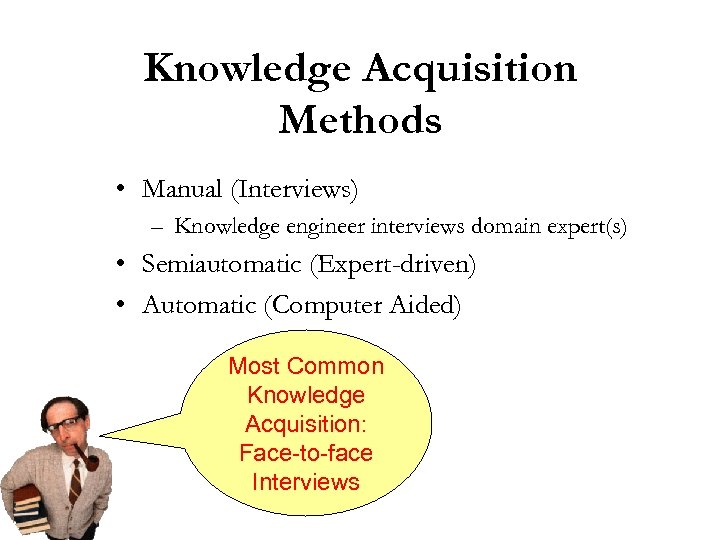
Knowledge Acquisition Methods • Manual (Interviews) – Knowledge engineer interviews domain expert(s) • Semiautomatic (Expert-driven) • Automatic (Computer Aided) Most Common Knowledge Acquisition: Face-to-face Interviews
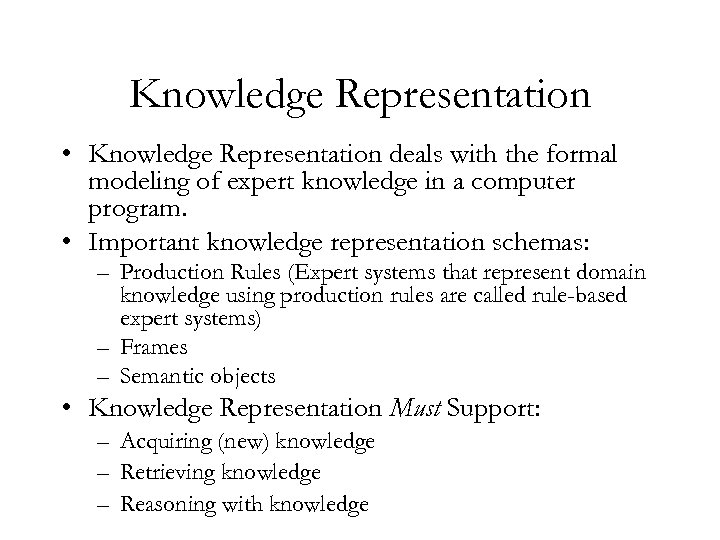
Knowledge Representation • Knowledge Representation deals with the formal modeling of expert knowledge in a computer program. • Important knowledge representation schemas: – Production Rules (Expert systems that represent domain knowledge using production rules are called rule-based expert systems) – Frames – Semantic objects • Knowledge Representation Must Support: – Acquiring (new) knowledge – Retrieving knowledge – Reasoning with knowledge
Production Rules • Condition-Action Pairs: – A RULE consists of an IF part and a THEN part (also called a condition and an action). if the IF part of the rule is satisfied; consequently, the THEN part can be concluded, or its problem-solving action taken. • Rules represent a model of actual human behavior • Rules represent an autonomous chunk of expertise • When combined, these chunks can lead to new conclusions
Advantages & Limitations of Rules • Advantage – Easy to understand (natural form of knowledge) – Easy to derive inference and explanations – Easy to modify and maintain • Limitations – Complex knowledge requires many rules – Search limitations in systems with many rules – Maintaining rule-based systems is difficult because of inter-dependencies between rules
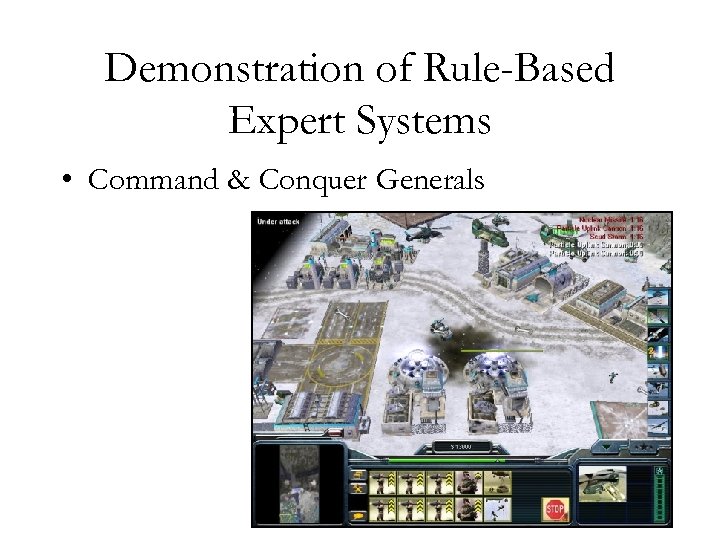
Demonstration of Rule-Based Expert Systems • Command & Conquer Generals
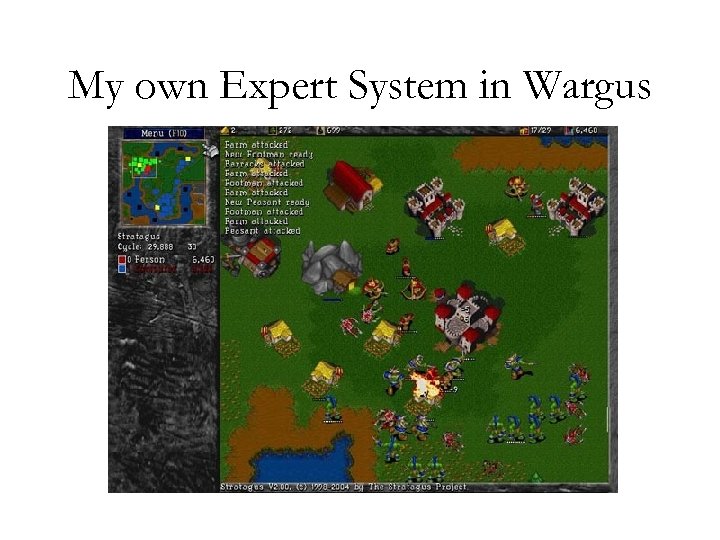
My own Expert System in Wargus
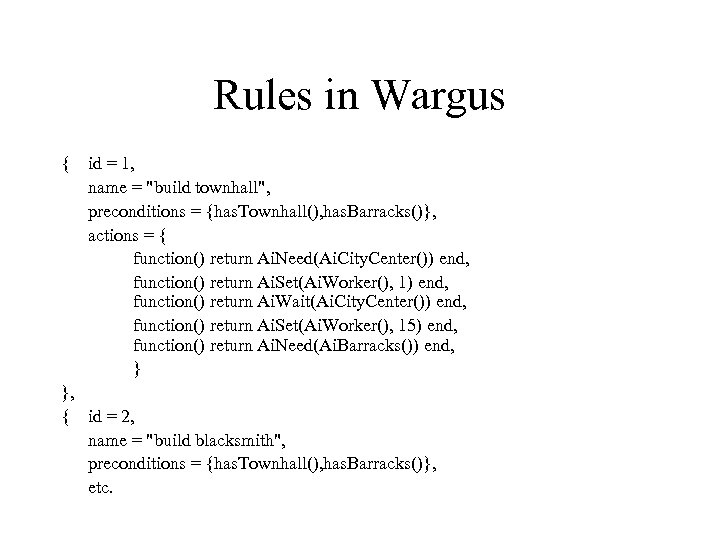
Rules in Wargus { id = 1, name = "build townhall", preconditions = {has. Townhall(), has. Barracks()}, actions = { function() return Ai. Need(Ai. City. Center()) end, function() return Ai. Set(Ai. Worker(), 1) end, function() return Ai. Wait(Ai. City. Center()) end, function() return Ai. Set(Ai. Worker(), 15) end, function() return Ai. Need(Ai. Barracks()) end, } }, { id = 2, name = "build blacksmith", preconditions = {has. Townhall(), has. Barracks()}, etc.
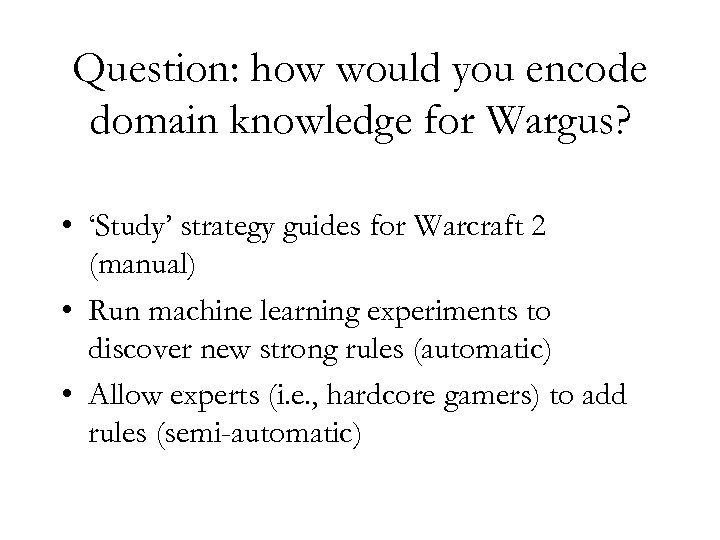
Question: how would you encode domain knowledge for Wargus? • ‘Study’ strategy guides for Warcraft 2 (manual) • Run machine learning experiments to discover new strong rules (automatic) • Allow experts (i. e. , hardcore gamers) to add rules (semi-automatic)
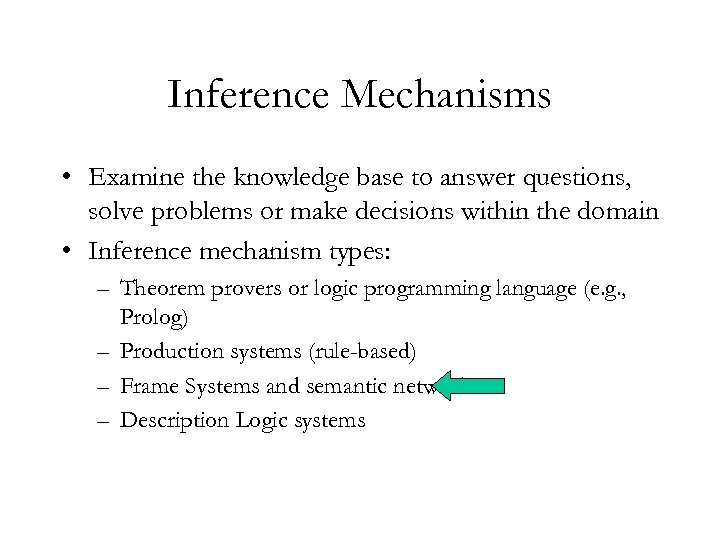
Inference Mechanisms • Examine the knowledge base to answer questions, solve problems or make decisions within the domain • Inference mechanism types: – Theorem provers or logic programming language (e. g. , Prolog) – Production systems (rule-based) – Frame Systems and semantic networks – Description Logic systems
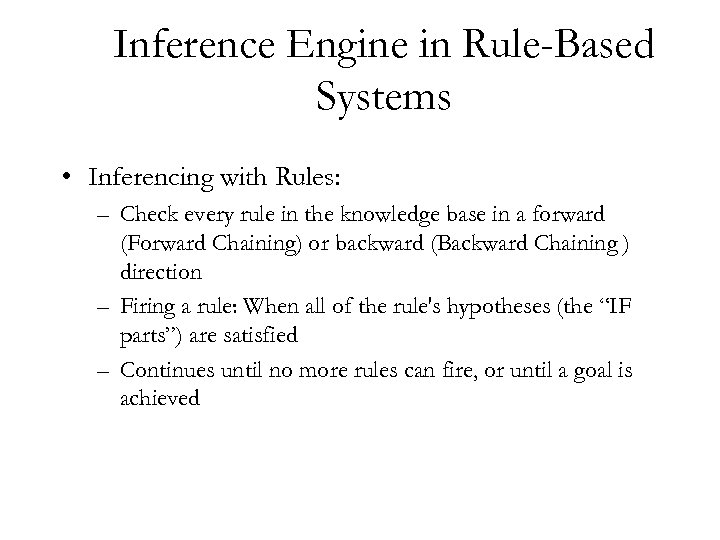
Inference Engine in Rule-Based Systems • Inferencing with Rules: – Check every rule in the knowledge base in a forward (Forward Chaining) or backward (Backward Chaining ) direction – Firing a rule: When all of the rule's hypotheses (the “IF parts”) are satisfied – Continues until no more rules can fire, or until a goal is achieved
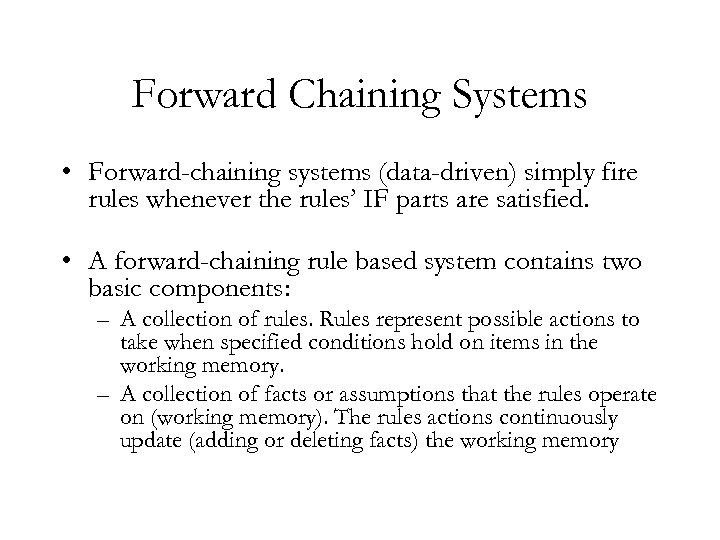
Forward Chaining Systems • Forward-chaining systems (data-driven) simply fire rules whenever the rules’ IF parts are satisfied. • A forward-chaining rule based system contains two basic components: – A collection of rules. Rules represent possible actions to take when specified conditions hold on items in the working memory. – A collection of facts or assumptions that the rules operate on (working memory). The rules actions continuously update (adding or deleting facts) the working memory
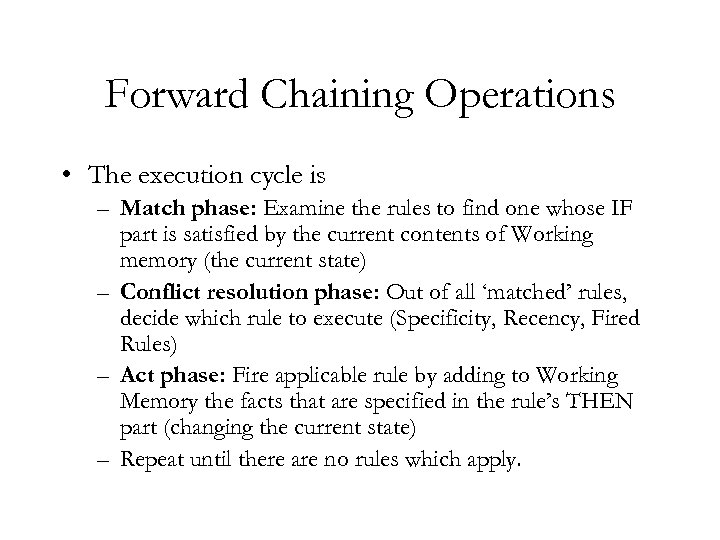
Forward Chaining Operations • The execution cycle is – Match phase: Examine the rules to find one whose IF part is satisfied by the current contents of Working memory (the current state) – Conflict resolution phase: Out of all ‘matched’ rules, decide which rule to execute (Specificity, Recency, Fired Rules) – Act phase: Fire applicable rule by adding to Working Memory the facts that are specified in the rule’s THEN part (changing the current state) – Repeat until there are no rules which apply.
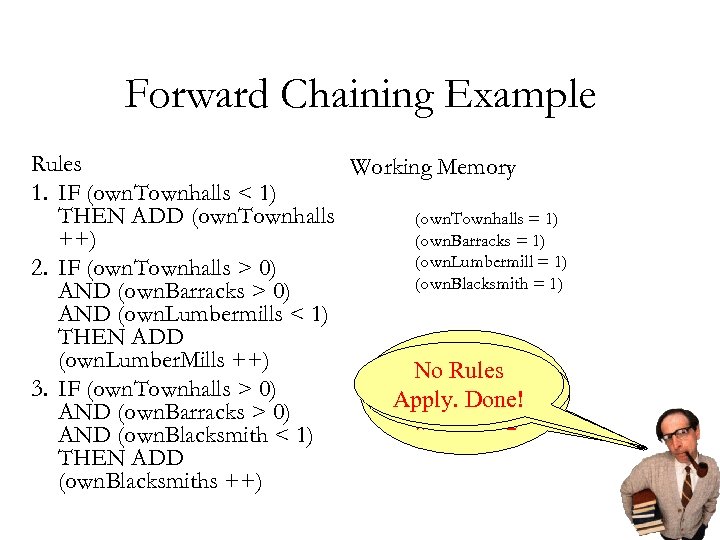
Forward Chaining Example Rules Working Memory 1. IF (own. Townhalls < 1) THEN ADD (own. Townhalls = 0) 1) (own. Barracks = 1) ++) (own. Lumbermill = 0) 1) 2. IF (own. Townhalls > 0) (own. Blacksmith = 0) 1) AND (own. Barracks > 0) AND (own. Lumbermills < 1) THEN ADD (own. Lumber. Mills ++) Rule 2 & Only. Rules 3 No Rule Only Rule 3 3. IF (own. Townhalls > 0) apply, Done! 1 applies Apply. assume applies AND (own. Barracks > 0) we select 2 AND (own. Blacksmith < 1) THEN ADD (own. Blacksmiths ++)
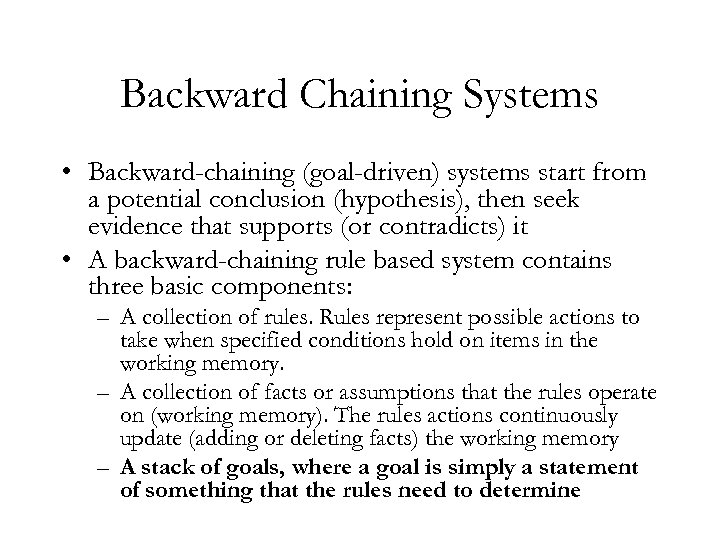
Backward Chaining Systems • Backward-chaining (goal-driven) systems start from a potential conclusion (hypothesis), then seek evidence that supports (or contradicts) it • A backward-chaining rule based system contains three basic components: – A collection of rules. Rules represent possible actions to take when specified conditions hold on items in the working memory. – A collection of facts or assumptions that the rules operate on (working memory). The rules actions continuously update (adding or deleting facts) the working memory – A stack of goals, where a goal is simply a statement of something that the rules need to determine
Backward Chaining Operations • The execution cycle is – Start with goal state – Check the conclusions of the rules to find all rules that can satisfy the top goal on the stack – Select one of these rules; the preconditions of the selected rule will be set as new goals on the goal stack – System terminates if goal stack is empty
Backward Chaining example Question: Does my Wargus opponent own a town hall? Statement: My Wargus opponent owns a town hall. Rule: If my Wargus opponent owns a lumber mill or black smith or barracks, then he owns a town hall. Backward Chaining: • Check the rule base to see what has to be “true” for my opponent to own a town hall. If my Wargus opponent either owns a barracks, blacksmith or lumber mill, then we may conclude that he has a town hall.
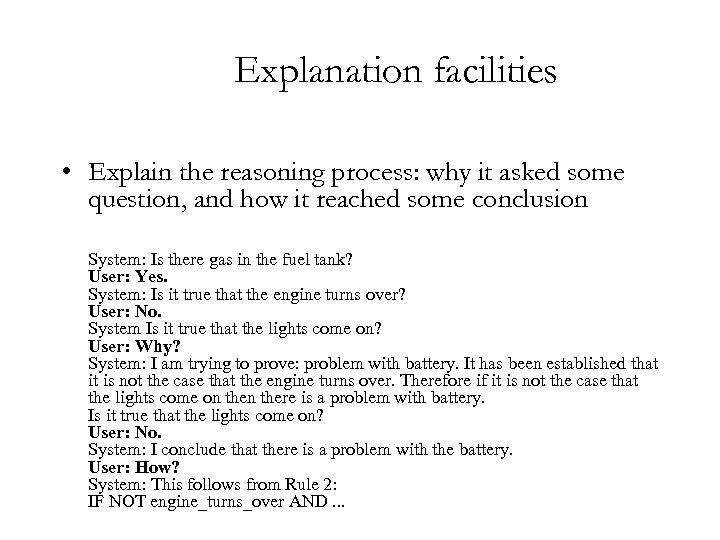
Explanation facilities • Explain the reasoning process: why it asked some question, and how it reached some conclusion System: Is there gas in the fuel tank? User: Yes. System: Is it true that the engine turns over? User: No. System Is it true that the lights come on? User: Why? System: I am trying to prove: problem with battery. It has been established that it is not the case that the engine turns over. Therefore if it is not the case that the lights come on there is a problem with battery. Is it true that the lights come on? User: No. System: I conclude that there is a problem with the battery. User: How? System: This follows from Rule 2: IF NOT engine_turns_over AND. . .
Why explain the reasoning process – Provides the user with a means of understanding the system behavior – People do not always accept the answers of an expert without some form of justification (especially if the expert is a machine!) – Presenting the chain of reasoning constructed by the system which is important in explaining the success or failure of the reasoning process
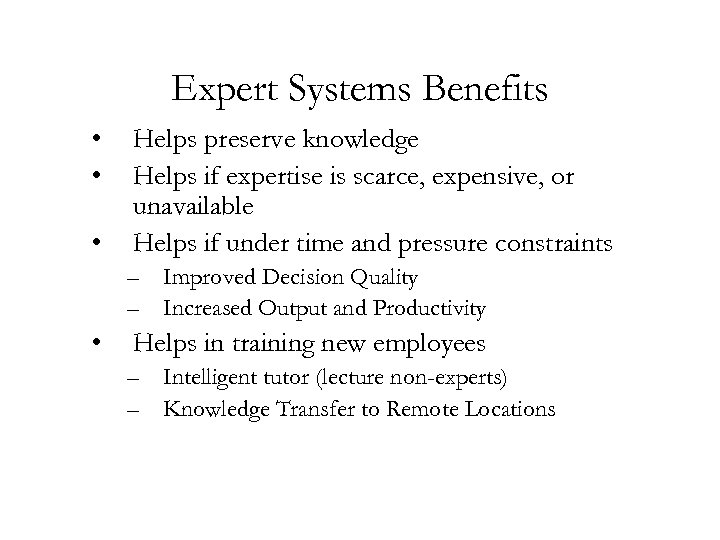
Expert Systems Benefits • • • Helps preserve knowledge Helps if expertise is scarce, expensive, or unavailable Helps if under time and pressure constraints – Improved Decision Quality – Increased Output and Productivity • Helps in training new employees – Intelligent tutor (lecture non-experts) – Knowledge Transfer to Remote Locations
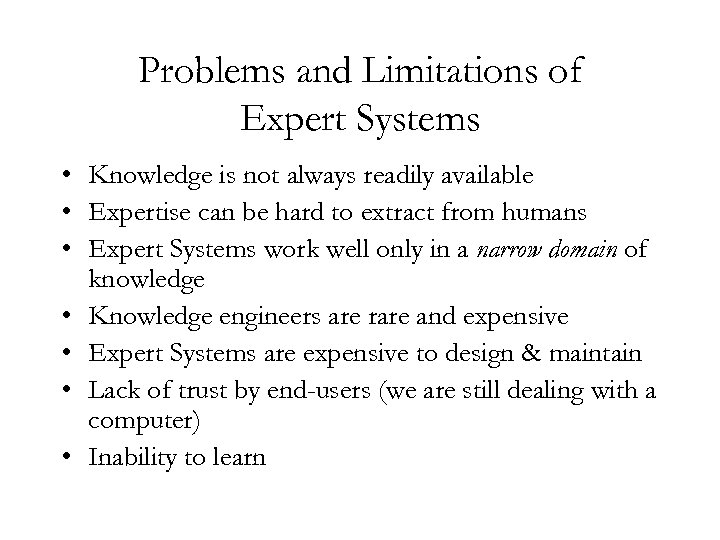
Problems and Limitations of Expert Systems • Knowledge is not always readily available • Expertise can be hard to extract from humans • Expert Systems work well only in a narrow domain of knowledge • Knowledge engineers are rare and expensive • Expert Systems are expensive to design & maintain • Lack of trust by end-users (we are still dealing with a computer) • Inability to learn
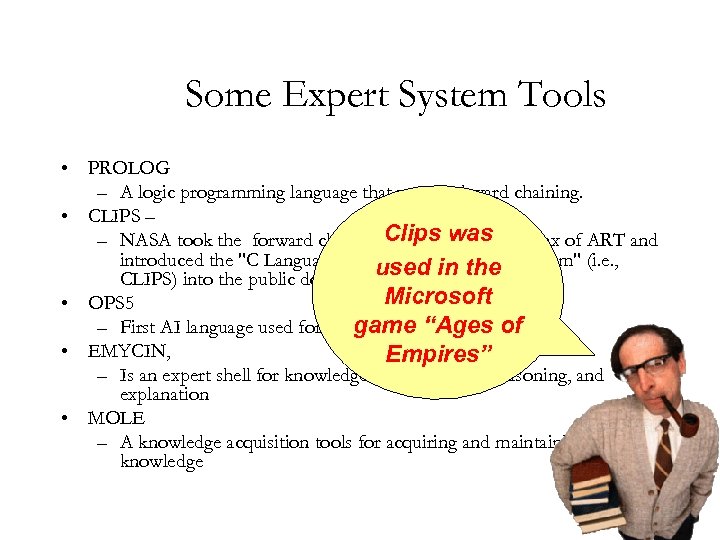
Some Expert System Tools • PROLOG – A logic programming language that uses backward chaining. • CLIPS – – NASA took the forward chaining. Clips was syntax of ART and capabilities and introduced the "C Language Integrated Production System" (i. e. , CLIPS) into the public domain. used in the Microsoft • OPS 5 – First AI language used for Production System (XCON) game “Ages of • EMYCIN, Empires” – Is an expert shell for knowledge representation, reasoning, and explanation • MOLE – A knowledge acquisition tools for acquiring and maintaining domain knowledge
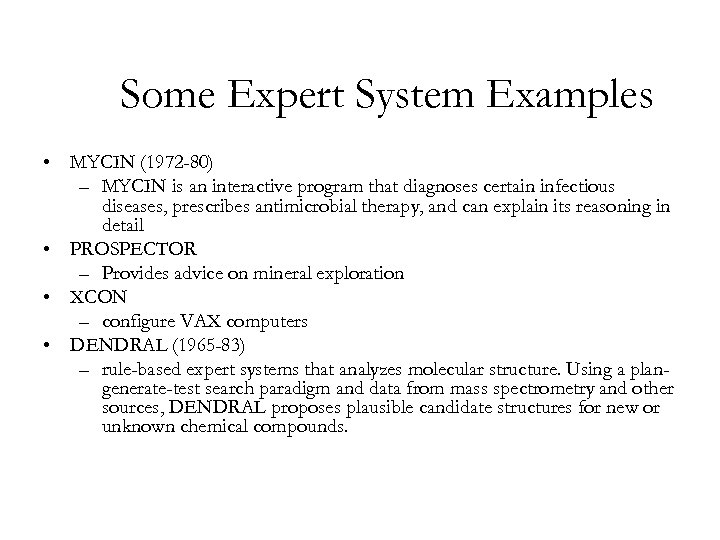
Some Expert System Examples • MYCIN (1972 -80) – MYCIN is an interactive program that diagnoses certain infectious diseases, prescribes antimicrobial therapy, and can explain its reasoning in detail • PROSPECTOR – Provides advice on mineral exploration • XCON – configure VAX computers • DENDRAL (1965 -83) – rule-based expert systems that analyzes molecular structure. Using a plangenerate-test search paradigm and data from mass spectrometry and other sources, DENDRAL proposes plausible candidate structures for new or unknown chemical compounds.
Скачать презентацию IDDS Rules-based Expert Systems 02 21 05 References Artificial Intelligence
035d9a15da3ab9880282a01ef40063d7.ppt