


 Скачать презентацию IDD Elimination Universal Salt Iodization Policy in
4eba500427c67289069e003ece9199c0.ppt
- Количество слайдов: 33
 IDD Elimination & Universal Salt Iodization Policy in Georgia Current Trends and Challenges Ms. Mariam Jashi APO Health – UNICEF Georgia Mr. Zurab Sekhniashvili Director, National Center for Nutrition National Conference “Enhancing Partnership for IDD Elimination in Georgia” 25 -28 June 2004 - Tbilisi Georgia PARTNERSHIP FOR IDD ELIMINATION IN GEORGIA
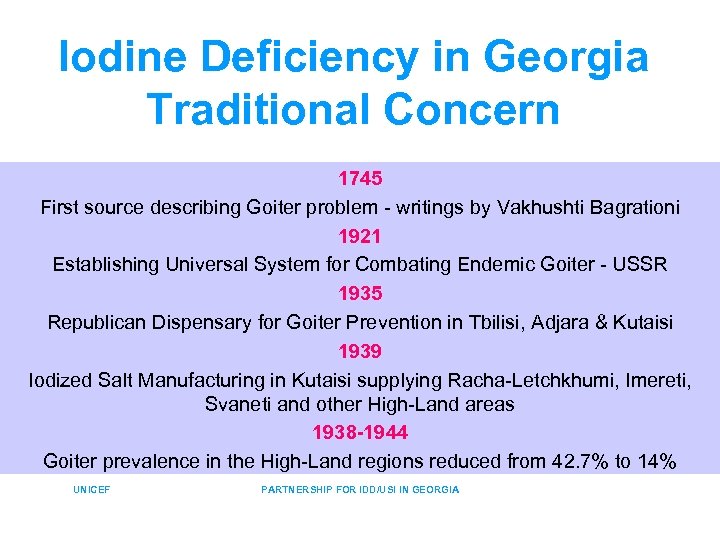 Iodine Deficiency in Georgia Traditional Concern 1745 First source describing Goiter problem - writings by Vakhushti Bagrationi 1921 Establishing Universal System for Combating Endemic Goiter - USSR 1935 Republican Dispensary for Goiter Prevention in Tbilisi, Adjara & Kutaisi 1939 Iodized Salt Manufacturing in Kutaisi supplying Racha-Letchkhumi, Imereti, Svaneti and other High-Land areas 1938 -1944 Goiter prevalence in the High-Land regions reduced from 42. 7% to 14% UNICEF PARTNERSHIP FOR IDD/USI IN GEORGIA
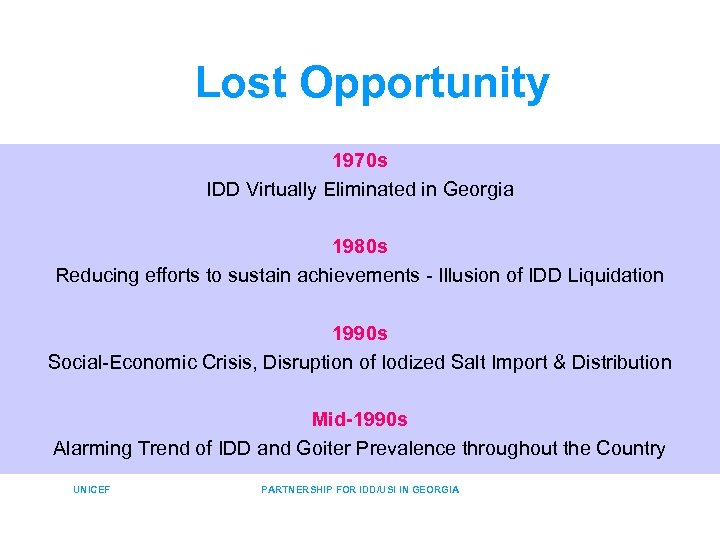 Lost Opportunity 1970 s IDD Virtually Eliminated in Georgia 1980 s Reducing efforts to sustain achievements - Illusion of IDD Liquidation 1990 s Social-Economic Crisis, Disruption of Iodized Salt Import & Distribution Mid-1990 s Alarming Trend of IDD and Goiter Prevalence throughout the Country UNICEF PARTNERSHIP FOR IDD/USI IN GEORGIA
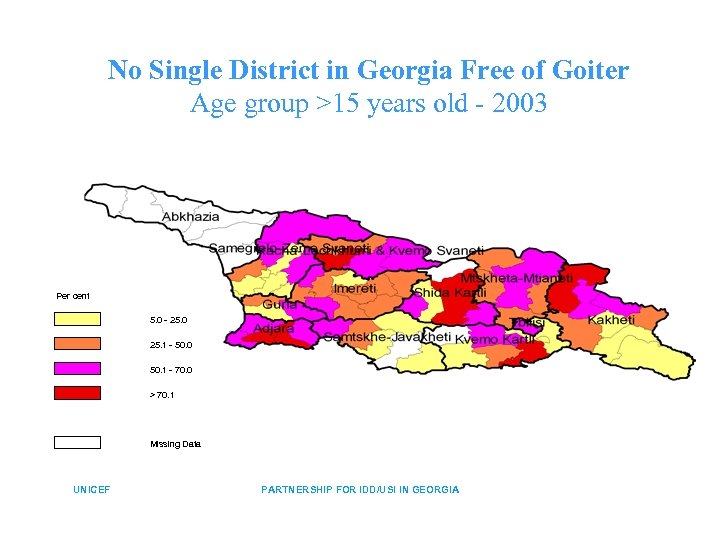 No Single District in Georgia Free of Goiter Age group >15 years old - 2003 Per cent 5. 0 - 25. 0 25. 1 - 50. 0 50. 1 - 70. 0 > 70. 1 Missing Data UNICEF PARTNERSHIP FOR IDD/USI IN GEORGIA
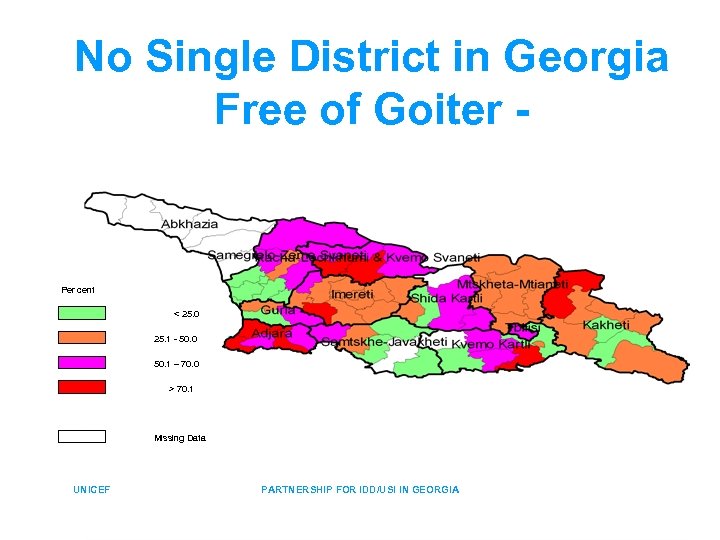 No Single District in Georgia Free of Goiter - Per cent < 25. 0 25. 1 - 50. 0 50. 1 – 70. 0 > 70. 1 Missing Data UNICEF PARTNERSHIP FOR IDD/USI IN GEORGIA
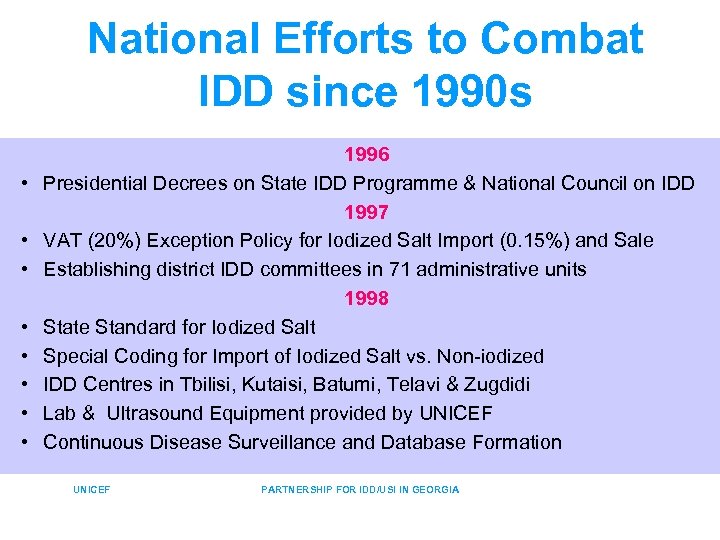 National Efforts to Combat IDD since 1990 s • • 1996 Presidential Decrees on State IDD Programme & National Council on IDD 1997 VAT (20%) Exception Policy for Iodized Salt Import (0. 15%) and Sale Establishing district IDD committees in 71 administrative units 1998 State Standard for Iodized Salt Special Coding for Import of Iodized Salt vs. Non-iodized IDD Centres in Tbilisi, Kutaisi, Batumi, Telavi & Zugdidi Lab & Ultrasound Equipment provided by UNICEF Continuous Disease Surveillance and Database Formation UNICEF PARTNERSHIP FOR IDD/USI IN GEORGIA
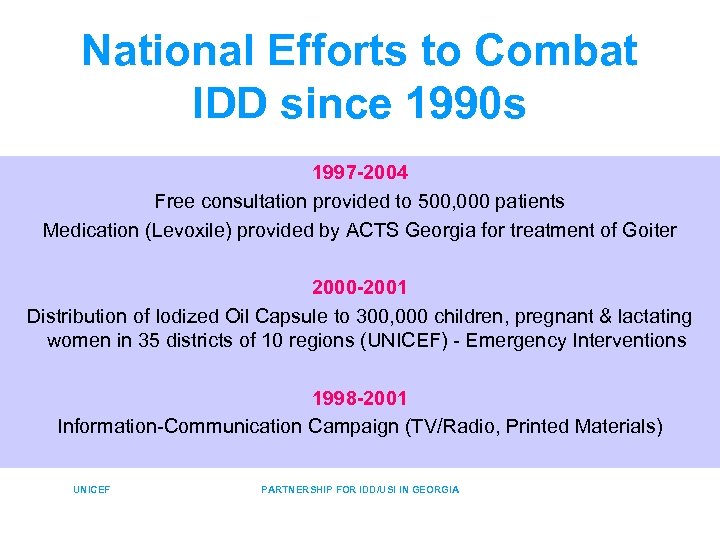 National Efforts to Combat IDD since 1990 s 1997 -2004 Free consultation provided to 500, 000 patients Medication (Levoxile) provided by ACTS Georgia for treatment of Goiter 2000 -2001 Distribution of Iodized Oil Capsule to 300, 000 children, pregnant & lactating women in 35 districts of 10 regions (UNICEF) - Emergency Interventions 1998 -2001 Information-Communication Campaign (TV/Radio, Printed Materials) UNICEF PARTNERSHIP FOR IDD/USI IN GEORGIA
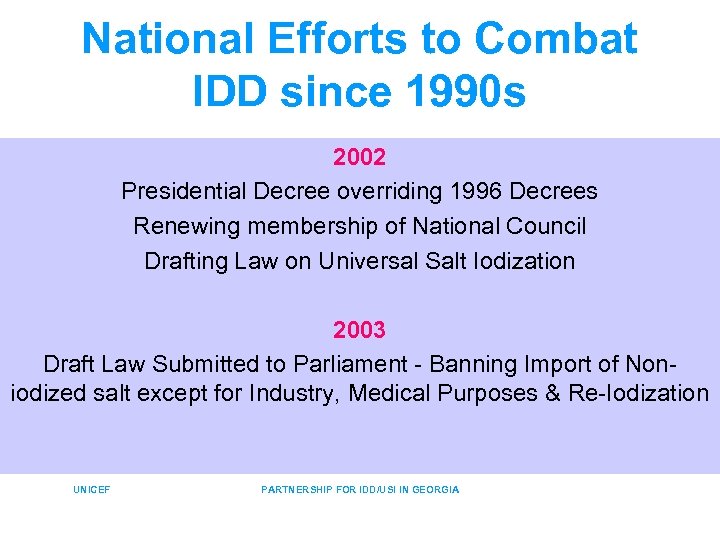 National Efforts to Combat IDD since 1990 s 2002 Presidential Decree overriding 1996 Decrees Renewing membership of National Council Drafting Law on Universal Salt Iodization 2003 Draft Law Submitted to Parliament - Banning Import of Noniodized salt except for Industry, Medical Purposes & Re-Iodization UNICEF PARTNERSHIP FOR IDD/USI IN GEORGIA
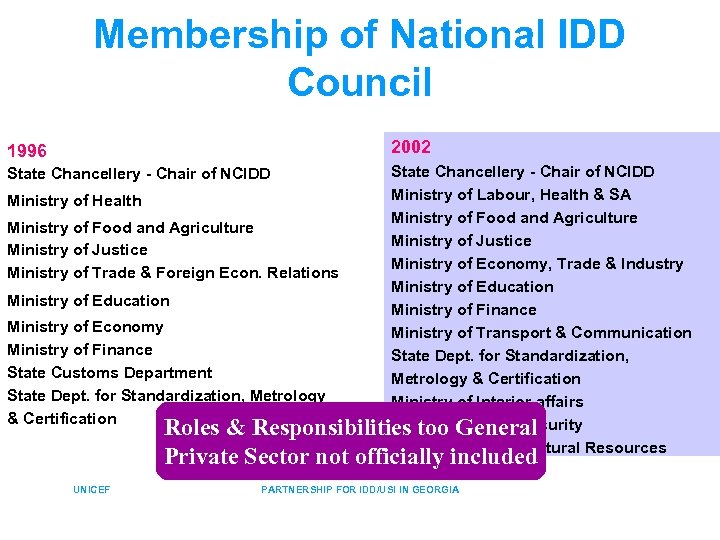 Membership of National IDD Council 2002 1996 State Chancellery - Chair of NCIDD Ministry of Labour, Health & SA Ministry of Health Ministry of Food and Agriculture Ministry of Justice Ministry of Economy, Trade & Industry Ministry of Trade & Foreign Econ. Relations Ministry of Education Ministry of Finance Ministry of Economy Ministry of Transport & Communication Ministry of Finance State Dept. for Standardization, State Customs Department Metrology & Certification State Dept. for Standardization, Metrology Ministry of Interior affairs & Certification Ministry of State Security Roles & Responsibilities too General Ministry of ENVR/Natural Resources State Chancellery - Chair of NCIDD Private Sector not officially included UNICEF PARTNERSHIP FOR IDD/USI IN GEORGIA
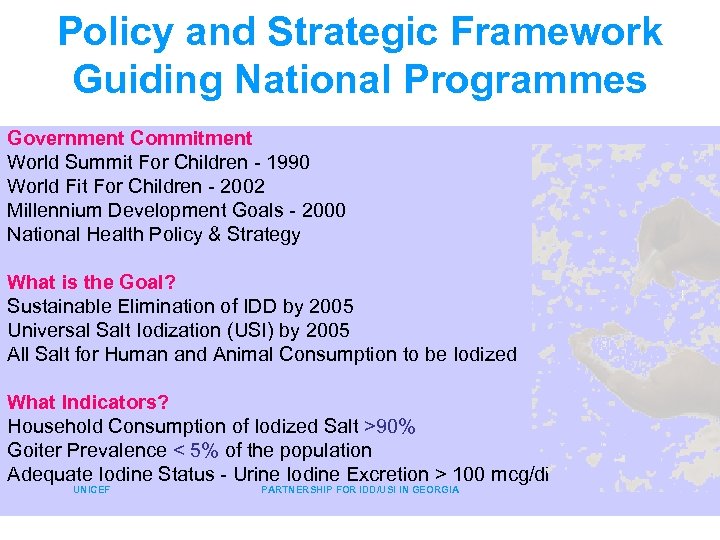 Policy and Strategic Framework Guiding National Programmes Government Commitment World Summit For Children - 1990 World Fit For Children - 2002 Millennium Development Goals - 2000 National Health Policy & Strategy What is the Goal? Sustainable Elimination of IDD by 2005 Universal Salt Iodization (USI) by 2005 All Salt for Human and Animal Consumption to be Iodized What Indicators? Household Consumption of Iodized Salt >90% Goiter Prevalence < 5% of the population Adequate Iodine Status - Urine Iodine Excretion > 100 mcg/dl UNICEF PARTNERSHIP FOR IDD/USI IN GEORGIA
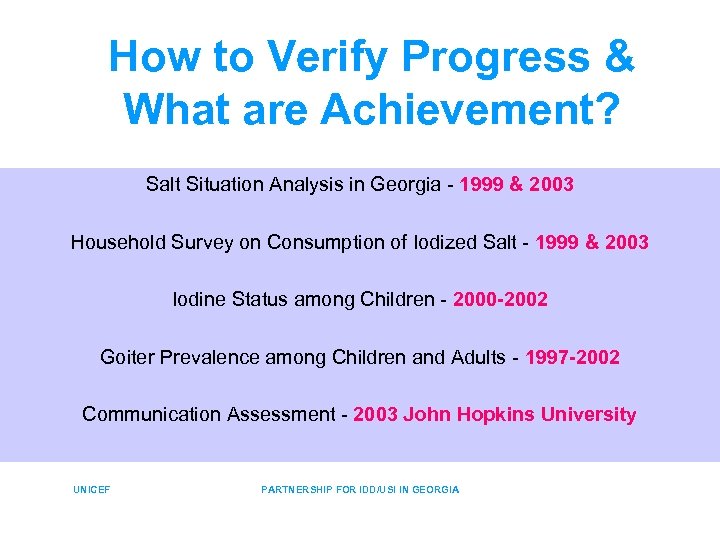 How to Verify Progress & What are Achievement? Salt Situation Analysis in Georgia - 1999 & 2003 Household Survey on Consumption of Iodized Salt - 1999 & 2003 Iodine Status among Children - 2000 -2002 Goiter Prevalence among Children and Adults - 1997 -2002 Communication Assessment - 2003 John Hopkins University UNICEF PARTNERSHIP FOR IDD/USI IN GEORGIA
 Progress and Status Findings from Salt Situation Analysis in Georgia 2003 Institute for Polling and Marketing UNICEF PARTNERSHIP FOR IDD/USI IN GEORGIA
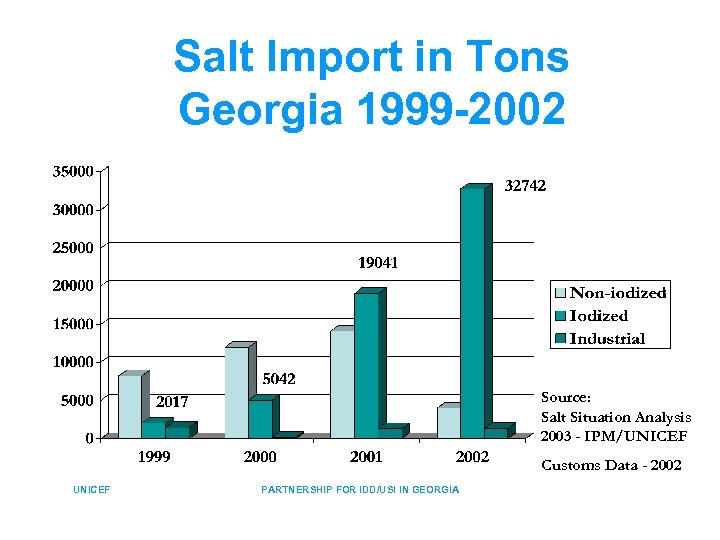 Salt Import in Tons Georgia 1999 -2002 Source: Salt Situation Analysis 2003 - IPM/UNICEF Customs Data - 2002 UNICEF PARTNERSHIP FOR IDD/USI IN GEORGIA
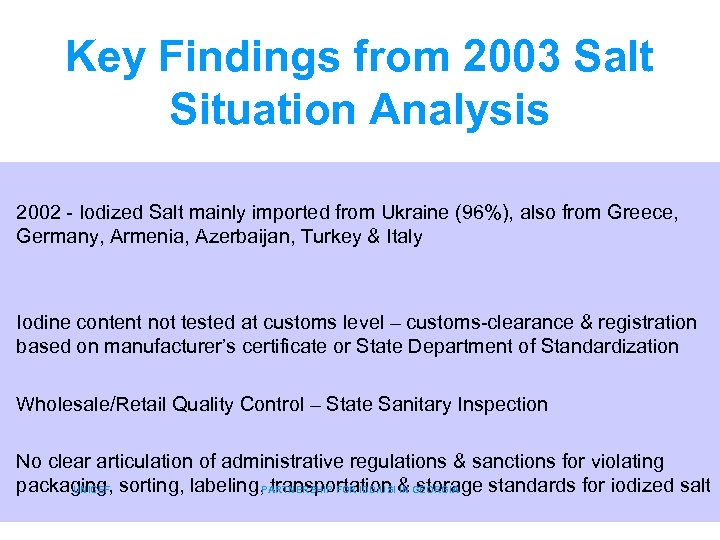 Key Findings from 2003 Salt Situation Analysis 2002 - Iodized Salt mainly imported from Ukraine (96%), also from Greece, Germany, Armenia, Azerbaijan, Turkey & Italy Iodine content not tested at customs level – customs-clearance & registration based on manufacturer’s certificate or State Department of Standardization Wholesale/Retail Quality Control – State Sanitary Inspection No clear articulation of administrative regulations & sanctions for violating packaging, sorting, labeling, PARTNERSHIP FOR IDD/USI & GEORGIA standards for iodized salt transportation IN storage UNICEF
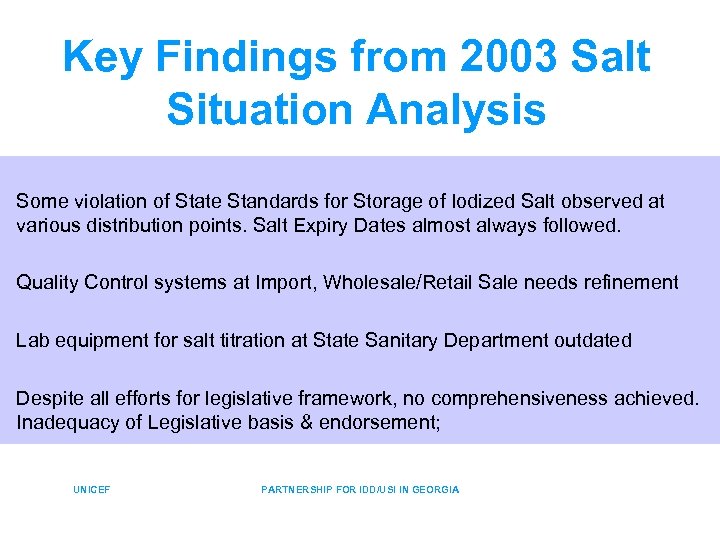 Key Findings from 2003 Salt Situation Analysis Some violation of State Standards for Storage of Iodized Salt observed at various distribution points. Salt Expiry Dates almost always followed. Quality Control systems at Import, Wholesale/Retail Sale needs refinement Lab equipment for salt titration at State Sanitary Department outdated Despite all efforts for legislative framework, no comprehensiveness achieved. Inadequacy of Legislative basis & endorsement; UNICEF PARTNERSHIP FOR IDD/USI IN GEORGIA
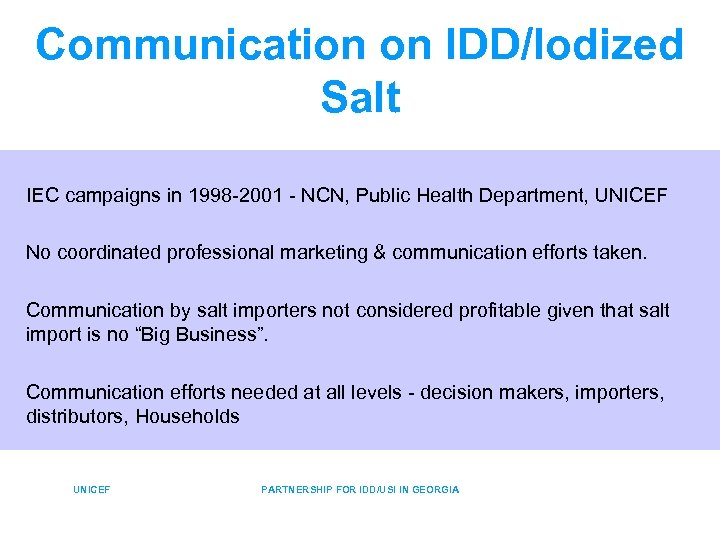 Communication on IDD/Iodized Salt IEC campaigns in 1998 -2001 - NCN, Public Health Department, UNICEF No coordinated professional marketing & communication efforts taken. Communication by salt importers not considered profitable given that salt import is no “Big Business”. Communication efforts needed at all levels - decision makers, importers, distributors, Households UNICEF PARTNERSHIP FOR IDD/USI IN GEORGIA
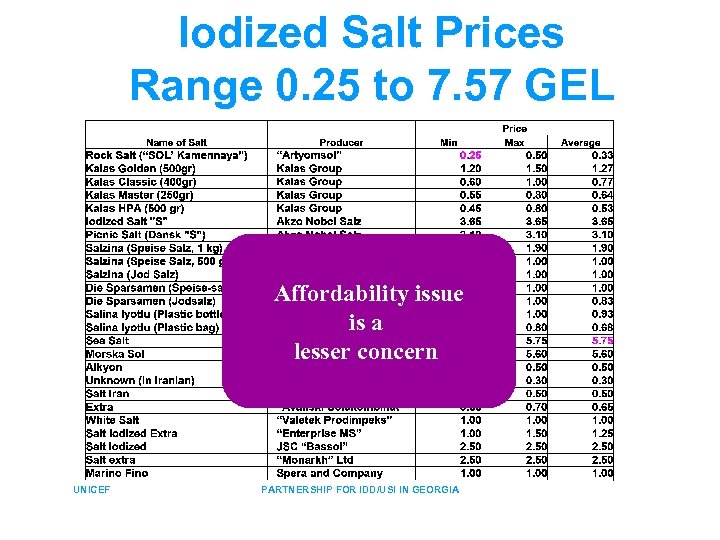 Iodized Salt Prices Range 0. 25 to 7. 57 GEL Affordability issue is a lesser concern UNICEF PARTNERSHIP FOR IDD/USI IN GEORGIA
 Household Consumption of Iodized Salt >90%? Findings from Household Survey 2003 State Department for Statistics UNICEF PARTNERSHIP FOR IDD/USI IN GEORGIA
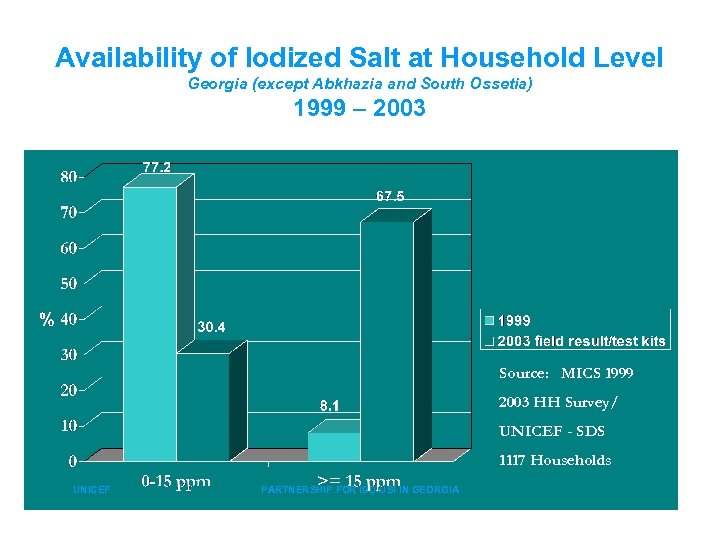 Availability of Iodized Salt at Household Level Georgia (except Abkhazia and South Ossetia) 1999 – 2003 Source: MICS 1999 2003 HH Survey/ UNICEF - SDS 1117 Households UNICEF PARTNERSHIP FOR IDD/USI IN GEORGIA
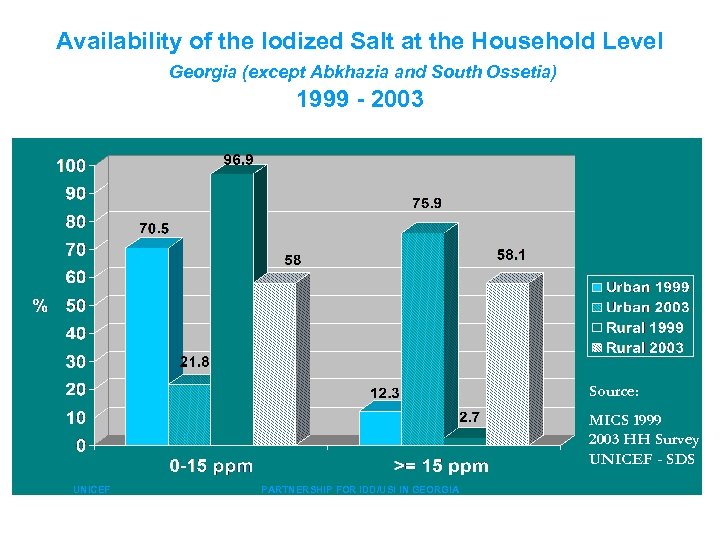 Availability of the Iodized Salt at the Household Level Georgia (except Abkhazia and South Ossetia) 1999 - 2003 Source: MICS 1999 2003 HH Survey UNICEF - SDS UNICEF PARTNERSHIP FOR IDD/USI IN GEORGIA
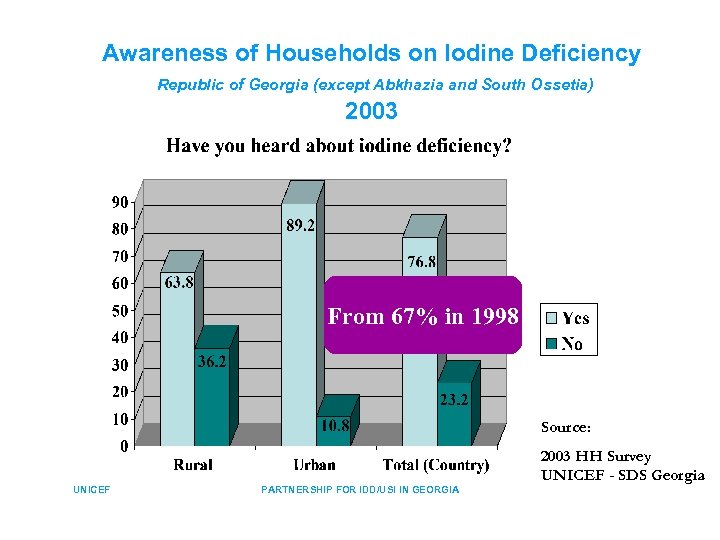 Awareness of Households on Iodine Deficiency Republic of Georgia (except Abkhazia and South Ossetia) 2003 From 67% in 1998 Source: UNICEF PARTNERSHIP FOR IDD/USI IN GEORGIA 2003 HH Survey UNICEF - SDS Georgia
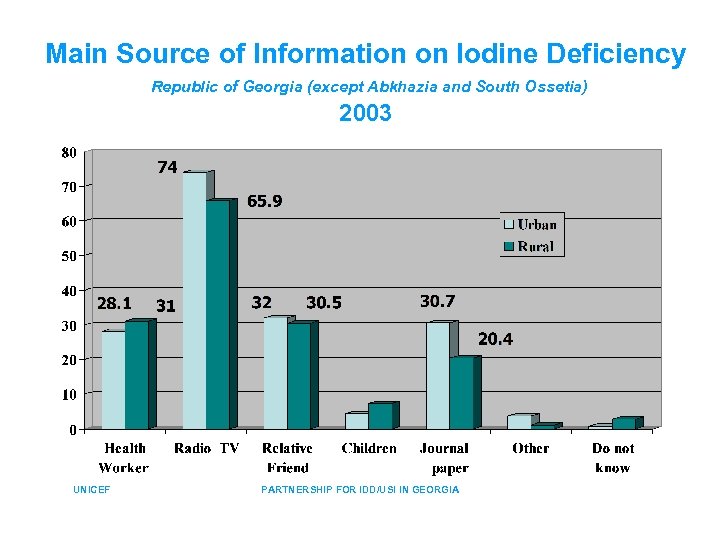 Main Source of Information on Iodine Deficiency Republic of Georgia (except Abkhazia and South Ossetia) 2003 UNICEF PARTNERSHIP FOR IDD/USI IN GEORGIA
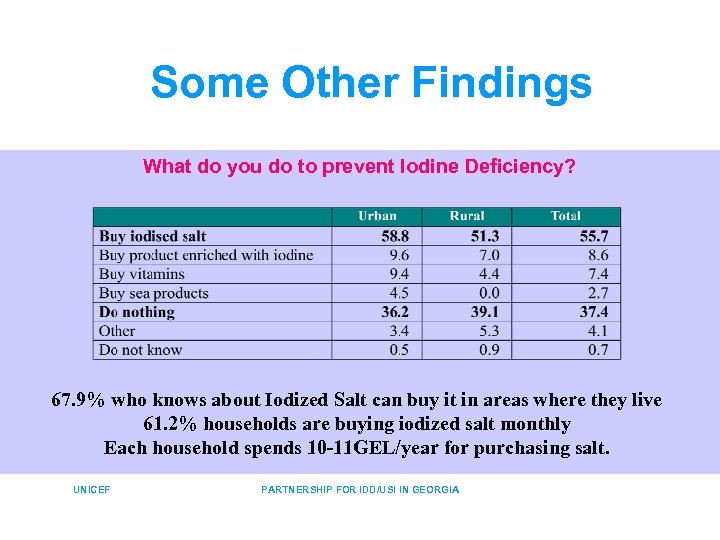 Some Other Findings What do you do to prevent Iodine Deficiency? 67. 9% who knows about Iodized Salt can buy it in areas where they live 61. 2% households are buying iodized salt monthly Each household spends 10 -11 GEL/year for purchasing salt. UNICEF PARTNERSHIP FOR IDD/USI IN GEORGIA
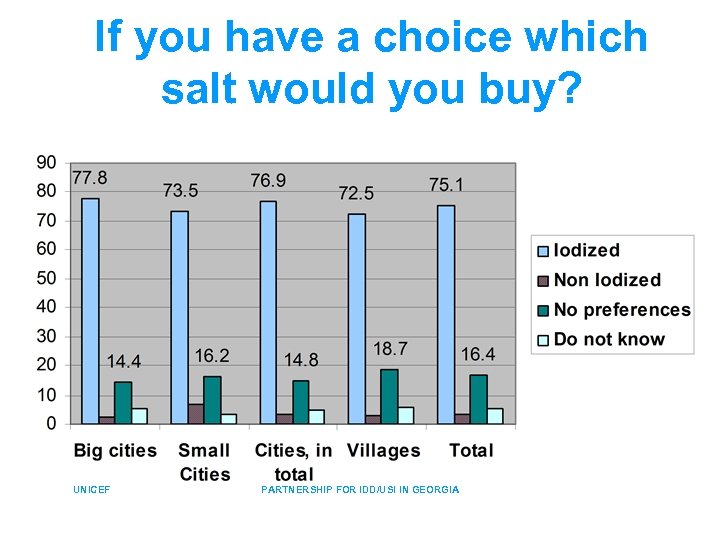 If you have a choice which salt would you buy? UNICEF PARTNERSHIP FOR IDD/USI IN GEORGIA
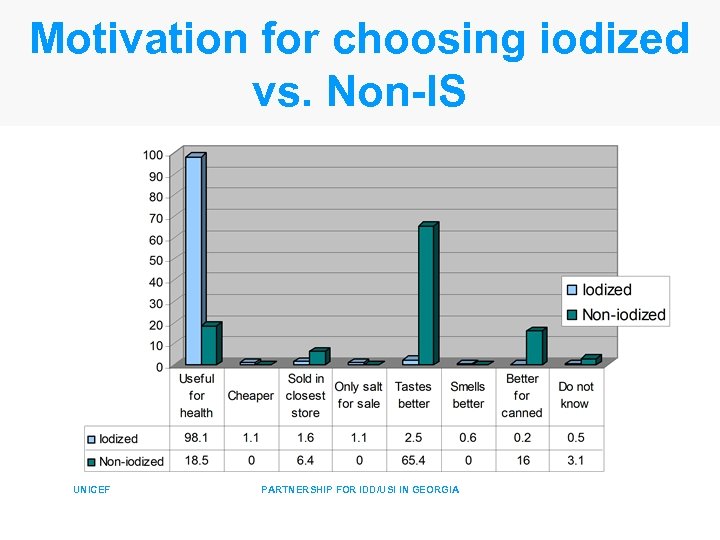 Motivation for choosing iodized vs. Non-IS UNICEF PARTNERSHIP FOR IDD/USI IN GEORGIA
 IDD Prevalence Data Findings from National Center of Nutrition 1. Urine Iodine Excretion data among children 2001 2. Goiter Prevalence among children and adults 1997 -2003 UNICEF PARTNERSHIP FOR IDD/USI IN GEORGIA
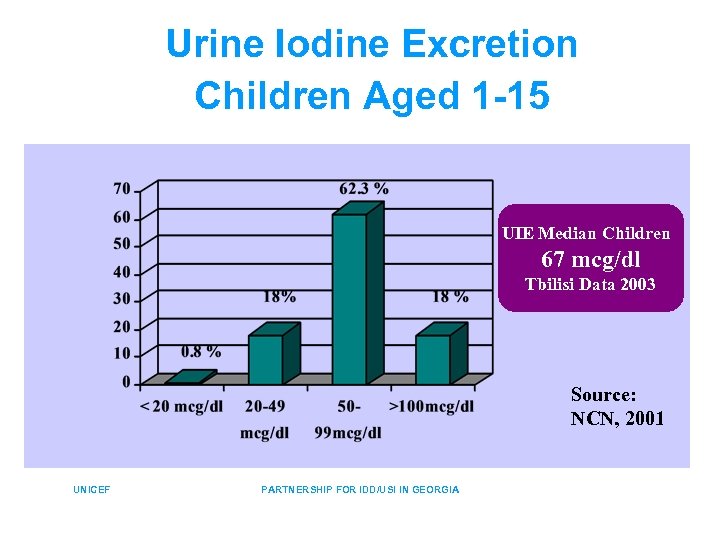 Urine Iodine Excretion Children Aged 1 -15 UIE Median Children 67 mcg/dl Tbilisi Data 2003 Source: NCN, 2001 UNICEF PARTNERSHIP FOR IDD/USI IN GEORGIA
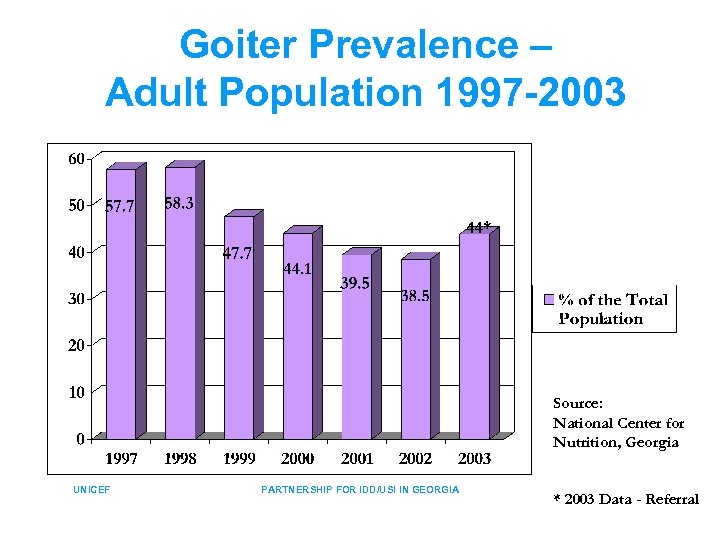 Goiter Prevalence – Adult Population 1997 -2003 Source: National Center for Nutrition, Georgia UNICEF PARTNERSHIP FOR IDD/USI IN GEORGIA * 2003 Data - Referral
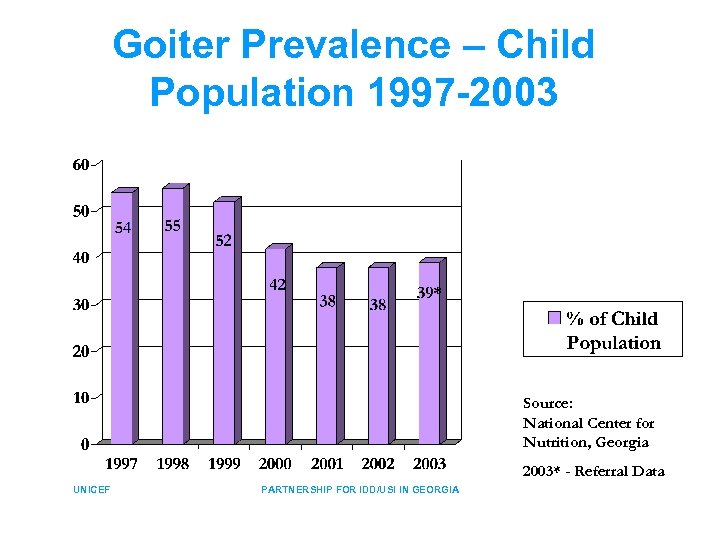 Goiter Prevalence – Child Population 1997 -2003 Source: National Center for Nutrition, Georgia 2003* - Referral Data UNICEF PARTNERSHIP FOR IDD/USI IN GEORGIA
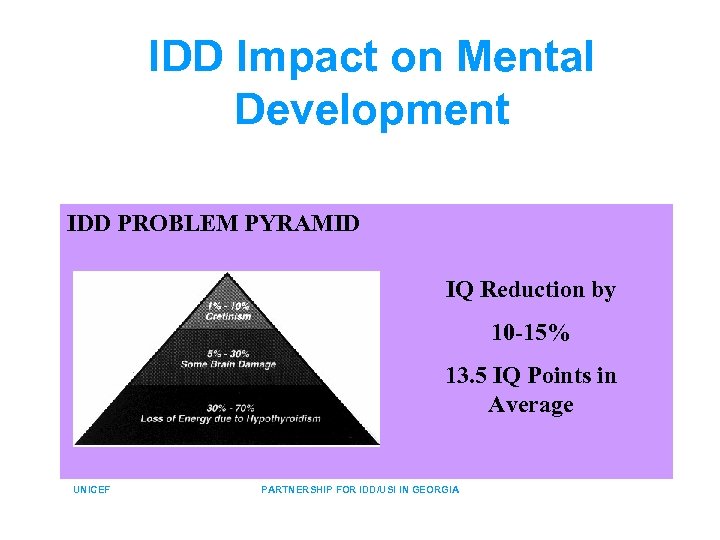 IDD Impact on Mental Development IDD PROBLEM PYRAMID IQ Reduction by 10 -15% 13. 5 IQ Points in Average UNICEF PARTNERSHIP FOR IDD/USI IN GEORGIA
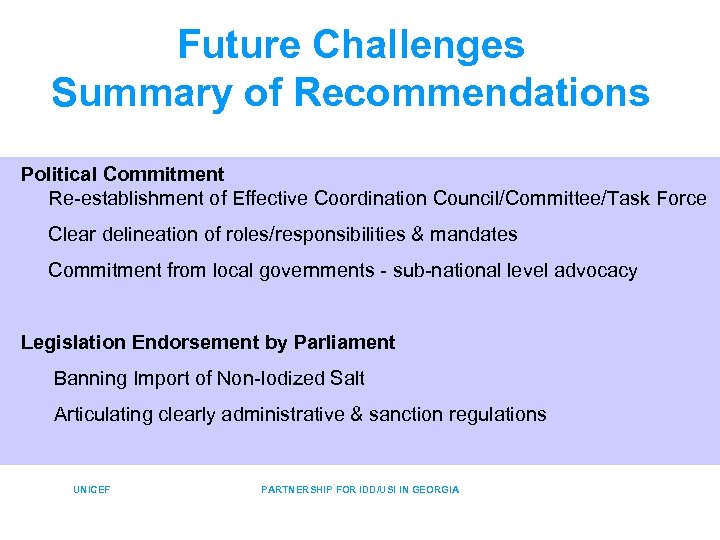 Future Challenges Summary of Recommendations Political Commitment Re-establishment of Effective Coordination Council/Committee/Task Force Clear delineation of roles/responsibilities & mandates Commitment from local governments - sub-national level advocacy Legislation Endorsement by Parliament Banning Import of Non-Iodized Salt Articulating clearly administrative & sanction regulations UNICEF PARTNERSHIP FOR IDD/USI IN GEORGIA
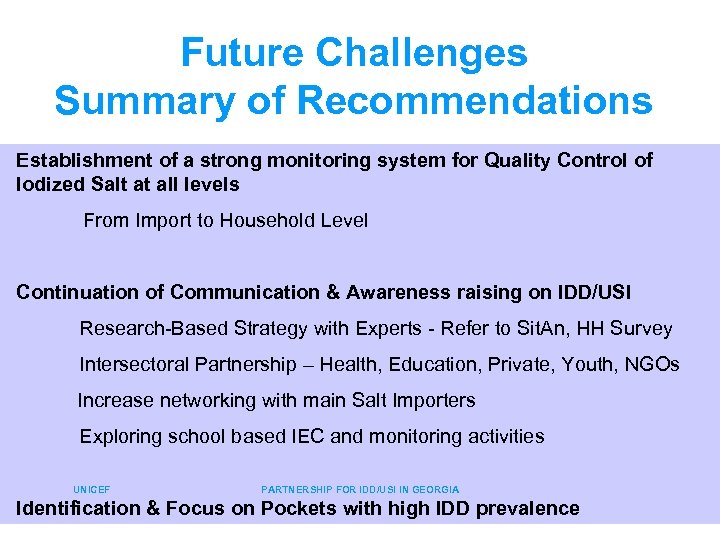 Future Challenges Summary of Recommendations Establishment of a strong monitoring system for Quality Control of Iodized Salt at all levels From Import to Household Level Continuation of Communication & Awareness raising on IDD/USI Research-Based Strategy with Experts - Refer to Sit. An, HH Survey Intersectoral Partnership – Health, Education, Private, Youth, NGOs Increase networking with main Salt Importers Exploring school based IEC and monitoring activities UNICEF PARTNERSHIP FOR IDD/USI IN GEORGIA Identification & Focus on Pockets with high IDD prevalence
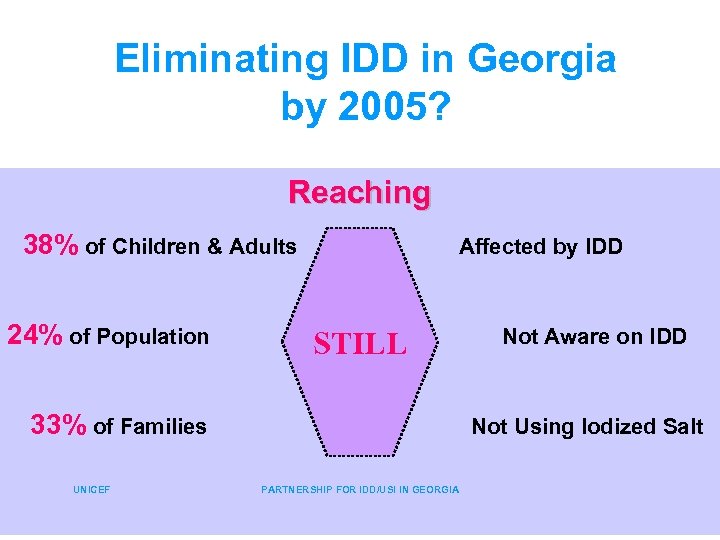 Eliminating IDD in Georgia by 2005? Reaching 38% of Children & Adults 24% of Population Affected by IDD STILL 33% of Families UNICEF Not Aware on IDD Not Using Iodized Salt PARTNERSHIP FOR IDD/USI IN GEORGIA